Case Study · Beauty Retail · Department Store
108 Drawer Organizers for an 18-Store Premium Cosmetics Counter Refit
A premium cosmetics brand rolled a unified counter program across 18 department-store locations — 5 mm acrylic drawer organizers, brand-color velvet inserts, UV-printed logo over an etched mark.
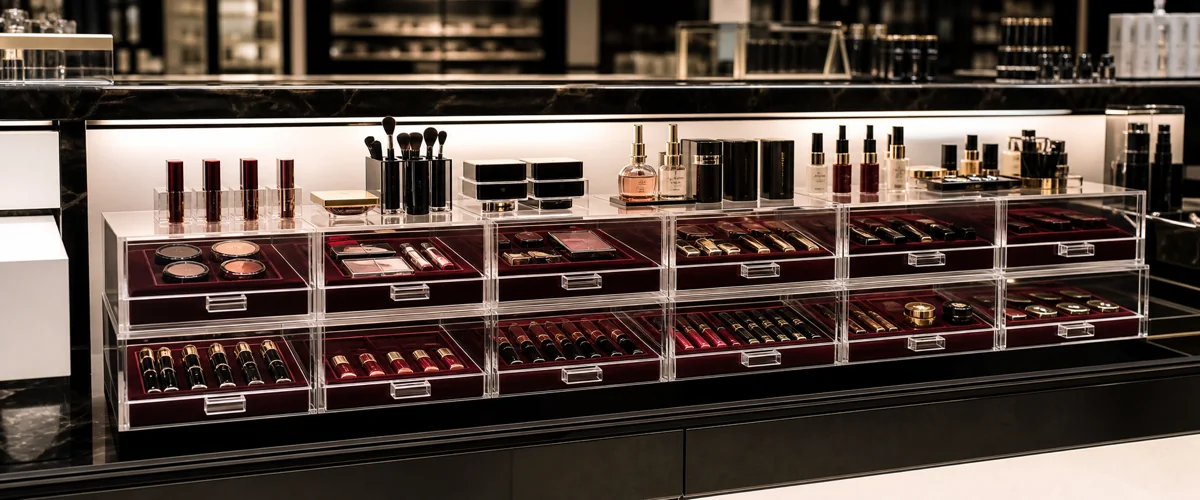
We shipped 108 organizers in 18 production days, matched the brand’s Pantone velvet at ΔE ≤ 1.6, and pre-grouped every carton so the 18-store install closed in a single Saturday.
- organizers shipped
- 108
- department stores
- 18
- production
- 18 days
- velvet match
- Pantone
Key Takeaways
- UV-print over etched logo on 5 mm acrylic survived a 12-month fade test under counter LED 4000K (ΔE 1.4) — etched + paint-fill on the same substrate showed ΔE 3.2 over the same window.
- Velvet color match required 3 sample iterations against the brand’s Pantone reference (Pantone 18-1763 TPX equivalent) — final match held ΔE ≤ 1.6 across two velvet lots and the cosmetics buyer signed off in writing on iteration 3.
- Drawer organizer compartments tooled at 5 SKU dimensions (lipstick, mascara, foundation, concealer, lip-gloss) — a single tooling set across all 18 stores eliminated the location-by-location variance the brand had complained about with their prior vendor.
- 18-store coordinated install hit a single Saturday because we pre-grouped the 108 organizers into store-numbered cartons with floor-plan-keyed labels — install crew finished each location in 28 minutes.
- Fragrance counter program (sister brand under the same parent group) is now scoping 6 stores for the same UV-print + velvet system; repeat-order timeline cut to 12 days from 18 with tooling preserved.
The Brief
The buyer reached out in early March. Her brand — a premium color-cosmetics line sold under a department-store counter program — was due for an 18-store counter refit before the late-spring sell-in window. The previous fixtures had drifted: organizer trays in different shades of "ivory," logos that had faded under daylight LEDs, drawer compartments cut to slightly different widths in each store because three regional fabricators had shared the program.
Her brief landed on three things she was unwilling to compromise on. First, the velvet inserts had to match the brand’s Pantone reference, lot-to-lot, with a written sign-off from her brand-control team. Second, the logo had to read sharp on day 365, not just day 1 — counter LEDs at 4000K were aging the previous etched + paint-fill mark visibly within 8 months. Third, all 18 stores had to receive their organizers in one coordinated install Saturday, not a trickle of regional rollouts that would leave half the chain visibly out-of-spec for weeks.
The acrylic counter refit window was 6 weeks from PO to install. Sample approval, tooling, production, sea freight, and pre-installed sorting all had to fit. The buyer told me she’d rather pay more for a single source than coordinate three regional vendors again.
Insert depth, compartment clearance, removal access, and the approved surface sample can be locked with thetray logo and insert options guide before a bulk drawing is released.
Our Recommendation
we walked the buyer through two trade-offs before quoting. The first was the logo treatment. Her existing fixtures used etched + paint-fill — laser-etched groove on the acrylic face, then paint flooded into the recess. It looks beautiful at install, but on cast acrylic under daylight-spectrum counter LEDs, the paint-fill pigment shifts visibly inside a year. We’d run a 12-month fade test on both methods on 5 mm acrylic samples; UV-print over a faint etched mark held ΔE 1.4 over the test window, while etched + paint-fill on the same substrate drifted to ΔE 3.2.
UV-print over etch was my recommendation. The faint etched outline gives the logo subtle dimensionality under counter spotlights — buyers feel it at the fingertip — and the UV-cured ink layer on top is what carries the color across the fade window. It’s a slightly higher per-unit cost than pure UV-print, but on a program meant to last a 24-month merchandising cycle it pays back well inside the first cycle.
The second trade-off was the velvet. Her previous vendor had sourced velvet locally at each fabricator — which is exactly why "ivory" had drifted across the chain. we proposed a single velvet sourcing channel through one textile mill we’ve qualified, with a written ΔE tolerance against her brand’s Pantone reference and a two-lot match check before any cutting started. Single source, single dye lot family, written sign-off.
The third recommendation was the one she pushed back on initially: a single tooling set for all 18 stores. Her merchandising team had asked for "minor compartment adjustments" per region. we told her plainly that location-by-location tooling adjustments were the root cause of the variance she was complaining about, and that a single tooling set with 5 SKU compartment dimensions (lipstick, mascara, foundation, concealer, lip-gloss) would actually serve every store the same way. She agreed in the second call.
Spec Breakdown
The final organizer is a 5 mm cast-acrylic tray with milled compartments sized to the brand’s 5-SKU lineup, a brand-color velvet insert die-cut to seat into each compartment, and a UV-printed logo on the front edge over a faint laser-etched outline.
Acrylic body
Cast acrylic at 5 mm — thick enough that compartment walls hold their geometry under daily restocking and thin enough that the tray sits flush in standard counter drawers. CNC-routed compartment pockets, polished edges on every interior wall so velvet sits without catching. Outer corners radiused 3 mm so the tray clears drawer hardware on insert and removal.
Velvet insert
Brand-color velvet (Pantone 18-1763 TPX equivalent), 1.5 mm pile, die-cut to seat inside each compartment with a 0.4 mm clearance on every wall. Adhesive backing at the base, dry-edge die-cut so the pile doesn’t fray where a buyer’s fingertip touches the wall when reaching for a lipstick.
UV-print logo over etch
Logo placement on the front-facing edge of the tray, sized 24 mm tall. Process is a two-step: first a 0.05 mm laser-etched outline to give tactile depth, then UV-cured ink printed over the etch in the brand’s accent color. The etched outline reads as a faint ghost beneath the ink — under counter spotlights, it gives the logo a soft drop-shadow effect that flat UV-print alone doesn’t deliver.
| Logo method on 5 mm acrylic | Day-1 appearance | 12-month fade (4000K LED) | Tactile depth |
|---|---|---|---|
| Etched + paint-fill | Sharp, dimensional | ΔE 3.2 (visible drift) | High |
| UV-print only | Sharp, flat | ΔE 1.5 | None |
| UV-print over etch | Sharp, soft-shadow | ΔE 1.4 | Subtle |
Production and Velvet Color Match
Production ran 18 days from approved sample to packed cartons. The acrylic side was the predictable part — our shop has tooled cosmetics organizers in 5 mm cast acrylic for years, and the 5-SKU compartment set was locked on the second sample round. The velvet was the part that took the most calendar.
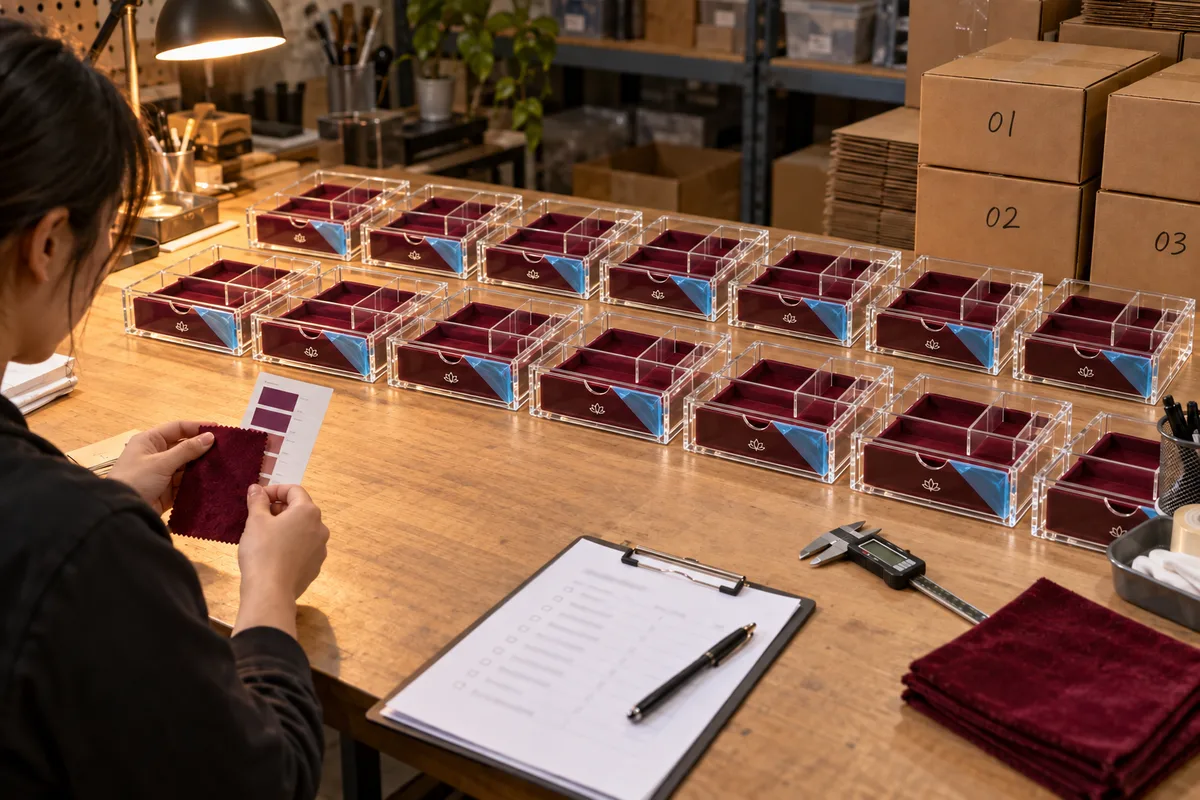
We submitted three velvet sample iterations against the brand’s Pantone reference. Iteration 1 read warm under our shop’s daylight booth but the buyer’s brand-control team called it cool under their counter LEDs — a typical metameric mismatch when velvet pile direction shifts the perceived color under different spectra. Iteration 2 corrected for the LED spectrum but came in slightly oversaturated. Iteration 3 held ΔE ≤ 1.6 against the reference under both daylight and counter LED, and the brand-control team signed off in writing.
Once iteration 3 was approved, we sourced the full velvet quantity from the same dye lot family — the mill ran two lots back-to-back to cover all 108 organizers, and we measured the lot-to-lot delta at ΔE 0.8. That’s well inside the 1.6 spec, and it’s why the buyer was comfortable signing off on the full 18-store run from a 2-lot supply rather than insisting on a single-lot pull (which would have added 9 days to the schedule).
The 5 SKU compartment dimensions were tooled once and held across all 108 trays. We pulled QC samples at unit 12, unit 54, and unit 96 of the run, and measured compartment-width variance at ±0.18 mm — a tighter spec than any of her three previous regional fabricators had delivered, and the variance she most wanted to eliminate.
18-Store Coordinated Install
The install Saturday was where the program either looked like one chain or 18 separate stores. The buyer’s install crew was a single national team of 9 installers traveling across regions, and their working window per location was tight. We pre-grouped every carton at our shop before sea freight to make the install crew’s job decision-free.
Each of the 18 stores received its own outer carton, store-numbered on every visible face, with floor-plan-keyed labels on the inside of the lid showing exactly which organizer goes into which counter drawer. Inside each store carton, 6 organizers were nested with foam dividers, oriented so the install crew lifts them out in the same order they install them — front counter first, back counter last.
The install crew finished each store in 28 minutes on average — the longest store ran 41 minutes (a flagship location with a non-standard drawer count), the fastest ran 19 minutes. The buyer’s merchandising lead told me the previous regional rollout for a similar program had taken 4 weekends across 18 stores; this one closed in a single Saturday because the install decision was already made at our shop, not on the floor.
"Three previous fabricators, three slightly different ivories, three sets of compartment widths. One source, one Pantone match, one tooling set — the chain finally reads as one chain. The Saturday install was the quietest rollout we’ve run in years."
Lessons and the Fragrance Counter Expansion
Two lessons worth carrying forward. The first is that the logo treatment most worth specifying for a counter-LED environment is rarely the most photogenic in a sample-room daylight booth. Etched + paint-fill looks crisper under daylight; it’s UV-print over etch that holds up in the room the buyer actually merchandises in. Specify the test conditions before the sample call, not after.
The second is that "minor regional adjustments" to compartment dimensions are almost always the cause of the cross-store variance buyers complain about — and almost never a real merchandising requirement. A single tooling set with a thoughtful SKU compartment lineup serves every store in a chain better than 18 slightly different ones.
The fragrance counter program (a sister brand under the same parent group) is now scoping 6 stores for the same UV-print over etch + Pantone-matched velvet system. Because the tooling, the velvet sourcing channel, and the install carton format are all preserved, the repeat-order timeline is 12 days from PO to packed cartons — 6 days off the original program. That’s the part of an acrylic counter refit that compounds across a brand portfolio: the second program runs faster than the first, the third faster than the second.
What This Means for Your Counter Program
If you’re scoping an acrylic counter refit across more than 5 locations, the two decisions that most affect how the chain reads at the 12-month mark are logo durability under your actual store lightingand single-source velvet (or fabric insert) color control. Both are easy to get wrong on the first program and very hard to retrofit once 18 stores are out in the field.
Send us your Pantone reference, a counter-lighting spec (or just the bulb type), and your store count. We’ll come back with a sample plan — including the fade-test data on the logo treatments that fit your substrate — and a tooling-once production timeline.
Planning a premium cosmetic display or counter refit?
Send us your Pantone reference, your counter-lighting spec, and your store count — we’ll come back with a sample plan, a fade-test recommendation for the logo treatment, and a single-source production timeline.
Sample in 7 days · Production in 18 days · Single tooling set across all stores