Acrylic Mahjong Set OEM: Plan Your Full Bundle
Choose the components, check each minimum, and approve the fit before you commit to a complete-set launch.
Need this made?Custom mahjong set configurator →
Key Takeaways
- Tiles start at 50 complete sets per design. Every accessory keeps its own minimum: a bundled order does not waive a 500-piece bag or 1,000-piece printed-box minimum.
- Listed configurations have reference tile prices of USD 53–73 per set FOB Shenzhen at 100–199 sets per design, with a published quantity ladder for other quantities; confirm the complete configuration. Unlisted variants need a quote. Racks, mats, cases and bags are separate lines.
- A worked 100-set example with two-layer engraved tiles, 20-inch magnetic rack sets and mats totals USD 11,230 before samples, freight, duties and other components.
- Approve the actual tiles, usable rack ledge, loaded case and bag together. Overall dimensions or a promotional image alone do not establish fit.
- One complete custom tile sample is USD 500, courier included, with a 15–17-day sample production window after the required approvals and payment. Other samples are separate and fees are not credited.
On this page
- What a full bundle actually covers
- Give each component its own order line
- A worked budget for 100 sets
- Lock the tile specification before the container
- Check rack and case fit with actual dimensions
- Separate textile choices from transport protection
- Plan the sample, payment and schedule separately
- Send one brief that can be checked line by line
Prices in this guide are indicative reference estimates. The final written quote depends on the complete custom specification and order scope.
What a full bundle actually covers
An acrylic mahjong set OEM order can combine custom tiles, racks and pushers, a mat, a case, bags and printed packaging. “Complete set” is not a fixed bill of materials: every quoted component needs its own specification, quantity and price. Stock dice and standard shrink-wrap export packing are included with the tiles; the other components are separate.
Decide what your customer should receive before comparing a per-set price. A tile-only launch, a kit for an existing player and a giftable first set may need different accessories. Do not pay for a box your order cannot meet the minimum for, or approve a bag before you know what must fit inside it.
This guide uses Wetop’s approved September 2026 price book. The mahjong price page and quote configurator hold the current ordering options. Estimates below are FOB Shenzhen unless stated otherwise; a final quote confirms scope and freight. The worked budget combines listed price-book lines; it is not a universal price for every tile count or set composition. Unlisted configurations require a quote.
Give each component its own order line
The tile minimum is 50 complete sets per design. It does not override the minimum for any accessory. Two different tile designs are two production lines for minimum-order purposes, even if they share a shipment.
| Component | Production minimum per design | Price or quotation basis |
|---|---|---|
| Custom acrylic tiles | 50 complete sets | USD 53–73 reference prices for listed configurations at 100–199 sets, adjusted by the published quantity ladder; final tile count and specification confirmed |
| Magnetic racks and pushers | 50 complete four-player sets | 20-inch: USD 40 / 38 / 35 at 50 / 100 / 500 sets; shorter lengths have separate published ladders |
| Printed play mat | 50 pcs | USD 7.50 / 7.30 / 6.50 at 50 / 100 / 500 pcs for the published 3 mm, 33 × 33-inch reference |
| Acrylic tile case | 50 pcs | Quote the approved structure, dimensions, lining and closure |
| Drawstring bag | 500 pcs | USD 2.23 reference estimate; size and print confirmed on the quote |
| Printed folding carton | 1,000 pcs | USD 0.50 standard-size reference estimate; final structure confirmed |
| Magnetic rigid gift box | 1,000 pcs | USD 1.35 standard-size reference estimate; final structure confirmed |
| Stock dice and export packing | With tile sets | Included; dice are stock only, not customized |
A four-player rack set means four racks plus four pushers, not four individual pieces in total. Thus 100 such sets means 400 racks and 400 pushers. Keep this counting unit in your purchase order so a supplier cannot accidentally quote a quarter of the intended quantity.
Other extras also have their own minimums: the published shuffler-card range starts at 200 sets of four and custom rule cards at 500 sets of four. For any printed content, supply artwork you have permission to use. Do not assume a licensed game card comes with the tiles.
For a 100-set launch, you can choose tiles, rack sets and mats at 100 each. A request for 100 custom drawstring bags or 100 printed boxes does not meet their published minimums. Either leave those lines out, arrange another route, or explicitly order the larger quantity. Extra stock still costs money and occupies space; confirm how it will be packed and delivered.
A worked budget for 100 sets
At the published 100-set tier, a two-layer engraved tile set is USD 67, a 20-inch magnetic rack-and-pusher set is USD 38, and a mat is USD 7.30. Together they are USD 112.30 per bundle, or USD 11,230 for 100 bundles. This is an illustrative goods subtotal, not an all-in landed quote.
| Line | Calculation | USD subtotal |
|---|---|---|
| Two-layer engraved tiles | 100 × 67.00 | 6,700.00 |
| 20-inch rack-and-pusher sets | 100 × 38.00 | 3,800.00 |
| Mats | 100 × 7.30 | 730.00 |
| Goods subtotal | 100 planned bundles | 11,230.00 |
The example does not contain an acrylic case, bag or printed box. It also excludes samples, freight, import duties and any separately quoted changes. Keep those exclusions visible beside the number when comparing supplier offers. A lower headline price with fewer components is not yet a saving.
The tile unit price moves with your quantity on the published ladder: orders under 100 sets carry a small-order surcharge, and the price per set steps down at 200, 300 and 500 sets. Accessory prices have their own tiers. Order the quantity you actually expect to need and compare the total cash commitment, not just the lowest unit price shown in a table.
Lock the tile specification before the container
Tile count, body size, layer construction and face process determine the tile specification. The published 100–199-set prices run from USD 53 for a one-layer UV-printed set to USD 73 for a four-layer engraved set, before your quantity’s ladder adjustment. Engraving with UV color fill and engraving with paint fill share the published engraved ladder; confirm which process your artwork requires.
Name the composition, not just “American mahjong set.” Specify the tile inventory, including jokers and blanks, so the factory can check files and packing against the same list. Body dimensions should be written as height × width × thickness with units. Custom sizes and unusual constructions need confirmation on the quote.
For color, choose stock sheet codes or give a custom target. Screen color is a planning reference; approve a physical sample, particularly when translucent rack material is paired with layered tiles. Different thicknesses can look different even when the color family is close. See colors, custom acrylic mahjong tile construction and artwork requirements.
We manufacture from your finished artwork. Reference pictures can help explain an initial brief, but they do not replace production files. Supply a file or artboard for every unique face, with quantities tied to the tile inventory. We do not provide a brand-design service.
Check rack and case fit with actual dimensions
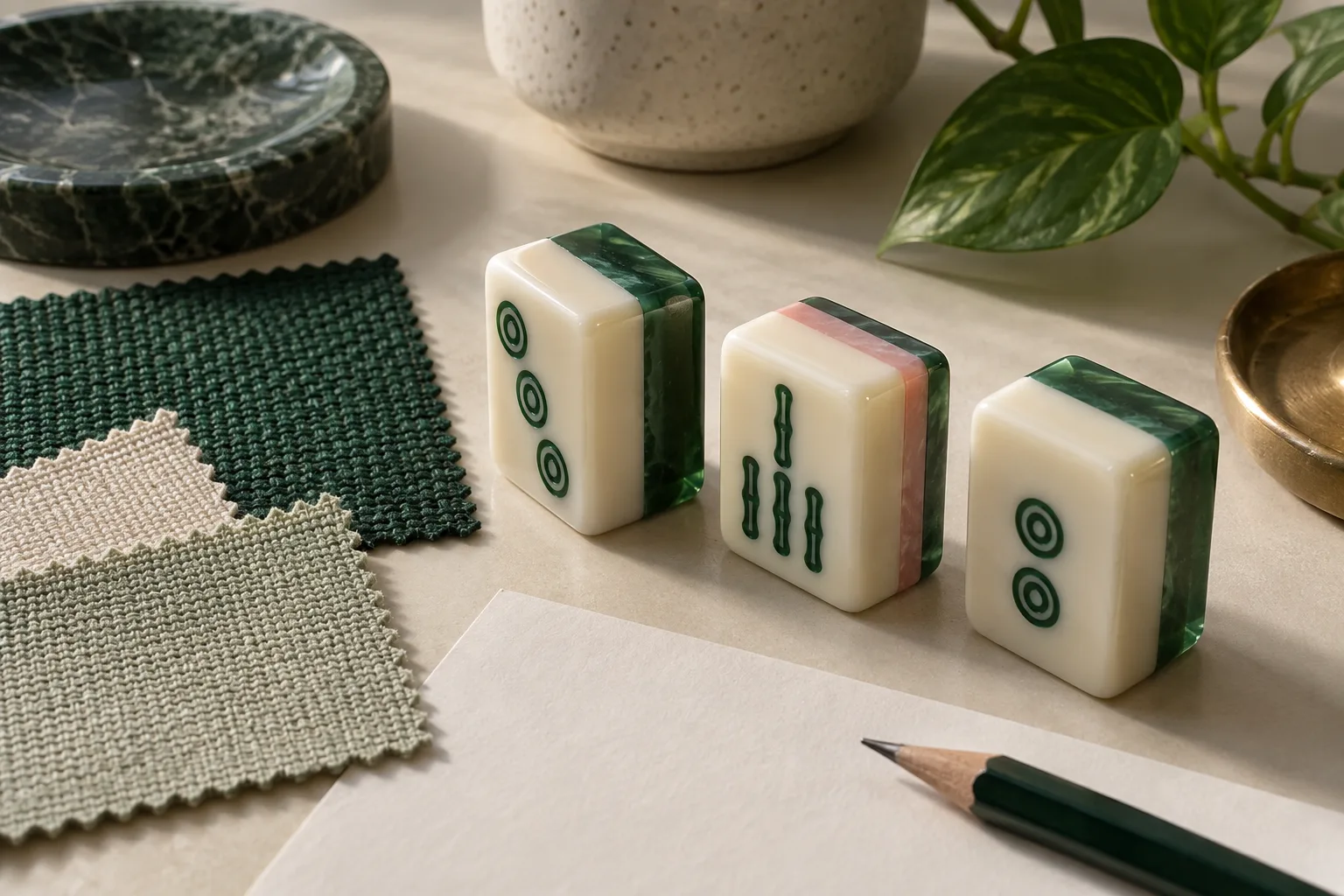
A rack’s overall length does not equal its usable tile ledge. Fourteen tiles at 23 mm wide occupy 322 mm; fourteen at 25 mm occupy 350 mm before clearance. End stops and connections use additional space. A nominal 14-inch rack is only 355.6 mm overall, so it cannot be declared suitable for the second example without checking the actual design.
Also check tile depth, back support and the exposed-tile area. For a case, define whether tiles lie flat or stand on edge, then account for the lining, dividers and closure. If racks belong in that case, include their packed dimensions rather than assuming a tile case holds the whole game kit.
Approve the loaded assembly once, using the components that will actually ship together. Close the lid, remove the tiles, use the rack and pack the detached pushers. Record the accepted drawing and sample so a later component change triggers a new fit check. The rack page and case page provide the relevant brief details.
Separate textile choices from transport protection
A printed mat, a rack sleeve and a padded bag have different jobs. The mat’s size and backing affect play space; the bag’s opening, internal dimensions and construction affect what it can carry. A drawstring-bag reference price cannot automatically price a zippered pouch or whole-set tote.
Wetop makes acrylic components and coordinates fabric accessories with specialist partners. The combined order still needs separate specifications and sample decisions. Do not assume the fabric part is ready merely because the tile proof is approved.
Standard shrink-wrap export packing is included with tiles. A decorative bag or gift box does not automatically replace the transport pack. Confirm packed weight, carton size, units per carton and any warehouse requirements. If testing is required, agree the method and the actual loaded configuration; a general mention of a testing standard is not a report for your order. See packaging options and checks.
Plan the sample, payment and schedule separately
The standard custom tile sample is one complete set at USD 500, courier included. The sample production window is 15–17 days after payment, finished artwork and proof approval. Courier transit is additional to production time.
Racks and pushers have a USD 200 sample fee for four racks and four pushers; a mat sample is USD 50; a box or bag sample is USD 200 per packaging design. Custom acrylic case samples are quoted to their confirmed structure. Sample fees are paid separately and are not credited to production. The sample page explains what to confirm before paying.
A sample schedule is not a guaranteed delivery date for the production order. Artwork revisions, special sheet colors, accessory approvals, the agreed production run and freight all affect the final timeline. Send the destination and target arrival date before committing to a launch calendar. The quotation should state payment milestones, the production window and the shipping basis for the actual order.
Send one brief that can be checked line by line
A useful first brief identifies the tile format and inventory, dimensions, layers and colors, face process, artwork status, accessory quantities, packaging route and destination. Where a choice is undecided, mark it as a question rather than letting the supplier guess.
Attach the available drawings or reference images and say which files are ready for production. If confidentiality matters, send reasonable NDA terms for review before restricted files. We do not disclose or reuse client artwork, and public availability does not grant permission to copy it. Common manufacturing methods should not be treated as a buyer’s exclusive process.
The mahjong configurator turns these decisions into an itemized request and displays the published estimate. Review its quantities against your intended bill of materials before submitting. The reviewed quote then confirms the scope, any outstanding specifications and freight, giving both sides a concrete basis for the next step.
Common questions
What does a complete acrylic mahjong OEM bundle cost?
There is no single price for every bundle. Listed tile configurations have reference prices of USD 53–73 per set FOB Shenzhen at 100–199 sets per design, with a published quantity ladder for other quantities; unlisted variants require a quote. In our 100-set example, two-layer engraved tiles, 20-inch magnetic rack sets and mats total USD 112.30 per bundle before samples, freight, duties, cases, bags and printed boxes.
Does ordering 50 tile sets let me order 50 of every accessory?
No. Each component keeps its own MOQ. Mahjong racks and mats start at 50 sets or pieces per design; drawstring bags start at 500 pcs and custom printed boxes at 1,000 pcs per design. Acrylic cases start at 50 pcs per design and are quoted to the confirmed specification.
What does the USD 500 tile sample include?
One complete custom tile set and courier, under the approved sample brief. Racks, mats, bags and printed boxes are separate sample lines. The full tile sample takes 15–17 days after payment, finished files and proof approval; sample fees are not credited to production.
Can I buy tiles and racks from you and source the bags elsewhere?
Yes. State which components Wetop should supply. Check the actual loaded dimensions and opening of any separately sourced container before approving the tile and rack specifications. Separate suppliers may have different schedules and acceptance requirements.
Can you sign an NDA before I share my artwork?
We can review and sign a reasonable NDA. We do not disclose or reuse your artwork. Terms should protect confidential designs without treating common manufacturing methods as one buyer’s exclusive property. Send the proposed terms before sharing restricted files.