Artwork files
Artwork files for your custom American mahjong tiles
Send outlined .ai or vector PDF files, one artboard per unique face at 1:1 tile size. Prefer no custom artwork? Choose our classic faces.
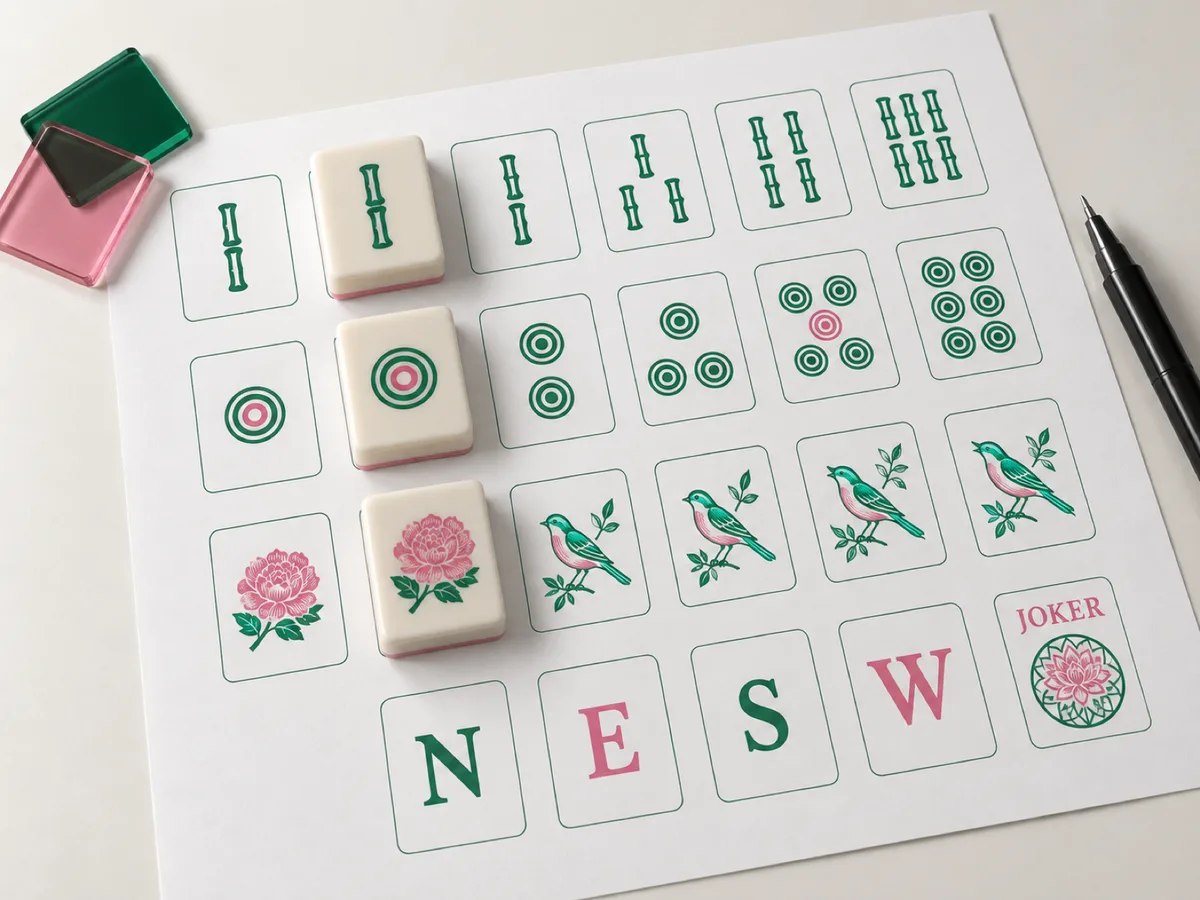
For your designer
The artwork standards as a two-page PDF
The file rules on this page in one sheet to hand over: accepted formats, artboard rules, the five-check gate, what changes between engraved and UV-printed faces, how to deliver the files, and a checklist to tick before sending. Effective 2026-09-19; A4, 2 pages.
File rules
Most first files arrive as PNGs, flattened PDFs or concept boards. Use this checklist with your designer to prepare a production file.
Format
Outlined Adobe Illustrator (.ai) or vector PDF
Why this matters
Engraving paths are cut from vectors. A PNG or JPG placed inside an .ai is still raster and cannot drive linework.
One artboard per unique face
One artboard for each unique face in your confirmed inventory; repeated tiles reuse the same artwork
Why this matters
Repeated tiles reuse one artboard. Name each artboard by tile (for example "bam-3", "joker", "back").
Artboard size
The tile face at 1:1 — 30 × 23, 32 × 23 or 36 × 25 mm (1.18 × 0.91, 1.26 × 0.91 or 1.42 × 0.98 in), or your custom body
Why this matters
Published dimensions are what your designer uses to set up artboards. We do not supply a template.
Text and strokes
Every font converted to outlines; every stroke expanded to a filled shape
Why this matters
Fonts we do not have substitute silently. Strokes scale differently from fills on the engraver.
Images
Embed any required raster assets; leave no external image links
Why this matters
Embedding assets prevents missing files. Raster images do not replace the vector paths required for engraving.
Colors
Named Pantone or hex values on every fill; separate layers for "engrave + fill" and "UV print only" areas
Why this matters
Choose a stock sheet code or discuss a custom sheet. Body and face colors are separate and are approved on the physical sample.
Line width, colors and text size
Lines 0.4 mm or wider recommended. No fixed limit on colors per tile or text size; it depends on your artwork and tile face size. Edge margin confirmed at proof
Why this matters
A hairline that reads on screen can close up at 23 mm wide. We flag anything too fine on the digital proof before the sample is cut.
Tile bodies and layer builds the artboards are sized to: sizes and layers. Which tiles a set contains: tile formats.
The five-check gate
These five checks prevent missing faces, substituted fonts and unreadable details. We flag any corrections for your designer before the sample is made.
True vector
AI or vector PDF. A placed PNG or JPG is still raster and cannot drive engraved linework.
Outlined text and strokes
Convert every font to outlines and expand strokes before export.
One artboard per unique face
Name each artboard and map it to the face inventory. Repeated tiles reuse artwork; the number of unique designs sets the artboard count.
Embedded images
The Links panel must be empty. Embed every image used in UV-print areas.
Named colors
Name face colors separately from body sheet codes. Choose stock sheet or a custom Pantone-matched sheet; approve the physical sample.
You supply finished artwork
We manufacture from outlined vector AI or PDF files. We do not supply editable templates or provide design, tracing, redraw, or vectorization services. Standard classic faces remain available when you do not have custom artwork.
You can provide your own complete face artwork or use available classic faces. Confirm any custom Jokers, backs or other changes in the brief. If you work with a designer, share the deliverables below before preparing files.
How the file moves from proof to sample to production, with the decisions at each step: artwork-to-production guide.
What to ask your designer for
- One .ai file (or vector PDF) with a named artboard per unique face at 1:1 tile size
- Fonts outlined, strokes expanded, images embedded
- Separate artwork groups for the selected face process, with engraved paths and fill colors clearly identified
- A PDF proof sheet showing every face as a thumbnail with its artboard name
- A short color list: which Pantone or hex goes where
What happens to your files
We can sign a reasonable NDA after reviewing and agreeing its terms. Your artwork and project files are used only to quote, sample and manufacture your order, never published or reused for another customer. The agreement should protect your confidential project information without treating common manufacturing methods as your exclusive property. Please send the proposed agreement for review before sharing confidential files.
Artwork questions
Do I have to design every tile?
No. A complete custom mahjong set needs one artboard per unique face, with repeated tiles reusing the same drawing. List the quantity of each face and any blanks in the complete-set manifest. If you choose our standard classic artwork, confirm that choice in the proof; it does not require you to redraw those faces.
I only have PNGs, a PDF from Canva, or AI-generated art. Can you use it?
A PDF can be suitable if it contains true vector paths and outlined fonts; its export app does not decide suitability. PNGs and AI-generated raster art need your designer to rebuild the engraving paths. We do not trace, redraw or vectorize. Give your designer the artwork standards PDF as the brief. Standard classic faces are always available if artwork is not ready.
Do you have a template with safe area and minimum line width?
We do not supply editable templates. Your designer sets the artboard to the published tile face size — 30 × 23, 32 × 23 or 36 × 25 mm — and we recommend lines of at least 0.4 mm. There is no fixed limit on colors per tile or text size; that depends on your artwork and the tile face size, and we confirm the edge margin and flag anything too fine on the digital proof before anything is cut.
What happens to my files after I send them?
We can sign a reasonable NDA after reviewing and agreeing its terms. Your artwork and project files are used only to quote, sample and manufacture your order, never published or reused for another customer. The agreement should protect your confidential project information without treating common manufacturing methods as your exclusive property. Please send the proposed agreement for review before sharing confidential files.
How is the artwork approved before the sample?
We check the files, then show the artwork on your tile drawing for approval. Your designer corrects any flagged file issues. After proof approval, we make the paid sample; the physical set you approve becomes the production reference.
Can I send the artwork after the quote?
Yes. Quote now with artwork status "in progress" and your expected date; the sample waits until the file passes the gate. Send the brief through the configurator so the quote is ready when the file is.
Ready to turn your artwork into tiles?
Tell us where your artwork stands and attach production files when ready. We confirm the specification and proof before sample making.