Business Card Holder Size and Spec Guide
Every brief specifies the logo. Almost none specify the front lip — the 8-12mm dimension that decides whether cards present cleanly or hide, jam, and tip out.
Need this made?Custom acrylic business card holders →
Key Takeaways
- The make-or-break spec on a business card holder is the front lip: 8-12mm holds a standard 51mm-tall card securely while leaving the name line visible; lower tips cards out, higher hides the card and makes single-card grab awkward.
- Capacity is arithmetic, not guesswork: standard cards run about 0.3-0.4mm thick, so a 12mm pocket gap holds roughly a 30-card stack and 18mm holds about 50 — spec the gap to the refill habit, not the maximum.
- US cards are 3.5 x 2 inches (89 x 51mm), most European cards 85 x 55mm — a pocket is cut to one card size, so international programs confirm the card spec before the holder spec.
- Four logo methods cover branded programs: silk-screen for 1-2 flat colors at volume, UV printing for full color, laser engraving for a permanent frosted mark, hot stamping for metallic foil. Custom Pantone-matched acrylic adds a $200-300 one-time color fee.
- Branded holders are a classic 100–500 piece program: 100-piece production MOQ, zero mold tooling, paid samples in 3–5 days, and production in 15–20 days, with unit cost dropping as quantity climbs.
On this page
- The spec your brief forgot
- The front lip: 8-12mm decides everything
- Formats: single pocket to multi-pocket wall racks
- Putting the brand on it: four logo methods
- What a 100-500 piece branded program costs to run
- Four mistakes that turn card holder orders into reworks
- The five-line spec that gets an accurate quote
The spec your brief forgot
Business card holder size is set by the card, not the logo: a pocket cut to an 89 x 51mm US card or an 85 x 55mm European card, a front lip that holds the stack, and a pocket gap sized to the refill habit. Yet every brief we receive for a branded card holder specifies the logo — placement, color, sometimes the exact Pantone. Almost none specify the front lip. Yet since founding Wetop in 2008, I’ve never seen a card holder program fail on logo quality; the ones that come back for rework fail because cards flopped forward, jammed in a too-tight pocket, or sat so deep the card face disappeared behind the acrylic.
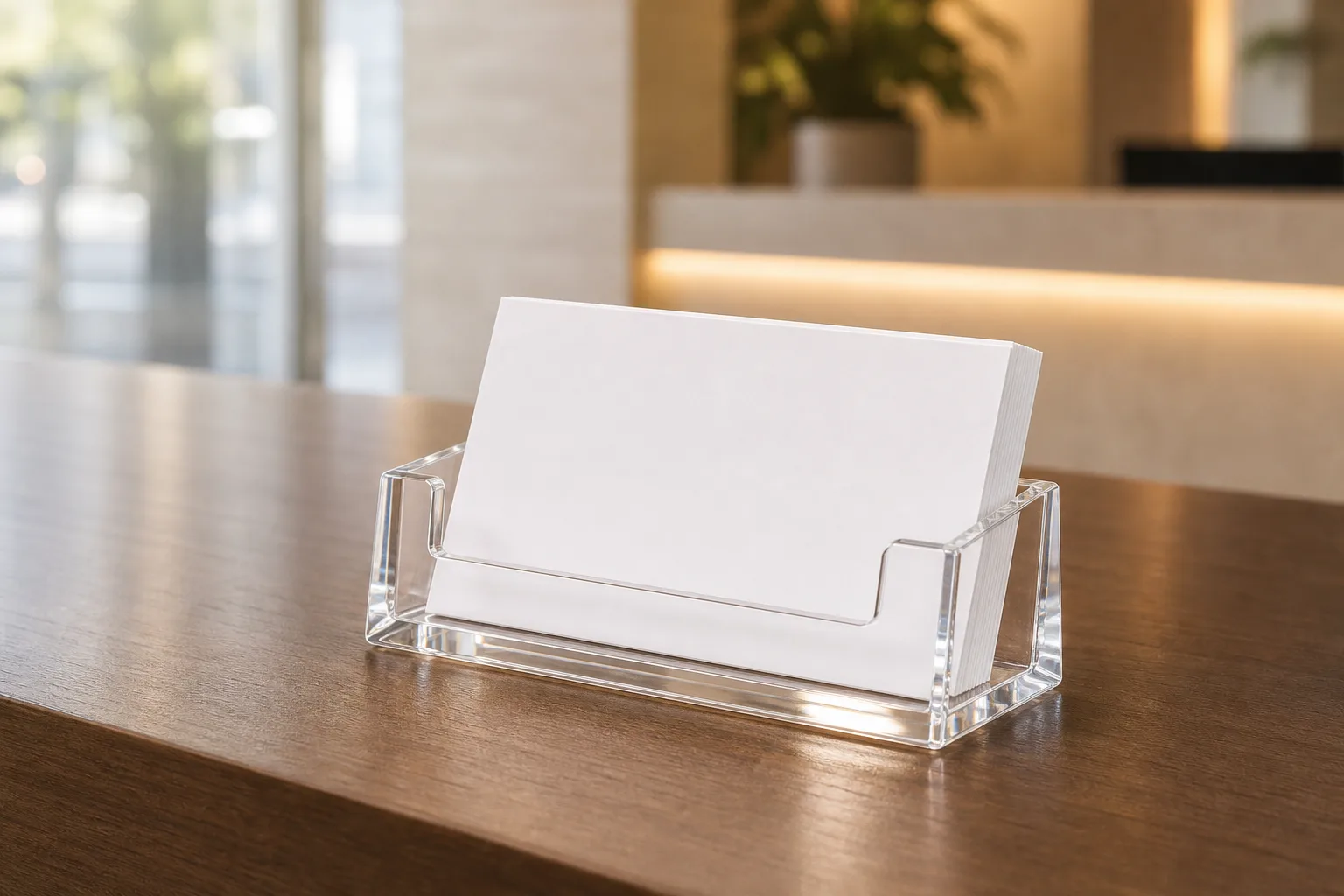
A business card holder is a small fabrication with unforgiving geometry: a pocket sized to a 89 x 51mm card, a front lip tall enough to hold a stack and short enough to keep the name line visible, and a base that keeps it planted when someone pulls one card out with a thumb. Get those three dimensions right and the logo has a stage; get them wrong and the branding rides on a fixture people fight with.
This guide covers the geometry first — lip height, pocket gap, card sizes — then the format choices, the four ways we put a brand on acrylic, and what a 100-500 piece branded program actually costs to run. It’s written from the briefs that cross my desk: what they say, and what they should say.
The front lip: 8-12mm decides everything
The front lip is the strip of acrylic that keeps cards in the pocket, and its height is the one dimension worth arguing about. The working range is 8-12mm. Below 8mm, a fresh stack leans forward and single cards tip out when the holder is bumped or the desk vibrates. Much above 12mm, the lip starts swallowing the card — on a standard card only 51mm tall, a 20mm lip hides nearly 40% of the face, usually including the name line the card exists to show.
The math is simple and worth doing on your own design. A US-standard card measures 3.5 x 2 inches — 89mm wide, 51mm tall.1 A 10mm lip leaves 41mm of card presenting above the acrylic: your logo visible, the name visible, comfortable thumb clearance for pulling one card. That 41mm of visible card is the actual product of the whole fixture, which is why we treat lip height as the primary spec and the logo as a decoration that rides on it.
Capacity is the second half of the geometry, and it’s arithmetic. Standard cards on 300-400gsm stock run about 0.3-0.4mm thick, so a 12mm front-to-back pocket gap holds roughly a 30-card stack and an 18mm gap holds about 50. Spec the gap to your refill habit, not the theoretical maximum: if your reception desk gets refilled weekly, you’re happier with 30 cards presenting neatly than 50 wedged so tight the top card bends on the way out. And when a pocket runs too tight for the stock — the “cards jam in the holder” complaint that shows up in buyer inquiries across this category — the cause is almost always premium stock: 600gsm, plastic, or metal cards run 0.5-0.8mm each, nearly double the thickness the pocket was cut for. If your cards are anything heavier than standard stock, say so in the brief.
One card size does not fit all markets. A pocket is cut to one card spec, so confirm your card before the holder:
| Card standard | Dimensions | Where it’s used | Pocket note |
|---|---|---|---|
| US / Canada standard | 3.5 x 2 in (89 x 51mm) | North America | The default our US clients spec |
| European standard | 85 x 55mm | Most of Europe | Narrower but 4mm taller — lip height matters more |
| Japanese standard | 91 x 55mm | Japan | Widest common card; needs its own pocket width |
| ID-1 (credit-card size) | 85.6 x 54mm | Membership and loyalty cards | Defined by ISO/IEC 7810; common for hybrid card programs2 |
Formats: single pocket to multi-pocket wall racks
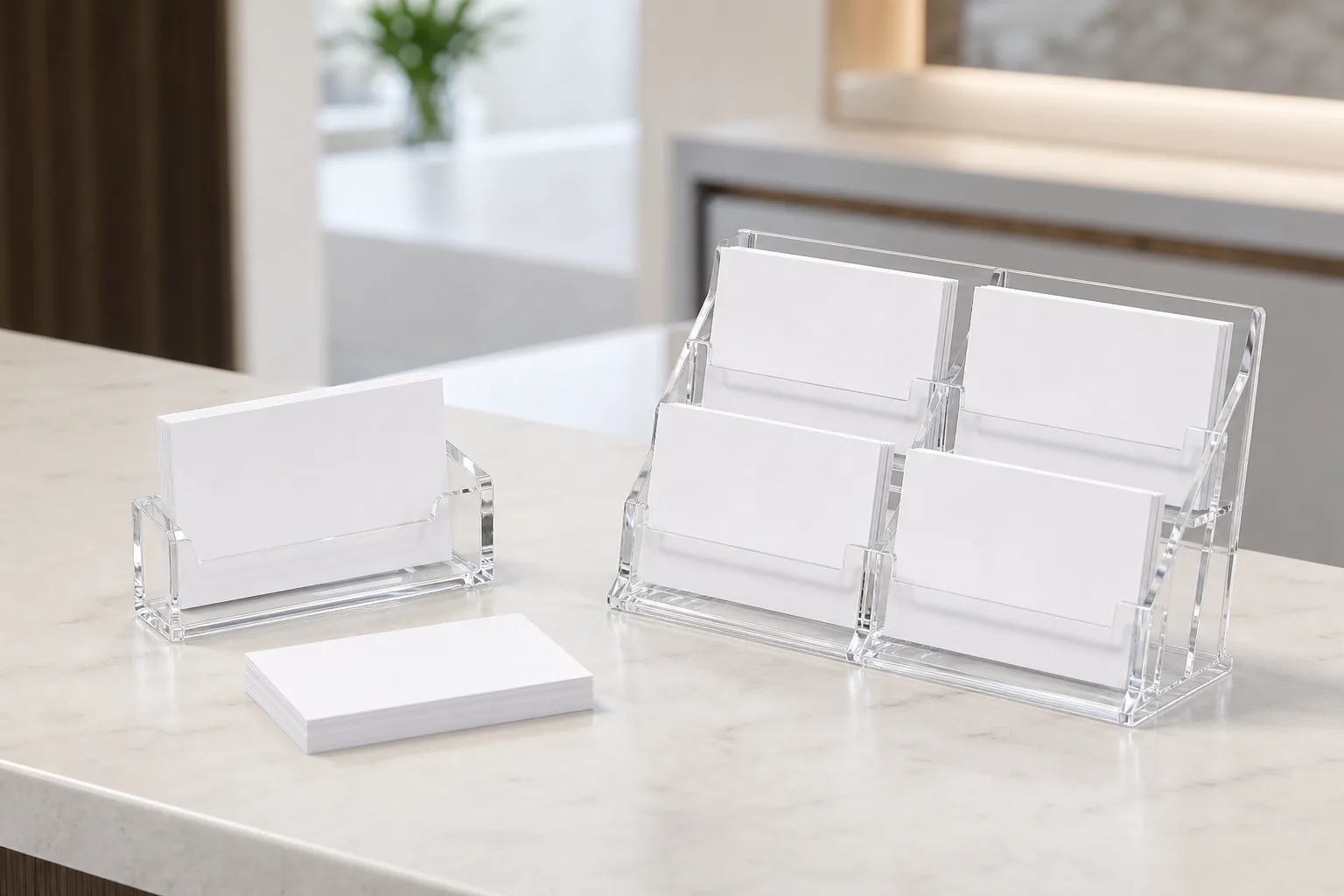
Format follows the job you’re giving the card. A single-pocket holder presents one company’s card at a reception desk; a multi-pocket countertop unit merchandises several cards side by side; a tiered or wall-mounted rack organizes dozens of cards where floor space is spoken for. The geometry rules from the last section apply to every pocket in all of them.
| Format | Typical footprint | Capacity | Best for |
|---|---|---|---|
| Single pocket, vertical | ~95 x 40mm base | 30-50 cards | Reception desks, checkout counters, one brand one card |
| Single pocket, slant | ~95 x 70mm base | 30-50 cards | Trade show tables — angled face reads from standing height |
| Multi-pocket countertop (2-6 pockets) | 200-500mm wide | 30-50 per pocket | Realtor offices, salons, service counters with several staff cards |
| Tiered (2-3 rows) | Stepped, ~150mm deep | 60-150 total | Card walls on a counter — every row visible at once |
| Wall-mount rack | Zero counter space | 30-50 per pocket | Corridors, waiting rooms, beside service windows |
Two format decisions come up on almost every branded program I review. First, vertical vs slant: a vertical holder reads best at eye level on a desk between seated people; a slanted face reads better on a low table or trade show counter approached from standing height — think about where your visitor’s eyes will be when they meet the card. Second, desktop vs wall: wall racks win wherever your counter is contested real estate — a hair salon’s front desk, a clinic reception — and they turn a card display into permanent signage. The pocket geometry stays identical; only the mounting changes, with pre-drilled holes and hardware included on wall units.
Whatever the format, the holder is jewelry for the card: clear cast acrylic, diamond- or flame-polished edges, and enough weight that a one-card pull doesn’t drag the fixture. That presentation logic is the same one behind our full range of custom acrylic displays — a card holder is simply the smallest member of the family.
Putting the brand on it: four logo methods
Four methods cover essentially every branded business card holder program: silk-screen printing, UV printing, laser engraving, and hot stamping. The right one depends on the artwork — flat spot color, full color, permanent mark, or metallic — and all four run at our standard 100-piece MOQ.
- Silk-screen printing — the volume workhorse for 1-2 flat brand colors. A flat screen setup fee plus a small per-unit cost, excellent opacity, and clean edges on logos and wordmarks. If the brand mark is one color, this is usually the answer.
- UV printing — full-color, photographic-quality artwork cured directly onto the acrylic. Gradients, multi-color logos, and small text all reproduce faithfully; no setup screens, so it’s also the flexible pick for short runs and multi-version programs (one holder design, ten franchisee logos).
- Laser engraving — a permanent frosted-white mark cut into the surface. It can’t rub, peel, or scratch off, reads as understated and premium, and suits firms that want branding without color: law offices, financial advisories, architecture studios.
- Hot stamping — metallic gold or silver foil pressed into the surface. The luxury cue for premium programs; pairs especially well with black or deep-colored acrylic.
Placement matters as much as method. The front lip is prime real estate — your logo sits directly under the presented cards — but it’s only 8-12mm tall, which suits a wordmark, not a detailed crest. Larger artwork goes on the base apron or the back panel. And if your brand calls for colored acrylic rather than a printed mark on clear, we match acrylic to brand colors with a custom Pantone formulation — a $200-300 one-time fee per color, after which every reorder hits the same shade. The full walkthrough of how that match works is in our Pantone color matching guide, and the complete decoration menu — printing, engraving, stamping, color — is on our custom acrylic fabrication page.
What a 100-500 piece branded program costs to run
Branded card holders are a textbook small-fixture program: 100-piece MOQ, no tooling fees, and a unit cost that falls meaningfully as quantity climbs toward 200-500 pieces. The no-tooling point is structural, not promotional — holders are CNC-cut and heat-bent from sheet rather than injection molded, so there is no mold to amortize and a custom pocket size costs about the same as a standard one.
What actually moves the per-unit number, in descending order: acrylic thickness and total material per holder (a tiered six-pocket unit is several times the material of a single pocket), decoration method (laser engraving and silk-screen carry setup economics that improve with volume; UV printing is flat), colored or Pantone-matched acrylic versus clear, and quantity. A typical program brief — 200 single-pocket holders, clear acrylic, one-color silk-screen logo — sits at the simple end of everything we quote, which is why turnaround on card holder programs runs fast: samples in 3-5 days, production in 15-20 days, 30% deposit with the balance before shipment, FOB Shenzhen.
In my experience the program shapes vary far more than the product does. A professional-services firm orders 100 for its own offices and refreshes on a rebrand. A franchise brand orders 300-500 with per-location logo versions under one PO — same holder, UV-printed variants. And giveaway-driven programs treat the holder as a branded takeaway; our branded trade show giveaway case study shows how a fixture-plus-giveaway program rolls out on a deadline. In every shape, the reorder is the point: the drawing, the pocket spec, and the print files stay on file with us, so round two is a one-line email.
Four mistakes that turn card holder orders into reworks
Almost every rework request I’ve seen on a business card holder traces back to one of four skipped checks — and all four are free to catch before production. If you check nothing else in this guide against your brief, check these.
- Speccing the lip from a product photo. A render or a competitor photo doesn’t reveal that the lip is 6mm — the buyer finds out when cards tip out on the first bumped desk. Put the number in the brief: 8-12mm, or ask us to recommend one; we size lips against real cards every week.
- Ignoring card stock thickness. 600gsm, plastic, and metal cards jam in a pocket cut for standard stock. Name the stock in the brief — or better, mail us the actual card so our sample pocket is cut to it.
- Putting detailed artwork on the front lip. A crest with fine linework dies at 10mm tall. Keep the lip for a wordmark and move the crest to the base or back panel, where we can print it large enough to stay legible from a meter away.
- Skipping the physical sample. Approve a paid sample before the 100-piece production run — pocket fit and material feel are exactly what a screen cannot show, and our samples take 3-5 days, not weeks.
None of these are exotic engineering; they’re the difference between a brief that describes a photo and a brief that describes a fixture. I’d rather answer five extra spec questions before a run than remake a single piece after one — and so would every buyer we’ve done it for.
The five-line spec that gets an accurate quote
A complete business card holder RFQ fits in five lines: your card size and stock, format and pocket count, front lip height (or “recommend one” — we will), logo method and artwork, and quantity. Add a photo of the desk or wall where the holders will land, and the first quote we send back is usually the final one.
Line four deserves the same discipline as the geometry. Send vector artwork (AI, EPS, or PDF) for silk-screen, engraving, and stamping; high-resolution files work for UV printing. If your artwork’s colors must match a brand book, name the Pantone codes in the brief. And before a 300-piece program runs, approve a physical sample — pocket fit and material feel are exactly the things a photo can’t confirm, a point we’ve made at length in our pre-production sample approval checklist. Mail us your actual card with the inquiry and the sample pocket is cut to it, not to a spec sheet’s idea of it.
When the spec is settled, our custom acrylic business card holders page covers the formats we build and ordering from 100 pieces per design.
That’s the whole discipline: card first, lip height second, logo third. Brief it in that order and your holder does its job for years — presenting the card, and the brand on it, exactly the way you imagined.
Footnotes
-
Business card size and dimension guide — MOO — confirms the US standard business card at 3.5 x 2 inches (8.9 x 5.1cm), the card dimension acrylic holder pockets in North American programs are cut to. ↩
-
ISO/IEC 7810:2019 — Identification cards, physical characteristics — the international standard defining the ID-1 card format (85.6 x 54mm) used by credit, membership, and loyalty cards that hybrid card-holder programs must pocket alongside paper business cards. ↩
Frequently Asked Questions
What is the right pocket depth for a business card holder?
A front lip of 8-12mm with a pocket gap of 10-18mm front-to-back. The 8-12mm lip holds a standard 51mm-tall card securely while keeping the name line visible; the gap sets capacity — at roughly 0.3-0.4mm per card, 12mm holds about a 30-card stack and 18mm about 50. Shallower lips let cards tip out; taller lips hide the card face.
How do you put a logo on an acrylic business card holder?
Four proven methods: silk-screen printing for 1-2 flat brand colors at volume pricing, UV printing for full-color artwork and gradients, laser engraving for a permanent frosted-white mark that can't rub off, and hot stamping for metallic gold or silver foil. The right pick depends on the artwork — flat logo, full color, or metallic — and all four run at 100-piece MOQ.
What is the minimum order for business card holders?
Our MOQ is 100 pieces per design — sized for a single office, a trade show team, or a first retail batch. There are no mold-tooling fees because holders are CNC-cut and heat-bent rather than molded, and unit cost drops meaningfully as orders climb toward 200-500 pieces. A paid sample is available before production.
Do European and US business cards fit the same holder?
Usually not cleanly. US cards measure 3.5 x 2 inches (89 x 51mm) while most European cards run 85 x 55mm — wider pocket needed for the US card, taller lip clearance for the EU card. A pocket is cut to one card size, so international programs either order two variants or standardize the card spec first.
Can a business card holder hold thick or textured cards?
Yes, with the pocket gap sized for it. Premium cards on 600gsm stock, plastic cards, and metal cards run 0.5-0.8mm thick — nearly double standard stock — so the same 30-card capacity needs a deeper gap. Send us the actual card (or its stock weight) and we cut a sample pocket to verify fit before production; samples ship in 3-5 days.
Explore Custom Acrylic Products
Browse product categories to compare formats, materials, and customization options before choosing the closest fit for your project.