Jewelry Display Trays: Sizes, Inserts and Orders
Tray shells last years; inserts wear out in months. Buy them as a two-part system and the reorder math changes completely.
Need this made?Acrylic jewelry displays →
Key Takeaways
- The trade-standard full-size jewelry tray footprint runs about 370 x 210 mm with 30-50 mm walls, so trays, drawer units, and travel cases from different vendors interstack — confirm the footprint before ordering anything custom.
- Buy trays as a two-part system: an acrylic shell that lasts 5+ years and swappable velvet inserts that wear out in 6-18 months — insert-only reorders typically cost a fraction of full tray replacement.
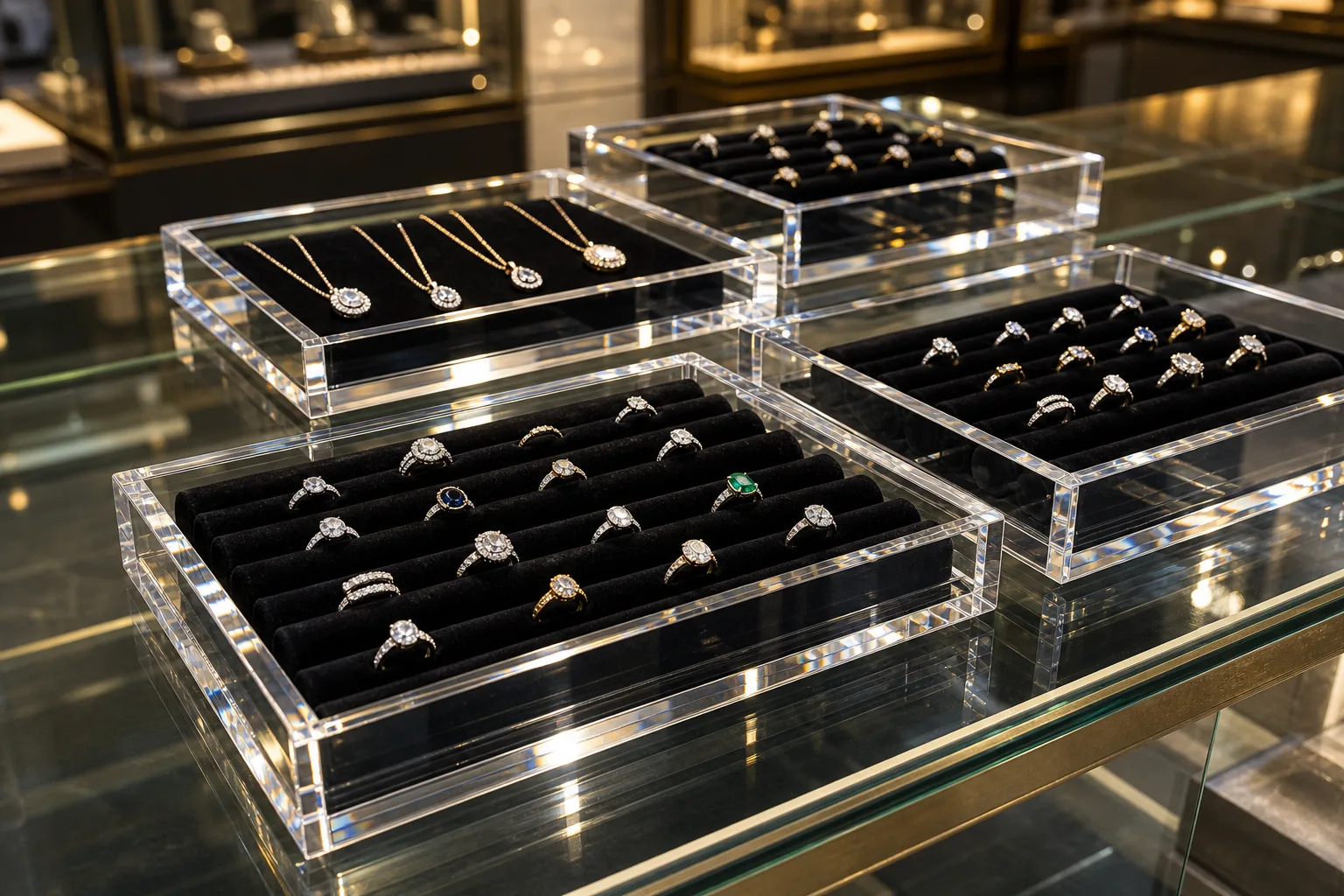
- Ring rows hold the most pieces per tray (30-50 slots); pendant pads show fewer pieces better. Counters earn the presentation formats, drawers and travel earn the density formats.
- Cast acrylic shells at 3 mm hold shape under a loaded insert — about 3.2 GPa elastic modulus — and a clear lid keeps roughly 92% light transmission, so stock stays visible even stacked.
- At a 100-piece MOQ per design, a mixed order of shells plus two insert sets per shell covers a season of wear for a multi-counter retailer in one production run.
On this page
Jewelry display tray sizes
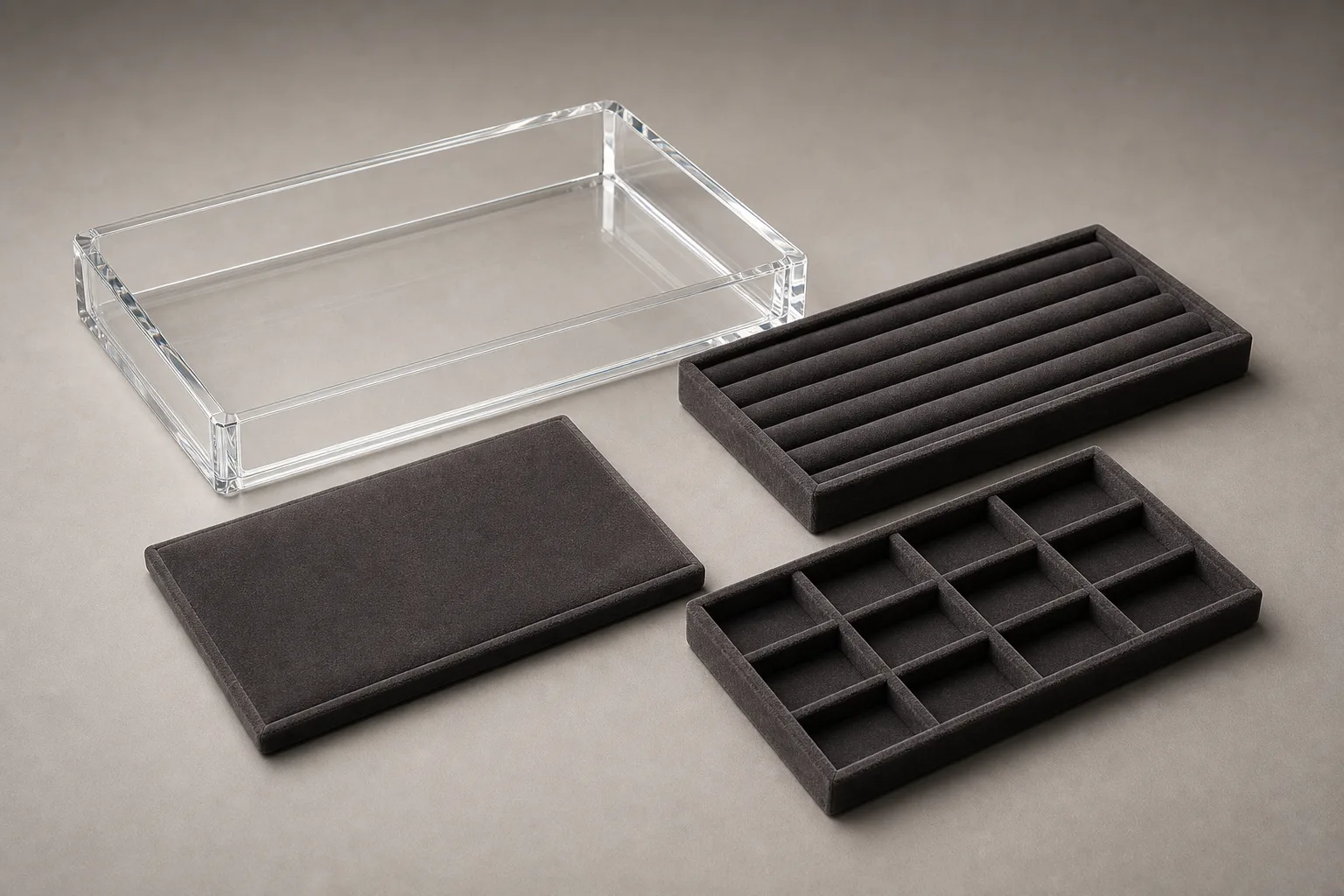
Standard full-size jewelry display trays measure about 370 x 210 mm, with walls 30-50 mm high. Half trays run about 210 x 180 mm and quarter trays smaller, all on the same module so they stack and share drawers. Inside sits a swappable velvet or flocked insert: ring rows, pendant pads, earring cards, or open compartments.
| Tray | Approx. footprint | Wall height | Typical use |
|---|---|---|---|
| Full tray | 370 x 210 mm | 30-50 mm | Counters, drawers, travel stacks |
| Half tray | 210 x 180 mm | 30-50 mm | Small drawers, mixed counters |
| Quarter tray | Below half size | 30-40 mm | Single-line displays, repairs bench |
That module is the most useful fact when buying jewelry display trays, because it lets a counter tray, a drawer unit, and a lidded travel stacker from different orders line up years apart. Since 2014, I’ve built jewelry display trays for boutiques, distributors, and trunk-show operators, and the buyers who stay happy are the ones who committed to a footprint early and let every later purchase snap to it. The buyers who ordered “whatever looked right” three times now own three tray families that don’t stack, don’t share inserts, and don’t fit the same drawer. Measure your counter or drawer interior before specifying the module; our shells are cut to a ±0.2 mm standard working tolerance, with fit-critical dimensions set on the drawing.
We make trays to order for retail and trade-show programs from 100 pieces per design; we don’t sell stock trays. For locking showcase formats and the full range of jewelry displays, see the application page; ring risers, ring-row trays and single-ring blocks are in its ring displays section. If you’re comparing display materials, the acrylic vs wood jewelry display guide covers that question, and for store-level layouts start with the jewelry display ideas guide.
Counter, drawer, or stackable: three trays, three jobs
Counter trays present, drawer trays store, and stackable trays travel — and the walls tell you which is which. Presentation trays run low-walled and open so pieces sit at eye level under glass; drawer trays run taller and denser; stackers add a rigid lid and a locating rim so loaded trays ride safely to a trunk show.
| Format | Typical spec | Capacity focus | Where it lives |
|---|---|---|---|
| Counter / presentation tray | Full-size, 30 mm walls, open top | Presentation over density | Inside showcase, top of glass |
| Drawer tray | Full or half-size, 40-50 mm walls | Density — rows and grids | Back-of-house, under-counter drawers |
| Stackable travel tray | Full-size, 40 mm walls + clear lid | Density + protection | Trunk shows, buying trips, transfers |
| Open compartment tray | Any module, movable dividers | Mixed and oversized pieces | Repairs bench, intake, bagging |
The mistake I see most often at quote stage is buying one tray type for all three jobs. A retailer specs a hundred beautiful low-wall presentation trays, then six months later asks why chains tangle in the drawers and why staff carry open trays to off-site events one at a time. The formats exist because the jobs differ: walls low enough for sightlines can’t also be walls tall enough to protect a stacked load. A working program usually splits roughly half drawer trays, a third counter trays, and the rest lidded stackers — then adjusts by how much of the business happens away from the store.
Stacking is a cut-geometry detail worth checking on any supplier’s sample, because stackable jewelry trays live or die on it: the lid or rim needs a locating step so the tray above registers on the tray below instead of sliding on polished acrylic. On our lines that step is CNC-cut into the shell, not glued on — glued ledges are the part that lets go when a loaded stack comes out of a cold van.
Insert systems: ring rows, pendant pads, earring flaps
Inserts do the actual selling. Ring rows — parallel padded slots — pack 30-50 rings into a full tray and are the density king. Pendant pads present 6-12 necklaces flat with the chain dressed. Earring flaps and card slots hold pairs upright. Open compartments with movable dividers catch everything else.
| Insert type | Pieces per full tray | Best for | Wear life (daily handling) |
|---|---|---|---|
| Ring rows | 30-50 | Stock depth, drawer storage | 6-12 months |
| Pendant pads | 6-12 | Counter presentation | 12-18 months |
| Earring flaps / cards | 12-24 pairs | Studs and drops | 12-18 months |
| Open compartments | varies | Bracelets, watches, mixed lots | 18+ months |
The production distinction that matters at order time is flocked versus wrapped. Flocking sprays adhesive and fiber directly onto a foam or board core — it’s fast, uniform, and the right call for high-count ring rows where the slot walls take constant finger pressure. Wrapped inserts stretch real velvet over the core and read richer on camera, which earns them the pendant pads and top-of-glass pieces; the trade-off is seams at tight inside corners, so deep narrow slots don’t wrap cleanly. When my team quotes a mixed program we usually spec flocked rows and wrapped pads for exactly that reason — each process where it holds up.
Color is a brand decision with one technical footnote: black and charcoal hide handling soil longest, light gray and cream photograph airier but show it sooner, and a custom Pantone-matched fiber or fabric carries our standard one-time $200-300 color fee, then repeats free on reorders.
| Published price reference | Scope | Price basis |
|---|---|---|
| Custom acrylic color setup | One custom-tinted acrylic shell color | $200 published low-end reference from the published $200–300 one-time range; not a tray unit quote |
Why swap-out inserts beat glued-in liners
Inserts wear out; shells don’t. Daily handling crushes velvet pile and shines flock in 6-18 months, while the acrylic shell underneath stays serviceable for five years or more. A tray with a glued-in liner makes you rebuy the whole unit on the liner’s schedule; a swap system lets you reorder only the part that wears.
Run the numbers on a 20-counter retailer holding 100 jewelry display trays. With glued liners, a tired-looking counter means 100 new trays every year or two. With swappable inserts, the same refresh is 100 insert sets — typically a fraction of full tray cost, lighter to ship, and faster to produce because there’s no shell fabrication in the run. The shells amortize toward zero while the refresh budget shrinks to consumables. This is the same tray-plus-insert logic we build into compartment trays across categories — our tray insert and compartment design guide goes deeper on divider geometry and fit tolerances.
When a “replace our trays” inquiry lands, I ask one question before quoting: were the old inserts glued? A yes usually means the retailer is about to repeat the same purchase. Roughly speaking, when the shell and insert are one part, every cosmetic problem becomes a capital problem: crushed pile on ten ring rows retires ten complete trays. Separate the parts and the same wear becomes a consumable line item that a store manager can approve without a budget meeting.
Two details make the economics actually work. First, fit: a swappable insert needs 0.5-1 mm of clearance to the shell wall — snug enough not to shift when a customer pulls a ring, loose enough that staff can lift it out with the finger notch. We cut both parts on the same drawing so that clearance is designed, not discovered. Second, file continuity: we keep your shell drawing and insert layouts on record, so a reorder two years later matches the originals — the drawing library that makes wave-two orders an email rather than a re-spec. Seasonal programs use this aggressively: one shell fleet, a black insert set for daily trade and a cream set for the bridal season, swapped in an afternoon.
Material: what the acrylic shell contributes
The shell’s job is rigidity, sightlines, and survival. Cast acrylic at 3 mm holds a loaded insert flat — the material carries an elastic modulus of about 3.2 GPa1 — and polished clear walls or lids keep stock visible even mid-stack, since clear cast acrylic transmits about 92% of visible light per ASTM D1003.2
Those two numbers translate directly to store behavior. Rigidity means a full tray of rings lifts from a drawer without the oil-canning flex that spills slots — the failure mode of thin thermoformed trays. Light transmission means a lidded stack still merchandises: staff and customers see the goods through the lid instead of opening five trays to find one pendant. Against wood, the acrylic shell wipes clean with no finish to strip; against covered cardboard — the traditional budget core of this category — it doesn’t soften at the corners after a humid season or a spilled coffee.
Clear isn’t the only finish. Black shells under black velvet read as one continuous block of dark and make gold pop; frosted walls soften showcase interiors; a mirror-finish riser under a tray set lifts the back row into sightline — the same trick our acrylic display risers do for tiered counter sets. Fine scratches on clear lids polish out on a buffing wheel, which is a repair glass simply doesn’t offer.
Ordering: MOQ, samples, and a program-sized first run
A custom tray program starts at 100 pieces per design, with samples in 3-5 days (USD 200-500 depending on complexity, paid separately and never credited to production), production in 15-20 days, and 30% deposit with the balance before shipment, FOB Shenzhen. Most tray orders carry no tooling fee; if a complex part needs one, the written quote states it. For jewelry display trays the practical first order is a mix: shells plus two insert sets per shell, so the first refresh is already on the shelf. We are an acrylic tray manufacturer rather than a reseller, so shells and inserts come off the same lines and the base formats the program builds on are all listed there.
Send three things with your inquiry and the quote comes back precise instead of provisional: your counter or drawer’s interior dimensions (we size the tray module to fit, not the other way around), your piece mix (ring-heavy programs need more rows; pendant-led brands need more pads), and logo artwork as a vector file if you want branded shells — UV print or laser etch both run at MOQ. For an adjacent reflective-fixture brief, the mirror-finish sneaker pillar project shows how geometry, finish, branding, sampling, inspection, and packing were controlled.
A last word on samples, because in this category they earn their courier fee twice over. A tray sample tells you things no drawing can: whether the ring-row slot width actually grips your average band, whether the insert lifts cleanly with one finger, whether the velvet shade reads warm or cool under your store’s lighting. When my team cuts a sample set we include one shell and one of each insert type you’re considering, so the decision happens with your own stock in the slots. Approve the sample, and the production run is cut on the same programs and inspected against it, so what you held is what ships.
When you’re ready, send dimensions and piece counts through our custom acrylic fabrication page. We’ll return a tray-module drawing, an insert layout, and a quote within a working day.
Footnotes
-
PMMA (acrylic) material properties, MakeItFrom — independent materials database listing cast acrylic’s elastic modulus of about 3.2 GPa, cited for shell rigidity under a loaded insert. ↩
-
Plaskolite OPTIX general-purpose acrylic sheet datasheet (PDF) — manufacturer datasheet reporting 92% total light transmission for clear cast acrylic sheet measured per ASTM D1003, cited for visibility through clear tray lids. ↩
Frequently Asked Questions
What jewelry display tray size fits a retail counter?
370 x 210 mm is a common full-tray planning footprint, but the approved counter, drawer and insert grid control the production size. Confirm the outside dimensions, usable inside area, wall height and stacking detail on the paid sample before bulk production.
Do you offer jewelry display trays wholesale?
100 pieces per design is the production MOQ. We don't stock or wholesale — every order is made to your spec in production quantities from 100 pcs. The common full-size trade footprint is about 370 x 210 mm, but the shell, insert grid, fabric and logo are approved for your program.
Which jewelry tray insert should I choose for rings vs pendants?
30-50 rings fit a typical full-tray row insert, while pendant pads usually present 6-12 pieces. Most counter programs mix both: rows for case storage and pads for the top-of-glass presentation moment.
Can I reorder just the velvet inserts without new trays?
1 retained shell drawing and insert BOM let us quote an insert-only reorder without remaking the acrylic body. Confirm the fabric, grid, quantity and any revised slot dimensions; production follows the current 15-20-day standard window after approval.
What is the minimum order for custom jewelry display trays?
100 pieces per design is the production MOQ. Samples take 3-5 days and cost USD 200-500 depending on complexity, paid separately and never credited to production. Production takes 15-20 days after sample approval.
What trays work best for trunk shows?
Stackable full-size trays with about 40 mm walls, a clear lid, and a locating rim, so loaded trays register on each other and ride without sliding. Use dense inserts such as ring rows for transport, and carry a few pendant pads for the presentation table at the show.
Do acrylic jewelry trays scratch or yellow over time?
3 controls matter most: keep protective film on through fabrication, approve the cleaning method, and specify the sheet grade for the display environment. Fine surface marks and UV exposure are separate risks, so the sample and material datasheet should be reviewed independently.
Specify a jewelry tray program
Send the tray footprint, insert grid, fabric or color reference, logo artwork, quantity and destination. We will return a line-item quote and a paid-sample plan; sample fees are paid separately and are not credited to production.