
Fluorescent Acrylic for Awards, Frames and Signs
Fluorescent acrylic glows at every cut edge without a light source. That effect depends on the sheet, the edge finish and the joints, so spec all three.
Need this made?Custom acrylic frames →
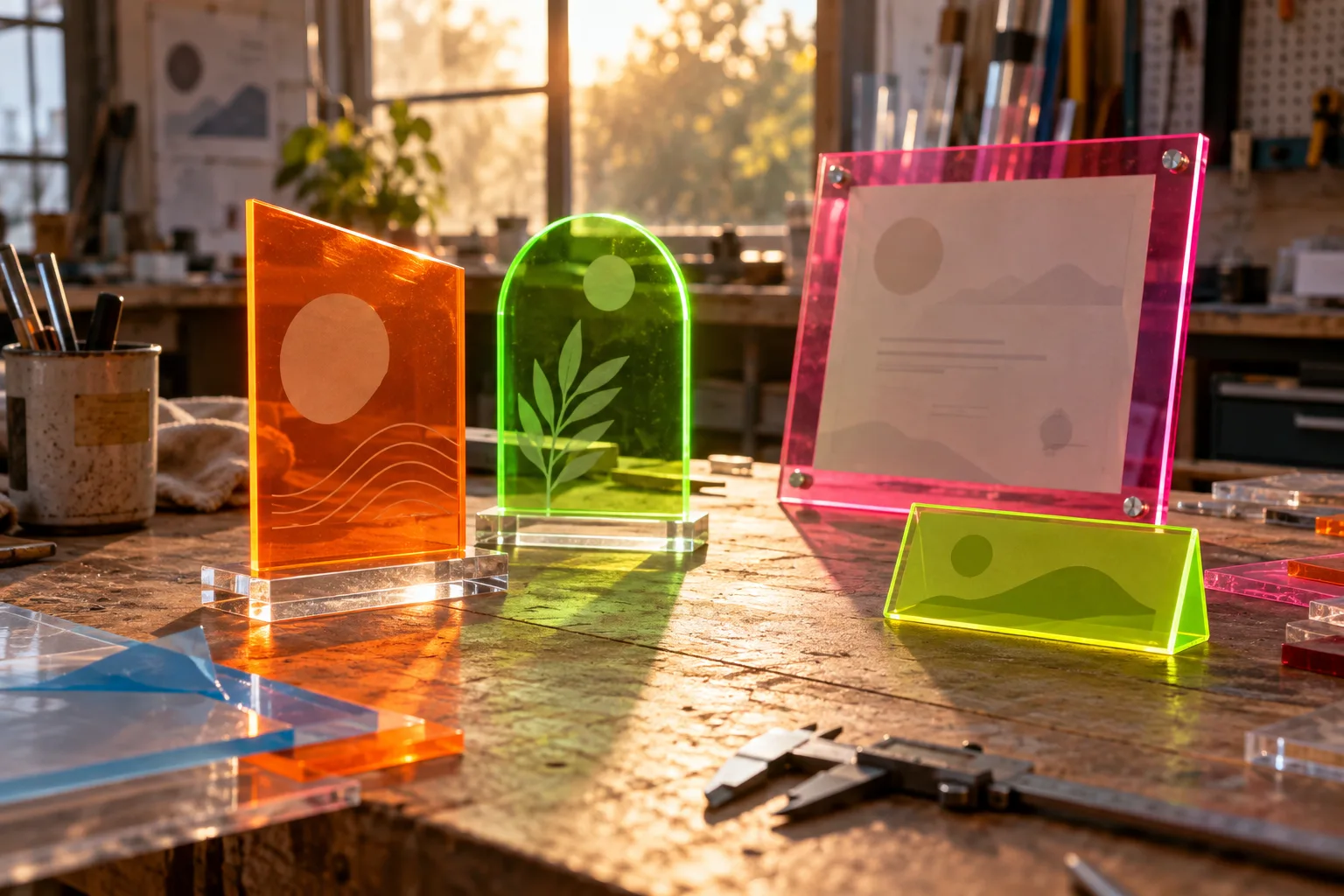
This guide covers custom awards, certificate frames and small signs made from fluorescent sheet. We fabricate finished pieces; we do not sell loose sheet.
Key Takeaways
- Fluorescent acrylic absorbs light across its face and re-emits it; much of that light is trapped inside the sheet and leaves at the cut edges, which is why the edges glow.
- Polished or laser-cut edges show the glow best; a rough or sanded edge scatters it.
- Cut every piece of one order from the same sheet batch and approve color on the physical sample, because fluorescent color can shift between batches.
- Treat fluorescent acrylic as an indoor material unless the sheet maker's data rates it for outdoor use.
- Available fluorescent colors, thickness and cast or extruded sheet are confirmed on your quote; production starts at 100 pieces per design.
On this page
Why fluorescent acrylic glows at the edges
Fluorescent acrylic is colored sheet with a fluorescent dye that absorbs light falling on its face and re-emits it at a longer wavelength. Much of that re-emitted light stays trapped inside the sheet by internal reflection and travels sideways until it reaches a cut edge. The edges therefore look brighter than the face, as if lit from inside, with no LEDs or power.
The same physics is used in luminescent solar concentrators, which collect light over a large face and deliver it to narrow edges. In a plate with a refractive index close to window glass, about 75–80% of the luminescence can be trapped by total internal reflection.1 Acrylic has a similar refractive index, which is why a thin fluorescent sheet throws so much light out of its edges.
For awards, frames and signs, that means the edge is the feature. A fluorescent border on a clear certificate frame, a tombstone award with glowing sides, or a small sign with engraved text all rely on light reaching a clean edge or cut.
Cast or extruded fluorescent sheet
Fluorescent acrylic is made as both cast and extruded sheet. Sheet makers list fluorescent colors in their cast lines; Röhm, for example, lists fluorescent yellow, orange, red and green among its PLEXIGLAS GS cast colors.2 Which colors are available in your thickness, from which sheet maker, is confirmed on your quote.
Cast sheet is usually the better choice for awards and frames that are machined, polished, engraved or solvent-bonded. It machines cleanly and holds a polished edge, and it tolerates bonding with less risk of stress cracking. Extruded sheet can be cheaper for flat laser-cut signs. The cast vs extruded guide explains the differences in detail; this guide does not repeat them.
Recent fluorescent requests we have quoted include certificate frames and award medals at 100 to 255 pieces, with buyers asking specifically for cast sheet, consistent color and clean bonded joints. Those three points shape the rest of the spec.
Keep color consistent across one order
Fluorescent color can shift slightly between sheet batches, and the shift is easy to see when two pieces stand side by side on an awards table. Cut every piece of one design from the same batch of sheet, and approve the color on the physical sample rather than a screen or a printed swatch.
Three steps keep a fluorescent order consistent:
- Cut the whole order, including spares, from one sheet batch where the quantity allows.
- Approve the color on the paid sample and keep it as the reference for inspection.
- For a repeat order, send the approved sample or its photo with the reorder so the new batch is checked against it.
Screen colors are not a reliable reference for fluorescent sheet. A monitor cannot show the edge glow, and a fluorescent pink or green looks different under daylight, warm LED and store lighting. Our awards hub lists 50+ standard colored sheets and Pantone-matched sheet on request; fluorescent colors are confirmed per quote.
Edge finish and bonded joints
The glow is only as good as the edge it leaves through. A polished or laser-cut edge lets the trapped light out as a bright line; a saw-cut or sanded edge scatters it into a duller band. Specify polished edges on every face that should glow, and frosted or covered edges where it should not.
| Edge or joint | Effect on the glow | When to use it |
|---|---|---|
| Diamond-polished edge | Brightest, even line | Award sides, frame borders, sign perimeters |
| Laser-cut edge | Bright, slightly glossy | Shaped awards and intricate outlines |
| Frosted or sanded edge | Softer, scattered glow | Where a muted edge is wanted |
| Solvent-bonded joint | Light crosses a clean joint; bubbles or glue marks show as dark spots | Frames and boxes made from several fluorescent parts |
Bonded fluorescent parts need clean, flat mating edges and controlled solvent, because any bubble or glue run in the joint shows against the glowing edge. Approve a bonded corner on the sample. The diamond vs flame polishing guide compares the two edge finishes we use.
Engraving behaves like an edge. A laser-engraved line or logo on fluorescent sheet catches the glow and often reads brighter than UV-printed text on the same piece, which suits names on an award.
Indoor use and fading
Plan fluorescent acrylic as an indoor material. Fluorescent dyes can lose intensity faster than standard pigments under long, direct sun, and outdoor ratings vary by sheet maker. Awards, frames and counter signs live indoors, where this is rarely a concern.
If a sign will face a shop window or sit outdoors, say so in the RFQ. We then check the chosen sheet’s rating before quoting rather than assume it. We do not offer time-based guarantees on color; the approved sample is the reference for every piece we inspect before shipment.
Fluorescent awards, frames and signs
The same sheet behaves differently across product types, so the spec changes with the product:
- Awards: a fluorescent tombstone or shaped award on a clear base, with polished sides and engraved names. See our custom acrylic awards and the service anniversary awards guide for planning a year of named awards.
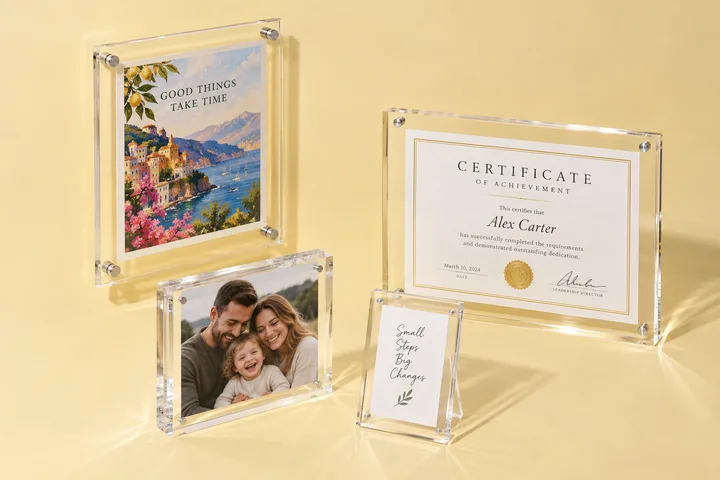
- Certificate frames: a clear front with a fluorescent border or back panel, bonded or held with standoffs. The frame is sized to the certificate first; see bulk acrylic frames and the certificate frame size guide.
- Small signs: laser-cut fluorescent letters or a fluorescent panel on a clear stand, for counters and events.
Our published frame reference uses clear sheet: an 8.5 × 11 in certificate frame in 5 mm clear acrylic with an engraved logo is from $8–16 each at 100 pieces, $5–11 at 500 and $4–9 at 5,000, FOB Shenzhen. A fluorescent version is quoted from your drawing once the sheet is confirmed.
What to send for a quote
A complete brief gets a quote within 24 hours. Include:
- Product type and a drawing or marked photo.
- Fluorescent color, or two acceptable options, and whether you need cast sheet.
- Size, thickness and which edges should glow.
- Names, logo files and the decoration method (engraving or printing).
- Quantity per design, destination and the event or delivery date.
Production starts at 100 pieces per design. The paid sample costs USD 200–500 depending on complexity, takes 3–5 days, is paid separately and is never credited to production. Production takes 15–20 days after the sample is approved.
Footnotes
-
Luminescent solar concentrator — Wikipedia — explains how fluorescent dyes in a transparent plate absorb light on the face and re-emit it, and states that about 75–80% of the luminescence can be trapped by total internal reflection and carried to the edges. ↩
-
PLEXIGLAS GS / XT — Röhm — the sheet maker’s product page listing fluorescent Yellow 1C50, Orange 2C01, Red 3C02 and Green 6C02 among its cast PLEXIGLAS GS colors. ↩
Frequently Asked Questions
Why do the edges of fluorescent acrylic glow?
The fluorescent dye absorbs light that falls on the face and re-emits it at a longer wavelength. Much of that re-emitted light is trapped inside the sheet by internal reflection and travels to the cut edges, so polished edges look brighter than the face.
Which fluorescent colors can you make awards and frames in?
Fluorescent sheet is made in several colors, most often yellow, orange, red, pink and green. Which colors are available in your thickness, and whether the sheet is cast or extruded, is confirmed on your quote and approved on the paid sample.
Can fluorescent acrylic be used outdoors?
Plan it as an indoor material. Fluorescent color can fade faster than standard colored sheet in direct sun, and ratings vary by sheet maker. If a sign will face the sun, tell us at the RFQ so the sheet's outdoor rating is checked before quoting.
Can you engrave or print on fluorescent acrylic?
Yes. Laser engraving, UV printing and screen printing all work on fluorescent sheet. Engraved lines catch the glow like an edge does, so engraved text often reads brighter than printed text on the same piece.
What is the minimum order for fluorescent acrylic awards or frames?
Production starts at 100 pieces per design. A paid pre-production sample costs USD 200–500 depending on complexity, takes 3–5 days, is paid separately and is never credited to production.
Send Your Fluorescent Award or Frame Brief
Attach the drawing or a marked photo, the color you want, size, thickness, quantity per design and destination. We reply within 24 hours and confirm the available fluorescent sheet on the quote.