


Blind Drop Shipping Custom Acrylic to Your Client
Your client should receive your product, not a factory's parcel. For custom work that takes a few decisions before the order runs, not after it ships.
Need this made?Custom acrylic fabrication services →
This guide is for resellers, print shops and promotional distributors who sell custom acrylic under their own name and want it delivered straight to their client.
Key Takeaways
- Drop shipping means the factory ships straight to your client; blind drop shipping also keeps the factory's identity out of the box and off the label.
- Custom orders add steps a stock drop ship does not have: the sample, the proof and the approval all run through you before production.
- Agree the carton markings, the packing list and the return details before production, because they are part of the packing spec.
- Customs paperwork is not the same as the packing list; the importer of record pays the duties, so decide who that is before choosing DDP.
- Split deliveries to several client addresses are planned at the RFQ, with one packing list per address.
On this page
Blind drop shipping versus drop shipping
Blind drop shipping means the manufacturer ships directly to your client and keeps its own identity out of the parcel: no factory branding, invoice or return address that points back to the source. Plain drop shipping only means the goods skip your warehouse. Both are common for resellers and distributors who sell under their own name.
The terms come from retail. Drop shipping is a form of retail in which the seller takes orders without holding stock and passes them to a manufacturer or wholesaler, which ships directly to the customer. Blind shipping sends the goods without a return address that identifies the supplier.1 For custom acrylic, the same idea applies to a production order instead of a catalog item.
Resellers ask for it for two reasons. Their client relationship is the business, and the client should see one supplier. And shipping twice, factory to reseller to client, adds freight, handling and time.
What a custom order adds before it ships
A custom drop-shipped order has steps that a stock drop ship never has: a proof, a paid sample and a written approval. All three run through you, the reseller, before production starts. Your client sees what you choose to show them, and the factory works only from your approval.
The usual order of steps:
- You send the drawing or artwork, quantity per design and delivery plan.
- We quote and prepare a proof for your approval.
- The paid sample ships to you, or to your client if you choose. It costs USD 200–500 depending on complexity, takes 3–5 days to make, is paid separately and is never credited to production.
- You approve in writing, and production runs for 15–20 days.
- Finished goods are inspected against the approved sample and packed to the agreed spec.
The reseller proof approval guide covers how to run approvals with a client who is not in the conversation with the factory.
Cartons, packing lists and labels
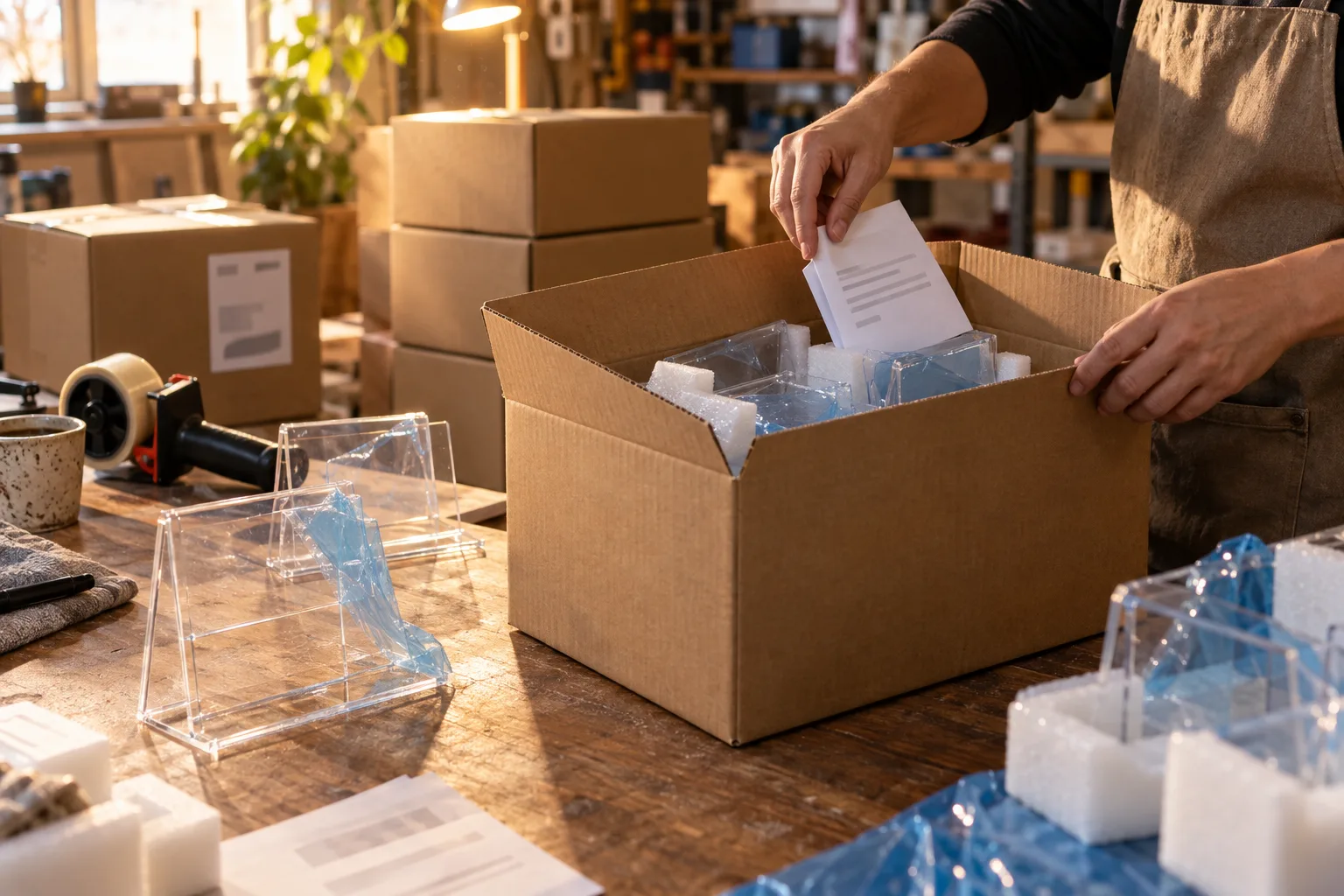
Agree how the shipment looks before production, because the markings are part of the packing spec, not a last-minute request. Decide what is printed on the outer cartons, what document goes inside, and whose details appear on the shipping label and as the return address.
Points to settle for each order:
| Item | Question to answer |
|---|---|
| Outer carton | Plain, or marked with your brand or your client’s? |
| Unit packaging | Plain bag or box, or your own printed packaging? |
| Packing list inside | Your packing list, a neutral one, or none? |
| Shipping label | Sender name and return address to show |
| Price documents | Kept out of the carton? |
Our packing tiers include plain white or kraft individual boxes, and the packing guide explains the four tiers from OPP bag to fulfilment-ready. For blind shipments we use plain outer cartons with no Wetop branding, leave our invoice out of the box, and pack your packing list and apply your labels; the exact markings go into the packing spec on your quote before production.
Customs paperwork and DDP
The packing list in the carton and the customs paperwork are different documents. Customs entries need a commercial invoice and the details of the parties, and those travel with the shipping documents rather than inside the box. Decide who the exporter, the consignee and the importer of record are before choosing the shipping term.
Our default term is FOB Shenzhen, with Ex-Works, CIF and DDP also available. Under DDP, delivery is quoted with duties paid to the named place. In the US, entry is filed by the owner, purchaser or a licensed customs broker they designate, and the obligation to pay duty falls on the person or firm in whose name the entry is filed.2 So when the end client receives a DDP shipment, someone has to be that importer of record, and it should be agreed in writing.
The FOB vs DDP guide compares the two terms leg by leg. For drop-shipped orders, tell us the destination, who should appear as consignee and whether your client expects a duties-paid delivery, and we can deliver DDP straight to your client; the shipping term and importer of record are confirmed on the quote.
Several delivery addresses
Splitting one production order across several client addresses is planned at the RFQ. Each address gets its own cartons, its own packing list and its own label, and the quantity per address is fixed before packing. The production minimum still applies per design, not per address.
Send the split as a simple table: address, contact, quantity per design and any delivery window. Mixed designs per address are counted and packed design by design. Late changes to the split after packing usually mean repacking, so lock the table when you approve the sample.
What to send for a quote
A complete brief gets a quote within 24 hours. For a blind drop-shipped order, include:
- Product drawing or marked photo, artwork, quantity per design.
- Where the sample goes: you or your client.
- Delivery addresses and quantities per address.
- Carton, unit packaging and label markings you need.
- The document to go inside the carton, if any.
- Shipping term and who acts as importer of record at the destination.
We build from your drawing as a custom acrylic fabrication partner and ship to the addresses you name. For display programs going straight to your client’s stores, see our custom acrylic display stands.
Footnotes
-
Drop shipping — Wikipedia — defines drop shipping as a retailer passing orders to a manufacturer or wholesaler that ships directly to the customer, and describes blind shipping as sending goods without a return address that identifies the supplier. ↩
-
Importing into the United States — U.S. Customs and Border Protection — CBP’s guide for commercial importers, stating that entry is filed by the owner, purchaser or a licensed customs broker they designate, and that the obligation to pay duty is upon the person or firm in whose name the entry is filed. ↩
Frequently Asked Questions
What is the difference between drop shipping and blind drop shipping?
In drop shipping the manufacturer ships directly to your customer instead of to you. In blind drop shipping the parcel also carries no manufacturer branding or return address, so your customer sees only your name or a neutral sender.
Can a custom acrylic order ship straight to my client?
Yes. A production order can ship blind to the address you name: plain outer cartons with no Wetop branding, no Wetop invoice in the box, your own packing list and labels, and DDP delivery to your client when you need duties paid. The exact markings are fixed in the packing spec on your quote.
Who approves the sample on a drop-shipped custom order?
You do. The paid sample and any proof go to you, or to your client only if you choose. Production starts after your written approval, so your client never deals with the factory directly unless you want them to.
Does DDP mean my client pays no import duties?
Under DDP the seller arranges delivery with duties paid. The duties still have to be paid by whoever is the importer of record on the entry, so agree that role before quoting DDP to an end client.
What is the minimum order for a drop-shipped custom order?
The same as any custom order: 100 pieces per design. A paid sample costs USD 200–500 depending on complexity, is paid separately and is never credited to production.
Send Your Client Order and Delivery Plan
Attach the product drawing, quantity per design, delivery addresses and how cartons and paperwork should be marked. We reply within 24 hours with a quote and confirm the shipping terms.