




Retail Ready Packaging Manufacturer Packing Guide
The packing tier you spec decides freight cube, damage risk and whether your warehouse repacks a single unit, so spec it like a dimension, not a default.
Need this made?Custom acrylic fabrication services →
Key Takeaways
- Acrylic orders leave a factory in one of four packing tiers — per-unit OPP bag, individual box, retail-ready printed box, or fulfilment-ready DTC pack — and each step up trades carton cost for labor your warehouse no longer does.
- A per-unit OPP bag with foam dividers protects bulk display stands at the lowest freight cube; a plain individual box adds crush protection and a labeling surface, but in the worked example below it also adds roughly 40% cube over the bare part.
- Nesting drafted parts is the cheapest freight saving available at design time: ten 250 × 130 × 140 mm covers nest into one 17.4 L carton against 64.8 L individually boxed — 73% less cube before anyone negotiates a freight rate.
- Master cartons fill up on weight as often as volume: cast acrylic runs about 1.18 g/cm³, so a carton of solid blocks reaches a sensible lifting weight long before it looks full.
- Damage risk follows the incoterm and the tier: under FOB Shenzhen the factory owns the goods through loading, and a fulfilment-ready pack must survive the parcel network — the leg that ISTA 3-Series testing simulates.
On this page
- Packing is a spec line, not a shipping afterthought
- The four packing tiers, from OPP bag to fulfilment-ready
- Foam, corners, and dividers: the protection stack inside the tier
- Nesting: design the parts to share cube
- Master-carton math: a worked example
- Small orders: carton size sets the air freight bill
- Who owns damage risk at each tier
- How to spec packing on your RFQ
Packing is a spec line, not a shipping afterthought
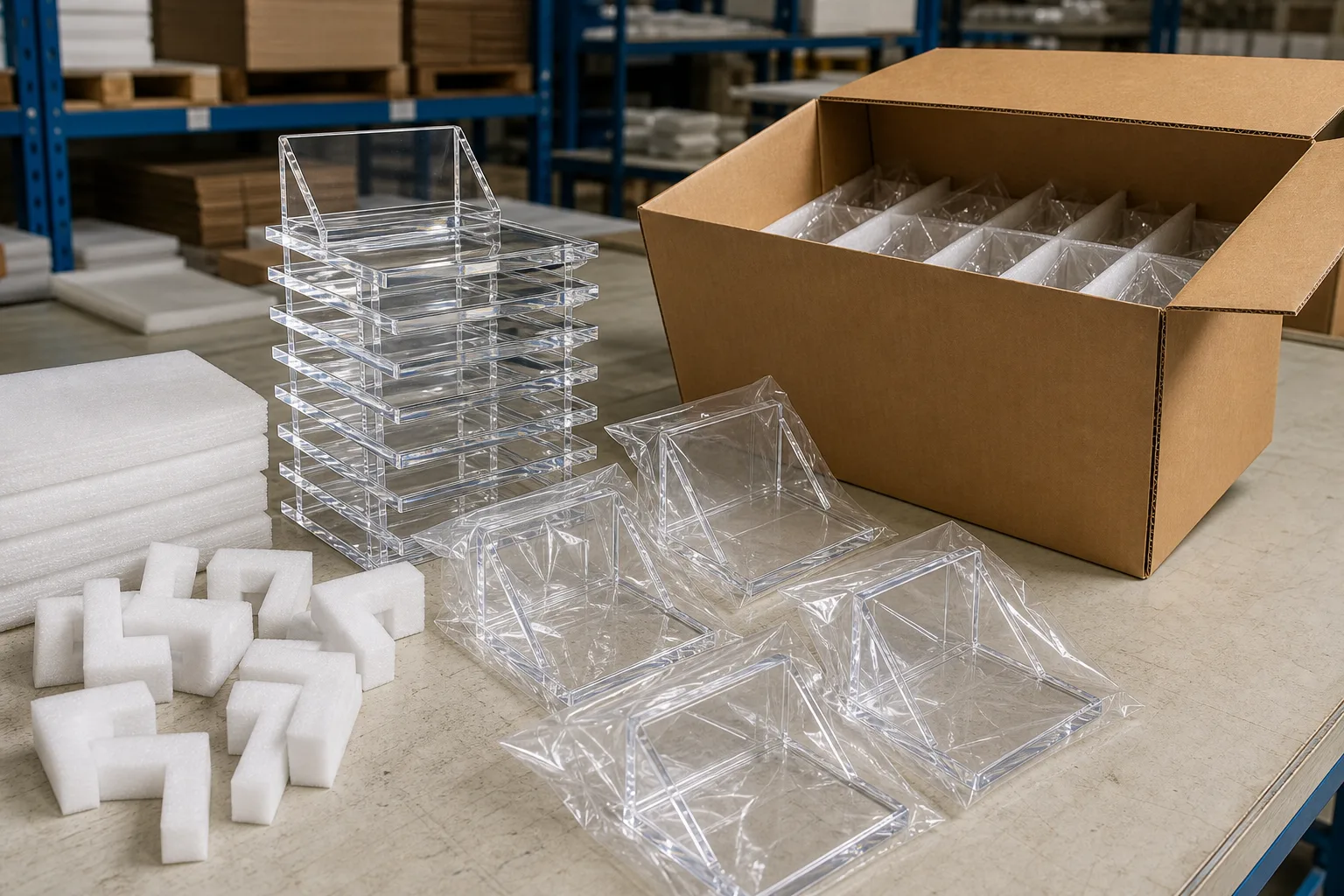
Stand at the packing bench at the end of our line for ten minutes and you can read each order’s destination without opening the paperwork. One stack of acrylic display stands is going into OPP bags, twenty to a foam-divided carton: a reseller’s warehouse. Beside it, printed boxes with die-cut inserts wait for units headed straight to store shelves — the bench where a retail ready packaging manufacturer earns the phrase. At the far end sit single parcels padded to cross a courier network alone; a DTC brand’s 3PL will ship those exactly as we sealed them.
Those are three of the four packing tiers every acrylic order leaves in: per-unit OPP bag, individual plain box, retail-ready printed box, and fulfilment-ready DTC pack. The tier is a spec decision with the same weight as material or edge finish, because it sets four numbers at once — the packing cost per unit, the freight cube, the damage risk on each leg of the journey, and the hours a receiving team spends repacking after arrival.
Most RFQs I see specify the acrylic to the half millimeter and leave packing as a single word: “export packing.” That works, and our default export standard below is genuinely protective. But since 2014, I have watched far more transit damage trace back to a mismatched tier than to too little foam — and buyers who spec the tier deliberately routinely ship the same product for less, or land it closer to shelf-ready, than buyers who take the default. This guide walks the bench end to end: the four tiers, the protection inside them, nesting, master-carton math, and who owns the damage risk at each step.
The four packing tiers, from OPP bag to fulfilment-ready
The four tiers form a ladder: each step up adds packaging material and factory labor, and removes handling work at your end. Per-unit OPP bags suit bulk restocks into your own warehouse; individual boxes add crush protection and a labeling surface; retail-ready boxes go straight to shelf; fulfilment-ready packs go straight to a parcel courier without being opened.
| Tier | What each unit gets | Best for | At the destination |
|---|---|---|---|
| Per-unit OPP bag | Clear OPP bag or PE foam sleeve; foam dividers between units in the master carton | Bulk restock to one warehouse; lowest freight cube | Staff unbag and merchandise each unit |
| Individual box | Plain white or kraft box, foam or paper insert, optional SKU label | Mixed-SKU orders; storage before rollout; resale in plain packaging | Boxes shelved or forwarded as-is |
| Retail-ready box | Printed, die-cut product box with insert; barcode on the box | Units sold or displayed in their own packaging | Straight from master carton to shelf |
| Fulfilment-ready pack | Parcel-grade box, protective void fill, ready for a shipping label | DTC brands using a 3PL; single-unit reshipment | 3PL applies a label and ships — no repack |
Two details from our bench that rarely appear on quotes. First, hardware never travels loose: hooks, screws, magnets, or spare pads go into a separate accessory bag inside the master carton, so nothing metallic rides against a polished face. Second, the tiers can be mixed in one order — we have packed the same SKU with 80% in bulk OPP bags for a warehouse and 20% retail-ready for a launch wall, on one purchase order. Worth remembering if your launch and your restock ship together.
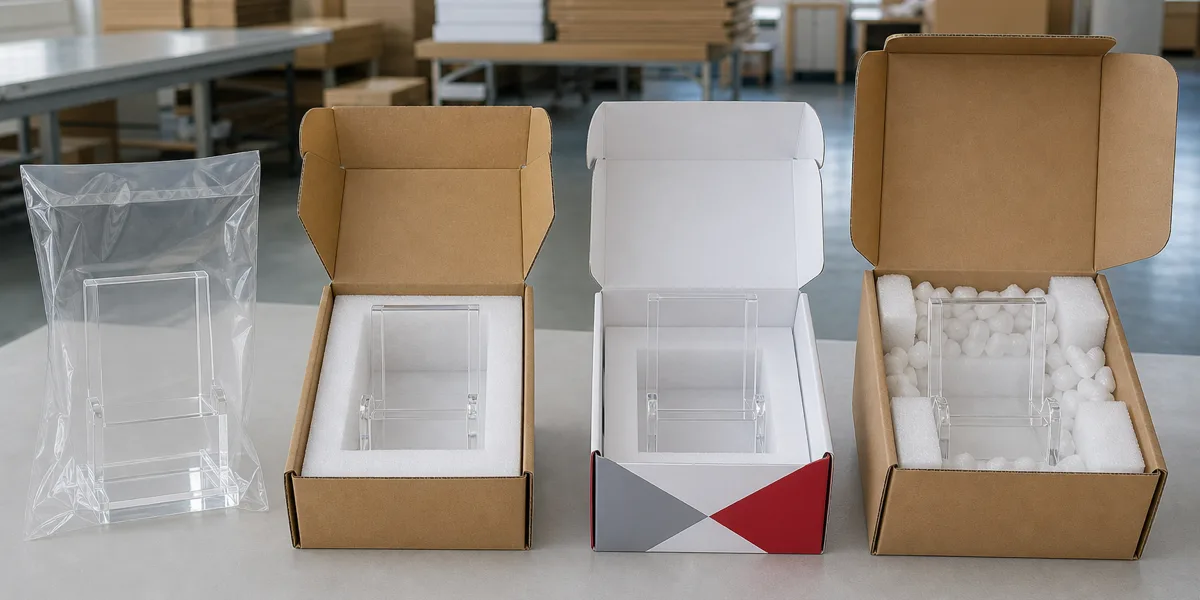
The upper tiers blur into product design. When a printed launch box includes a fitted insert, packaging becomes part of the product specification. The custom acrylic packaging insert project covers buyer-approved fit, restraint, outer-package relationship, carton orientation, and test scope. A fulfilment-ready pack also needs the buyer or 3PL to approve labels, opening sequence, packing orientation, and any space reserved for components added after production.
One honest caveat on the top tier: fulfilment-ready only pays when it is designed in from the start. Factory filler chosen for a 20-unit export carton is not automatically right for a single parcel bounced through automated sortation — if your plan is direct-to-customer shipping, tell us at the RFQ and we pad each unit for that journey, not for the group carton.
Foam, corners, and dividers: the protection stack inside the tier
Whatever tier you choose, the inside of the master carton follows one standard: every piece individually wrapped in PE foam or bubble film, foam dividers between pieces, and a double-wall corrugated outer carton sized to leave 50–80 mm of foam on all six sides of the load. Corners and edges take the extra care, because that is where acrylic actually fails in transit.
A polished acrylic panel almost never cracks across its face inside a properly filled carton — the failure mode is a chipped corner or a bruised edge from a point impact. So corner protectors go on before anything else on fragile builds, and fragile assemblies — large cases, thin frames, mirror-finish pieces — also carry FRAGILE / THIS SIDE UP marks on every face of the outer carton. Dividers matter as much as wrap: two wrapped pieces that can touch under vibration will polish each other’s film through and haze the contact point on a long enough journey.
The one layer this guide deliberately does not cover is the masking film on the acrylic surface itself. Film is its own spec — adhesion grade, dwell time, peel behavior — and choosing it badly creates residue problems that have nothing to do with cartons; our acrylic protective film guide owns that decision. Here, film is simply the first wrap the packing bench receives, already applied.
I check one thing on every protection spec before it goes to the bench: the loaded weight. Wrap and dividers are dimensioned for the piece, but the carton is dimensioned for the stack — and acrylic is heavier than most buyers expect, which is where the next two sections start.
Nesting: design the parts to share cube
Nesting means shaping parts so they stack into each other’s empty space — the way paper cups share a sleeve — and it is the cheapest freight saving in the whole spec, because it is decided at design time and costs nothing per unit afterward. Covers, trays, risers, and open-bottom cases are all candidates; solid blocks and closed boxes are not.
The geometry is simple: a part nests when its walls carry a few degrees of draft, so each piece settles over the one below until wall meets wall. Wall thickness plus the clearance you allow sets the stack pitch — the vertical distance each added piece contributes. On the worked example in the next section, a 140 mm tall cover with 3 mm walls and roughly a millimeter of clearance nests at a 30 mm pitch: ten covers stand 410 mm tall instead of 1,400 mm end to end.
Nesting has costs, and I would rather list them here than have a buyer discover them at the sample stage. The draft angle must exist in the design — a dead-vertical wall cannot nest — and drafted walls change how a piece reads on a shelf, so the first question I ask is who owns the aesthetics. Nested faces also ride close together, so every interface gets an interleaf sheet, and printed or engraved faces need the clearance sized so decoration never bears load. When you ask us to quote a nested design, the intake list is short: your material and wall thickness, the print method, the nesting clearance your design can accept, and the quantity per tier.
Weight is the quiet constraint that decides how far nesting can go. Cast acrylic runs about 1.18 g/cm³1 — denser than water — so cube is only half the packing problem. The example cover carries just under half a kilogram of material, and ten nested covers make a comfortable 5–6 kg carton. Solid pieces flip that math: fifty small solid display blocks of 400 cm³ each come to roughly 23 kg before the carton is a third full of air, which is why we cap carton counts by gross weight as often as by volume.
Master-carton math: a worked example
Here is the arithmetic on one real geometry, a 250 × 130 × 140 mm drafted acrylic cover with 3 mm walls. Individually boxed in a 270 × 150 × 160 mm carton, each unit occupies 6.48 liters; ten units, 64.8 liters. Nested at a 30 mm pitch, the same ten covers fill one 270 × 150 × 430 mm master carton — 17.4 liters, a 73% cube reduction. I drew both cartons below at one scale and with the same 150 mm depth on purpose, so the areas on the page compare true volume.
Scale that to an order and the tier decision turns into freight money. A thousand covers individually boxed claim 6.48 CBM of LCL space; nested, 1.74 CBM — and LCL ocean freight is billed by exactly that cubic meter. Against a 20-foot container’s 33.2 m³ of cubic capacity2, the boxed version of a large program starts crowding the container years before the nested version does. The individual box also carries its own overhead worth naming: the bare cover bounds 4.55 liters, so the plain box alone adds roughly 40% cube before the master carton is even chosen.
None of this means nesting always wins. The same ten covers retail-ready — each in a printed box — deliberately spend that cube to arrive shelf-ready, and for a launch program that trade is usually correct. The point of the math is that it should be a decision you make at the RFQ, with the CBM difference in front of you, not a discovery on the freight invoice.
Small orders: carton size sets the air freight bill
On a small order the packing choice moves the freight bill more than it does on a container load, because small shipments usually fly. Air and courier freight is charged on chargeable weight: the greater of the actual gross weight and the dimensional weight worked out from the carton size. Light, bulky acrylic cartons are billed on their size.
The rule is industry-wide. Dimensional (volumetric) weight is the length × width × height of the carton divided by a carrier divisor, and the carrier bills whichever is greater, that or the actual weight; international air freight commonly uses 6,000 cm³ per kilogram and the express couriers 5,000.3 A lower divisor means a higher billed weight for the same carton, so a courier quote and an air-cargo quote on the same cartons can bill different weights.
Run the ten covers from the worked example above through it. Individually boxed, the ten 270 × 150 × 160 mm cartons total 64,800 cm³, which is 10.8 kg of dimensional weight at 6,000, while the covers themselves weigh just under 5 kg. The air bill is set by the boxes. Nested in the one 270 × 150 × 430 mm master carton, the dimensional weight drops to about 2.9 kg, so the actual 5–6 kg gross weight becomes the billed weight. Same product, roughly half the chargeable weight, before anyone negotiates a rate.
Three things follow for a small batch:
- Ask for the carton plan with the quote. Carton count, per-carton dimensions and gross weight are the inputs every forwarder and courier needs; without them an air estimate is a guess.
- Choose the packing tier with the freight mode in mind. Individual retail boxes are worth their cube when each unit ships on to a consumer; for a launch quantity that flies to one warehouse, bulk packing or nesting keeps the billed weight down.
- Decide the mode and the term together. Whether a small order should fly or sail, and whether to buy it FOB or delivered duty paid, is covered in the FOB vs DDP guide. Remember that FOB is a sea term, so an air shipment is quoted on a carrier or delivered term instead.
Who owns damage risk at each tier
Damage responsibility follows two lines: the shipping term, which fixes where ownership transfers, and the packing tier, which fixes which journey the pack must survive. Under FOB Shenzhen — our default term — we own the goods until they are loaded for export; the ocean or air leg then runs under the buyer’s forwarder and cargo insurance.
The terms move that line, not the physics. EXW hands risk over at our door; CIF and DDP keep the supplier responsible deeper into the journey — the full decision framework lives in our FOB vs DDP guide. What the packing tier changes is the journey itself. A master carton on a pallet in a container rides one environment. A fulfilment-ready parcel rides a much rougher one — belt sorters, chutes, and van stacks — which is why the parcel world has its own simulation standards: ISTA’s 3-Series tests exist to reproduce the damage-producing motions and forces of exactly that distribution environment4. A pack that was engineered for the group carton has simply never been asked the question a single parcel gets asked several times a day.
Our job at the bench is to make the handoff auditable. Every piece passes 100% inspection before packing, fragile builds get a plain drop-check on a packed sample carton, and we photograph packed cartons before sealing — so if a claim ever arises, both sides can tell factory damage from transit damage in minutes instead of emails. On fulfilment-ready programs we also recommend your 3PL receives one advance sample parcel: the cheapest possible test of the exact box their label will go on.
How to spec packing on your RFQ
A complete packing spec is seven lines, and it takes five minutes to write into the same RFQ that carries the part dimensions. Here is the list I wish every incoming inquiry included:
- Tier — bulk OPP bag, individual box, retail-ready, or fulfilment-ready (mixes welcome, state the split)
- Inner quantity — units per inner box, if any
- Master quantity — units per master carton, or “factory optimal”
- Carton cap — any gross-weight or dimension limit the receiving dock or 3PL enforces
- Marks — carton labeling, barcodes, SKU codes, side marks
- Destination type — own warehouse, retail DC, or 3PL, and the country
- Nesting — whether the design may be drafted to nest, and the acceptable clearance
Everything else stays on our side of the bench: dividers, foam allowance, corner protection, and carton board grade are ours to engineer to the standard above, and they ride on the same schedule as the parts — samples in 3–5 days, production in 15–20 days, from our 100-piece MOQ. The packed sample is part of the approval: we send photos of the packed carton, not just the part, before bulk packing starts.
Put the packing tier on the RFQ next to material and finish, and the quote comes back with it engineered in rather than bolted on afterward. Destination still moving — a launch that might go retail-ready, a warehouse program that might add a DTC channel? Say that in the message and we price two tiers side by side, with the CBM and cost difference made explicit. Send the spec either way.
Footnotes
-
PMMA (Acrylic) — properties and typical values, AZoM — materials database entry listing cast acrylic density at 1.18 g/cm³, the figure behind the carton gross-weight arithmetic in the nesting section. ↩
-
Dry container dimensions and capacity — DSV — carrier reference table showing a 20 ft dry container at 33.2 m³ cubic capacity (40 ft: 67.7 m³), the baseline for the CBM comparison in the master-carton example. ↩
-
Dimensional weight — Wikipedia — defines dimensional (volumetric) weight as an estimated weight calculated from a package’s dimensions, states that the fee is based on the dimensional or actual weight, whichever is greater, and lists common divisors (6,000 cm³/kg for international air freight, 5,000 cm³/kg for FedEx/UPS international and DHL). ↩
-
ISTA test procedures — International Safe Transit Association — index of packaged-product transit tests; the 3-Series general simulation tests reproduce the damage-producing motions, forces, and sequences of transport distribution environments, with procedure 3A covering individually shipped parcels — the leg referenced in the damage-risk section. ↩
Frequently Asked Questions
Can acrylic displays be individually wrapped without individual boxes?
Yes — that is our standard bulk tier. Each display goes into its own OPP bag or PE foam sleeve, pieces are separated by foam dividers inside a double-wall master carton, and the carton is sized to leave 50–80 mm of foam around the load. Hardware like hooks or screws travels in a separate accessory bag inside the same carton. It is the lowest-freight-cube option and the right choice when the whole order lands at one warehouse and your own team merchandises the units.
Can each acrylic unit ship in its own retail-ready box?
Yes. We print and die-cut individual product boxes so each unit can go from the master carton straight to a shelf or straight into a reshipment. To quote it we need your box artwork or logo files, any barcode or SKU that must appear on the box, and the destination type. The box can also be upsized on request — for example, leaving clearance for a base or component you add on your side before the unit reaches the end customer.
Can custom acrylic pieces be nested to reduce shipping volume?
Often, yes — if nesting is designed in before production. Parts need drafted walls so one piece settles into or over the next; wall thickness plus a small clearance sets the stack pitch. In our worked example, ten 250 × 130 × 140 mm covers nest at a 30 mm pitch into a single 17.4 L carton instead of 64.8 L individually boxed. To quote a nested design we need the material and thickness, the print method, the nesting clearance you can accept, and quantities per tier.
What protection goes inside an acrylic master carton?
Our standard: each piece individually wrapped in PE foam or bubble film, foam dividers between pieces, and a double-wall corrugated outer carton sized to allow 50–80 mm of foam on all six sides. Fragile assemblies — large cases, thin frames, mirror-finish pieces — get added corner protection and FRAGILE / THIS SIDE UP marks on every face. Protective masking film on the acrylic surface itself is a separate spec from the packing tier.
Who is responsible if an acrylic order arrives damaged in transit?
It depends on the shipping term. Under FOB Shenzhen — our default — we own the goods until they are loaded for export; after that the freight leg runs under your forwarder and your cargo insurance. Under DDP the supplier carries the goods much further; under EXW you take over at the factory door. Whatever the term, we photograph packed cartons and inspect 100% of pieces before sealing, so both sides can tell factory damage from transit damage.
Want the packing spec quoted with the parts?
Tell us where the order lands — bulk warehouse, retail shelf, or a 3PL shipping direct to customers — and we'll quote the packing tier alongside the parts: carton dimensions, gross weights, and photos of the packed sample before anything ships.