Acrylic Box Lid Types: 7 Closures & What Each Costs
Most box RFQs name a size and a color and stop there.
Need this made?Custom acrylic boxes →
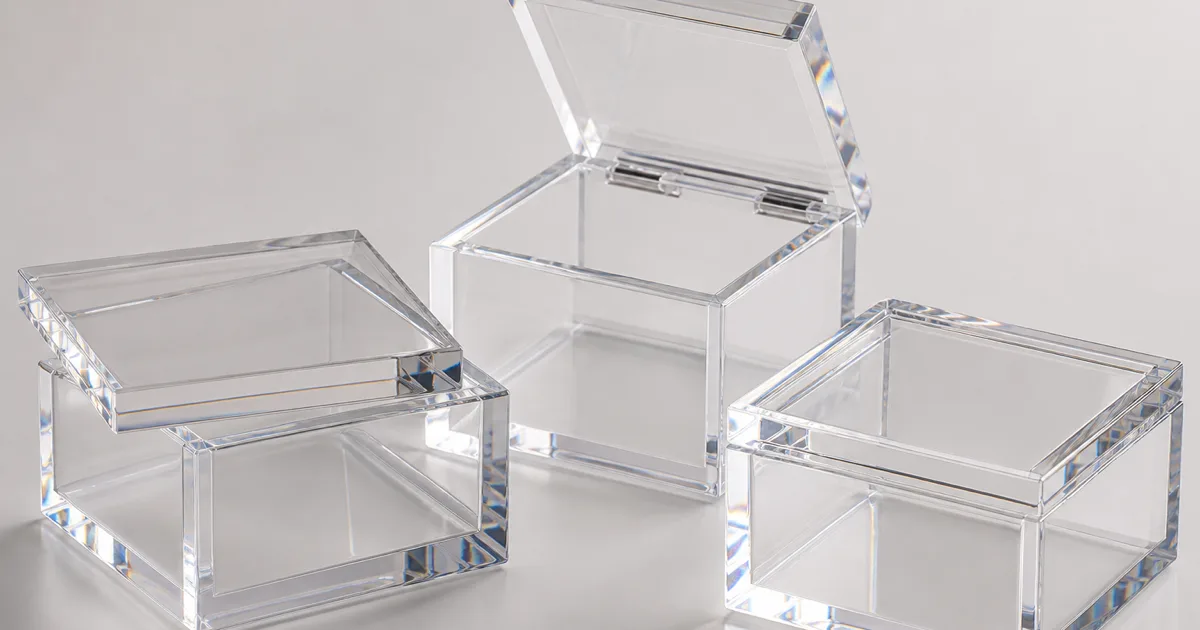
The line that actually moves your quote is how the lid stays on — and buyers guess wrong on the cost of it.
Key Takeaways
- The closure type — not the box size — is usually the single biggest swing on an acrylic box with lid quote, because a hinge, a lock, or a gasket each adds hardware plus assembly labor a plain lift-off lid never touches.
- A hinged acrylic box does cost more than a separate lift-off lid: the hinge is added hardware and a bonding/assembly step, whereas a lift-off lid is just a second cut part with no attachment labor.
- Acrylic cannot form a true one-piece living hinge — PMMA is brittle and cracks under repeated flexing — so an acrylic 'hinged' box means a bonded metal or plastic hinge, which is why it carries real hardware cost.
- Magnetic closures use embedded neodymium magnets (grades like N42–N52) that must be inset and bonded during assembly; higher pull force means a larger or higher-grade magnet, and that hardware-plus-labor cost is invisible in a photo but real in the quote.
- Lockable closures (hasp for a padlock, or a keyed cam-lock) are the right call for ballot, donation, and secure-display boxes; the lock body and its cutout add the most hardware and fitting labor of any common closure.
On this page
- The short answer — how the lid stays on drives the cost
- The seven closure types at a glance
- Lift-off (loose) lid — the lowest-cost default
- Telescoping (shoe-box) lid — clean look, low cost
- Snap / friction-fit — stays shut, opens by hand
- Hinged lid — and the living-hinge question every buyer asks
- Magnetic (neodymium) closure — the clean premium look
- Lockable (hasp / cam-lock) — for security, ballots, and donations
- Gasket / sealed lid — dust-tight and splash-resistant
- How to choose — three questions that pick the closure
- How we sourced the closure facts in this guide
The short answer — how the lid stays on drives the cost
Acrylic box lid types come down to seven common closures — lift-off, telescoping, hinged, snap/friction-fit, magnetic, lockable, and gasket-sealed — and the closure you pick is usually the single biggest cost swing on the whole quote. A plain lift-off lid is just a second cut part. Every other closure adds hardware, a tighter tolerance, or an assembly step on top of that. Pick the closure to the job, and the price follows.
I’ve watched this play out on hundreds of box RFQs since 2008. A buyer specifies dimensions, clarity, and maybe a print — then defaults to whatever lid is cheapest, or asks for a hinge because it “feels” premium, without knowing that the hinge is what just moved their per-unit cost more than a millimeter of wall thickness would. This guide walks all seven acrylic box lid types the way I walk a first-time buyer through them: what each one is for, and the honest cost driver behind it, so you can spec the right lid before you ask anyone to quote it.
The seven closure types at a glance
Each of the acrylic box lid types maps to a use-case and a relative cost, and the cost almost always tracks how much hardware and assembly labor the closure adds on top of a plain cut lid. The matrix below is the fast version — match your use-case to the closure, read the relative cost, then jump to the section that explains the tradeoff.
| Closure | Best use-case | What drives its cost | Relative cost |
|---|---|---|---|
| Lift-off (loose) lid | Retail display, simple storage, frequent full-open access | Just a second cut part — no attachment | Lowest |
| Telescoping (shoe-box) lid | Premium retail, gift presentation, dust cover | Tighter tolerance on the overlapping walls | Low |
| Snap / friction-fit | Small parts, samples, boxes opened often but must stay shut | Precise lip/groove geometry, tight tolerance | Low–medium |
| Hinged (bonded hinge) | Reusable boxes, display cases opened from one edge | Hinge hardware + alignment and bonding labor | Medium–high |
| Magnetic (neodymium) | Unboxing/gift, clean no-hardware look, repeated open/close | Embedded magnets + inset and bonding labor | Medium–high |
| Lockable (hasp / cam-lock) | Ballot, donation, secure display, controlled access | Lock body + cutout and fitting labor | Highest |
| Gasket / sealed | Dust-tight or splash-resistant protection | Seal channel + gasket material + fitting | Medium–high |
The pattern to read here: the three cheapest closures (lift-off, telescoping, snap) add no hardware — they’re won or lost on cut accuracy and tolerance. The four that cost more (hinged, magnetic, lockable, sealed) each bolt something onto the box and pay someone to fit it. That single distinction — does the closure add hardware and assembly, or just a tighter cut — is the whole cost story, and it’s the thing most RFQs leave unspecified.
Lift-off (loose) lid — the lowest-cost default
A lift-off lid is a separate top panel that rests over the box walls with no attachment — the simplest, cheapest closure there is. It’s the right call whenever the box is a display or storage container that gets fully opened, the contents don’t need a locked or sealed top, and you want the lowest per-unit cost. Most retail display boxes and plain storage boxes ship this way.
The cost story is short because there’s almost nothing to it. A lift-off lid is just a second cut part — the same material, the same edge finishing, no hinge, no magnet, no lock, and critically, no assembly labor to attach anything. That’s why it’s the baseline every other closure gets priced against. When a buyer asks me why a hinged version of the same box costs more, this is the honest anchor: the hinge is added to what a lift-off lid already is. The one thing to get right is the lid-to-wall fit. Too loose and it slides off in handling; too tight and the buyer fights it. For a straight loose lid we build a small clearance so it seats cleanly without binding, and if the box needs to stay shut in transit, that’s the signal to step up to a friction-fit or telescoping design rather than over-tightening a loose lid.
Telescoping (shoe-box) lid — clean look, low cost
A telescoping lid is an outer cap whose walls slide down over the outside of the box walls, like a shoe-box top — it reads premium, holds itself in place, and costs only slightly more than a plain lift-off lid. It’s the closure I recommend most often when a buyer wants a clean gift or retail presentation without paying for hardware. The overlapping walls hide the seam line, give the box a finished silhouette, and keep the lid from sliding off on their own.
What drives the small cost step over a loose lid is tolerance, not hardware. The lid walls have to overlap the box walls closely enough to grip and align but loosely enough to slide on and off without scuffing — that’s a tighter fit to cut and check than a flat loose lid, but it adds no magnet, hinge, or lock. For a dust-cover or a premium unboxing where you want the lid to feel deliberate as it settles, telescoping is usually the best value on the whole menu: most of the premium look of a magnetic or hinged box, at close to lift-off cost. If you’re weighing a telescoping cover against a fully separate hinged display case, our clear acrylic box vs lidded display case comparison walks through where each structure wins.
Snap / friction-fit — stays shut, opens by hand
A snap or friction-fit closure holds the lid shut through a precise lip-and-groove or interference fit, so the box stays closed in handling but still opens by hand without hardware. It’s the right choice for small-parts boxes, sample boxes, and anything that gets opened often but must not fall open in a bag or on a shelf. The lid clicks or presses into place and holds by the geometry alone.
The cost sits just above a telescoping lid because the closing geometry has to be cut to a tight, repeatable tolerance — a lip that’s too shallow won’t hold, one that’s too deep cracks the acrylic on the way in, since PMMA is rigid and doesn’t forgive an over-tight press fit. There’s no added hardware, so the premium is all in cut precision and sample validation. This is a closure I always push to prove on a physical sample before bulk, because “snug enough to stay shut, easy enough to open” is a feel you can’t confirm from a drawing. On any friction-fit box the sample stage earns its keep — approve the click, then run the order.
Hinged lid — and the living-hinge question every buyer asks
A hinged acrylic box opens on a hinge fixed to one edge, and it costs more than a plain lift-off lid because the hinge is added hardware plus the labor to align and bond it during assembly. It’s the right call for reusable boxes and display cases that get opened from a single edge repeatedly, where a loose lid would be lost or fumbled. The tradeoff is straightforward: you gain a captive, one-motion open, and you pay for the hinge and the fitting.
Here’s the part buyers get wrong, and it’s the most common closure question I field: acrylic cannot form a true one-piece living hinge. A living hinge — the flexible molded web on a polypropylene box that bends without breaking — needs a ductile plastic. Polypropylene and polyethylene are the standard living-hinge materials precisely because they resist fatigue and can flex millions of times.1 Cast acrylic (PMMA) is the opposite: a rigid, brittle thermoplastic that cracks under repeated flexing.2 So when you order a “hinged acrylic box,” what you’re getting is a bonded hinge — a small metal or plastic hinge fixed across the lid-to-body joint. Even hinge makers who use acrylic build it as the rigid wing and put a separate flexible membrane in as the actual hinge.1 That’s why the hinge is real hardware with real cost: it’s a discrete part someone has to source, position, and bond square so the lid tracks true.
On the exact cost question — does a hinged box cost more than a separate lift-off lid? Yes, and now the reason is concrete. A lift-off lid is one extra cut part with zero attachment labor. A hinged lid is that same lid plus a hinge (hardware) plus the assembly time to align and bond it accurately. Two cost lines get added that a loose lid never touches. The size of the premium depends on hinge quality and box dimensions — a small jewelry box with a tiny hinge adds less than a large display case with a piano-style hinge — but the direction is never in doubt. If your use-case doesn’t truly need a captive lid, a telescoping or friction-fit lid gives you a stays-put closure for less. When it does need the hinge, spec it knowing you’re buying hardware, not a flexed piece of acrylic.
Magnetic (neodymium) closure — the clean premium look
A magnetic acrylic box closes with small neodymium magnets embedded in the lid and body, pulling shut with no visible hardware — the closure that reads most premium for gift and unboxing programs. It’s the right pick when you want a lid that snaps closed cleanly, opens with a light pull, and keeps the box’s clarity uninterrupted by a hinge or lock. Buyers reaching for a high-end retail or corporate-gift feel land here often.
The cost driver is hardware you can’t see in the photo: rare-earth magnets that have to be inset into the acrylic and bonded during assembly. Magnet strength is graded, and the grade sets both the pull and the cost — an N52 magnet carries a higher residual flux density (around 14,500 Gauss) than an N35 (around 11,700), and delivers meaningfully more holding force at the same size.3 More pull means a larger or higher-grade magnet, and every magnet is a pocket to machine, a part to place, and a bond to cure. So a magnetic box carries a medium-to-high closure premium — modest for a light single-magnet catch, higher for a big lid that needs several strong magnets to close with authority. The spec question I ask buyers is how heavy and how frequent the open/close is: a light gift lid needs far less magnet than a display box lid you want to thunk shut a hundred times a day. Match the magnet to that, not to “as strong as possible,” and you don’t overpay for pull you’ll never feel.
Lockable (hasp / cam-lock) — for security, ballots, and donations
A lockable acrylic box uses either a hasp that accepts a standard padlock or a keyed cam-lock built into the lid, and it carries the highest closure cost because the lock body plus its cutout and fitting add the most hardware and labor of any common closure. It’s the right — and often only — choice when the box must resist casual opening: ballot boxes, donation and collection boxes, suggestion boxes, and secure display cases where the contents need controlled access.
The two mechanisms suit different needs. A hasp is a metal loop-and-staple fixed across the lid seam that closes with any padlock the buyer supplies — flexible, replaceable, and familiar to anyone running an election or a fundraiser. A cam-lock is a keyed cylinder set into the acrylic that rotates a small cam behind the wall to latch the lid — cleaner-looking and self-contained, with no dangling padlock, but keyed to a specific lock. Either way the cost is real: the lock is sourced hardware, and seating it means a precise cutout in the acrylic (cut wrong, the panel cracks or the lock wobbles) plus the assembly labor to fit and test it. That’s why a lockable box sits at the top of the closure-cost menu. If security is the actual requirement — a clear box people can see into but not open — this is the closure that delivers it, and it’s worth the premium because no cheaper closure does the job. We build these routinely as acrylic ballot and donation boxes with the lock fitted and inspected before ship. The same lock option applies to a wedding acrylic ballot and card boxes, where gift envelopes sit in the box through the reception.
Gasket / sealed lid — dust-tight and splash-resistant
A gasket or sealed lid adds a seal — typically a soft gasket seated in a channel around the rim — so the closed box resists dust ingress and light splashing. It’s the right closure only when the contents genuinely need that protection: archival items, sensitive electronics, dry goods that must stay particle-free, or a display where airborne dust would spoil the look over time. For ordinary retail, display, or storage, it’s cost you don’t need.
The cost comes from three added elements: a seal channel machined or built into the rim, the gasket material itself, and the labor to fit and seat it so it actually seals. None of that exists on a plain lid, which is why a sealed box lands in the medium-to-high band. The engineering caution I give buyers: define what you’re sealing against. A dust-tight seal for an archival display is a different (and lighter) build than a splash-resistant seal for a wet environment, and neither makes an acrylic box waterproof or airtight to a laboratory standard — that’s not what a bonded acrylic box with a gasket is for. Tell your fabricator the real threat (dust, the occasional splash, humidity) and the seal gets specified to that need instead of over-built. If dust protection is the whole reason you’re adding a lid, a snug telescoping cover already blocks most of it and may be all you need.
How to choose — three questions that pick the closure
Every closure decision comes down to how the lid needs to behave and how much you’re protecting against — and three questions settle it fast. Answer them before you send an RFQ and your quote comes back tighter, because the fabricator isn’t guessing at the one spec that moves the price most.
- Does the lid need to stay attached to the box? No — the box gets fully opened or the lid stored off → lift-off (cheapest) or telescoping (clean look, still cheap). Yes, captive on one edge → hinged (buy the hardware knowingly).
- Does it need to stay shut, and how premium should closing feel? Just needs to not fall open, opened by hand → snap/friction-fit. Wants a premium, hardware-free snap for gifting or unboxing → magnetic.
- Does it need to resist opening or protect the contents? Resist unauthorized opening (ballot, donation, secure) → lockable (hasp or cam-lock; highest cost, but the only closure that secures). Keep dust or splash out → gasket/sealed, specified to the real threat.
When the answers point one way, that’s your closure. When they split — say, a gift box you also want to lock — the tiebreaker is the requirement you can’t drop: security beats aesthetics, so it goes lockable. Notice too that closure interacts with wall thickness: a hinge or lock puts point loads on the panel it’s fixed to, so a thin wall that’s fine for a loose lid may need stepping up when you bolt hardware to it — the tradeoffs are in our acrylic box wall thickness guide. The boutique gift-box project shows how closure, finish, insert, artwork, and packing were defined as controlled inputs. Once you’ve landed on a closure, send us the box brief with the closure named and we’ll pressure-test it against the contents and handling before quoting.
How we sourced the closure facts in this guide
The engineering claims here come from third-party materials and hardware references, not from internal Wetop testing. The living-hinge facts — that polypropylene and polyethylene are the standard flexible-hinge materials and that acrylic serves as a rigid wing rather than a flexing membrane — come from living-hinge fabrication references;1 acrylic’s rigid, brittle nature (why it can’t form a one-piece flex hinge) from published PMMA material data;2 and the neodymium magnet grade-to-strength relationship (N35 vs N52 residual flux density and pull) from magnet-grade specification references.3 The cost statements are deliberately factor-level — which closures add hardware and assembly labor versus which add only a tighter cut — rather than fabricated dollar figures, because a real acrylic box price depends on size, thickness, decoration, quantity, and terms, and we quote every custom box rather than sell it at a fixed price.
What we bring to this comparison is the buyer-facing pattern of which closure fits which job, learned across 2,000+ custom projects for buyers in 25+ countries since 2008. We manufacture custom acrylic boxes under our ISO 9001 system with a 100-piece MOQ, samples in 3–5 days, and production in 15–20 days, and we inspect every piece — closure hardware fitted and function-checked — before it ships. For the full box range and a closure recommendation on your specific project, start at our custom acrylic boxes page or the acrylic boxes hub. We review this guide against its cited sources periodically and update it when a referenced figure changes.
Footnotes
-
Living Hinge stock profiles — Petro Extrusion — describes living-hinge construction using a flexible polyester/thermoplastic membrane with rigid acrylic, polycarbonate, or PETG wings, tested for over 1,000,000 flexes, cited for the point that acrylic itself serves as a rigid wing and cannot be the flexing living-hinge element. ↩ ↩2 ↩3
-
PMMA (Acrylic) material properties — MakeItFrom — materials database entry showing cast PMMA as a rigid, brittle thermoplastic, cited for why acrylic cracks under the repeated flexing a true living hinge requires. ↩ ↩2
-
Magnet Grades: Pull Force, Gauss, and N Numbers — Stanford Magnets — compares neodymium grades, showing N52 residual flux density near 14,500 Gauss versus N35 near 11,700 Gauss and roughly double the pull force at the same size, cited for the magnetic-closure grade-to-strength-to-cost relationship. ↩ ↩2
Frequently Asked Questions
Does a hinged acrylic box cost more than a separate lift-off lid?
Yes. A lift-off lid is just a second cut part that drops on — no attachment, no hardware. A hinged lid adds a metal or plastic hinge (hardware cost) plus the labor to align and bond it during assembly, and acrylic can't form a one-piece flex hinge, so the hinge is always separate hardware. Expect a hinged box to carry a per-unit premium over a plain lift-off lid, with the exact gap driven by hinge quality and box size, not a fixed markup.
Can an acrylic box have a real living hinge like a polypropylene case?
No. A living hinge relies on a thin flexible web that bends millions of times without cracking, and that needs a ductile plastic like polypropylene or polyethylene. Cast acrylic (PMMA) is a rigid, brittle thermoplastic — it cracks under repeated flexing. An acrylic box that opens on a hinge uses a bonded metal or plastic hinge, not a flexed section of the acrylic itself.
Which acrylic box closure is best for a retail or gift presentation?
For an unboxing moment, a magnetic closure or a telescoping (shoe-box) lid reads most premium — both close cleanly with no visible hardware fighting the clarity. Magnetic adds embedded magnets and assembly labor; telescoping adds only a precise tolerance fit, so it's often the better value when you want a clean look without lock or hinge cost. A plain lift-off lid is the lowest-cost option and still fine for straightforward retail display.
What closure should a ballot, donation, or secure-display box use?
A lockable closure — either a hasp that takes a standard padlock, or a keyed cam-lock built into the lid. Both prevent casual opening, which is the whole point of a ballot or donation box. The lock body and the cutout to seat it add the most hardware and fitting labor of the common closures, so a lockable box carries the highest closure premium — but it's the only closure that actually delivers security.
Do I need a gasket or sealed lid on an acrylic box?
Only if the contents need dust-tight or splash-resistant protection — archival items, electronics, or anything sensitive to airborne particles. A gasket or sealed lid adds a seal channel plus the gasket material and its fitting labor. For ordinary retail, display, or storage use, a snug lift-off or telescoping lid is enough and skips that cost. Tell your fabricator what the box is protecting against so the seal is specified to the real need, not over-built.
Explore Custom Acrylic Products
Browse product categories to compare formats, materials, and customization options before choosing the closest fit for your project.