Launching a Custom Collectible Display Case Line
You have a product worth protecting and no sales history to size the order.
Need this made?Collectible display cases →
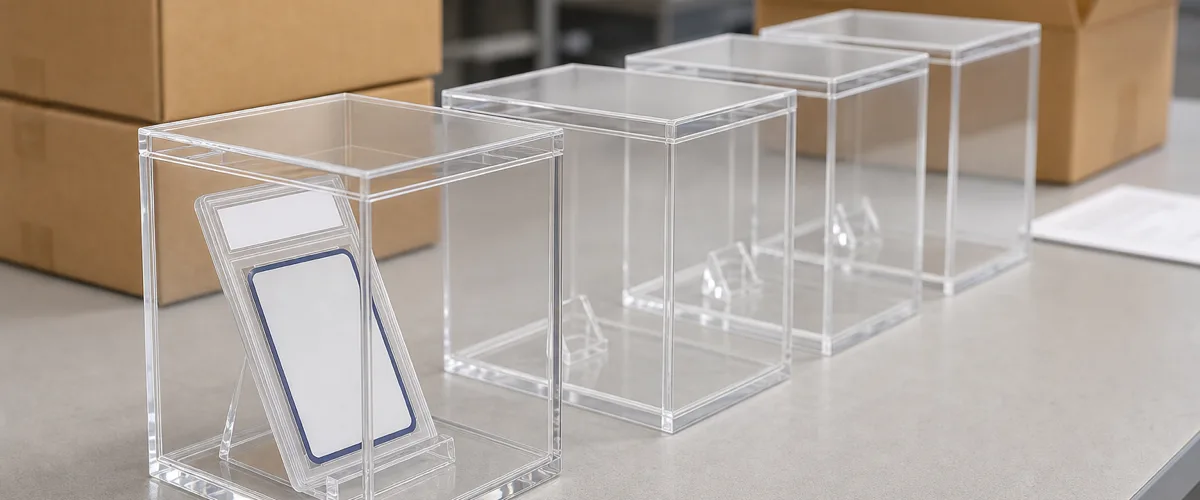
Here is how a first run of 100-200 cases gets sequenced, branded, and reordered without betting the margin.
Key Takeaways
- A collectible line launch sequences in four gates — a 3-5 day sample, a 100-200 unit first run built in 15-20 days, a measured sell-through window, and a reorder triggered before stock falls below lead-time demand.
- The 100-piece minimum applies per design, so a three-size line launches at 300 units total, quoted as one family rather than three separate bets.
- Laser engraving prices as a one-time file setup plus per-unit machine time, with no screens or dies to amortize — which is what keeps per-case branding viable at 100-200 unit launch volume.
- A blank first run is a legitimate hedge: cases sell unbranded while the market answers, and engraving joins the reorder once a SKU has earned it.
- Reorder timing is arithmetic, not instinct: production runs 15-20 days plus freight, so the reorder triggers when remaining stock roughly equals what sells during that window.
On this page
- Where a collectible line launch starts, and where it stalls
- Sizing the first run against a forecast you don’t have
- Per-unit engraving economics at launch volume
- Blank runs: the launch hedge nobody regrets
- Sample-to-scale sequencing
- Protecting margin at 100-200 units
- Reorder timing when the forecast is a guess
- What a first-quote request needs
Where a collectible line launch starts, and where it stalls
Sketch the launch we coordinate several times a year — a composite of the ecommerce sellers I’ve worked with since 2020, not any one client. A seller has a collectible product moving: graded card slabs, die-cast models, a small figure line. They want a custom collectible display case sold under their own brand alongside it. They can guess next month’s orders, but next quarter is a blank. So they ask three questions in one email: what is the smallest run that still prices like a product, can every case carry the brand, and what happens if it sells out in three weeks — or sits for three months.
The answer we give is a sequence, and the sequence is the whole trick. A collectible line launch runs through four gates: a production-grade sample in 3-5 days, a first run of 100-200 units built in 15-20 days, a selling window that converts guesses into sell-through data, and a reorder triggered by arithmetic rather than nerve. Our minimum is 100 pieces per design, and every gate is sized so you never bet more than one step ahead of your data.
This guide walks those gates in order. It deliberately skips two questions that live elsewhere: what to display and in what style is covered on our collectible display cases page, and the glass-versus-acrylic material decision has our collector-focused comparison to itself. If the spec is already settled and the question is dimensions and options, the collectible display case product page is the faster read, and a line built around building sets has its own LEGO acrylic display case page. What follows is the playbook I walk those sellers through, gate by gate.
Sizing the first run against a forecast you don’t have
The right first run for most collectible display line launches sits between 100 and 200 units — large enough to price like a product and prove real demand, small enough that a miss is a lesson instead of a warehouse problem. The instinct to order 1,000 units for a better unit price is usually the most expensive decision of the launch.
The reason is that unsold stock is not neutral. Fulfillment-industry guidance puts inventory carrying cost — storage, capital, insurance, shrinkage — at around 30% of total inventory cost,1 which means the discount earned by tripling a speculative order can be quietly consumed by the cost of sitting on it. The metric that should size the second order is sell-through rate: units sold in a period divided by units available in that period.2 At launch it does not exist yet. The first run’s real job is to buy that number at the lowest defensible cost.
Our 100-piece floor works in your favor here, because it applies per design rather than per order. A line with a one-slab, a two-slab, and a four-slab case launches at 300 units total, and we quote it as one family: the three geometries nest across our shared sheets and run in one production window, which prices meaningfully better than three separate purchase orders. The fixed-cost logic behind the floor — programming, jigs, first-article inspection — is laid out in our MOQ economics guide, and it explains why 100 is where custom work starts pricing like a product. I usually steer first-time sellers toward 100 per design and volume courage toward the reorder, where data does the arguing.
Per-unit engraving economics at launch volume
Branding is where launch budgets get surprised, so here is the structure before the choice. Decoration methods differ less in what they cost per unit than in what they cost before the first unit: screen printing needs a screen per color per artwork, hot-stamp foil needs a metal die, and both of those setups amortize gracefully at 500 units and painfully at 100.
Laser engraving inverts that math, which is why it is the branding route we quote first on a custom collectible display case at launch volume. The setup is a one-time artwork file, and the cost after that is per-unit machine time. The result is a frosted, tone-on-tone mark cut into the acrylic itself — permanent, with no ink to scratch and no film edge to lift under handling. The tradeoff is color: engraving is monochrome by nature. When the brand needs full color, UV digital printing carries artwork of any complexity with no per-color setup, and our acrylic printing methods guide walks the full decision table method by method.
What I ask sellers to do is simple: request the branding as its own quote line. A launch budget has five moving parts — the case, the branding, the packaging, the freight, and the sample — and when we price each separately, you can see exactly what putting your logo on every unit adds, and decide with numbers instead of attachment. Sometimes the answer is engraving on every case from day one. Sometimes it is the subject of the next section.
Blank runs: the launch hedge nobody regrets
A blank first run — cases with no branding at all — is not a compromise; for forecast-uncertain launches it is often the play we suggest first. The case sells on fit, clarity, and protection, which is what collectors are buying anyway. The branding decision waits until sell-through data exists to justify it.
The economics favor the hedge more than sellers expect. Removing decoration removes its per-unit line and any setup from the launch budget, and it removes a constraint that matters more: a blank case is SKU-agnostic. If you launch three sizes and one outsells the others two to one, blank stock serves whichever listing moves, while branded variants would have locked that guess in at the factory. Engraving then joins the reorder as a one-time file setup on a geometry that has already proven itself — nothing about the sequence penalizes deciding later.
We quote blank and branded versions side by side on request, and I encourage exactly that comparison at the first-quote stage even from sellers who are sure they want branding. Seeing the delta on paper turns a brand-identity question into a margin question, and margin questions have answers. I have yet to coordinate a launch where starting blank was the regret; the regrets I hear about are oversized first orders. The one thing a blank run does not change is the build standard: the same material, the same polish, and our 100% inspection before packing. Blank refers to the artwork, never the quality bar.
Sample-to-scale sequencing
Nothing in the launch matters if gate one is skipped: every first order we take gets a production-grade sample, shipped in 3-5 days, made on the same machines and material we will use for the eventual run. A sample answers the questions a render cannot — whether the slab or model actually seats the way the drawing promised, how the wall thickness feels in hand, whether the lid style suits repeated opening — and the difference between approving a render and approving a physical piece is the subject of our pre-production sample approval checklist.
Our sequence from there is fixed and short. Sample approval starts the clock; we take a 30% deposit to open production; the run itself takes 15-20 days on our floor; the 70% balance clears before shipment; freight takes days by courier or several weeks by sea, chosen by urgency and budget. End to end, a seller who approves a sample this week is typically listing product inside five to six weeks. We built a three-slab graded-card display for a card retailer on exactly this sample-first footing — the fit questions were settled on one physical piece before 200 went to production, as documented in our graded card retailer case study.
One sequencing rule I hold firm on with new sellers: never let a marketing date compress gate one. A launch date pressured enough to skip the sample does not actually save the 3-5 days — it moves the fit-check to your customers, at 100-200 units of scale. Every stage we run after the sample is fast precisely because the sample settled the questions.
Protecting margin at 100-200 units
Small-run margin is protected at the design stage, not negotiated afterward. The costs that punish launch volume are setups — programming, jigs, screens, dies — so the discipline we push for is one process family: one material family, one finishing route, one branding method across every SKU in the run. Three case sizes that share process share setups; a fourth SKU that adds a new material or a printed gradient quietly imports a second cost structure into a 150-unit order.
The second protection is quoting structure. Ask for 100/200/300 tiers on day one, even when run one is 100 — the request costs nothing and the response shows the whole curve: how setup amortizes, where packaging breaks, what the reorder will actually cost at each volume. Sellers who skip this negotiate their reorder blind against a number they have never seen. We quote tiers side by side on request precisely because the launch decision and the reorder decision are the same curve read at two points.
The third is a design freeze between run one and run two — the discipline I argue for most often. Reorders price well because we already hold the geometry, files, and jigs; a dimension tweak between runs reopens sampling and resets part of the setup math. If the first run teaches you the case needs a change, make it — but make it knowingly, as a versioned revision, not as a casual note on a purchase order. Sellers in the graded card display vertical feel this acutely, because slab standards do the dimensioning for you: get the fit right at the sample and the geometry may never need to move again. Graded coin slabs work the same way on a coin display case.
Reorder timing when the forecast is a guess
The reorder is where launch anxiety collects — it is the decision I get the most nervous emails about — and it is also the most mechanical one in the whole sequence. You do not need a forecast; you need a trigger. Track weekly units sold from the moment the first run lists. A reorder takes 15-20 days of production plus the freight leg, so the trigger is the week remaining stock roughly equals what sells during that window. Place the reorder then — not when the shelf is empty, and not when a good week spikes your confidence.
Two properties of a repeat order make this easier than the first run. We keep the files, drawings, and jigs from run one, so a same-spec reorder skips sampling entirely and goes straight onto our production schedule — the confirmation is a spec check and a purchase order, not a project. And the tier curve requested at launch now does its real work: sell-through data2 tells you whether the reorder is a repeat at 100, a step to 200, or a bigger jump, and the pricing at each point is already on paper. One of our longer-running examples of this rhythm is a French seller’s console display case program, reordered across multiple runs on retained tooling — documented in our repeat-order case study, and the console and cartridge formats behind it sit on our video game display case page.
For sellers running several SKUs, apply the trigger per SKU, not per line. Winners and laggards will separate within weeks, and the whole point of a 100-200 unit launch is the freedom to reorder the winner at volume while letting a laggard sell down — a freedom the 1,000-unit launch spent on day one.
What a first-quote request needs
A quotable first request is shorter than most sellers think: the object being displayed (dimensions, or a photo with one known measurement), the case quantity you are weighing, whether branding is in scope for run one, and the destination country for the freight leg. From that we return a tiered quote — 100/200/300, branded and blank as separate lines — within 24 hours, and we flag anything in the geometry that a sample should settle.
We do not need final artwork, a CAD file, or a locked forecast to start; the sequence exists so none of those are day-one requirements. Send us the product and the quantities you’re considering and the launch math comes back on paper — or if the design itself is still forming, start with the custom acrylic fabrication process and we’ll shape the case spec with you before anything is priced. Either way, the first physical thing you commit to is one sample, five weeks ahead of your first sale.
Footnotes
-
Inventory Carrying Cost: Formula and Definition — ShipBob — fulfillment-industry reference putting total inventory carrying cost at around 30% of total inventory cost, the figure behind the first-run sizing argument against speculative volume. ↩
-
Sell-Through Rate: How to Calculate and Improve It — Shopify Retail — retail-operations reference defining sell-through rate as units sold divided by stock available in a period, the metric used here to size and time reorders. ↩ ↩2
Frequently Asked Questions
What is the minimum order for launching a custom collectible display case line?
Our minimum is 100 pieces per design, and it exists because programming, jigs, and first-article inspection are fixed costs per geometry. A line with three case sizes therefore launches at 300 units total, quoted as one family so the designs share sheets and one production window. Samples ship in 3-5 days and production runs 15-20 days after sample approval, so a first run is typically sellable inside five to six weeks.
Can every case in a small run carry my brand engraving?
Yes. Laser engraving is priced as artwork setup plus per-unit machine time, so it works cleanly at the 100-piece production MOQ. The mark is a permanent frosted tone-on-tone finish cut into the acrylic itself — no ink, no film, nothing to peel. Full-color UV printing is also available when the artwork needs color, and we quote either method as its own line so you can see exactly what branding adds per unit.
Can I order blank display cases first and add branding on the reorder?
Yes, and for forecast-uncertain launches we often suggest it. A blank case sells on fit and clarity, the branding decision waits until sell-through data exists, and the engraving file is a one-time setup you can add to any later run. We keep your drawings and specs on file, so a branded reorder needs only the artwork — the case geometry is already proven.
How do I plan reorders when I can't forecast sell-through yet?
Work backward from the lead time instead of forward from a forecast. A reorder takes 15-20 days of production plus freight, so track weekly units sold from the first run and place the reorder when remaining stock roughly equals what sells during that window. Because we retain your files and jigs, reorders skip the sampling stage entirely — the trigger point is the only decision left.
Do reorders price the same as the first run?
Ask for tiered pricing before the first run so there is no guessing later: we quote 100/200/300 quantities side by side on request, and the tiers show how setup and packaging spread as volume grows. A reorder at the same quantity and spec prices from the same structure, with sampling already done. If the reorder jumps a tier, the unit price steps down along the curve you saw on day one.
Ready to price a first run?
Send the object you're protecting — dimensions or a photo is enough — with the run size you're weighing. We'll quote 100/200/300 tiers side by side, branded and blank, so the launch math is on paper before you commit to anything.