Acrylic MOQ: Why Custom Runs Start at 100 Pieces
A minimum order quantity is not a factory being difficult — it is arithmetic.
Need this made?Custom acrylic fabrication services →
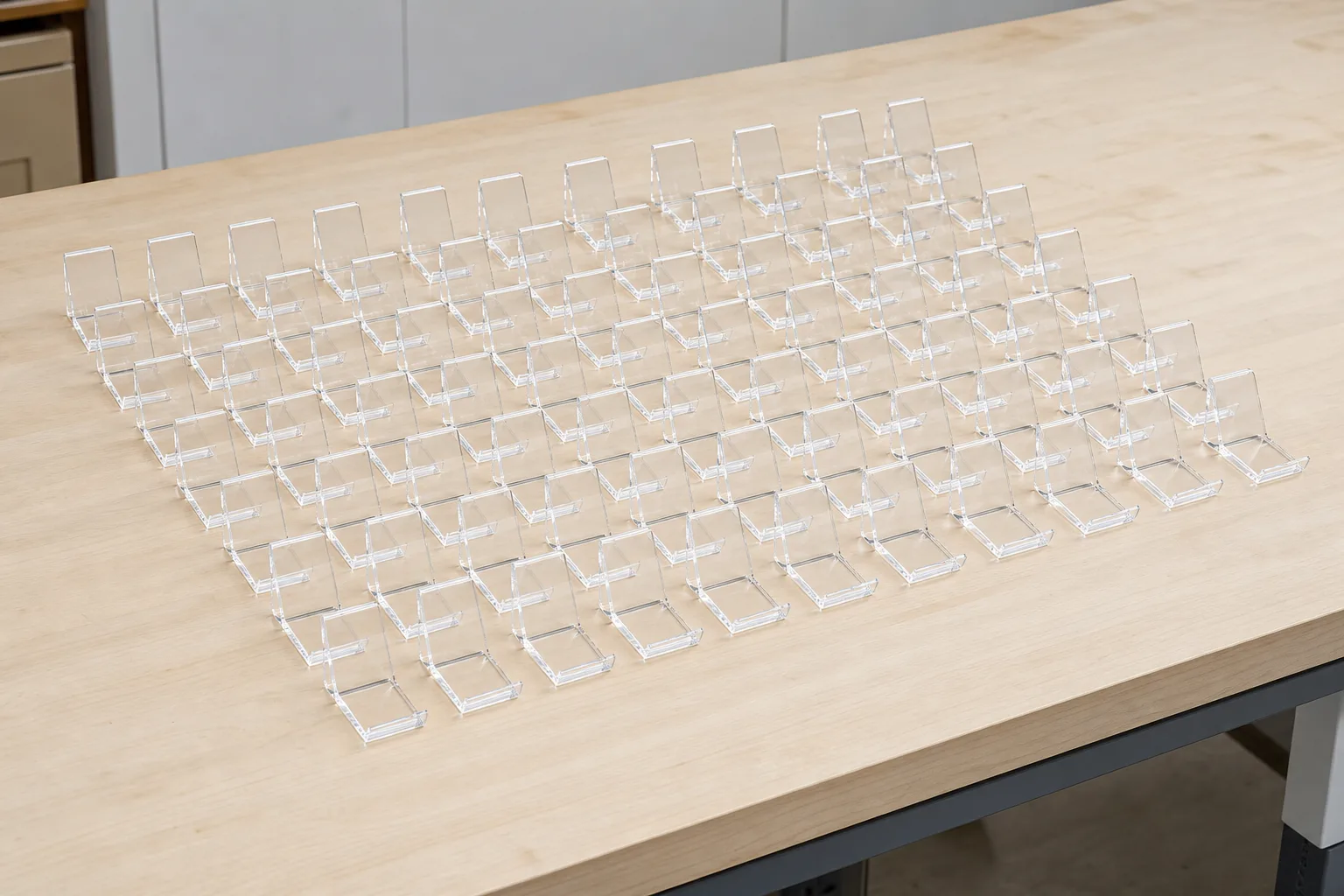
Here is the fixed-cost math behind the 100-piece line, and how to make a small run price well.
Key Takeaways
- An acrylic MOQ exists because every custom run carries fixed costs — CAD/CAM programming, machine setup, jigs, first-article inspection — that are the same whether the run is 5 pieces or 500. At 100 pieces, those costs amortize to a sane share of unit price.
- Custom acrylic can start at 100 pieces because it is CNC-cut and formed from sheet, not molded: there is no steel tooling to pay off. Injection-molded plastic runs carry mold costs from about $2,000 into six figures, which is why molded MOQs start in the thousands.
- The unit-price curve is steep from 1 to 100, drops meaningfully from 100 to 500 as setup amortizes toward zero, then flattens — past several hundred pieces, price is mostly material, labor, and freight.
- Factories quoting 300-500 piece MOQs are not pricing differently — they are organized for long line runs, where changeovers and per-order QC paperwork make small POs unprofitable for them.
- Buying 100 pieces intelligently means one design per run, standard thickness and stock colors, a 3-5 day sample before the deposit, and reordering against your archived cutting programs instead of re-engineering.
On this page
The acrylic MOQ myth: it is not gatekeeping
Most buyers read an acrylic MOQ as a factory being difficult — an arbitrary wall between them and the twelve pieces they actually want. The truth is less dramatic: a minimum order quantity is arithmetic. The first piece of any custom design is expensive; every piece after it costs a fraction as much; and the MOQ is the point where that math produces a unit price a buyer will accept.
An MOQ (minimum order quantity) is the smallest production run a manufacturer will accept for a custom design. Ours is 100 pieces per design. That number is not a sales tactic and not a quality threshold — it is the run size at which the fixed costs of starting a custom job amortize down to a sane share of each unit’s price.
I have been explaining this number since founding Wetop in 2008, and the conversation has barely changed: a buyer wants 20 pieces, hears “100,” and assumes we are rounding up for profit. So this guide shows the actual cost anatomy — what gets spent before the first piece comes off the line, why sheet fabrication lets the minimum sit at 100 rather than 5,000 pieces, what the price curve does between 100 and 5,000 pieces, and how to buy a small run so the arithmetic works in your favor. If you’re looking for the practical path to ordering at 100 pieces — configurator choices, consolidation tricks, what to put in the RFQ — our custom acrylic fabrication process covers the how; this page covers the why behind the number.
What the first piece actually costs
Every custom acrylic run pays a set of fixed costs before piece one is cut: CAD/CAM programming, machine setup, jigs and fixtures, print or engraving setup, and first-article inspection. None of these scale with quantity — the programming for 5 pieces is the programming for 500 — which is exactly why very small runs price so badly.
Walk through what happens between a signed-off drawing and the first finished unit. An engineer converts the drawing into cutting programs — toolpaths for the CNC router or laser, bend positions for the line bender. Operators set up each machine: load and square the sheet stock, mount the right cutters, run test cuts on offcut material. If the design needs bonding or bending, someone builds a jig so all hundred units come out identical. If there is a logo, the print team sets up the UV printer or laser engraver and proofs the artwork on scrap. Then QC pulls the first article — the first complete unit — and measures it against the drawing before the run proceeds. That chain of work is real hours from real people, and it is identical for any quantity.
| Cost component | Fixed or variable? | Recurs on reorder? |
|---|---|---|
| CAD/CAM programming and toolpaths | Fixed per design | No — programs stay archived |
| Machine setup (cutting, bending, polishing) | Fixed per run | Yes, but faster with archived programs |
| Jigs and fixtures for assembly | Fixed per design | No — jigs are kept for repeat runs |
| Print / engraving setup and artwork proof | Fixed per design | No — files stay on record |
| First-article inspection | Fixed per run | Yes — every run gets one |
| Sheet material | Variable per piece | Yes |
| Machine time, polishing, assembly labor | Variable per piece | Yes |
| Packaging and cartons | Mostly variable | Yes |
Read that table as a fraction: fixed costs over quantity, plus variable cost. At 10 pieces, the fixed block dominates and the unit price looks offensive. At 100, it becomes a minority share of the unit price. At 500, it is background noise. The MOQ is simply where we stop having to quote prices that make buyers think we are gouging them.
The “per design” wording in the table deserves a concrete example, because it is the part of an acrylic MOQ that surprises buyers most often. Say a program is one countertop display in two widths plus a matching riser. That is three geometries — three sets of toolpaths, three first-articles — so it is three designs of 100, not one order of 100. What softens it: we quote the family together, we nest all three designs across shared sheets, and we run them in one production window, so the combined order prices far better than three separate POs would. The minimum protects the per-design fixed work; it does not punish a buyer for ordering a coherent set.
Why 100 works here: zero tooling
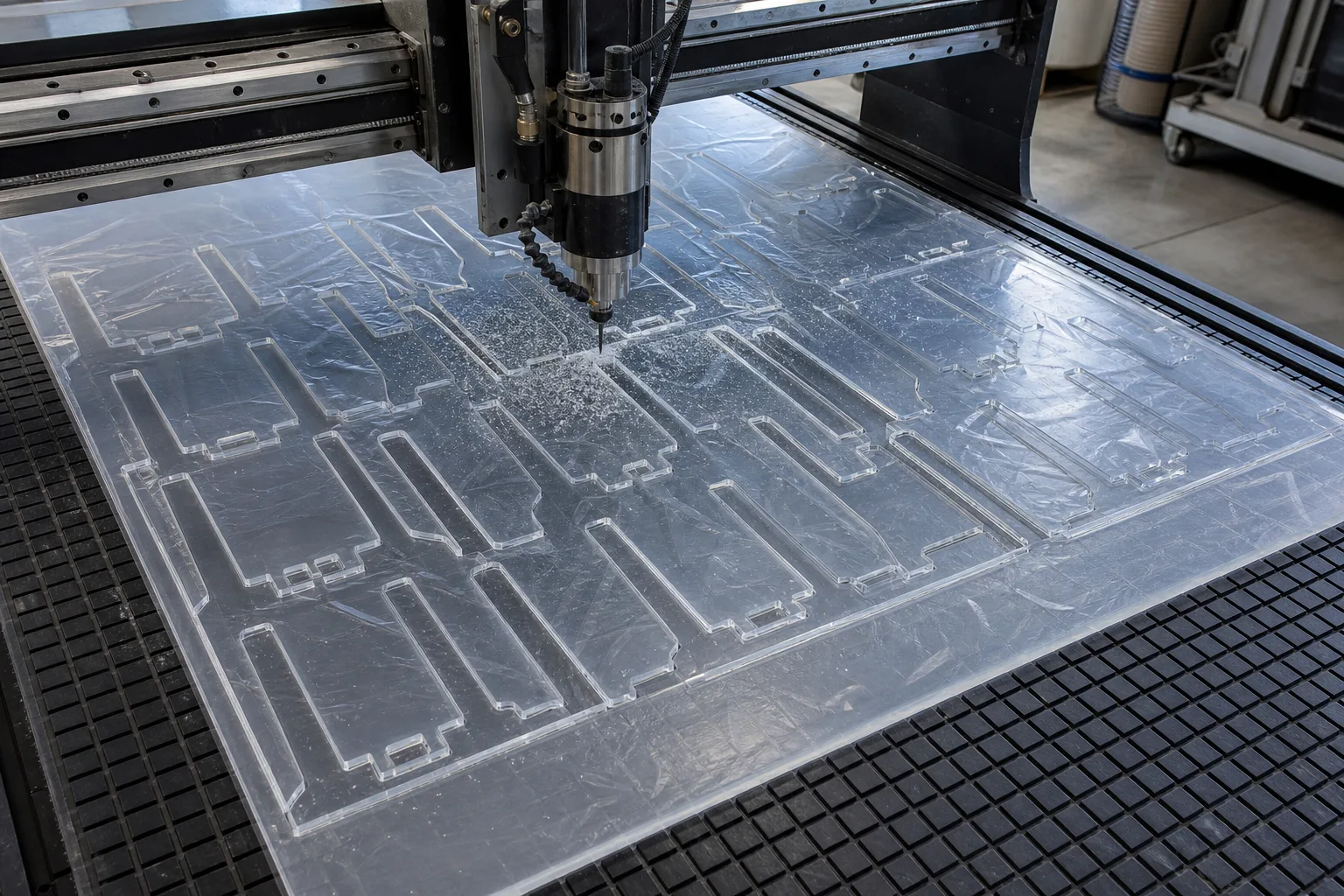
Custom acrylic can start at 100 pieces for one structural reason: there is no tooling to pay off. Acrylic products are CNC-cut, laser-cut, and formed from flat cast sheet, so a new design costs programming hours, not machined steel. That is why most designs carry no tooling fee — there is no tool.
Compare the molded world. An injection-molded plastic part requires a mold — a machined block of aluminum or steel with the part’s geometry cut into it. A modest aluminum mold for a 1,000-5,000 unit run costs roughly $2,000-5,000, and high-volume steel tooling ranges from $5,000 into six figures.1 That cost exists before the first part, and it only makes sense spread over thousands of units — which is why molded MOQs start in the thousands and why “custom plastic” so often means “custom, if you want 10,000 of them.”
Sheet fabrication deletes that entire cost class. When your acrylic MOQ covers programming and setup instead of steel, the minimum can sit at 100 — and design changes stay affordable, because revising a toolpath is an hour of engineering, not a $4,000 mold modification. This is also why the economics favor genuinely custom geometry: on our lines, a custom dimension costs barely more to program than a catalog dimension. The trade-off is honest, though — above roughly 10,000 identical units, molding’s per-piece economics win and fabrication’s flexibility premium stops paying for itself. Between 100 and a few thousand pieces is where cut-from-sheet acrylic is the rational buy, and that window is exactly where most B2B display, tray, and case programs live. Our custom acrylic fabrication page covers what that flexibility includes — dimensions, colors, print, engraving, and packaging, all without tooling charges.
The 100 vs 500 vs 5,000 price curve
The unit-price curve for custom acrylic has three regions: steep below 100 pieces, where fixed costs dominate; a meaningful slide from 100 to 500, as setup amortizes toward zero and sheet nesting gets efficient; and a long flat tail past several hundred, where price is mostly material, labor, and freight.
| Run size | What dominates unit price | What changes at this scale |
|---|---|---|
| Under 100 | Setup and programming share | Fixed costs make unit prices look unreasonable — this is why the MOQ exists |
| 100-250 | Setup share still visible | Workable custom runs; sampling and QC per-run costs are felt but fair |
| 250-500 | Material + labor take over | Best price movement per quantity step; sheet nesting reaches full efficiency |
| 500-5,000 | Material, labor, freight | Curve flattens; savings come from packaging density and freight mode, not the factory floor |
| 10,000+ | Process choice itself | Molding starts beating fabrication on identical high-volume parts |
Two honest notes on that curve. First, the biggest single price move a small buyer can make is getting from under-MOQ quantities to 100 — that step retires the ugliest arithmetic. The move from 100 to 500 helps meaningfully; the move from 500 to 5,000 helps far less than buyers expect, because by then the factory-side fixed costs are already fully diluted. Second, at the large end the action shifts to logistics: cartons per pallet, sea versus air, port charges. We walk through worked pricing tiers on real display projects in our acrylic display stand cost guide at 100, 500 and 1,000 pieces, which puts numbers on the shape described here.
The curve also matters for cash flow, which small buyers feel more sharply than unit price. A 100-piece run at our terms — 30% deposit, balance before shipment — commits a fraction of the cash a 500-piece “better price” run demands, and the goods convert back to cash in weeks rather than quarters. For a first order with a new supplier, the smaller cash exposure is itself worth something, a point we cover in our ordering and payment FAQ.
What the curve means in practice: order the quantity your sell-through supports, not the quantity that maximizes the discount. I have watched more money wasted on 1,000-piece orders bought for a unit-price thrill — 600 of which sat in a warehouse — than on any premium paid for a 100-piece run. The right reading of the curve is that 100 is a legitimate, economically sound place to start.
Why bigger factories quote 300-500 MOQs
When a large acrylic factory quotes a 300 or 500 piece minimum, it is not pricing the product differently — it is protecting a production system built for long runs. Frequent changeovers, per-order paperwork, and per-order QC make a 100-piece PO genuinely unprofitable inside that system, so the minimum filters such orders out.
The mechanics are worth understanding, because they explain who you should be talking to. A line organized for volume wants each machine cutting the same program for as long as possible; every changeover — new sheet stock, new toolpaths, new fixtures — is paid downtime. Sales, order management, and export documentation cost roughly the same per PO whether the PO is 100 pieces or 5,000, so a big factory’s overhead per piece explodes on small orders. And quality systems add per-run work that cannot be skipped: under a quality management system like ISO 9001, every production run carries its own inspection records and traceability documentation regardless of size.2 None of this is bad practice — it is the correct design for a factory whose business is 5,000-piece POs.
This is why I tell buyers to read a quoted MOQ as a compatibility signal, not a price signal. A 500-piece minimum from a good factory means a 100-piece program is simply the wrong shape for their system — pushing them to make an exception buys a reluctant order at the bottom of their priority list, behind every full-line PO on the schedule. When I talk with buyers who have been through that, the complaint is never the price they negotiated; it is the three-week quote cycles and the sample that took a month. Matching order size to a factory built for it matters more than winning the exception.
Our answer to the same arithmetic is different because the factory is organized for frequent changeovers, archived programs, and first-article inspection across many custom jobs. An example is a specialty pet retailer’s 300-unit acrylic snake enclosure run: three sizes at 100 pieces each on one modular jig. Our production MOQ is 100 pieces per design; a paid sample remains available before production.
How to buy 100 pieces intelligently
Buying at MOQ well means minimizing the fixed costs your 100 pieces have to carry. Five habits do most of the work: one design per run, standard thicknesses, stock colors, a sample before the deposit, and reorders placed against archived programs rather than re-engineered from scratch.
One design per run. The MOQ is per design because programming, jigs, and first-article checks are per design. A three-size set is three designs of 100 — we quote sets together and share sheet programs to soften this, but consolidating your line into fewer geometries is the strongest cost lever you control.
Standard thickness, stock color. 3, 5, and 8mm sheet in clear, black, white, and common tints is always in stock. A custom Pantone-matched color is available at a one-time $200-300 per color — worth it for a brand program, wasted money if a stock tint is close enough. On a 100-piece run, that one-time charge is a visible share of the invoice; on 500 it disappears.
Sample before deposit. A sample ships in 3-5 days and settles fit, finish, and color questions while changes still cost nothing. Payment then runs 30% deposit with the balance before shipment, and production takes 15-20 days, FOB Shenzhen. The sequence matters: buyers who sample first almost never need the second production run to fix the first.
Plan the reorder into the first order. Look back at the fixed-cost table: programming, jigs, and artwork setup do not recur. Your cutting programs stay archived, so a reorder eight months later skips most of what made the first run’s arithmetic tight. The first 100 pieces are the expensive ones; the second 100 are just material and machine time. If a design is likely to repeat, say so on the RFQ — it changes how we build the jigs.
Start with the product family, not the quote form. Browsing our acrylic display stands hub — or whichever category fits your program — before writing the RFQ tends to produce cleaner specs and fewer design revisions. When the spec is ready, send it over; we respond within 24 hours, and 100 pieces is a welcome order here, not a favor.
Footnotes
-
How much does injection molding cost? — Formlabs — documents injection mold tooling costs of roughly $2,000-5,000 for an aluminum mold serving 1,000-5,000 units and $5,000 to $100,000 for high-volume tooling, the cost class that CNC-cut acrylic fabrication avoids entirely. ↩
-
ISO 9001:2015 Quality management systems — Requirements — ISO — the quality management standard whose documented-information and traceability requirements apply per production run, part of why per-order overhead makes small POs uneconomical inside volume-organized factories. ↩
Frequently Asked Questions
What is the MOQ for custom acrylic products?
Our minimum order is 100 pieces per design, with samples in 3-5 days and production in 15-20 days. The figure comes from fixed-cost math: programming, machine setup, jigs, and first-article inspection cost the same for any run size, and at 100 pieces they amortize to a reasonable share of unit price. Many larger factories set 300-500 piece minimums because their lines are organized for long runs.
Why do acrylic manufacturers have minimum order quantities at all?
Because the first piece of any custom design is expensive and every piece after it costs little. A custom run carries fixed costs — CAD/CAM programming, cutting and polishing setup, fixtures, print setup, first-article QC — that don't change with quantity. Below a certain run size, those fixed costs would dominate the unit price; the MOQ is the point where the arithmetic works for both sides.
Why can acrylic MOQs be lower than injection molding MOQs?
No tooling. Custom acrylic is CNC-cut, laser-cut, and formed from flat sheet, so a new design costs programming time, not steel. Injection molding requires a machined mold — roughly $2,000-5,000 for a modest aluminum tool and up to six figures for high-volume steel — which forces molded MOQs into the thousands to pay the mold off. Acrylic fabrication skips that entire cost class.
Does the 100-piece MOQ apply per design or per order?
Per design. A three-size riser set is three designs of 100 each, not one order of 100. In practice we quote related designs together and cut them from shared sheet programs, which softens the difference — but each distinct geometry needs its own programming, setup, and first-article check, which is what the minimum actually pays for.
How can I get the best price on a small acrylic order?
Keep one design per run, stay on standard thicknesses (3, 5, 8mm) and stock colors, approve a 3-5 day sample before committing the 30% deposit, and consolidate sizes into one PO so sheet programs are shared. On reorders, your cutting programs and print files are already archived, so repeat runs skip most of the setup cost that the first run absorbed.
Explore Custom Acrylic Products
Browse product categories to compare formats, materials, and customization options before choosing the closest fit for your project.