
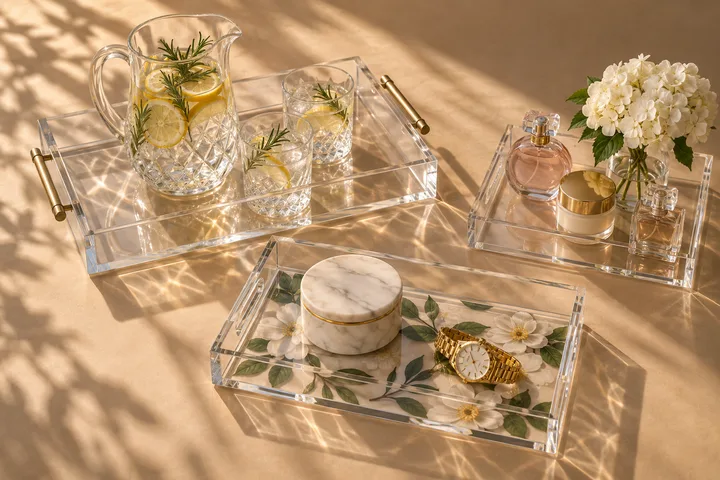
How to Clean Acrylic Furniture — Daily and Weekly Protocol
A care plan should name the sheet grade, approved cleaner, cloth, test area and response to scratches before staff clean the finished piece.
Need this made?Custom acrylic furniture →
Key Takeaways
- PMMA is softer than glass. Loose grit, contaminated cloths and cleaners that conflict with the named sheet manufacturer's guidance can scratch or craze acrylic furniture.
- Use only cleaners, concentrations, contact times and cloths approved for the named PMMA grade and finish, and test the method on the approved sample or a hidden area before broad use.
- Scratch restoration is finish- and feature-specific; test a hidden area and refer deep marks, coated faces, bonded joints and load-bearing edges to a qualified fabricator.
On this page
- How Do You Clean Acrylic Furniture Without Scratching It?
- The Cleaning Agents That Destroy Acrylic (and the Ones That Do Not)
- Daily Cleaning Protocol — 60-Second Routine That Preserves Clarity
- Weekly Deep-Clean — Removing Fingerprints, Smudges, and Light Haze
- Scratch Restoration — The 3-Step Micro-Mesh Protocol
- Printable Maintenance Card for Housekeeping Staff
How Do You Clean Acrylic Furniture Without Scratching It?
How to clean acrylic furniture without scratching it: remove loose grit first, then use lukewarm water, mild soap and a clean soft cloth while avoiding dry wiping, abrasive pads and incompatible solvents.
PMMA (polymethyl methacrylate) is softer than standard soda-lime glass, so a dry paper towel, a rag with embedded grit or an incompatible spray can leave visible marks. The cleaning sequence matters as much as the product on the cloth: rinse or lift particles before wiping, keep the cloth clean, and test any commercial cleaner against the quoted material grade and finish.
Haze can come from surface abrasion, incompatible chemicals, residue or damage below the surface. Do not diagnose it from a photograph alone: stop using the suspect cleaner, record what was applied and test the care method on an inconspicuous area or approved sample.
This matters more for acrylic furniture than for custom acrylic display stands because furniture surfaces are larger, touched more often, and cleaned more aggressively. (For display cases, risers and sign holders, use the acrylic display cleaning guide.) A 1,200 mm acrylic dining table gets wiped down after every meal. A small countertop sign holder might get dusted once a week. The accumulated damage scales with surface area and cleaning frequency, so furniture demands a stricter acrylic furniture care protocol than any other product category we build.
Some marks on an uncoated face can be improved with a sheet-maker-approved polish, while deep marks, coated faces, bonded joints and load-bearing edges need a qualified fabricator’s review. Prevention starts with removing grit and approving the cleaner and cloth.
The Cleaning Agents That Destroy Acrylic (and the Ones That Do Not)
The first rule is to follow the named PMMA grade manufacturer’s care guidance. Mild soap and lukewarm water are common starting points, while ammonia, acetone and other unapproved solvents should be avoided; commercial cleaners still need a spot test on the actual finish.
The compatibility guidance below follows PMMA manufacturer care information rather than an unpublished Wetop laboratory claim.1
What destroys acrylic
Ammonia-based glass cleaners. Avoid them unless the named sheet manufacturer’s guidance explicitly approves the exact product and use condition; chemical stress can appear as haze or crazing.
Alcohol and disinfectant wipes. Compatibility varies with grade, stress, concentration and contact time. Use only when the sheet manufacturer and buyer’s procedure approve the exact product.
Acetone, MEK and similar solvents. Keep them away from PMMA and follow the sheet manufacturer’s incident guidance if exposure occurs.
Abrasive cleaners and pads. Do not use them on a polished acrylic face because they can mark the surface.
What is safe
Lukewarm water with mild soap. Use the concentration and rinse method permitted by the sheet manufacturer, with a clean soft cloth and a spot test on the actual finish.
Dedicated plastic cleaners. Confirm that the exact product is approved for the quoted PMMA grade and any coating, then test it before staff-wide use.
Distilled water. Tap water contains minerals that leave spots on polished acrylic. For commercial installations where water-spot-free clarity matters — retail display furniture, hotel lobby pieces — distilled water is worth the cost.
Daily Cleaning Protocol — 60-Second Routine That Preserves Clarity
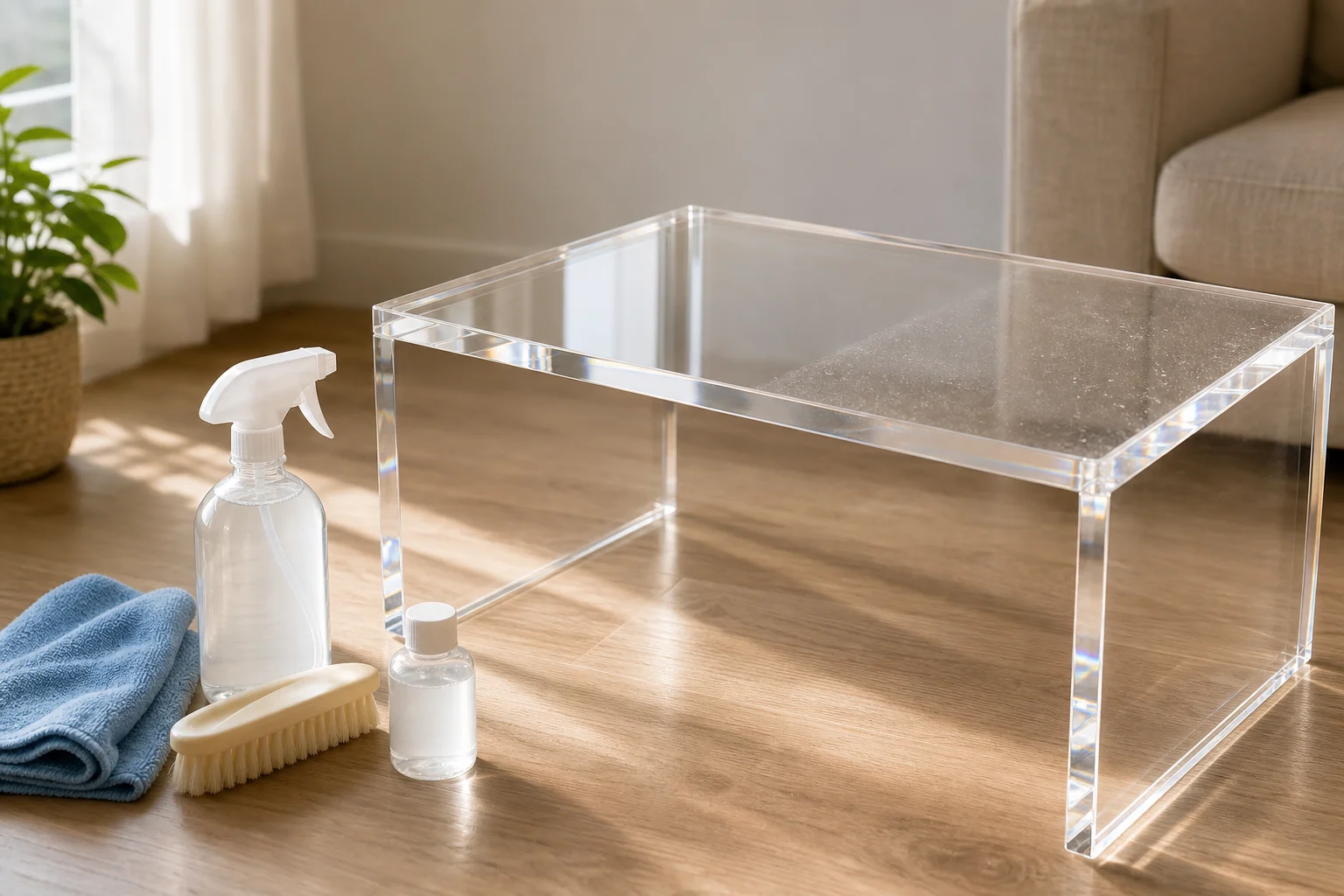
The routine is simple: remove loose grit, dampen a clean soft cloth with the approved solution, wipe without pressing contaminants across the surface, rinse if required, and pat dry with a second clean cloth.
Use this step-by-step routine only after checking it against the named sheet manufacturer’s care guidance for the acrylic furniture construction:
Step 1 — Blow or rinse loose particles off the surface. Dust, crumbs, and grit are the primary abrasive. If you wipe them across the surface with a cloth, they act like sandpaper. A quick blast of compressed air (the canned kind used for keyboards) or a gentle rinse with lukewarm water removes loose particles before you touch the surface.
Step 2 — Dampen a clean, soft cloth with lukewarm water. Add a small amount of mild dish soap if the named sheet manufacturer’s guidance permits it. A cloth used on another surface may carry embedded grit, so keep the furniture-care cloth clean and separate.
Step 3 — Wipe in straight, overlapping passes in one direction. Never circular motions. Circular wiping concentrates grit into a swirl pattern that catches light at every angle. Straight passes push particles off the edge. Overlap each pass by about one-third of the cloth width to avoid leaving streaks.
Step 4 — Pat dry with a second clean microfiber cloth. Air-drying leaves water spots, especially with tap water. Patting instead of wiping prevents the cloth from dragging any remaining particles across the surface.
Use this sequence as a starting point, then follow the named sheet manufacturer’s care guidance and the method approved on the sample.
Weekly Deep-Clean — Removing Fingerprints, Smudges, and Light Haze
A weekly deep-clean removes the oil buildup, fingerprint haze, and light static dust that daily wiping does not fully address. This is where acrylic furniture care shifts from maintenance to restoration of that showroom clarity.
What you need: The cleaner and concentration approved for the named PMMA grade, clean water if the instructions require it, and clean soft cloths reserved for the acrylic surface.
The weekly process:
- Remove everything from the furniture surface. Lift objects straight up — do not slide them across the acrylic.
- Blow or rinse loose dust off the surface (same as the daily protocol).
- Soak one microfiber cloth in the soapy water and wring it until damp, not dripping. Excess water pools in joints and edges on assembled furniture.
- Wipe the entire surface with straight overlapping passes. For a clean acrylic table, start at one end and work toward the other so you are not reaching across already-cleaned areas.
- Rinse the cloth in clean water (no soap) and do a second pass to remove soap residue.
- Pat dry with the second microfiber cloth.
- Apply an anti-static product only if its maker and the PMMA sheet guidance approve the exact finish; test it before broad use.
For commercial installations, document the approved cleaner, cloth, dilution and response to spills in the staff care record. Do not add an anti-static treatment unless it has been approved for the exact finish.
One additional detail for the outdoor furniture use case: if the piece sits in direct sunlight, clean it in the shade or after sunset. Cleaning agents evaporate faster in direct sun, leaving residue that bonds to the warm surface. The same applies to any acrylic furniture near a window with strong afternoon light.
Scratch Restoration — The 3-Step Micro-Mesh Protocol
Some light marks on an uncoated, non-structural face may respond to a PMMA-maker-approved polishing system. Do not apply a universal sanding sequence to coated faces, bonded joints, polished edges or load-bearing features.
Before you start: Identify the grade, coating and feature, photograph the mark, and test the proposed system on the paid sample or a hidden area. Refer deep marks and any structural, coated, bonded or edge feature to a qualified fabricator.
Step 1 — Wet-sand with 1500-grit micro-mesh
Use only the abrasive grade, lubricant and motion specified by the approved restoration-system instructions for the exact PMMA face. Stop if the test area develops distortion, haze or a finish mismatch.
Step 2 — Refine with 2000-grit, then 4000-grit
If the approved system uses progressively finer media, follow its sequence without skipping steps and keep the work confined to the qualified test area.
Step 3 — Polish and buff
Apply only the polish approved for the sheet and restoration system, then inspect the test area under the same light used to accept the original finish.2
Deep scratches and any mark near a joint, coating, edge or load-bearing feature need professional review. For a custom furniture order, send the drawing, material grade, finish and photographs so the appropriate next step can be assessed.
Printable Maintenance Card for Housekeeping Staff
The following maintenance-card format can be adapted to the named material grade, approved cleaner and the buyer’s staff routine.
Below is the content of that card, formatted as a schedule your team can implement immediately.
Routine cleaning
| Step | Action | Tool |
|---|---|---|
| 1 | Blow loose dust off surface | Compressed air or gentle water rinse |
| 2 | Dampen a fresh microfiber cloth with lukewarm water + 1 drop dish soap | Clean microfiber cloth (washed separately from kitchen rags) |
| 3 | Wipe in straight overlapping passes — one direction only | Same damp cloth |
| 4 | Pat dry with a second clean microfiber cloth | Dry microfiber cloth |
Periodic cleaning
| Step | Action | Tool |
|---|---|---|
| 1 | Remove all objects — lift, do not slide | Hands only |
| 2 | Full soapy water wash (lukewarm, mild dish soap) | Basin + microfiber cloth |
| 3 | Rinse pass with clean water | Rinsed microfiber cloth |
| 4 | Pat dry | Dry microfiber cloth |
| 5 | Apply an anti-static product only after the product maker and PMMA guidance approve it for the exact finish; test first | Approved product + approved cloth |
Monthly
- Inspect surfaces for scratch accumulation under angled light. If marks are visible, record the face, edge, joint or coating involved and seek the sheet maker’s or a qualified fabricator’s approved method before polishing.
- Replace any cloth that is worn, contaminated or no longer soft.
- Check joints, edges and hardware for looseness or damage and remove the piece from service if a structural concern appears.
Annually (commercial installations)
- Have a qualified fabricator review accumulated marks, joints, edges and hardware on high-traffic pieces such as restaurant tables and retail display furniture.
- Compare any color or surface change with the approved sample and named sheet datasheet before selecting a film, coating or restoration method.
Agents that require manufacturer approval or avoidance
- Windex or any ammonia-based cleaner
- Rubbing alcohol or IPA wipes unless the exact product, concentration and contact time are approved for the named grade
- Acetone, paint thinner, or nail polish remover
- Comet, Soft Scrub, Magic Eraser, or any abrasive cleaner
- Paper towels, newspaper, or rough cotton rags
- Dry wiping without dampening first
Record the approved grade, cleaner, cloth and test method on the card so future staff can repeat the same care routine. Escalate marks on coated faces, bonded joints, load-bearing edges or unknown grades to a qualified fabricator instead of improvising a restoration method.
Footnotes
-
PLEXIGLAS care & handling guidance — Evonik technical information — manufacturer care guidelines for cast PMMA, confirming ammonia and solvent incompatibility. ↩
-
ASTM D4060 — Standard Test Method for Abrasion Resistance of Organic Coatings by the Taber Abraser — the abrasion-resistance test protocol referenced for scratch restoration performance on PMMA surfaces. ↩
Frequently Asked Questions
Can you use Windex on acrylic furniture?
Do not use a cleaner merely because it is sold for glass. Check its ingredients against the named PMMA sheet manufacturer's care guidance, avoid ammonia and unapproved solvents, and test the buyer's proposed cleaner on the paid sample or an inconspicuous area.
How do you remove scratches from acrylic furniture?
First identify whether the mark is on an uncoated face, a polished edge, a bonded joint or a load-bearing feature. Test any maker-approved polish on a hidden area; refer deep marks, coated surfaces, joints and structural edges to a qualified acrylic fabricator rather than applying one sanding recipe to every feature.
How often should acrylic furniture be cleaned?
Set the cleaning frequency from actual dust, touch and spill exposure. Remove grit before wiping, use the approved cloth and cleaner, and record any haze, crack, loose joint or damaged edge for inspection instead of following a universal daily or annual schedule.
Does acrylic furniture scratch easily?
Acrylic is softer than common glass and can be marked by trapped grit or abrasive wiping. Some face marks may respond to a sheet-maker-approved polish, but no method can promise complete restoration across coated faces, bonded joints, edges and structural features.
How to clean acrylic furniture without scratching it?
Use a clean, soft, non-abrasive microfiber cloth reserved for the acrylic surface. Rinse or replace it when grit is present, because trapped particles can scratch even when the cleaning solution is compatible.
Should dust be removed before wet-cleaning an acrylic table?
Yes. Lift loose dust with clean water or a gentle air flow before wiping, then use a damp cloth rather than dragging dry grit across the surface.
Can acrylic furniture be disinfected in a commercial space?
Only with a product confirmed compatible with the exact PMMA grade and finish. Test the proposed disinfectant on the approved sample or an inconspicuous area, follow the chemical maker's dilution and contact-time instructions, and avoid ammonia, acetone and unapproved solvents.
How should acrylic furniture edges and joints be cleaned?
Use a damp soft cloth with mild soap, support the piece, and avoid flooding bonded joints or forcing liquid into hardware interfaces. Do not scrape polished edges with blades or abrasive pads.
Can removable cushions or hardware be cleaned separately?
Yes, when the assembly drawing identifies removable parts and their cleaning instructions. Remove only the components designed for service, protect the acrylic from tools, and reinstall hardware to the approved fit without overtightening.
Can I approve a furniture care protocol before production?
Yes. Ask for the proposed material grade, finish and cleaning card with the paid sample, then test the buyer's actual cloth and cleaner before bulk approval. Sample fees are paid separately and are not credited to production.
Need a maintenance plan with your next acrylic furniture order?
Send the furniture dimensions, use environment, cleaning routine, quantity and destination for a production quote and paid-sample plan. Sample fees are paid separately and are not credited to production.