


Delivered project · Luxury Retail · Flagship Showroom
Luxury Retail Showroom — 100-Set Nesting Side Table Rollout
The visual merchandising team of a European luxury fashion retailer needed 100 nesting side-table sets, three tiers each, for its flagship showroom and boutique network.
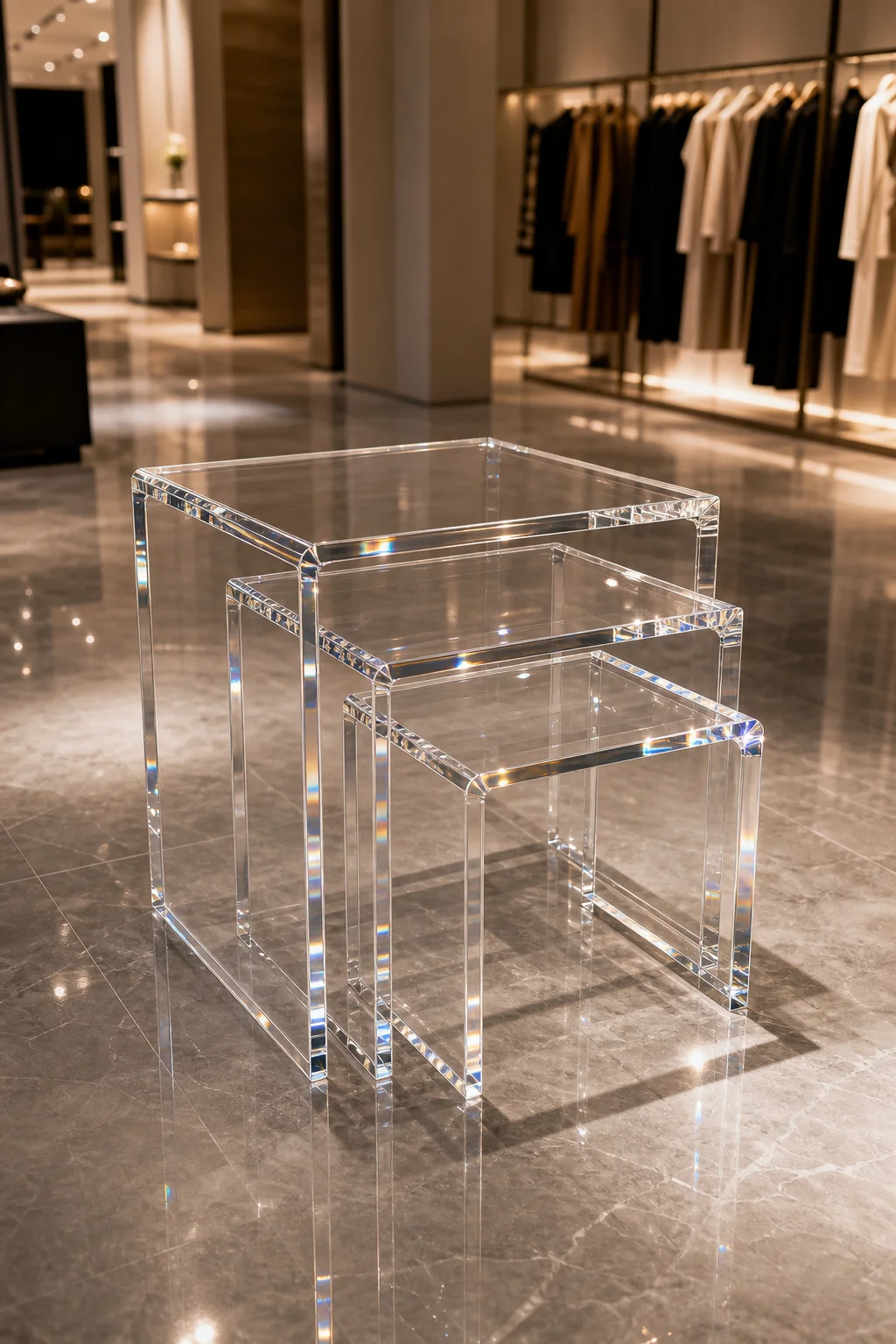
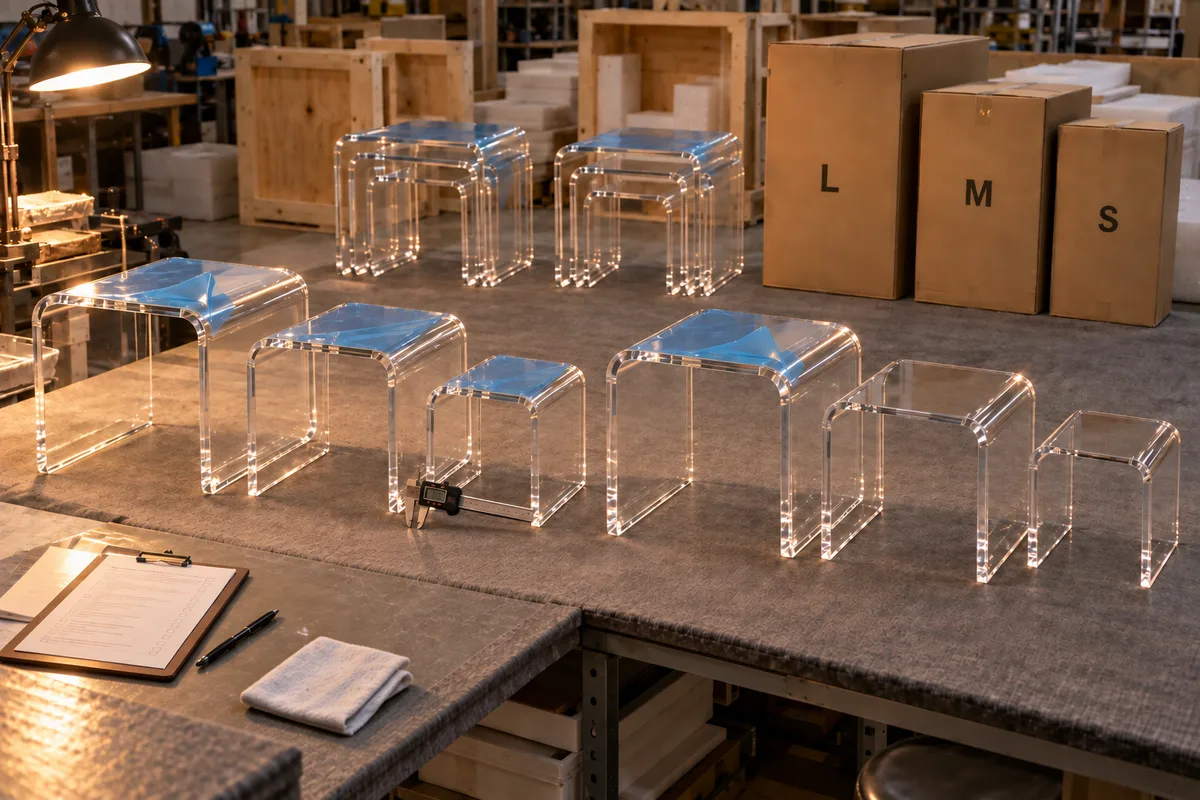
Their previous tables had wobbled and hazed within 8 months. We made all 300 pieces in 12 mm cast PMMA, test-fitted every nested pair to ±0.3 mm before diamond polishing, added an anti-scratch coating and crated each nest on its own. Production took 18 days to FOB, and every piece arrived intact after 14 days at sea. Delivered: 100 three-tier nesting sets with a ±0.3 mm fit, coated cast-PMMA finish and individual crates, with zero transit damage.
- nesting tolerance
- ±0.3 mm
- cast PMMA thickness
- 12 mm
- production to FOB
- 18 days
Ordering a similar project
New orders start at 100 pieces per design. The paid sample is billed separately and never credited to production. Standard production takes 15–20 days after sample approval.
Key Takeaways
- A European luxury fashion retailer needed 100 three-tier nesting side-table sets for its flagship showroom and boutique network after its previous tables wobbled and hazed within 8 months. We delivered all 300 pieces in 18 days to FOB.
- We held nesting tolerance to ±0.3 mm across all 300 pieces by test-fitting every pair before polish. At that fit the tiers stopped wobbling and each nest read as one sculptural object.
- We used 12 mm cast PMMA with a 4-side diamond polish, because extruded sheet at this thickness shows flow lines under showroom spot lighting, and added an anti-scratch nano-coating (pencil hardness 4H) for daily handling. Uncoated cast hazes from micro-scratches over 6-12 months.
- Each nest shipped in its own foam-cushion crate with inter-tier separators. All 300 pieces arrived after 14 days of ocean freight with zero breakage.
The Challenge
The buyer's visual merchandising team rotated product staging across 3 showroom zones daily — handbags, shoes, and ready-to-wear — with each zone using nesting side tables as product pedestals; the same sets were rolled out to the retailer's European boutiques, 100 sets in all. Each table was a 3-tier nest: large (600 × 400 × 450 mm), medium (500 × 340 × 350 mm), and small (400 × 280 × 250 mm). The tiers stacked inside one another for overnight storage and pulled apart for daytime staging.
The previous acrylic supplier had delivered nesting tables with ±1.2 mm dimensional variance. At that tolerance, the medium tier wobbled inside the large and the small tier rocked inside the medium — audible rattling during rearrangement, visible gap lines under showroom spot lighting. After 8 months, accumulated micro-scratching from daily nesting and unnesting had hazed the surfaces enough that the retailer's brand team pulled the tables from rotation.
The showroom environment itself compounded the problem. High-CRI LED spot lighting at 4000K, standard in European luxury retail, exposed every surface flaw that overhead fluorescent would hide. The retailer's brand guidelines required acrylic furniture to read as glass: no visible flow lines, no edge cloudiness, no surface haze. Any table that failed under their lighting rig got pulled, whatever its structural condition.
Three specs drove the replacement brief: nesting tolerance tight enough to eliminate wobble (the retailer's architect specified ±0.5 mm, which we tightened to ±0.3 mm), anti-scratch performance that survives 3+ years of daily VM rotation, and optical clarity that reads as glass under directional lighting. The deadline was 5 weeks in total, including ocean freight to Europe.
Our Approach
Three production decisions decided whether the tables would hold their fit and finish through 3+ years of daily rotation.
Nesting tolerance engineering
The wobble problem on the previous supplier's tables traced to two root causes: inconsistent sheet thickness (extruded PMMA varies ±0.5-0.8 mm at 12 mm nominal) and CNC routing tolerance accumulated across 3 nested dimensions. We specified 12 mm cast PMMA (thickness tolerance ±0.15 mm vs ±0.5-0.8 mm on extruded) and ran all 300 pieces on the same CNC program with toolpath compensation calibrated to the actual sheet thickness measured at incoming QC. Each nested pair was test-fit on the production floor before polishing — if any pair showed detectable wobble, the offending piece went back to CNC for a single re-pass on the mating edge. Final tolerance across all 300 pieces: ±0.3 mm, which is the threshold below which wobble disappears and the 3-tier nest sits as a single rigid stack.
Anti-scratch coating decision
Daily handling under directional lighting made surface protection a real cost decision. We quoted uncoated PMMA and a coated option. The buyer compared finish samples under the showroom lighting and chose an anti-scratch nano-coating rated at 4H pencil hardness. We took the coating grade, hardness method, appearance and care instructions from the coating supplier's data and the approved sample, not from a generic service-life promise.
Optical clarity QC process
At 12 mm thickness, the difference between cast and extruded PMMA is visible to the naked eye under spot lighting. Extruded sheet shows flow lines — faint directional streaks from the extrusion process — that are invisible at 3-6 mm but unmistakable at 12 mm under the high-CRI LED spots used in luxury retail environments. Cast sheet has no flow lines because the polymerization happens in a static mold. We inspected each piece under 4000K directional LED at 1-meter distance (simulating showroom conditions) and rejected any piece showing visible inclusions, flow artifacts, or surface defects exceeding 0.2 mm.
Construction: CNC routing from 12 mm cast PMMA sheet, solvent welding at all structural joints (solvent weld is stronger than the parent material at this thickness — the joint fails in the sheet before it fails at the weld line), 4-side diamond polishing, nano-coating application, individual test-fit of each 3-tier nest. Our custom acrylic fabrication page shows the full furniture workflow.
Production, Packing and Delivery
Production ran 18 days from approved spec to FOB. Substrate sourcing took 4 days (single-batch cast PMMA order for sheet consistency across all 300 pieces). CNC routing ran 6 days (100 nests × 3 tiers, each piece CNC'd and test-fit before moving to polish). Diamond polishing + nano-coating application took 5 days. Final QC, individual foam-cushion crating, and inter-tier separators took 3 days. Ocean freight ran 14 days to the European port.
Crating was the other variable that determined whether the 300 pieces arrived intact. Each 3-tier nest shipped in its own foam-cushion crate with closed-cell polyethylene separators between tiers — the separators prevent surface-to-surface contact during transit vibration, which is the primary cause of micro-scratching on coated acrylic in shipping. The 100 crates palletized into a single 40-foot container for the 14-day ocean freight leg. On arrival, the retailer's receiving team unpacked and test-fit each nest on-site: zero breakage, zero coating damage, zero dimensional drift from transit stress. Standard bubble-wrap packing on uncoated acrylic typically runs 3-5% transit damage at this piece count.
At shipment we recorded the approved finish, coating data, nesting clearance, joint condition and handling assumptions, so the retailer has a record to check against in its own rotation and maintenance reviews.
Project notes: The tables were moved every day, so we treated nesting fit, surface protection and handling marks as seriously as the day-one showroom look.
If You're Planning Something Similar
For nesting or stacking furniture that gets handled daily, fit and packing decide how long it lasts. On 3-tier nests, ±0.3 mm is where wobble disappears; a supplier quoting ±1.0 mm, or no nesting tolerance at all, means rattle and visible gap lines within the first month. At 12 mm, extruded sheet shows flow lines under directional LED at CRI 90+ that are invisible at 3 mm, so specify cast. For ocean shipments longer than 7 days, crate each nest with separators between tiers; on this order that cost $12-$18 per nest, against $0 in transit damage. Compare coated and uncoated finish samples under your own showroom lighting.
See our custom acrylic side tables. For furniture already in rotation, the cleaning and maintenance guide covers daily care that protects the coating.
Planning nesting acrylic tables for a retail showroom?
Send us your nesting dimensions, tier count, surface-finish requirements and showroom lighting. We'll come back with a tolerance spec, coating recommendation, crating method and per-unit pricing at your order quantity.
This order: sample in 7 days · production in 16–20 days · repeat orders in 10–14 days