Oversize cut
Each cast PMMA panel is cut 2–3mm larger than the finished dimension, leaving stock for the miter pass and a final clean-up cut.
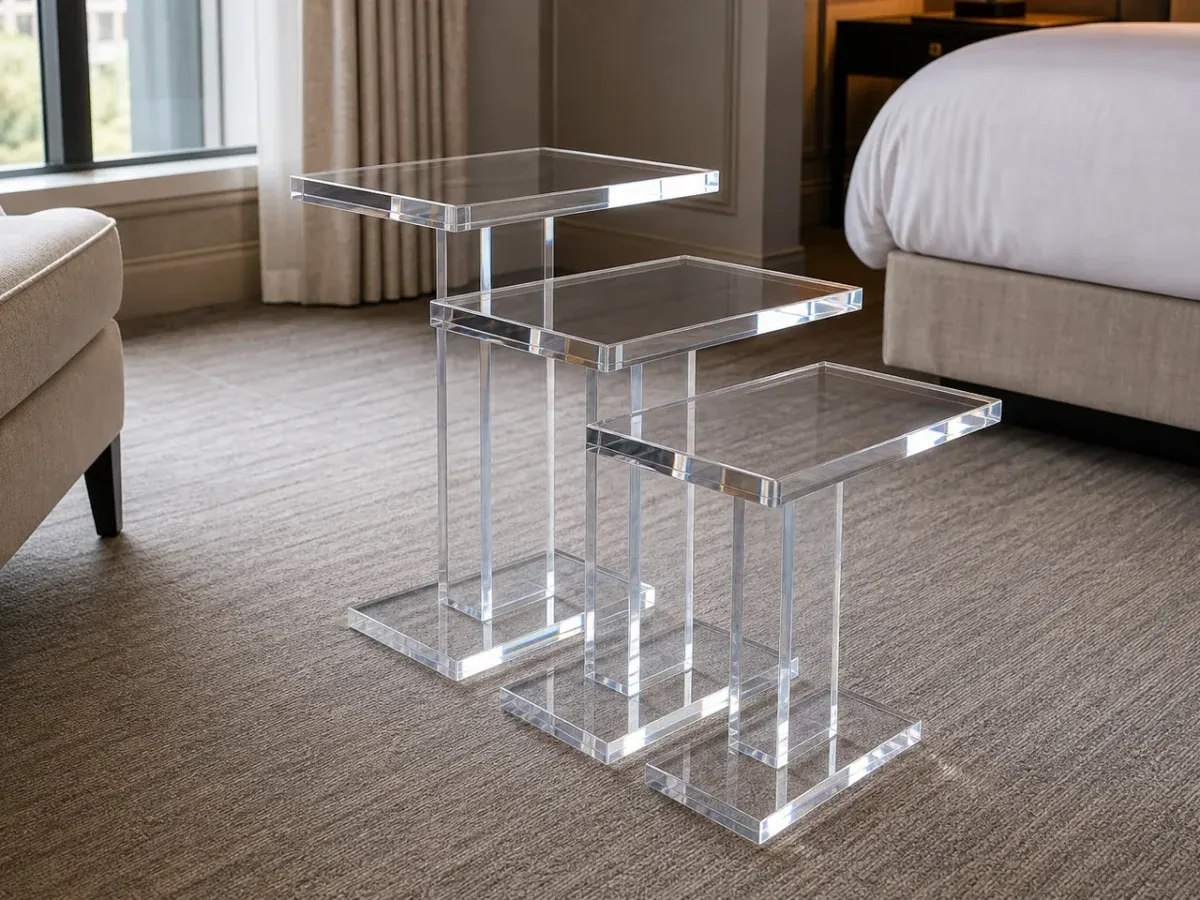
Nesting trios, pedestals, C-tables — six configurations, 2–3mm tolerance, batch-matched across rollouts.
Custom acrylic side tables for boutique hotels, members' clubs, luxury retail showrooms, restaurant lounges, and corporate offices. Six configurations: nesting sets of 3 (the hospitality default), round pedestals, rectangular 4-leg (most-ordered geometry, crosses over to boutique-hotel nightstand spec), C-tables (cantilevered slide-in for laptop reach over a sofa arm), cocktail/drink tables (paired around lounge seating), and solid accent cubes. Cast PMMA at 20–25mm top thickness, diamond-polished edges, 2–3mm nesting clearance held at QC, and batch-matched color across multi-property rollouts. MOQ 10 pieces per unique SKU; nesting trio = 30 pieces (10 sets of 3). Sample 7–10 days; production 18–25 days for 10 sets.
ISO 9001 Certified 2–3mm Nesting Tolerance Diamond-Polished Edges Samples in 7–10 Days
The engineering is in the tolerances you don't see.
Nesting trios at 2–3mm clearance, mitered cubes joint-polished before bonding, C-table counterweights engineered to laptop loads.
Acrylic side tables come in six configurations: nesting sets of 3 (the hospitality default), round pedestals (sculptural single-piece), rectangular 4-leg (the most-ordered geometry, crosses over to nightstand spec), C-tables (cantilevered slide-in over a seat), cocktail / drink tables (paired around lounge seating), and solid accent cubes (mitered-corner statement piece). All in cast PMMA at 20–25mm top thickness with diamond-polished edges as standard.
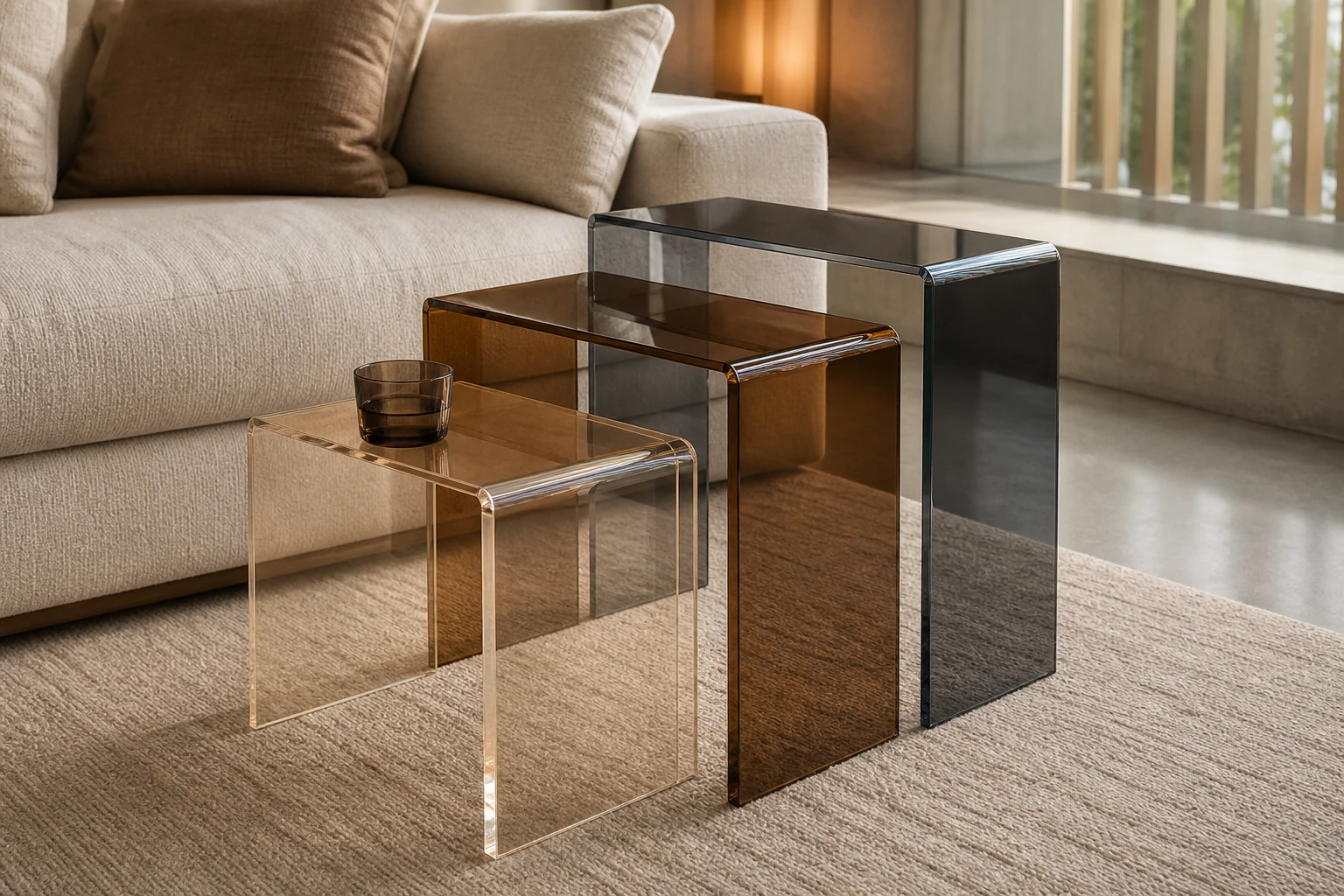
Stepped heights (45/40/35cm), pedestal or 3-leg base. The hospitality workhorse — tucks compact, fans out for service. 2–3mm nesting clearance held on every set
Jump to details below ›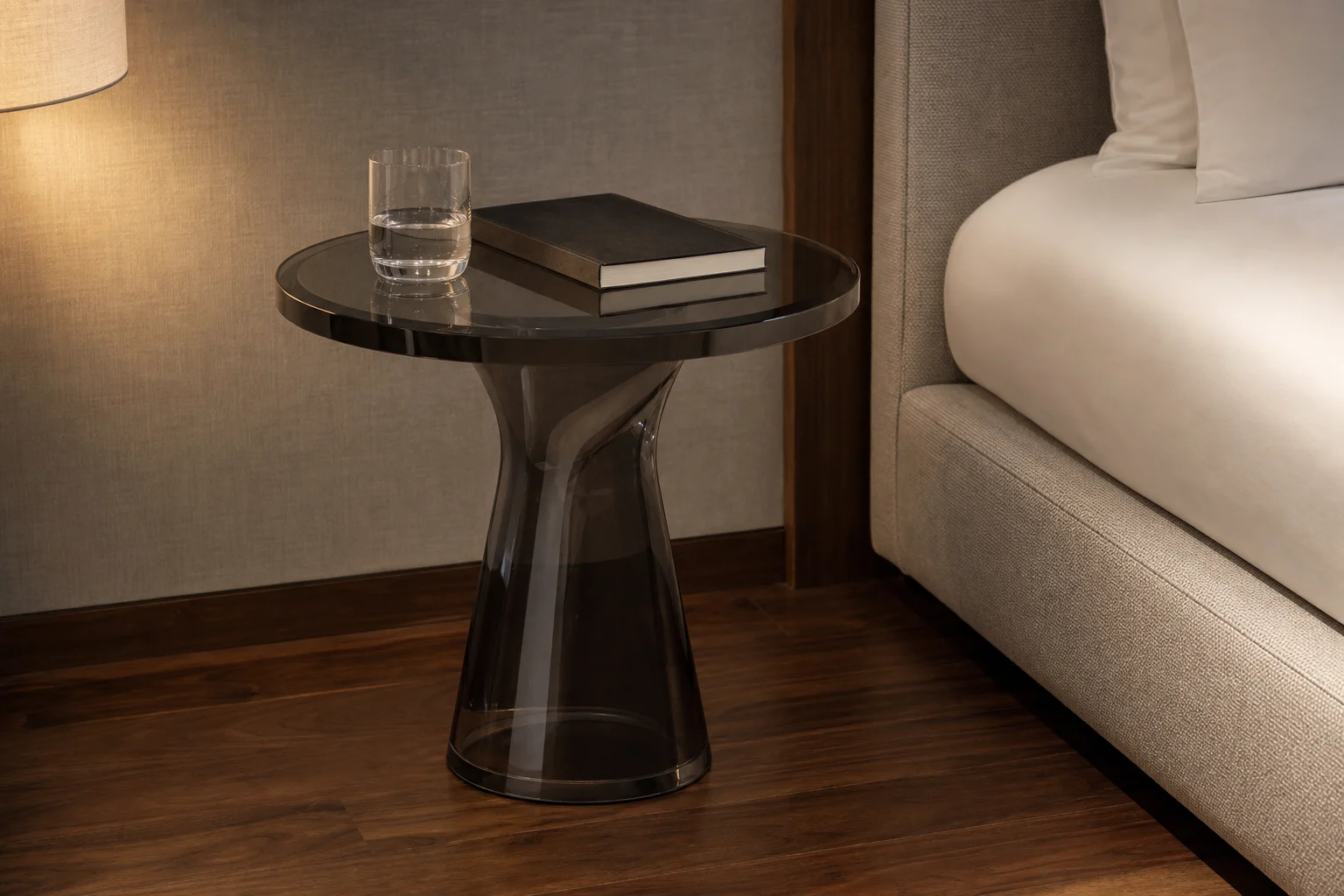
40–50cm diameter on a single sculptural pedestal. Floating-top look; minimal visible structure. Pedestal tapers 20% from base to top for stability without visual heaviness
Jump to details below ›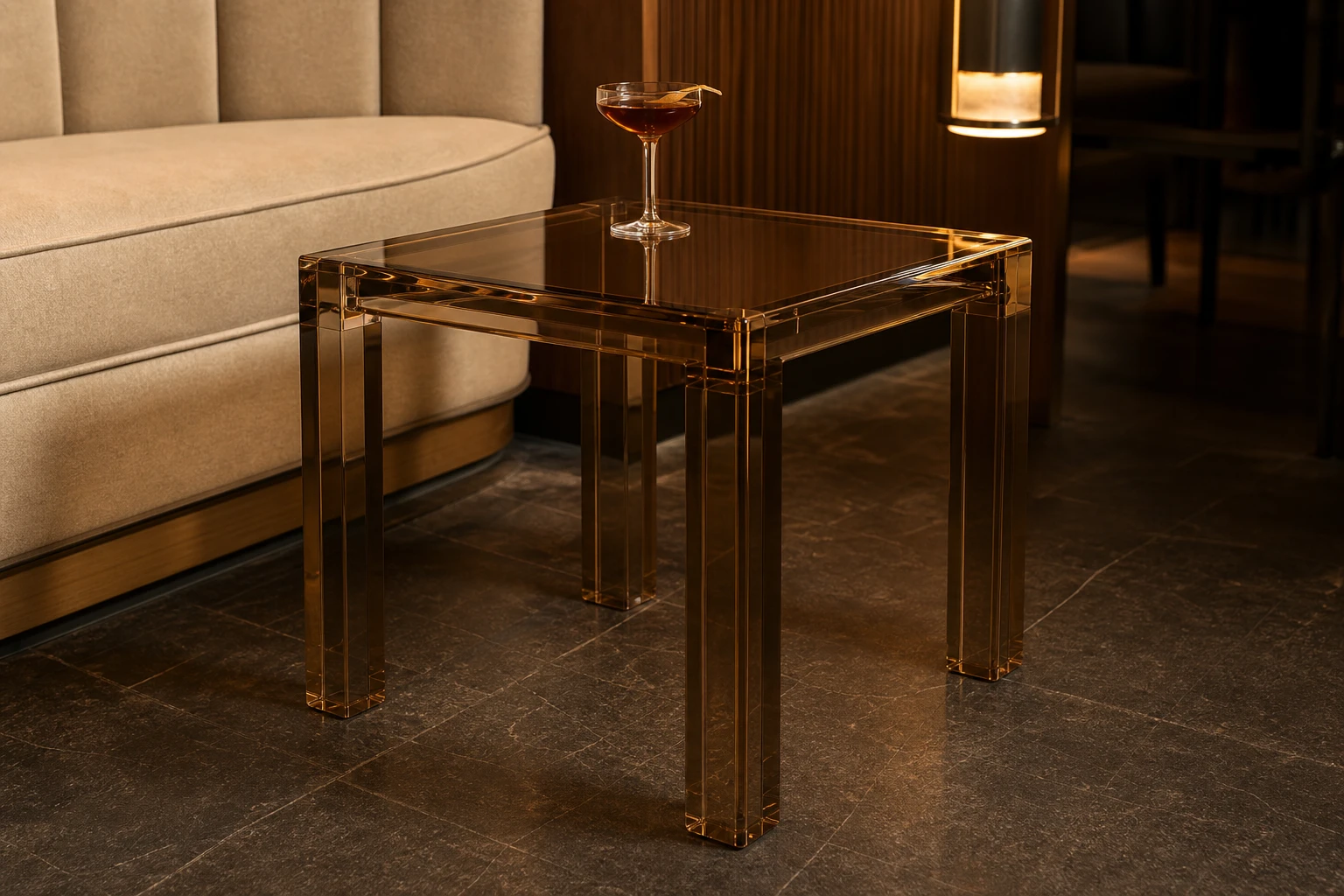
50 × 50 × 60cm — the most-ordered geometry. Four acrylic legs at each corner. Pairs with armchairs and crosses over to boutique-hotel nightstand spec
Jump to details below ›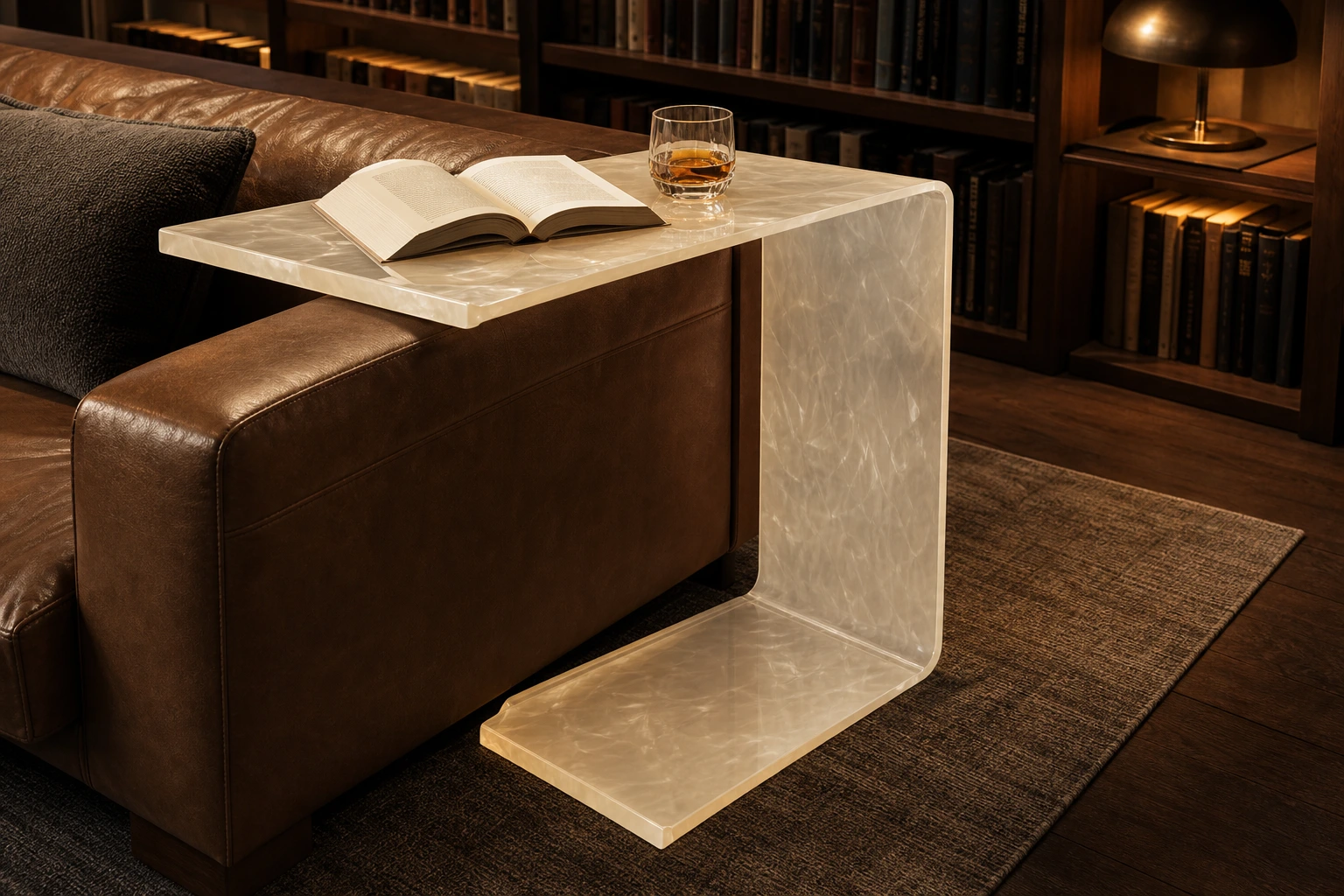
Slides under a sofa or armchair to bring the surface over the seat — 50–55cm reach for laptop / drink at seat-arm height. Engineered base counters the tipping moment
Jump to details below ›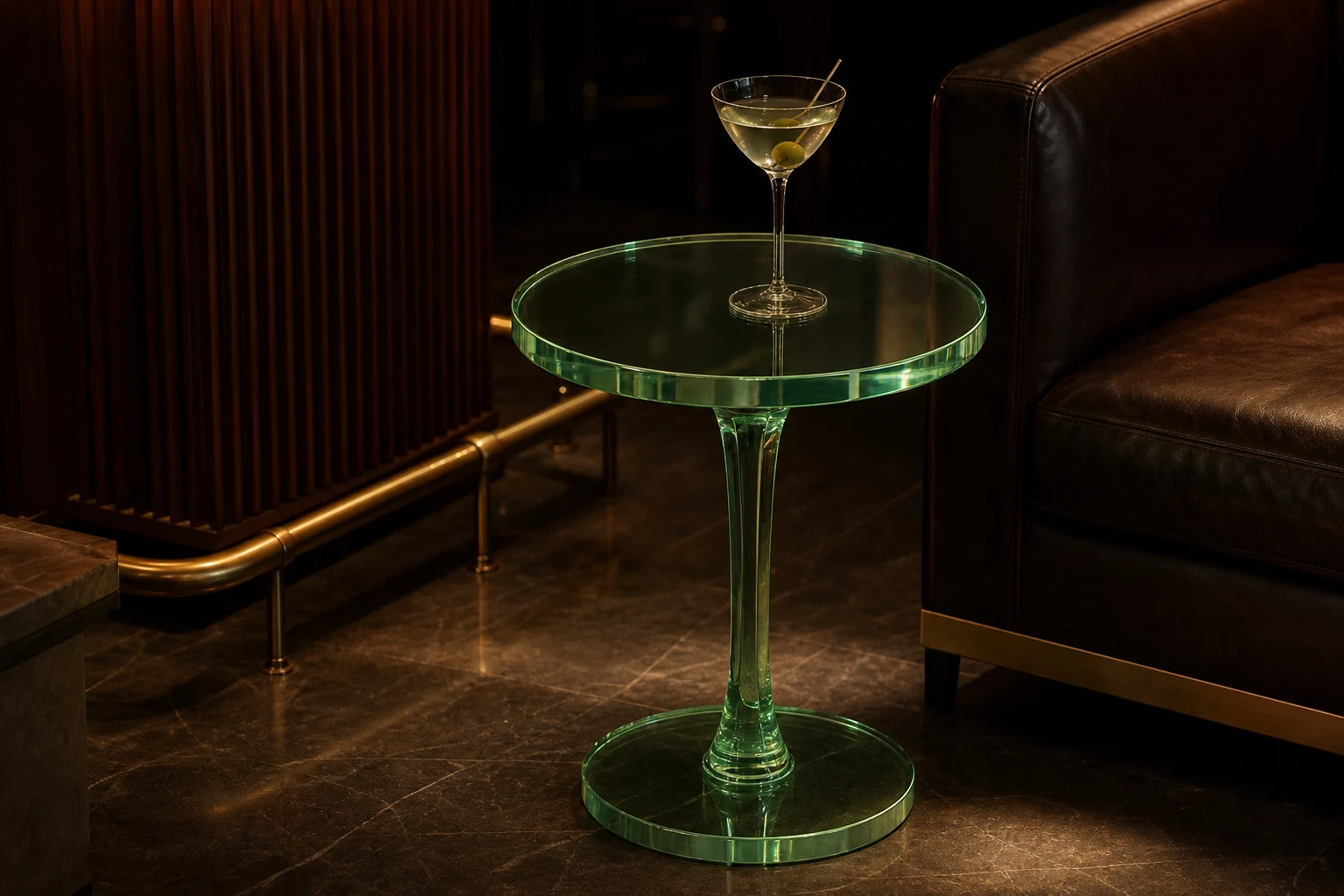
Tall narrow (30cm Ø, 50–55cm tall) on a pedestal or 3-leg base. Lounge seating where the surface holds a single drink or small plate. Most often paired in 2s
Jump to details below ›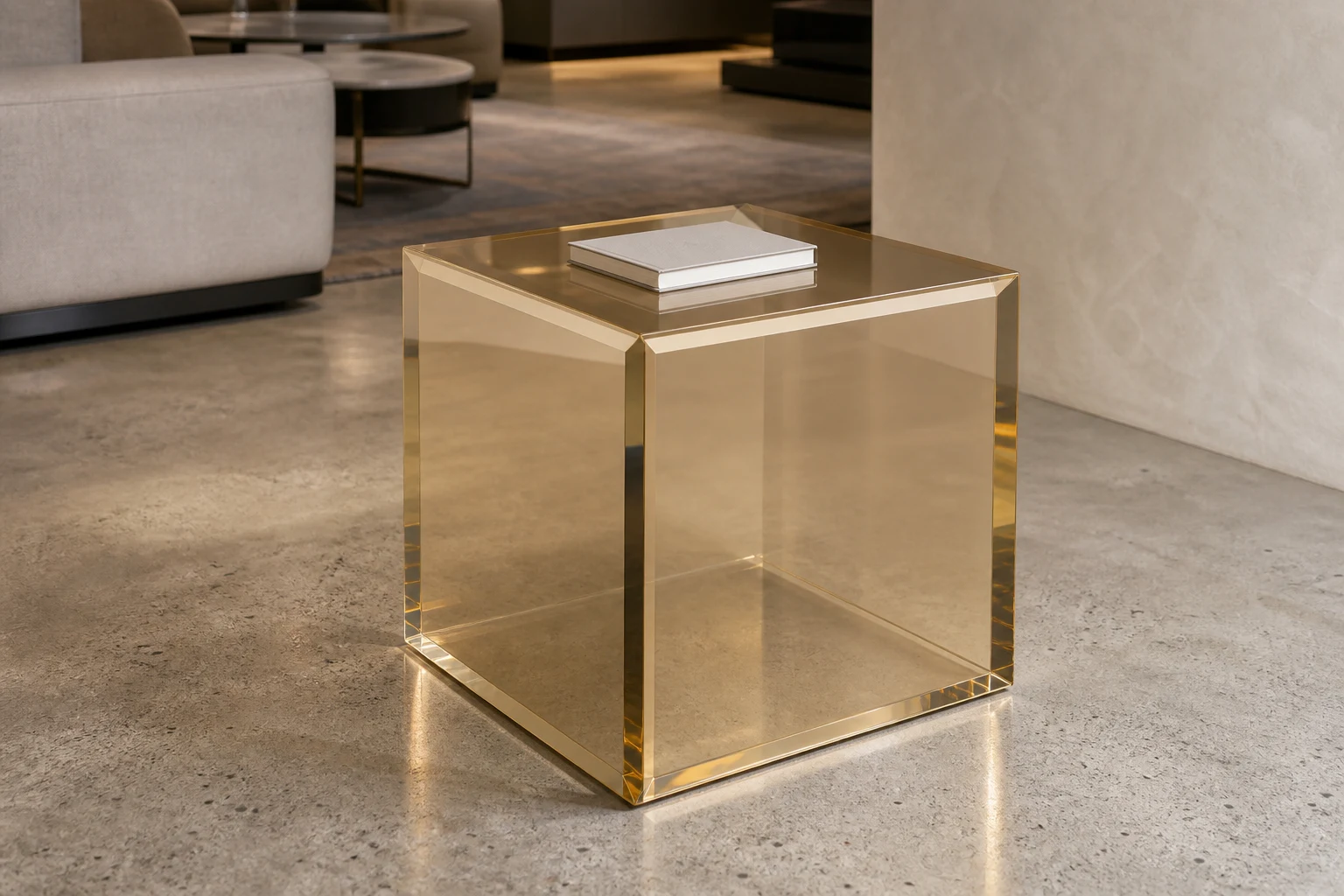
Solid cast acrylic cube (40cm) — sculptural standalone form, doubles as ottoman-side or display platform. Mitered 45° corners for an invisible joint line
Jump to details below ›Need a different furniture type? See the acrylic furniture hub for coffee tables, console tables, dining tables, and chairs.
A custom acrylic side table is a small-scale accent piece — typically 30–60cm wide and 45–60cm tall — built from cast PMMA (also called Lucite or Plexiglas by trade name) instead of wood, metal, or glass. The surface holds a lamp, a drink, a book, a laptop, or a small display object. The geometry matters because side tables are usually paired with seating and visible from every angle, which is why the configuration decision (nesting trio versus single pedestal versus C-table versus cube) drives the design language as much as the material does.
Side tables are where precision tolerances and set economics matter most. A nesting trio has to fit together cleanly — we hold 2–3mm clearance between nested pieces, locked at sample. A round pedestal has to balance under daily housekeeping handling — we taper the pedestal width 20% from base to top for stability without visual heaviness. An accent cube has to read as solid sculpture without visible joint lines — we use 45° mitered corners with optical-clear adhesive, hand-polished before bonding. A C-table has to stay stable under a laptop placed on the cantilevered surface — the base is engineered as a counterweight, not guessed at. The work shows up in small details that are invisible if done right, glaring if done wrong.
Side tables ship most often as part of a coordinated set with coffee tables, consoles, or chairs across a multi-property rollout. We run multi-SKU orders on one production batch with batch color matching enforced as a QC checkpoint between SKUs — the smoke tint on a 30cm drink table has to read identical to the smoke on a 1.2m coffee table at the same property. Send a brief, drawing, or photo of an inspiration piece. Sample 7–10 days; what you approve is what we produce.
Popular with: boutique hotels & resorts · members' clubs · luxury retail flagships · restaurant lounges · corporate lobbies · interior designers on multi-site projects
Discuss Your Project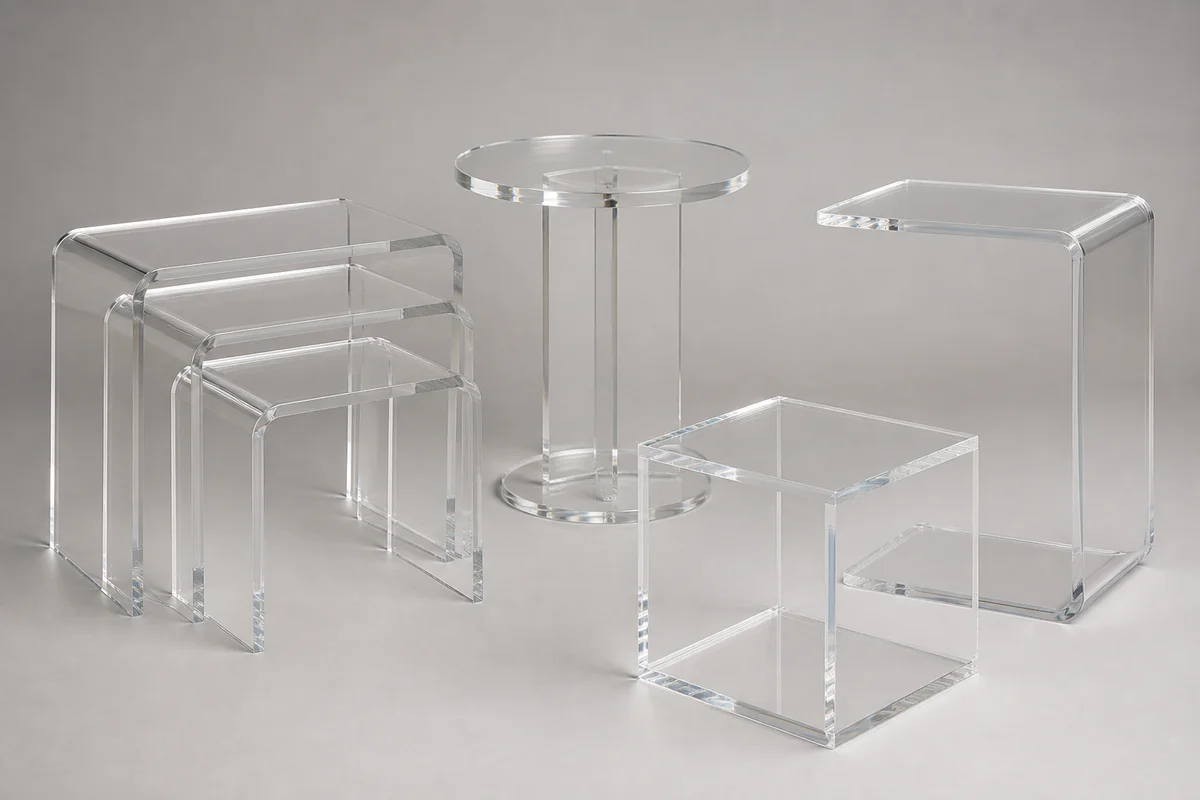
Side tables span a wider configuration range than coffee tables — six distinct geometries, each with its own dimensional band, pairing logic, and typical use case. The table below is our working reference; we confirm exact thickness and base configuration against your room setup during sample.
| Configuration | Dimensions & Construction | Typical Pairing | Use Case |
|---|---|---|---|
| Nesting set of 3 | Tops ~45 × 35cm · heights 45/40/35cm · 20–22mm top · single pedestal or 3-leg | Often paired with a coffee table at matching tint — bundled saves 5–8% on the side line | Hotel guest rooms · restaurant lounge accents · members' club library tables · retail flagship seating zones |
| Round pedestal | 40–50cm Ø · 50–55cm tall · 22–25mm top · single sculptural pedestal (tapered 20%) | Single piece beside a lounge sofa, or as a pair flanking a lobby armchair | Hotel suite accent · boutique hotel lobby seating · luxury retail showroom · gallery rest-zone |
| Rectangular 4-leg | 50 × 50cm × 60cm tall · 20–22mm top · 4 acrylic legs at each corner | Crosses over to boutique-hotel nightstand spec (45 × 35cm × 60cm) — orderable as nightstand line | Hotel guest-room nightstands · restaurant private dining ante-tables · corporate lounge accent |
| C-table | Surface ~40 × 30cm · 50–55cm reach · 20mm top · deep solid base (30mm+ at foot) | Standalone beside a sofa or club chair — rarely paired | Members' club libraries · hotel suite work zones · corporate lounge laptop stations |
| Drink table | 30cm Ø · 50–55cm tall · 22mm top · pedestal or 3-leg base | Almost always in pairs (2 per lounge grouping) — small footprint per piece | Hotel lobby lounges · restaurant cocktail-bar zones · private members' lounges · event-space breakouts |
| Accent cube | 40cm cube · 20–25mm walls · mitered 45° corners · self-supporting five-sided form | Pairs well as bookends flanking a coffee table; doubles as merchandise platform | Corporate lounge accent · luxury retail platform · gallery seating-zone sculpture · hotel suite statement piece |
Working reference for cast PMMA at standard commercial handling loads. Confirmed during sample against your exact spec.
Nesting acrylic side tables fail one of two ways. Too tight — under 2mm clearance — and the smaller table won't lift out of the larger under normal hand pressure. Housekeeping ends up rocking it free, which damages the edge polish over time. Too loose — over 3mm — and the gap reads as imprecision in product photography, especially under directional lighting where the gap throws a visible shadow line. The right clearance is 2–3mm, locked at sample, inspected on every set at packing.
The 2.5mm gap is the working clearance — what lets housekeeping lift the smaller table out one-handed and lets the foam crate insert sit flush in transit. Cast PMMA holds the spec over time; extruded drifts. Every set is stack-tested at packing before it ships.
| Piece | Typical Span | Top / Wall Thickness | MOQ |
|---|---|---|---|
| Coffee Table | 1.0–1.4m | 25–30mm | 10 |
| Side Table (this page) | 0.3–0.6m · trio = 30 pcs | 20–25mm | 10 (per SKU) |
| Console Table | 1.2–1.6m × 0.35m | 25–30mm | 10 |
| Chair | 45 / 65 / 75cm seat | 8–10mm shell | 10 |
| Dining Table | 1.6–2.4m | 30–40mm | 10 |
Side tables look simple — the engineering is in the tolerances and the set economics. Wrong nesting gap reads as either too tight or too loose; wrong cantilever counterweight lets the C-table tip; wrong mitered joint shows a visible seam on the cube; wrong batch color across a multi-property rollout breaks the design coherence. Wetop has been building custom acrylic for B2B buyers since 2008 — 25+ countries, ISO 9001 certified, 2,000+ projects, in-house CNC and diamond polishing.
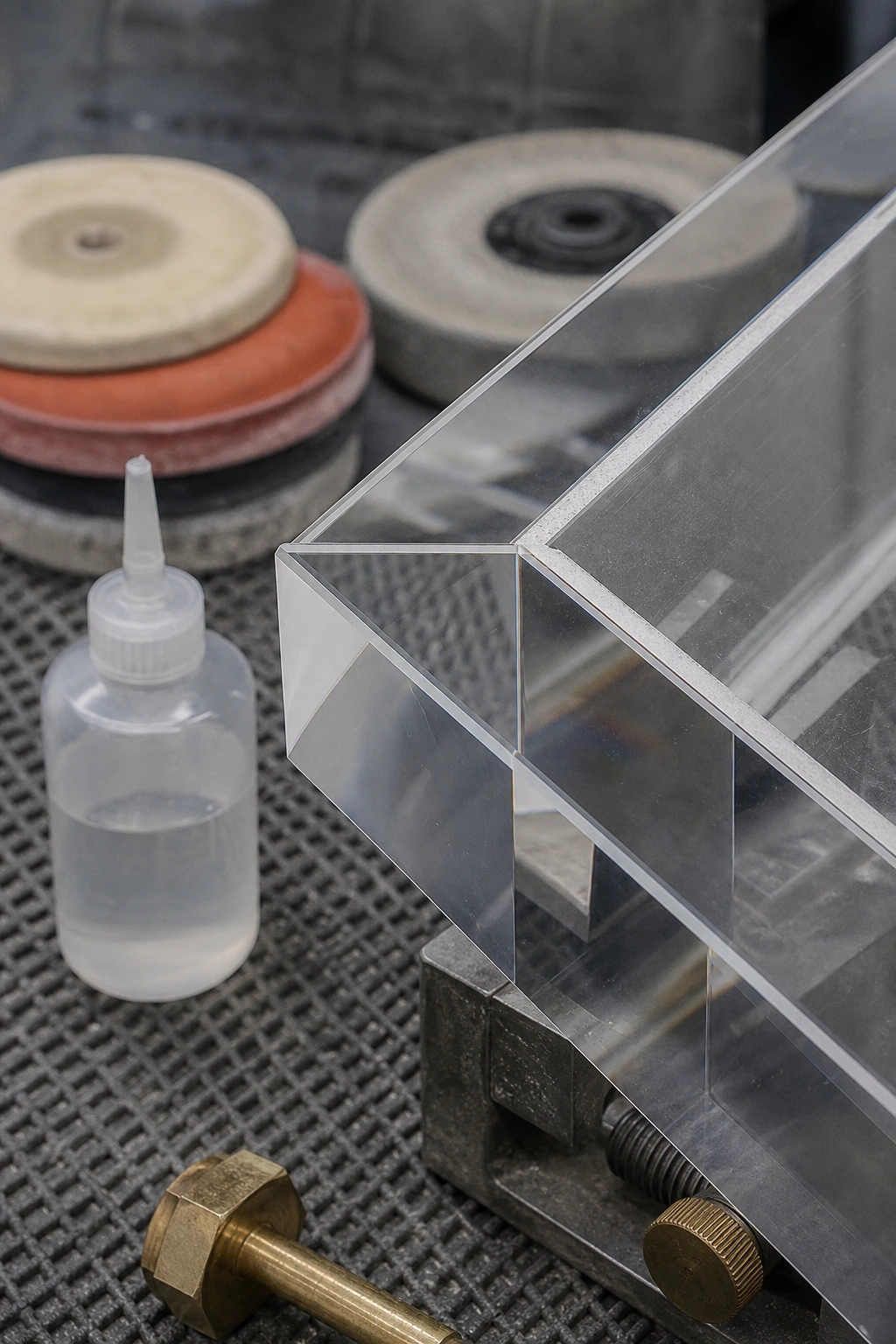
Nesting acrylic side tables fail one of two ways: too tight (the smaller table won't lift out of the larger under hand pressure) or too loose (rattles in transit, photographs sloppy). We hold a 2–3mm clearance between the inner edge of the larger table and the outer edge of the next size down — enough to lift and rotate cleanly, tight enough to look intentional. The clearance is locked at sample, then 100% inspected on every set at packing. Photographed across 12 properties, the gap reads identical.
Side tables almost never ship alone. Nesting trios ship as 3 SKUs × 10 sets = 30 pieces. Drink tables most often run in pairs around lounge seating. Cubes ship as bookends flanking an armchair. We've built our setup, casting, and packaging around set buying — three stepped sizes share one casting run, one polishing batch, one foam-die for crating. The per-piece cost on a coordinated trio is lower than three unrelated SKUs ordered separately, which is why hospitality rollouts default to set buying with us.
Multi-property rollouts depend on the side table matching the coffee table and console exactly: same edge profile, same color tint, same logo placement. We run coordinated orders on one production batch with batch color QC enforced between the smaller and larger pieces — the smoke tint on a 30cm drink table has to read identical to the smoke tint on a 1.2m coffee table at the same property. Coordinated bundling typically saves 5–8% on the side-table line because setup is shared.
Nesting trio, round pedestal, 4-leg rectangle, C-table cantilever, drink table, accent cube. Each has a different structural problem to solve — pedestal sculpting, leg load distribution, cantilever moment, mitered-corner joint integrity. We engineer each configuration against its own failure mode, not against a generic furniture template. The result: a C-table that doesn't tip under a laptop, a cube without visible joint lines, a nesting set that lifts cleanly under daily housekeeping handling.
Our nesting trios had to lift cleanly under daily housekeeping handling — the 2mm clearance held across all 60 sets we ordered. Photographed identically across 12 properties. The trio is the spec we couldn't get from European studios; Wetop delivered it on the first sample.
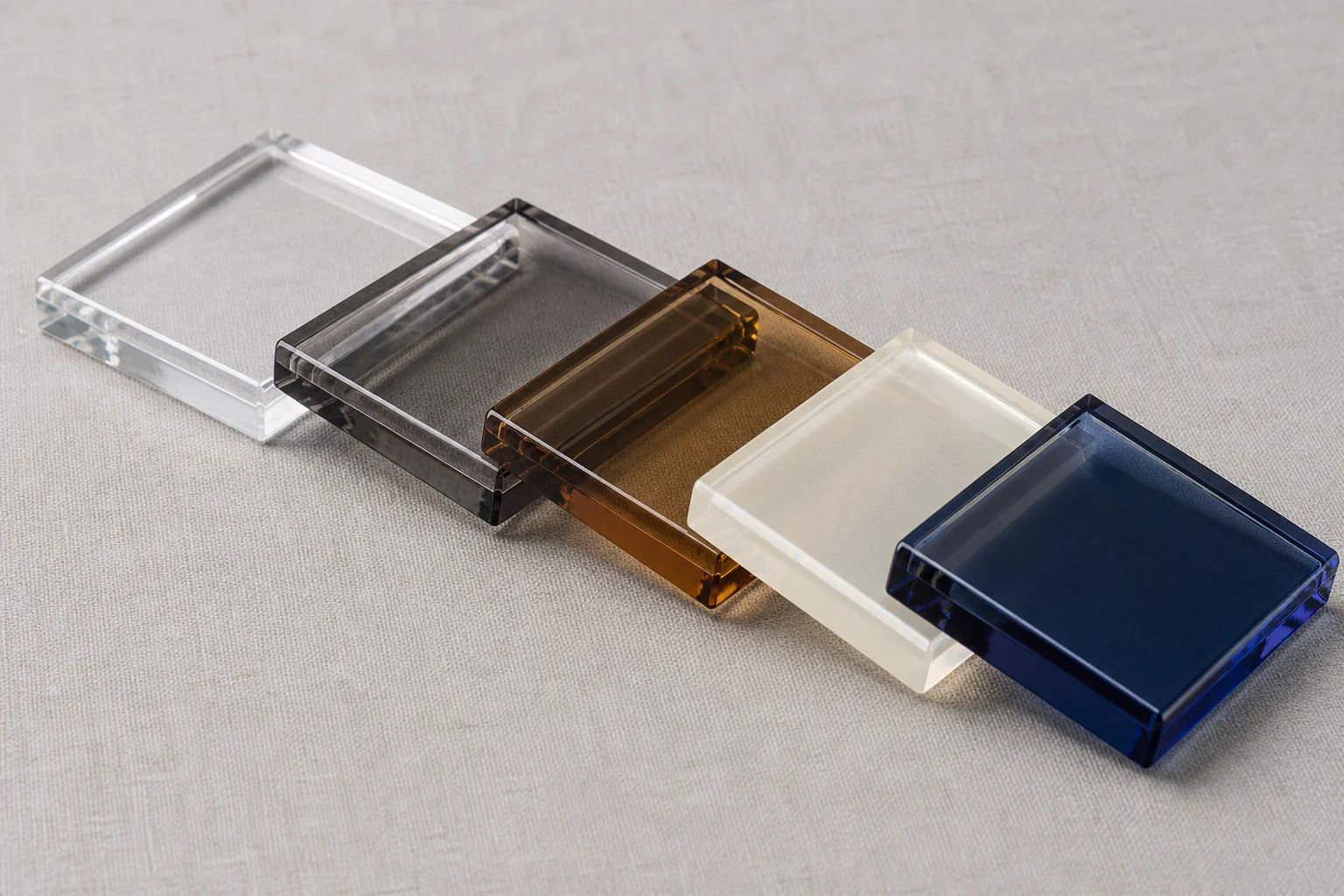
Side tables ship in cast PMMA at 20–25mm top thickness with diamond-polished edges as standard. Five material variants, six edge / finish options, nesting precision held to 2–3mm clearance on every trio, and cantilever counterweight engineered to the C-table's reach depth.
| Material | Properties |
|---|---|
| Clear cast PMMA | 92% light transmission, optical clarity |
| Smoke tint | Whole-body grey-tinted cast — softens light, common on hotel suite spec |
| Bronze tint | Warm amber tone — pairs with wood-and-leather club interiors |
| Pearlescent | Soft milky-translucent finish — light passes, objects blur |
| Custom Pantone-match | Color through the body, matched to brand reference; held batch-to-batch |
| Finish | Result |
|---|---|
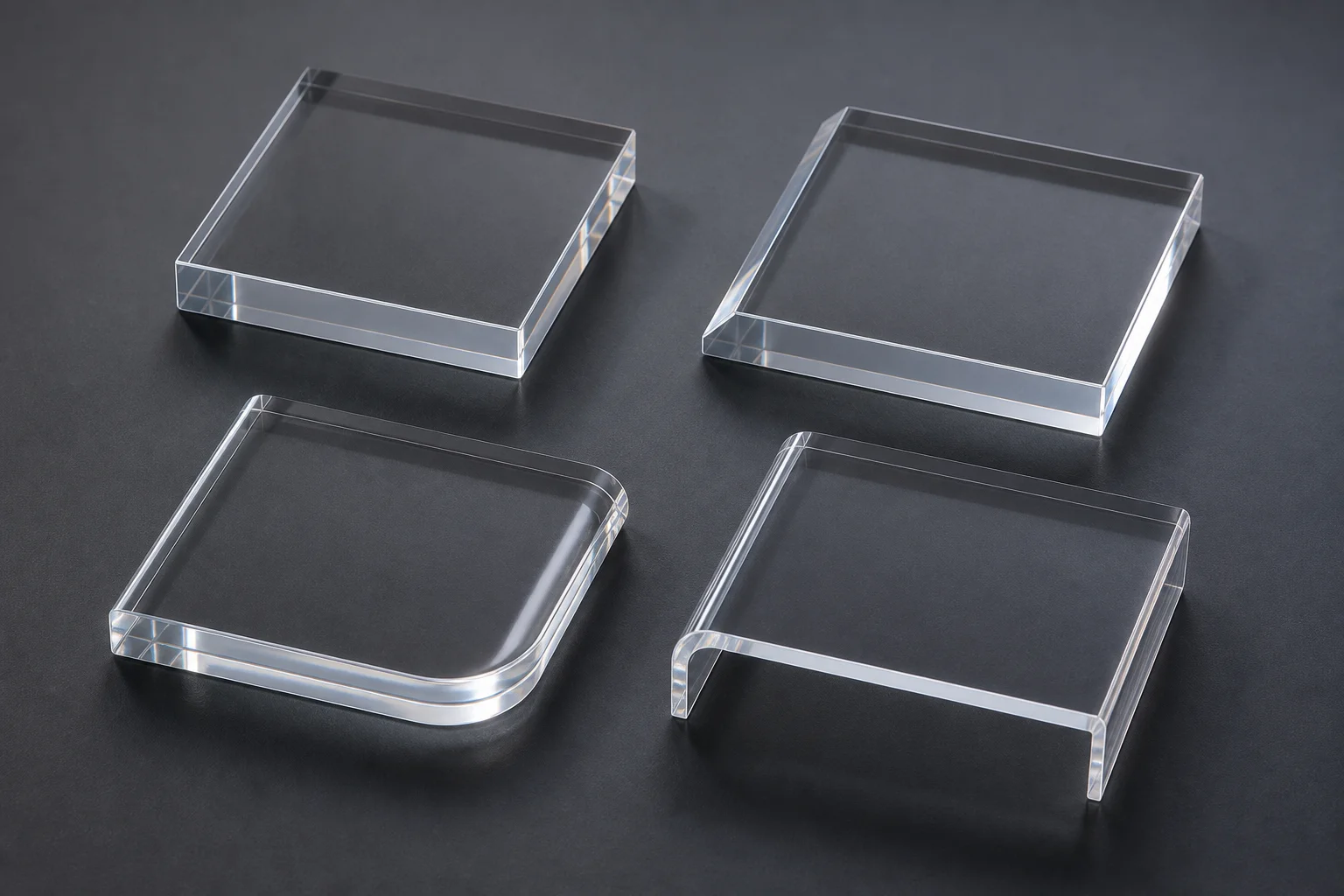
| Diamond polish (standard) | Optically clear edge — reads like glass on every visible edge |
| 45° chamfered | Light-catching angled edge — most common on rectangular 4-leg tops |
| Bull-nose rounded | Softer corner — used on pedestal tables and lounge pieces |
| Mirror-polished (extra-fine) | Final-pass polish — most-ordered on accent cubes where the edge IS the visual element |
| Subsurface laser engraving | Frosted-white logo inside the body of the top, permanent, no surface wear |
| UV print on hidden underside | Full-color logo, invisible from the room side |
| Spec | Details |
|---|---|
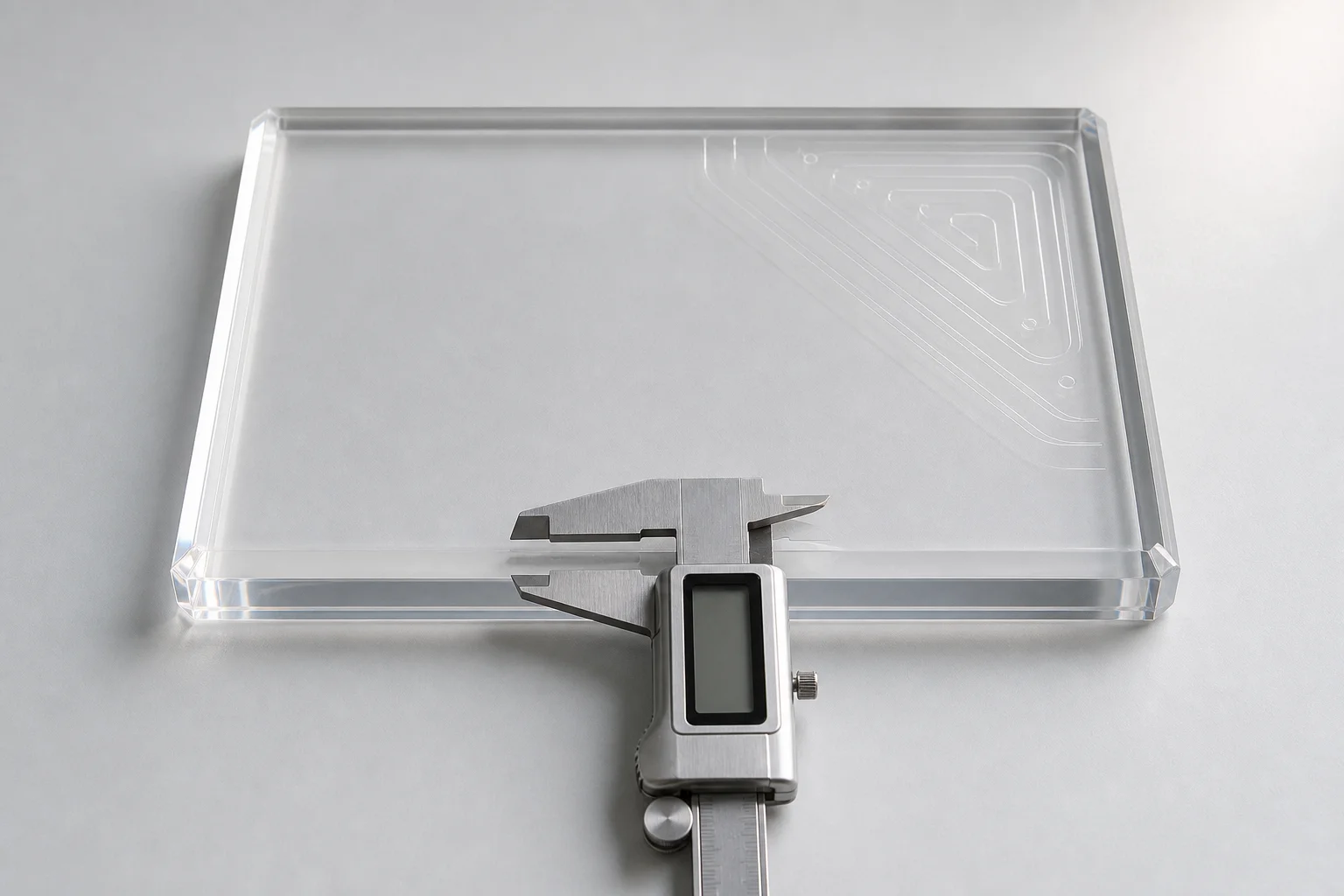
| Top thickness | 20–25mm sized to span + handling load |
| Max single-piece span | 60cm diameter / 50 × 50cm rectangular |
| Base architecture | Single pedestal · 3-leg · 4-leg · C-frame cantilever · mitered cube |
| Nesting precision | 2–3mm clearance between sizes — locked at sample, 100% inspected at packing |
| C-table counterweight | 30mm+ base thickness, base longer F-B than surface is wide |
| Cube joint | 45° mitered, hand-polished before bonding, optical-clear adhesive, fixture-cured |
| MOQ | 10 pieces per unique SKU (nesting trio = 30 pieces / 10 sets) |
| Sample lead time | 7–10 days |
| Production lead time | 18–25 days for 10 sets |
The six configurations don't share a single finish default — each has a preferred edge profile that matches its visual role in the room. The table below is the working pairing we quote against unless the brief calls for an override.
| Configuration | Default Edge Profile | Default Surface Finish | Why This Pairing |
|---|---|---|---|
| Nesting trio | Diamond-polished square or 45° chamfered | Clear or matched tint across set | The trio is photographed as a set — chamfered edges catch light identically on all three pieces, which reads as deliberate design. |
| Round pedestal | Bull-nose rounded | Smoke or bronze tint common | Bull-nose softens the round edge under hand contact — the pedestal table is touched and brushed past more than any other configuration. |
| Rectangular 4-leg | 45° chamfered | Clear standard; tinted on suite spec | Chamfered reads as an intentional design line on the rectangular top, especially when paired with armchair upholstery. |
| C-table | Diamond-polished square | Clear standard | The C-table is a work surface — square edges sit flush against a laptop case without rocking. |
| Drink table | Bull-nose or chamfered | Clear or single accent tint per pair | Lounge bar context — softer edges read warmer; chamfered catches the bar lighting. |
| Accent cube | Mirror-polished (extra-fine) | Clear, bronze, or pearlescent | The cube IS the visual element — mirror polish on every face turns the cube into a sculptural object that catches every room light. |
Not sure what configuration fits your room? Send us a brief, drawing, or reference image — we recommend configuration, dimensions, edge profile, and base architecture based on your seating layout and brand interior reference.
Get Configuration RecommendationsFour of our six configurations (nesting, pedestal, 4-leg, drink table) share a common engineering pattern — a tabletop on a base. Two configurations are different: the C-table is a cantilever (the surface reaches over the seat without a leg under it), and the accent cube is a hollow five-sided form joined at mitered corners. Both have their own engineering problem, and both are the configurations where a generic "side table" factory falls down.
A C-table slides under a sofa or armchair so the surface sits over the seat at laptop or coffee-cup height. The reach — front-to-back from where the base contacts the floor to where the surface sits over the seat — is typically 50–55cm. That reach creates a tipping moment: a 5kg laptop placed at the far edge of the surface multiplied by the moment arm has to be absorbed by the base.
The engineering call is the base mass and footprint, not the surface thickness. We use a deep solid acrylic base (30mm+ thickness at the foot, sometimes stepped to 40mm), with the base longer front-to-back than the surface is wide. The result: the table doesn't shift or tip when used as a real laptop surface in a members' lounge. Sample step: we test the table with a 5kg laptop weight placed at the worst-case far edge of the surface, with a 2kg forearm load on top, and confirm the C-table holds level under the combined load. That's the only test that matters.
An accent cube is five 20–25mm cast acrylic panels joined into a hollow form (or in larger sizes, a solid block CNC-shaped from a thick cast slab). The five-sided cube has five seams — front edge to top, top to back, top to left side, top to right side, back to base contact. Each seam is the failure point: any visible joint line reads as poorly made, even at arm's length.
Each cast PMMA panel is cut 2–3mm larger than the finished dimension, leaving stock for the miter pass and a final clean-up cut.
CNC mills the 45° miter into the inside face of every panel in a single program, so all five faces meet at true 90° outside corners.
Operators polish the miter face under magnification to erase machining lines — any tool-mark left behind reads as a visible seam after bonding.
Optical-clear two-part adhesive wicks into the joint by capillary action; a precision fixture clamps the assembly for the full cure window so the bond line stays invisible.
Each of the six configurations has its own dimensional band, base architecture, use space, and pairing logic. The cards below show the working spec for each — useful for narrowing down the configuration before you send a full brief.
Spec: Stepped heights 45/40/35cm. Top sizes typically ~45 × 35cm. 20–22mm cast PMMA tops. Single pedestal or 3-leg base. 2–3mm clearance between sizes — locked at sample, inspected at packing.
Use space: Hotel guest rooms, members' club libraries, restaurant lounge groupings, retail flagship seating zones. The trio tucks compact when not in use and fans out for service when guests arrive.
Pairing: Often coordinated with a matching coffee table in the same tint. Bundling saves 5–8% on the side line.
Spec: 40–50cm diameter top at 50–55cm height. 22–25mm cast top. Single sculptural acrylic pedestal, tapered 20% from base to top for stability without visual heaviness. Diamond-polished edges as standard.
Use space: Boutique hotel suites, lobby lounge seating zones, gallery rest-areas, retail flagship displays. The floating-top appearance suits high-end interiors where the table has to recede so seating and merchandise carry the visual weight.
Pairing: Single beside a lounge sofa, or paired in 2s flanking a lobby armchair. Works as a standalone hero piece in suite design.
Spec: 50 × 50cm × 60cm tall is the most-ordered geometry. 20–22mm top. Four acrylic legs at each corner. Lightest visual footprint of the six configurations — the table reads as 'almost invisible' alongside a heavier armchair or sofa.
Use space: Hotel guest-room nightstands (45 × 35cm × 60cm spec), restaurant private dining ante-tables, corporate lounge accent pieces. The rectangular profile crosses over to nightstand line for boutique hospitality.
Pairing: Pairs with vintage seating, brass-finish chairs, or where the seating itself is the visual statement. Mixes with wood and leather without competing.
Spec: C-shaped frame slides under a sofa or armchair, surface positioned over the seat at laptop or coffee-cup height. Surface ~40 × 30cm, reach depth 50–55cm. 20mm top. Deep solid acrylic base, longer front-to-back than the surface is wide, weighted (30mm+ thickness at foot) to counter the tipping moment.
Use space: Members' club libraries, hotel-suite work zones, corporate lounge laptop stations. Anywhere the user wants a stable surface over the seat without dragging a coffee table across the room.
Pairing: Standalone beside a sofa or club chair — rarely ordered as a pair. Often specified alongside the lounge chair brand-spec for a coordinated workstation feel.
Spec: Tall narrow geometry — 30cm Ø top at 50–55cm height. 22mm top. Pedestal or 3-leg base; pedestal more common because of the small footprint. Holds a single drink, a phone, a small plate — not a laptop.
Use space: Lounge bars, hotel lobby seating zones, restaurant lounge waiting areas, private members' lounges, event-space breakouts. The footprint is small enough to fit between two lounge chairs.
Pairing: Almost always specified in pairs — 2 per lounge grouping is the standard hospitality unit. Multi-property rollouts often order 24–60 pieces across 12–30 properties.
Spec: Solid-reading cast acrylic cube — 40cm cube standard, 35cm and 45cm also common. Walls are 20–25mm cast acrylic joined at 45° mitered corners with optical-clear adhesive — joint line invisible at arm's length. Sits as a sculptural standalone object that doubles as a surface.
Use space: Corporate lounge accent pieces, luxury retail merchandise platforms, gallery seating-zone sculpture, hotel suite statement pieces. Reads as half furniture, half sculpture; specified by interior designers who want a single dramatic acrylic piece per room.
Pairing: Pairs well as bookends flanking a coffee table or sofa. Doubles as a merchandise display platform in retail showrooms — common in luxury watch and jewelry brands.
Side tables ship most often as part of a coordinated multi-SKU order — hospitality groups, luxury retail flagships, restaurant lounges, corporate offices, galleries and members' clubs, and interior designers managing multi-site projects. Single-SKU MOQ is 10 pieces; nesting trios require 30 pieces (10 sets) because each height is a separate SKU.
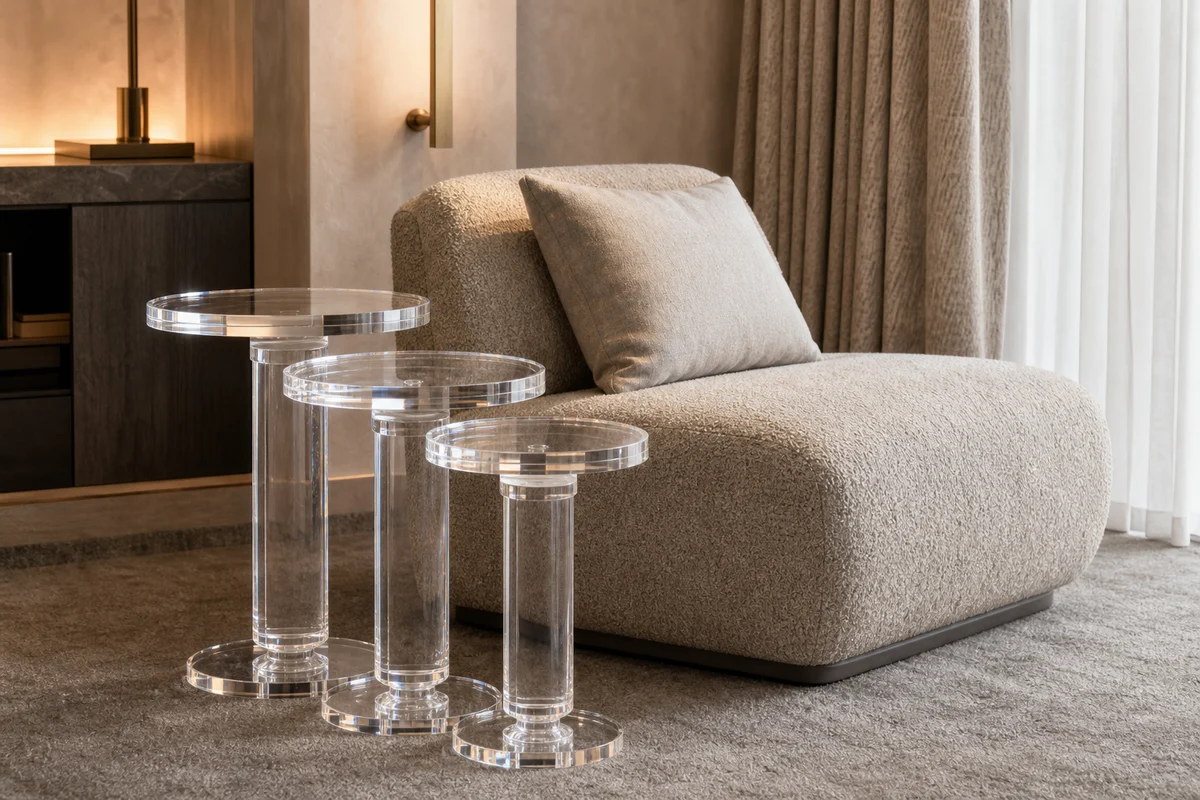
Guest-room nesting trios, suite cocktail tables, lobby lounge accents. Multi-property rollouts of 18–60 pieces with batch color matching across production runs. Round-pedestal singles and nesting sets dominate the order mix.
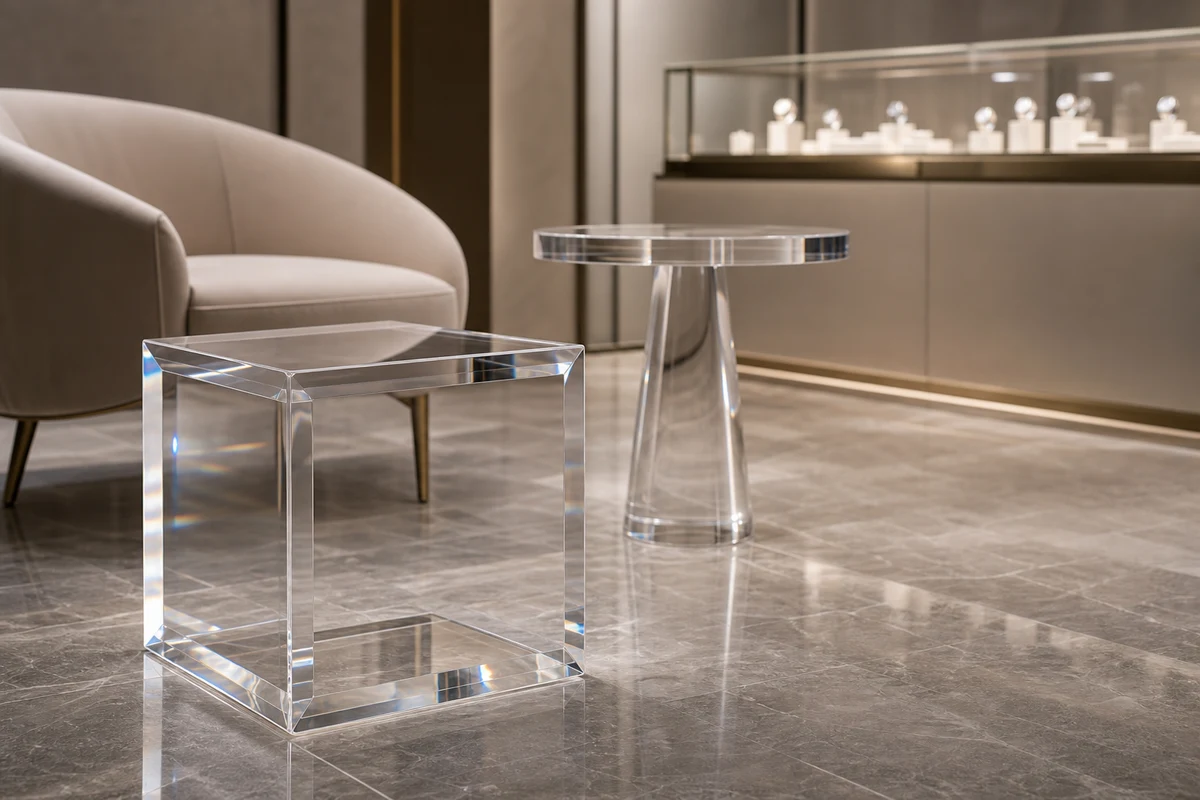
Pedestals doubling as merchandise display platforms, accent cubes as low pedestals for watch or jewelry display, drink tables in the seating zone. Often paired with a centerpiece coffee table on the same PO.
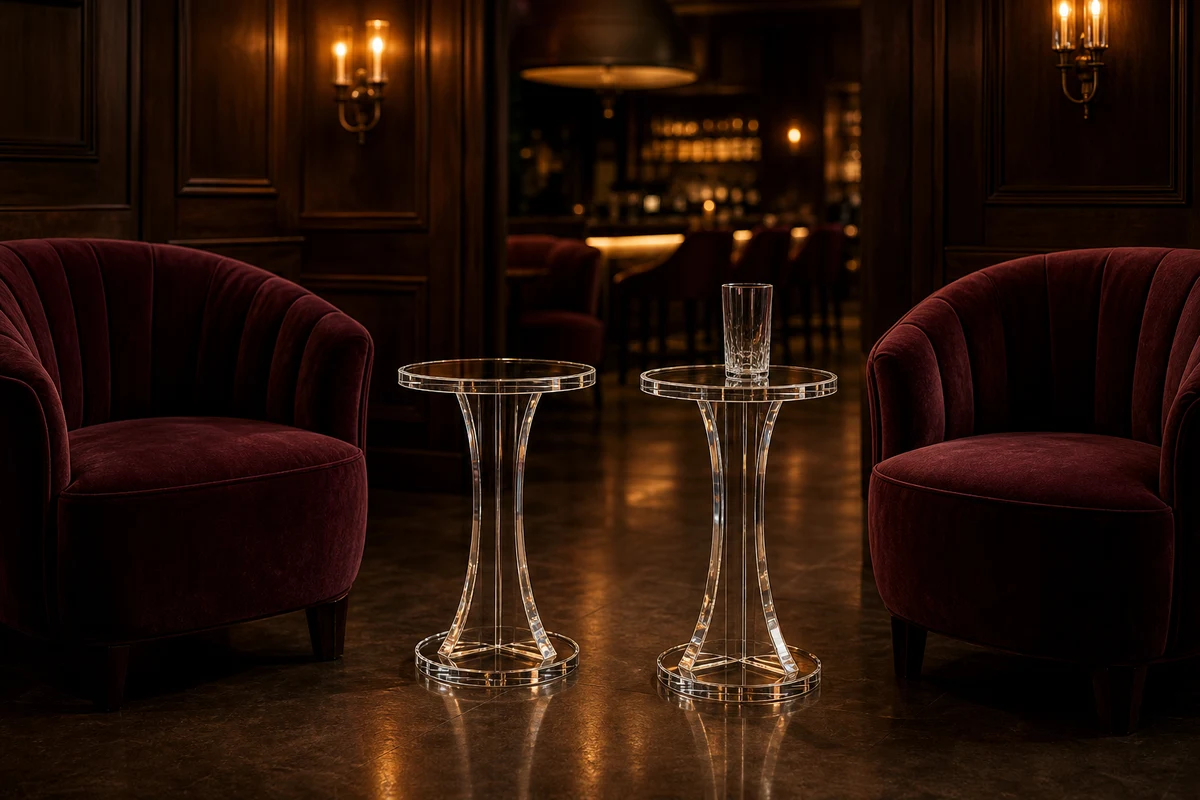
Cocktail tables, ante-tables in private dining waiting zones, drink-tables in bar lounges. Edge durability and lifted weight matter — the table is handled daily by service staff and lifted to clean under.
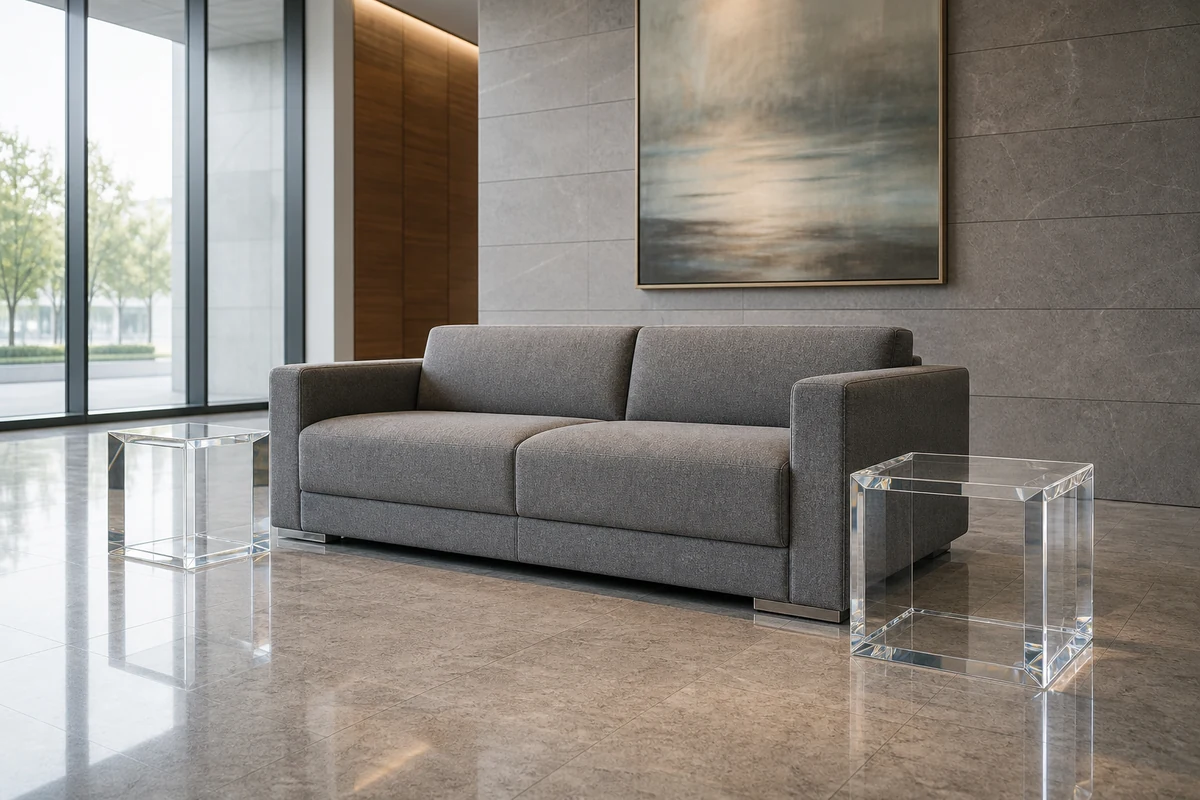
Accent cubes flanking reception seating, drink tables in executive lounge groupings, rectangular 4-leg side tables beside brand-color tinted coffee tables. Coordinated orders on one PO.
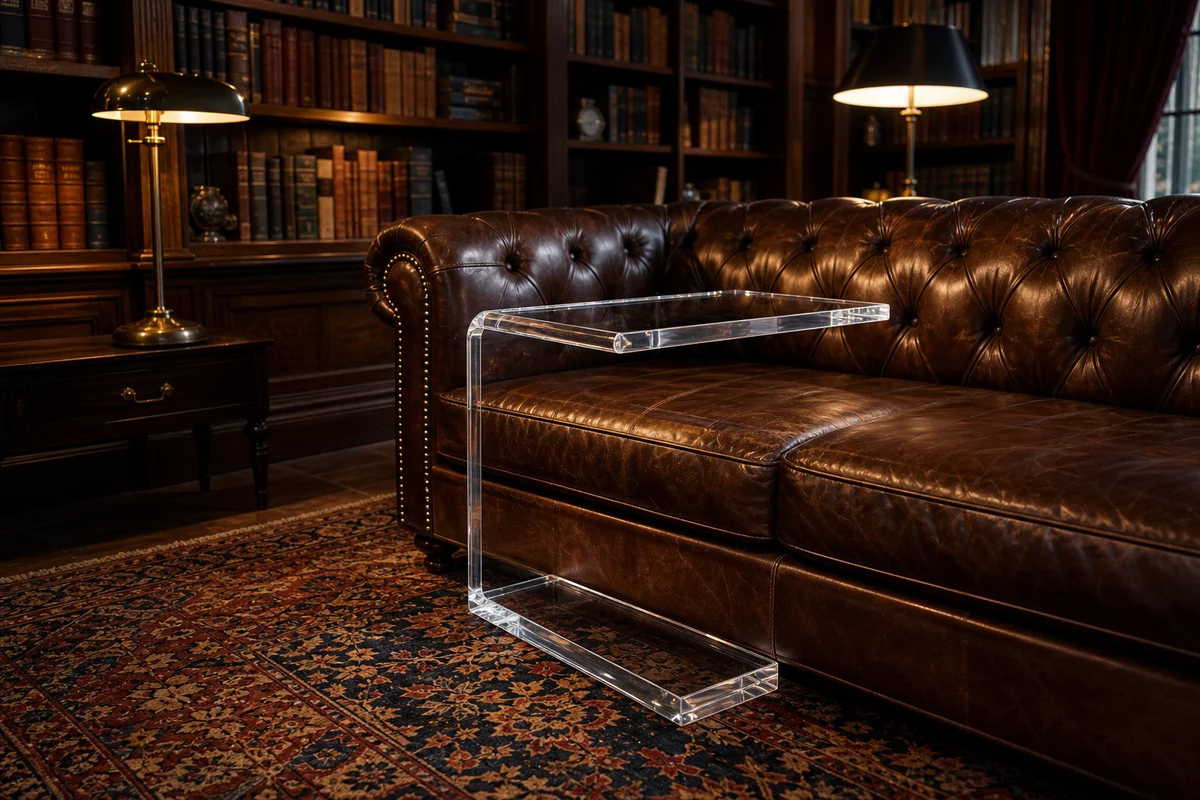
C-tables for laptop work over a sofa arm, round pedestals beside leather club chairs, gallery seating-zone side tables. Subsurface engraved club mark; smoke or bronze tint typical.
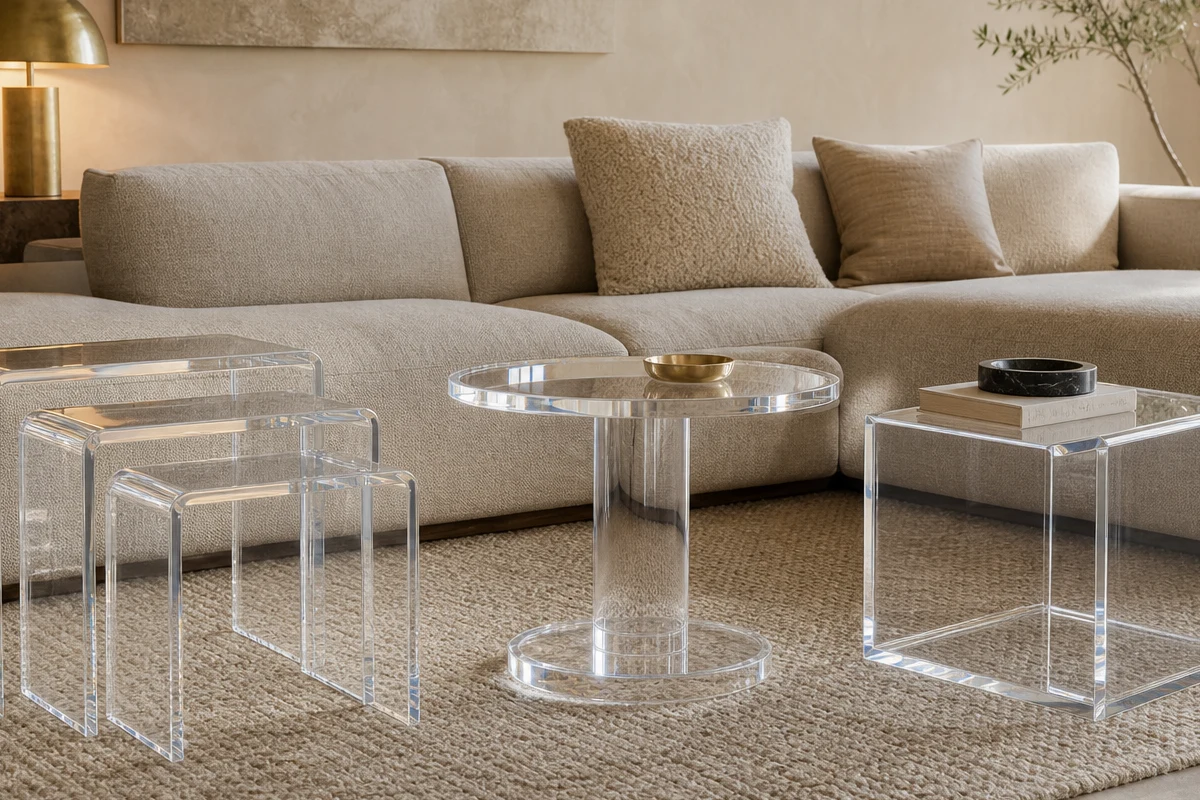
Mixed-color nesting sets and graduated tints across multi-site installations. Designers managing 6+ residential or hospitality projects spec side tables as part of a coordinated whole-room rollout on one PO.
Representative side-table projects from the past 18 months — luxury retail nesting trios, boutique hotel pedestals, members' club C-tables, corporate lounge cubes.
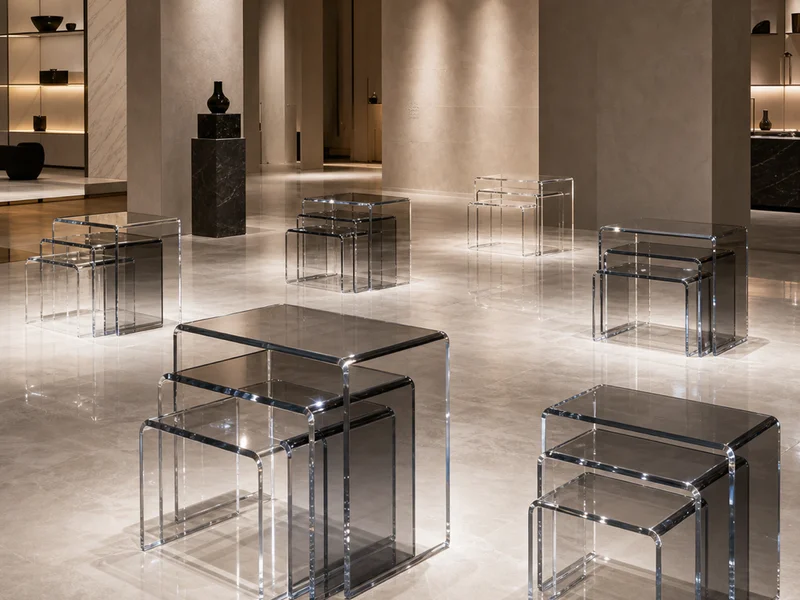
30 pieces (10 sets of 3) · 22mm clear cast acrylic · stepped heights 45/40/35cm · single pedestal base · diamond polish · graduated clear-to-smoke tint across the set · 2.5mm nesting clearance held across all 10 sets
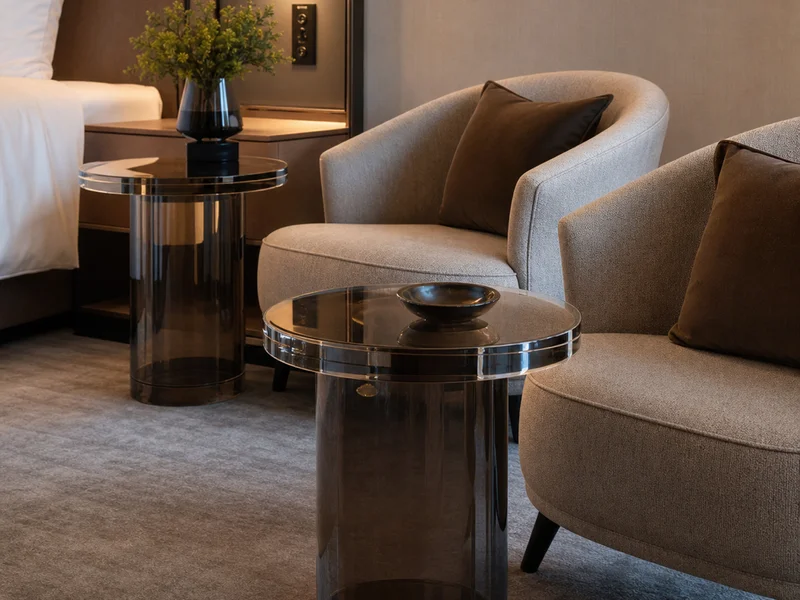
36 pieces · 22mm smoke-tinted cast acrylic · 50cm Ø top · single sculptural pedestal tapered 20% · bull-nose edge · brand-color smoke tint matched batch-to-batch across 12 properties
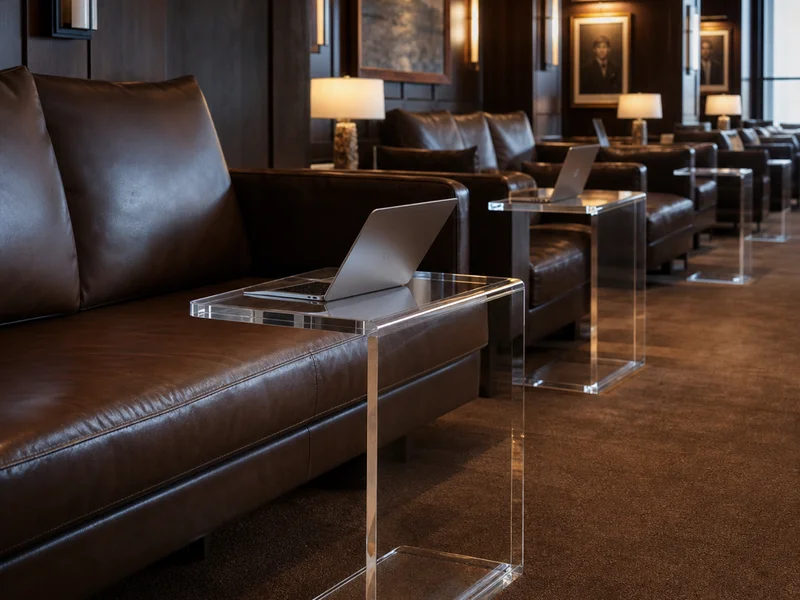
10 pieces · 20mm clear cast acrylic top · C-frame cantilever · 50cm reach · subsurface laser-engraved club mark on the visible top · 30mm solid acrylic base counterweight for stability under laptop load
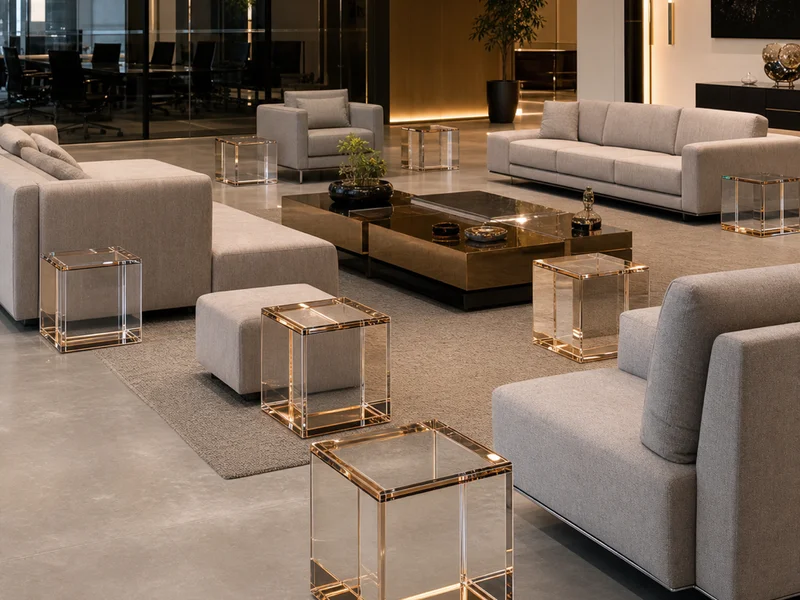
8 pieces (paired flanking 4 lounge groupings) · 25mm cast acrylic walls · 40cm cube · mitered 45° corners with optical-clear bond · clear-with-bronze-accent gradient · paired with bronze-tinted coffee tables on same PO
The nesting sets across twelve flagships look identical. Our visual merchandising team confirmed batch color match across two production runs and 2.5mm nesting clearance held on every set. Set economics worked too — 30-piece trio order priced like a single SKU run, which kept the per-store rollout inside budget.
Have a similar side-table project?
Start a Similar ProjectSide-table quotes are built up from six factors: set complexity (trio vs single), pedestal sculpting, C-table cantilever engineering, cube mitered-corner construction, color and branding, and order quantity. The biggest cost lever isn't unit price negotiation — it's coordinated bundling with coffee tables, consoles, or chairs on one PO, which typically saves 5–8% on the side-table line through shared setup.
Nesting trios add ~10% per set over three identical singles because each height is a separate cutting program, different top thickness call, and different polishing pass. The trade: setup is shared across the three sizes, so the trio still costs 15–20% less than three unrelated SKUs of similar size ordered separately. Mixed-tint nesting (e.g. graduated smoke across 3 heights) adds another 5–10% — each tone is a separate cast batch.
A round-pedestal table on a single tapered acrylic base adds 15–25% over a 4-leg version of the same top dimension. The pedestal is CNC-shaped from a thicker cast block (30mm+ at the base, tapered to 22mm at the top contact), then diamond-polished on all visible curves. Custom pedestal forms — torus, hourglass, twin-column — are quoted per design but typically add 25–35% over the standard tapered cylinder.
C-tables run +10% over a same-surface-area rectangular 4-leg. The cantilever requires a deep solid base (30mm+ at the foot, longer front-to-back than the surface is wide) to absorb the tipping moment under laptop load. We model the moment at sample and adjust base mass — the C-table that ships isn't a guessed dimension, it's an engineered counterweight to the cantilever load. The math costs setup time, which prices in.
Accent cubes add +15% over a 4-leg rectangular of equivalent material weight. The five-sided cube joins at 45° mitered edges with optical-clear adhesive — the joint line has to be invisible at arm's length, which means hand-polishing the miter before bonding and pressure-curing the joint under a fixture. Mirror-polished cube faces add another 10% on top — most-ordered when the cube is the room's hero piece.
Clear cast PMMA is the lowest-cost finish. Whole-body smoke / bronze / pearlescent tints add 15–25% to material cost. Custom Pantone-match adds another 5–10% over standard tints. Subsurface laser engraving (frosted-white logo inside the body of the top) is the cleanest brand integration on a small surface — placement on the top edge or center is optimal. UV print on the hidden underside is the alternative when the visible top must stay unmarked.
Unit cost drops 18–25% between MOQ 10 and 50 pieces per SKU on a single configuration. Coordinated orders bundling side tables with coffee tables or consoles share setup, color casting, and crating — typically shaving another 5–8% off the side-table line. The biggest single lever for a multi-property rollout buyer is bundling all furniture types on one PO, not negotiating side-table unit price in isolation.
For broader furniture pricing context, see the acrylic furniture hub.
From your first message to delivered side tables — 3 steps, with set-size and coordination logic baked in.
Tell us the configuration (nesting trio, round pedestal, 4-leg rectangle, C-table, drink table, or cube), the dimensions, top thickness preference, edge profile, base type, color tint, branding, and quantity per SKU. Crucially, tell us whether you're ordering as pairs / trios / sets, and whether the side tables coordinate with coffee tables, consoles, or chairs on the same PO. Coordinated rollouts get bundled pricing.
We respond within 24 hoursWe CNC-cut and edge-polish one representative piece — typically the medium-height table from a nesting trio, or the round pedestal at base spec. For nesting orders we also confirm the 2–3mm clearance against the larger size at sample. Same cast acrylic gauge, edge finish, color tint, and logo placement as bulk. Sample fees are paid separately and are not credited to production orders; the approved sample is the QC reference for the production batch.
Sample ready in 7–10 daysEvery piece passes 100% inspection: edge polish, surface clarity, color batch match between SKUs (the smoke tint on a 30cm drink table has to read identical to the smoke on a 1.2m coffee table at the same property), and nesting clearance held to 2–3mm on every trio. Reinforced crating for sea freight, sized per SKU; air-first batch available for fixed-date launches. FOB Shenzhen; CIF and DDP available.
Production 18–25 days for 10 setsA custom acrylic side table is a small-scale accent piece — typically 30–60cm wide and 45–60cm tall — built from cast PMMA (also called Lucite or Plexiglas by trade name) for use beside lounge seating, hotel beds, restaurant lounges, and showroom display zones. We build six core configurations: nesting sets of 3, round pedestals, rectangular 4-leg, C-tables that slide under a sofa, tall narrow cocktail/drink tables, and solid accent cubes. Every piece is cast acrylic (not extruded), diamond-polished on every visible edge, and sized to the handling load and span of its specific use.
Three SKUs. Each stepped height in a nesting set is a separately CNC-cut and edge-polished piece, with its own cutting program, top thickness call, and base spec. We treat them as three SKUs against the MOQ, which means a nesting trio at minimum-order pricing is 10 sets × 3 pieces = 30 pieces total. That math catches a lot of first-time buyers off guard, so we flag it on the first quote. The upside: nesting trios share setup across the three sizes on one production run, so the per-piece cost is lower than three unrelated SKUs ordered separately.
We hold 2–3mm clearance between the inner edge of the larger table and the outer edge of the next size down. Tighter than that and the smaller piece won't lift out cleanly under hand pressure — housekeeping ends up rocking it free, which damages the edge polish over time. Looser than that and the gap reads as imprecision in product photography. We confirm the clearance against your sample set before we cut bulk, and 100% inspect the clearance on every set at packing. If the room layout means the tables need to nest in a non-standard sequence (e.g. tallest on the outside), we re-tune the clearance for the reversed stack at sample.
Nesting sets of 3 in stepped heights — typically 45cm / 40cm / 35cm — are the workhorse hospitality SKU. The trio tucks neatly under itself when not in use, fans out for service when guests arrive, and reads as one coherent design piece in the room. Round 40–50cm diameter tops on a single sculptural acrylic pedestal is the most-ordered single-piece geometry; rectangular 50 × 35cm at 50cm tall with 4 acrylic legs is the second-most common. C-tables and accent cubes are specialty configurations — high-impact in members' clubs and corporate lounges but lower-volume than the nesting and pedestal staples.
Yes — boutique-hotel nightstand orders are a regular use of our side-table line. The typical nightstand spec is 45 × 35cm at 60cm tall, which sits just outside our smallest rectangular 4-leg side table dimension. We extend the legs to nightstand height, often add a discreet shelf or routed lamp-cord channel along the rear edge, and run the same diamond-polished cast PMMA finish as the rest of the room's side tables. A coordinated rollout — bedside nightstand + lounge area side table + suite cocktail table in matching tint — is a common one-PO order across 12–60-property hospitality groups.
10 pieces per unique SKU. A nesting set of 3 different heights counts as 3 SKUs, so the working minimum for nesting is 30 pieces — 10 sets of 3 — when ordering trios at MOQ. A single-height standalone side table SKU can go as low as 10 pieces. Pair-ordered configurations (drink tables placed in 2s alongside a lounge sofa, cubes placed in 2s flanking an armchair) most often run 10–20 pairs per design, which means 20–40 pieces. Multi-property hospitality rollouts typically run 24–60 pieces per SKU; luxury retail showrooms order 10–18 pieces per design.
Yes — coordinated multi-piece sets across furniture types is the most common multi-property hospitality order. We match edge profile, color tint, and logo treatment across coffee tables, side tables, consoles, and chairs on one purchase order. Batch QC enforces color consistency between SKUs. Coordinated bundling typically saves 5–8% on the side-table line because the setup, color casting, and packaging design are shared with the larger pieces. If a rollout spec calls for a clear-with-bronze-accent suite across 18 properties, that's a single production run for us — not 18 separate jobs.
C-table stability is an engineering call, not a finish call. The cantilever — typically 50–55cm of reach over a sofa or armchair seat — applies a tipping moment that has to be absorbed by the base. We use a deep solid acrylic base, longer front-to-back than the surface is wide, and weighted to counter the moment under a 5–8kg laptop plus a forearm pressing down. The cast PMMA base is typically 30mm+ at the foot. The result: the C-table doesn't shift or tip when used as a real laptop surface, which is the only test that matters in a members' lounge or hotel suite.
Tell us the configuration (nesting trio, pedestal, 4-leg, C-table, drink, cube), set size (pairs, trios), dimensions, edge profile, tint, branding, and quantity per SKU. Coordinated orders bundling side tables with coffee tables, consoles, or chairs on one PO get 5–8% bundle savings on the side line. We respond within 24 hours. MOQ 10 pieces per SKU; nesting trio = 30 pieces (10 sets). Sample 7–10 days.