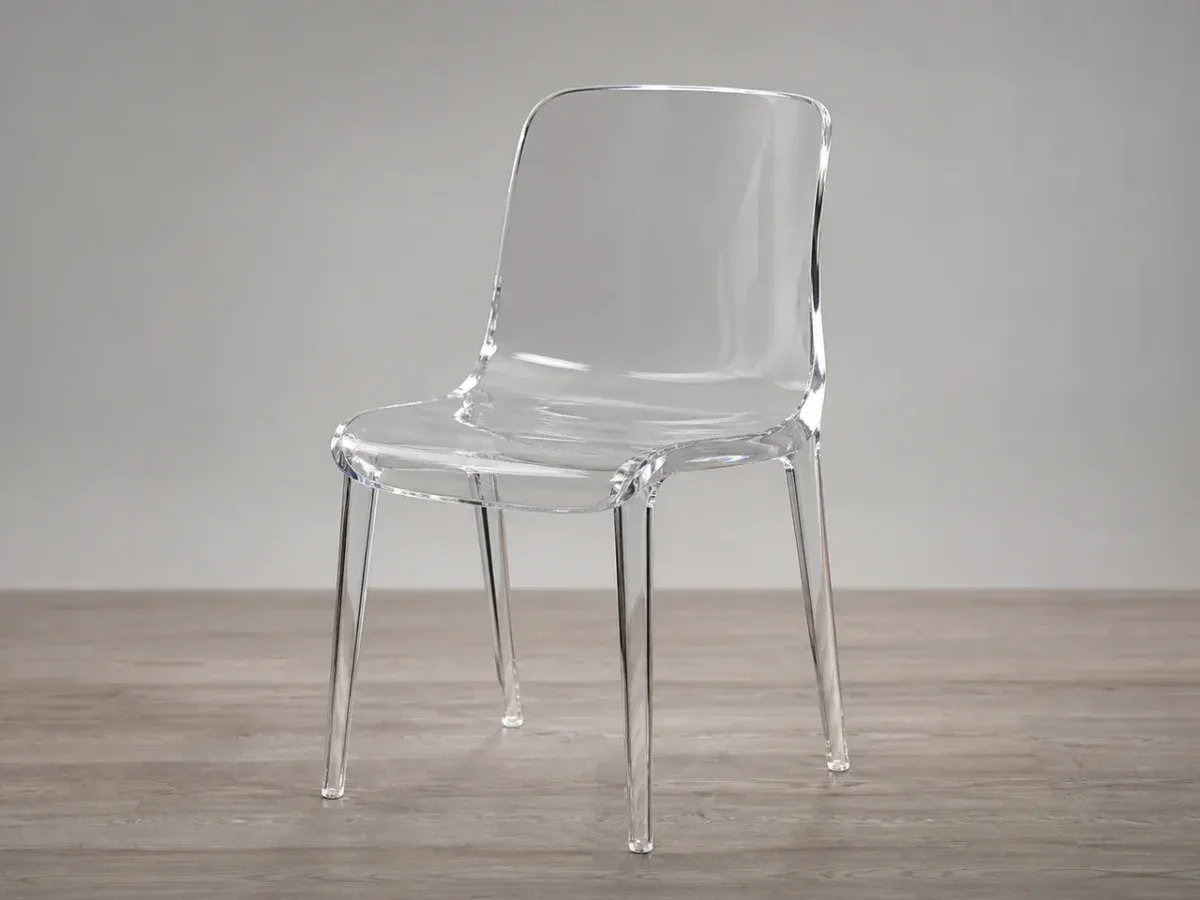
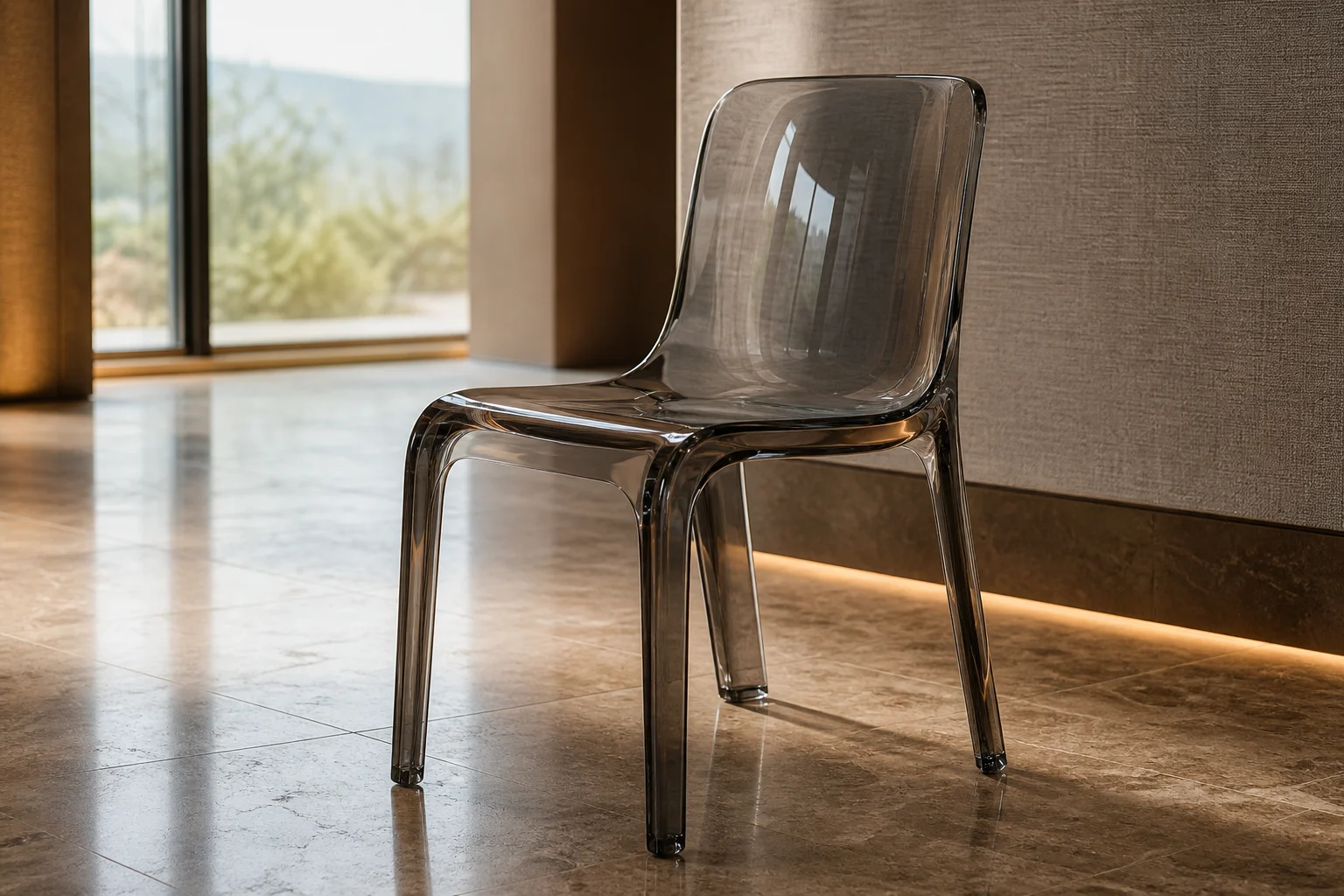
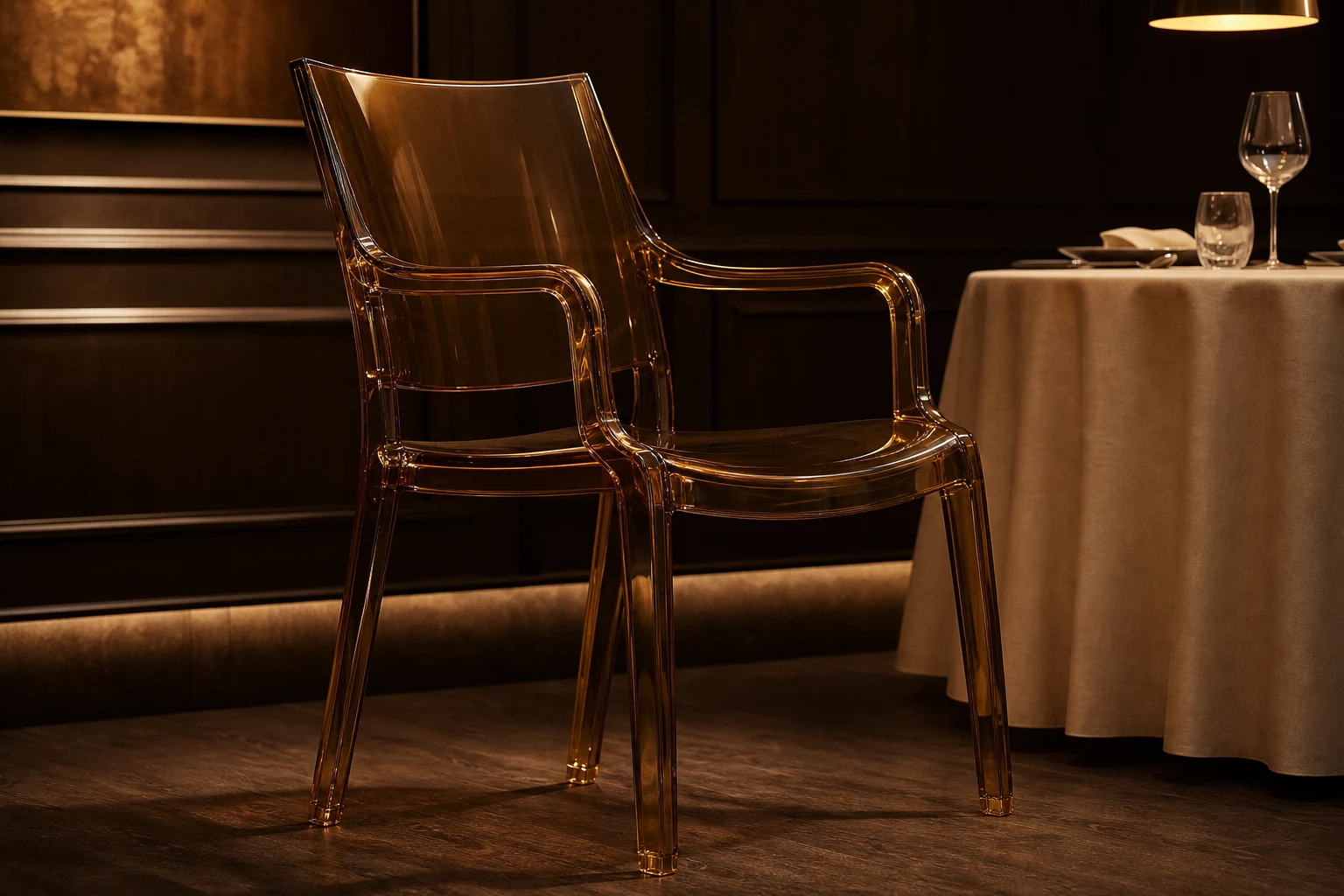
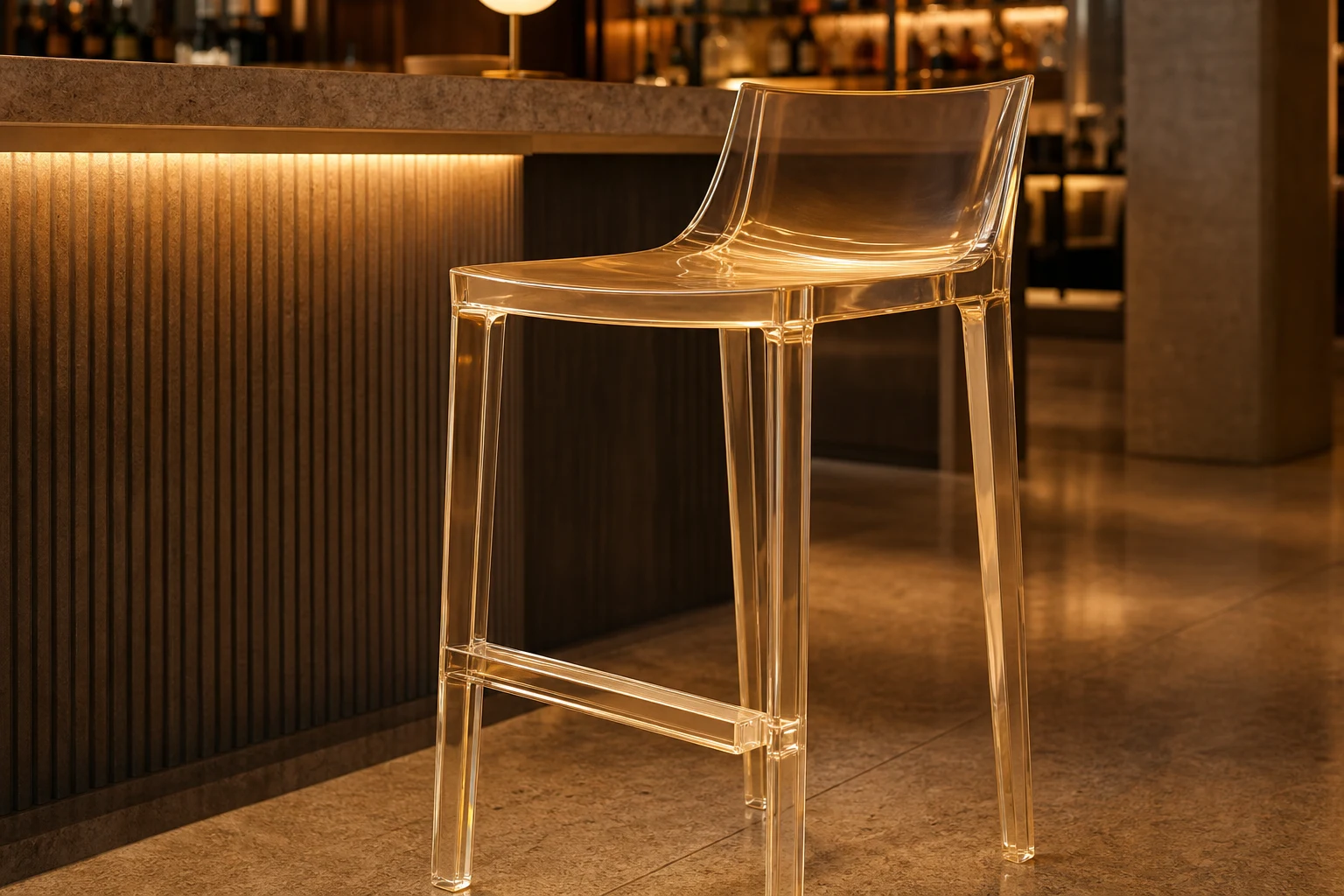
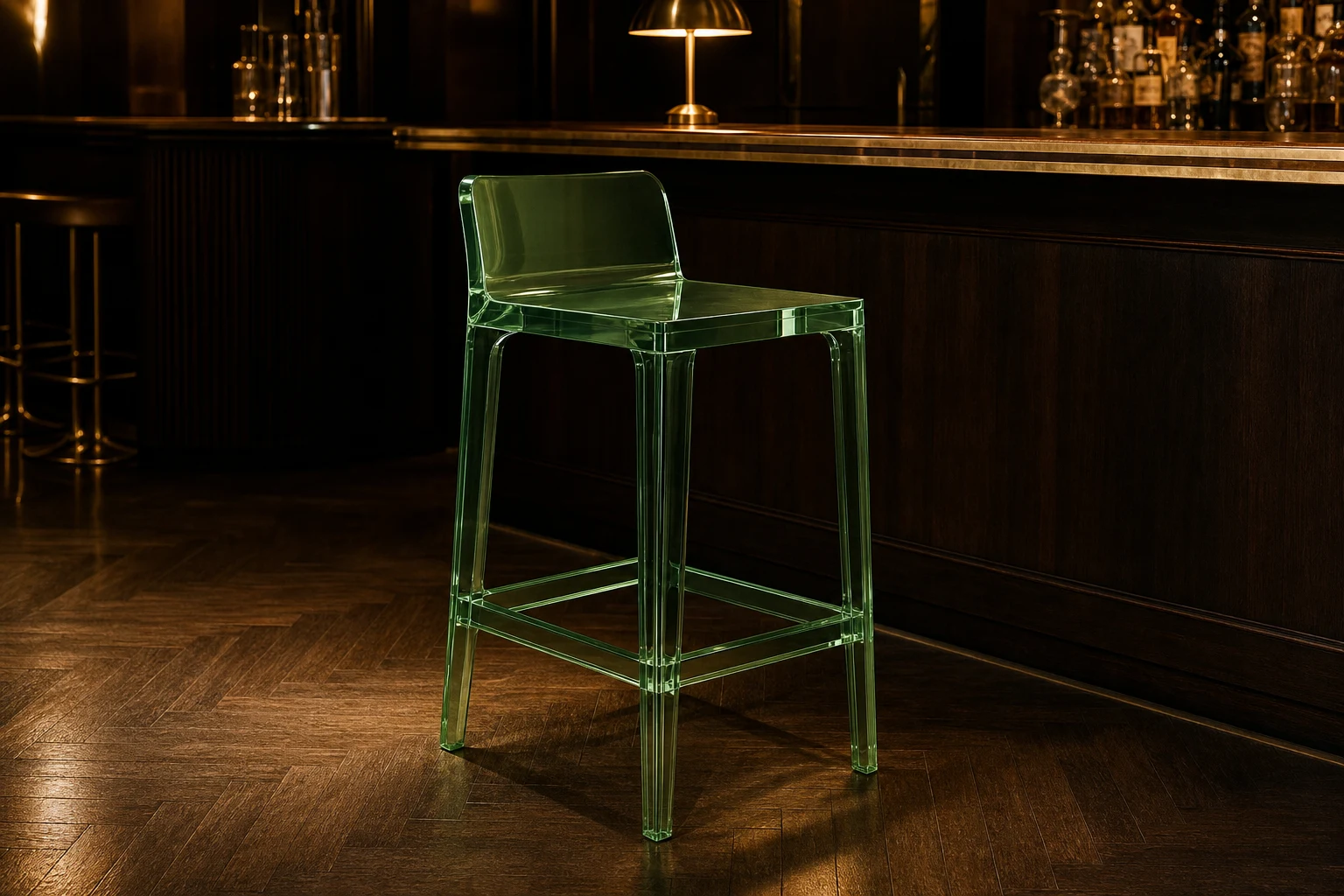
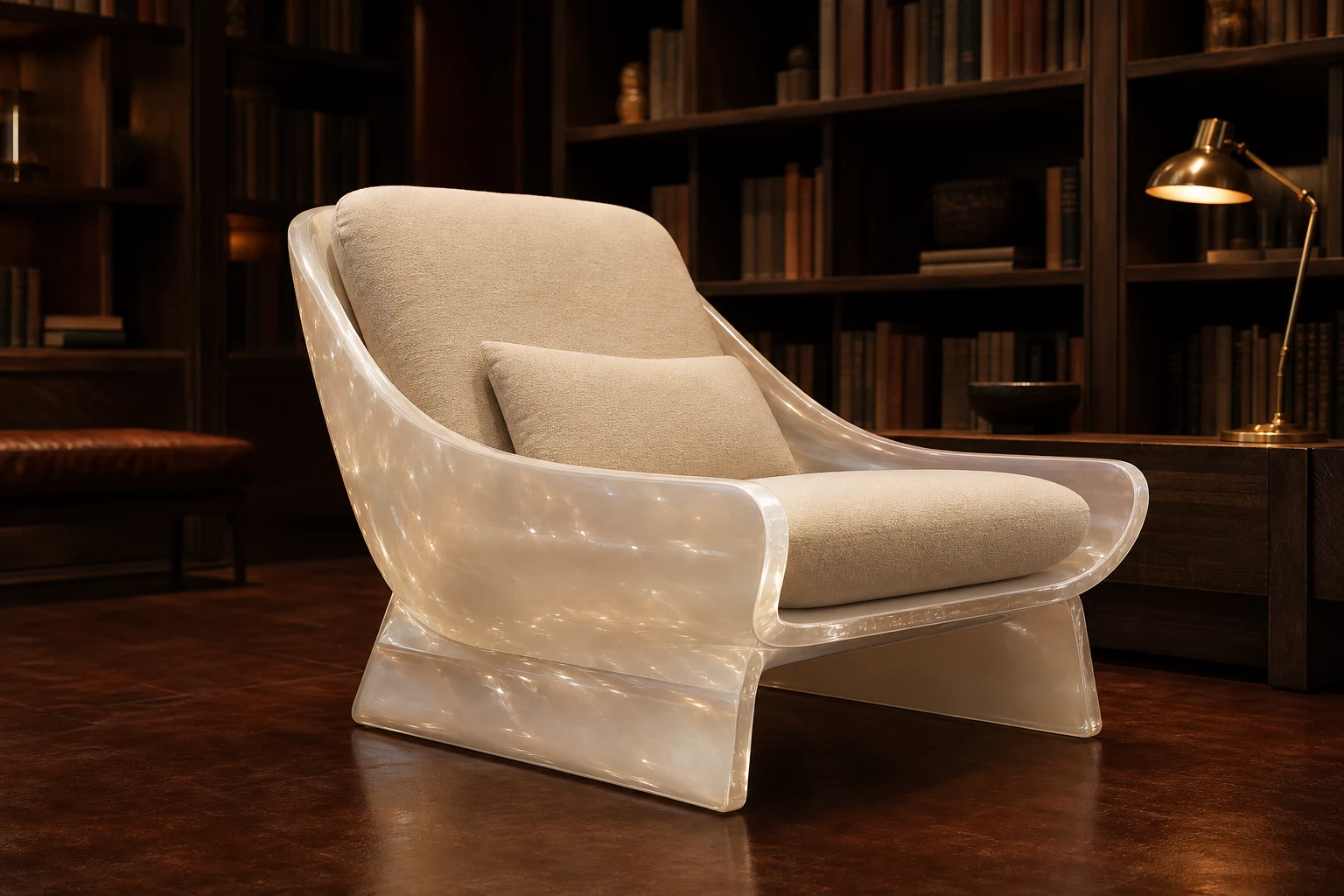
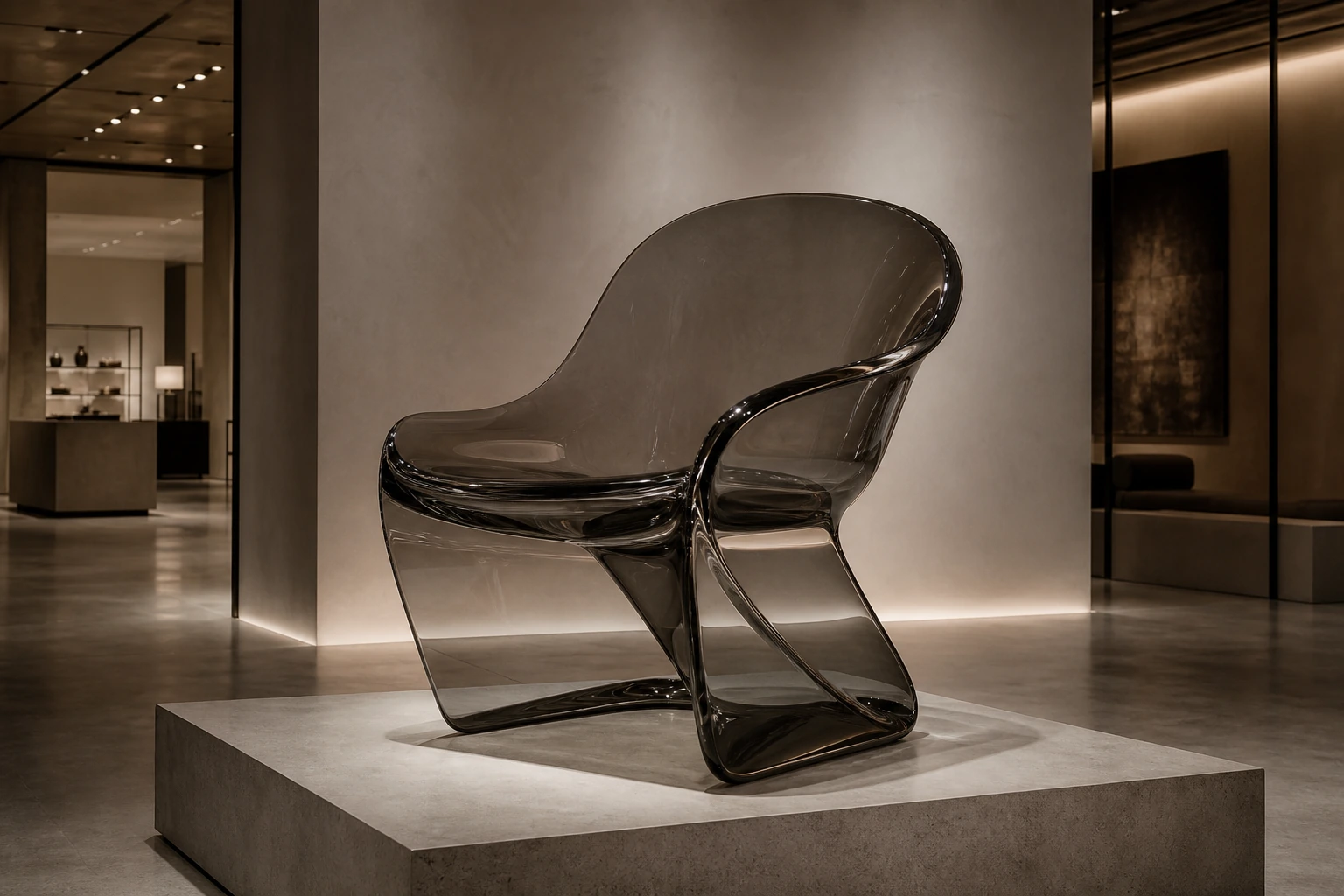
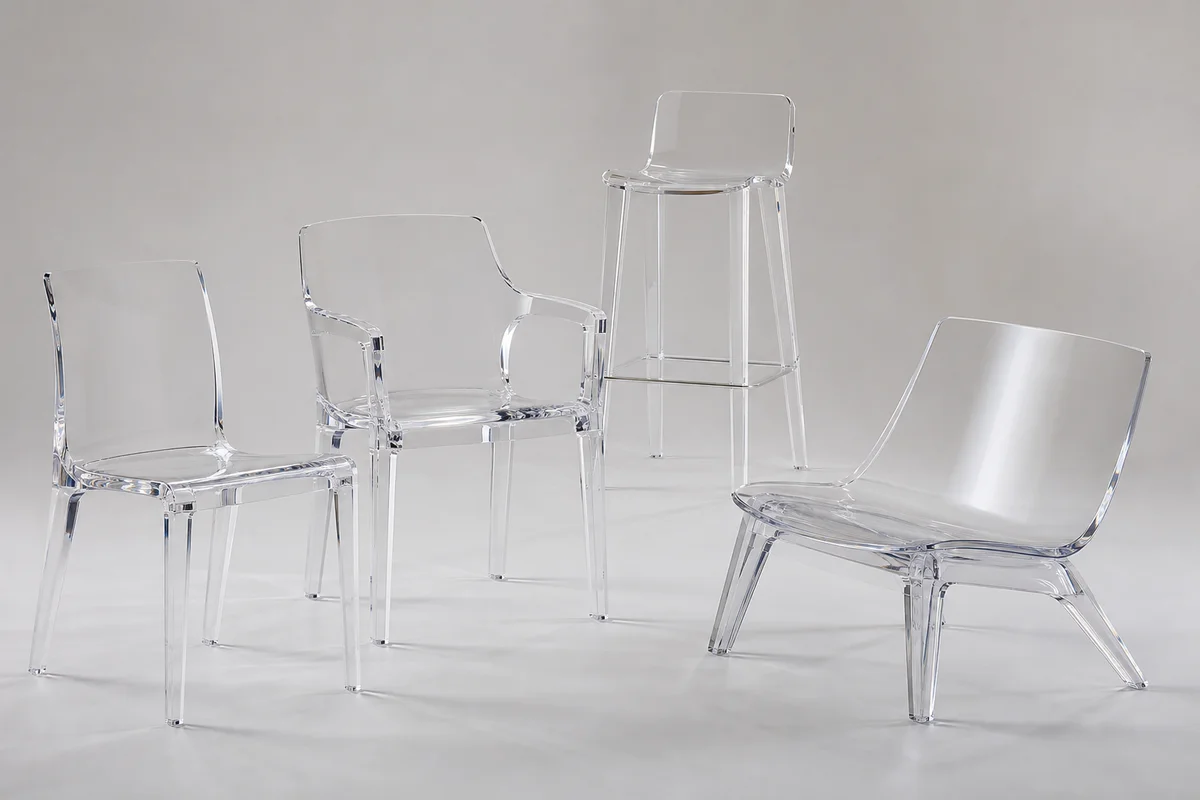
Molded cast PMMA seat-and-back. Six commercial configurations. Batch color match enforced across multi-property rollouts.
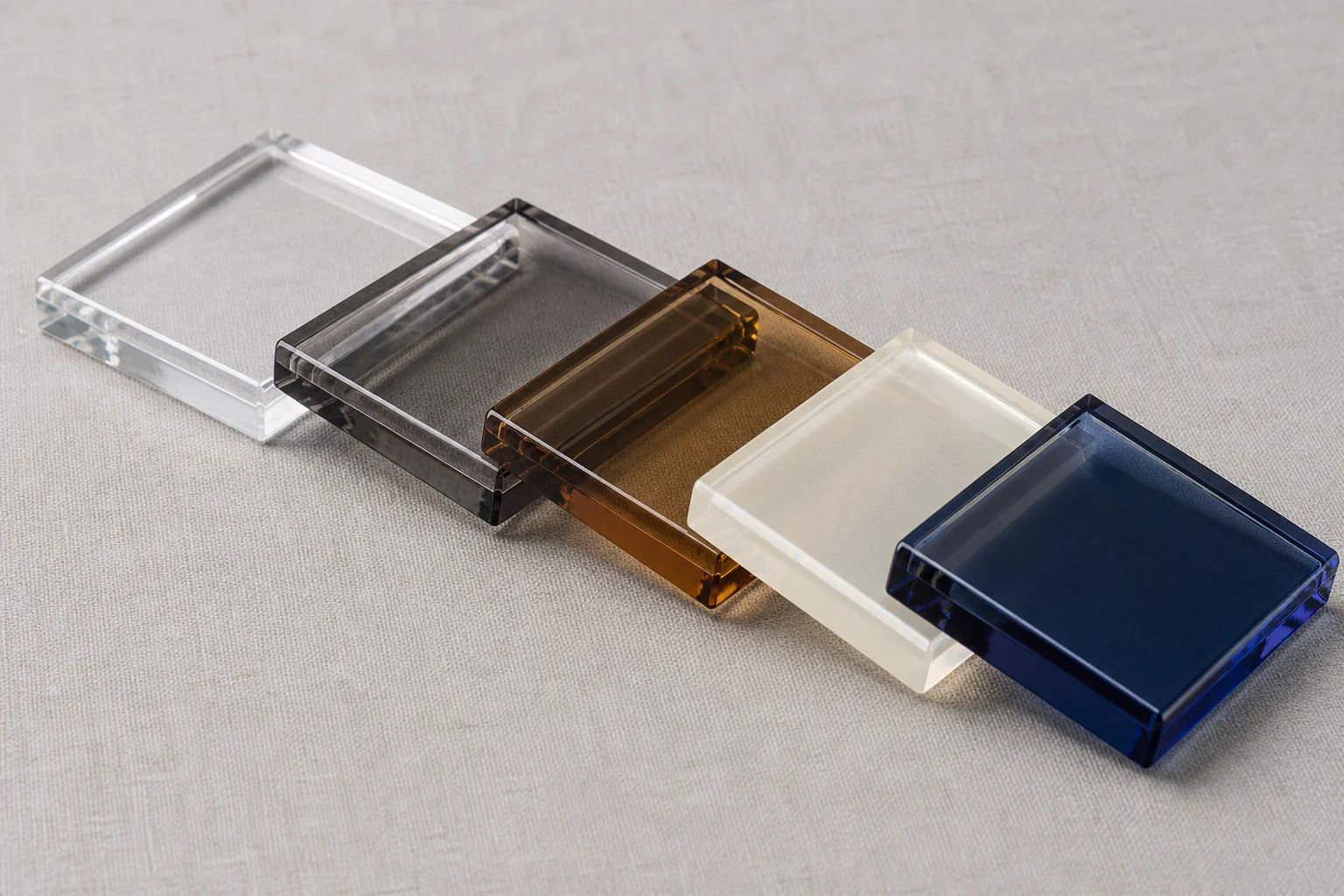
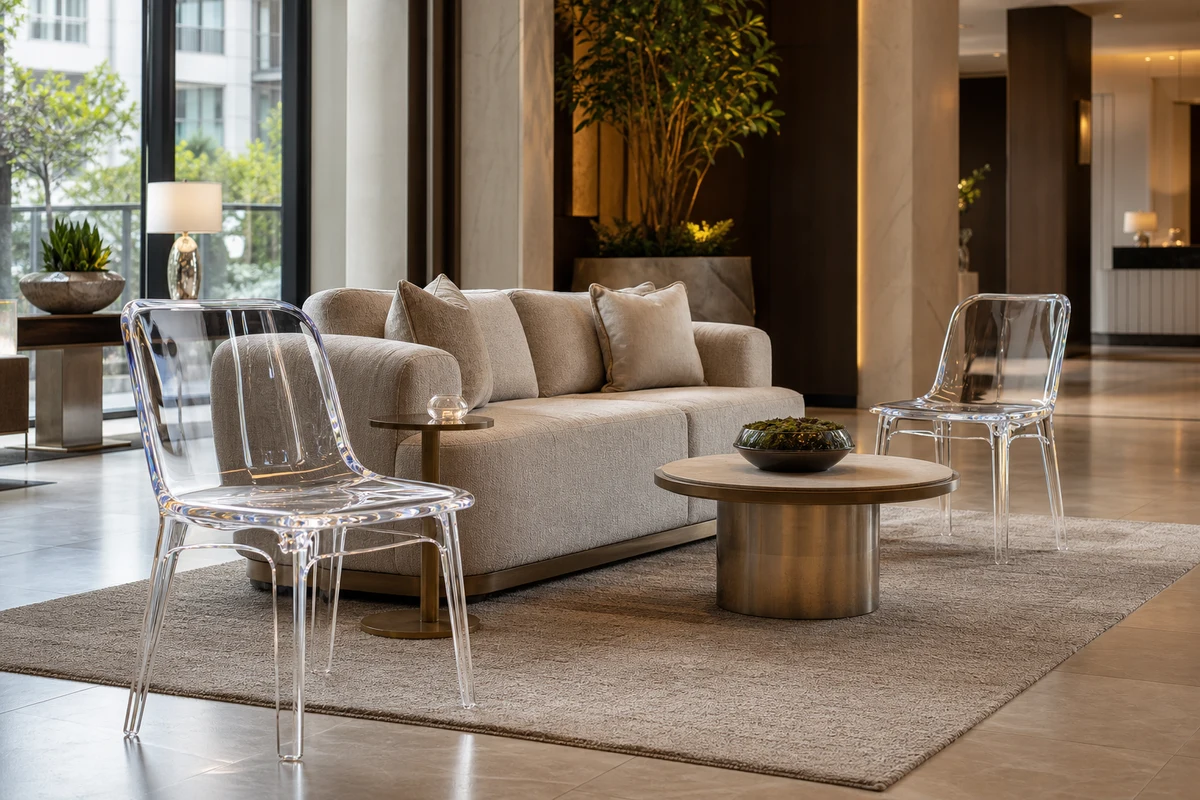
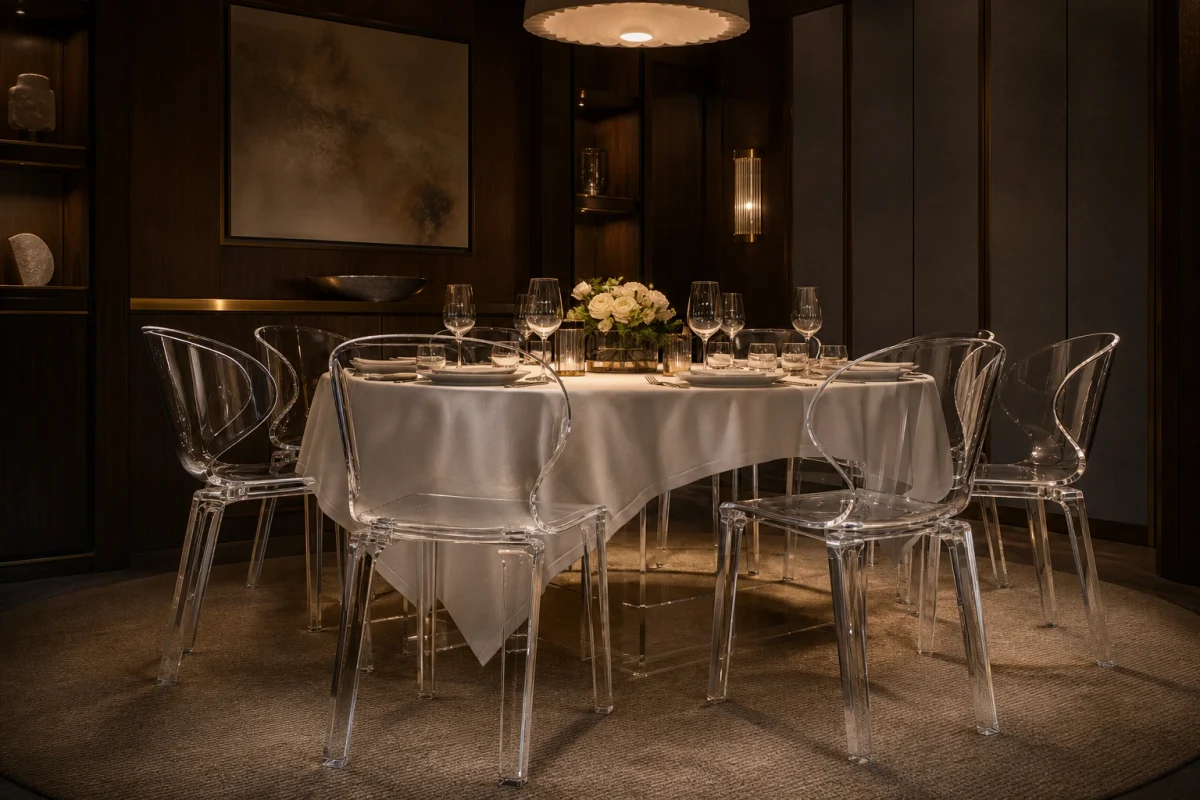
Custom acrylic chairs for boutique hotels, fine-dining restaurants, members' clubs, corporate HQs, and luxury retail flagships. Six configurations — side chair, dining chair, counter stool, bar stool, lounge chair, sculptural accent. Each one built around a single molded cast PMMA seat-and-back shell at 8–10mm wall thickness, with legs bonded to a hidden reinforcing plate underneath. Tinted whole-body color (smoke, bronze, pearlescent, custom Pantone) and three upholstery paths (slip-on cushion, Velcro-removable pad, fully bonded leather or fabric). Engineered for commercial daily use; every new design sat-tested at sample stage. MOQ 10 chairs per design.
ISO 9001 Certified Since 2008 Molded Cast PMMA Shell 2,000+ B2B Projects Sample in 10–14 Days
Comfort and cleanability decided at spec, not at reorder.
Seat-and-back is one molded cast PMMA shell. Whole-body tints carry through the body. Upholstery picked around your cleaning protocol.
Six Chair Configurations
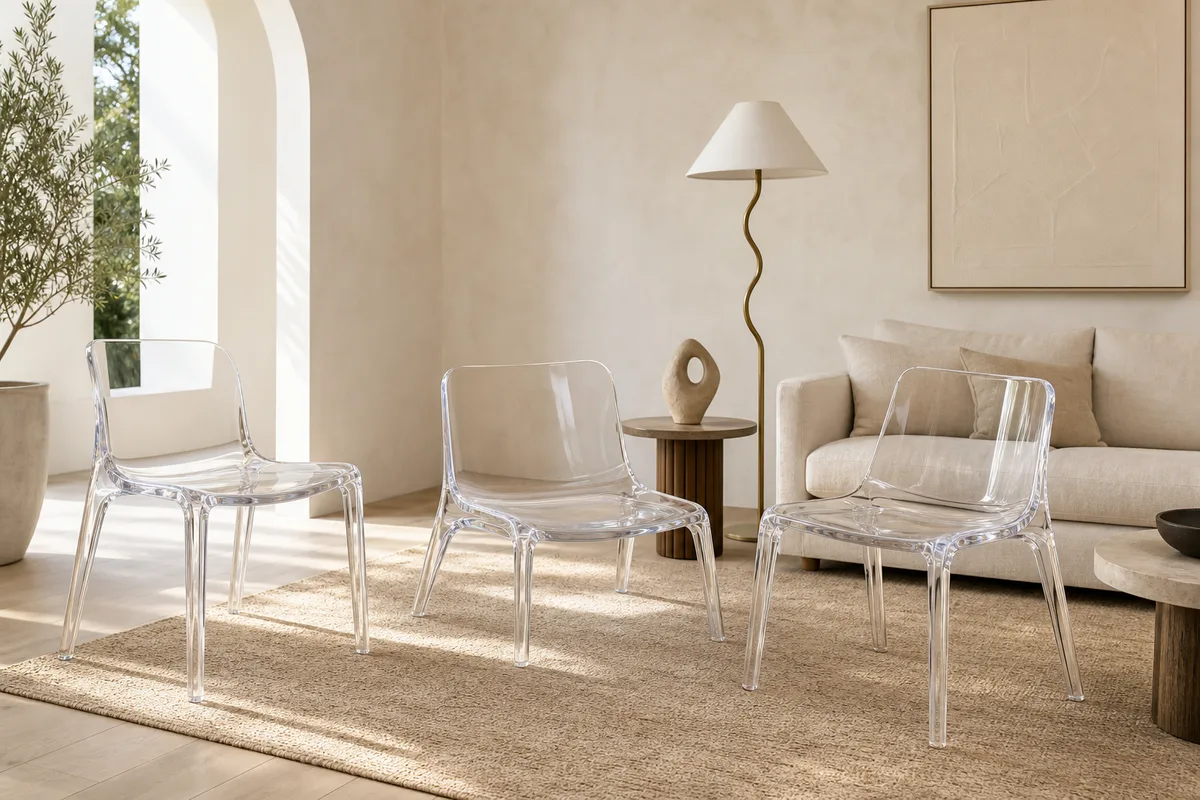
Acrylic chairs come in six commercial configurations, each tied to a specific seat height and use case: side chair (45cm seat, no arms), dining chair (45cm seat, with or without arms), counter stool (65cm seat with footrest), bar stool (75cm seat with footrest), lounge chair (38cm seat with deeper recline), and sculptural accent chair (custom one-off). All built on a molded cast PMMA seat-and-back shell at 8–10mm wall thickness.
Need a different furniture type? See the acrylic furniture hub for coffee tables, side tables, console tables, and dining tables — chairs frequently ship together with a coordinated table on one PO.
What Is a Custom Acrylic Chair?
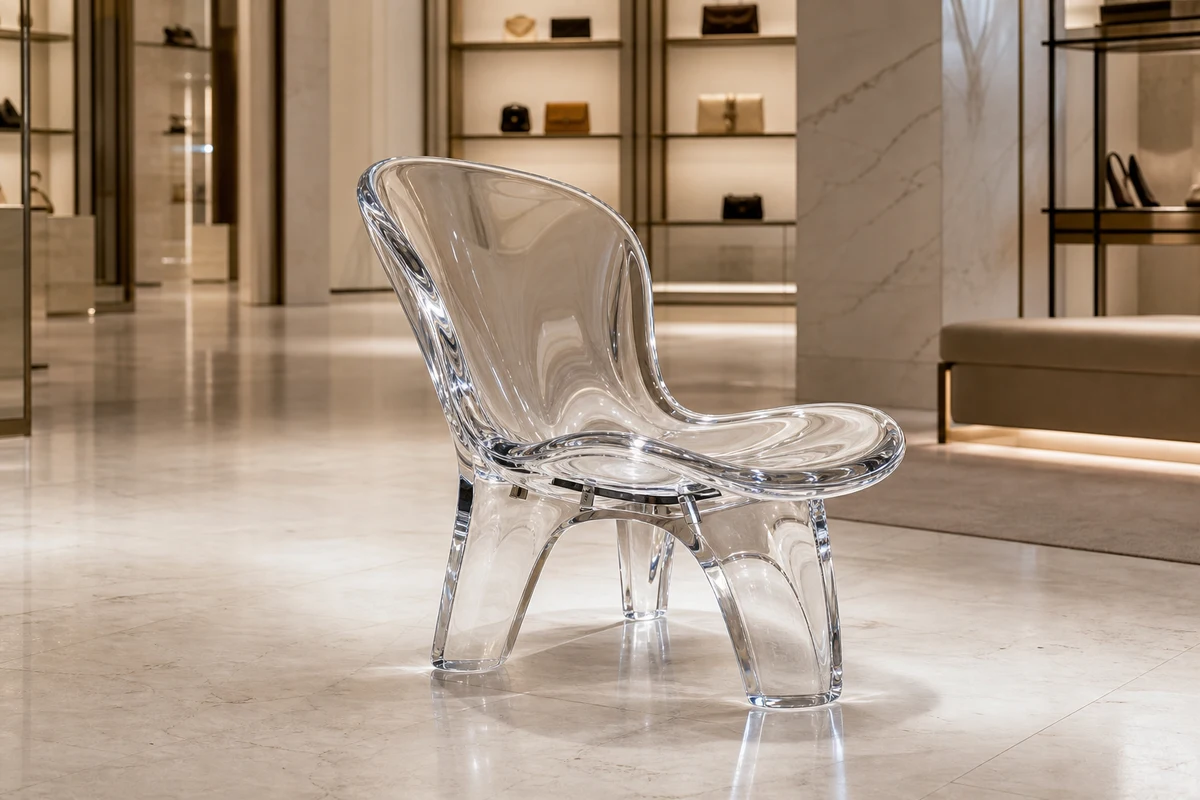
A custom acrylic chair is a seated piece built around a molded cast PMMA seat-and-back shell, with legs and base components fabricated from flat cast acrylic sheet bonded to a hidden reinforcing plate. For commercial hospitality use, the chair has to hold a seated guest comfortably for the length of a meal or a lounge stay, look intentional in a lobby or restaurant context, and survive daily handling by housekeeping or service staff — wiped, stacked, moved between zones, occasionally bumped by a service trolley. The molded shell is what makes it comfortable. Cutting flat acrylic and bonding panels can't approximate the ergonomic curve of a single molded seat-and-back.
Dynamic load engineering
Chairs are the highest-engineering furniture piece we build. Tables hold weight passively; chairs take dynamic load — someone sitting with force, leaning back, rocking, occasionally tipping back on two legs. Failures show up as cracks at the seat-to-leg junction or stress whitening at flex points after months in service.
Single molded shell
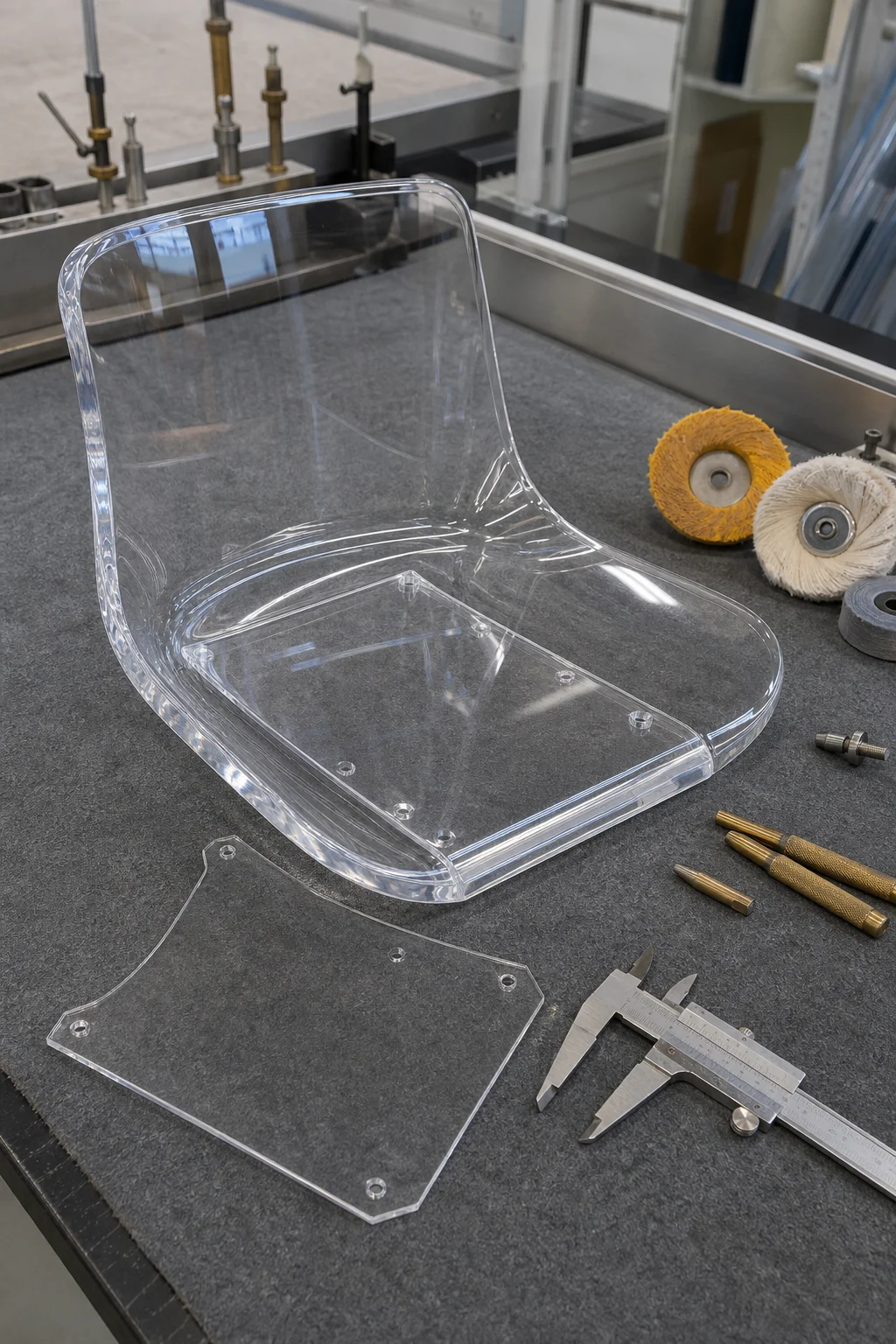
We mold the seat-and-back as a single curved cast PMMA shell at 8–10mm wall thickness so there are no joint failures across the structural surface. Legs bond to a hidden reinforcing plate under the seat, distributing load across four mounting points. Every new design is sat-tested at sample stage under repeated dynamic load; the result is documented on the sample sign-off sheet you keep on file.
Chairs ship most often as part of a coordinated dining or lounge set — chairs plus dining table, or chairs plus coffee and side tables for a lounge zone. Send a brief, drawing, or reference image of an inspiration chair. Sample 10–14 days; production 28–35 days for 10 chairs.
About two-thirds of chair orders ship as a coordinated chair-plus-table set; multi-property hospitality rollouts of 24–60 chairs are the typical commercial volume.
Chair Dimensions, Seat Heights & Use Case Reference
Chair dimensions follow standard ergonomic bands tied to use case — 45cm seat for side and dining at a standard table, 65cm for counter-height seating, 75cm for bar-height, 38cm for lounge with deeper recline. The table below is our working reference for molded cast PMMA seat-and-back shells at 8–10mm wall thickness on a 4-leg or pedestal base, engineered for commercial daily use. Test data per project is documented on the sample sign-off; we don't issue a separate numeric BIFMA certificate.
Configuration
Typical Dimensions
Use Case
Base Options
Notes
Side chair
45cm seat height, 45 × 45cm seat, 80cm back height
Lobby seating, waiting rooms, library zones
4-leg standard
No arms; the hospitality default
Dining chair (no arms)
45cm seat height, 45 × 50cm seat, 85cm back height
Restaurants, breakfast rooms, private dining
4-leg or X-base
Restaurant-chain rollout default
Dining chair with arms
45cm seat height, 45 × 50cm seat, 65cm arm height
Private dining, chef's-table, executive dining
4-leg
Adds ~15% per chair vs no-arm version
Counter stool
65cm seat height, 40 × 40cm seat, footrest at 25cm
Kitchen counters, hotel lobby bars, retail POS counters
4-leg or pedestal
Footrest required at this height
Bar stool
75cm seat height, 40 × 40cm seat, footrest at 30cm
Working reference for molded cast PMMA chairs at 8–10mm wall thickness, engineered for commercial daily use. Each new chair design is sat-tested at sample stage; the spec is confirmed on the sample sign-off sheet.
Chair sample lead time runs longer than flat-cut table work because the molded seat-and-back shell needs mold setup before the sample piece can be pressed.
Why Acrylic for Commercial Chairs?
Cast PMMA molded chairs combine optical clarity with the load capacity needed for commercial daily seating. Versus glass, cast PMMA is many times more impact-resistant and shatter-resistant — glass at seat scale is not viable for hospitality use. Versus wood, it doesn't swell from spilled drinks, doesn't chip on chair-leg-to-floor impact, and cleans up to like-new finish where wood absorbs stains permanently. Versus traditional commercial chair materials, cast acrylic is the rare option that reads as transparent while still engineered for everyday hospitality service. The comparison below covers the four material decisions a hospitality buyer typically weighs at spec time.
Cast Acrylic (PMMA)
Glass
Wood
Steel / Powder-Coat
Clarity
92% light transmission; whole-body tint available
~90% transmission
Opaque
Opaque
Impact resistance
Many times stronger than glass; shatter-resistant
Fragile — shatters into shards under guest weight or accidental drop
Cracks at stress points; splits along grain
Dents and surface-finish scratches
Weight per chair
Lighter than glass — easier to stack and reposition for service
Not viable at seat scale
Heavy, slow to reposition
Heavy
Daily commercial use
No warping, no staining, wipes clean; spilled drinks not a concern
Not viable for seating
Stains; finish wears at high-touch points
Cold to touch; powder-coat chip-prone
Color matching
Whole-body tints; Pantone match through the shell — no chip-prone surface paint
Surface-applied only; not for seating
Stain/finish; visible batch variation across multi-property rollouts
Powder coat with chip-prone finish
Load engineering
Engineered for commercial daily use; sat-tested at sample stage
Not viable
Joinery-dependent; varies batch-to-batch
High load but visually heavy in lounge contexts
Best for
Hotel lobbies, fine-dining chains, members' clubs, retail flagships, hotel bars
Not viable
Heritage interiors, residential, traditional fine dining
Chairs are molded from cast PMMA seat-and-back shells at 8–10mm wall thickness, with cast PMMA legs bonded to a hidden reinforcing plate underneath the seat. Six configurations, three upholstery paths, four base styles, and a documented sample sign-off for every new design. The diagram below shows why a molded shell is structurally different from a flat-cut bonded seat, which is the single most common confusion when a buyer is comparing acrylic chair vendors.
Shell Material Options
Material
Properties
Clear cast PMMA
92% light transmission; the chair recedes visually, the seated guest is the focal point
45cm side & dining · 65cm counter · 75cm bar · 38cm lounge
Load engineering
Engineered for commercial daily use; sat-tested at sample stage; test result documented on sign-off
Leg base options
4-leg, X-base, sled-base, pedestal — all bond to hidden reinforcing plate
MOQ
10 chairs per design (each unique SKU)
Sample lead time
10–14 days standard; 3–4 weeks for sculptural accent (custom mold tooling)
Production lead time
28–35 days for 10 chairs · 45–55 days for 24–48 pieces
The molded shell is what separates a hospitality-grade acrylic chair from a CNC-routed decorative piece. Cutting flat acrylic and bonding a seat panel to a back panel can't approximate the structural integrity of a single molded shell — the bonded seam at the 90° junction fails under dynamic load.
Not sure which configuration, tint, or upholstery path fits your project? Send us a brief, drawing, or reference image — we'll recommend the spec and quote it.
Chairs combine the most molding work, the most engineering at sample stage, and the most material decisions in the furniture line. A wrong shell thickness shows up as stress whitening within months; a wrong leg-to-shell joint cracks at the bonded plate after a year of commercial use; a wrong upholstery spec means the customer has to re-cover the seats within twelve months. Wetop has been building custom acrylic for B2B buyers since 2008 — 2,000+ projects shipped to 25+ countries, ISO 9001 certified, 5,000 m² facility with 65+ employees, in-house CNC and polishing throughout.
Molded Seat-and-Back Shell, Not Flat-Cut Panels
The seat-and-back is a single curved piece molded from heated cast PMMA — 8–10mm wall thickness across the shell. Molding is what gives the chair its ergonomic curve and structural integrity; cutting flat acrylic and bonding panels can't achieve a comfortable seat that survives daily commercial use. The molded shell also eliminates the joint failures that show up on flat-cut chairs after a year of guest weight — there's no bonded seam across the structural surface to crack.
Hidden Leg-to-Shell Reinforcing Plate
The legs don't bond directly to the underside of the seat. They bond to a hidden reinforcing plate that distributes load across four mounting points and lives flush against the underside of the molded shell. That plate is the reason a chair built to our spec doesn't develop stress whitening at the leg-to-seat junction after months in service. It also lets us swap leg styles (4-leg, X-base, sled-base, pedestal) on the same shell without redesigning the structural connection.
Upholstery Path Picked Around Cleaning Reality
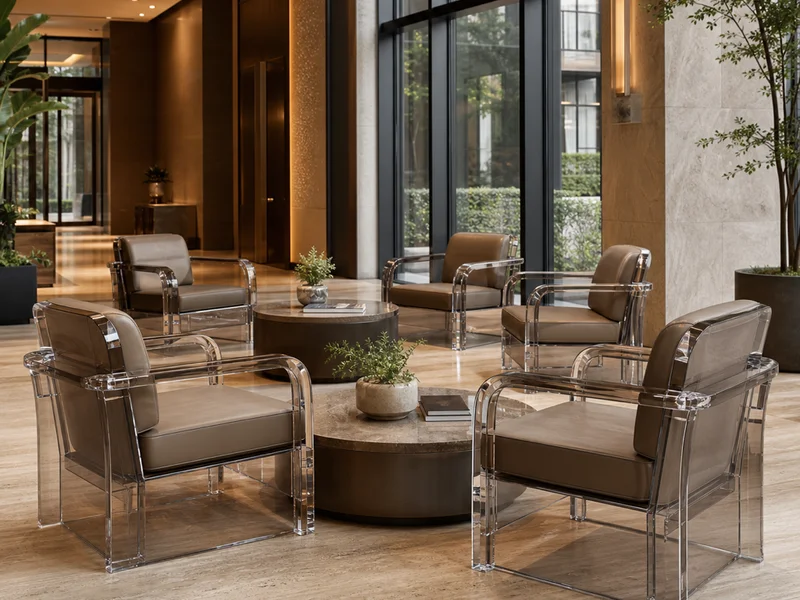
Three upholstery options, picked around how the chair will be cleaned in service. Slip-on cushion with hidden silicone bumpers — most-ordered for restaurants and hotel breakfast rooms, lifts off in seconds for housekeeping wipe-down. Bonded Velcro-removable seat pad — looks integrated, removable for laundering, common in members' clubs. Fully bonded leather or designer fabric — signature pieces and accent chairs where the upholstery is the design and re-covering is a refurb event, not a weekly task. We match Pantone or fabric swatch on every spec.
Coordinated Chair + Table Orders on One PO
Chairs ship most often as part of a full dining set or lounge package — chairs plus dining table, or chairs plus coffee and side tables for a lounge zone. We run multi-SKU coordinated orders on one production batch with batch color match enforced as a documented QC checkpoint between the molded chair shells and the flat-cut table tops. Multi-property hospitality rollouts of 24–60 chairs across 8–12 properties depend on this batch consistency — the chair in property #1 has to read identical to the chair in property #12.
"
We sat on the sample chair for an hour before we approved bulk. Two years in, no shell cracks across the chairs we deployed and no stress whitening at the leg joints. The molded seat is what made the comfort spec work — a flat-cut bonded chair wouldn't have held up to that service load.
— Procurement Lead, Fine-Dining Restaurant Chain
Chair Configuration Details
Each configuration has its own seat height, ergonomic profile, base options, and use-case fit. Below is the working spec for each, with the typical commercial order shapes we see.
Side Chair (45cm seat, no arms)
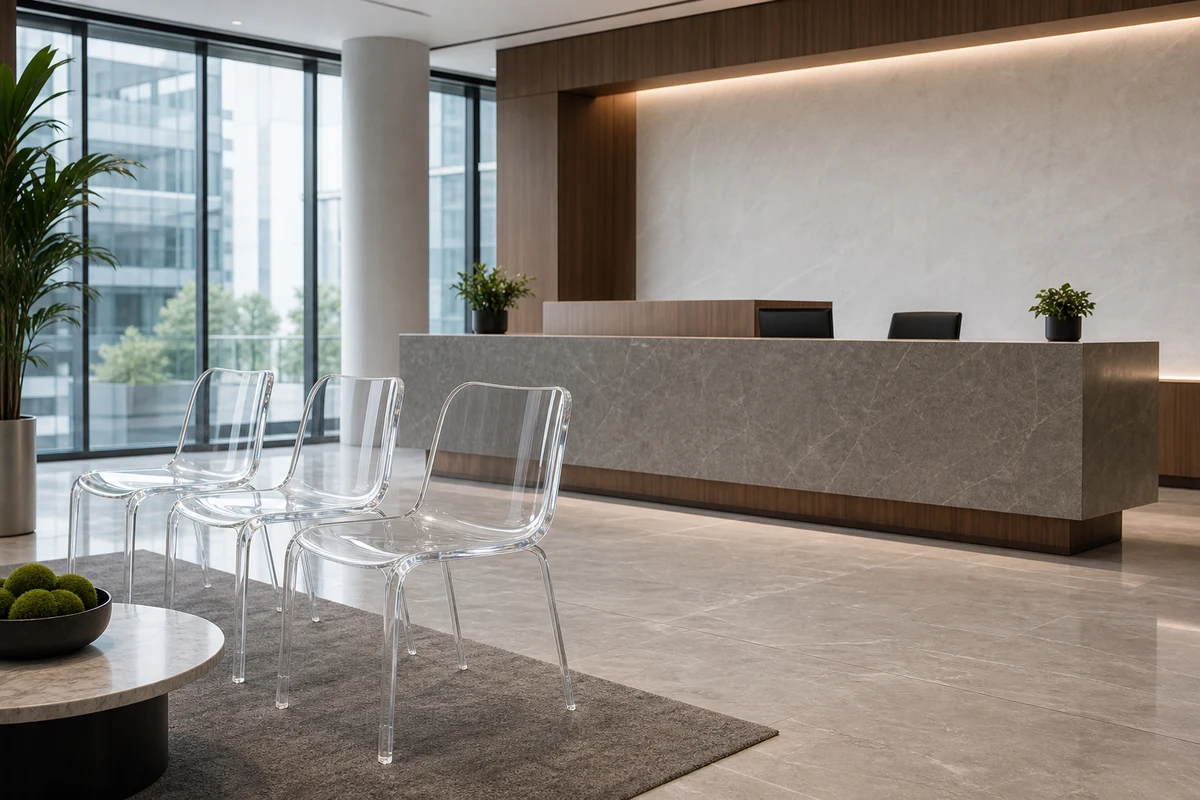
The cleanest visual profile in the line. 45cm seat height, 4-leg base, no armrests. Used in hotel lobbies, retail showroom waiting areas, members' club libraries, and corporate reception zones. Most-ordered configuration for hospitality rollouts because it stacks cleanly in storage and reads identical from any angle. Whole-body tinted versions (smoke, bronze) are the typical pick when the brief calls for the chair to recede visually so the seated guest becomes the focal point.
Dining Chair (45cm seat, with or without arms)
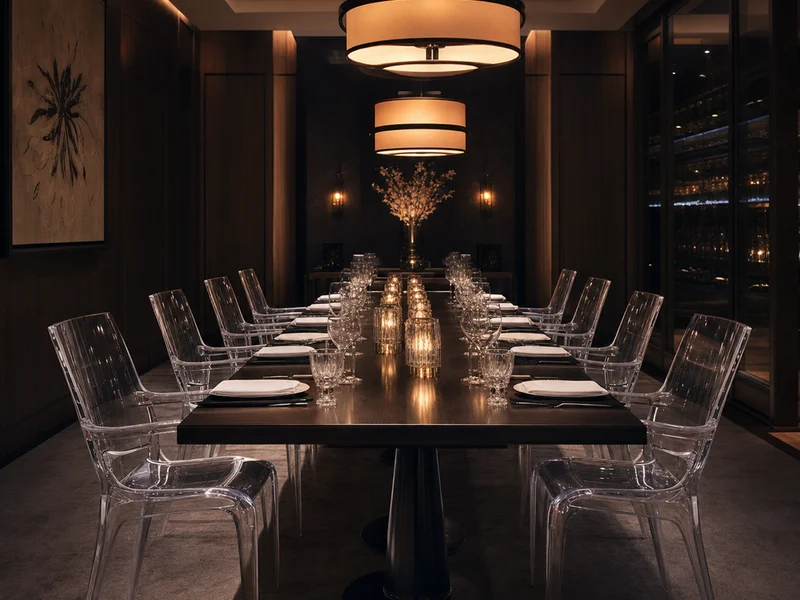
Fine-dining private rooms, chef's-table seating, hotel breakfast rooms, restaurant-chain hospitality dining. 4-leg or X-base — X-base reads more modern and lets the chair tuck closer to the table for tighter seating layouts. With armrests adds roughly 15% per chair; armrests are spec'd when the dining room serves multi-course tasting menus where guests sit longer. Most restaurant-chain rollouts pick the no-arm version for cleaner stacking between service shifts.
Counter Stool (65cm seat, integrated footrest)
65cm seat, integrated footrest at 25cm. Used at hotel lobby bars, reception counter seating, kitchen islands in residence-club suites, and retail point-of-sale counters where the guest is seated facing staff. Footrest is structural at this height, not optional — the chair needs the foot support for stable seated posture. Cushioned slip-on seat pad is the typical add in commercial use; the bare acrylic seat is comfortable for short interactions but not for an hour-long meeting.
Bar Stool (75cm seat, low-back support)
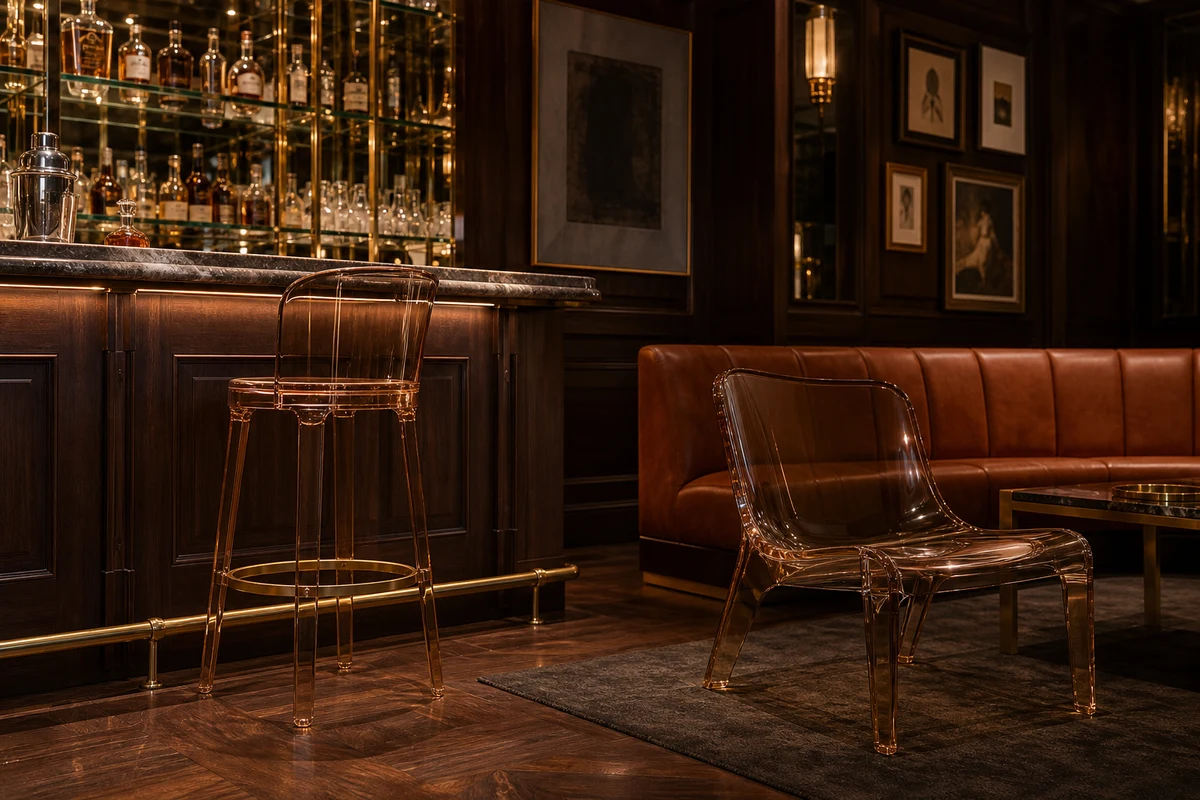
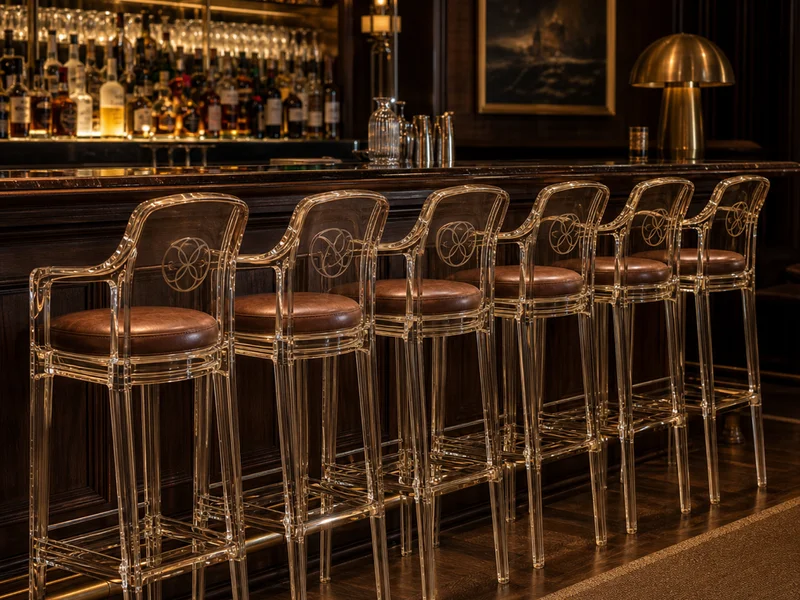
75cm seat, integrated footrest at 30cm. Hotel cocktail bars, members' club bars, restaurant bar seating. Often spec'd with a low back or armrests for support at bar height — guests at bar height shift weight more than at dining height. Most-ordered with smoke or bronze tint so the chair reads intentional against backbar lighting and the mirrored bottle display behind it. Clear bar stools work in daylight-led lobby bars; tinted versions earn their cost in evening service.
Lounge Chair (38cm seat, deeper recline)
Lower 38cm seat with deeper recline angle, 100cm back height. Hotel lobby lounge zones, members' club reading areas, corporate executive lounges. Upholstered cushion (slip-on or bonded) is the standard spec — bare acrylic seat is rarely comfortable for extended sitting, and lounge seating is built for the 20-minute-plus stay. Pearlescent or bronze tint is the typical pick because lounge zones use warmer ambient lighting and clear acrylic can read cold against warm fabrics.
Sculptural Accent Chair (custom one-off)
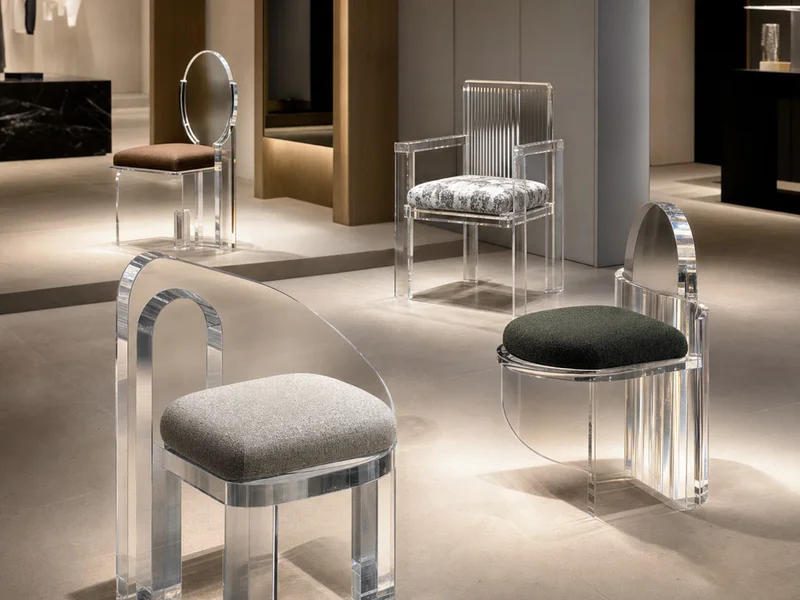
Custom one-off ergonomic design. The signature silhouette piece — often the visual centerpiece in a flagship retail space, a hotel suite living area, a members' club library, or a luxury-brand lobby. Custom mold required, so sample lead time is longer (3–4 weeks instead of 10–14 days) and the design cost includes the one-time mold tooling. Most accent chairs ship as 4–12 pieces — they're set pieces, not rollout volume.
Three Upholstery Paths — Picked Around Cleaning Reality
The upholstery decision on a commercial acrylic chair is a service-operations decision before it is an aesthetic one. The question to answer first is: who cleans this chair, how often, and what tools do they have? Housekeeping wiping down a restaurant chair after every service has different requirements than a members' club steward refreshing the lounge once a week. We've spec'd all three paths across the past 18 months of orders and the breakdown below is the working framework.
Slip-On Cushion (most-ordered)
Bonded Velcro-Removable Pad
Fully Bonded Leather / Fabric
Look
Cushion reads as a separate piece on the molded shell
Integrated — the pad reads as part of the chair
Fully integrated — the upholstery is the chair
Cleaning by service staff
Lift off, wipe shell, replace cushion — under 30 seconds per chair
Wipe in place; full removal needs a steward, not housekeeping
Spot-clean only; deep clean is a vendor visit
Laundering / replacement
Cushion covers go to laundry; spare cushions stocked on-site
Velcro-back peels off for laundering; pad stays with the chair
Not removable — re-cover is a refurb event, not a weekly task
Best for
Restaurant chains, hotel breakfast rooms, fine-dining service zones
Members' clubs, corporate executive dining, hotel lounge zones
Signature accent chairs, flagship retail seating, hotel suite living rooms
Cost add
Modest add over bare shell — silicone bumpers + cushion fabrication
Adds 10–20% — bonded backing + Velcro hardware + pad work
Adds 25–40% — fabric grade and hand-finishing drive the spread
Order shape
Multi-property hospitality rollouts of 24–60 chairs
Member-club orders of 12–36 pieces, often custom club-color fabric
Signature pieces in batches of 4–12
Cleaning cadence by venue
Restaurants with multiple service shifts per day default to slip-on cushion — speed-to-clean matters more than the integrated look. Members' clubs default to Velcro-removable so the steward can refresh weekly without disrupting the visual. Flagship retail and hotel suites pick fully bonded because the chair is a set piece, not a service chair.
Bare-shell warning
On lounge chairs with deep recline, the bare molded shell is rarely comfortable past 15–20 minutes — we tell every lounge-chair buyer to spec at minimum a slip-on cushion. Side and dining chairs at 45cm seat height work fine bare for a 60-minute service; the seat profile is engineered for that posture and the shell flexes slightly under load to relieve pressure.
Who Uses Acrylic Chairs?
Chair buyers are B2B hospitality: boutique hotels, fine-dining restaurants and chains, cocktail bars and members' clubs, corporate HQs, luxury retail flagships, and interior designers managing multi-site rollouts. MOQ is 10 chairs per design (per SKU); coordinated chair + table orders share setup on one production batch.
Boutique Hotels — Lobby & Lounge
Side chairs in lobby seating, lounge chairs in members' lounges, bar stools at the hotel bar. Multi-property rollouts of 24–60 chairs across 8–12 properties with batch color matching enforced as a documented production checkpoint.
Fine-Dining & Restaurant Chains
Dining chairs as the primary order — 24–96 per location across one or two configurations. Restaurant-chain rollouts of 48–200 chairs per batch typical. Almost always paired with a coordinated acrylic dining table on one PO.
Galleries, Members' Clubs & Cocktail Bars
Gallery lounge seating, members'-club library chairs, cocktail-bar stools at 75cm with low back or armrests. Smoke or bronze tint typical to pair with wood-and-leather interiors. Bonded leather seat pads in club-color most-ordered.
Corporate HQs & Office Lobbies
Reception side chairs, executive lounge chairs, brand-color tinted dining chairs in executive dining rooms. Subsurface laser-engraved brand mark on the seat-back underside. Coordinated chair + table on one PO.
Luxury Retail Flagships
Side chairs in seating areas, accent chairs as visual centerpieces. The clear acrylic chair lets the surrounding merchandise stay visually dominant. Often single signature pieces (sculptural accent) or small sets of 4–8.
Interior Designers (Multi-Site)
Designers managing chair rollouts across 6+ hospitality or residential properties — coordinated chair + table sets on one PO. Mixed-SKU orders (lounge + side + bar stool) common when each unique SKU hits the 10-piece floor.
Representative chair projects from the past 18 months — restaurant chains, boutique hotel groups, members' clubs, and luxury retail flagships. Multi-property rollouts with batch color match enforced as a documented QC checkpoint.
96 chairs across 12 locations · molded clear cast PMMA seat-and-back · 4-leg base on 72 pieces · X-base on 24 chef's-table chairs · subsurface laser-engraved chain mark on seat-back underside · batch color match enforced across 12-property rollout
Fine-dining restaurant chain, US · Delivered in 48 days (air-first 12 chairs for soft-launch property)
Boutique Hotel Group — Lobby Lounge Chairs With Upholstery
24 lounge chairs across 8 properties · molded smoke-tinted cast PMMA · 38cm seat with deeper recline · bonded Velcro-removable cushion in hospitality-grade vinyl · 8-property batch color match · pearlescent armrest accents on 8 hero-property pieces
Boutique hotel group, North America · Delivered in 42 days (one shipment to brand HQ for property distribution)
Private Members' Club — Library Bar Stools
12 bar stools · 75cm seat height · molded bronze-tinted cast PMMA · low-back with bonded leather seat in club-house burgundy · subsurface engraved club mark on the back rest · custom Pantone match validated at sample with color chip
Private members' club, London · Delivered in 38 days · Coordinated with bar counter top on one PO
Luxury Retail Flagship — Sculptural Accent Chair
4 accent chairs · custom one-off ergonomic design · molded clear cast PMMA · signature silhouette · bonded designer fabric seat · placed as visual centerpieces in flagship-store seating zones · custom mold tooling amortized into first run
Luxury flagship retail, Europe · Delivered in 52 days (custom mold required, 3-week sample stage)
“
We tested the sample chair across two private dining rooms before scaling. No seat-shell cracks, no leg-joint stress whitening across the chairs we deployed. The acrylic chair was the variable our service operations team worried about; now it's a non-issue across twelve locations and reads identical from property to property.
— Service Operations Director, US Fine-Dining Restaurant Chain
Chair pricing is quoted up from five factors: configuration (and whether it has armrests), molded shell engineering (wall thickness, custom mold tooling), color and upholstery path, branding and logo integration, and order quantity. If you only need a rough quote before final artwork to size a budget, send the spec — we come back inside 24 hours with a per-piece range.
Configuration & Armrests
Side chair is the lowest-cost entry. Dining chair with armrests adds roughly 15% per piece versus the same chair without arms. Counter and bar stools add about 10% because of footrest fabrication. Lounge chairs add 20–25% (larger seat, deeper recline, more upholstery work). Sculptural accent chairs are custom-priced — the mold tooling is a one-time line item, then the per-piece cost follows.
Molded Shell Engineering
The molded seat-and-back shell is the structural cost driver. 8mm wall thickness is the standard spec; 10mm is the step-up for high-traffic commercial use, signature pieces, or designs with longer back spans. Custom mold tooling for a bespoke chair design is a one-time cost amortized into the first production run — that's why accent chair sample lead time runs 3–4 weeks instead of the standard 10–14 days.
Color & Upholstery Path
Clear cast PMMA is the lowest-cost finish. Whole-body tints (smoke, bronze, pearlescent) add 15–25%. Custom Pantone match adds one sample iteration with a color-chip validation step. Upholstery: slip-on cushion is a modest add; bonded Velcro-removable seat pad adds 10–20%; fully bonded leather or designer fabric adds 25–40% depending on fabric grade and how much hand-finishing the seat profile needs.
Branding & Logo Integration
Subsurface laser-engraved logo on the seat-back underside is the cleanest brand integration — frosted-white permanent mark, no surface wear, scales per chair. Visible engraved logos on the back rest are also common for members' clubs. Whole-chair custom-color cut-throughs (brand silhouette routed into the back panel of an accent chair) are bespoke per design and quoted as part of the mold tooling.
Quantity & Multi-Property Rollouts
Per-piece cost drops 20–30% between the 10-piece MOQ and a 48-piece run as setup amortizes across the batch. Multi-property hospitality rollouts at 24–60 chairs are the typical commercial order — one production batch, one batch color match, one freight setup. Coordinated chair-plus-table orders on one PO save 5–10% in setup and packaging versus two separate POs.
Chair Price-Modifier Matrix — Indicative Add-Ons
Use this as a rough scoping reference before you send the full brief. Final per-piece pricing depends on quantity, mold tooling status, and fabric grade — we confirm the exact numbers on the detailed quote inside 24 hours of your message.
Spec Variable
Baseline (lowest-cost)
Step-Up Option
Indicative Cost Impact vs Baseline
Configuration
Side chair, no arms, 45cm seat
Dining chair with armrests
+~15% per chair (armrest geometry + bonding)
Footrest
Side / dining chair (no footrest)
Counter stool 65cm / bar stool 75cm
+~10% per chair (footrest fabrication)
Seat profile
Side / dining (45cm seat, standard recline)
Lounge chair (38cm seat, deeper recline)
+~20–25% per chair (larger shell, more material)
Shell wall thickness
8mm cast PMMA shell
10mm cast PMMA shell (high-traffic spec)
+~10–15% per chair (more material per shell)
Color
Clear cast PMMA
Whole-body tint (smoke / bronze / pearlescent)
+~15–25% per chair (tinted dye lot, color-chip validation)
Custom Pantone match
Standard tint
Brand-color Pantone match
+~5–10% on top of tint (one extra sample iteration)
Upholstery path
Bare molded shell
Slip-on cushion with silicone bumpers
Modest add (cushion fabrication only)
Upholstery — integrated look
Slip-on cushion
Bonded Velcro-removable pad
+~10–20% per chair
Upholstery — signature
Slip-on cushion
Fully bonded leather / designer fabric
+~25–40% per chair (fabric grade dependent)
Branding
No logo
Subsurface laser-engraved logo on seat-back underside
Modest add per piece, scales with piece count
Mold tooling
Existing chair design (standard mold)
Custom one-off mold for sculptural accent
One-time tooling fee amortized into first run
Quantity
10 chairs (MOQ)
48 chairs (multi-property rollout)
Per-piece cost drops 20–30% across this range
Coordinated order
Chair-only PO
Chairs + dining table on one PO
Saves 5–10% in setup & packaging vs separate POs
Indicative ranges, not a price list. Multi-property rollouts and coordinated chair-plus-table orders are quoted per program; we structure the quote to highlight the savings vs separate POs.
From your first message to delivered chairs — three steps, anchored on a sample approval gate.
1
Send Your Brief — or Just a Rough Quote Request
Tell us the configuration (side, dining, counter, bar, lounge, accent), with or without arms, seat height, color tint preference, upholstery preference, branding, and quantity per SKU. Reference photos of an inspiration chair help us match the silhouette. If you only need a rough quote before final artwork, send the spec without the full brief — we'll come back inside 24 hours with a per-piece range so you can size the budget before committing.
We respond within 24 hours
2
Sit on the Sample Before You Approve Bulk
We mold a production sample seat-and-back shell, fabricate the legs, bond the reinforcing plate, and assemble one full chair — same cast acrylic tint, same edge polish, same upholstery spec, same brand marking as bulk. You sit on it, photograph it under your room lighting, do a color-chip validation against your Pantone reference, and sign off on comfort and finish. Sample fees are paid separately and are not credited to production orders. The sample approval gate is non-negotiable — we don't run bulk until the sample is signed off in writing.
Sample ready in 10–14 days (molded seat takes longer than flat-cut display work)
3
Bulk Production with Batch Color Match Enforced
Every chair passes 100% inspection — seat-shell integrity, leg-to-shell joint, surface polish, color match against the approved sample, upholstery alignment. Sat-test re-verified every 50 pieces in bulk. Batch color match documented as a QC checkpoint so chairs across a multi-property rollout read identical. Reinforced crating for sea freight; air-first batch available ahead of a fixed-date property opening.
Production 28–35 days for 10 chairs; 45–55 days for 24–48 pieces
Is a custom acrylic chair really safe for daily commercial seating?
+
Yes — but the engineering that makes it safe is in the seat-and-back shell, not in the gauge of the leg. We mold the seat-and-back as a single curved cast PMMA piece at 8–10mm wall thickness so there are no joint failures across the structural surface. The legs bond to a hidden reinforcing plate underneath the seat, distributing load to four points. Each new chair design is sat-tested at sample stage under repeated dynamic load before we approve it for bulk; we document the test result on the sample sign-off sheet you keep on file. The honest version: we don't issue a numeric BIFMA certificate — we engineer for commercial daily use and verify on every sample.
Cast PMMA or molded acrylic — and what's the actual difference for a chair?
+
The seat-and-back shell is molded acrylic — cast PMMA sheet heated and pressed into a curved mold to form the ergonomic seat profile. The legs and any flat brace components are cast PMMA cut and edge-polished from sheet. Both processes start with cast PMMA as the input material; we never use extruded acrylic at any structural point in a chair. The shorthand: molding gives you the comfortable curve, flat-cut acrylic gives you the leg and brace. Cutting flat acrylic and bonding panels can't approximate the comfort of a molded shell, which is why a credible custom acrylic chair always involves a mold.
Can the seat be upholstered or get a custom cushion — and which option do hospitality buyers usually pick?
+
Three upholstery paths, and the choice depends on how the chair will be cleaned in service. (1) Slip-on seat cushion held by four hidden silicone bumpers — most-ordered for restaurants and hotel breakfast rooms because housekeeping can lift it off, wipe the molded shell, and replace the cushion in seconds. (2) Bonded upholstered seat pad with a removable Velcro-style backing — looks integrated, removable for laundering, common in members' clubs. (3) Fully bonded leather or fabric seat — no removability, used on signature pieces and accent chairs where the upholstery is the design. We can match your existing upholstery fabric or supply standard hospitality-grade vinyl options; send us a swatch on the brief.
What chair configurations do you build, and what's the seat-height spec for each?
+
Six configurations cover every commercial seating context. Side chair (no arms, 45cm seat height) — lobby seating, waiting rooms, members' club libraries. Dining chair (no arms or with armrests, 45cm seat) — restaurants, private dining rooms, breakfast rooms. Counter stool (65cm seat with integrated footrest at 25cm) — kitchen counters, hotel lobby bars, reception counters. Bar stool (75cm seat with footrest at 30cm) — cocktail bars, hotel bars, members' bars. Lounge chair (38cm seat with deeper recline) — hotel lobby lounge zones, members' club reading areas. Sculptural accent chair — one-off custom design for flagship spaces. Each is custom — seat depth, back height, leg style (4-leg, X-base, sled-base, pedestal) all spec'd to your design brief.
Can you do whole-body tinted chairs to match a brand identity — and how do you keep color consistent across multiple properties?
+
Yes — tinted cast PMMA sheets in standard smoke, bronze, pearlescent, or custom Pantone match. The seat shell is molded from the tinted sheet so the color runs uniformly through the body of the material, not painted on a surface that can chip. For multi-property hospitality rollouts, batch color match across the entire production run is enforced as a documented QC checkpoint — every chair in the order ships from the same dye lot or color-corrected production batch, so the chairs in property #1 read identical to property #12. Custom Pantone match adds one sample iteration with a color-chip validation step before we approve the bulk dye lot.
What's the lead time, MOQ, and a rough quote before I send a final brief?
+
MOQ is 10 chairs per design. Sample 10–14 days — the molded seat shell takes longer than flat-cut display work because of the mold setup. Production 28–35 days for 10 chairs; 45–55 days for 24–48 pieces. For a rough quote before final artwork, send the configuration (side, dining, counter, bar, lounge, accent), with/without arms, tint preference, upholstery preference, and quantity per SKU — we'll come back inside 24 hours with a per-piece range. The detailed quote follows the brief; we don't ask for full artwork on the first message. Multi-property hospitality rollouts (4 chairs per property × 12 properties = 48 pieces) typically air-first a small batch ahead of the soft-launch property and ship the bulk by sea.
Does adding armrests, upholstery, or a tint change the price meaningfully?
+
Yes — each is a quotable line item. Armrests on a dining chair add roughly 15% per piece versus the same chair without arms, because the armrest geometry adds molding work and structural bonding. Whole-body tints (smoke, bronze, pearlescent) add 15–25% over clear cast PMMA. Slip-on cushion is a modest add; bonded leather or designer fabric seat can add 25–40% depending on fabric grade. Footrests on counter and bar stools add 10% because they require a separate fabrication step. The detailed quote breaks all of this out as line items so you can value-engineer before sample.
How do you handle ordering chairs and a table together — is there a discount for the coordinated set?
+
Chairs ship most often as part of a coordinated dining or lounge set — chairs plus dining table, or chairs plus coffee and side tables for a lounge zone. We run multi-SKU coordinated orders on one production batch with batch color match enforced as QC between the molded chair shells and the flat-cut table tops, so the smoke tint on the chair reads as the same smoke tint on the table. Coordinated chair-plus-table orders typically save 5–10% in setup and packaging compared to two separate purchase orders, plus they ship together which cuts one freight setup. Multi-property hospitality rollouts (chairs and tables across 12 properties) almost always go on a single coordinated PO for this reason.
Designing a Hospitality or Dining Chair Rollout? Let's Quote It.
Tell us the configuration, seat height, color, upholstery, branding, and quantity per SKU. We respond within 24 hours with a per-piece range. MOQ 10 chairs per design; sample 10–14 days; production 28–35 days for 10 chairs.