UV-cure adhesive
Optical-clear UV-cure bond at every leg-to-top connection. Stronger than solvent bond and invisible from the room side because it cures water-clear — no cloudiness, no yellowing over time.
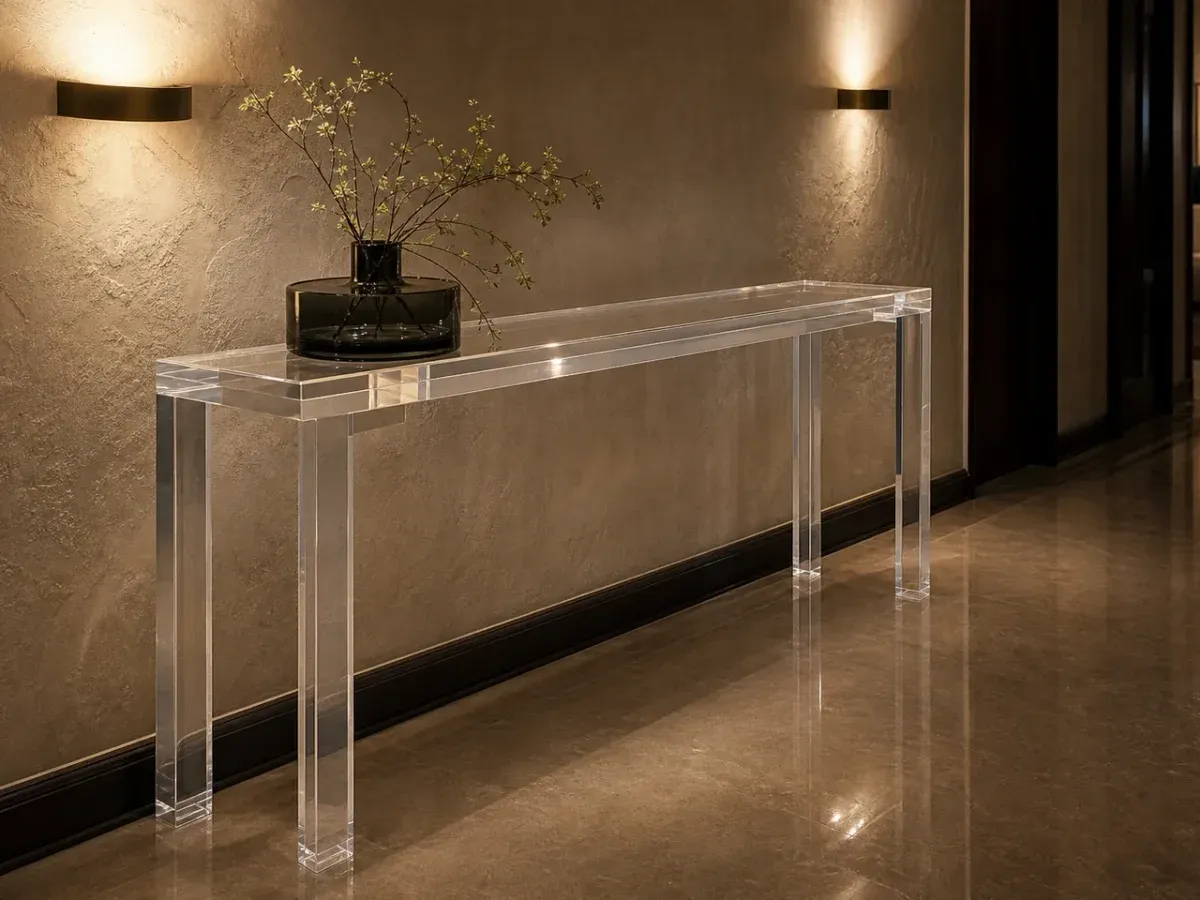
Lobby corridors, entry walls, reception zones — six shapes, hidden cable, optional LED halo.
Custom acrylic console tables for boutique hotels, luxury retail entries, corporate reception areas, members' clubs, and restaurant reception zones. Six shape options — standard rectangular, demilune (half-moon), asymmetric, curved-front, slim-profile, and LED-edge. Cast PMMA at 25–30mm top thickness, reinforced leg-to-top joints with hidden internal acrylic gussets, optional cable channel for AV/lamp wiring, optional integrated underside LED halo. MOQ 10 pieces per design; sample 7–10 days; production 22–28 days for 10 pieces.
ISO 9001 Certified Reinforced Corner Joints Hidden Cable Channel Optional LED Edge Halo
Built for the corridor, not the centerpiece.
Narrow depth (30–40cm), reinforced corner joints with internal acrylic gussets, optional hidden cable channel and integrated LED-edge halo.
Acrylic console tables come in six shape options: standard rectangular (the hospitality default), demilune / half-moon (curved entry wall), asymmetric (off-center alignment), curved-front (gentle bow), slim-profile (25cm depth for tight corridors), and LED-edge (integrated underside halo). All in cast PMMA at 25–30mm top thickness with diamond-polished edges and reinforced leg-to-top joints. Each shape maps to a different architectural setting — choose by the wall geometry and the corridor footprint, not by visual preference alone.
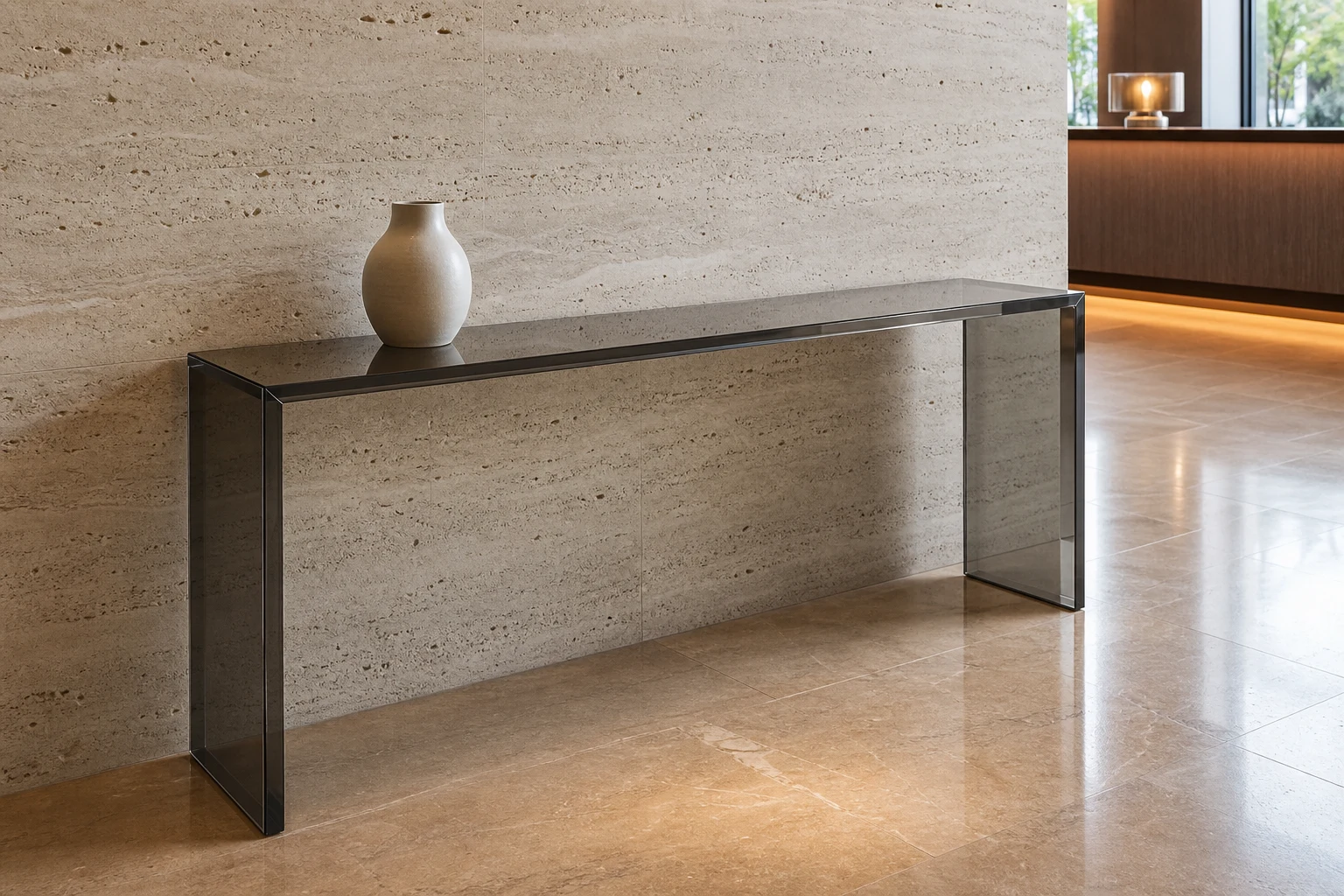
1.2–1.6m wide, 30–40cm deep, 75–85cm tall. The hospitality default — fits any corridor, entry wall, or lobby alignment
Jump to details below ›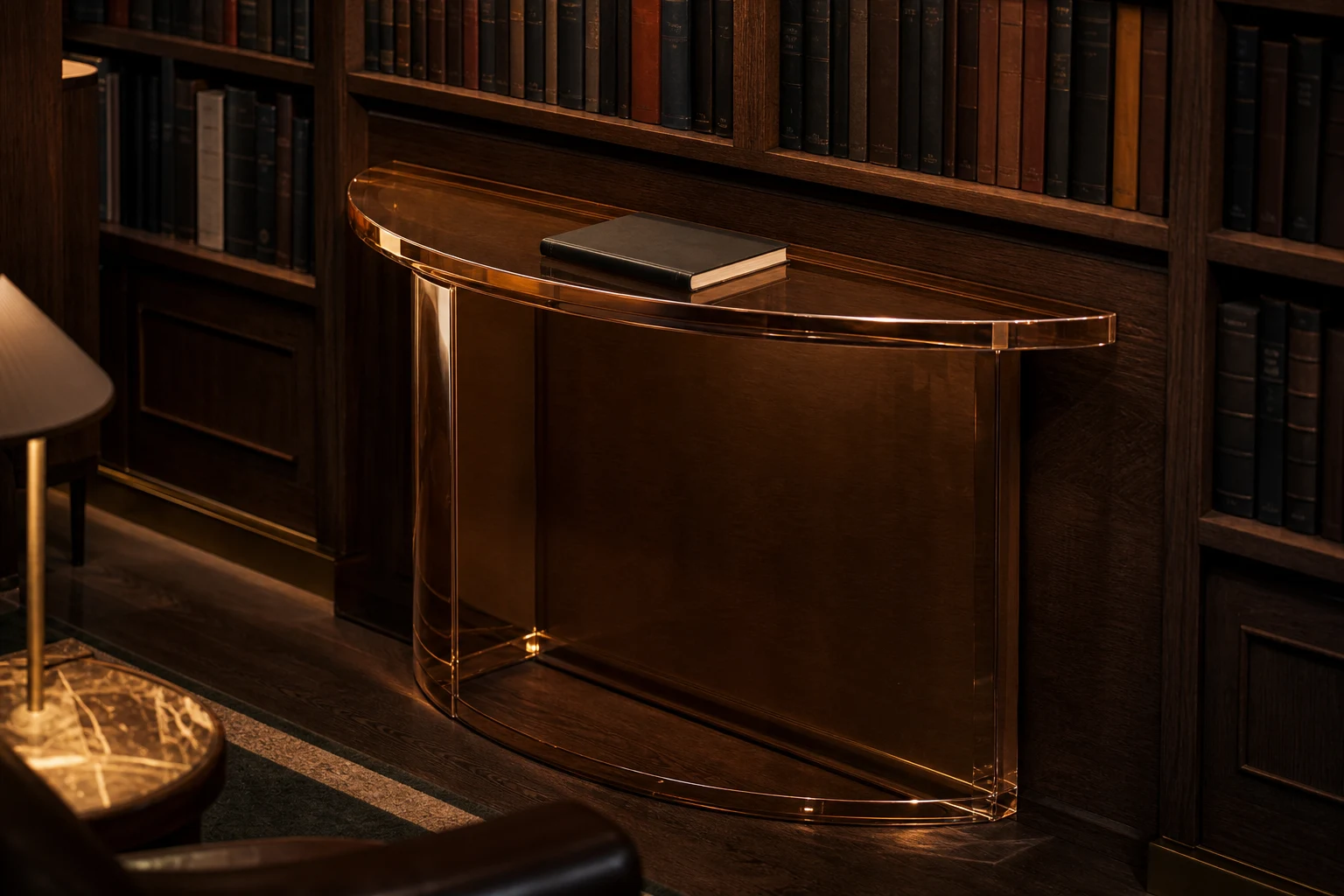
Half-circle plan against a curved entry wall. CNC-routed from a thick cast block; the curve reads as a single sculptural piece
Jump to details below ›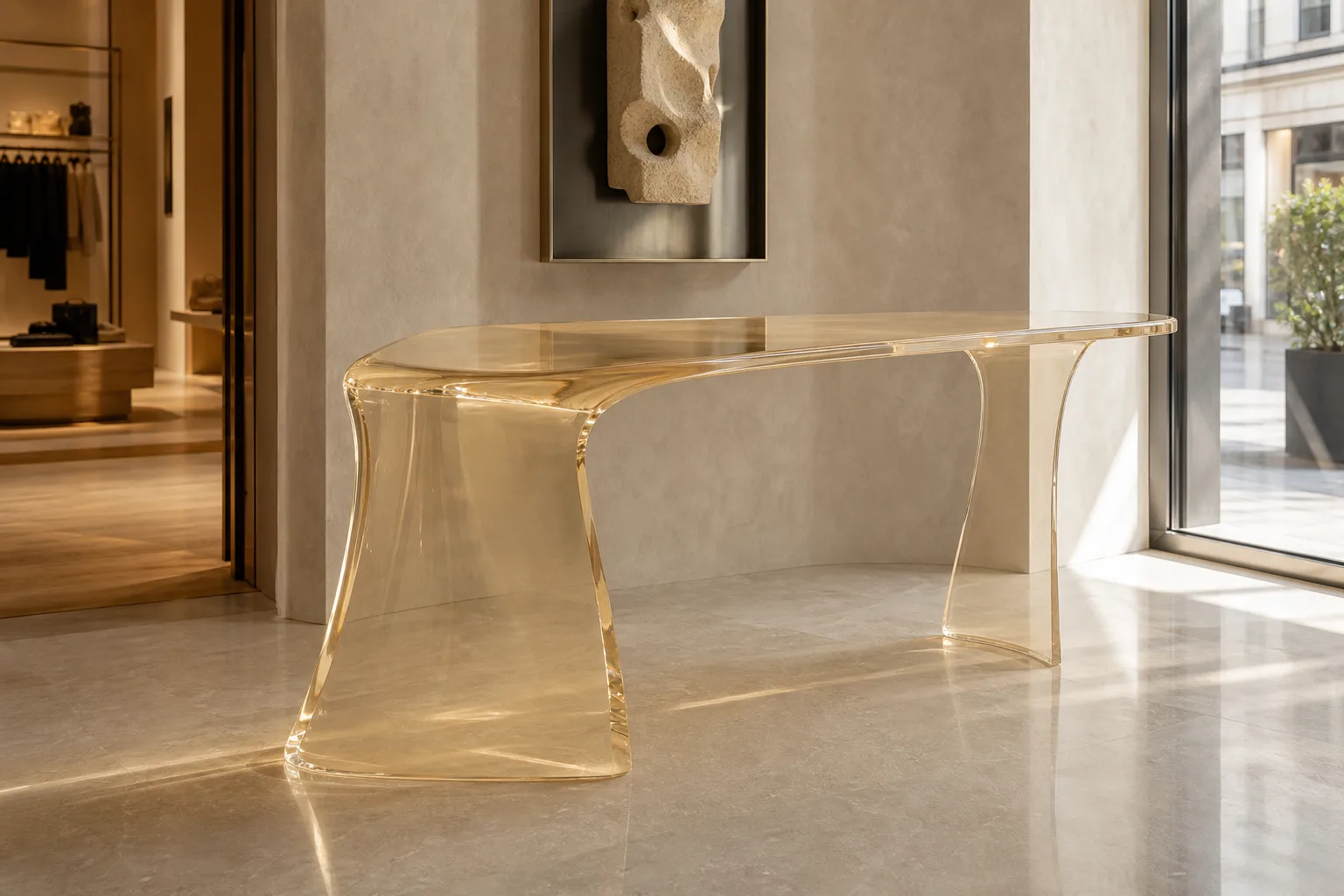
One side longer than the other — pairs with off-center hallway alignment, doorways, or asymmetric architectural elements
Jump to details below ›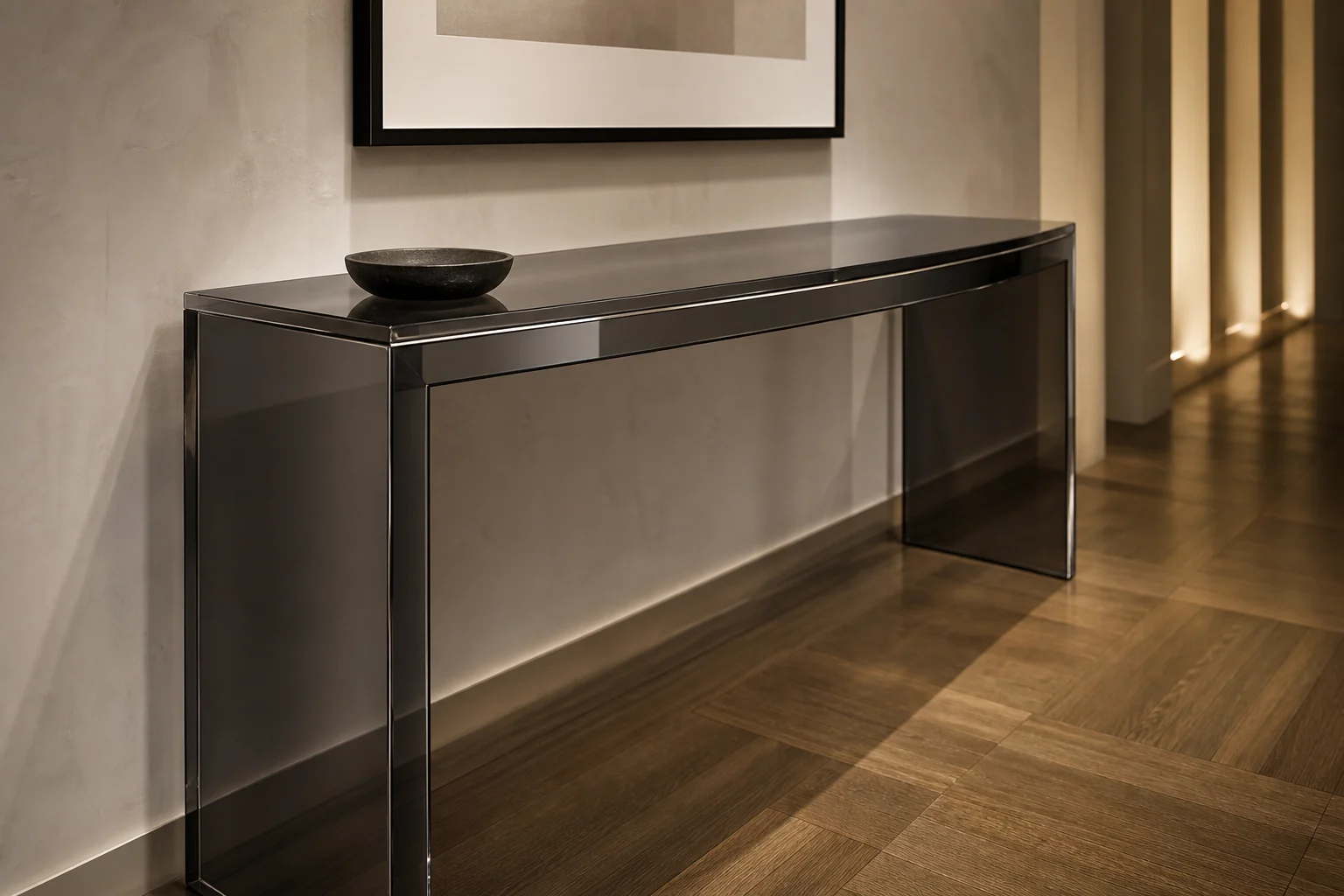
Gentle bow front for softer geometry. Keeps the wall-aligned footprint but adds visual movement
Jump to details below ›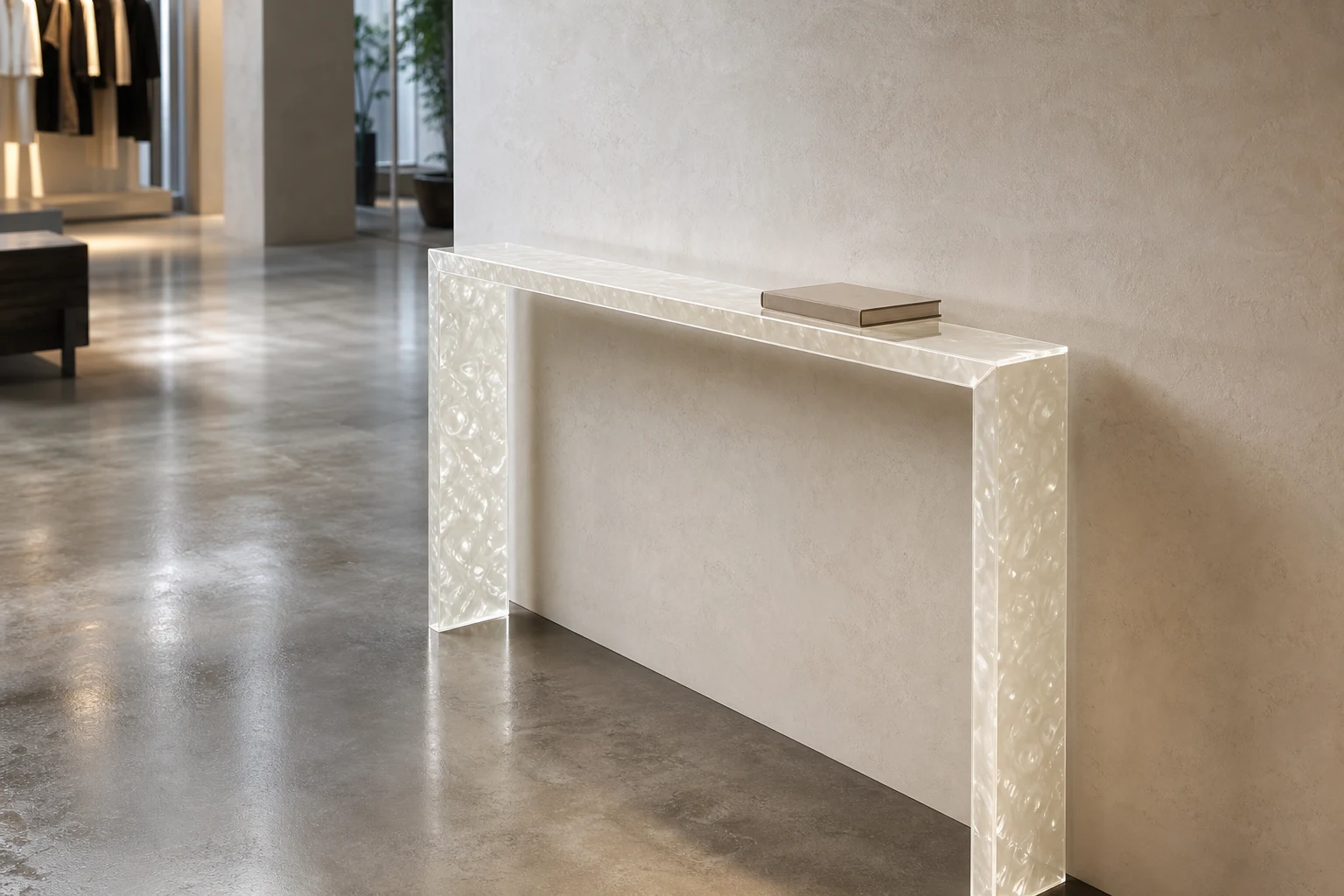
25cm depth — for tight corridors and narrow entry walls where standard 35cm depth is too deep
Jump to details below ›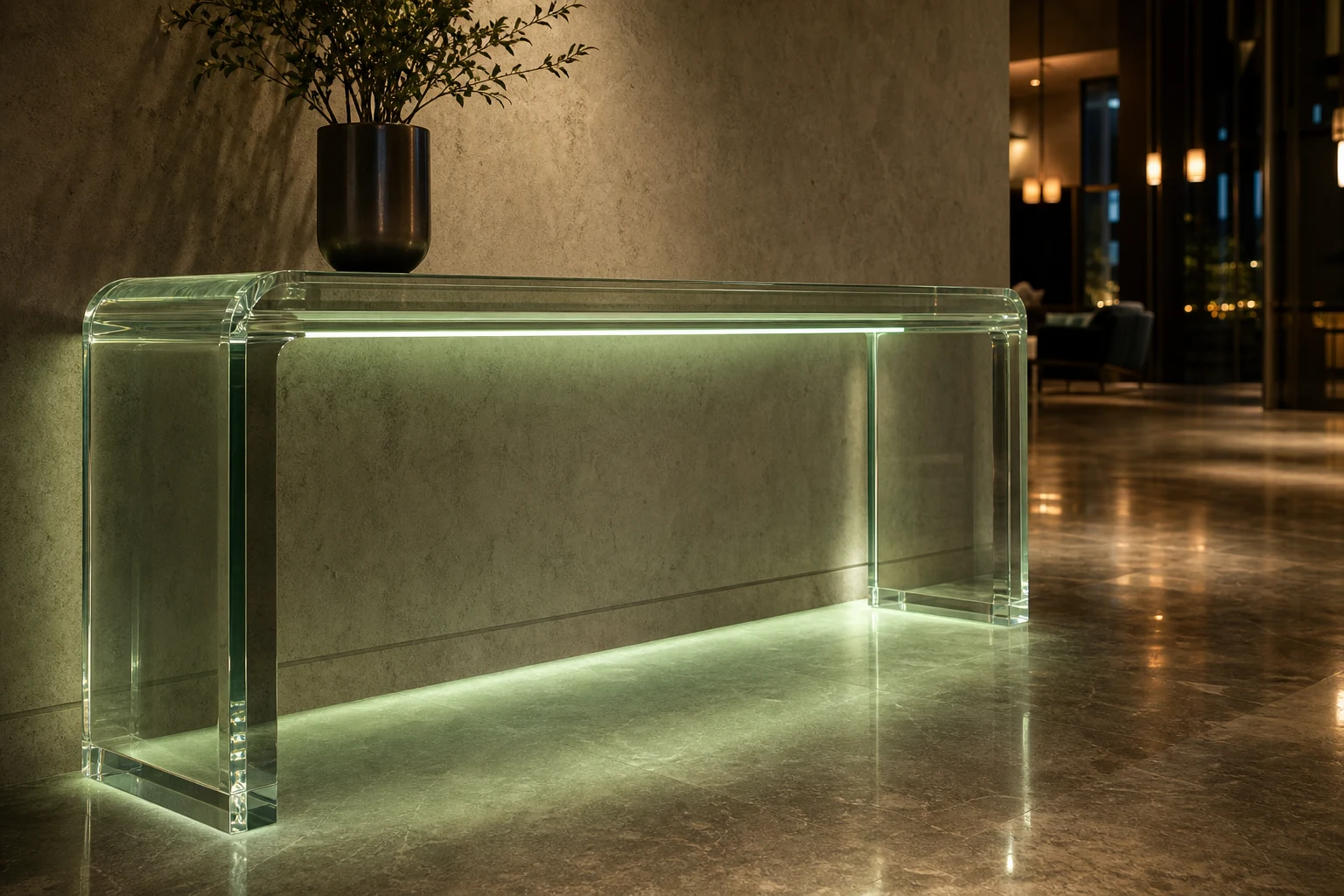
Integrated underside LED-edge halo. Wayfinding lighting in boutique-hotel corridors; architectural accent in corporate lobbies
Jump to details below ›Need a different furniture type? See acrylic furniture hub for coffee tables, side tables, dining tables, and chairs.
A custom acrylic console table is a narrow, wall-aligned, standing-height table — typically 1.2–1.6m wide, 30–40cm deep, 75–85cm tall — built from cast PMMA. For commercial use the console sits in a lobby corridor, an entry wall, a reception zone, or a circulation passage. The surface holds a lamp, a key drop, a sculpture, a POS terminal, or a brand display object; the geometry matters because consoles are usually wall-aligned and seen in horizontal traffic, so the proportions read as architectural rather than furniture.
Consoles fail at the leg-to-top joint, not at the surface. Standing-height furniture takes asymmetric load — guests lean, brace against the corner, set down weighted bags, remove a coat while resting one hand on the table edge. We reinforce every leg-to-top junction with optical-clear UV-cure adhesive and a hidden internal acrylic gusset, so the corner holds under unintended pressure without visible hardware. Optional hidden cable channel routes lamp or AV wiring through the rear underside. Optional integrated LED-edge halo projects a soft glow onto the floor for after-dark wayfinding.
The shape decision matters more on a console than on most other furniture types. A coffee table sits in the middle of a seating arrangement and gets viewed in the round; its shape choice is largely aesthetic. A console is wall-aligned and seen as architecture — the shape has to match the wall geometry it's set against. A rectangular console in a curved rotunda entry stops awkwardly against the arc; a demilune in a square corridor reads as a leftover piece from another room. That's why the six-shape option set on this page is keyed to architectural settings, not to design preference alone.
Consoles ship most often in multi-property hospitality rollouts — one console per property × 12–24 properties with batch color matching enforced as a QC checkpoint, not an afterthought. Send a brief, drawing, or wall photo. Sample 7–10 days; what you approve is what we produce.
Popular with: boutique hotels & resorts · luxury retail entries · corporate reception & AV · members' clubs · restaurant reception zones · interior designers on multi-property rollouts
Discuss Your Project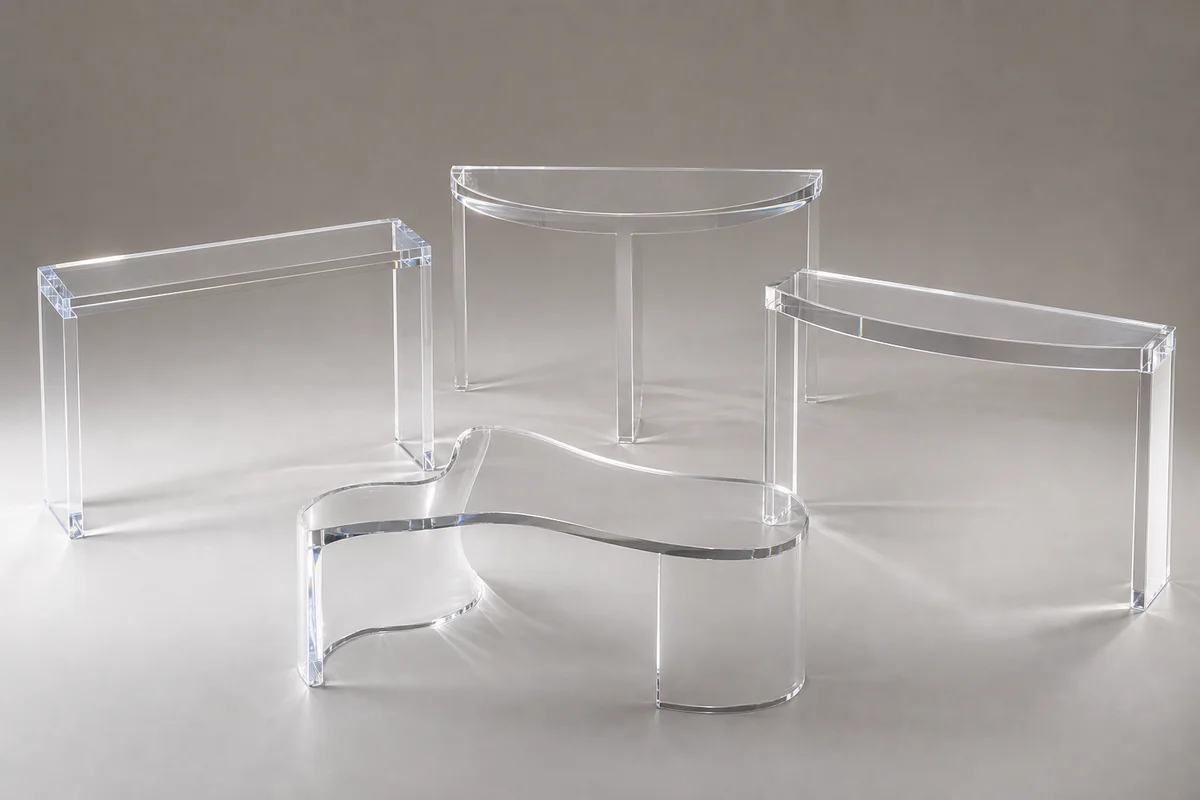
Console proportions follow a tight band — depth 30–40cm, height 75–85cm, length 1.2–1.6m is where most hospitality and corporate briefs land. The table below is our working reference for cast PMMA tops at standing-height loads. Load engineering for your exact span and base configuration is confirmed on sample sign-off, not on the spec sheet — project-specific brief data drives the final thickness call.
| Shape | Typical Length × Height | Top Thickness | Depth | Base |
|---|---|---|---|---|
| Standard rectangular | 1.2–1.6m × 75–85cm tall | 25–30mm | 30–40cm | 4-leg or 2-pedestal |
| Demilune | 1.2m chord × 80cm tall | 25–30mm | 40cm radial | 2-leg or single curved pedestal |
| Asymmetric | 1.4m total × 80cm tall | 25mm | 30–35cm | Asymmetric 3-leg |
| Curved-front | 1.4m × 80cm tall | 25–30mm | 35cm bow (~5–8cm variation) | 4-leg matching bow |
| Slim-profile | 1.2–1.4m × 80cm tall | 25mm | 25cm | 4-leg slim |
| LED-edge | 1.4m × 80cm tall | 25–30mm | 35cm + cable run | 4-leg + integrated channel |
Working reference for cast PMMA at standing-height loads. Engineering working estimate; project-specific load data confirmed on sample sign-off.
Coffee tables and side tables fail at the top — distributed load over a long span flexes the surface. Console tables fail somewhere else entirely. Because a console is standing-height (75–85cm), guests interact with it through asymmetric load: they lean against the corner while reading a key card, brace against it while removing a coat, set down a weighted shoulder bag at one edge with sudden impact, or rest a full hand on the edge while bending to fix a shoe. None of that registers on the surface; all of it concentrates at the leg-to-top junction.
Two engineering moves keep that junction from failing — adhesive and gusset. Together they handle both the pull-apart load and the lateral brace load that a single solution can't cover alone. The small-impact load (roller bags, housekeeping carts, door swings) is then absorbed by cast PMMA itself — glass cracks at the corner under the same pattern; cast acrylic scuffs at worst.
Optical-clear UV-cure bond at every leg-to-top connection. Stronger than solvent bond and invisible from the room side because it cures water-clear — no cloudiness, no yellowing over time.
A cast acrylic gusset routed into the underside of the top at each leg position, optically matched to the top and seated below the visible plane. The leg loads through a wider footprint rather than a single point.
Adhesive alone holds against pull-apart tension but not lateral brace torque from a guest leaning on the corner. The gusset widens the footprint so torque dissipates across the underside. Either one alone is a partial solution we don't ship.
| Piece | Typical Span | Top / Wall Thickness | MOQ |
|---|---|---|---|
| Coffee Table | 1.0–1.4m | 25–30mm | 10 |
| Side Table | 0.4–0.6m | 20–25mm | 10 |
| Console Table (this page) | 1.2–1.6m × 0.30–0.40m | 25–30mm | 10 |
| Chair | 45 / 65 / 75cm seat | 8–10mm shell | 10 |
| Dining Table | 1.6–2.4m | 30–40mm | 10 |
Consoles look simple — the engineering sits in the joints and the optional infrastructure. Wrong corner reinforcement fails under guest brace load; wrong cable-channel placement makes the AV wiring visible from the room side; LED-edge halo without a tuned diffuser reads as a hard line rather than a soft glow. Wetop has been building custom acrylic for B2B buyers since 2008 — 25 countries, ISO 9001 certified, in-house CNC and polishing — and the four engineering moves below are what distinguishes hospitality-grade consoles from glued-up custom-furniture experiments.
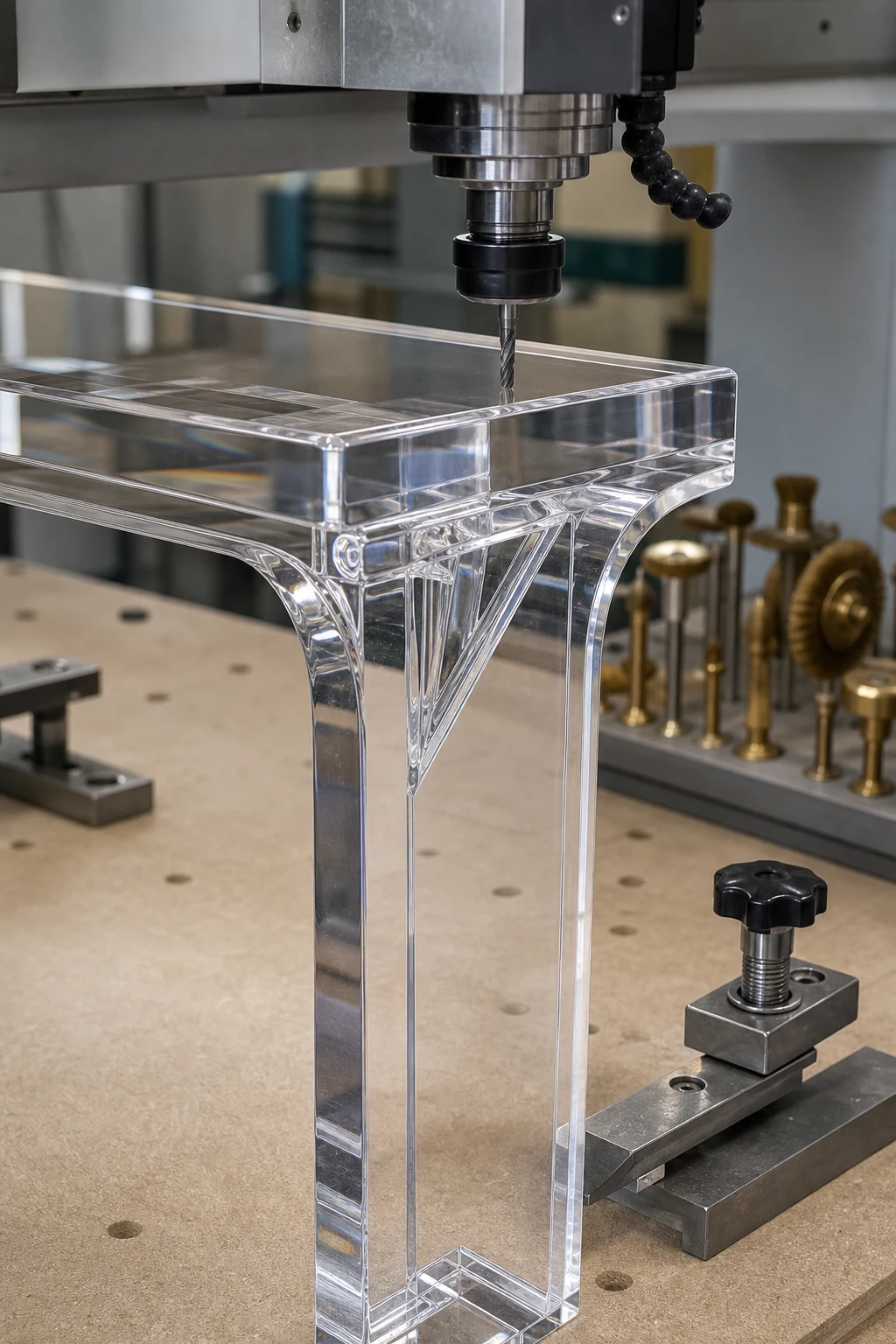
Console tables fail at the leg-to-top corner under accidental pressure — a guest leans heavily, sets down a weighted bag, braces against the corner while removing a coat. Every Wetop console joint carries optical-clear UV-cure adhesive plus a hidden internal acrylic gusset at each leg-to-top connection. The corner stays invisible from the room side; the strength is engineered in, not bolted on. Eighteen-month brace cycles on installed pieces show no visible joint stress.
We mill a 6–10mm channel along the back underside of the top, drop the wires through one rear leg, and exit at floor level behind the console. Wiring stays invisible from the room side. For corporate AV use, hollow boxed enclosures inside one leg house power strips, routers, or charging hubs with a hinged access panel. Exit-position and channel geometry are project-specific and confirmed at sample.
A milled channel along the underside front edge houses a dimmable LED strip; light projects a soft halo onto the floor and washes the underside of the top with even glow. In-line dimmer routed through the cable channel. Warm-white standard; cool-white and color-temp adjustable available. Used in boutique hotels for after-dark wayfinding along suite-floor corridors and in corporate receptions as evening architectural accent.
Hospitality rollouts run one console per property across 12–24 properties — and the buyer expects every piece to read as one batch. We pull the full quantity from a single cast lot where volume allows, colorimeter-check every tinted piece against the approved sample tile, and reject any unit that drifts beyond the agreed delta. Where the order exceeds a single cast lot, we plan the cut sequence so each property receives a balanced mix rather than one site getting all the lighter pieces.
The LED-edge consoles in our lobby corridor work after-hours like soft wayfinding. The reinforced corner joint hasn't shown stress at 18 months, even with guests bracing against them when they reach for the elevator call.
Multi-property rollouts are the order shape we plan for most carefully because the buyer's quality test isn't "does this one piece look right" — it's "do all twelve pieces look the same at every property." That's a different problem. Three planning steps keep the answer yes.
Cast PMMA shows real lot-to-lot tone variation. Where volume allows, all tops pull from a single cast batch. For 18+ pieces in 30mm, we balance the cut sequence so each property gets a mix — not three lighter pieces at property A and three darker at property B.
Every tinted unit measured against the approved sample tile with a handheld colorimeter; delta recorded. Pieces drifting beyond tolerance get rejected at QC, not shipped and replaced later. Tolerance is set per-project on sample sign-off — bronze shifts sooner than smoked clear.
Reinforced corner joint, chamfered edge profile, and any subsurface engraving read identically across the batch. Same CNC toolpath every piece, polished on one line in one shift where possible, engraving depth and position checked against a measured reference.
Console tables ship in cast PMMA at 25–30mm top thickness with reinforced leg-to-top joints as standard. Five material variants, six edge and surface finish options, and optional cable channel + LED-edge infrastructure are quotable on every order. The tables below are the standard options on every console quote — send a brief and we'll recommend the combination that fits your wall, your traffic, and your brand reference.
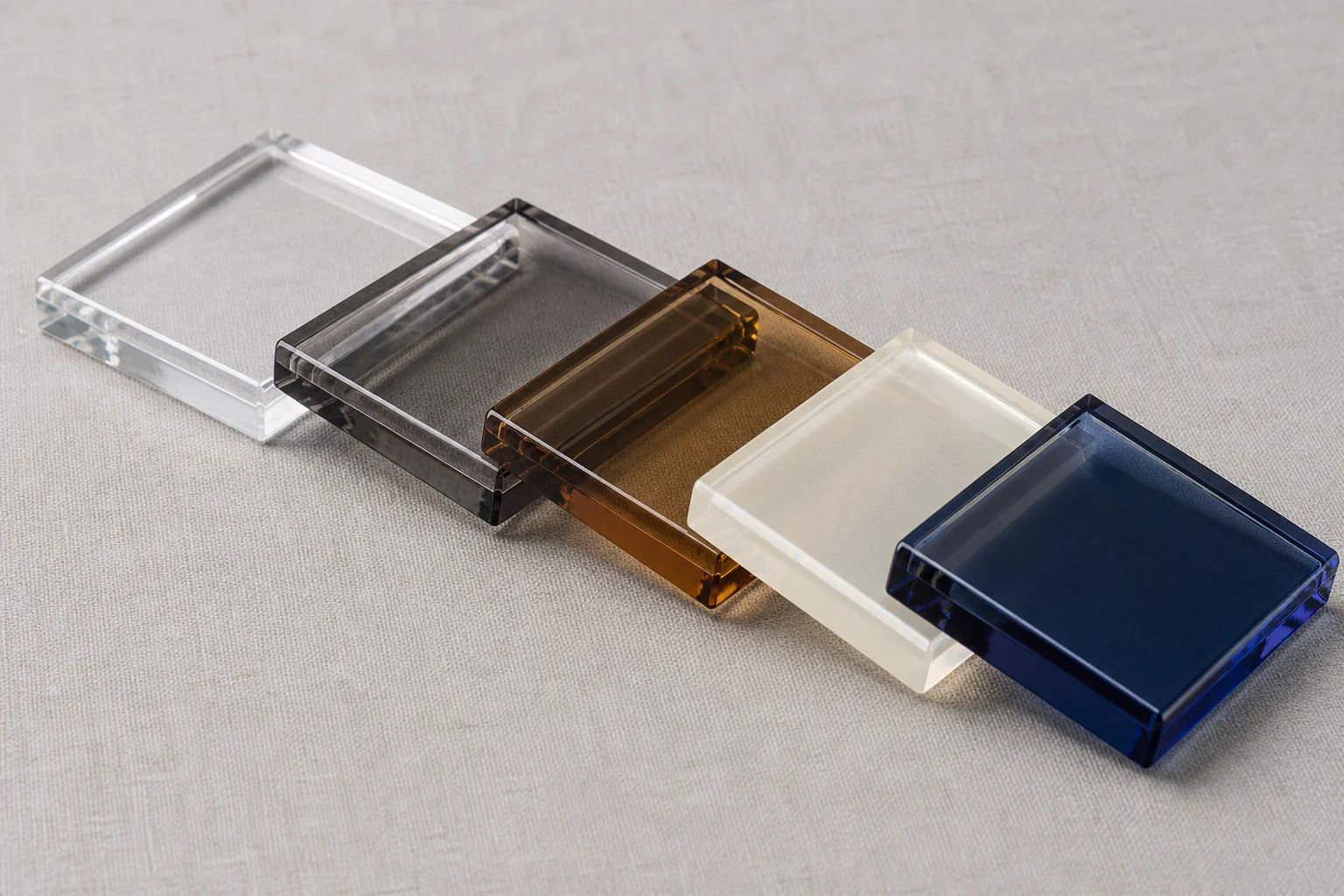
| Material | Properties |
|---|---|
| Clear cast PMMA | 92% light transmission, optical clarity — the default for hospitality corridors where the console should disappear into the architecture |
| Smoke tint | Whole-body grey-tinted cast — softens corridor light, pairs with neutral palette interiors |
| Bronze tint | Warm amber tone — pairs with wood-and-leather club and library interiors |
| Pearlescent | Soft milky-translucent finish — light passes, object outlines blur |
| Custom Pantone-match | Color through the body, matched to a Pantone reference or supplied chip |
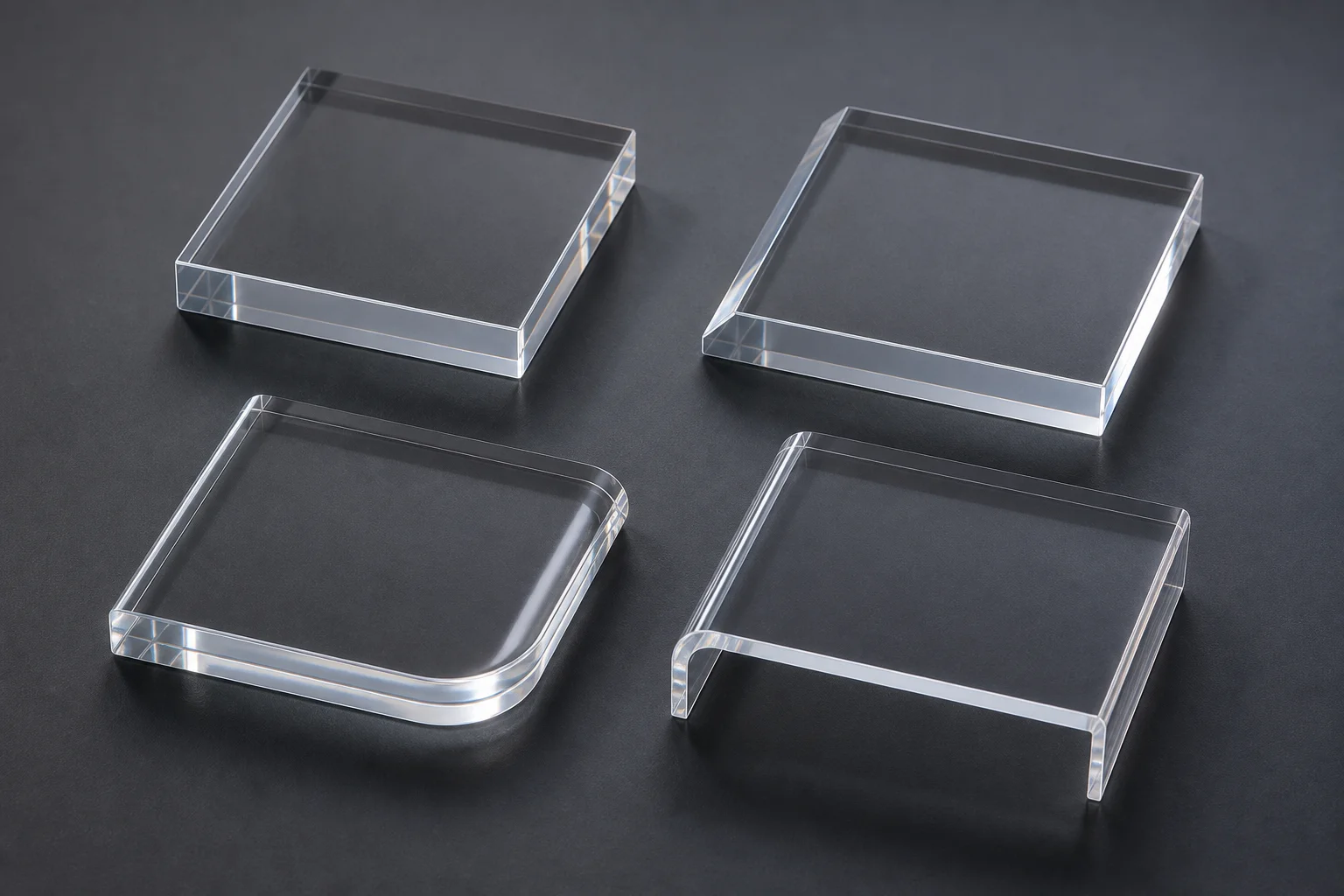
| Finish | Result |
|---|---|
| Diamond polish (standard) | Optically clear edge — reads like glass |
| 45° chamfered | Light-catching angled edge — most-ordered for rectangular consoles |
| Bull-nose rounded | Softer front edge — used for high-traffic corridors where the front edge gets brushed |
| Reinforced corner joint | Hidden internal acrylic gusset + UV-cure adhesive — holds against brace load |
| Subsurface laser engraving | Frosted-white logo or property mark inside the body of the top |
| Integrated LED-edge halo | Dimmable underside glow for wayfinding and architectural accent |
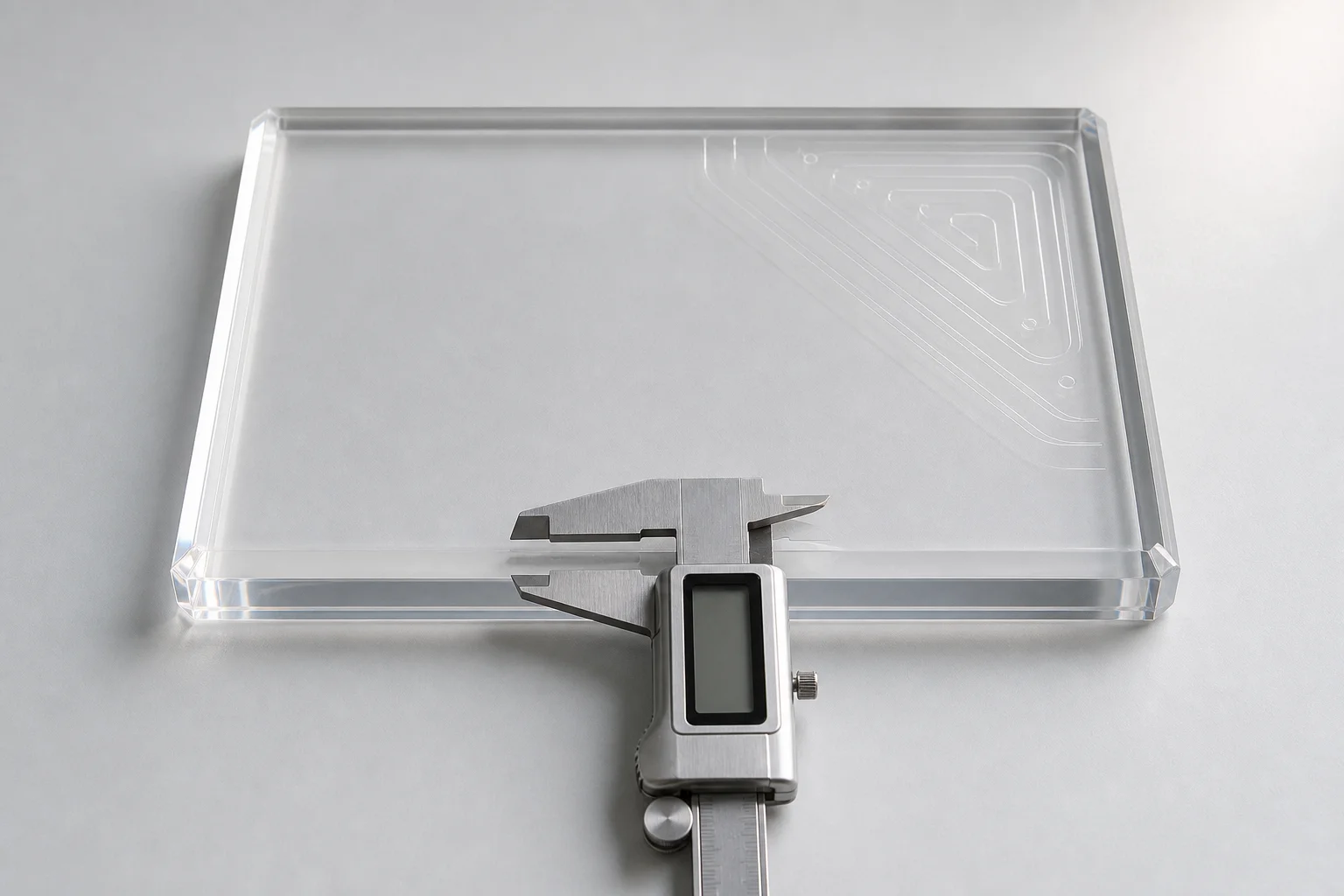
| Spec | Details |
|---|---|
| Top thickness | 25–30mm cast PMMA |
| Length / depth | 1.2–1.6m length × 30–40cm depth (25cm slim-profile available) |
| Height | 75–85cm (80cm most-ordered) |
| Base architecture | 4-leg, 2-pedestal, asymmetric 3-leg, single curved pedestal (demilune), integrated cable run (LED-edge) |
| Load engineering | Engineering working estimate sized to span and brief; project-specific load data confirmed on sample sign-off |
| Optional infrastructure | Hidden 6–10mm cable channel through one rear leg; integrated LED-edge halo (dimmable); boxed-leg AV enclosure |
| MOQ | 10 pieces per design |
| Sample lead time | 7–10 days |
| Production lead time | 22–28 days for 10 pieces; 35–45 days for 12–24 pieces |
Not sure what spec fits your project? Send us a brief, drawing, or reference image — we'll recommend material, edge profile, base architecture, and whether cable channel and LED-edge make sense for your use case.
Get Material RecommendationsTwo console-specific infrastructure options ship together more often than not: the hidden cable channel (for AV, lamp, or POS wiring) and the integrated LED-edge halo (for wayfinding and architectural accent). They share the same milled channel along the underside, so adding both at once is more cost-efficient than spec'ing one and retrofitting the other later. The cross-section below shows how the two systems fit into a single underside-routed channel.
The channel runs the full length of the console along the back underside, typically 6–10mm wide and 6–8mm deep. Wires drop vertically through one rear leg via an internal conduit and exit at floor level, hidden by the wall behind the console. For corporate AV briefs where a power strip, router, or charging hub needs housing, we box out an 8 × 8 × 25cm enclosure inside one leg with a hinged access panel — optical-clear hinges and magnetic catch so the leg face reads as solid acrylic.
Three cable-run patterns cover the bulk of briefs: single-lamp routing (one cable through the back-left leg to a wall outlet), AV head-unit routing (two-to-four cables into a boxed-leg power strip or signal hub), and POS-terminal routing for restaurant maître d' stations (power + data through one rear leg into a floor box under the carpet edge). Exit positions, channel geometry, and access-panel placement are project-specific and confirmed at sample.
The LED strip sits in a milled channel along the underside front edge, behind a frosted diffuser that converts the line of LEDs into an even glow. Standard color temperature is warm-white (~2700K) — most-ordered for hotel-lobby corridors. Cool-white (~4000K) is available for retail entries and corporate receptions with cooler ambient palettes; color-temp adjustable strips are quotable where the lighting needs to shift from warm-day to cool-evening.
All variants are dimmable via an in-line dimmer routed through the cable channel; brightness is tuned at installation to match the corridor, not fixed at the factory. Hospitality installs typically land at 20–30% of full brightness for after-dark wayfinding; corporate receptions running evening events bias to 40–50%. One thing the LED-edge does NOT do well: replace overhead lighting. If the brief asks the console light to substitute for a downlight, we'll say so on the quote — the console isn't the right tool for an under-lit task surface.
Shape and infrastructure aren't independent decisions on a console — certain combinations cluster in actual buyer briefs. The table below shows the combinations we ship most often and the typical setting. Most-ordered is rectangular + cable channel for hospitality lobbies; the next cluster is curved-front + LED-edge for hotel corridors that need wayfinding plus a softer geometry. Demilune + LED-edge is the showpiece combination for retail entries with curved entry walls.
| Shape | Cable Channel | LED-Edge Halo | Typical Setting |
|---|---|---|---|
| Rectangular | Most-ordered | Common | Hotel lobby, corporate reception, restaurant maître d' |
| Demilune | Optional | Showpiece combination | Retail flagship entry, hotel rotunda |
| Asymmetric | Common | Less common | Off-center corridor, residential-conversion hotels |
| Curved-front | Common | Most-ordered combination | Hotel suite-floor wayfinding, members' club library |
| Slim-profile | Optional | Optional | Tight retail walks, narrow hotel corridors |
| LED-edge (dedicated) | Required (shares channel) | Standard on this SKU | Corporate reception evening accent |
"Most-ordered" and "common" describe what we ship most often; any shape + infrastructure combination is quotable.
Cast PMMA is the right material for commercial console tables when transparency is the design choice — narrow-depth corridor pieces where wood or steel would visually block sight lines. Versus glass, cast PMMA is more impact-resistant and won't shatter into shards when a guest brushes against the corner. Versus wood, it doesn't swell, stain, or warp on standing-height exposure. The comparison below shows the four material decisions a hospitality buyer typically weighs at spec time.
| Cast Acrylic (PMMA) | Glass | Wood | Steel | |
|---|---|---|---|---|
| Clarity | 92% light transmission | 90% | Opaque | Opaque |
| Impact resistance | Significantly stronger than glass | Fragile, shatters into shards | Dents under impact | Dents/scratches |
| Weight (per piece) | About half the weight of glass | Heavy — freight cost adds up | Heavy | Heavy |
| Daily commercial use | No warping, no staining, easy clean | Fingerprints; cracks under stress | Warps; absorbs spills permanently | Rusts in humid corridors |
| Color matching | Whole-body tints, Pantone-match | Limited tints, surface-applied | Stain/finish, batch variation | Powder coat, chip-prone |
| Branding integration | Subsurface engraving, UV print, tint | Limited to surface etching | Engraving, branding inlay | Etching, applied badges |
| Cable / LED integration | Routed channel + LED strip fits naturally into underside | Difficult — no clean way to hide a channel | Possible but adds visible joinery | Possible via separate raceway |
| Best for | Hotel lobby corridor, entry, and reception consoles where sight lines and signature lighting matter | Display vitrines, low-traffic accents | Heritage interiors, residential | Structural fixtures, industrial |
Related guides: acrylic thickness engineering guide · cast vs extruded acrylic explainer.
Each shape option has its own machining method, base architecture, recommended use space, and price band. The shape decision is driven by the wall geometry and the corridor footprint, not by visual preference alone — pick the shape that matches the architectural setting, then layer the material, finish, cable, and LED options on top.
Straight wall + clean rectangular corridor → rectangular; anything else fights the architecture. Curved wall (rotunda lobbies, curved-front entry, library niches) → demilune is the only shape that resolves cleanly; a rectangle against a curve reads as a leftover piece.
If the standard 30–40cm depth blocks circulation — narrow hotel suite-floor passes, retail walks where merchandise takes the rest of the width, residential-conversion hotels — slim-profile drops to 25cm and resolves the conflict without abandoning the piece.
If a fire-extinguisher cabinet, mechanical column, or doorway interrupts the wall plane, asymmetric (60/40 split keyed to the interruption) is the answer. A rectangular console forced into the same footprint stops short and leaves an awkward gap.
If the rectilinear architecture wants softening but a full demilune is too sculptural, curved-front gives gentle visual movement while keeping the wall-aligned rear flat. Most-ordered shape in boutique-hotel suite-floor corridors for exactly that reason.
Cable channel and LED-edge are independent of shape — any of the five shapes above can carry either or both. The LED-edge dedicated SKU is for projects where LED is the primary spec driver; otherwise treat it as an option layered on top of your chosen shape.
If your brief lands cleanly on one of these decision branches, the spec writes itself. If it lands at an awkward intersection — narrow footprint plus curved wall, off-center alignment plus AV cable requirements — send us a wall photo and we'll walk through the trade-offs on the sample brief before any production commitment.
The curve needs visual space around it to read as sculptural; a half-moon trapped in a narrow rectangular corridor reads as a piece installed in the wrong room. Where the architecture is rectilinear, curved-front does the softening job and demilune doesn't.
The 25cm depth is for circulation-conflict situations. It's not for a console carrying a substantial display object — hero sculpture, heavy lamp with a wide base, stack of magazines. Pick standard depth and live with the floor footprint, or pick a different piece type.
The halo is for accent, wayfinding, and architectural detail — not general illumination. If the brief asks the console light to replace a corridor downlight, that's a lighting-design problem the console can't solve, and we'll point that out before any sample commitment.
Console buyers are B2B: hospitality groups for lobby corridors and suite-floor circulation, luxury retail for entry zones, fine-dining reception, corporate reception with AV requirements, galleries and members' clubs for library corridors, and interior designers on multi-property rollouts. Buyer language we hear repeatedly — "match across properties," "hide the cable," "after-dark wayfinding" — all map back to the four engineering moves on this page.
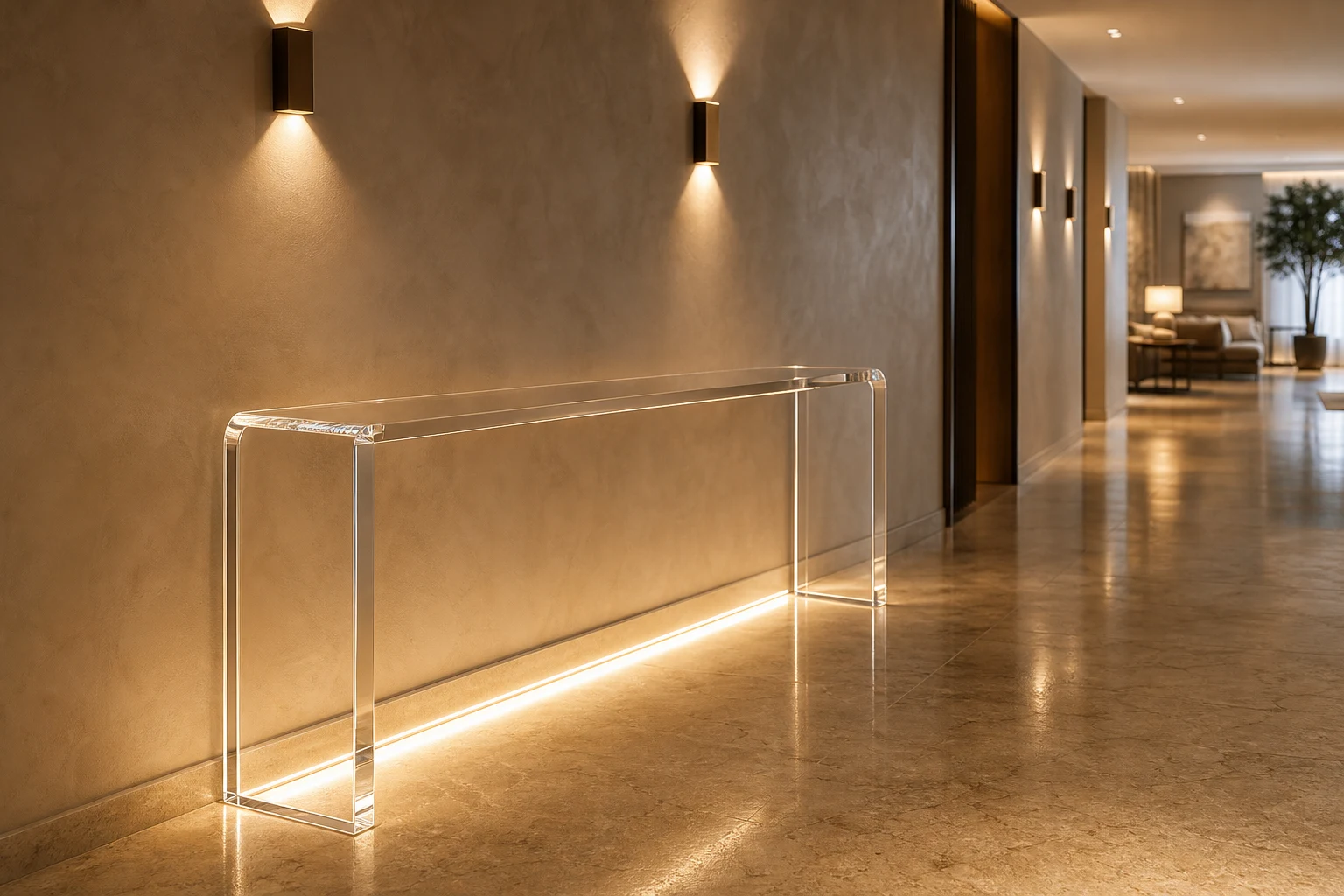
Standing-height consoles along lobby corridors, suite-floor circulation, and elevator lobbies. Multi-property rollouts of 12–24 pieces with batch color matching. LED-edge for after-dark wayfinding most-requested upgrade.
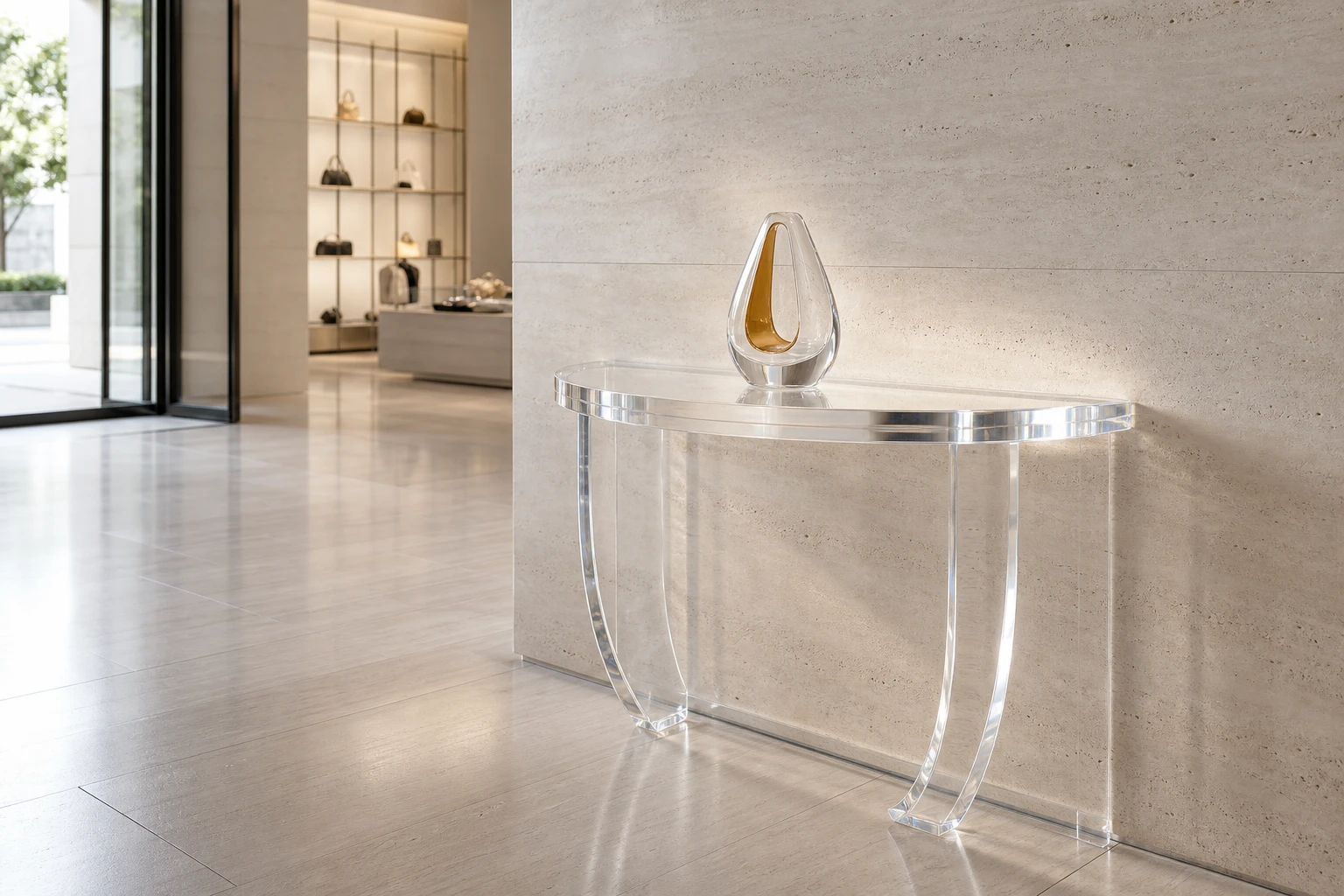
Entry-zone consoles as the brand's first physical impression. Demilune and curved-front lead for sculptural entries; slim-profile workhorse for narrow retail walks. Display object on top is typically a hero or seasonal piece.
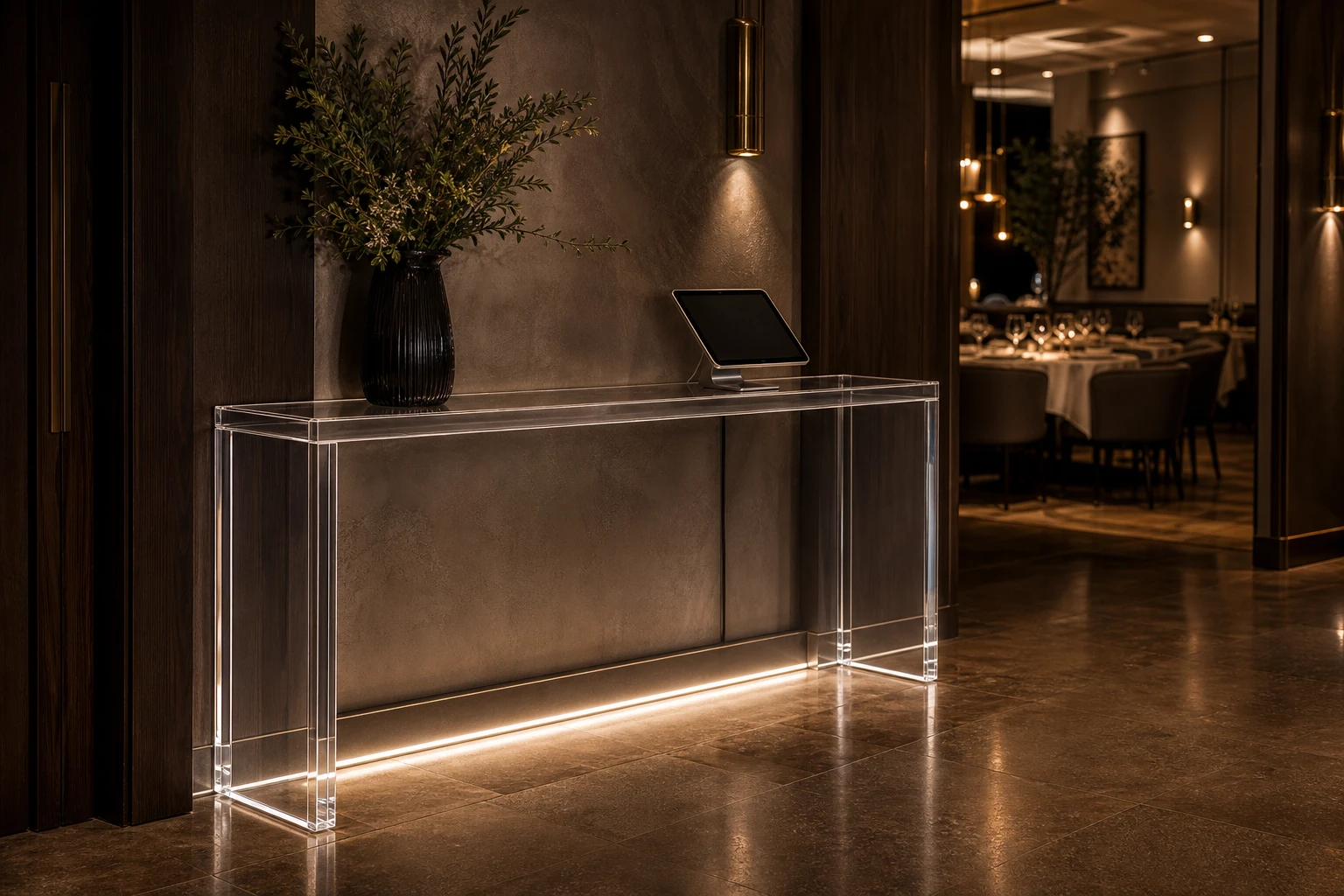
Maître d' station consoles, bar-approach passages, private dining entry consoles. Hidden cable channel for POS / reservation-tablet wiring; LED-edge underside halo for dim restaurant ambient lighting.
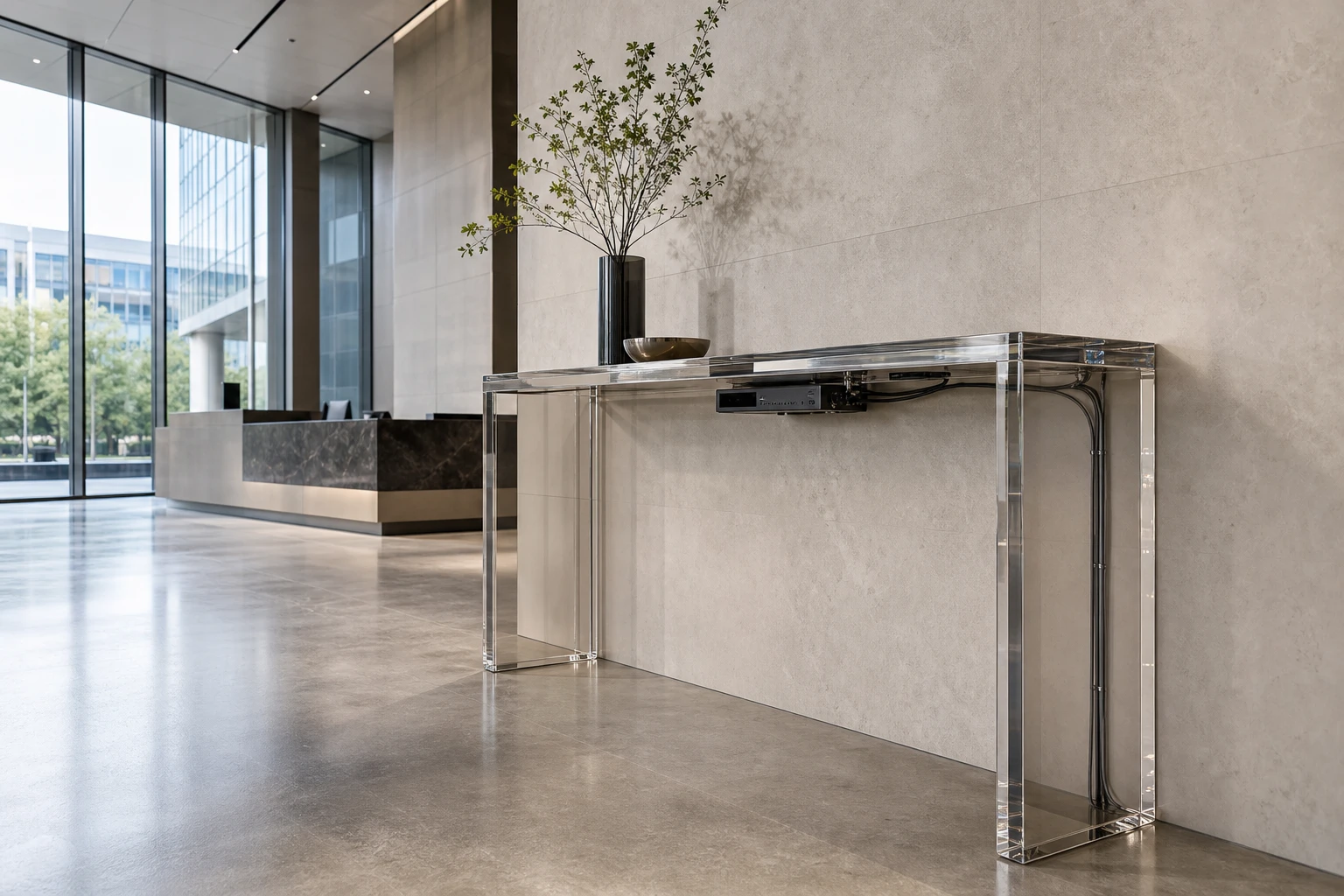
Reception-zone consoles, AV equipment consoles with hidden cable channels, lobby-floor brand-statement pieces with subsurface laser-engraved logos. Bronze or smoke tint to match heavier millwork.
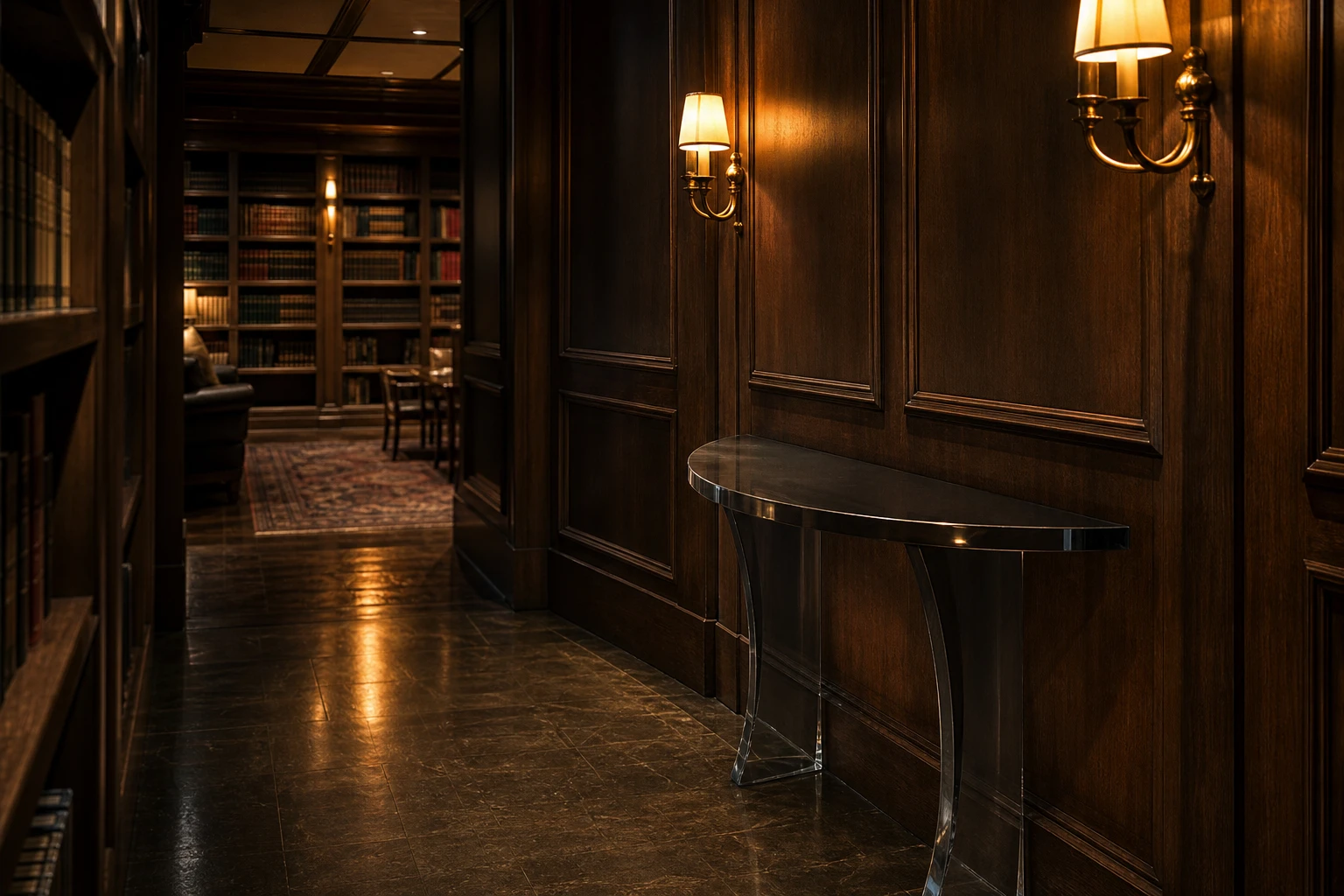
Library-corridor consoles, member-list display surfaces, gallery entry consoles. Smoke or bronze tint typical to read intentional against wood-and-leather club interiors. Demilune for rotunda library entries.
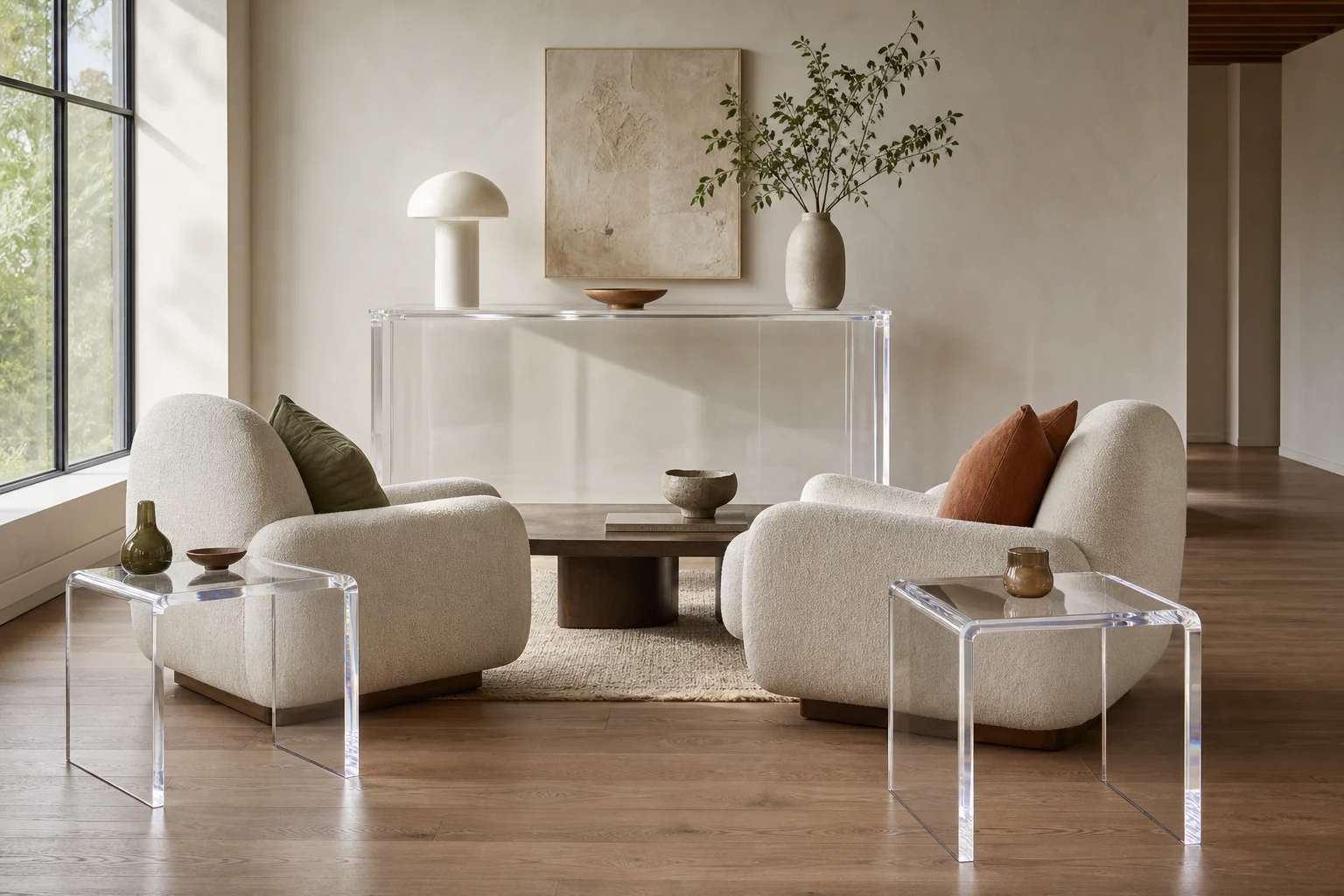
Designers managing console rollouts across 6+ properties — coordinated with seating-zone tables. Mixed-shape multi-SKU orders on one PO are common (e.g. 6 rectangular + 4 demilune across 10 sites).
The shape buyers reach for is highly predictable by segment. Boutique hotels lead with standard rectangular for lobby corridors and curved-front for suite-floor wayfinding (frequently combined with LED-edge). Luxury retail favors demilune for flagship entries where the brand language is sculptural. Corporate reception is overwhelmingly rectangular, sometimes bronze-tinted with a subsurface-engraved logo and LED-edge for evening events. Members' clubs go curved-front in smoke or bronze for library corridors. Restaurant reception is rectangular with hidden cable channel for POS terminal wiring. The slim-profile and asymmetric shapes are corridor-driven — wherever the architecture is too narrow or too off-center for a standard footprint.
| Buyer Type | Most-Ordered Shape | Typical Tint | Typical Infrastructure |
|---|---|---|---|
| Boutique hotel — lobby corridor | Standard rectangular | Clear | Cable channel for lamp wiring |
| Boutique hotel — suite-floor wayfinding | Curved-front | Clear or smoke | LED-edge halo + cable channel |
| Luxury retail — flagship entry | Demilune | Clear | Optional LED-edge halo |
| Corporate reception | Standard rectangular | Bronze or clear | Subsurface logo + LED-edge for evening events |
| Members' club library corridor | Curved-front | Smoke or bronze | Cable channel for desk-lamp wiring |
| Restaurant maître d' station | Standard rectangular | Clear or smoke | Cable channel for POS terminal |
| Narrow hotel corridor / retail walk | Slim-profile | Clear | Optional cable channel |
"Most-ordered" reflects the cluster we see most often in actual briefs; any shape × buyer combination is quotable when the wall geometry supports it.
Representative console projects from the past 18 months — boutique hotels, luxury retail flagships, corporate HQs, members' clubs.
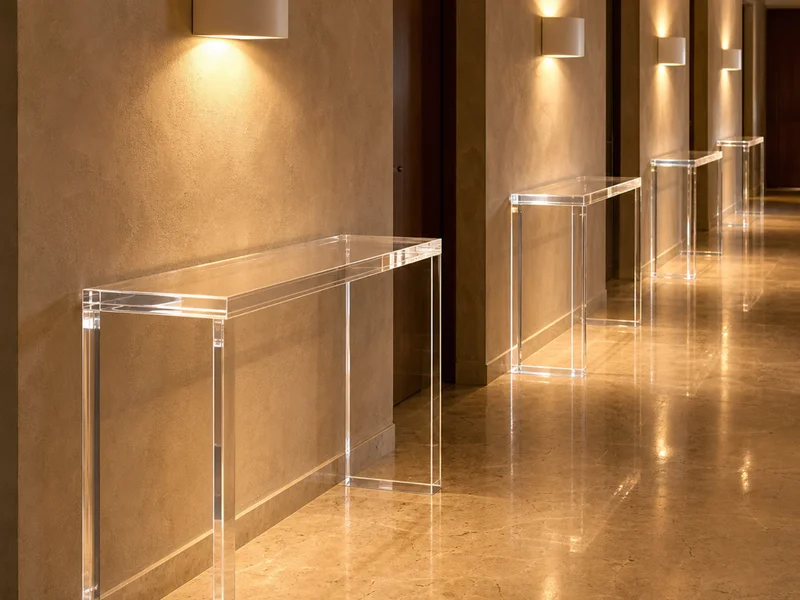
12 pieces · 25mm clear cast acrylic · 1.4m × 0.35m × 80cm · 4-leg base with reinforced leg-to-top gussets · chamfered edges · subsurface engraved property mark on top · batch-matched clear tone across all 12 sites · individually crated for distributed-property shipping
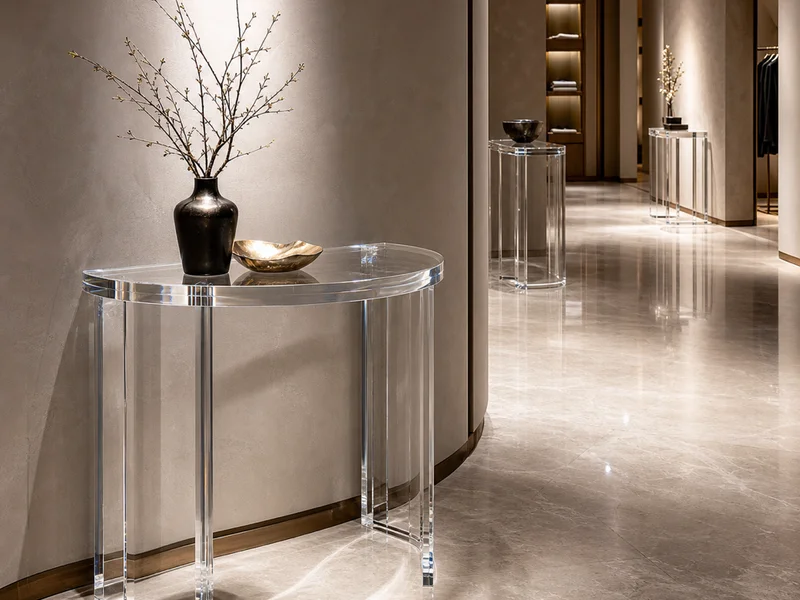
1 statement piece + 2 satellite consoles · 30mm clear cast · 1.2m demilune chord curve · CNC-routed from thick cast block (no glued arc seam) · 2-leg curved pedestal · diamond polish + bull-nose front edge · sample iterated twice to dial in the front-arc geometry against the curved entry wall
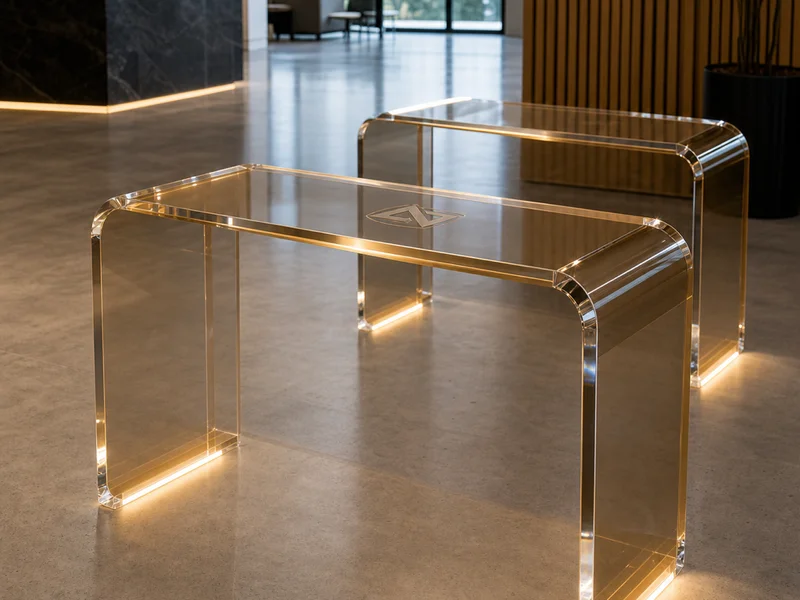
4 pieces · 30mm bronze-tinted cast · 1.6m × 0.4m × 80cm · integrated underside LED halo (warm-white dimmable, ~2700K) · hidden cable channel exiting through one rear leg · subsurface laser-engraved logo on top, under-lit by the LED halo · Pantone-matched bronze tint colorimeter-checked across all 4 units
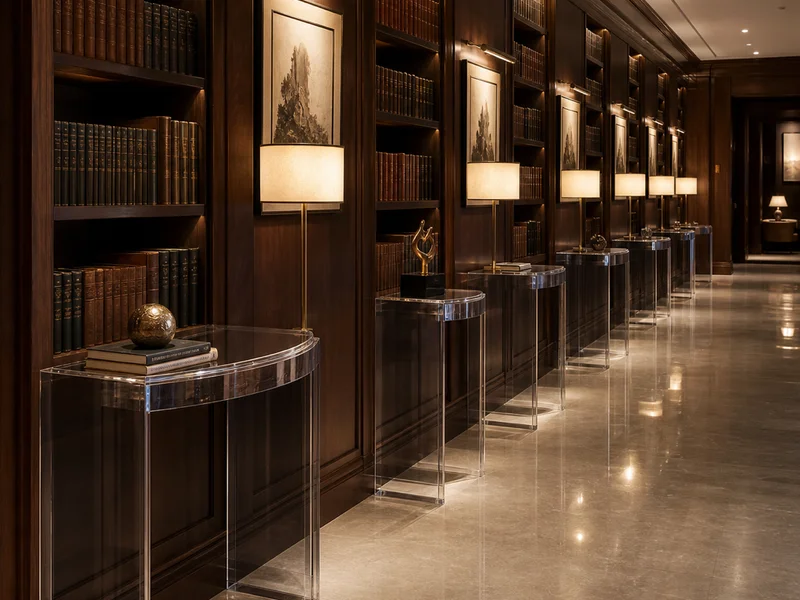
10 pieces · 25mm smoke-tinted cast · 1.4m bow-front × 0.35m × 80cm · gentle 6cm bow at center · 4-leg matching the bow · smoke tone matched to existing wood-and-leather library millwork · cable channel for desk-lamp wiring routed through rear right leg on every piece
The console with hidden cable channel solved our after-dark wayfinding without adding a single visible wire. Housekeeping cleans it with what they already use. Two years in, no edge wear, no joint stress at the corner.
Have a similar console project? See the 54-piece boutique hotel furniture program that anchored its lobby phase on console and coffee tables.
Start a Similar ProjectConsole pricing builds up from five factors: top thickness and length, shape complexity (rectangular has the lowest cost; demilune carries the biggest shape premium), cable channel and LED-edge infrastructure, color and tint plus branding, and order quantity. Below is how each factor affects unit cost — useful when you're scoping a budget before sending a full brief.
25mm is standard for 1.2–1.4m consoles; 30mm is the step-up for 1.6m+ spans or where the load brief includes a heavy lamp, a substantial sculpture, or a hero display object. Material cost scales with length × thickness, so a 1.6m × 30mm console runs noticeably more than a 1.2m × 25mm piece of the same shape and finish.
Standard rectangular is the lowest cost point. Curved-front adds modestly for the bow-cut; asymmetric adds a small premium for the off-center 60/40 cut; demilune adds the largest shape premium because the curve is CNC-routed from a thicker cast block with extra material waste. Slim-profile carries no shape premium and can run slightly lower on material because it uses 25cm of depth instead of 35cm.
Hidden cable channel adds a modest per-piece cost for the milling operation and the routing through one rear leg. LED-edge integration adds materially more per piece — the LED strip, the diffuser, the cable, and the in-line dimmer all factor in, plus the channel milling itself. Boxed-leg AV enclosures for power strips or routers are bespoke and quoted per leg.
Whole-body tints (smoke, bronze, pearlescent, custom Pantone-match) add a working premium over clear cast acrylic — the color is in the cast, not surface paint, so it doesn't chip or wear. Subsurface laser engraving on the visible top is the standard branding method (frosted-white, permanent, no surface texture). UV print on the hidden underside is also available where the brand artwork is multi-color.
Unit cost drops noticeably between MOQ 10 and 24 pieces. Multi-property hospitality rollouts of 12–24 consoles are the typical order shape; coordinating the console with a sister coffee-table line, nesting side tables, or a matching dining-table run on one PO shares setup, color QC, and packaging across the production batch — that saves another 5–8% on combined unit cost compared with separate purchase orders.
For broader furniture pricing context, see the acrylic furniture hub. For multi-piece coordinated rollouts (console + coffee table + side tables on one PO), the hub's pricing section explains the multi-SKU setup savings.
Pricing is configuration-driven, so an exact unit cost only resolves when you send a brief. The bands below describe roughly how the configuration stack affects unit cost relative to the simplest 25mm rectangular clear console at MOQ 10 — the lowest-cost configuration we ship. Use this for budget scoping before you send a full brief; the quote itself confirms the actual number.
| Configuration | Cost Relative to Baseline | Typical Driver |
|---|---|---|
| 25mm rectangular clear, MOQ 10 (baseline) | 1.0× | Lowest material, simplest cut |
| 30mm rectangular clear, MOQ 10 | ~1.15× | Top thickness step-up |
| 25mm slim-profile clear, MOQ 10 | ~0.95× | Reduced depth → less material |
| 25mm curved-front clear, MOQ 10 | ~1.10× | Bow-cut machining |
| 25mm asymmetric clear, MOQ 10 | ~1.15× | Off-center cut + base adjustment |
| 30mm demilune clear, MOQ 10 | ~1.30× | CNC-routed from thick cast block |
| + Smoke or bronze tint (whole-body) | + ~15–20% | Cast PMMA color premium |
| + Custom Pantone-match tint | + ~20–25% | Cast color iteration to brand reference |
| + Hidden cable channel | + small per-piece increment | Milling + leg routing |
| + Integrated LED-edge halo | + ~15–20% | LED strip + diffuser + cable + dimmer |
| + Subsurface laser-engraved logo | + small per-piece increment | Engraving operation per piece |
| Volume drop: MOQ 10 → 24 pieces | ~ -8–12% per unit | Setup amortization across batch |
| Coordinated multi-SKU set (console + coffee + side) | ~ -5–8% per unit | Shared setup, color QC, packaging |
Relative working bands for scoping purposes. Actual unit cost confirmed on quote.
From your first message to delivered consoles — 3 steps.
Tell us the shape (rectangular, demilune, asymmetric, curved-front, slim-profile, or LED-edge), the wall length and depth available, top thickness preference, base type, color or tint, cable-channel and LED requirements, branding artwork, and quantity. A wall photo or floor plan helps us check the dimensions against the actual space — corridor footprints are tight, and 5cm in either direction matters at this scale.
We respond within 24 hoursWe CNC-cut and edge-polish a production sample to your exact spec. Same cast acrylic gauge, edge finish, color tint, cable-channel routing, and LED placement as the bulk run. You photograph the sample against your actual wall under your actual lighting and sign off on fit, finish, color, and any branding artwork. Sample fees are paid separately and are not credited to production orders. Color-matched tints get a colorimeter measurement on the approved tile that becomes the QC reference for the bulk run.
Sample ready in 7–10 daysEvery console passes 100% inspection — joint integrity at all leg-to-top connections, edge polish, surface clarity, color match against the approved sample tile, cable-channel routing and LED functionality where spec'd. Crating is reinforced for sea freight; air-first batch available for a fixed-date soft-launch property. FOB Shenzhen; CIF and DDP available for hospitality groups consolidating with other furniture lines.
Production 22–28 days for 10 pieces; 35–45 days for 12–24 piecesThe standard project timeline lands in three clusters: sample week (days 1–10), production window (days 10–40), and freight (days 40–60 sea, or days 40–48 air-first). For air-first soft-launch projects, the first installed piece lands at roughly day 30. The figure below shows the timeline as we plan it in actual project schedules.
Console tables are large enough that crating and freight are part of the spec conversation, not an afterthought. Three patterns cover the bulk of our shipping.
All 10–24 pieces crated together, sea freight FOB Shenzhen or CIF to your nearest port. Reinforced crating with foam corners and inter-piece padding; consoles ship horizontally underside-up to protect polished edges. Transit 25–40 days.
12–24 properties × one console per site — the typical hospitality rollout. Each piece individually crated and labeled with property name and address; we coordinate with your logistics partner (CHEP, forwarder, or in-house) to route each crate.
2–4 pieces by air ahead of the soft-launch property, balance sea. Used when a fixed opening date requires the soft-launch piece installed and photographed before bulk arrives. Air 5–8 days; first installed piece about Day 30 from PO.
All three patterns are quotable on the same brief; we recommend the right one based on your opening calendar, property count, and budget constraints.
Depth 30–40cm; height 75–85cm. Console tables are wall-aligned and standing-height — narrower than dining tables, taller than coffee tables. Hotel lobby corridors typically run 35cm deep to leave foot clearance; entry-hall consoles often go 40cm deep when they double as a key/mail drop. 80cm height is the most-ordered band — high enough that a lamp clears a seated guest's sightline, low enough for a standing visitor to set down a key.
Yes — discreet cable channels are a common spec on our hospitality and corporate consoles. We route a 6–10mm channel along the back underside of the top, drop the wires down through one rear leg, and exit at floor level behind the console. The wiring stays invisible from the room side; you only see it from behind, against the wall, which is hidden by the console itself. For corporate AV consoles where a power strip, a router, or a charging hub needs housing, we can also box-out a hollow enclosure inside one leg with a hinged access panel. Routing dimensions and exit position confirmed at sample sign-off.
25–30mm cast acrylic at a 1.4m × 0.35m console scale carries normal hospitality loads — a sizeable hotel-lobby lamp, a key bowl, a sculpture, a small AV head unit — well within working tolerance. We give project-specific load figures on sample sign-off so the spec matches your actual brief. Where consoles fail isn't the surface — it's the leg-to-top joint when someone leans heavily on the corner or braces against it while removing a coat. We reinforce every joint with optical-clear UV-cure adhesive plus a hidden internal acrylic gusset at each leg-to-top connection, which holds the corner under unintended brace and impact load. The gusset is invisible from the room side; the strength is in the engineering, not the appearance.
Six shape options work at console scale. Standard rectangular is the hospitality default. Demilune (half-moon) sits against a curved entry wall or rotunda. Asymmetric runs one side longer than the other for off-center hallway alignment or when a fire-extinguisher cabinet or column breaks the wall plane. Curved-front carries a gentle bow at the front edge for softer geometry. Slim-profile drops to 25cm depth for tight corridors and behind-sofa wall placement. LED-edge adds an integrated underside halo for wayfinding. Demilune and curved-front require CNC routing from a thicker cast block — that adds material and machining time; the visual payoff is significant in entry corridors with curved architectural elements.
Yes — that's the LED-edge option. A milled channel along the underside front edge houses a dimmable LED strip; the light projects a soft halo onto the floor at the console's perimeter and washes the underside of the top with an even glow. Brightness is tuned by an in-line dimmer routed through the cable channel, so the after-dark level can be calibrated to the corridor's ambient lighting. Color temperature comes in fixed warm-white (most-ordered for hotel lobbies), fixed cool-white, or color-temp adjustable. Boutique hotels use it for after-dark wayfinding along suite-floor corridors; corporate receptions use it as architectural lighting accent during evening events.
MOQ is 10 pieces per design. Sample 7–10 days; production 22–28 days for 10 pieces; 35–45 days for 12–24 pieces. Multi-property hospitality rollouts — one console per property × 12–24 properties — commonly air-first 2–4 pieces ahead of the soft-launch property and ship the rest sea. Total lead from PO to first installed piece runs about 30 days when we air-first. Mixed-shape orders (e.g. 6 rectangular + 6 demilune across 12 properties) are fine; each unique SKU just needs to hit the 10-piece floor, and the production batch shares setup and color QC across the run.
Batch color matching is enforced as a QC checkpoint, not an afterthought. For clear consoles we run the full quantity from one cast batch where possible — minor lot-to-lot tone variation in cast acrylic is real, and pulling from a single batch eliminates it. For tinted consoles (smoke, bronze, custom Pantone), we colorimeter-check every piece against the approved sample tile and reject any unit that drifts beyond the agreed delta. Bronze and smoke tints in particular show subtle batch-to-batch shift if you mix runs; we don't. For rollouts beyond a single cast batch's volume, we plan the cut sequence in advance so each property receives a balanced mix of cast lots rather than one property getting all the lighter or all the darker pieces.
Yes — and on a corporate console table it's the most-requested branding method. Subsurface laser engraving etches a frosted-white mark inside the body of the top, visible from above but with no surface texture and no wear over time. For an under-lit logo, we combine subsurface engraving with the LED-edge option — the integrated underside light catches the frosted engraving and makes the logo glow softly when ambient lighting is low. Placement is typically center-third of the top, sized so it reads from a standing approach without dominating the surface. We confirm engraving artwork, depth, and position on the sample so a 4-console reception rollout reads identically across all four pieces.
Tell us the shape, dimensions, top thickness, base type, color, cable-channel and LED requirements, branding, and quantity. Wall photo or floor plan helps. We respond within 24 hours. MOQ 10 pieces; sample 7–10 days; production 22–28 days for 10 pieces.