Pull-out clearance — 75–80cm
On each long side of the table — the distance a seated chair needs to slide back for the guest to stand and exit without bumping the wall or the next chair.
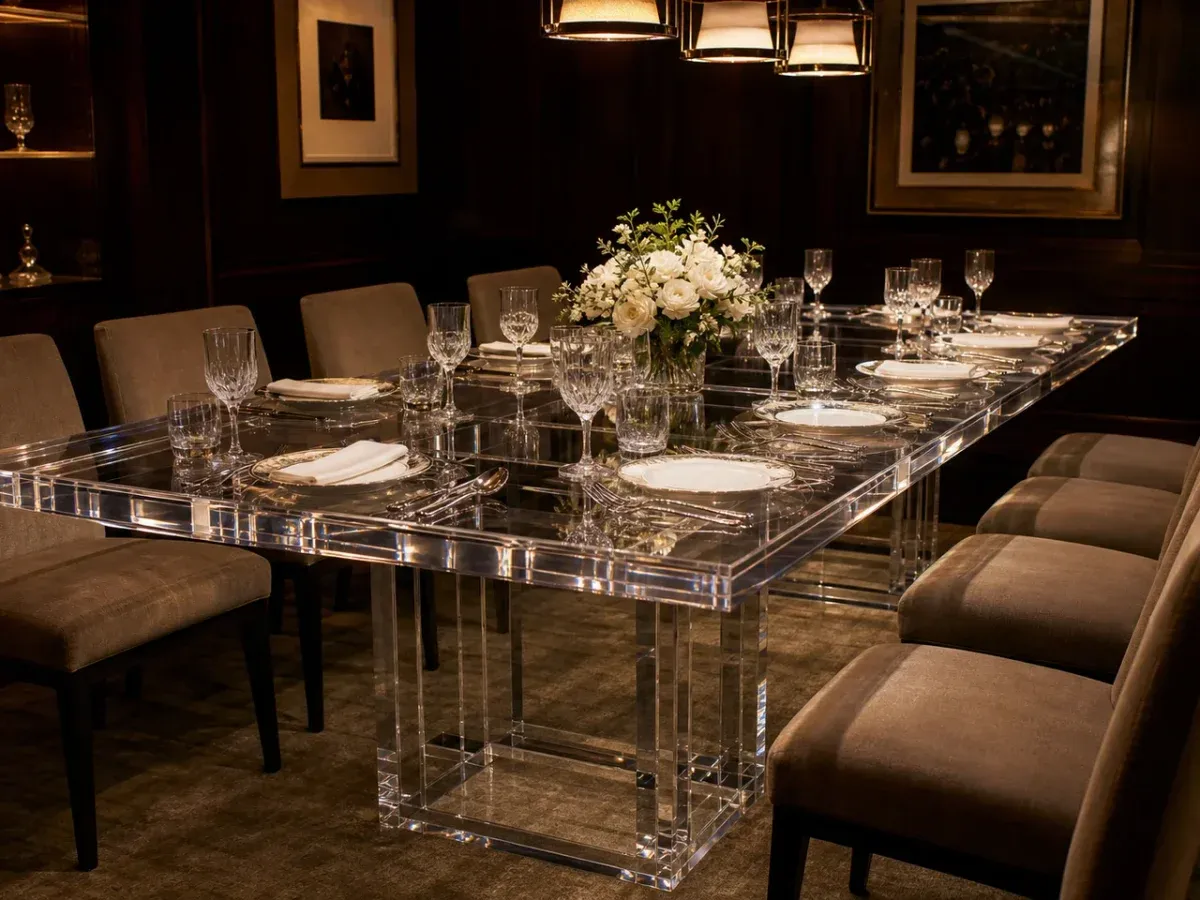
30–40mm tops sized to span. Multi-pedestal bases. Engineered for daily fine-dining service.
Custom acrylic dining tables for fine-dining restaurant chains, boutique hotel restaurants, members'-club private rooms, corporate boardrooms, and event venues. Six shape options — rectangular (the fine-dining default), oval (boat-edge social geometry), round (equality seating up to 1.8m), square (modernist statement), boat-shaped (boardroom-dining dual-use), and expandable (variable-seating with hidden insert leaf). Cast PMMA at 30–40mm top thickness sized to span, multi-pedestal or apron-reinforced bases, diamond-polished edges, batch-matched color across multi-property rollouts. Most often spec'd as a coordinated set with matching acrylic chairs on one purchase order. MOQ 10 pieces per design; sample 10–14 days; production 30–40 days for 10 tables.
ISO 9001 Certified Since 2008 30–40mm Tops Sized to Span Diamond-Polished Edges Sample in 10–14 Days
Engineered for the load of daily service.
Thickness scales with span — 30mm at 2.0m, 40mm at 2.4m. Multi-pedestal or apron-reinforced bases for full service without a visible support line.
Acrylic dining tables come in six shape options, each tied to a specific dining context and seating geometry: rectangular (the fine-dining default, seats 4–10), oval (boat-edge social geometry, seats 6–8), round (equality seating up to 1.8m, seats 6–10), square (modernist statement, seats 4–8), boat-shaped (boardroom-dining dual-use, seats 6–8), and expandable (variable seating via hidden center insert leaf, seats 6 base / 8 extended). All in cast PMMA at 30–40mm top thickness on multi-pedestal or apron-reinforced bases.
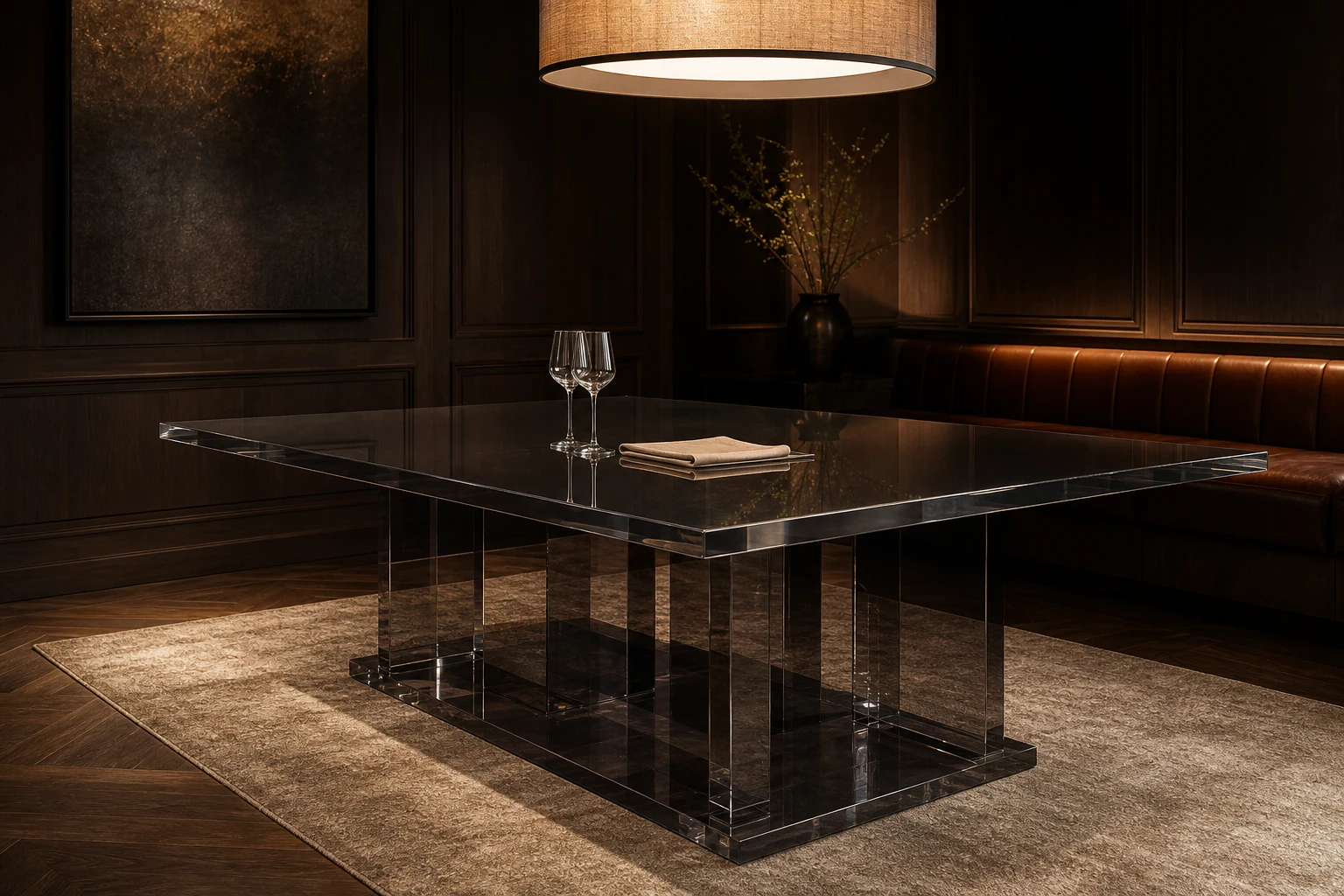
1.6–2.4m × 0.9–1.0m × 75cm tall. Seats 4–10. The fine-dining default — fits private dining rooms, chef's tables, restaurant-chain layouts. Multi-pedestal base preferred
Jump to details below ›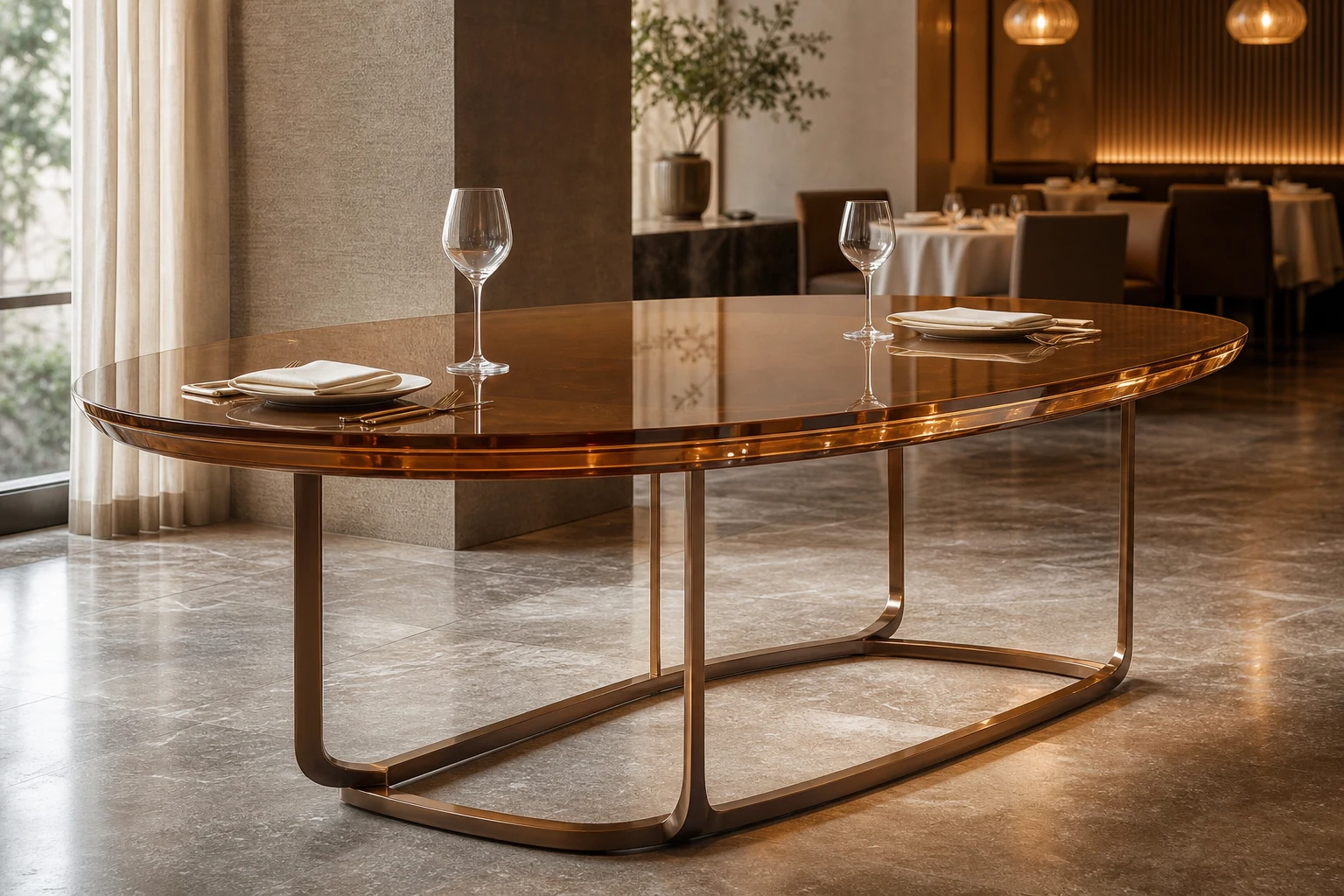
1.8 × 1.0m or 2.2 × 1.1m, boat-edge profile. Seats 6–8. Softens rectangular geometry — popular for hotel restaurant private rooms where the seating arc matters
Jump to details below ›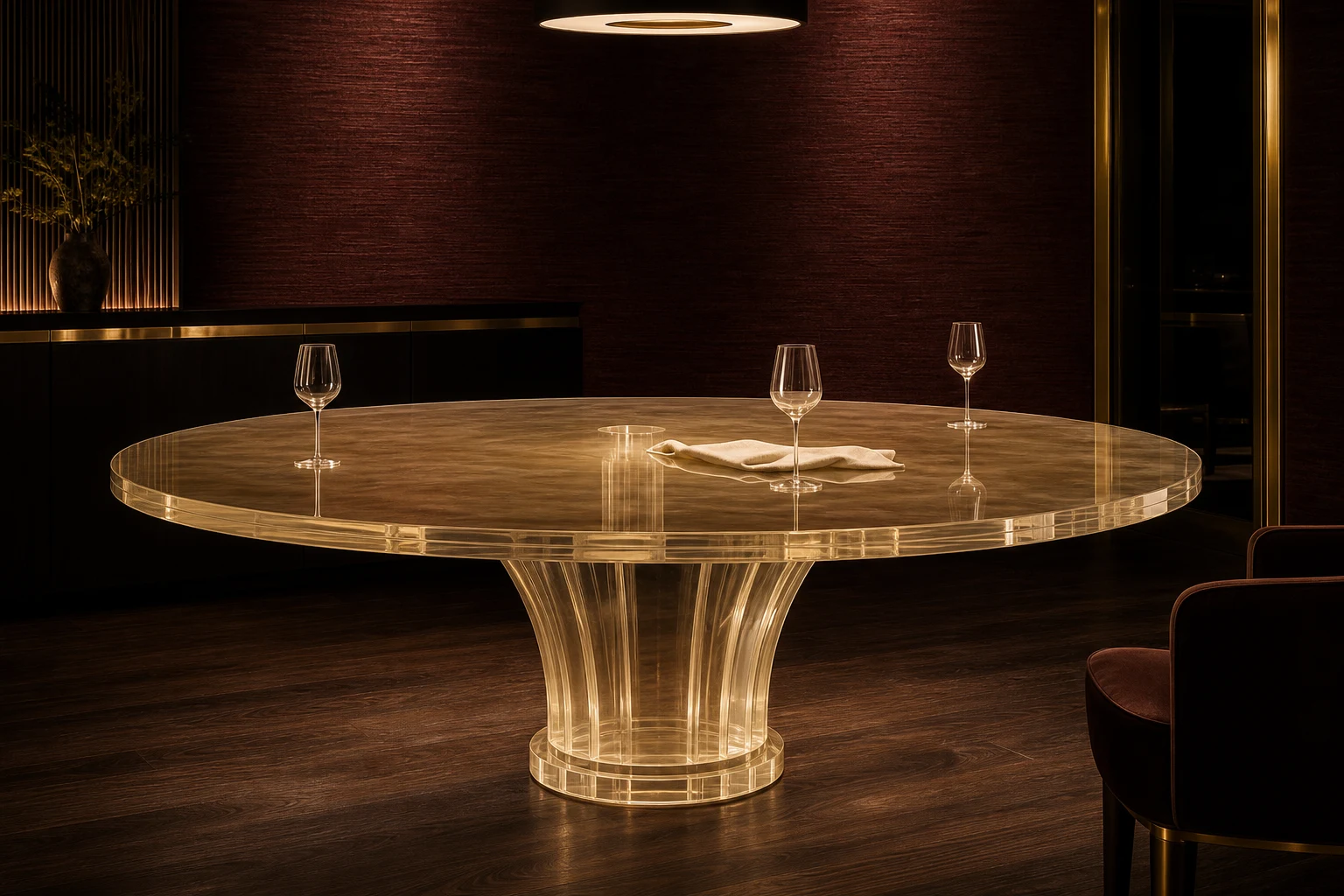
1.4–1.8m diameter. Seats 6–10. Conversation-focused — equality seating where every guest sees every other guest. Single sculptural pedestal preferred for legroom
Jump to details below ›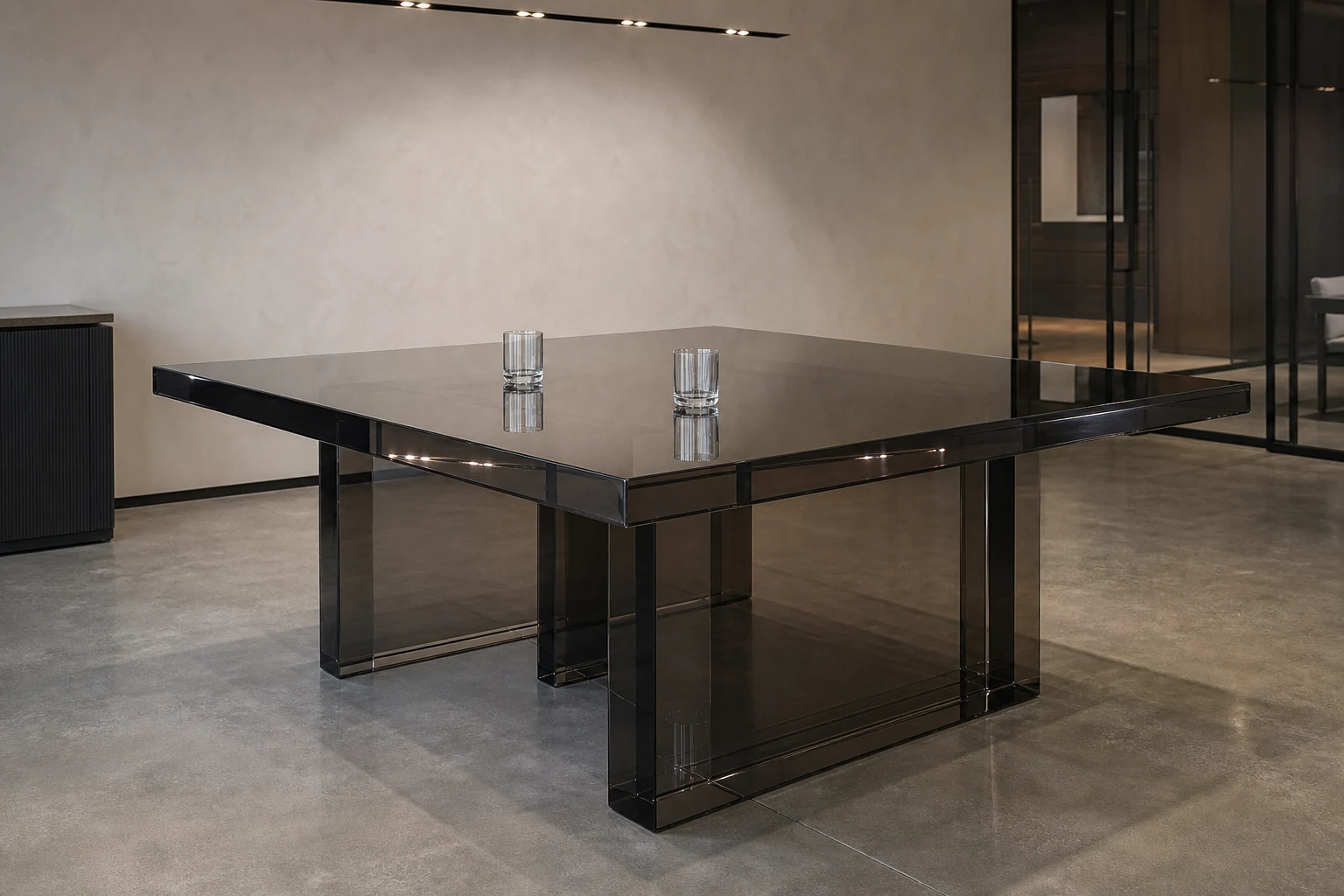
1.0–1.6m square × 75cm tall. Seats 4–8. Symmetrical statement geometry — modernist fine dining, executive board-level dining rooms, intimate chef's table
Jump to details below ›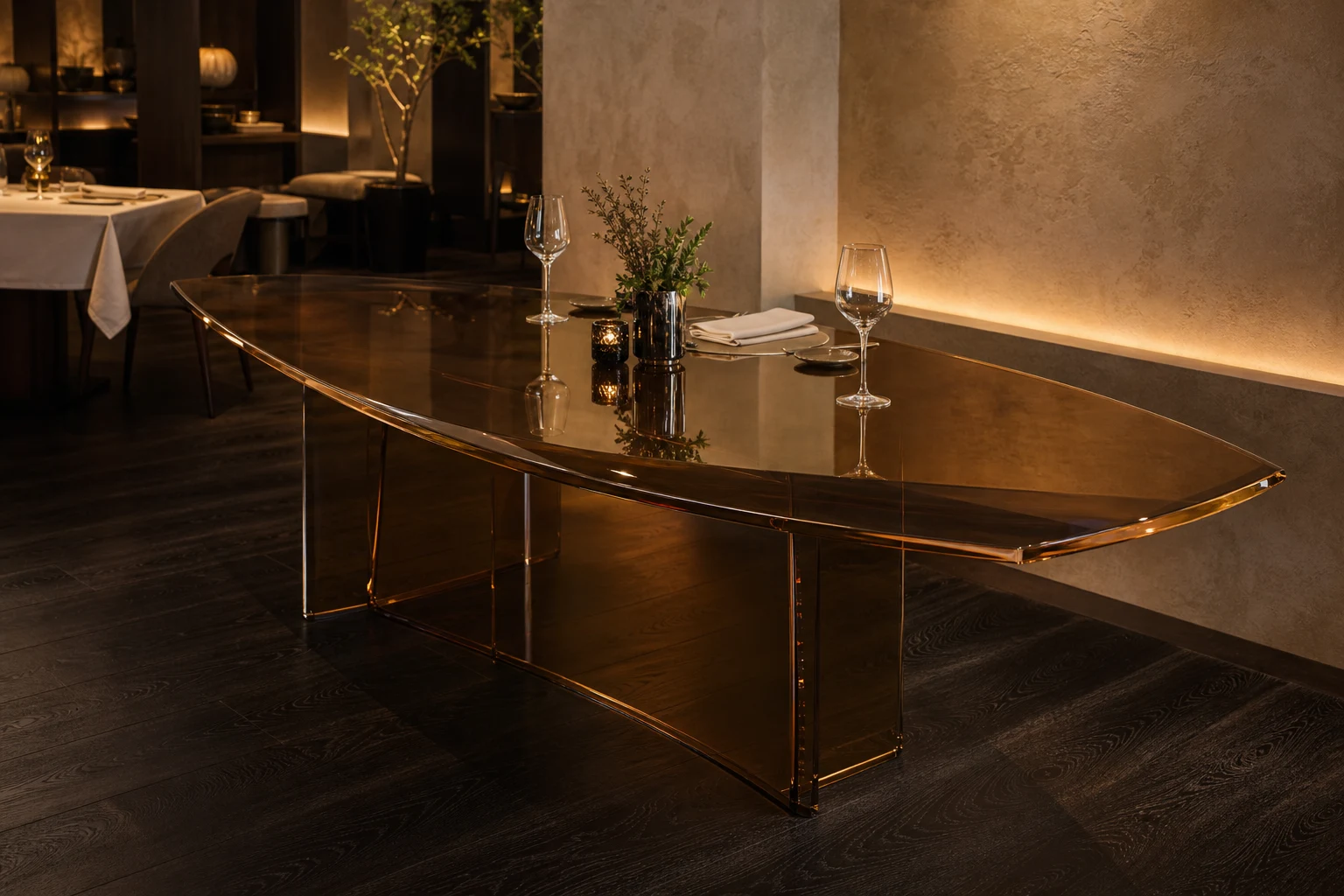
Wider at the center, tapers at the ends. 2.0–2.4m long. Optimal sightlines for boardroom-and-dining dual use — corporate executive dining, members' club private rooms
Jump to details below ›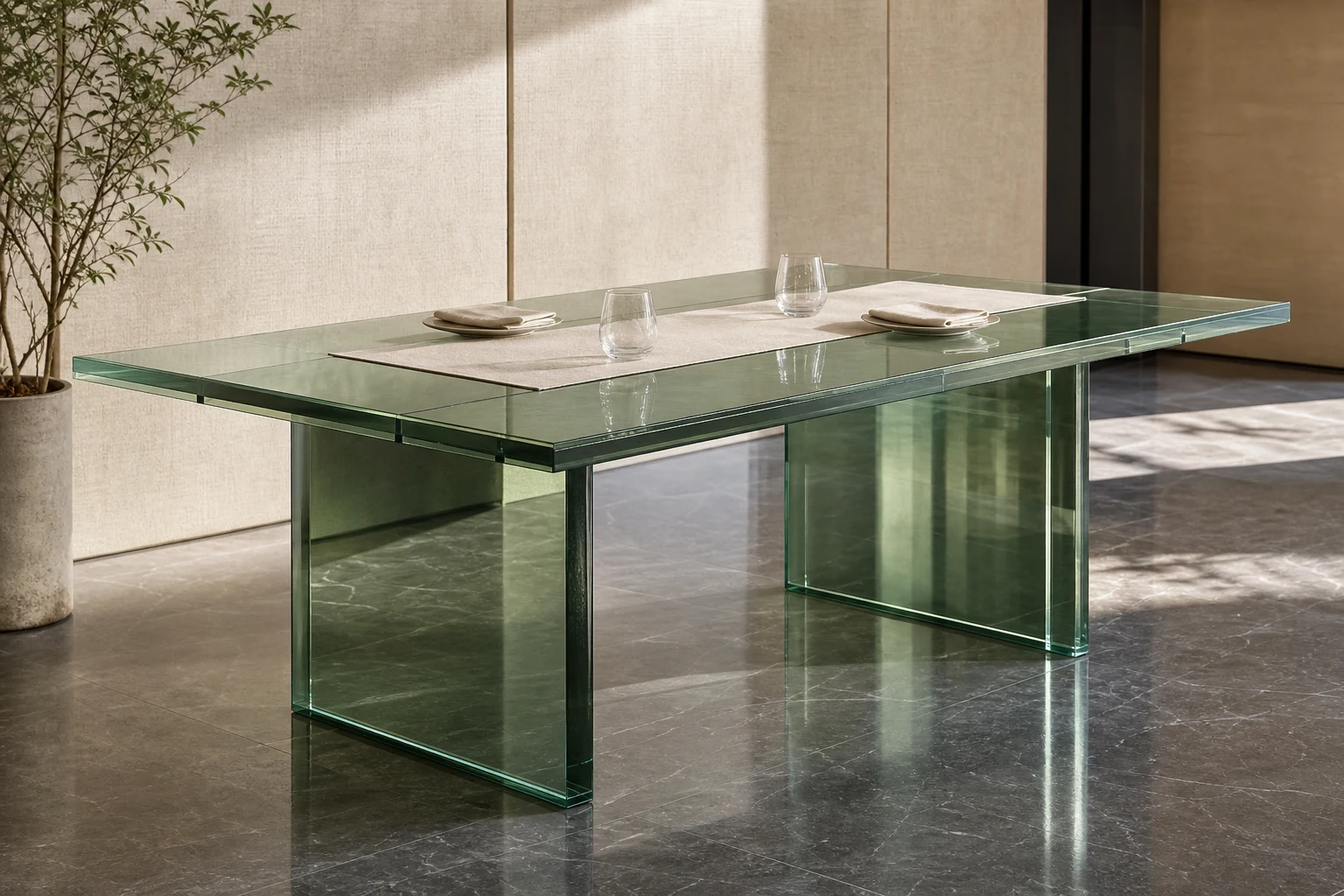
1.8m base extending to 2.4m via hidden center insert leaf. Variable-seating private rooms, event spaces, executive dining rooms that host occasional larger dinners
Jump to details below ›Building a full dining set? Pair with acrylic chairs on one purchase order — same edge profile, same color tint, one production batch. Most dining tables we ship leave the factory with a coordinated chair set.
A custom acrylic dining table is a service-load-rated dining surface built from 30–40mm cast PMMA on a multi-pedestal or apron-reinforced base. For fine-dining and hospitality use, the table holds normal table service — plates, glassware, linens, place settings, full elbow load along the perimeter — across 1.6–2.4m spans without visible deflection under operator inspection. Cast acrylic gives you the optical clarity of glass with significantly higher impact resistance and no shatter risk under hospitality traffic — the trade-off our restaurant chain and hotel-group clients make at spec time.
Dining tables are the highest-engineering piece in our furniture line — higher than coffee tables, side tables, or chairs. The reason is the span. A 2.4m rectangular top crosses a long unsupported distance, holds plate-and-glass service, takes full elbow load during dinner, and absorbs occasional leaning weight as guests settle into their chairs. Wrong top thickness deflects visibly under service load; wrong base architecture fails at the joint under leaning pressure; wrong color match across a 12-property chain rollout reads as "different table" rather than "same brand." We size the top thickness against the exact span and service load, build the base for distributed support at the engineered load points, and diamond-polish every visible edge for the optical-clarity finish that holds up under daily commercial cleaning protocol.
The shape decision matters as much as the thickness decision. A rectangular 2.0m × 1.0m fits the conventional fine-dining private room but reads formal — guests sit across from each other in pairs along the long axis. A round 1.6m at the same seating count reads more social — every guest sees every other guest across the centerline, which changes the conversation dynamic and is why members'-club private rooms specify round. Oval tables sit between the two — they preserve seating reach for tasting-menu service while softening the geometry. Boat-shaped tables optimize sightlines for boardroom-dining hybrid use. Expandable tables solve the variable-seating problem in event-space private rooms. The shape choice is a programming decision before it's a fabrication decision; we walk it through with the buyer at quote stage if it isn't already locked in the brief.
Most dining tables we ship leave the factory as part of a coordinated set — table + 6, 8, or 12 chairs per cover on one purchase order with matched edge profile and color tint across SKUs. Send a brief — room dimensions, seating count, shape preference, color, branding, coordinated chair spec. Sample 10–14 days; production 30–40 days for 10 tables.
Popular with: fine-dining restaurant chains · boutique hotel restaurants · members' clubs & private dining rooms · corporate boardrooms & executive dining · event spaces & venues
Discuss Your Project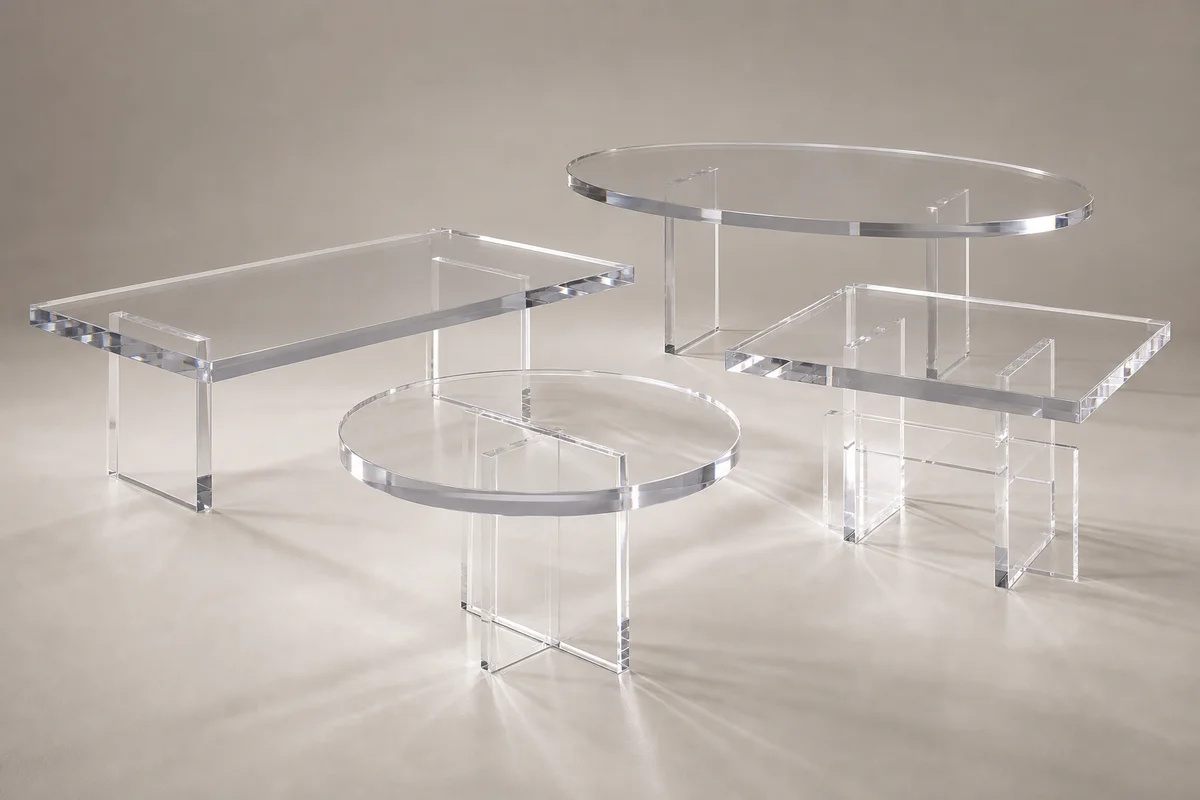
Dining table proportions follow industry-standard seating ratios — roughly 60cm of perimeter per seated guest — and service-load engineering for top thickness — 30mm minimum for 2.0m tops, stepping to 40mm for 2.4m+ spans. The table below is our working reference. We confirm proportion against your private dining room dimensions at quote stage; room width minus chair-pull-out clearance has to leave at least 90cm for service circulation.
| Shape | Typical Size | Recommended Seating | Top Thickness | Base Architecture |
|---|---|---|---|---|
| Rectangular | 1.6m × 0.9m × 75cm tall | 4 seats | 30mm | Single pedestal or 4-leg |
| Rectangular | 2.0m × 1.0m × 75cm tall | 6 seats | 30mm | 2-pedestal or apron-reinforced 4-leg |
| Rectangular | 2.4m × 1.0m × 75cm tall | 8 seats | 35–40mm | 2- or 3-pedestal |
| Rectangular | 2.8m × 1.1m × 75cm tall | 10 seats | 40mm | 3-pedestal or apron + center pedestal |
| Oval | 1.8 × 1.0m boat-edge | 6 seats | 30mm | 2-pedestal or trestle |
| Oval | 2.2 × 1.1m boat-edge | 8 seats | 35mm | 2-pedestal or trestle |
| Round | 1.4m diameter | 6 seats | 30mm | Single sculptural pedestal |
| Round | 1.6m diameter | 8 seats | 30–35mm | Single sculptural pedestal |
| Round | 1.8m diameter | 10 seats | 35mm | Single sculptural pedestal with wider footprint |
| Square | 1.0–1.4m square | 4 seats | 30mm | Single pedestal or 4-leg |
| Boat-shaped | 2.0–2.4m × 1.1–1.3m widest | 6–8 seats | 35–40mm | Apron-reinforced multi-leg |
| Expandable | 1.8m base extending to 2.4m via leaf | 6 base / 8 extended | 30–35mm | Multi-pedestal + hidden leaf-storage mechanism |
Working reference for cast PMMA dining table tops under standard fine-dining and boardroom service load. Industry-standard seating ratio (~60cm perimeter per guest). Confirmed against your exact room dimensions during sample.
The seating capacity table above assumes the table fits comfortably in the room. We validate three clearance rules against your private dining room dimensions at quote stage.
On each long side of the table — the distance a seated chair needs to slide back for the guest to stand and exit without bumping the wall or the next chair.
On at least one long side so service staff can move plates and clear courses without brushing seated guests during a multi-course dinner.
At each end of the table when guests are not seated at the heads — enough for a server to pass and clear without the table feeling boxed in.
For a 2.0m × 1.0m rectangular dining table seating 6, the room needs to be at least 2.6m wide (1.0m table + 80cm pull-out × 2) and ideally 2.7m for the service side to land at 90cm. We catch room-clearance mismatches at quote stage from the room dimensions in your brief — under-sized rooms get an oval or smaller rectangular recommendation rather than a tight squeeze on the original spec.
Long dining tables fail in one of two ways under service load: centerline deflection (top sags visibly between supports under full plate-and-glass service plus perimeter elbow load) or base joint failure (a leg cracks at the bond to the top under leaning weight during a long dinner). Both failures are base-architecture decisions, not top-thickness decisions alone. We default to two engineered base patterns — multi-pedestal for clean sightlines, apron-reinforced 4-leg for distributed rigidity — chosen against the span and the dining-use intensity.
Numeric deflection specs in millimeters tell you less than they appear to about how a dining table feels in service. We run two operator inspections at sample — what passes is what ships.
Fully-set sample table, plate-and-glass service in place, full elbow load along the perimeter from operators standing at the table, viewed from a seated guest's eye level under directional pendant lighting. Pass criterion: zero visible centerline flex. If the top flexes even fractionally we step the thickness up before bulk production.
Operators lean into the long edge with full body weight, simulating the guest who slumps forward during a three-hour dinner. We inspect leg-to-top bond, pedestal-to-floor contact, and apron-to-top adhesion. Pass criterion: no movement, no stress whitening at any joint under the worst-case leaning load the table will see in service.
The closest competitor material for a fine-dining table top is tempered glass at similar thickness. Acrylic wins on three counts that hospitality buyers consistently flag in the brief.
A 2.0m × 1.0m cast acrylic top at 35mm is meaningfully lighter than the same dimensions in glass. The table reconfigures more easily between room layouts, and the floor-loading consideration eases in older heritage properties.
Cast PMMA fails by cracking rather than shattering into shards. That removes the failure mode — flying glass across a fully-set service — that closes a restaurant for a shift on the tempered-glass equivalent.
Diamond-polished cast acrylic edges hold their optical clarity under daily restaurant cleaning chemistry. Polished glass edges gradually chip and micro-fracture along the perimeter under repeated wipe-down, dulling the rim within a season.
Glass still has its place — vitrines, low-traffic accent surfaces, signature surfaces under controlled service. But for daily commercial dining across a multi-property chain, acrylic at 30–40mm is the more durable choice, and the one the chains we supply keep specifying on rollout after rollout.
| Piece | Typical Span | Top / Wall Thickness | MOQ |
|---|---|---|---|
| Coffee Table | 1.0–1.4m | 25–30mm | 10 |
| Side Table | 0.3–0.6m | 20–25mm | 10 (per SKU) |
| Console Table | 1.2–1.6m × 0.35m | 25–30mm | 10 |
| Chair | 45 / 65 / 75cm seat | 8–10mm shell | 10 |
| Dining Table (this page) | 1.6–2.8m | 30–40mm | 10 |
Dining tables are the highest-engineering piece in our furniture line. Wrong top thickness deflects visibly under service load; wrong base architecture fails at the joint under leaning pressure; wrong color match across a chain rollout reads as "different table" rather than "same brand"; under-spec'd diamond polish hazes within months of daily commercial cleaning. Wetop has been building custom cast acrylic for B2B buyers since 2008 — 25+ countries, ISO 9001 certified since year one, 2,000+ projects, in-house CNC and diamond polishing on every visible edge.
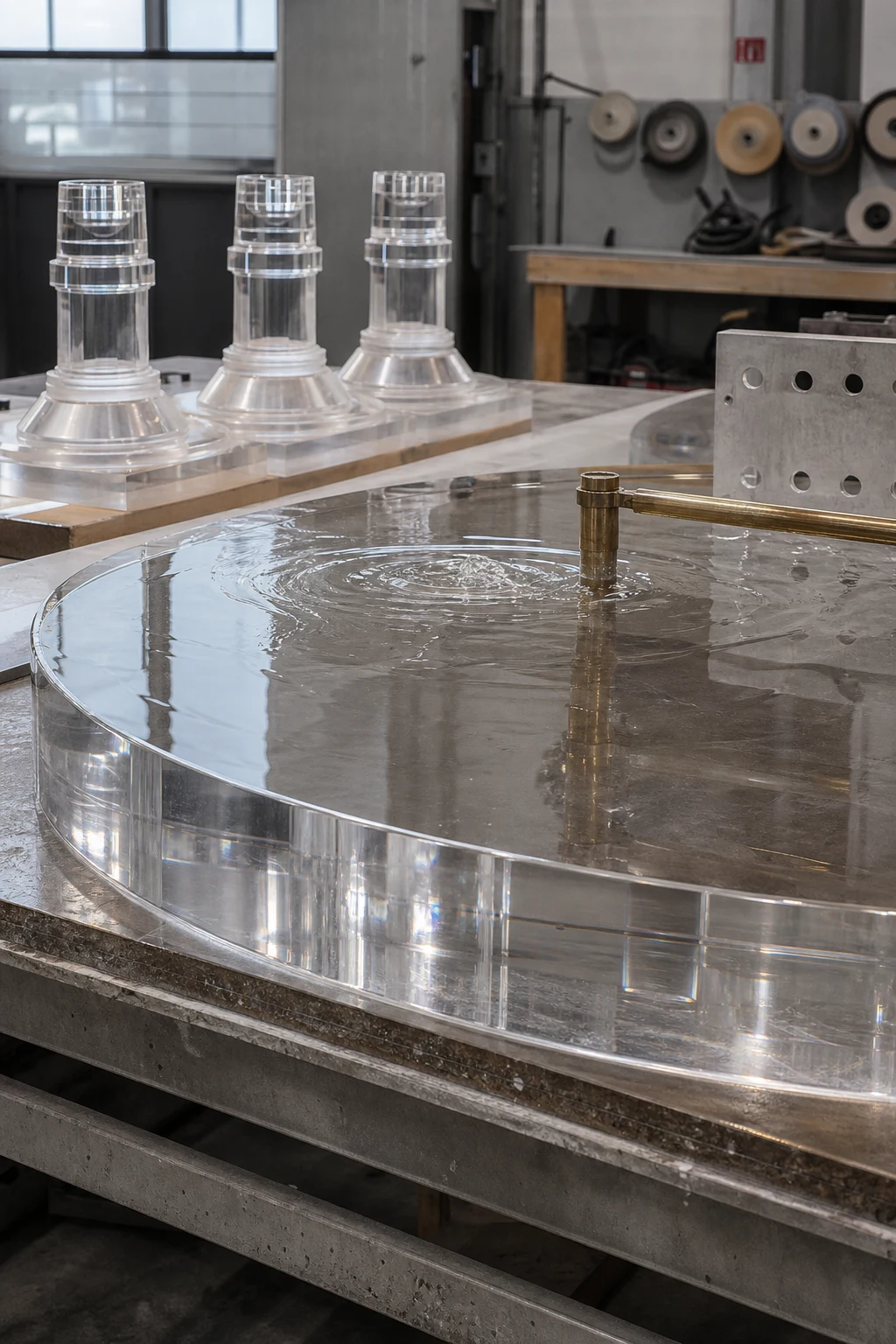
Cast acrylic deflection grows nonlinearly with span — a 5mm thickness step at the longer end of the range eliminates centerline flex under full service load. We default to 30mm for 2.0m × 1.0m, step to 35mm for 2.2m, and 40mm for 2.4m+ spans. Every dining quote includes a deflection check against your exact dimensions and a qualitative pass-criterion confirmed on the sample table: fully set with plate-and-glass service plus perimeter elbow load, no visible flex at centerline under operator inspection.
Long dining tables need distributed base support, not a single point load at the middle. We default to 2-pedestal architecture for 1.6–2.0m, 3-pedestal for 2.0m+, or a 4-leg base with hidden cast acrylic apron underneath as an alternative aesthetic. The apron is invisible from the room but adds significant rigidity for boardroom-dining contexts where leaning load along the table edge is heavy. The right base architecture is what keeps the table feeling stable through a three-hour tasting menu service.
Every visible edge on the dining tables we ship is diamond-polished as standard — the optical-clarity finish that holds up under daily restaurant cleaning protocol. We default to 45° chamfered edges for fine-dining specs because the chamfer catches the pendant lighting and reads as deliberate design from the seated guest's eye level. Bull-nose rounded edges go on chef's tables and corner-prone seating layouts. The finish is engineered for hospitality-grade use; care guidance ships with every restaurant order.
Most dining table orders ship as part of a coordinated set — table + 6 or 8 chairs per cover, sometimes 12 chairs for banquet-style spec — on a single purchase order. We match edge profile, color tint, and brand mark across SKUs and run both lines on one production batch so the molded chair shell and the flat-cut table top color-match exactly. The smoke tint on the table reads as the same smoke tint on the chair under the same dining room lighting. Coordinated chair-plus-table orders typically save 5–10% in setup and packaging.
Fine-dining restaurant chains, hotel groups, and members'-club chains roll out dining table specs across multiple locations — typically 6–24 properties per program. Batch color match across the entire production run is enforced as a documented QC checkpoint: every dining table in the rollout ships from the same dye lot or color-corrected production batch, so the table in property #1 reads identical to the table in property #12 under the same room lighting. Custom Pantone-match adds one sample iteration with a color-chip validation step before bulk dye lot.
Twelve properties, twelve rectangular tables, color match held across two production batches. The 2-pedestal base reads as deliberate design rather than a structural compromise — guests notice the table without noticing the engineering, which is exactly what we wanted.
Dining tables ship in cast PMMA at 30–40mm top thickness on multi-pedestal or apron-reinforced bases, with diamond-polished edges as standard. Five material variants, six edge / finish options, and a deflection check against your exact span and load on every quote.
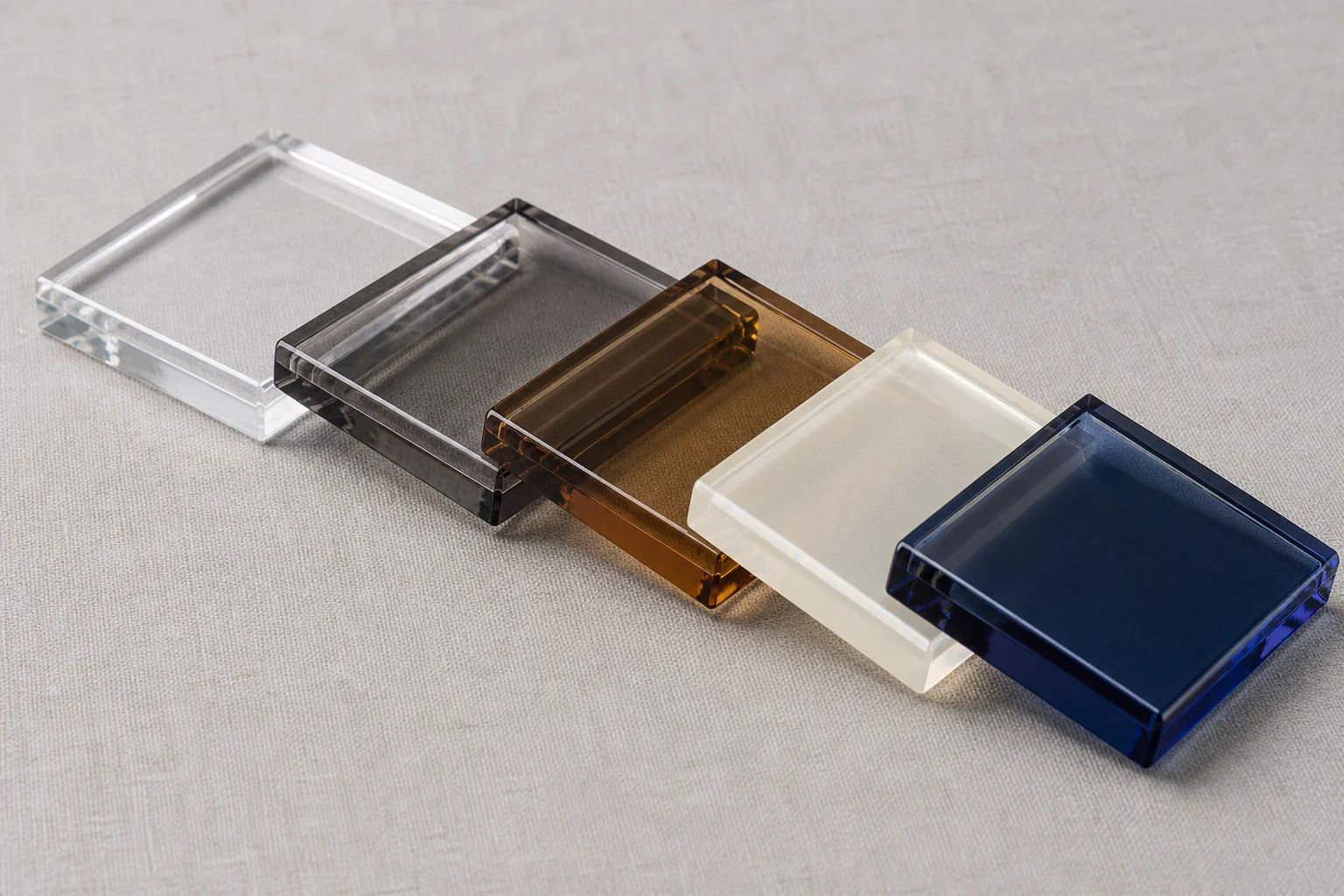
| Material | Properties |
|---|---|
| Clear cast PMMA | 92% light transmission, optical clarity, reads as glass |
| Smoke tint | Whole-body grey-tinted cast — softens room light, common on hotel restaurant spec |
| Bronze tint | Warm amber tone — pairs with wood-and-leather club interiors and members'-club private rooms |
| Pearlescent | Soft milky-translucent finish — light passes, objects on the table blur softly |
| Custom Pantone-match | Color through the body, matched to corporate brand reference; held batch-to-batch across multi-property rollouts |
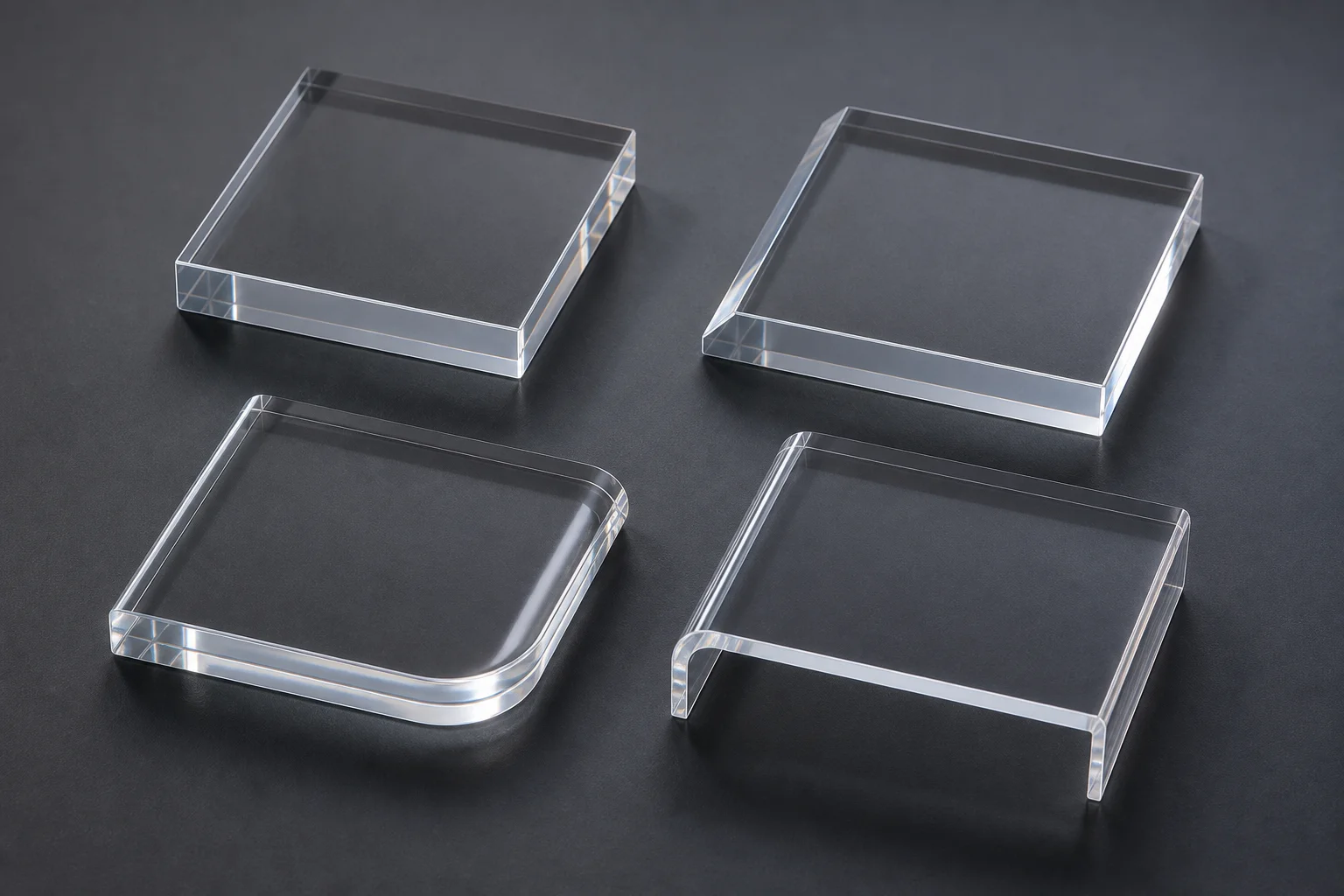
| Finish | Result |
|---|---|
| Diamond polish (standard) | Optically clear edge — reads like glass under restaurant pendant lighting |
| 45° chamfered | Light-catching angled edge — most-ordered for fine-dining specs, reads as deliberate design |
| Bull-nose rounded | Softer corner — used on chef's tables and corner-prone seating layouts |
| Boat-edge profile | Long edges curve gently from centerline to ends — oval format standard |
| Subsurface laser-engraved logo | Frosted-white center-top mark — permanent, no surface wear, reads deliberate |
| UV print on hidden underside | Full-color logo, invisible from the room side — preserves unmarked top aesthetic |
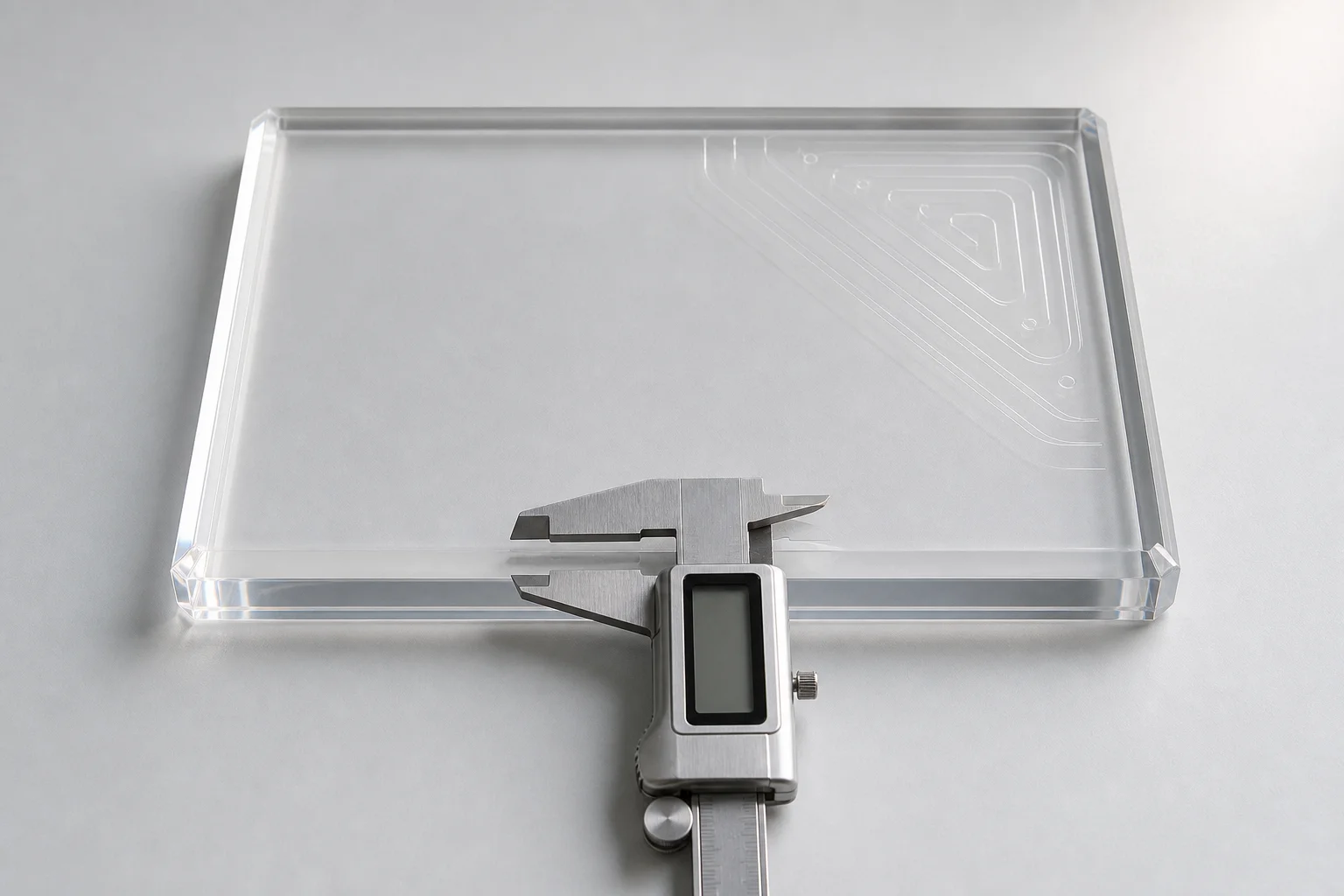
| Spec | Details |
|---|---|
| Top thickness | 30mm for 2.0m × 1.0m; 35mm for 2.2m; 40mm for 2.4m+ spans |
| Max single-panel span | 2.8m × 1.1m (longer spans joined from precision-cut panels) |
| Base architecture | Multi-pedestal · apron-reinforced 4-leg · trestle · single sculptural pedestal (round <1.6m) |
| Service-load engineering | Sized to fully-set plate-and-glass service plus perimeter elbow load; centerline pass at sample |
| Coordinated chair sets | Table + chairs on one PO, matched edge profile and tint, one production batch, dye-lot color match |
| MOQ | 10 pieces per design |
| Sample lead time | 10–14 days (large cast piece — longer than small accent pieces) |
| Production lead time | 30–40 days for 10 tables; 45–60 days for 12–24 tables |
Not sure what shape, thickness, or base configuration fits your private dining room or boardroom? Send us a brief with room dimensions, seating count, and a reference image — we recommend shape, thickness, base architecture, and edge profile based on your dining-use intensity.
Get Configuration RecommendationsEach of the six dining shapes has its own dimensional band, recommended seating count, and typical use space. The cards below show the working spec for each — useful for narrowing the shape decision before you send a full brief.
Spec: 1.6–2.4m × 0.9–1.0m × 75cm tall. 30mm top for 2.0m × 1.0m; step to 35mm at 2.2m and 40mm at 2.4m+. 2- or 3-pedestal base preferred over apron-reinforced 4-leg for the clean sightline through the table base. Chamfered or square edge.
Use space: Fine-dining private rooms, chef's tables, hotel restaurant private dining rooms, executive dining rooms. The hospitality default — fits most private dining room dimensions and reads as the classical dining geometry guests expect.
Recommended seating: 1.6m = 4 seats · 2.0m = 6 seats · 2.4m = 8 seats · 2.8m = 10 seats
Spec: 1.8 × 1.0m or 2.2 × 1.1m, with boat-edge profile (the long edges curve gently from the centerline to the ends). 30–35mm top thickness. 2-pedestal or trestle base — trestle works particularly well under the curved geometry and reads sculptural from the room.
Use space: Hotel restaurant private rooms where the seating arc matters, fine-dining tasting-menu rooms, members'-club private rooms. Softens rectangular geometry while preserving the seating reach across the long axis. Reads warmer than a square-edged rectangle.
Recommended seating: 1.8 × 1.0m = 6 seats · 2.2 × 1.1m = 8 seats
Spec: 1.4–1.8m diameter at 75cm tall. 30mm top for 1.4–1.6m, stepping to 35mm at 1.8m. Single sculptural pedestal as standard — tapered cast acrylic column from a wider base to a narrower top contact, footprint sized to the diameter for stability.
Use space: Boardroom dining where equality seating matters (no head-of-table position), members'-club private dining rooms, chef's tables in fine-dining restaurants, hotel suite-floor private dining. Conversation-focused — every guest sees every other guest across the centerline.
Recommended seating: 1.4m Ø = 6 seats · 1.6m Ø = 8 seats · 1.8m Ø = 10 seats
Spec: 1.0–1.6m square × 75cm tall. 30mm top. Single pedestal or 4-leg both work; pedestal gives more legroom for the seated guest, 4-leg reads more residential. Chamfered or square edge depending on the room language.
Use space: Modernist fine-dining private rooms, executive board-level dining, intimate chef's tables in tasting-menu restaurants. The strong modernist statement geometry — symmetrical, deliberate, reads as deliberate design rather than functional dining.
Recommended seating: 1.0m = 4 seats · 1.4m = 6 seats · 1.6m = 8 seats
Spec: Widest at the center (1.1–1.3m), tapers symmetrically toward the ends. 2.0–2.4m total length. 35–40mm top. Apron-reinforced multi-leg base — the apron is invisible from the room but adds critical rigidity for the long span at the wider center.
Use space: Corporate executive boardrooms doubling as private dining, members'-club private rooms with dual conference-and-dining use, hotel executive-floor signature dining rooms. Optimizes sightlines for the corporate-dining hybrid use case — every seat sees the center and across.
Recommended seating: 2.0m = 6 seats · 2.4m = 8 seats
Spec: 1.8m base × 1.0m extending to 2.4m via a hidden center insert leaf. 30–35mm top. Leaf stores in a concealed compartment in the table apron when not in use; mechanism is engineered for repeated use without misalignment. Multi-pedestal base with apron storage.
Use space: Variable-seating private rooms (a 6-cover dinner extends to an 8-cover dinner without changing the room), executive boardrooms that host occasional larger dinners, event-space private dining rooms where the same room reconfigures across events.
Recommended seating: 1.8m base = 6 seats · 2.4m extended = 8 seats
Dining-table buyers are B2B: fine-dining restaurant chains, hotel restaurants, members' clubs, corporate boardrooms, event venues, and interior designers managing multi-property hospitality groups. MOQ 10 tables per design; most orders ship as coordinated table + chairs sets on one PO. Multi-location chains hit the MOQ naturally — one table per private dining room × 10+ properties.
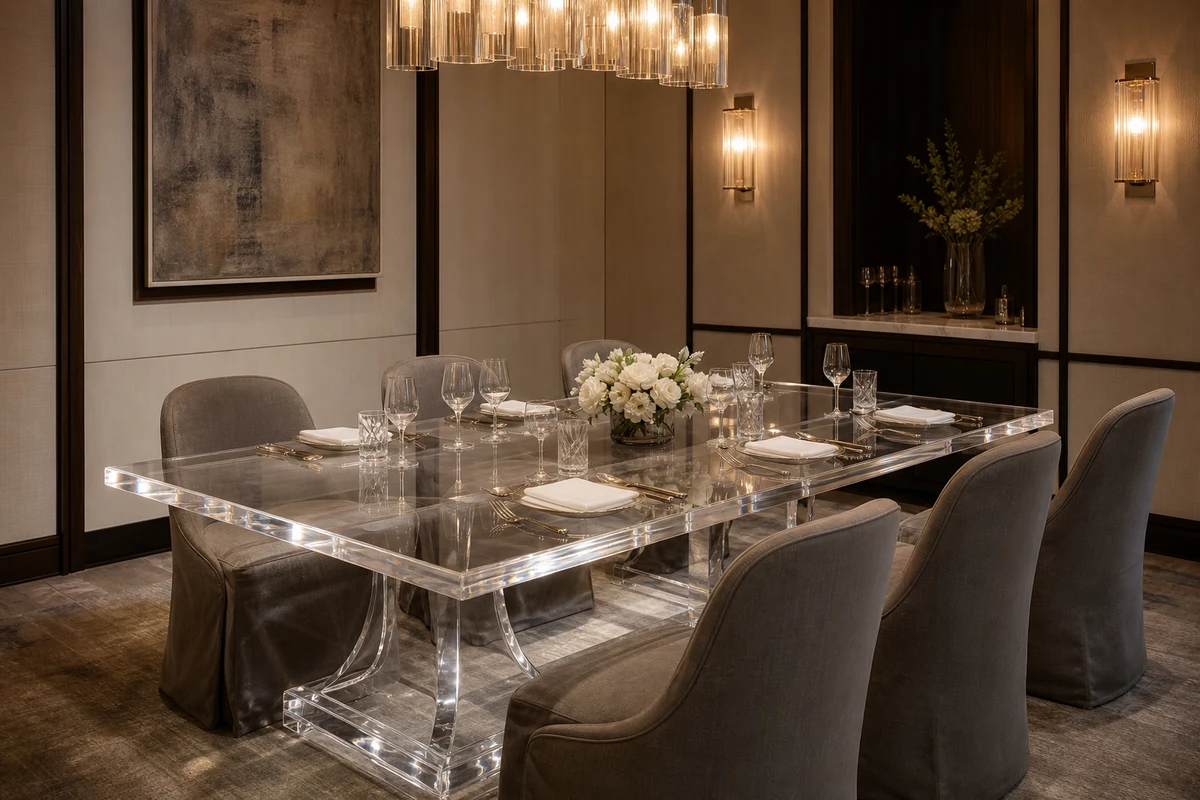
Multi-location chain rollouts of 10–24 tables (one per private dining room × number of properties). Rectangular 2.0m × 1.0m most-ordered; 2-pedestal base, chamfered edge, subsurface chain mark. Batch color match enforced across the program.
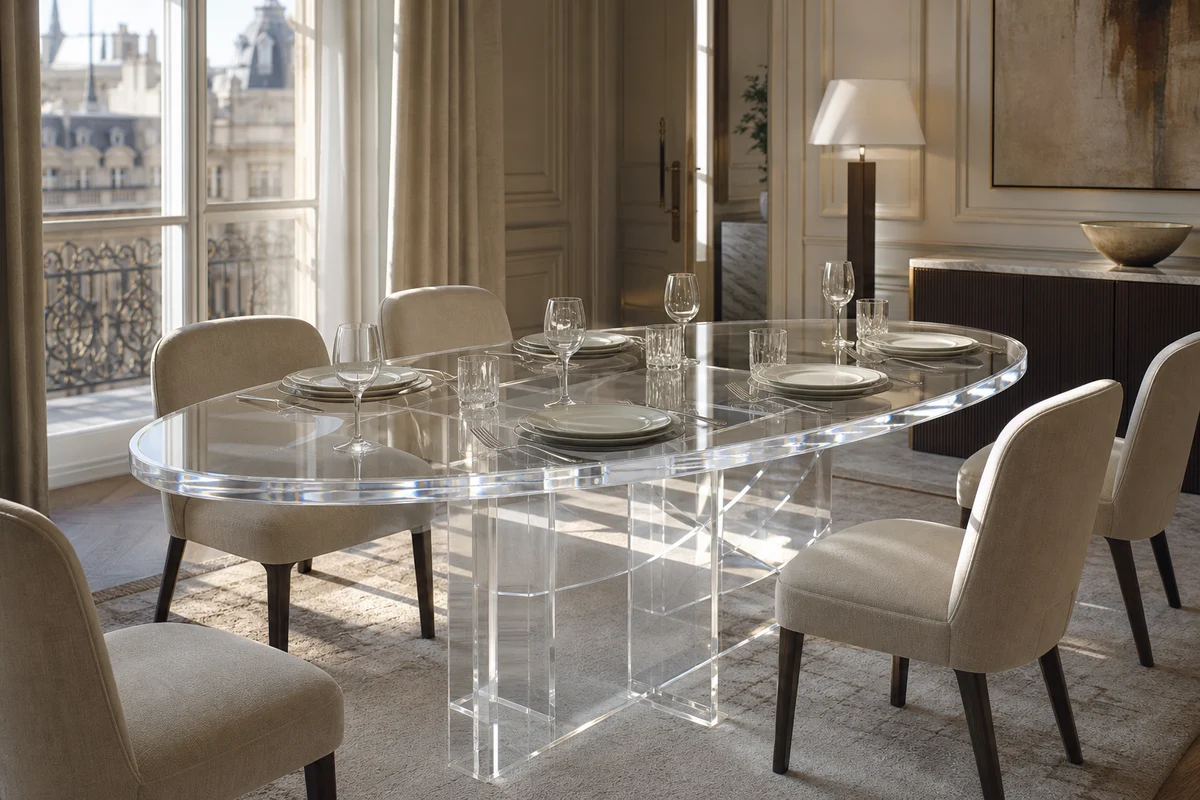
Hotel signature-restaurant tables, suite-floor private dining rooms, club-floor breakfast service. Oval and round formats most-ordered for hotel private rooms. Often spec'd with coordinated hotel-branded chairs on one PO.
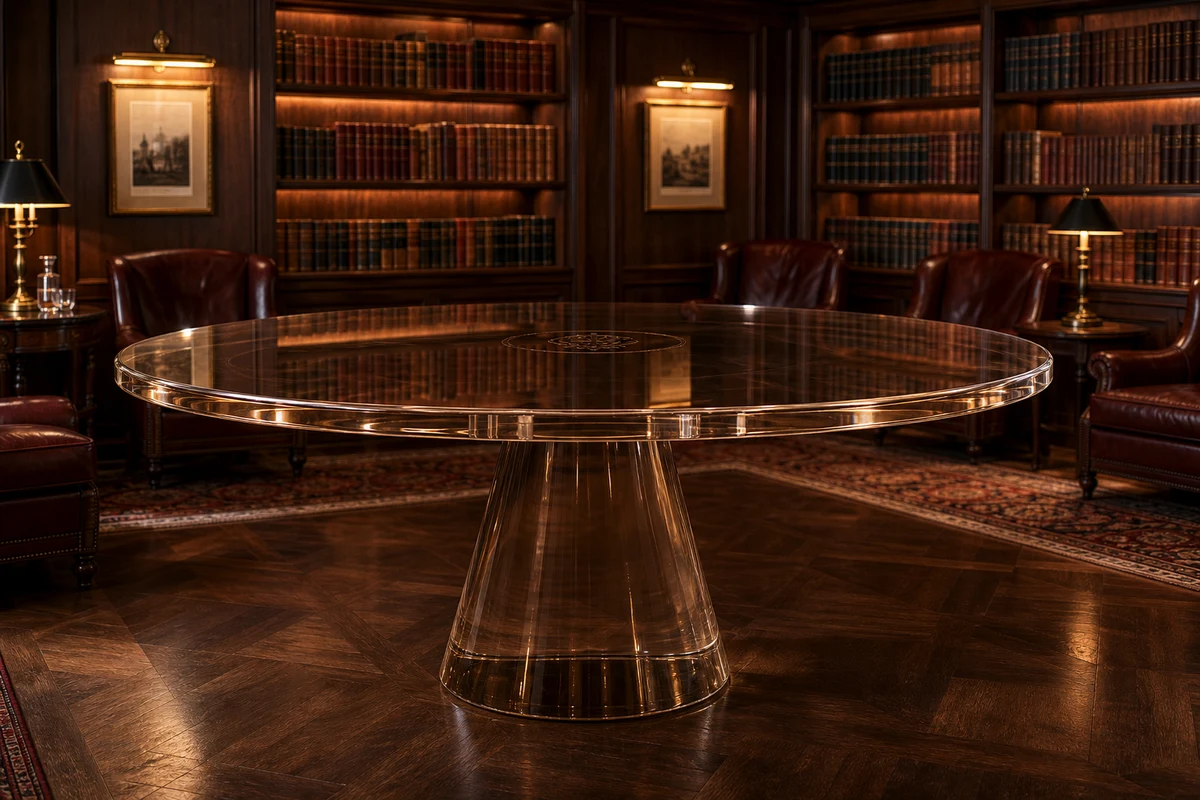
Gallery dining surfaces, members'-club library tables, signature private-room dining surfaces. Round 1.6m with sculptural single-pedestal base is most-requested. Bronze or smoke tint typical; subsurface engraved club mark standard.
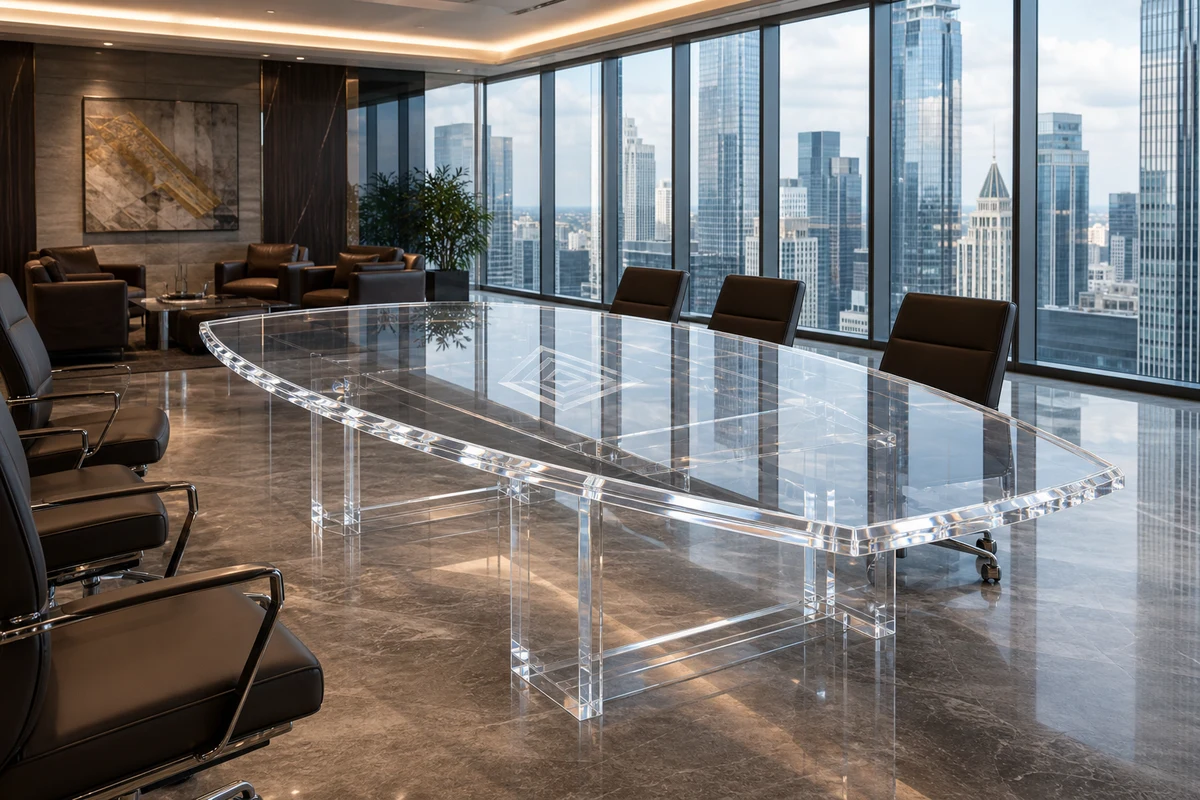
Boardroom tables doubling as executive dining surfaces. Boat-shaped (sightline-optimized) and expandable formats most-ordered. Apron-reinforced base for leaning load. Subsurface logo engraving on center top.
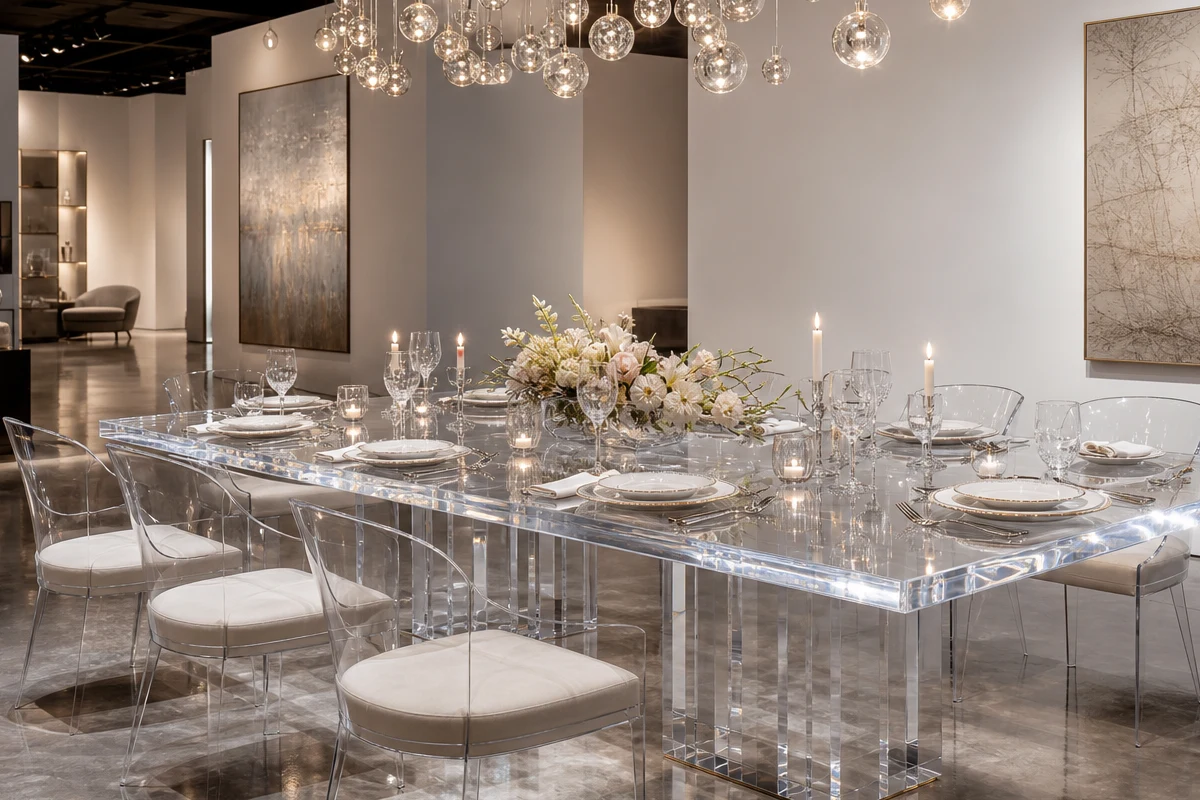
Variable-seating private event rooms — wedding venues, gallery dining events, luxury retail VIP dining. Expandable formats most-ordered for venues that reconfigure across events. Clear cast PMMA reads neutrally against changing styling.
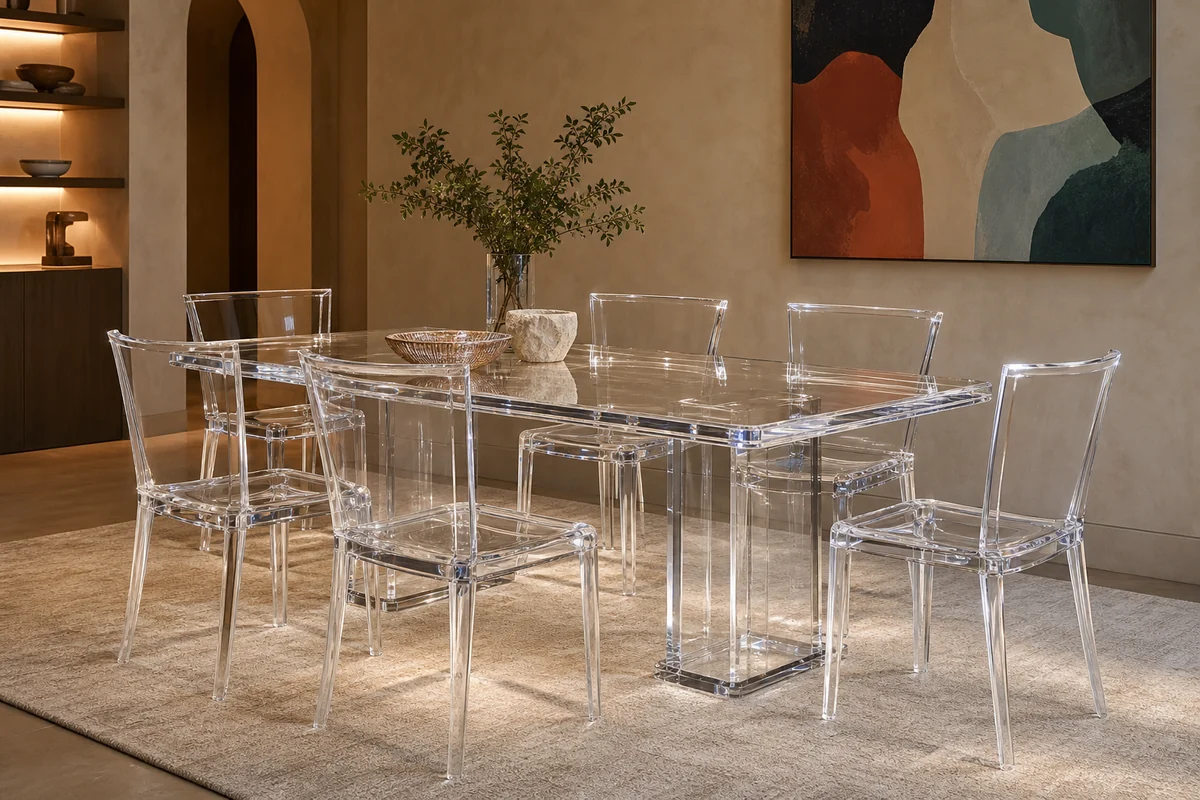
Designers spec'ing dining rollouts across multi-property hospitality groups — coordinated table + chair sets on one PO. Mixed shape orders fine (8 rectangular + 4 round across 12 sites) when each unique SKU hits the 10-piece floor.
Representative dining-table projects — fine-dining restaurant chain rollouts, boutique hotel private-dining sets, corporate boardroom statement pieces, members'-club library dining.
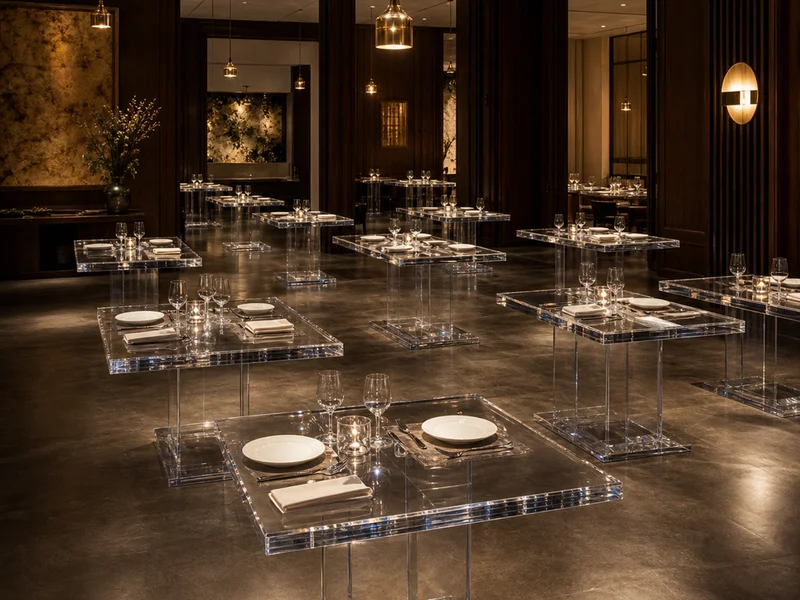
12 tables across 12 properties · 35mm clear cast acrylic · 2.0m × 1.0m rectangular · 2-pedestal base · 45° chamfered edges · subsurface laser-engraved chain mark on center top · batch color match enforced across 12 production sites · paired with 96 matching dining chairs on same PO (8 per cover)
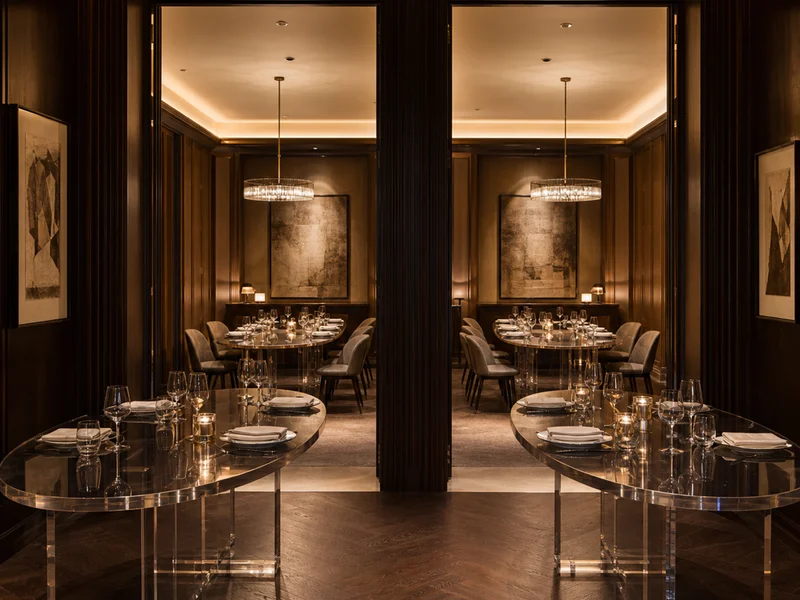
8 tables across 8 properties · 35mm smoke-tinted cast acrylic · 2.0 × 1.0m oval with boat-edge profile · trestle base · diamond polish on every visible edge · custom Pantone-matched smoke tint validated at sample with color chip · 8-property batch color match
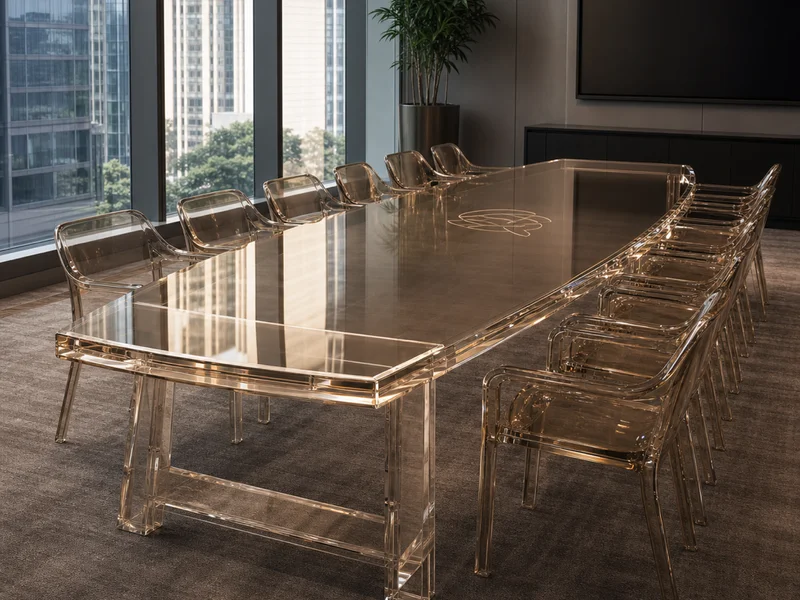
1 statement piece · 40mm bronze-tinted cast acrylic · 2.4m × 1.2m widest at center · boat-shape profile · apron-reinforced 4-leg base · subsurface laser-engraved corporate mark on center top · paired with 12 matching bronze-tinted dining chairs on same PO
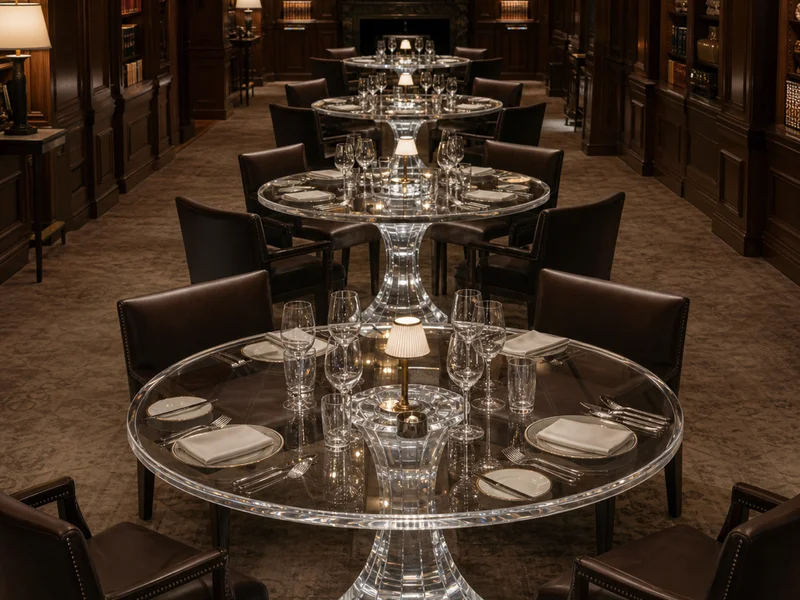
10 tables · 30mm clear cast acrylic · 1.6m diameter · single sculptural tapered pedestal · bull-nose rounded edge · subsurface engraved club mark on the top · paired with 60 matching dining chairs (6 per cover) on coordinated PO · clear-with-bronze-accent variant on 2 hero-room tables
Air-first split for the flagship opening — first table photographed on site three weeks before bulk arrived. The remaining 11 tables landed sea-freight on schedule, all reading identical to the air-shipped piece under the restaurant's tungsten lighting. No glass-table-replacement insurance line item this cycle.
Have a similar dining-table project?
Start a Similar ProjectDining-table pricing is built up from five drivers — top thickness and span (the biggest single variable), base architecture, color and tint, branding integration, and order quantity with coordinated bundling. The biggest cost lever for a multi-property buyer isn't unit-price negotiation; it's bundling the table + chairs + accent pieces on one coordinated PO, which typically saves 5–10% on the line through shared setup.
30mm is the baseline for a 2.0m × 1.0m top. Stepping to 35mm adds roughly 25% to material cost (more cast PMMA per square meter); stepping to 40mm adds roughly 50%. A 2.4m × 1.0m top at 40mm uses more than 2× the material of a 1.6m × 0.9m top at 30mm. The thickness call follows the span, not the buyer preference — under-spec'ing the top to save material is the most common pitfall and we flag it on every quote where it would compromise the deflection pass.
Single pedestal is the lowest-cost base; multi-pedestal adds roughly 10–15% per pedestal because each pedestal is a separately CNC-shaped and polished cast acrylic column. Apron-reinforced 4-leg adds roughly 15–20% versus single-pedestal — the hidden cast acrylic apron is a substantial fabrication line item even though it's invisible from the room. Boat-shaped and expandable formats add 15–25% for the additional fabrication complexity (asymmetric profiles, leaf-storage mechanism).
Diamond-polished square edge is the standard finish included in base pricing. 45° chamfered adds roughly 5% per linear meter of edge because the chamfer is a separate polishing pass. Bull-nose rounded adds 8–10% — the rounded profile requires more passes to remove machining lines. Boat-edge profile on oval formats adds 10–12% because the curve has to be hand-finished where the CNC pass leaves micro-faceting on tight radii. Long tables have more linear edge, so the edge-profile premium scales with table length.
Clear cast PMMA is the lowest-cost finish. Whole-body tints — smoke, bronze, pearlescent — add 15–25% over clear. Custom Pantone-match adds another 5–10% on top of the standard tint price for the color-chip validation step at sample. Multi-property chain rollouts requiring batch-matched color across production runs add a small QC overhead but no per-piece premium — the dye-lot discipline is built into our standard process.
Subsurface laser-engraved logo on the center top is the cleanest brand integration — frosted-white permanent mark inside the body of the acrylic, no surface wear, reads as deliberate design. UV print on a hidden underside is the alternative when the visible top must stay unmarked (some hotel groups prefer this for the unbranded room aesthetic). Whole-table custom-color tint matching corporate brand color is the most premium branding integration.
Unit cost drops 20–25% between MOQ 10 and 24 tables — setup is amortized across more pieces. Coordinated table + chairs orders save another 5–10% in setup and packaging versus two separate POs. Restaurant chain rollouts at 12+ tables (one per property) are the typical commercial order size where the per-piece cost lands lowest. The biggest single lever for a multi-property buyer isn't unit-price negotiation — it's bundling the table + chair + side-piece order on one PO.
For broader furniture pricing context, see the acrylic furniture hub.
From your first message to delivered dining tables — 3 steps, with coordinated table + chairs procurement baked into the brief.
Tell us the shape (rectangular, oval, round, square, boat-shaped, expandable), dimensions, top thickness preference (or let us spec to span), base architecture, color tint, branding, and quantity. Crucially, tell us whether the order is a coordinated table+chairs set on one PO and how many chairs per cover — most dining tables we ship leave with matching acrylic chairs. Room dimensions and seating count help us validate proportion against your private dining room layout.
We respond within 24 hoursWe CNC-cut and edge-polish one representative dining table from your order — typically the rectangular or round centerpiece configuration. Same cast acrylic gauge, base architecture, edge finish, color tint, and brand marking as bulk. You walk around it in the room, set it with plate-and-glass service, sit at it, sign off on dimensions, finish, and deflection under operator inspection. Sample fees are paid separately and are not credited to production orders; the approved sample is the QC reference for the production batch.
Sample ready in 10–14 days (large cast piece — diamond-polish pass alone is more time than a small accent piece)Every dining table passes 100% inspection — top thickness verification, surface clarity, edge polish, color batch match against the approved sample, base joint integrity, deflection under operator inspection at fully-set service load. Batch color match documented as a QC checkpoint across multi-property rollouts. Heavy-duty reinforced crating sized per table for sea freight; air-first available for fixed-date property launches. FOB Shenzhen; CIF and DDP available.
Production 30–40 days for 10 tables; 45–60 days for 12–24 tables30mm is our working floor for a 2.0m × 1.0m top in fine-dining service; we step to 35mm for 2.2m and 40mm for 2.4m spans because cast acrylic deflection grows nonlinearly with span. The qualitative test we run on every dining sample: a fully-set table with plates, water glasses, flatware, and centerpiece, plus full elbow load along the perimeter — no visible centerline flex under operator inspection. Multi-pedestal or apron-reinforced bases are non-negotiable for tops over 1.8m; single-pedestal designs work up to about 1.6m diameter on round formats but read undersized once a rectangular span gets long.
Yes, with one care protocol we ship with every restaurant order. Cast PMMA handles plate-and-glass service without scratching when cleaned with microfiber plus mild detergent — not abrasive cleaners, not ammonia-based glass cleaners, not bleach-based housekeeping chemistry. Hot plates straight from the pass should land on a placemat or trivet; direct contact with surfaces above the cast acrylic softening threshold causes localized stress whitening at the contact point, which is a permanent mark on an otherwise clear top. Restaurants that brief their service staff on these two rules at training don't see issues; the chains we supply use the laminated care card we ship as part of the host-station SOP.
Three base architectures cover every dining table we ship. Multi-pedestal — 2 or 3 sculptural cast acrylic pedestals supporting the top at engineered load points, the most popular for 1.8–2.4m rectangular and oval tables. Apron-reinforced 4-leg — four acrylic legs joined by a hidden cast acrylic apron underneath the top, invisible from the room but adding significant rigidity, often spec'd for boardroom-dining contexts where leaning load is heavy. Single sculptural pedestal — used on round tables up to 1.6m diameter and small square formats. For very long tables (2.4m+) we often combine apron-reinforced legs with a discreet center pedestal for distributed support.
Yes — this is one of the core reasons our hospitality clients pick acrylic over glass for dining tops. Cast PMMA at 30mm+ has significantly higher impact resistance than glass and doesn't shatter into shards if it fails under impact. Optical clarity is on par with glass; diamond polish on every visible edge makes the edge profile read like glass under restaurant lighting. For fine dining in a high-traffic restaurant — where staff move quickly past the table, full plate services cross the surface multiple times per cover, and the occasional dropped cutlery is inevitable — acrylic gives you the visual of glass with hospitality-safe durability. We brief this trade-off in writing on every dining quote.
Industry standard for rectangular dining tables is roughly 60cm of perimeter per seated guest. So 1.6m seats 4 (two each side), 2.0m seats 6, 2.4m seats 8, and a 2.8m seats 10. Add another 30cm at each short end if you're seating guests at the heads. Round tables work to a similar perimeter ratio: 1.4m diameter seats 6 comfortably, 1.6m seats 8, 1.8m seats 10. Oval tables sit between round and rectangular for the same nominal length. We confirm proportion against your private dining room dimensions at quote stage — room width minus chair-pull-out clearance on both sides has to leave at least 90cm for service circulation.
Yes — coordinated table + chair orders are the dominant order shape in this category. Most dining tables we ship leave the factory as part of a coordinated set: table + 6 or 8 chairs per cover, sometimes 12 chairs for a banquet-style spec, on a single purchase order. We match edge profile, color tint, and brand logo treatment across the table top and chair shells, and run both SKUs on one production batch so the molded chair shell and the flat-cut table top color-match exactly out of the same dye lot. The procurement saving is meaningful — coordinated table+chairs on one PO typically saves 5–10% in setup and packaging versus two separate purchase orders. See our acrylic chairs page for chair configuration options.
MOQ is 10 pieces per design — which applies even for dining tables despite the unit value being higher than a chair or side table. The logic that makes it work for hospitality chains: a fine-dining group rolling out a private dining room concept across 10+ locations needs one table per private dining room × number of properties, which lands at or above 10 pieces naturally. A single-property order of one dining table + 10 chairs counts as 2 SKUs — the chair line meets MOQ on its own (10 chairs), but the table line wouldn't qualify unless 10 tables are ordered. Multi-location restaurant rollouts, hotel groups, and members'-club chains hit the MOQ without engineering for it; single-restaurant orders typically combine with sister-property orders to qualify.
Sample 10–14 days because a representative dining-table sample is a large cast piece and the diamond-polishing pass on the perimeter alone is more time than a small accent piece. Production 30–40 days for 10 tables; 45–60 days for 12–24 tables. For multi-location chain rollouts with fixed-date property openings, we air-first 2–4 tables ahead of the soft-launch property and ship the bulk by sea — the standard hospitality cadence. We document the property-by-property delivery schedule on the order acknowledgment so the procurement team can give site managers a definitive crate arrival date.
Tell us the shape, dimensions, top thickness, base architecture, color tint, branding, and quantity. Coordinated chair orders can be specified in one brief. We respond within 24 hours. MOQ 10 pieces per design; sample 10–14 days; production 30–40 days for 10 tables; 45–60 days for 12–24.