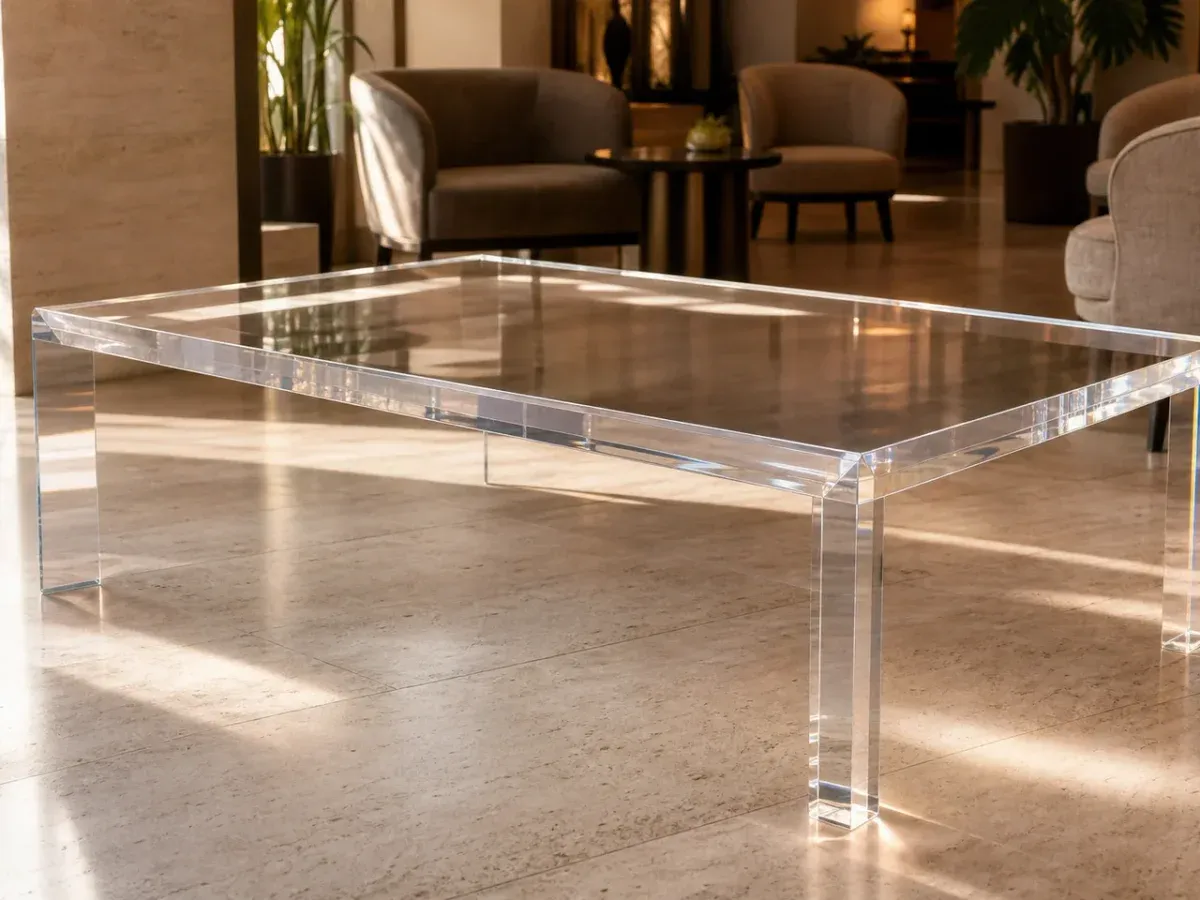
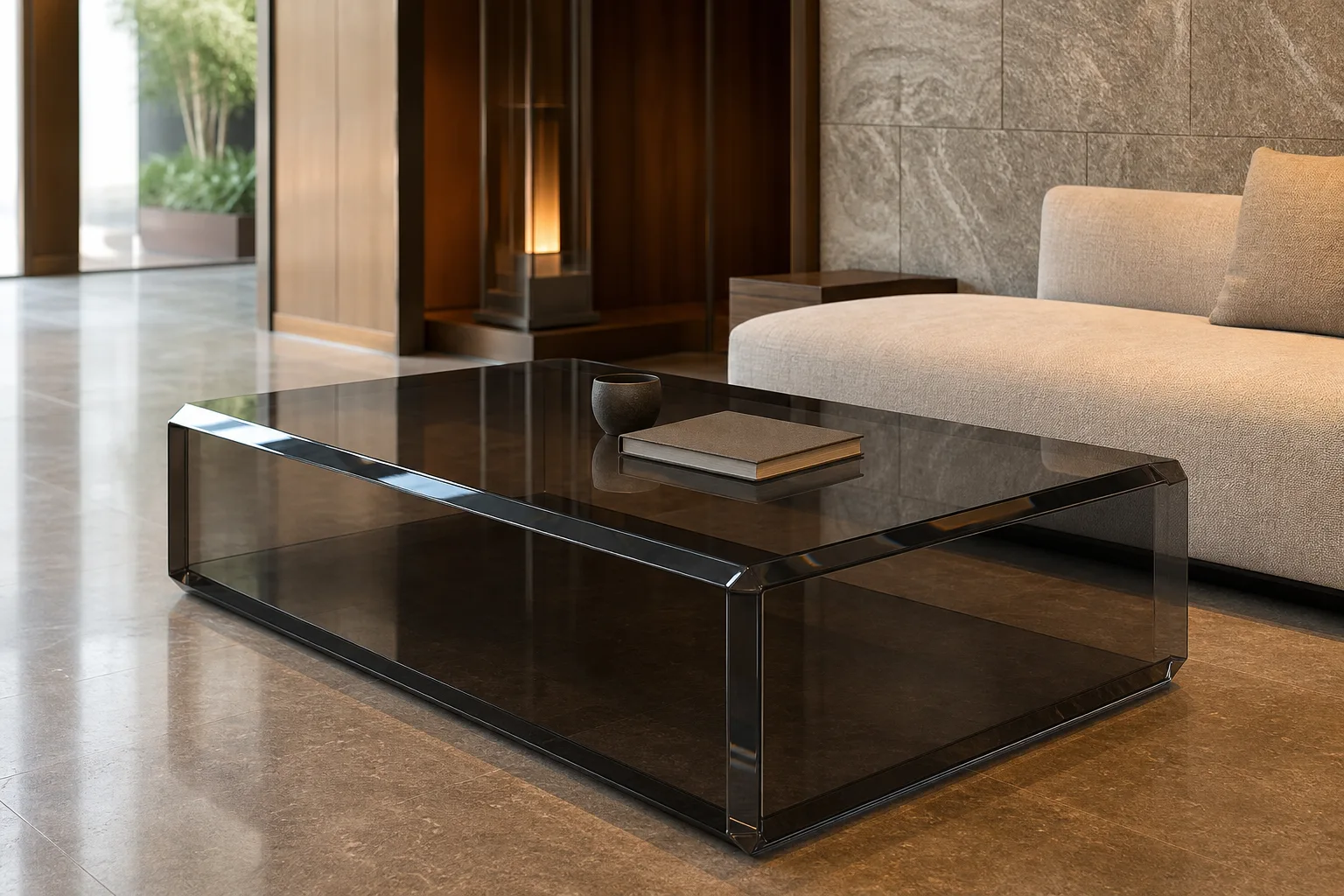
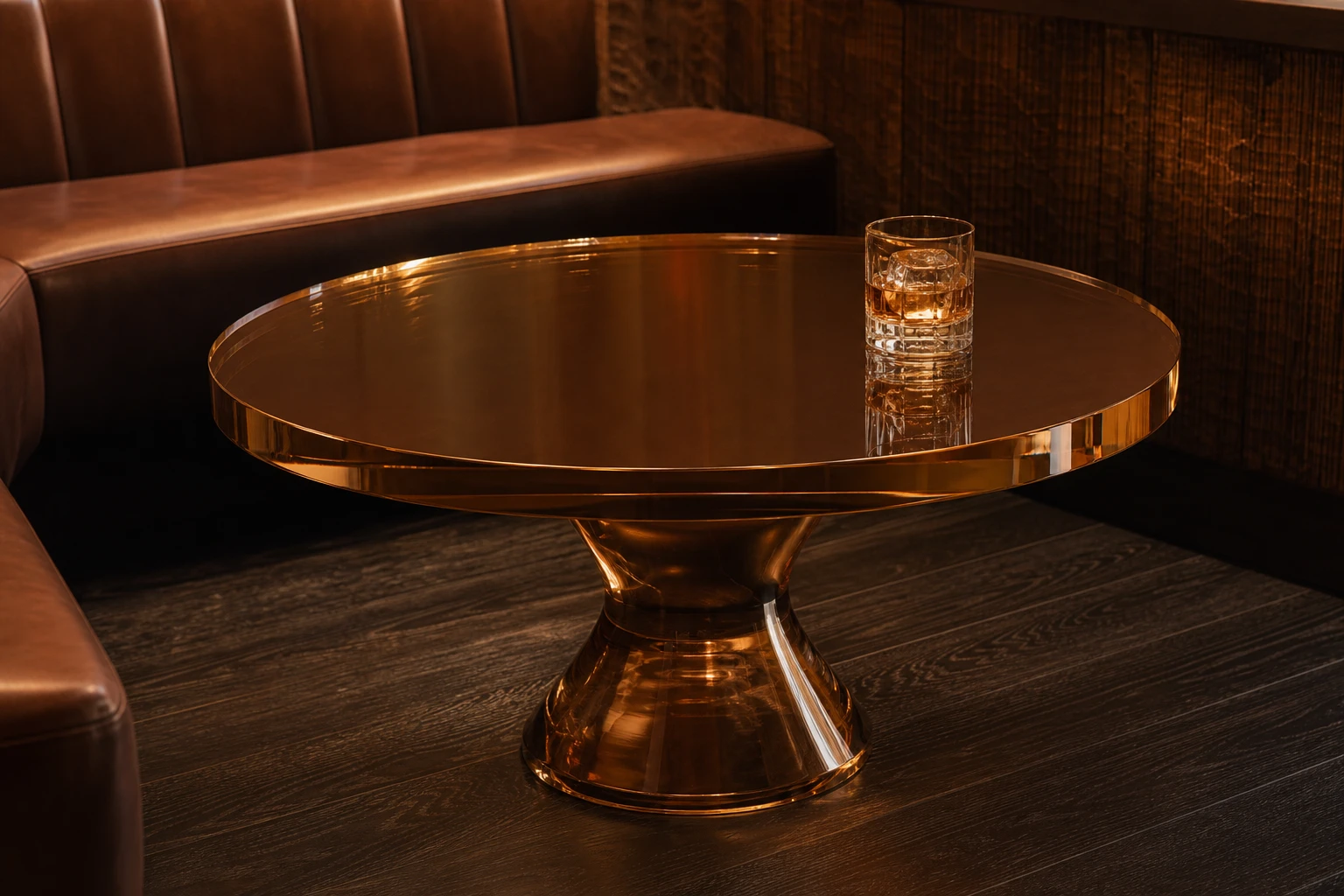
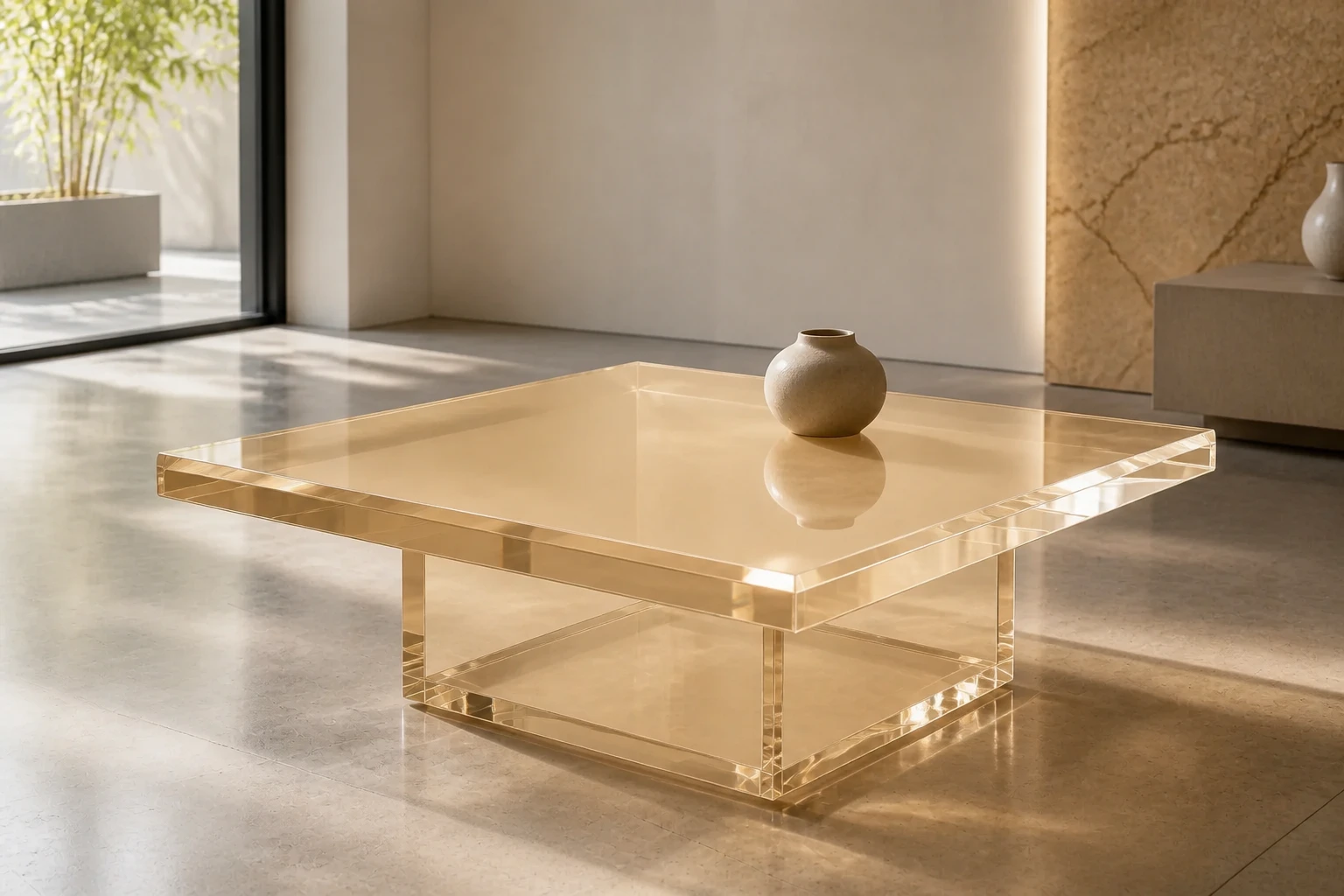
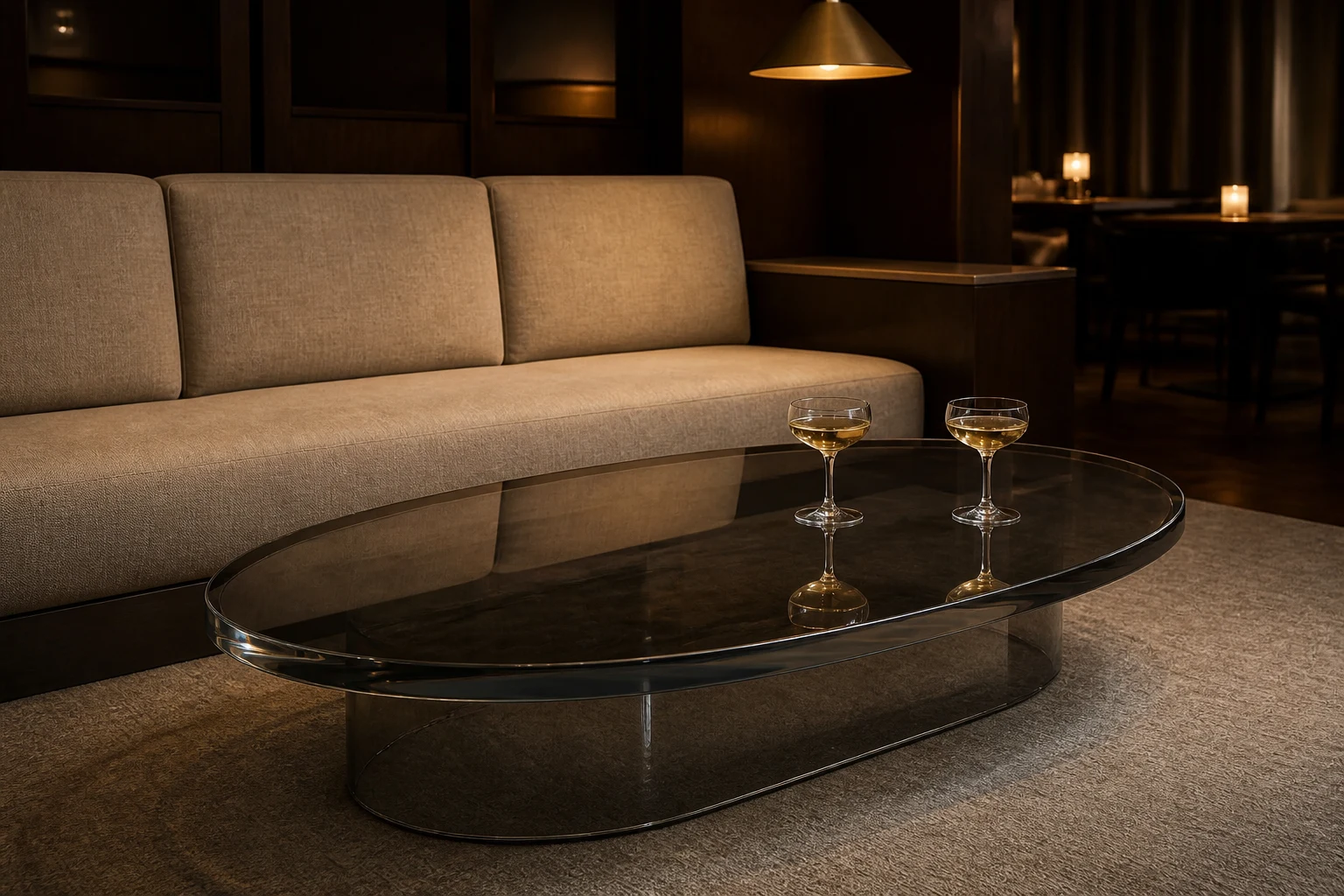
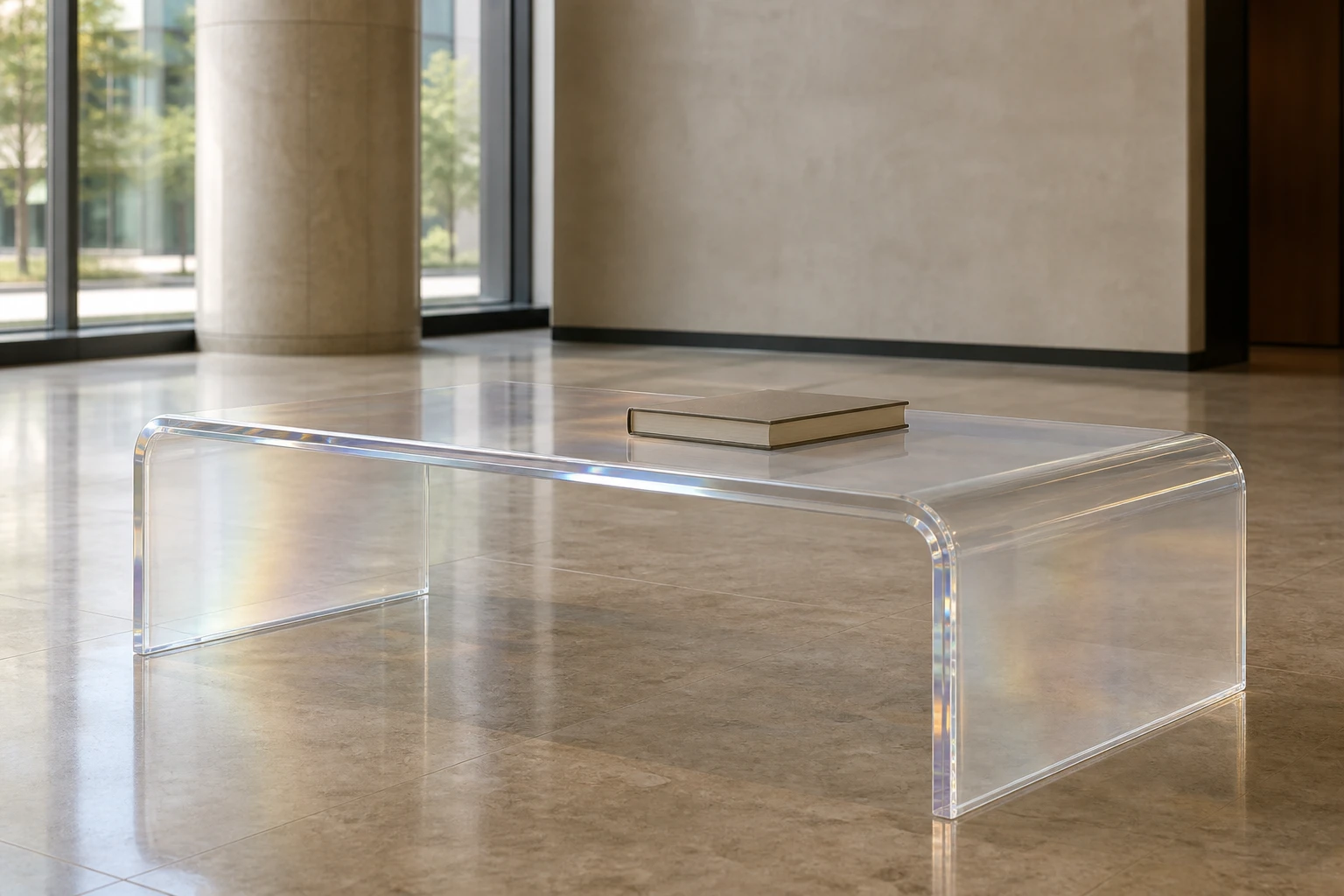
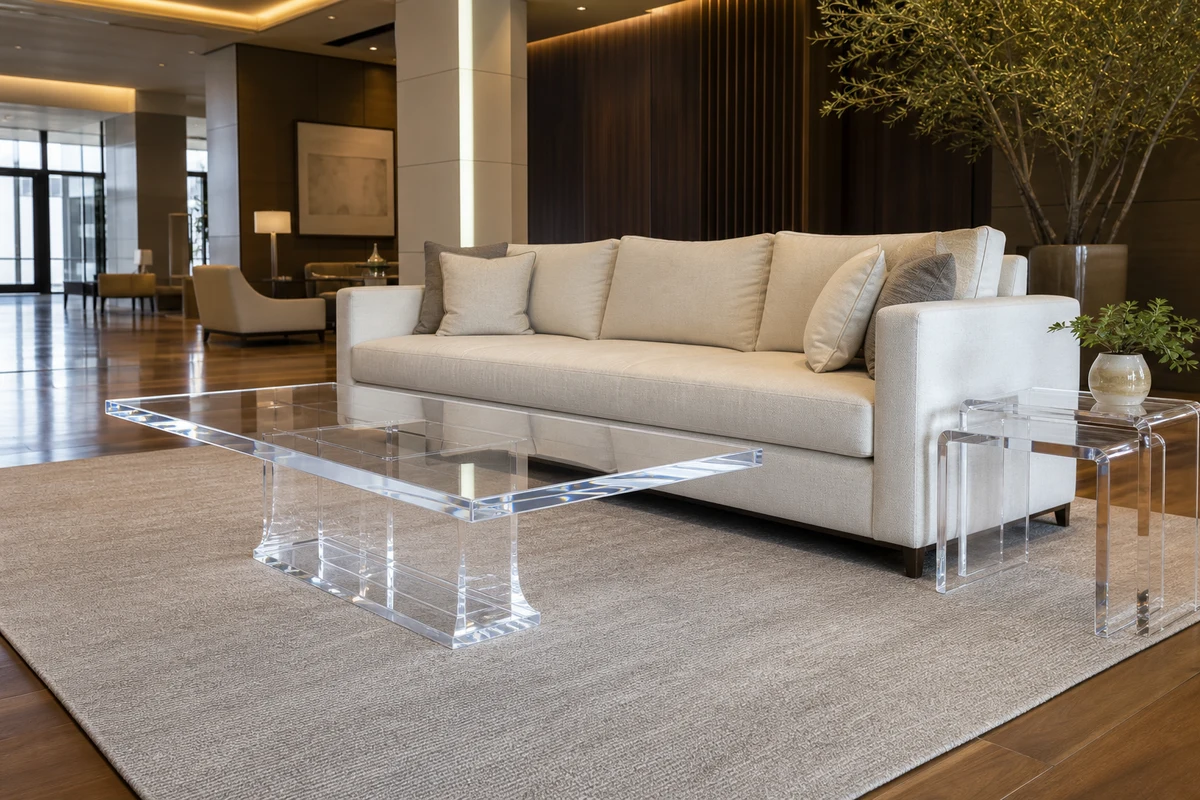
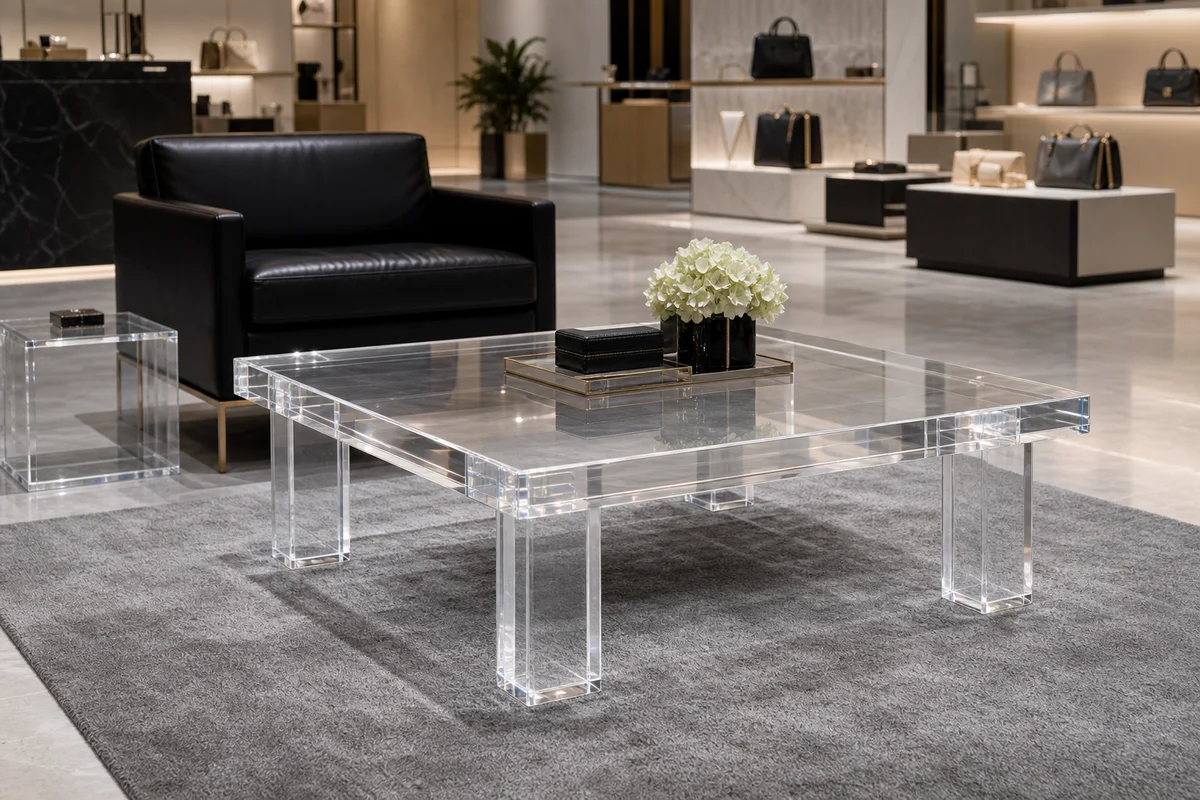
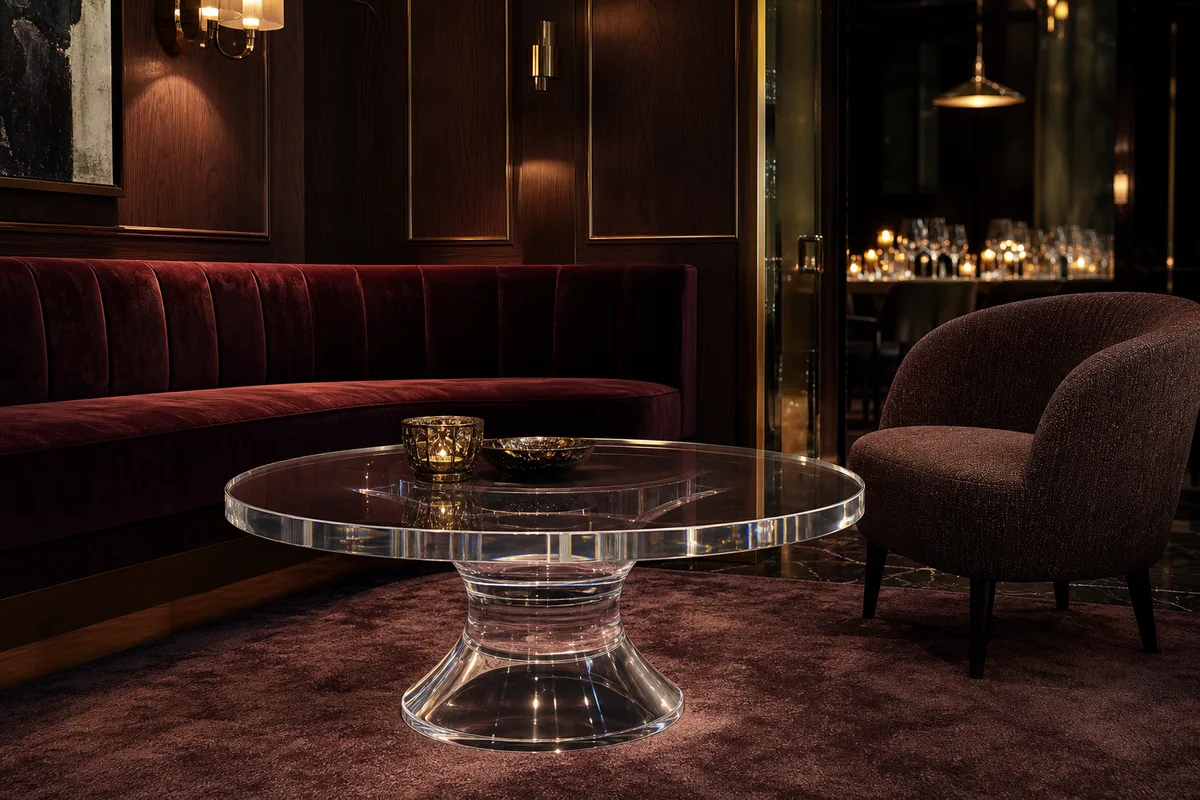
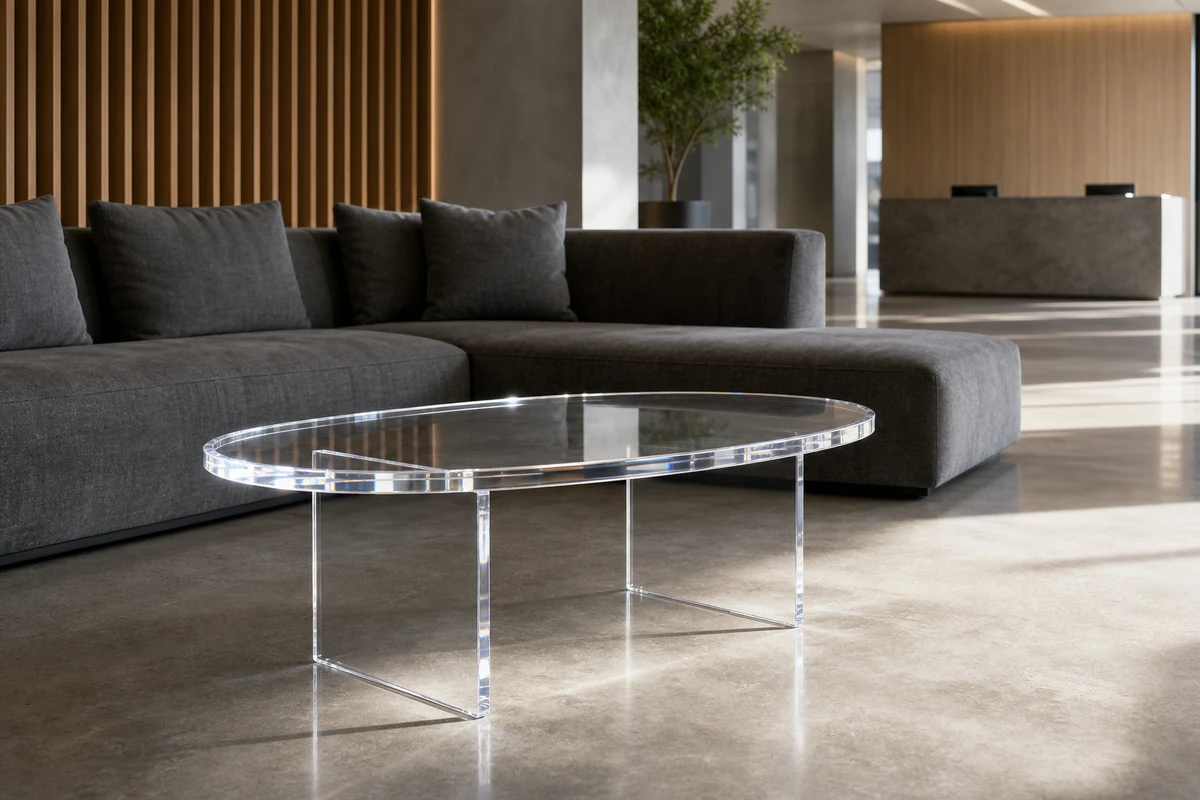
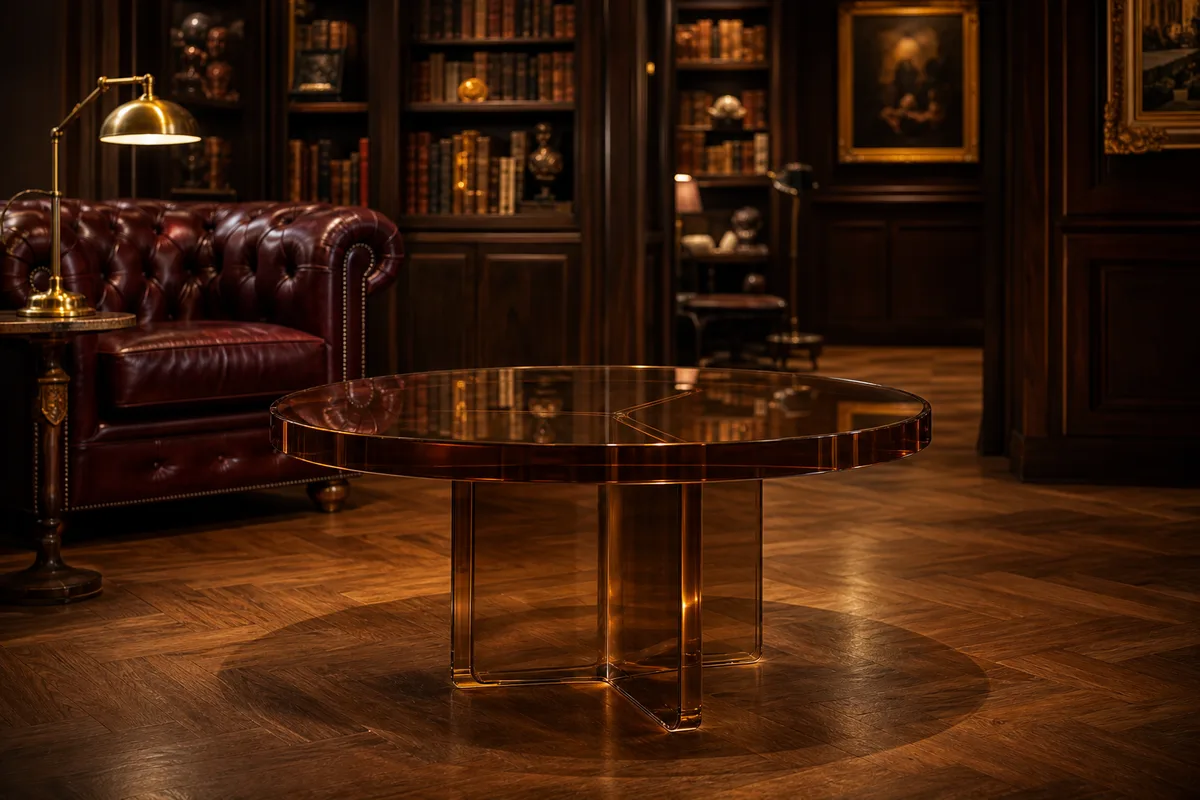
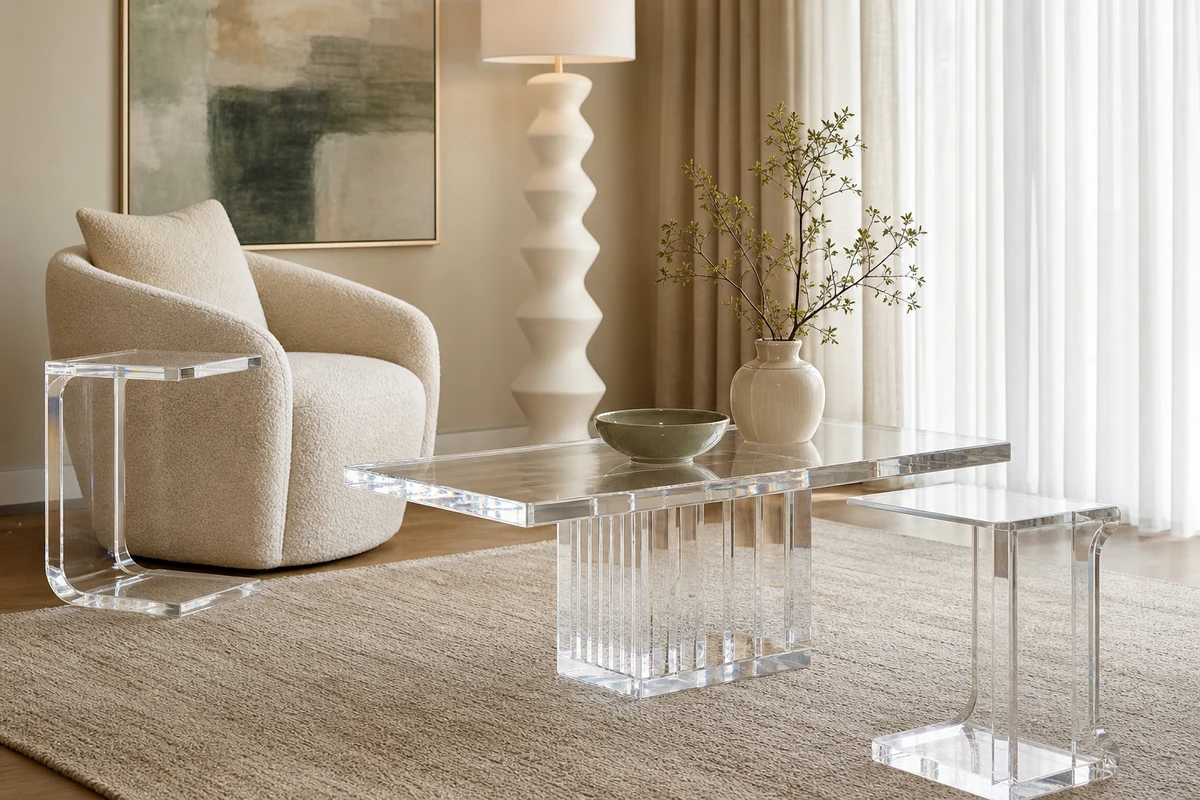
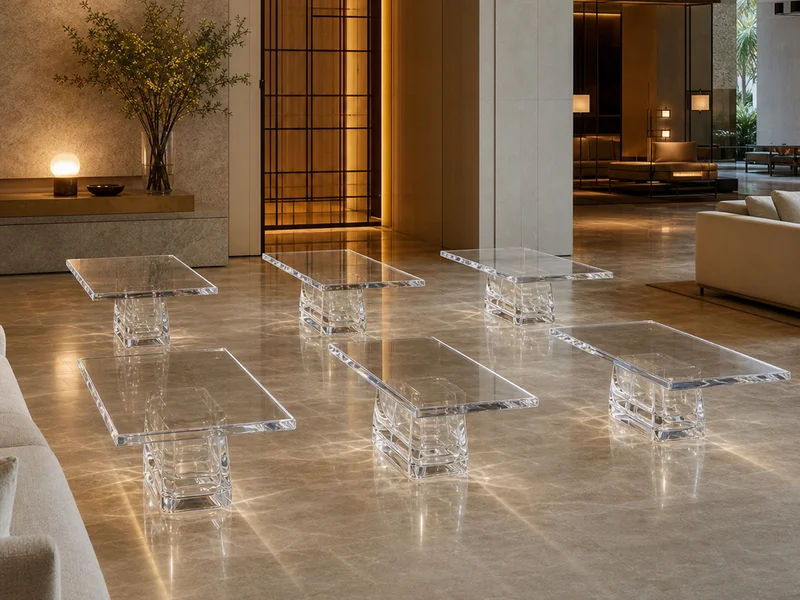
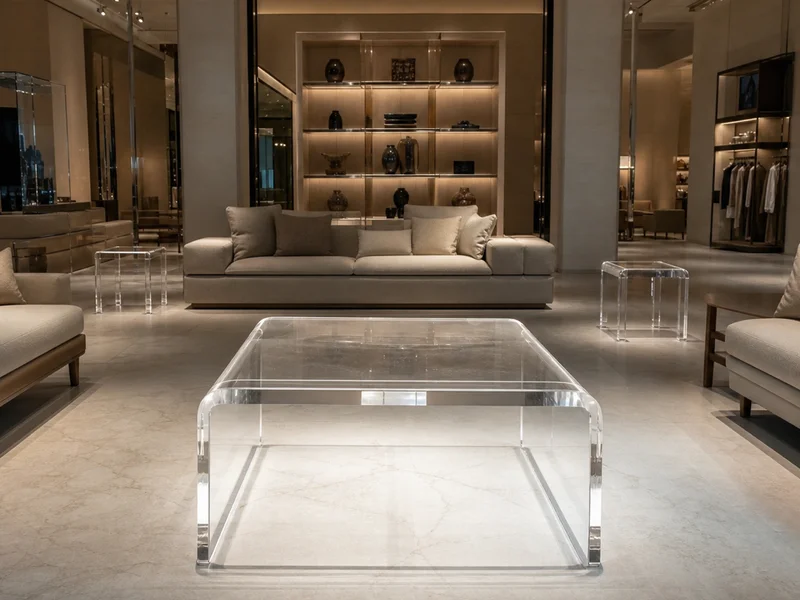
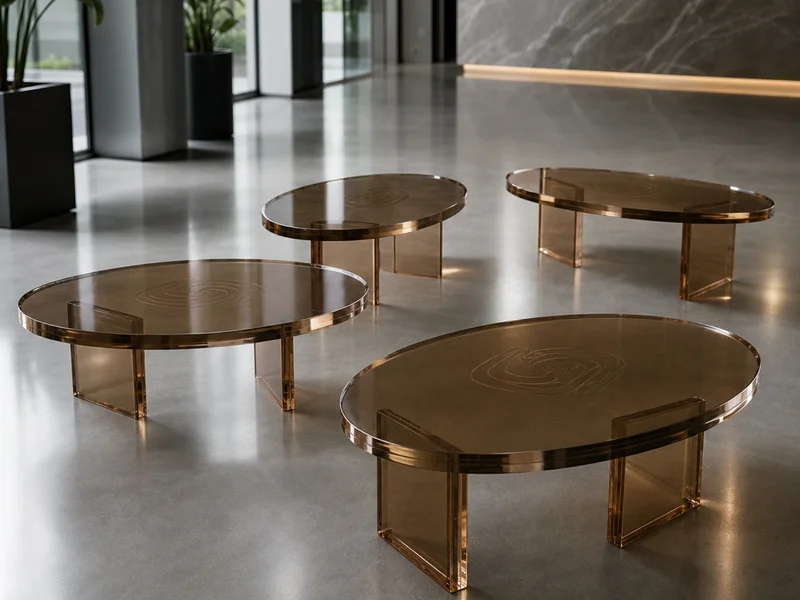
Single clear cast acrylic coffee table with thick 45° chamfered diamond-polished edges, photographed at low angle in a boutique hotel lobby

Custom Acrylic Coffee Tables

Six shapes. Five edge profiles. 25mm cast PMMA working minimum at 1.2m span. Batch-matched across rollouts.

Built for boutique hotel groups, members' clubs, and luxury retail flagships — not drop-ship inventory. MOQ 10 pieces; sample 7–10 days.

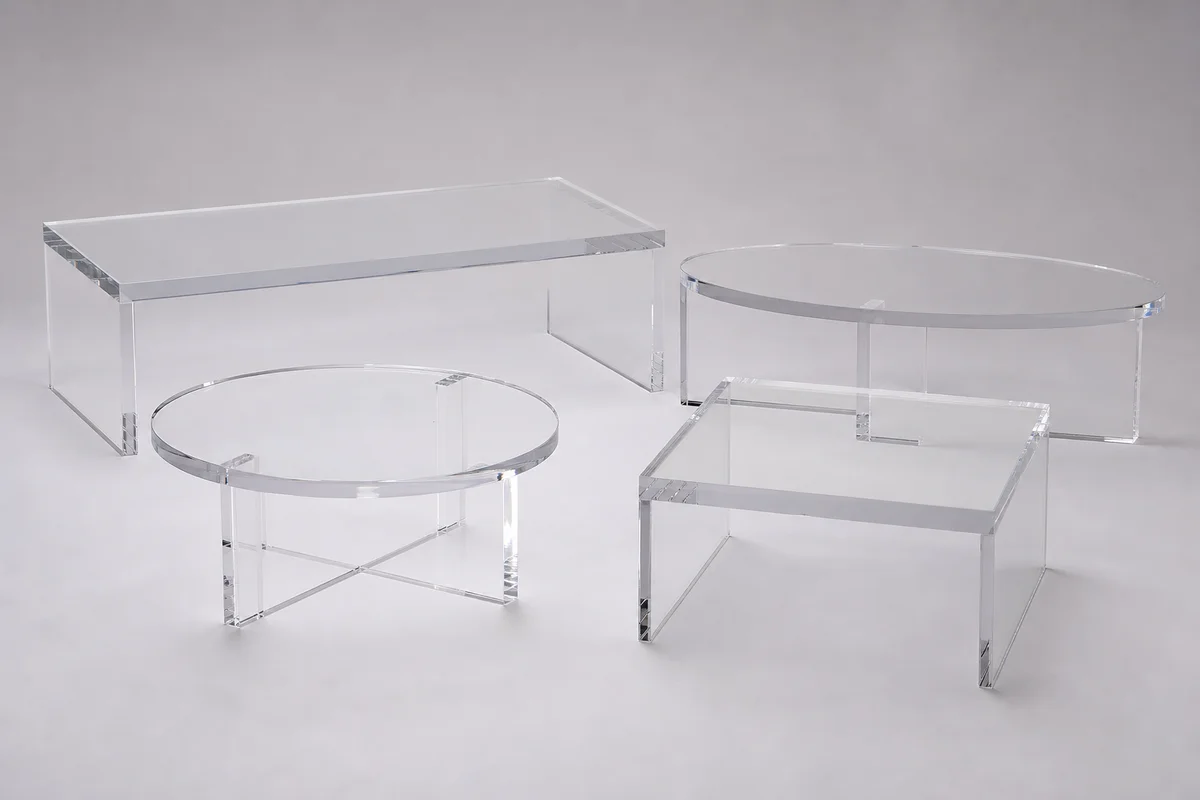
Custom acrylic coffee tables for boutique hotel lobbies, luxury retail flagships, private members' clubs, restaurant lounges, and corporate HQ executive seating zones. Six shape options — rectangular (1.2m × 0.6m standard), round (80cm Ø), square (1m × 1m), oval boat-shape (1.2m × 0.7m), waterfall continuous-wrap, and pedestal-base sculptural. Five edge profiles: 45° chamfered (most-ordered), bevelled, bull-nose, square, waterfall. 25mm cast PMMA is our working minimum at a 1.2m × 0.6m span — a figure based on cast acrylic mechanics, with project-specific data documented on sample sign-off. Whole-body tints (clear, smoke, bronze, pearlescent, custom Pantone) carry color uniform through the body. Subsurface laser-engraved logos sit permanently inside the acrylic, not on the surface. MOQ 10 pieces per design.

ISO 9001 Certified Since 2008 25mm Working Minimum at 1.2m Diamond-Polished Edges Sample in 7–10 Days

Boutique hospitality groups Private members' clubs European luxury retail MEA palace hotels 2,000+ projects delivered

Built to recede so the seating leads.

25–30mm cast PMMA tops, diamond-polished edges, whole-body tints carried through the body. Sized to your span and lighting, not stocked.

For Interior Designers & Hospitality Procurement Leads

If you're specifying acrylic coffee tables for a hospitality project, multi-property rollout, or luxury retail flagship, this section is for you. We work directly with interior design studios and procurement leads — not through a dealer network, not through a distributor. You brief us, we sample, you approve, we produce and ship. One point of contact from first email to delivery.

What We Provide for Your Spec Package

  • Production drawings with dimensions, edge profile, base architecture, and material callouts
  • Material data sheet (cast PMMA mechanical properties, UV-stabilized grade available)
  • Color-chip validation against your Pantone reference under daylight and room lighting
  • Sample sign-off sheet documenting approved specs — filed for reorder consistency
  • Batch color-match QC documentation for multi-property rollouts

Typical Project Shapes We Handle

  • Boutique hotel pre-opening: 10–30 tables across lobby, lounge, and suites
  • Multi-property rollout: 50–200 tables across 5–20 properties, batch color-matched
  • Members' club fit-out: coordinated coffee + side + console tables on one PO
  • Luxury retail flagship: 5–15 display tables with brand-specific tint and subsurface engraving
  • One-off statement piece: single sculptural table for a signature lobby or penthouse

Need a spec sheet or production drawing before you commit? Send us your brief — we respond within 24 hours with a preliminary spec package.

Six Coffee Table Shape Options

Acrylic coffee tables come in six shape options, each tied to a typical span, base architecture, and use-case fit: rectangular (1.2m × 0.6m standard, the hospitality default), round (80cm Ø most-ordered, sculptural pedestal), square (1m × 1m centerpiece geometry), oval boat-shaped (1.2m × 0.7m, easier service circulation than rectangular), waterfall continuous-wrap (architectural single-piece slab), and pedestal-base sculptural (floating-top look on a custom pedestal). All built in cast PMMA at 25–30mm top thickness with diamond-polished edges as standard.

What Is a Custom Acrylic Coffee Table?

A custom acrylic coffee table is a lobby- or lounge-scale table built from cast PMMA (also called Lucite or Plexiglas by trade name) instead of wood, metal, or glass — sized to span and load, edge-polished to optical clarity, and bonded with optical-clear adhesive for an invisible joint between top and base. For commercial settings — boutique hotels, members' clubs, luxury retail seating, corporate HQ lobbies, restaurant lounges — the material lets the surrounding seating and merchandise carry the visual weight without the bulk of wood or the safety risk of furniture-scale glass.

Coffee Table Dimensions, Heights & Spec Reference

Coffee tables work in a forgiving span range — 1.0–1.4m long-axis is where almost every hospitality and lounge brief lands — but the top thickness has to scale with the span to keep the surface optically flat under load. The table below is our working reference for cast PMMA tops at 42cm hospitality-default height. The 25mm working figure at 1.2m × 0.6m is based on cast acrylic mechanics; project-specific data is documented on the sample sign-off you keep on file.

Shape & Configuration Typical Size Top Thickness Standard Height Base Options Use Case
Rectangular (standard) 1.2m × 0.6m 25mm working min 42cm Pedestal · trestle · 4-leg Boutique-hotel lobby, members' club lounge — the hospitality default
Rectangular (long-span) 1.4m × 0.6m 30mm 42cm Trestle or 4-leg Larger lobby layouts, restaurant lounge groupings
Round 80cm Ø (most-ordered) · 60–100cm available 25mm 42cm Single sculptural pedestal Private dining lounge, lounge-bar between four chairs, flexible seating
Square 1m × 1m 25–30mm 42cm Pedestal or 4-leg Symmetrical four-seat lounge centerpiece, retail showroom focal point
Oval (boat-shaped) 1.2m × 0.7m 25–30mm 42cm Two-leg trestle or pedestal Softer geometry; long enough for a lounge reach, easier to walk around than rectangular
Waterfall continuous-wrap 1.0–1.4m × 0.6m 25–30mm 42cm Integral — slab wraps to floor Architectural single-piece statement, luxury flagship and signature hotel suite
Lower-height (lounge) 1.2m × 0.6m 25mm 38cm Pedestal or sculptural Deep-lounge seating zones — pairs with 38–40cm sofa seat height

Working reference for cast PMMA coffee tables at standard hospitality-default 42cm height. Lower-lounge height (38cm) coordinates with 38–40cm sofa seats; standard-height (42cm) coordinates with 42–45cm seats. Project-specific spec confirmed on sample sign-off.

Why a 5mm Difference in Thickness Matters at Coffee-Table Scale

At a 1.2m × 0.6m rectangular span, the difference between 20mm cast PMMA and 25mm cast PMMA is the difference between a top that reads optically flat and a top with a visible centerline sag. Cast acrylic flexes under load; the working figure for thickness is set so the flex stays under the visual threshold for the span. Drop below that figure and the sag catches reflections from above — a failure mode you cannot un-see once it has shown up in a boutique-hotel lobby. The diagram below shows the qualitative difference at the same 1.2m span between a 20mm top (visible sag along the centerline) and a 25mm top (no visible sag under typical load). The exact deflection figure is documented on the sample sign-off against your real-world load profile.

Side cross-section comparing visible centerline sag at 20mm cast PMMA versus no visible sag at 25mm cast PMMA on a 1.2m × 0.6m rectangular coffee table top under typical centerpiece load. Two side-by-side side cross-sections of a 1.2m × 0.6m rectangular coffee table top resting on two pedestal supports at the ends, with a distributed load arrow stack pressing down on the center. On the left, a 20mm cast PMMA top shows a visible downward curve along the centerline labelled "visible sag — catches reflections". On the right, a 25mm cast PMMA top shows a flat line labelled "no visible sag under typical load". The 25mm version is the working minimum at this span; exact deflection figure documented on sample sign-off. 20mm vs 25mm cast PMMA at 1.2m × 0.6m span — qualitative comparison Side cross-section under typical centerpiece + book-stack load 20mm cast PMMA top (below working minimum) Visible sag along the centerline Catches reflections — reads as imprecise in lobby photography Not used in any Wetop coffee table at 1.2m span 25mm cast PMMA top (Wetop working minimum) No visible sag under typical load Top reads optically flat — clean reflections from above Working minimum at this span; exact figure on sample sign-off
Qualitative comparison only — the exact deflection figure depends on your specific load (centerpieces, books, occasional weight) and is documented on the sample sign-off against your real-world use case. The point of this diagram: 5mm of cast PMMA thickness at coffee-table scale is the visible-vs-invisible threshold, not a marketing distinction.

Five Edge Profiles — Cross-Section Side-by-Side

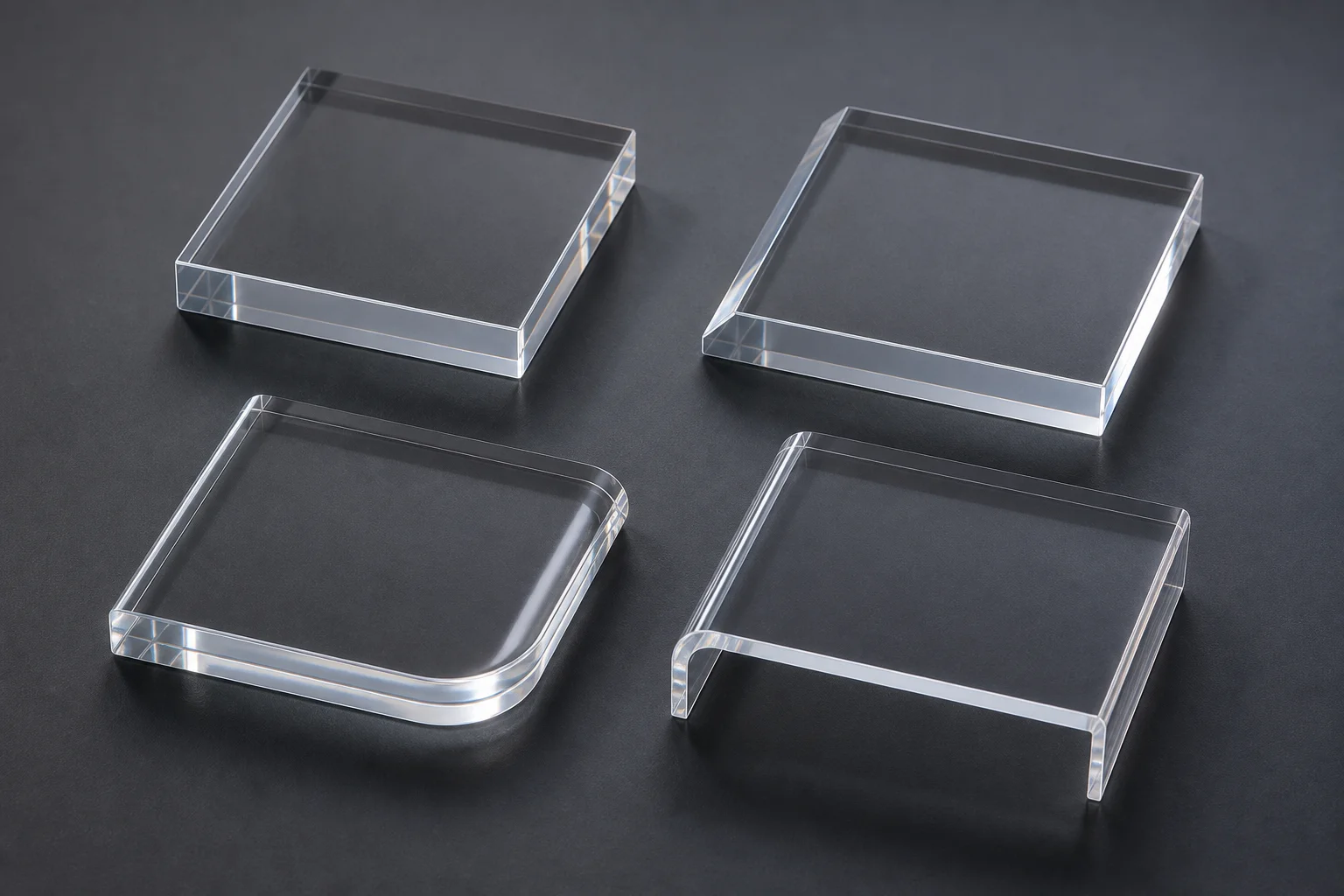
Coffee-table edges sit at hand height — they're touched, photographed, and visible from every angle in the room. The edge profile is a design decision, not a finish step. We diamond-polish to optical clarity on every visible edge as standard. The five profile options below each create a different visual read under room lighting: chamfered catches directional light without glare; bevelled is more refined; bull-nose softens the corner; square reads as a clean modernist line; waterfall folds the top down to the floor as one continuous slab.

Stylized cross-section of five coffee-table edge profiles side-by-side: 45° chamfered, bevelled, bull-nose rounded, square diamond-polished, and waterfall continuous-wrap. Five stylized side cross-sections of a 25mm cast acrylic coffee table edge in different finishes. 45° chamfered shows the top edge cut at 45 degrees to catch directional light. Bevelled shows a shallower angle for a more refined look. Bull-nose rounded shows a half-radius. Square diamond-polished shows a clean perpendicular edge. Waterfall continuous-wrap shows the top folding continuously down into a vertical leg with no joint line at the corner. Each profile carries a brief design-effect note below. Drawings are stylized for clarity, not to engineering scale. Five coffee-table edge profiles in cross-section 25mm cast PMMA top — same thickness, five different visual reads 45° Chamfered Light-catching Reads thinner — most ordered Bevelled Shallower angle Refined — members' clubs Bull-Nose Half-radius Softer corner — lounge Square Diamond-polish Clean modernist line Waterfall Continuous wrap Single sculptural piece
Edge profile is a design decision, not a finish step. 45° chamfered is the most-ordered for hospitality coffee tables because it catches light without the hard glare of a square edge and makes a 25–30mm top read visually thinner than it is. Pick against your room lighting and lounge context, not against a spec sheet.
Compare a coffee table to the other acrylic furniture types we build
PieceKey DimensionTop / Wall ThicknessMOQSample
Coffee Table (this page)1.0–1.4m span · 42cm height25–30mm top107–10 days
Side Table0.4–0.6m span · 38–60cm height20–25mm top107–10 days
Console Table1.2–1.6m × 0.35m · 75cm height25–30mm top107–10 days
Dining Table1.6–2.4m span · 75cm height30–40mm top107–10 days
Chair45 / 65 / 75 / 38cm seat8–10mm molded shell1010–14 days

Coffee tables most often ship coordinated with side tables and chairs on one PO — same dye lot, same edge profile, batch color match enforced as a documented QC checkpoint.

Why Acrylic for Coffee Tables?

Cast PMMA is the right material for commercial coffee tables when transparency is the design choice — you want the table to recede so the seating and surrounding merchandise carry the visual weight. Versus glass, cast PMMA is many times more impact-resistant and won't shatter in a high-traffic lobby. Versus wood, it doesn't swell from spilled drinks, doesn't warp under hospitality-grade cleaning, and accepts whole-body Pantone tints uniform through the body without surface-paint chipping risk. The comparison below covers the four material decisions a hospitality buyer typically weighs at spec time.

Cast Acrylic (PMMA)GlassWoodSteel / Powder-Coat
Clarity92% light transmission; whole-body tint available~90% transmissionOpaqueOpaque
Impact resistanceMany times stronger than glass; shatter-resistantFragile — shatters into shards in a high-traffic lobbyDents under impact; corners chipDents and surface-finish scratches
Weight per pieceMuch lighter than glass — freight cost lower per pieceHeavy — freight cost adds up across multi-property rolloutsHeavy, slow to repositionHeavy
Daily commercial useNo warping, no staining, wipes clean; spilled drinks not a concernFingerprints visible; cracks under stress at seat-edge contactWarps in humid conditions; absorbs spills permanentlyRusts in humid kitchens / restrooms; powder-coat chip-prone
Color matchingWhole-body tints; Pantone match through the body — no chip-prone surface paintSurface-applied tints only; limited rangeStain/finish; visible batch variation across multi-property rolloutsPowder coat with chip-prone finish
Branding integrationSubsurface engraving (permanent inside the body), UV print, tintLimited to surface etchingEngraving, branded inlay (visible grain interference)Etching, applied badges
Best forHospitality lobby & lounge centerpiece tables where transparency is the design choiceDisplay vitrines, low-traffic accent piecesHeritage interiors, residential, traditional fine diningStructural fixtures, industrial

Acrylic vs Tempered Glass vs Solid Surface vs Hardwood — Honest Comparison

Four materials compete for the same brief when a hospitality or luxury-retail buyer specs a coffee table. Cast acrylic wins on transparency and freight economics but loses on scratch resistance and heat tolerance. The comparison below is honest about where acrylic is the wrong choice — because the table that lands on your floor should match the room, not the factory's strongest margin.

Cast Acrylic (PMMA)Tempered GlassCorian / Solid SurfaceHardwood
Visual weightNear-invisible — 92% light transmission. The table recedes; the seating leads.Clear but reads heavier. Green edge tint visible on panels above 12mm.Opaque. The table itself is the visual statement.Opaque. Grain and finish carry warmth but dominate the room.
Edge profile options5 profiles (chamfered, bevelled, bull-nose, square, waterfall) — all diamond-polished to optical clarityFlat-polished or bevelled only. No waterfall. Post-tempering machining is limited.Thermoformed seamless edges. Routed profiles read matte, not glassy.Routed profiles with visible grain at the edge. Wide shape range but never transparent.
Custom dimensionsAny shape CNC-cut from sheet. No mold. 25–30mm handles spans up to 1.4m.Separate tempering run per size. Higher setup cost for custom dimensions.Fabricated from sheet; seam lines visible on spans above ~0.8m.Any dimension from solid stock. Long spans need engineered joints.
Lead time (12-piece run)~30 days (sample 7–10d + production 20–28d). Air-first option available.~45–60 days. Tempering batch scheduling + safety certification + heavy freight.~45–60 days. Fabrication + curing cycle. Custom color surcharges above ~25 pcs.~40–50 days. Kiln-dried stock + multi-coat finishing + curing.
Repair / replace over 5 yearsMinor scratches buff out with micro-mesh polish. Deep scratches or cracks → replace the piece. Acrylic scratches more easily than glass under daily use — this is the honest trade-off.Scratch-resistant surface, but shatters on point impact — full replacement, no repair.Surface damage sands and refinishes on-site. Heat marks require professional sanding. Very repairable.Refinishable many times over decades. Water rings and humidity warping need professional restoration.
Where it winsTransparency + shatter-resistance + body-color matching + lightweight freight + subsurface brand engravingScratch resistance + heat resistance + perceived luxury heftSeamless fabrication + heat resistance + on-site repairability + antibacterial optionsHeritage warmth + structural capacity for heavy loads + decades of refinishing life
Where it losesScratches more easily than glass. Not heat-resistant above ~80°C — hot mugs leave marks without a coaster. Can yellow under years of unfiltered UV without stabilizer.Shatters on impact. Green edge tint on thick panels. No body-color options. Heavy freight across rollouts.Opaque — can't achieve the "invisible table" look. Heavy. Not viable as structural leg material.Warps and stains in humid hospitality environments. Visible grain variation across multi-property rollouts.

Materials, Finishes & Coffee Table Specs

Coffee tables ship in cast PMMA at 25–30mm top thickness, diamond-polished on every visible edge as standard. Five material variants, six edge / finish options, and technical specs sized to your span and load on every quote. Five base architectures (single pedestal, two-leg trestle, 4-leg cube, sculptural floating, integral waterfall) cover almost every coffee-table design we ship.

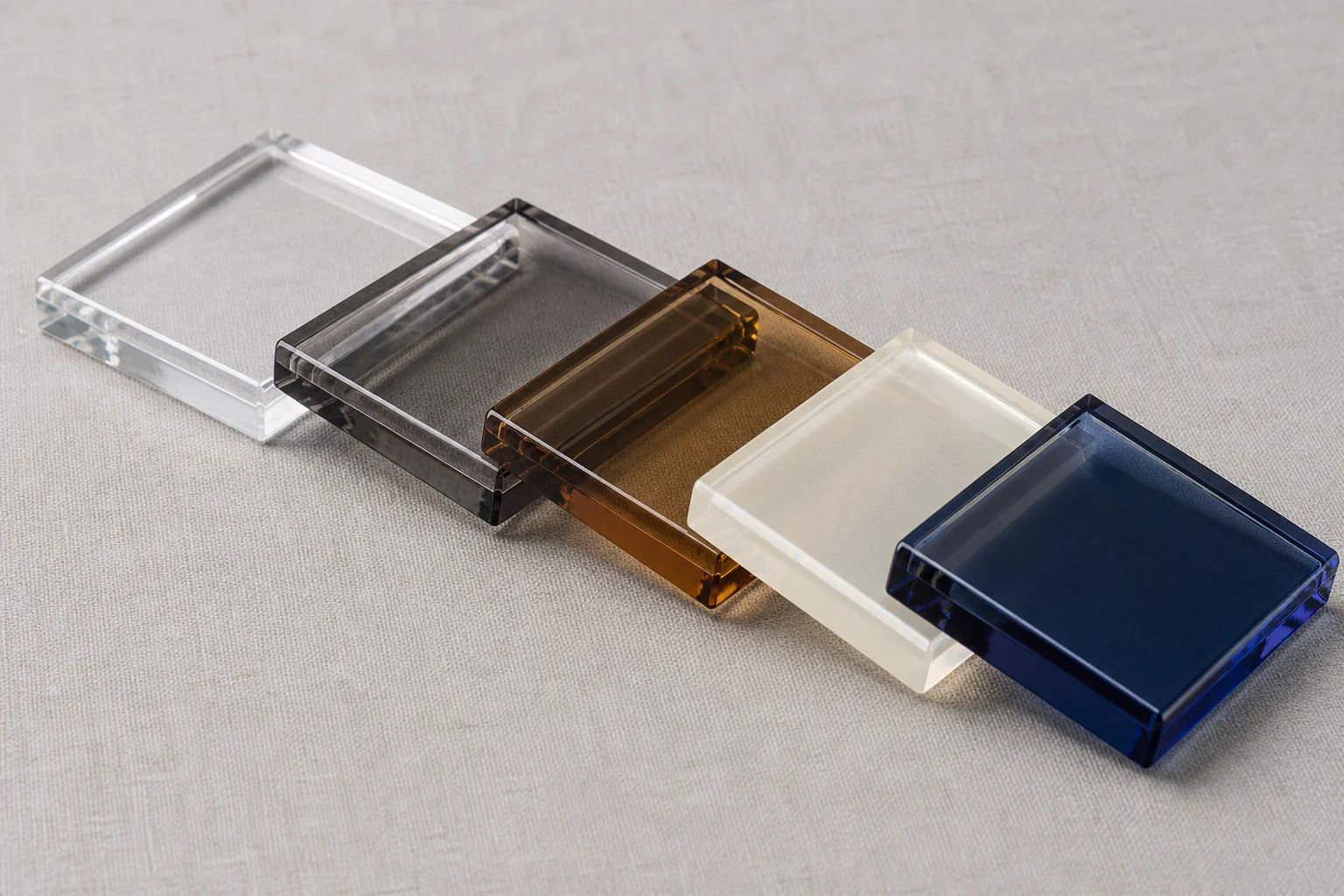
Cast PMMA material options for acrylic coffee tables — clear, smoke, bronze, pearlescent, custom Pantone

Top Material Options

MaterialProperties
Clear cast PMMA92% light transmission; the table recedes visually, the seating and merchandise carry the visual weight
Smoke tintWhole-body grey-tinted cast — softens lobby light, reads intentional against warm interiors
Bronze tintWarm amber tone — pairs with wood-and-leather club interiors, signature for members'-club library tables
PearlescentSoft milky-translucent finish — favored for lounge contexts in warm-lit lobby zones
Custom Pantone-matchColor uniform through the body — corporate brand color, hospitality group palette; validated at sample with color-chip check
Diamond-polished edge profiles and surface finishes for acrylic coffee tables — chamfered, bevelled, bull-nose, square, waterfall

Edge & Surface Finishes

FinishResult
Diamond polish (standard)Optically clear edge — reads like glass; resists micro-chipping under daily handling
45° chamferedLight-catching angled edge — most-ordered for hospitality coffee tables; reads thinner than the actual top
Bevelled (shallower angle)More refined read — common in members' clubs and luxury retail flagships
Bull-nose roundedSofter corner profile — used on lounge contexts where guests routinely touch the edge
Square diamond-polishedClean modernist line — clean perpendicular edge, no facet
Waterfall continuous-wrapSlab folds top-to-floor as one piece — architectural single-piece look, no joint at the corner
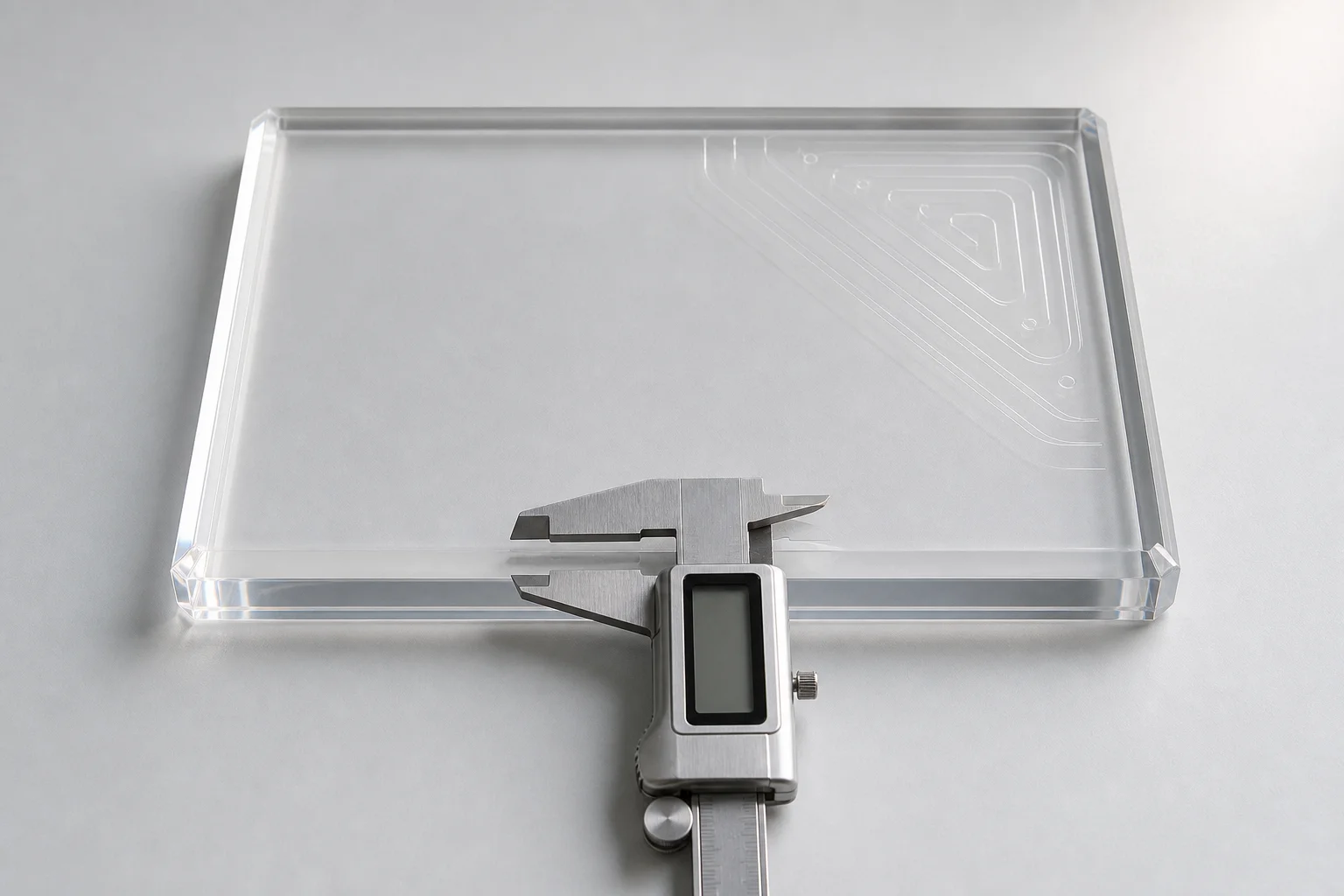
Subsurface laser engravingFrosted-white logo inside the body — permanent, no surface wear, scales per piece
UV print on hidden undersideFull-color logo, invisible from the room side, reads from a specific angle
Acrylic coffee table technical specifications and working spec reference

Technical Specifications

SpecDetails
Top thickness25mm working min at 1.2m × 0.6m; 30mm for 1.4m spans or heavier centerpieces
Working span range1.0–1.4m long-axis (rectangular & oval); 60–100cm Ø (round); 0.8–1.0m square
Standard height42cm hospitality default; 38cm lower-lounge band; 45cm upper-lounge
Base architectureSingle pedestal · two-leg trestle · 4-leg cube · sculptural floating · integral waterfall
Load engineeringSized to span + load; working figure for 1.2m × 0.6m is based on cast PMMA mechanics; project-specific data on sample sign-off
Edge profile45° chamfered diamond-polish is the default; bevelled, bull-nose, square, waterfall all available
MOQ10 pieces per design (each unique SKU)
Sample lead time7–10 days standard; 14 days for waterfall continuous-wrap (single-piece CNC)
Production lead time20–28 days for 10 pieces · 35–45 days for 24–48 pieces

Not sure which shape, edge profile, base, or tint fits your project? Send us a brief, drawing, reference image, or even a phone photo of the sofa the coffee table has to pair with — we'll recommend the spec and quote it.

Get Material Recommendations

Why Businesses Choose Wetop for Acrylic Coffee Tables

Coffee tables are where material discipline shows. Wrong top thickness deflects under load and reads as a soft sag along the centerline; wrong edge profile catches glare instead of light; wrong color match between batches breaks the rollout look across multi-property hospitality programs. Wetop has been building custom acrylic for B2B buyers since 2008 — 2,000+ projects shipped to 25+ countries, ISO 9001 certified, 5,000 m² facility with 65+ employees, in-house CNC and diamond polishing throughout. The five decisions below are what we walk every coffee-table buyer through.

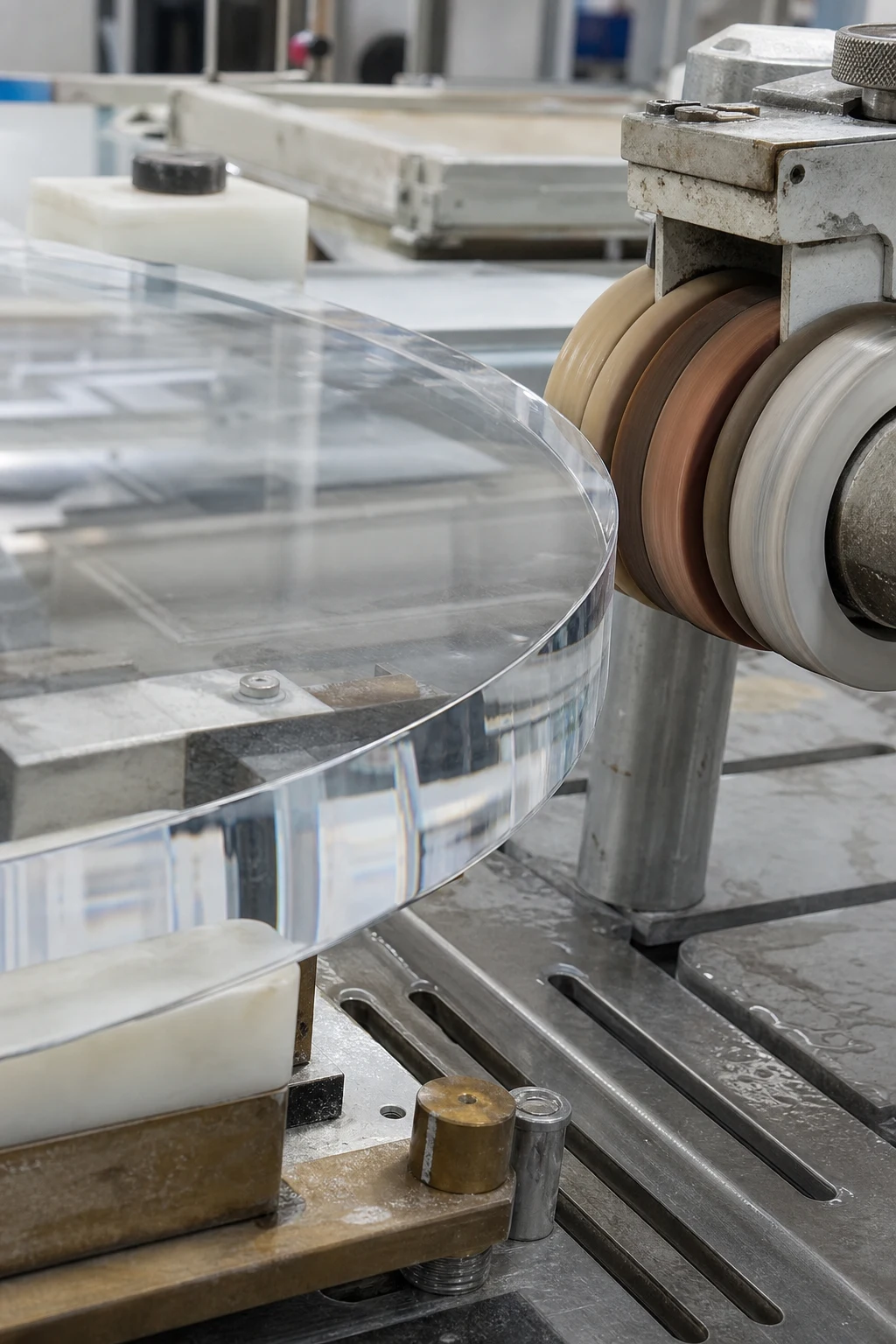
Wetop Acrylic workshop — diamond-polishing the 45° chamfered perimeter edge of a 25mm cast PMMA coffee-table top on a workshop bench

25mm Working Minimum at 1.2m × 0.6m, Sized to Your Real Span

Coffee-table thickness is a structural call, not a marketing one. 25mm cast PMMA is our working minimum at a 1.2m × 0.6m rectangular span — at that thickness the centerline stays optically flat under typical centerpiece and book-stack loads. Drop 5mm and the same span begins to show a soft sag along the centerline that catches reflections; that's the failure mode hospitality buyers can't un-see once it has shown up in a lobby. For longer spans (1.4m+) or heavier centerpieces (stone bowls, large sculptural vases, art books in stacks) we step up to 30mm. We confirm the spec against your real dimensions and load profile at sample, and the working figure is documented on the sample sign-off you keep on file.

Five Edge Profiles, Diamond-Polished to Optical Clarity

Coffee-table edges sit at hand height — they're touched, photographed, and visible from every angle in the room. We diamond-polish to optical clarity on every visible edge as standard (not flame-polished, which fogs over time on cast PMMA). Five profile options: 45° chamfered (most-ordered, light-catching, reads thinner), bevelled (shallower angle, refined), bull-nose (rounded, softer corner), square (clean modernist line), and waterfall continuous-wrap (single slab top-to-floor). The cross-section diagram further down shows the visual effect of each one — pick the profile against your room lighting and the lounge context, not against a spec sheet.

Whole-Body Tints, Batch-Matched Across Multi-Property Rollouts

Tinted cast PMMA holds the color through the body of the sheet, not as surface paint that can chip on edge handling. Standard tints — clear, smoke, bronze, pearlescent — are routine; custom Pantone match adds one sample iteration with a color-chip validation step. For multi-property rollouts, batch color match across the full program is enforced as a documented QC checkpoint: the table in property #1 reads identical to the table in property #12 because they ship from the same dye lot or a color-corrected production batch. The chip is filed against your Pantone reference so reorder runs in subsequent years can be matched back to the original spec.

Coordinated Coffee + Side Tables on One PO, 5–8% Bundle Saving

Coffee tables almost never ship alone in a hospitality context. The standard rollout pattern is coffee table + side tables (a nesting trio or a pair of drink tables) in matching tint and edge profile, coordinated with the lounge chairs on the same PO. We run multi-SKU coordinated orders on one production batch — same dye lot, one polishing pass, one crating design — and batch color match between the larger and smaller pieces is documented as a QC gate. The bundle saving is typically 5–8% on the coffee-table line versus quoting it as a standalone, and the visual coherence at the property is the real argument for ordering together.

Subsurface Laser-Engraved Logos, Permanent Through the Body

Subsurface laser engraving is the most-ordered branding integration on our coffee tables — frosted-white logo created inside the body of the acrylic, not on the surface, so it can't be worn down by cleaning or surface contact. Placement is your call: centered on the top, offset in a corner, or on the hidden underside if you want the visible top unmarked. UV print on a hidden underside is the alternative for full-color marks that read only from a specific angle. We supply a vector mockup at sample stage so position and depth are signed off before bulk.

"
We rolled out 18 coffee tables across three boutique-hotel properties — three different tint specs, all from one production batch. The bronze tone matched on the first sample and held identical across all three properties when we photographed them side-by-side. That's why we keep coming back.

— Procurement Director, US Boutique Hotel Group

Five Base Architectures — How the Top Stands Up

The base does two things: it stands the top up at the right height, and it carries the visual language of the piece. A single sculptural pedestal under a round top reads as one sculptural object; a two-leg trestle under a rectangular top reads as modern-architectural; a 4-leg cube under a square top reads as the lightest visual footprint. We size base thickness to the top weight and the configuration — pedestal bases under heavy centerpieces use 30mm+ acrylic at the base for stability, tapered to 22mm at the top contact for an invisible joint line. Five architectures cover almost every coffee-table design we ship.

Single pedestal

One solid acrylic column — typically 25–30cm wide at base, tapered or straight, CNC-cut from a thick cast block and bonded to the top with optical-clear adhesive. Most-ordered base for round and oval geometries: single sculptural floor presence, no leg collision at flexible seating angles. Custom forms (twin-column, hourglass) add 25–35%.

Two-leg trestle

Parallel acrylic slabs at each end — typically 30mm thick, 60–80cm long, running cross-grain to the top. The modern-architectural look; common under rectangular and oval tops in restaurant lounges and corporate executive zones where the modern-line read is on brief. Deliberate rhythm: top, gap, leg, gap, leg.

4-leg cube

Acrylic legs at each corner — typically 25–30mm thick, square or rectangular cross-section. The lightest visual footprint of the five. Common under square and rectangular tops in members' clubs where the seating is the visual statement. Mixes well with wood-and-leather interiors because slim acrylic legs don't compete.

Sculptural floating

A more elaborate single-base form — twin-column, hourglass, asymmetric, art-piece — designed as part of the visual statement, not just structural support. Bespoke per design; the mold or CNC program is a one-time cost amortized into the first run. Common on luxury retail flagship centerpieces and signature hotel suites.

Integral waterfall

No separate base; the top wraps down to the floor as one continuous slab, single-piece CNC from a thick cast block. The architectural single-piece look under display lighting. Adds roughly 50% to unit cost because the bend is single-piece CNC and the polished edge runs continuously along the fold. Reserved for statement pieces.

A pattern we see across the past 18 months of coffee-table orders: about half of all hospitality rollouts spec single pedestal (the safe default), about a quarter spec two-leg trestle (where the design language is modern-architectural), and the rest split between 4-leg cube (members' club libraries), sculptural floating (luxury retail and signature suite), and integral waterfall (centerpiece statement pieces). Multi-property rollouts almost always go with single pedestal or two-leg trestle — both bases share production setup cleanly across the SKUs in a coordinated coffee + side + chair order.

Coffee Table Shape Details

Each of the six shape options has its own typical span, base architecture, and use-case fit. Below is the working spec on each, with the typical pairing and order shape we see across the past 18 months.

Rectangular (1.2m × 0.6m Standard)

Rectangular (1.2m × 0.6m Standard)

Spec. 1.2m × 0.6m is the hospitality default; 1.0m–1.4m × 0.6m is the working range. 25mm cast PMMA working minimum at 1.2m; step up to 30mm for 1.4m spans or heavier centerpieces. Pedestal, two-leg trestle, or 4-leg base — pedestal is the most-ordered for boutique-hotel rollouts because it gives the table a single sculptural floor presence. 45° chamfered edge is the default profile.

Typical pairing & order shape. Pairs with a nesting trio of side tables at matching tint, or a pair of 30cm drink tables flanking the lounge sofa. Coordinated chair + coffee + side on one PO is the typical hospitality rollout shape.

Round (80cm Ø Most-Ordered)

Round (80cm Ø Most-Ordered)

Spec. 80cm Ø is the most-ordered size; 60–100cm is the working range. 25mm cast PMMA top. Single sculptural pedestal base preferred — gives a floating-top floor presence without leg collision at flexible seating angles. Bull-nose or 45° chamfered edge work equally well; bull-nose softens the round profile, chamfered reads more architectural.

Typical pairing & order shape. Popular in private dining lounges and lounge-bar seating where the table sits between four chairs at flexible angles. Pairs with a single round drink table at the perimeter of the seating zone. Subsurface engraved club mark is a common branding ask for members' clubs.

Square (1m × 1m Centerpiece)

Square (1m × 1m Centerpiece)

Spec. 1m × 1m is the centerpiece geometry; 0.8–1.0m is the working range. 25mm cast PMMA top at 1m; 30mm if the brief calls for a heavier visual weight. Pedestal or 4-leg base — 4-leg works better when seating wraps the table on all four sides. Bevelled or chamfered edges both common; bull-nose if the brief calls for a softer corner profile.

Typical pairing & order shape. Symmetrical four-seat lounge arrangements and showroom focal points. Pairs with four matching armchairs around the perimeter and a pair of drink tables at the room edges. Common in luxury retail flagship seating zones and corporate HQ executive lounges.

Oval (1.2m × 0.7m Boat-Shaped)

Oval (1.2m × 0.7m Boat-Shaped)

Spec. 1.2m × 0.7m is the most-ordered oval; 1.0–1.4m long-axis is the working range. 25–30mm cast PMMA top — the oval geometry asks for slightly more thickness than a rectangular at the same long-axis because the unsupported center is wider. Two-leg trestle base or single sculptural pedestal — trestle is more common for ovals because it tracks the long-axis cleanly.

Typical pairing & order shape. Softens rectangular geometry while keeping the seating reach. Easier to walk around than a 1.4m rectangular because the boat-shape corners are tapered. Common in restaurant lounge groupings and boutique-hotel lobby zones where service circulation matters.

Waterfall Continuous-Wrap

Waterfall Continuous-Wrap

Spec. Continuous slab wraps from top to floor with no visible leg-to-top joint. Single-piece CNC from a thick cast block — 25–30mm slab. Reads as one continuous sculptural object. Adds ~50% to unit cost over a flat-top pedestal design because the bend has to be cut from a single sheet and polished as one continuous edge along the fold.

Typical pairing & order shape. Distinctive architectural look for luxury retail flagships, signature hotel suite design, and members' club library statement pieces. Reads as one piece of glass under display lighting. Often specified alongside a matching console or accent cube — both built around the same continuous-slab discipline.

Pedestal-Base Sculptural

Pedestal-Base Sculptural

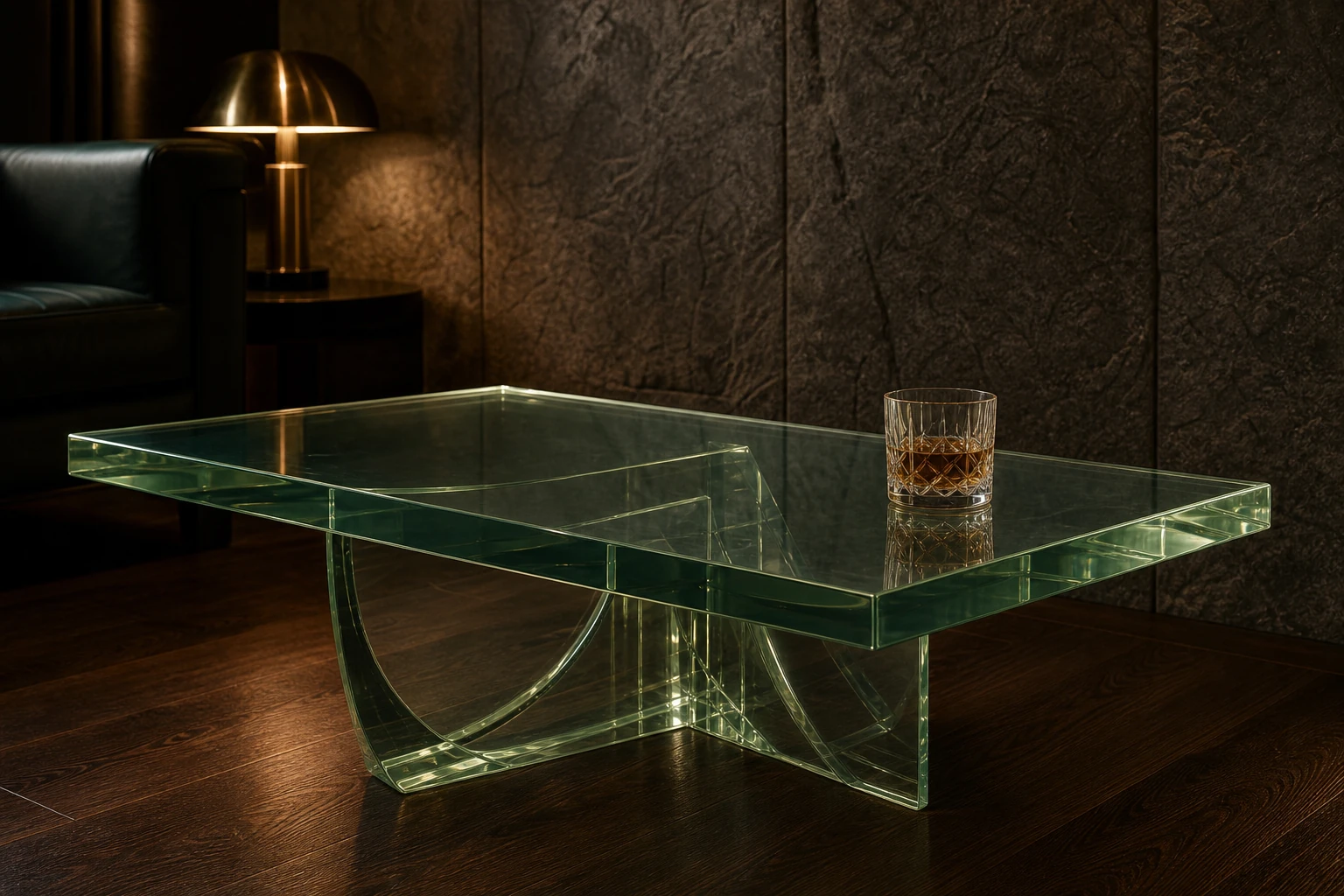
Spec. Top supported by a single sculptural acrylic pedestal — typically 25–30cm wide tapered, twin-column, hourglass, or asymmetric. The pedestal is CNC-cut from a thick cast block (30mm+ at the base, tapered to 22mm at the top contact) and bonded to the top with optical-clear adhesive for an invisible joint. Works under round, square, or oval tops.

Typical pairing & order shape. Minimizes visible structure so the seating and merchandise carry the visual weight. Common in boutique hotel suites, lobby lounge seating zones, and gallery rest-areas. Custom pedestal forms (twin-column, hourglass) are quoted per design and add 25–35% over the standard tapered cylinder.

Who Uses Acrylic Coffee Tables?

Coffee-table buyers are B2B hospitality: boutique hotel groups, luxury retail flagships, fine-dining lounges, corporate HQ lobbies, galleries and members' clubs, and interior designers managing multi-site rollouts. MOQ is 10 pieces per design; coordinated coffee + side + chairs orders share setup on one production batch.

Clear cast acrylic coffee table with nesting side tables in a boutique hotel lobby

Boutique Hotels & Resorts

Lobby lounge coffee tables, club-floor lounges, suite seating zones. Multi-property rollouts of 12–60 pieces with batch color matching enforced across production runs. Coordinated coffee + side tables + chairs on one PO is standard.

Clear cast acrylic side tables and accent cube in a luxury retail showroom seating zone

Luxury Retail & Showrooms

Centerpiece coffee tables in flagship-store seating areas. The clear acrylic reads visually quiet so merchandise and seating lead. Single statement pieces or sets of 2–4 across multiple zones.

Clear cast acrylic table set for service in a fine-dining restaurant private dining room

Fine-Dining & Restaurant Lounges

Lounge-bar coffee tables, private-room ante-tables, chef's-table waiting areas. Edge durability and cleanability under daily handling. Consistent batch color across restaurant-chain rollouts.

Clear cast acrylic coffee table and console in a corporate HQ lobby reception

Corporate HQs & Office Lobbies

Reception seating coffee tables paired with sofas, executive-floor lounge centerpieces. Brand-color Pantone tint + subsurface laser-engraved corporate mark is the standard ask.

Clear cast acrylic pedestal and display platform in a contemporary gallery exhibition space

Galleries, Museums & Members' Clubs

Library reading tables, gallery lounge seating, private club coffee tables. Bronze or smoke tint typical to read intentional against heavier wood-and-leather interiors. UV-filtering upgrade available.

Coordinated set of clear cast acrylic furniture — coffee, side, accent chair — in a designer styled living zone

Interior Designers (Multi-Site)

Designers managing residential or hospitality coffee-table rollouts across 6+ properties. Coordinated multi-piece sets on one PO with shared setup; batch tint match across all sites.

Acrylic Coffee Tables We've Built

Representative coffee-table projects from the past 18 months — boutique hotel groups, private members' clubs, luxury retail flagships, and corporate HQs. Multi-property rollouts with batch color match enforced as a documented QC checkpoint.

Boutique Hotel Group — 12-Piece Rectangular Coffee Table Rollout. 12 pieces across 6 properties · 25mm clear cast PMMA · 1.2m × 0.6m rectangular · 45° chamfered diamond-polished edge · single sculptural pedestal · subsurface laser-engraved property mark on the top · 6-property batch color match documented at QC

Boutique Hotel Group — 12-Piece Rectangular Coffee Table Rollout

12 pieces across 6 properties · 25mm clear cast PMMA · 1.2m × 0.6m rectangular · 45° chamfered diamond-polished edge · single sculptural pedestal · subsurface laser-engraved property mark on the top · 6-property batch color match documented at QC

Boutique hotel group, US · Delivered in 32 days (air-first 2 pieces for soft-launch property)

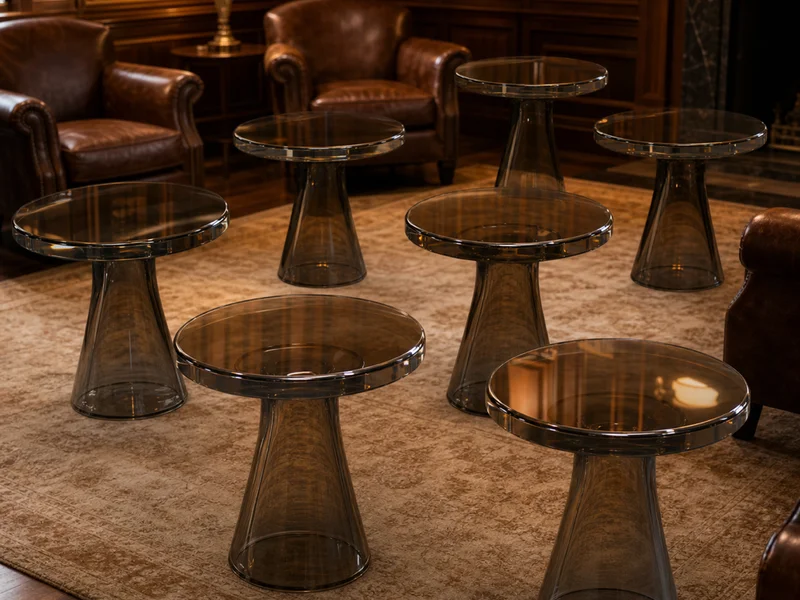
Private Members' Club — Round Pedestal Library Tables. 8 pieces · 25mm smoke-tinted cast PMMA · 80cm Ø round · bull-nose diamond-polished edge · single sculptural acrylic pedestal tapered 20% · subsurface engraved club mark · custom Pantone match validated at sample with color chip

Private Members' Club — Round Pedestal Library Tables

8 pieces · 25mm smoke-tinted cast PMMA · 80cm Ø round · bull-nose diamond-polished edge · single sculptural acrylic pedestal tapered 20% · subsurface engraved club mark · custom Pantone match validated at sample with color chip

Private members' club, London · Delivered in 32 days · Coordinated with matching drink tables on one PO

Luxury Retail Flagship — Waterfall Continuous-Wrap Centerpiece. 1 centerpiece + 4 satellite lounge tables · 30mm clear cast PMMA waterfall slab on centerpiece · 4-leg satellite design with chamfered edge · diamond polish across all 5 pieces · clear-with-bronze-accent gradient · single-piece CNC on the waterfall centerpiece

Luxury Retail Flagship — Waterfall Continuous-Wrap Centerpiece

1 centerpiece + 4 satellite lounge tables · 30mm clear cast PMMA waterfall slab on centerpiece · 4-leg satellite design with chamfered edge · diamond polish across all 5 pieces · clear-with-bronze-accent gradient · single-piece CNC on the waterfall centerpiece

Luxury flagship showroom, North America · Delivered in 38 days (air-first centerpiece for soft-launch)

Corporate HQ Lobby — Oval Trestle Coffee Tables. 4 pieces · 30mm bronze-tinted cast PMMA · 1.2m × 0.7m oval boat-shape · two-leg trestle base · bevelled diamond-polished edge · subsurface laser-engraved corporate mark · Pantone-matched bronze tint validated at sample

Corporate HQ Lobby — Oval Trestle Coffee Tables

4 pieces · 30mm bronze-tinted cast PMMA · 1.2m × 0.7m oval boat-shape · two-leg trestle base · bevelled diamond-polished edge · subsurface laser-engraved corporate mark · Pantone-matched bronze tint validated at sample

Tech HQ, US · Delivered in 26 days · Coordinated with matching console table and side tables on one PO

We refit our lounge twice with six coffee tables each cycle and the new tables match the originals to the millimetre. The chamfered edge still catches the light the same way after eighteen months of daily wear — no fogging on the diamond polish, no visible deflection at the centerline.

— Operations Director, Private Members' Club (London)

Have a similar coffee-table project?

Start a Similar Project

What Affects Acrylic Coffee Table Pricing

Coffee-table quotes are built up from five factors: top thickness (sized to span and load), edge profile, color and tint, branding and logo integration, and order quantity (plus coordinated bundling). If you only need a rough quote before final artwork to size a budget, send the spec — we come back inside 24 hours with a per-piece range.

Top Thickness (25 / 30 / 40mm)

Cast PMMA is sold by weight. 25mm is the working minimum at 1.2m × 0.6m and the baseline. 30mm adds roughly 30% in material cost and is the spec for 1.4m spans or heavier centerpieces. 40mm reads as substantial visual weight and is reserved for waterfall continuous-wrap and signature statement pieces — adds roughly 60%+ over 25mm. We don't quote thicker than the engineering requires; over-spec'ing thickness is a waste of your budget that we'll flag on the first quote.

Edge Profile (Chamfered → Waterfall)

45° chamfered diamond-polish is the baseline; the unit cost we quote starts here. Bevelled (shallower 22–30°) adds modest machining time, roughly 5%. Bull-nose roundover adds about 10% because the polishing pass takes longer. Square diamond-polished is the same cost as chamfered. Waterfall continuous-wrap is the largest single adder — roughly 50% — because the bend is single-piece CNC from a thick cast block and the polished edge runs continuously along the fold.

Color, Tint & Custom Pantone Match

Clear cast PMMA is the lowest-cost finish. Whole-body tints (smoke, bronze, pearlescent) add 15–25% to material cost — the tinted sheet stock is more expensive than clear cast. Custom Pantone match adds another 5–10% over standard tints and one extra sample iteration with a color-chip validation step against your Pantone reference under daylight and your room lighting. For multi-property rollouts, the documented color-chip is filed for reorder matching in subsequent years.

Branding & Logo Integration

Subsurface laser engraving on the top is the cleanest brand integration on a coffee table — frosted-white permanent mark, no surface wear, scales per piece. UV-print on a hidden underside is the alternative when the visible top must stay unmarked. Whole-piece custom-cut logos (brand silhouette routed into a pedestal or base) are bespoke and quoted per design. Placement is your call at sample; we provide a vector mockup so position is signed off before bulk.

Quantity & Production Scale

Per-piece cost drops 18–25% between the 10-piece MOQ and a 30-piece run as setup amortizes across the batch. Multi-property hospitality rollouts of 24–60 pieces are the typical commercial order shape. Coordinated coffee + side + chair orders on one PO save another 5–8% in setup and packaging — the casting batch, polishing line, and crating design are shared across the SKUs. The biggest single lever on a multi-property rollout isn't negotiating the coffee-table unit price; it's bundling the furniture types on one PO.

Coffee Table Price-Modifier Matrix — Indicative Add-Ons

Use this as a rough scoping reference before you send the full brief. Final per-piece pricing depends on quantity, edge profile, fabric grade, and coordination shape — we confirm the exact numbers on the detailed quote inside 24 hours of your message.

Spec Variable Baseline (lowest-cost) Step-Up Option Indicative Cost Impact vs Baseline
Top thickness25mm cast PMMA (1.2m × 0.6m working min)30mm cast PMMA (1.4m spans / heavier centerpieces)+~30% (more material per top)
Top thickness — signature30mm cast PMMA40mm cast PMMA (waterfall + statement pieces)+~60% over 25mm baseline
Edge profile45° chamfered diamond-polishBevelled diamond-polish+~5% (modest extra machining)
Edge profile — softer45° chamferedBull-nose rounded+~10% (longer polishing pass)
Edge profile — architecturalFlat-top pedestal designWaterfall continuous-wrap+~50% (single-piece CNC from thick block)
ColorClear cast PMMAWhole-body tint (smoke / bronze / pearlescent)+~15–25% (tinted dye lot, color-chip validation)
Custom Pantone matchStandard tintBrand-color Pantone match+~5–10% on top of tint (one extra sample iteration)
Base architectureSingle pedestal (standard tapered cylinder)Sculptural floating (twin-column, hourglass)+~25–35% (bespoke CNC program per design)
BrandingNo logoSubsurface laser-engraved logo on the topModest add per piece, scales with piece count
Branding — full colorSubsurface engraved logoUV print on hidden undersideSimilar order of magnitude to subsurface engraving
Quantity10 pieces (MOQ)30 pieces (multi-property rollout)Per-piece cost drops 18–25% across this range
Coordinated orderCoffee-table-only POCoffee + side + chair on one POSaves 5–8% on the coffee-table line vs separate POs

Indicative ranges, not a price list. Multi-property rollouts and coordinated coffee + side + chair orders are quoted per program; we structure the quote to highlight the bundle saving against the per-SKU baseline.

For broader furniture pricing context, see the acrylic furniture hub. For load-engineering reference and the cast-vs-extruded acrylic argument, see the thickness engineering guide and the cast vs extruded acrylic explainer.

Get a Detailed Quote we respond within 24 hours

How to Order Custom Acrylic Coffee Tables

From your first message to delivered coffee tables — three steps, anchored on the sample approval gate.

1

Send Your Brief — Shape, Span, Edge, Tint, Base

Tell us the shape (rectangular, round, square, oval, waterfall, pedestal-base), dimensions, top thickness preference (or let us spec it to your span and load), edge profile, base type, color tint, branding, coordinated side-table or chair pieces, and quantity per SKU. Reference photos of an inspiration table or the sofa height the coffee table has to pair with both help us tighten the quote. If you only need a rough quote before final artwork, send the spec without the full brief — we'll come back inside 24 hours with a per-piece range so you can size the budget before committing.

We respond within 24 hours
2

Approve a Sample — Color-Chip + Thickness Validation

We CNC-cut and edge-polish a full-spec production sample to your dimensions, edge profile, color tint, and logo placement. The sample is the same cast PMMA gauge, the same edge finish, and the same color batch as bulk. You photograph it under your room lighting, do a color-chip validation against your Pantone reference, sit beside it at the planned sofa height to confirm the proportion, and sign off in writing. Sample cost is credited to first order; the approved sample is the QC reference for the production run.

Sample ready in 7–10 days
3

Bulk Production with Batch Color Match Enforced

Every coffee table passes 100% inspection — edge polish uniformity, surface clarity, color match against the approved sample, dimensional tolerance, logo placement. Batch color match across the production run is documented as a QC checkpoint, so coffee tables across a multi-property rollout read identical. Reinforced crating for sea freight, sized per piece. Air-first batch available ahead of a fixed-date property opening (typically 2 pieces air, 8 pieces sea on a 10-piece order).

Production 20–28 days for 10 pieces; 35–45 days for 24–48 pieces

Frequently Asked Questions

How thick does an acrylic coffee table top need to be at a 1.2m × 0.6m span?

25mm cast PMMA is our working minimum for a 1.2m × 0.6m rectangular top. That figure comes from cast acrylic mechanics — a 1.2m span carrying typical centerpiece-plus-occasional-book-stack loads stays optically flat at 25mm; the same span at 20mm starts to read as a soft sag along the centerline that catches reflections, which is the failure mode you cannot un-see once it has shown up in a hospitality lobby. Longer spans (1.4m+) or heavier centerpieces step the spec up to 30mm. We don't quote thicker than the engineering requires, and we don't substitute extruded acrylic to hit a price point. Project-specific load and deflection data is documented on the sample sign-off sheet you keep on file.

Five edge profiles — chamfered, bevelled, bull-nose, square, waterfall — which one is the working default?

45° chamfered diamond-polished is our most-ordered edge for hospitality coffee tables, and it has been for years. The angled facet catches directional light from above without the hard glare a square edge throws, and it makes a 25–30mm top read visually thinner than it actually is — which is the design intent on almost every lobby brief that lands with us. Bevelled (a shallower 22–30° cut) reads even more refined and is the spec for members' clubs and luxury retail flagships. Bull-nose rounded softens the corner profile and is the common pick for lounge contexts where guests routinely touch the edge. Square diamond-polished is the modernist line — clean, perpendicular, no facet. Waterfall continuous-wrap is the architectural look — the top folds down into a leg as one continuous slab, no visible joint at the corner. The cross-section diagram further down shows all five side-by-side.

Can the color match a brand Pantone through the body of the acrylic, not as surface paint?

Yes — whole-body tints in cast PMMA carry the color uniformly through the thickness of the material, top-to-bottom. The tint is cast into the sheet, not applied after; you can edge-polish a tinted top and the color reads identical on the polished edge as on the surface. Standard whole-body tints include clear, smoke (grey), bronze (warm amber), and pearlescent (milky translucent). Custom Pantone match is a one-extra-sample-iteration step with a color-chip validation against your Pantone reference under daylight and under your room lighting. For multi-property rollouts, batch color match across the full production run is enforced as a documented QC checkpoint — every coffee table ships from the same dye lot or color-corrected production batch, so the table in property #1 reads identical to the table in property #12.

What base architectures work for a coffee table — single pedestal, trestle, 4-leg, sculptural, waterfall?

Five base architectures cover almost every coffee-table design we ship. (1) Single pedestal — one solid acrylic column rising to the top, the most-ordered base for round and oval geometries because it gives the table a sculptural floor presence without leg collision. (2) Two-leg trestle — parallel acrylic slabs at each end of the top, the modern-architectural look, common under rectangular and oval tops. (3) 4-leg cube — acrylic legs at each corner, the lightest visual footprint, common under square and rectangular tops in members' clubs where the seating itself is the visual statement. (4) Sculptural floating — a more elaborate single-base form (twin-column, hourglass, asymmetric) designed as part of the visual statement. (5) Integral waterfall — no separate base; the top wraps down to the floor as one continuous slab, single-piece CNC from a thick cast block. All bonded with optical-clear adhesive for an invisible joint at the top, except waterfall which has no joint at all.

What's the height coordination between coffee table and sofa seat?

Coffee tables work in a 38–45cm height band. A 38cm coffee table pairs with a deep lounge seat at 38–40cm — the surface sits just at or slightly below the seat front edge, which is the proportion most boutique-hotel lobbies and members' clubs spec. A 42–45cm coffee table pairs with a more upright dining-adjacent or hotel-lobby seat at 42–45cm; this is closer to the European hospitality default. Below 38cm reads as too low for a hotel lobby (guests have to reach down for a drink); above 45cm starts to crowd the seated guest's lap. We confirm the exact height against your sofa or armchair seat spec on the brief — send the seat height with the coffee-table dimensions and we'll match the proportion.

What's the MOQ, lead time, and rough quote before I send a final brief?

MOQ is 10 pieces per design. Sample 7–10 days; production 20–28 days for 10 pieces; sea freight 25–40 days; air freight 5–8 days for a small batch. For a rough quote before final artwork, send the shape (rectangular / round / square / oval / waterfall / pedestal-base), dimensions, top thickness preference (or let us spec it to your span), edge profile, base type, color tint, branding, and quantity per SKU. We respond within 24 hours with a per-piece range. A common pattern for boutique-hotel pre-opening: we sample, you approve, we air-first 2 pieces ahead of the property launch and the remaining 8 ship sea — first pieces on site in ~30 days, full set in ~50. We re-quote the air premium against the unit cost.

Can the coffee table ship coordinated with side tables or chairs in the same tint on one PO?

Yes — coordinated chair + table + side table sets on one PO is one of our most common order shapes for hospitality and members'-club rollouts. We match edge profile, color tint, and logo treatment across the coffee table, the side tables, the console, and the chairs on a single purchase order. Batch QC enforces color consistency between SKUs — the bronze tint on a 1.2m coffee table has to read identical to the bronze tint on a 30cm drink-table beside the same sofa under the same property lighting. Coordinated multi-piece orders typically save 5–8% in setup and packaging compared to separate POs because the casting, polishing line, and crating design are shared. If a rollout spec calls for a clear-with-bronze-accent suite across 18 properties, that's a single production run for us — not 18 separate jobs.

Can you laser-engrave a brand logo into the coffee table without it being a surface mark that can wear?

Yes — subsurface laser engraving. The mark is created inside the body of the acrylic, not on the top surface, so it cannot be worn down by daily cleaning or surface contact. The result is a frosted-white logo visible from above through the clear (or tinted) acrylic body. Placement is your call — centered on the top, offset in a corner, or on the hidden underside if you want the visible top to stay unmarked. Subsurface engraving is the most-ordered branding integration for members' club library tables, boutique-hotel lobby tables, and corporate HQ pieces. UV print on the hidden underside is the alternative when you want a full-color logo that reads only from a specific angle. We supply a vector mockup at sample stage so you confirm position before bulk.

Designing a Hotel Lobby, Lounge, or Members'-Club Coffee Table Program? Let's Quote It.

Tell us the shape, dimensions, edge profile, base type, color tint, branding, and quantity per SKU. Coordinated coffee + side + chair orders on one PO get 5–8% bundle savings. We respond within 24 hours. MOQ 10 pieces per design; sample 7–10 days; production 20–28 days for 10 pieces.