


Case Study · Video-Game Retail · France
420 Game and Console Display Cases — and the Vent Design That Lets a Running PS5 Breathe
A French video-game retail chain came back for its second order: 420 acrylic display pieces across four SKUs, anchored by a new PS5 console enclosure.
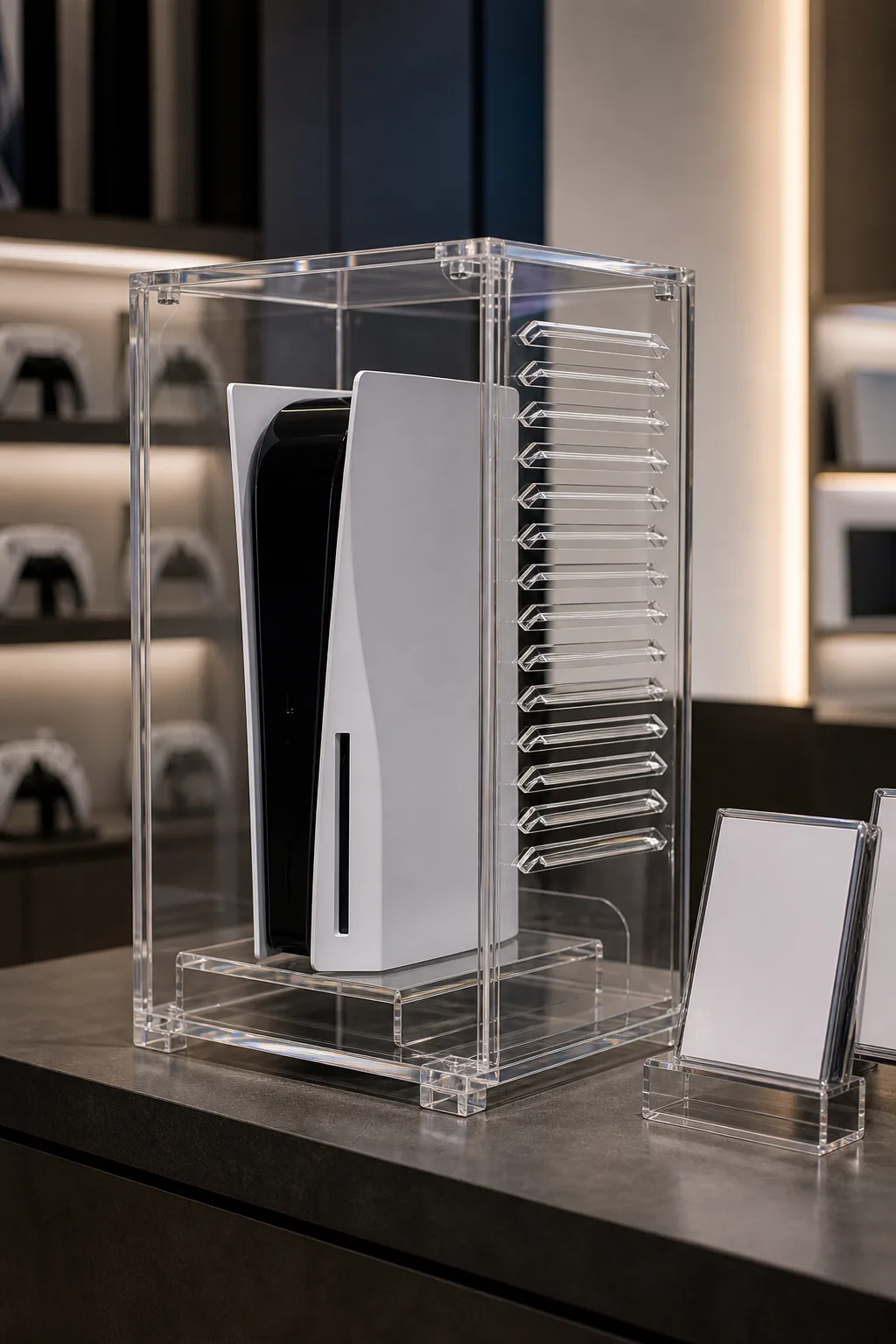
That enclosure had to do two contradictory things — shield a powered PS5 demo unit from shop dust while letting it exhaust its own heat. Downward-angled louvers, a raised-plinth intake, and a full-width rear cutout resolved the conflict; the three repeat SKUs skipped sampling entirely and cut straight from files retained after the first order. The run shipped in 16 production days with zero rejects, and the enclosure is now part of the chain's standard store kit.
- pieces shipped
- 420
- display SKUs
- 4
- re-samples on repeat SKUs
- 0
- production time
- 16 days
Key Takeaways
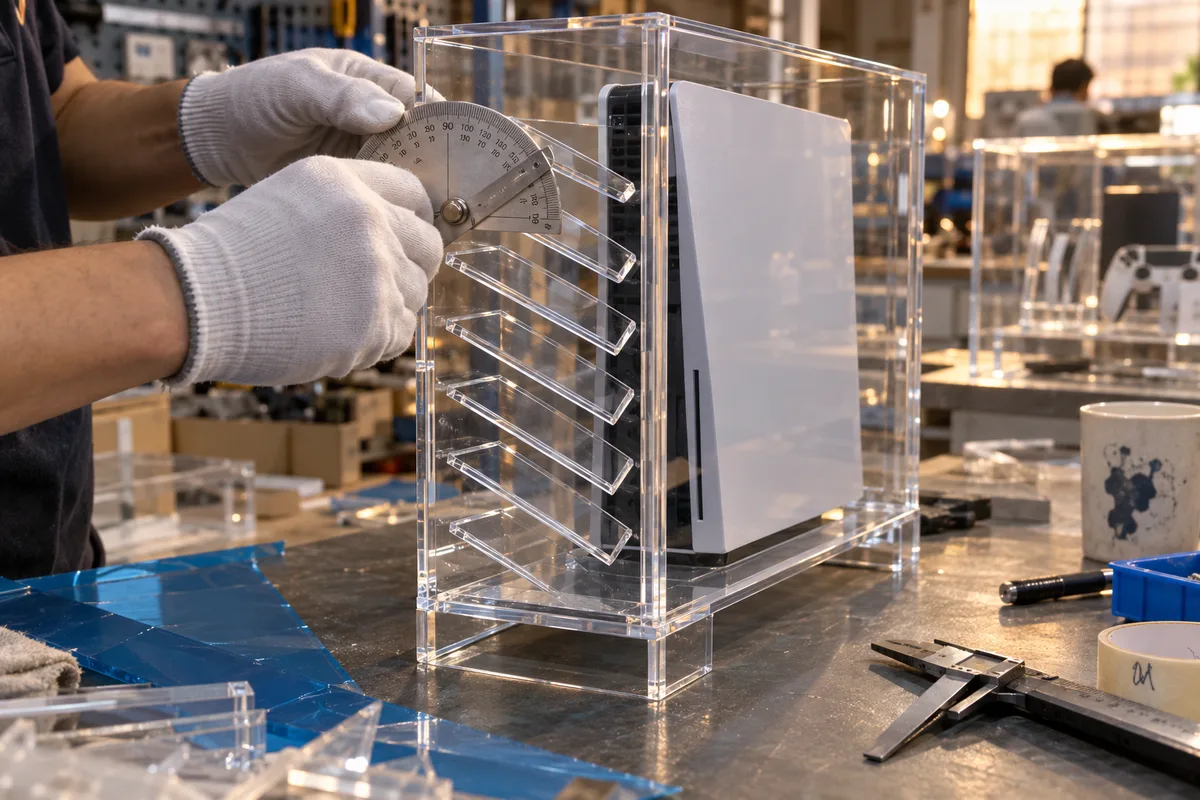
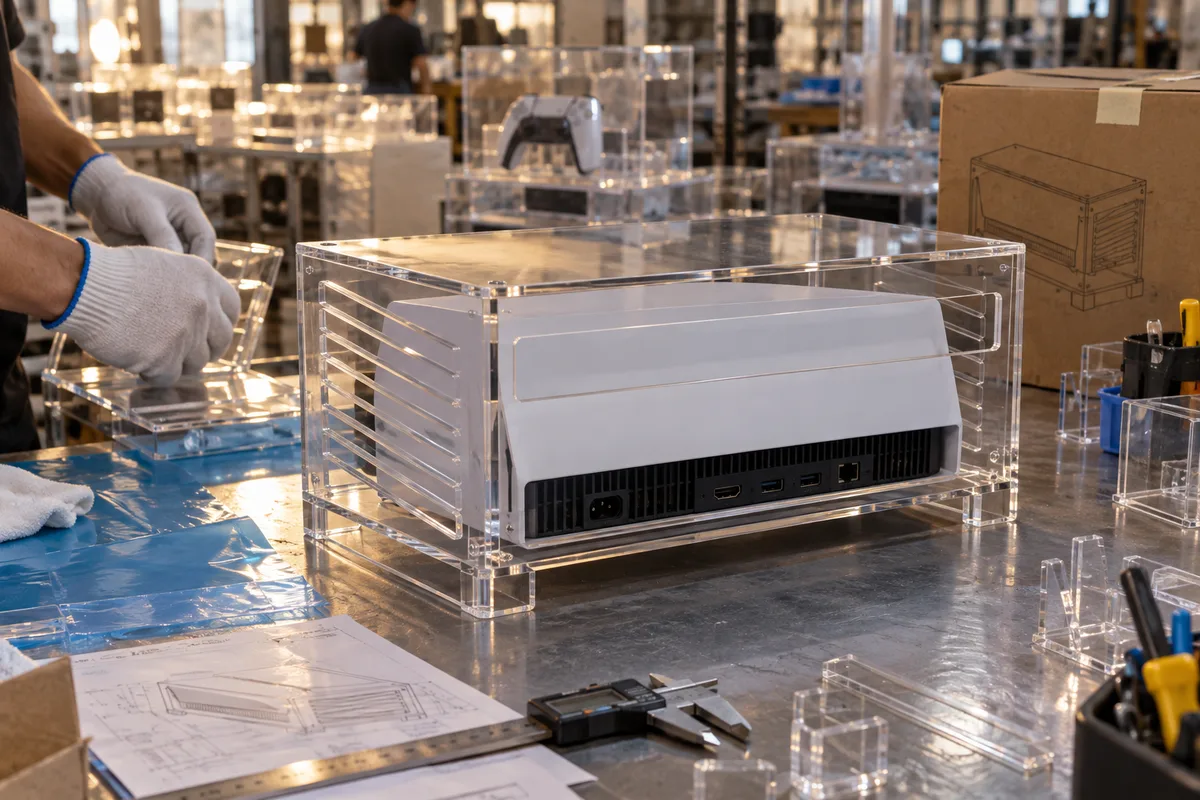
- A sealed acrylic box over a powered PS5 traps its own exhaust; an open shelf coats the intake grilles in shop dust. The enclosure resolves the conflict with geometry: raised-plinth intake, downward-angled side louvers, full-width rear exhaust cutout, closed top.
- The louvers angle down at 45 degrees, so there is no straight line of sight — or dust path — into the case; airborne dust settles on the outer louver face instead of on the console.
- Three of the four SKUs were repeats from the chain's first order and went straight to production from cutting files on record — no samples, no re-approval, no sampling fee.
- Only the new console enclosure was sampled: 5 days to a sample the client tested with their own powered demo unit before releasing the 420-piece run.
- The full order — 100 enclosures, 120 game stands, 100 counter tiers, 100 lockable cases — shipped from a 16-day production run with zero rejects at pre-shipment inspection.
The Challenge
Every game shop demo station fights the same physics: the console needs airflow, the display case wants to be a sealed box. A PS5 is, among other things, a vacuum cleaner: its fans pull shop air — and everything floating in it — through the machine for eight retail hours a day. The chain's demo units sat on open shelves, and within a few months each one wore a gray film of dust, fingerprints from curious customers, and the occasional sticky handprint at child height. The units looked worse than the sealed stock the store was trying to sell.
The obvious fix made things worse. A staff member had covered one demo unit with a plain acrylic box, and the console cooked inside it — a sealed enclosure traps the machine's own exhaust and recirculates it into the intakes. So the chain faced a genuine conflict: open shelving protects the console's airflow and surrenders it to dust and handling; a closed case protects the surface and starves the cooling. The buying team already knew our work — their first order, placed earlier in the year, covered sealed-game stands, counter tiers, and lockable cases for their store counters — and the reorder request arrived with one new line on it: a console enclosure that resolves the contradiction, plus more of everything they already had. They also made a process point clear: they did not want to pay for sampling, or wait for it, on SKUs we had already built once.
Our Approach
The order split naturally into two problems. One was airflow geometry — designing an enclosure that breathes without gaping. The other was process — proving that a repeat order should be faster and cheaper than a first order, not a rerun of it.
An enclosure that breathes without gaping
A modern console dictates the airflow plan: it pulls air in along its front and sides and exhausts out the back. The enclosure follows that path instead of blocking it. The console sits on a raised plinth with an open gap at the front base, which feeds cool floor-level air under and up to the intakes. Both side panels carry banks of louvered slots angled downward at 45 degrees — open to airflow, closed to line of sight, so airborne dust settles on the outer face of each louver rather than drifting into the case. The rear panel has a full-width cutout that lets exhaust heat and cables leave together. The top and front — the surfaces where dust lands and fingers reach — stay completely closed. The whole enclosure runs 5 mm acrylic, because a console is a heavy object and a thin-walled box around one flexes; the interior clears the PS5's roughly 390 × 104 × 260 mm body with breathing room on every face rather than hugging it.
We do not run thermal labs, and we did not pretend to. What we did was ship the sample enclosure in 5 days and let the client run the real test: their own demo unit, powered, looping store demos inside the sample case on a live shop counter. They reported no thermal warnings across the trial and released the production run on that evidence — their machine, their shop floor, their call.
Four SKUs, one counter system
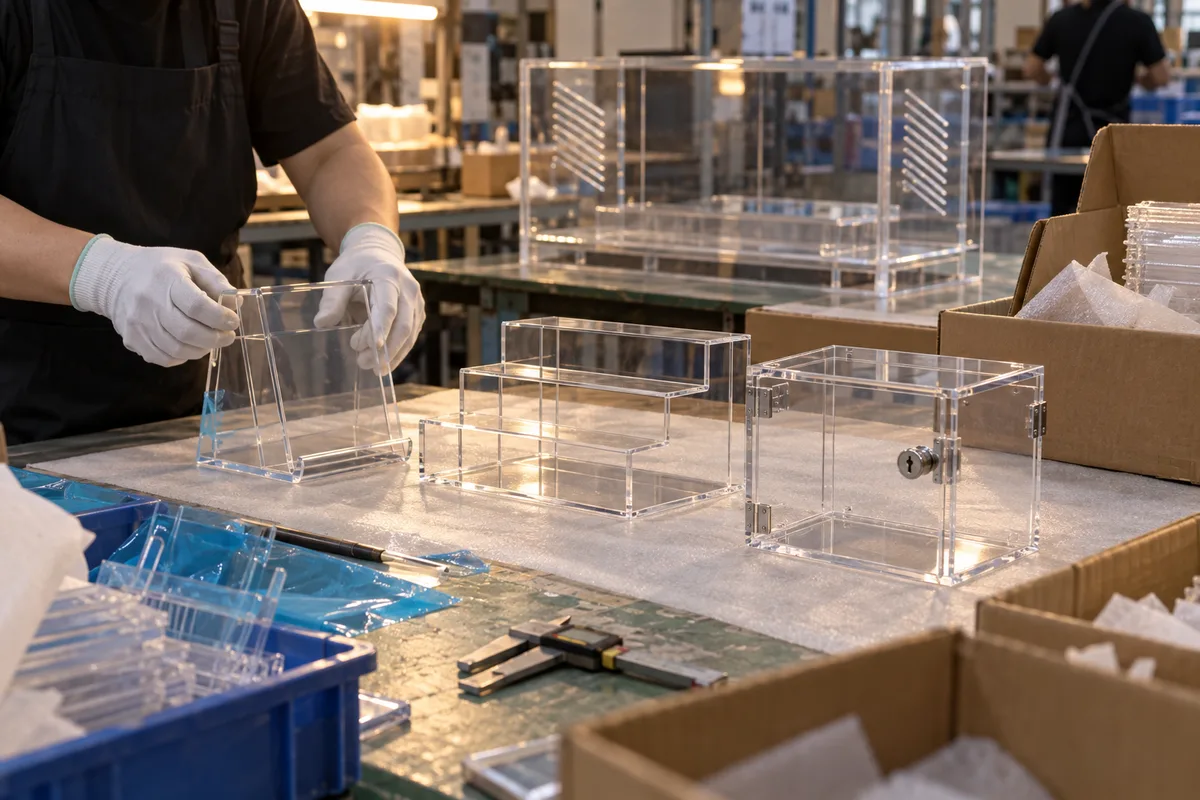
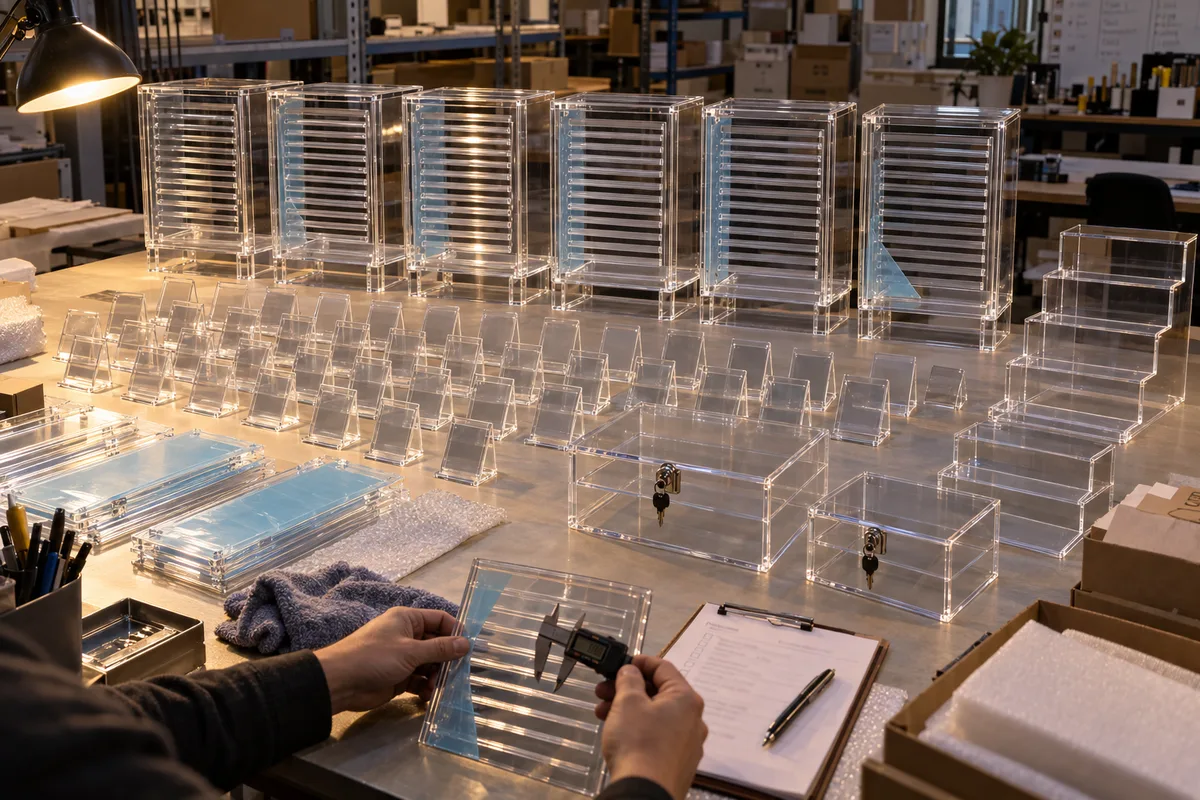
The reorder kept the chain's existing display language and added the enclosure to it. Thesingle-game stand (3 mm, angled back so a sealed box face reads under shop light) handles featured releases at the register. The five-game counter tier steps a row of boxed games so every spine and cover is visible at once. The lockable collector case— 5 mm walls, flush barrel lock — holds graded and collector's-edition stock that stays behind acrylic until a customer is serious. And the new console enclosure anchors the demo station. The mix ran 100 enclosures, 120 stands, 100 tiers, and 100 lockable cases — 420 pieces formatted per store set. The format logic behind these choices is on ourvideo game display cases page, and the broader family of counter and collector formats is covered underacrylic display cases.
The repeat half went straight to production
Because this was a second order, three of the four SKUs already existed in our files: cutting geometry, slot dimensions, polish and packing specs, all retained from the first run under the chain's account. Those three SKUs started cutting on day one — no new samples, no re-approval round, no sampling fee. Only the console enclosure, as a genuinely new design, went through the sample step. That is the entire economics of therepeat-order tooling library: the first order pays for the engineering; every order after it buys only production. The client paid the standard 30% deposit, the run finished in 16 days after the enclosure sample was approved, and the balance was settled before shipment — a shorter deposit-to-ship cycle than their first order, on a larger piece count.
| SKU | Thickness | Qty | Sampling status |
|---|---|---|---|
| Console enclosure (new) | 5 mm | 100 | 5-day sample, client-validated with a powered demo unit |
| Single-game stand (repeat) | 3 mm | 120 | No sampling — cut from files on record |
| Five-game counter tier (repeat) | 3 mm | 100 | No sampling — cut from files on record |
| Lockable collector case (repeat) | 5 mm | 100 | No sampling — cut from files on record |
The Results
All 420 pieces shipped from a 16-day production run, passed 100% pre-shipment inspection against the approved samples and retained specs, and reached the chain's distribution point as store-ready sets.
The number worth dwelling on is the zero in the sampling column. On a first order, sampling is non-negotiable — it is how a buyer four time zones away verifies fit and finish before committing to volume. But re-sampling an unchanged design on a reorder is paying twice for the same answer. Three of the four SKUs — 320 of the 420 pieces — moved on day one because the files existed, and the calendar the client saved went to the one SKU that deserved scrutiny: the new enclosure, validated not by our claims but by their own console running on their own counter.
The enclosure itself earned a longer life than the order. The chain has added it to the standard kit that outfits each store's demo station, which means future orders call it off the same cutting files the way this order called off the game stands — a new SKU on this PO, a repeat SKU on the next.
"The three SKUs we reordered went straight into production — nothing to re-approve, no sample fees — and the demo unit has run inside the new enclosure since spring without a single thermal warning."
What This Means for Your Project
If your display has to house something that generates heat — a console, a projector, a powered collectible, an LED-heavy fixture — the question to put to any fabricator is where does the air come in, and where does it leave? A case that ignores the airflow path is a heat box with good optics. The geometry that fixes it (low intake, angled louvers, dedicated exhaust) costs little to cut and everything to skip, and the honest way to validate it is the way this client did: run your real hardware in the sample before you release the volume.
And if you expect to order more than once, ask what happens to your files after the first run. A fabricator that retains cutting files and specs turns your second order into pure production — faster, cheaper in calendar, and identical in fit to the pieces already on your counters. A 100-piece MOQ per design means a single-location shop can start the same program this chain runs at 420 pieces a cycle.
Common Questions
Can a powered game console run inside an acrylic display case?
Yes — if the enclosure is designed around the console's airflow instead of against it. A fully sealed acrylic box over a running console traps its own exhaust and turns into a heat box. This enclosure gives the console an intake path (a raised plinth with an open gap at the front), downward-angled louver banks on both side panels aligned to the console's intake zones, and a full-width rear cutout that lets exhaust and cables leave the case. The top and front stay closed, which is where dust settles and fingers land.
Do repeat acrylic orders really skip the sampling step?
When nothing about the design has changed, yes. After a first production run we retain the cutting files, slot dimensions, and finishing specs under the client's account — what we call the tooling library. A reorder of the same SKU goes straight to production against those files, so the buyer pays no sampling round and loses no calendar to it. Anything new or revised still gets sampled: on this order, the three repeat SKUs started cutting on day one while only the new console enclosure went through a 5-day sample.
What acrylic thickness does a console enclosure need?
5 mm for the enclosure itself. A modern console is a heavy object with a large footprint, and a thin-walled enclosure around it will flex, rattle, and read as flimsy at retail. The smaller pieces in the same family don't need that gauge — the sealed-game stands and counter tiers in this order ran 3 mm, which is stable and cost-efficient for boxed games. Matching gauge to load per SKU, instead of one thickness across the set, is part of what keeps a multi-SKU order affordable.
Outfitting a game store — or reordering a design you already trust?
Tell us the consoles, game formats, and quantities per store — or reference a past order and we'll quote the rerun straight from your files, no re-sampling.
Samples in 3–5 days · Production 15–20 days · MOQ 100 pieces per design · 30% deposit, balance before shipment