



Airtight Acrylic Box: What a Dust Seal Can Do
Most boxes sold as airtight are not. Here is what a well-fitted acrylic lid actually blocks, what a gasket adds, and when a collector needs more.
Need this made?Custom acrylic boxes →
Key Takeaways
- A bonded acrylic box with an opening lid should be specified as dust-resistant, not hermetically airtight, unless a project-specific test standard says otherwise.
- Lid clearance must be named on the drawing and approved on a fit sample; no single clearance guarantees dust performance across every box size and fabrication route.
- Felt cushions a lid, while a specified gasket can reduce air exchange; the gasket profile, compression target, closure force, and test method belong in the order.
- Conservation practice defines damp as sustained humidity above 75% RH — inside any enclosure, a desiccant pouch manages moisture better than chasing a hermetic seal.
- A conservation-spec microclimate enclosure needs a conservator-defined air-exchange and material brief; a retail dust cover is not an equivalent substitute.
On this page
- The honest answer first: dust-resistant, not airtight
- Where “airtight” claims break down
- Lid fit: lip, rabbet, and the clearance that decides everything
- Gaskets: felt versus a real seal
- Bonded five-side construction: the part that really is tight
- Desiccant and humidity: manage RH, don’t chase a hermetic seal
- When a conservation specification is required
- Specifying a dust-sealed box from us
The honest answer first: dust-resistant, not airtight
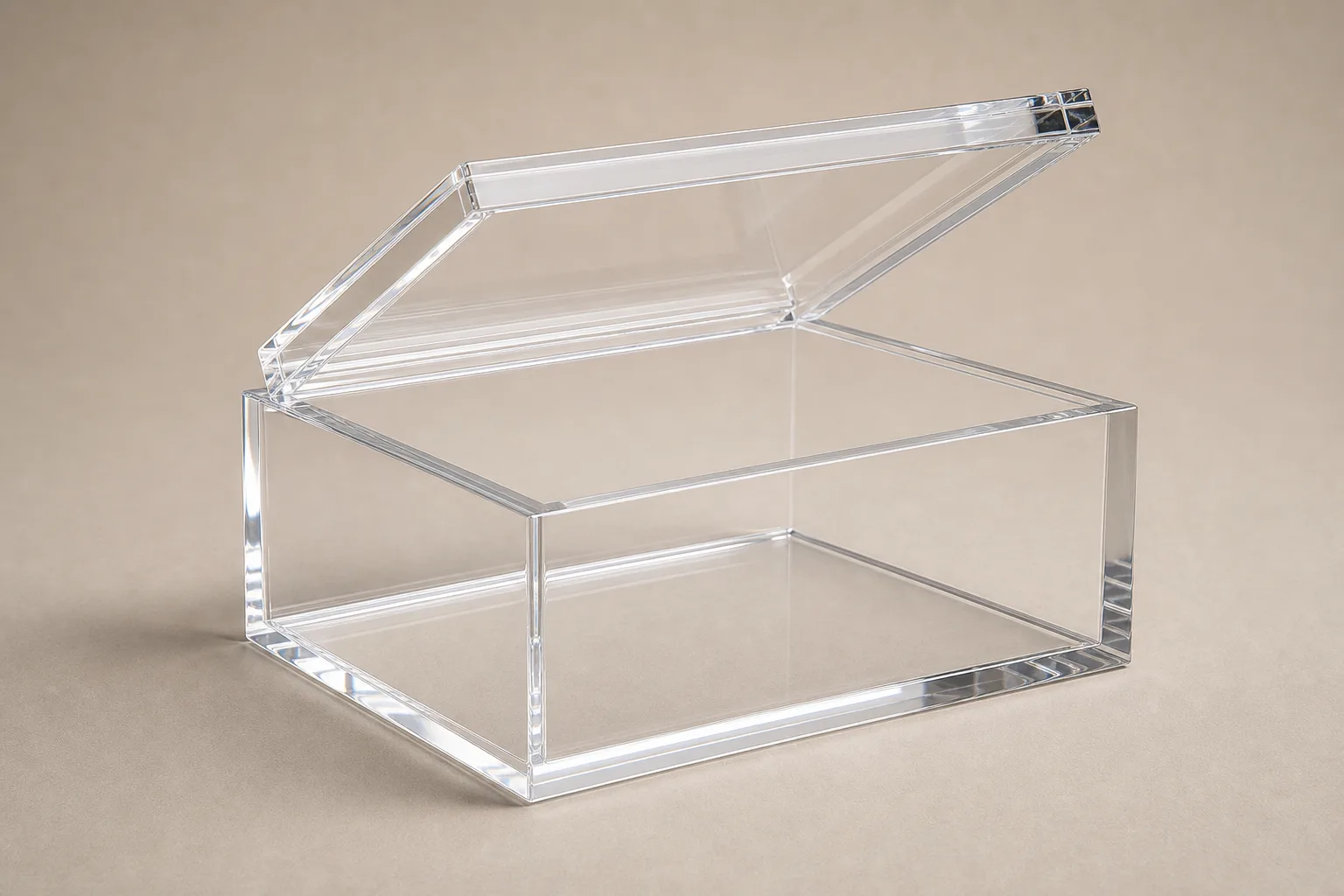
An airtight acrylic box with an opening lid should be specified as dust-resistant unless the complete enclosure passes a named airtightness test. A lid that lifts off exchanges air with the room. That distinction is the subject of this guide.
An acrylic display box can use a solvent-bonded PMMA shell with an opening lid or base. The drawing can control the nominal clearance, but the sample and agreed inspection method determine whether the fit is acceptable for the named environment.
That honesty matters more than it sounds. A buyer who believes the box is hermetic skips the desiccant, parks a humidity-sensitive collectible inside, and blames the box when the label curls. A buyer who knows the box is a dust barrier — and treats humidity as a separate job — gets exactly the protection they paid for. This guide covers the sealing mechanics: lid fits, clearances, gaskets, bonded construction, and the point where a collector genuinely needs more. Archival standards — UV transmission limits, Oddy-tested materials, conservation specs — belong to our museum display case specs guide; this page owns the physics of the gap between lid and box.
Where “airtight” claims break down
An airtight acrylic box claim must account for the lid gap, seam quality, gasket, closure force, and test method. Any opening creates a potential air path. Solvent-bonded seams are not certified gas-tight by appearance alone, and a felt liner is not an airtightness test.
Take the interfaces one at a time. A lift-off lid rides on clearance, while a hinged or sliding lid adds hardware interfaces. Seam quality varies with material, preparation, bonding, and inspection. Felt cushions, quiets, and grips; it should not be specified as an airtight gasket.
A cleaner interior after shelf use can support a dust-resistance observation, but it does not establish a hermetic rating. Humidity, odor, liquid ingress, and particle ingress require separate acceptance methods.
Lid fit: lip, rabbet, and the clearance that decides everything
Dust control in an acrylic box starts with a named clearance and lid geometry. A recessed lip — an inner frame bonded under the lid, sometimes machined as a rabbet step — creates a longer ingress path than a plain lift-off lid. The working clearance must be quoted for the actual dimensions, material, and fabrication route, then approved on a sample.
The mechanism is simple: dust settles by gravity and drifts on slow air currents, so it travels poorly around corners. A lip lid makes any particle turn twice — up over the wall, down past the lip — through a gap thinner than a business card. When my inspection team checks a lipped lid, we verify the lip engages on all four sides and that the lid seats without rocking; a lid that rocks has one corner riding high, and that corner is where the dust gets in.
Clearance is also where fabrication quality becomes visible before dust testing. On a sample, seat the lid, check engagement on every side, record any rocking or interference, and measure the gap with the inspection method written into the order. Do not substitute folded paper for a specified gauge.
| Lid / closure type | Typical working gap | Dust control | Air exchange | Best for |
|---|---|---|---|---|
| Plain lift-off lid | Quote-specific | Basic particle-ingress control | Higher | Low-cost retail display |
| Recessed lip / rabbet lid | Quote-specific | Longer particle-ingress path | Lower than plain lift-off | Collectibles, shelf display |
| Felt-lined lip lid | Quote-specific contact | Cushioning; particle result must be tested | Project-specific | Premium display, loose items |
| Silicone-gasket lid | Supplier-specified compression | Depends on closure and test | Project-specific | Dusty retail floors, humid rooms |
| Bonded 5-side + gasketed base | Supplier-specified compression | Depends on complete enclosure | Project-specific | Conservation-led specifications |
The environment and acceptance test decide whether a plain lid, recessed lip, or gasket is appropriate. The full menu of hinges, magnets, and locks is covered in acrylic box lid and closure types.
When several boxes carry standing load, lid clearance alone is not enough; the stackable acrylic boxes guide adds the shoulder, interlock and multi-unit sample checks.
Gaskets: felt versus a real seal
Felt and silicone sit at opposite ends of the sealing spectrum, though listings use them interchangeably. Felt is a liner: it cushions the lid, damps rattle, and closes the visual gap, but air moves through it freely. A silicone strip compressed in a machined channel is a seal: it closes the air path itself.
A working gasket needs a compression target taken from the named gasket supplier, a locating geometry that controls its position, and continuity around the perimeter. The drawing should also state how the closure applies force and how the assembled enclosure will be checked.
A gasket can add cost, a visible seat line, and closure force. Specify it only after naming the ingress target, gasket material, compression range, closure, and test method. Open open countertop display case formats serve a different access requirement and should not be compared as the same enclosure.
Bonded five-side construction: the part that really is tight
The bonded shell reduces the number of opening interfaces, but appearance alone does not establish gas-tight or permanent particle-tight performance. Material, joint preparation, bonding, cure, and the agreed inspection method all affect the result.
A common collector format is a bonded five-side cover over a separate base, which concentrates the opening interface at the base seat. A machined lip or a supplier-specified gasket can be quoted there, but the drawing, sample, closure force, and agreed test determine performance. Seam quality is its own inspection discipline, covered in our acrylic box joinery and seam quality guide.
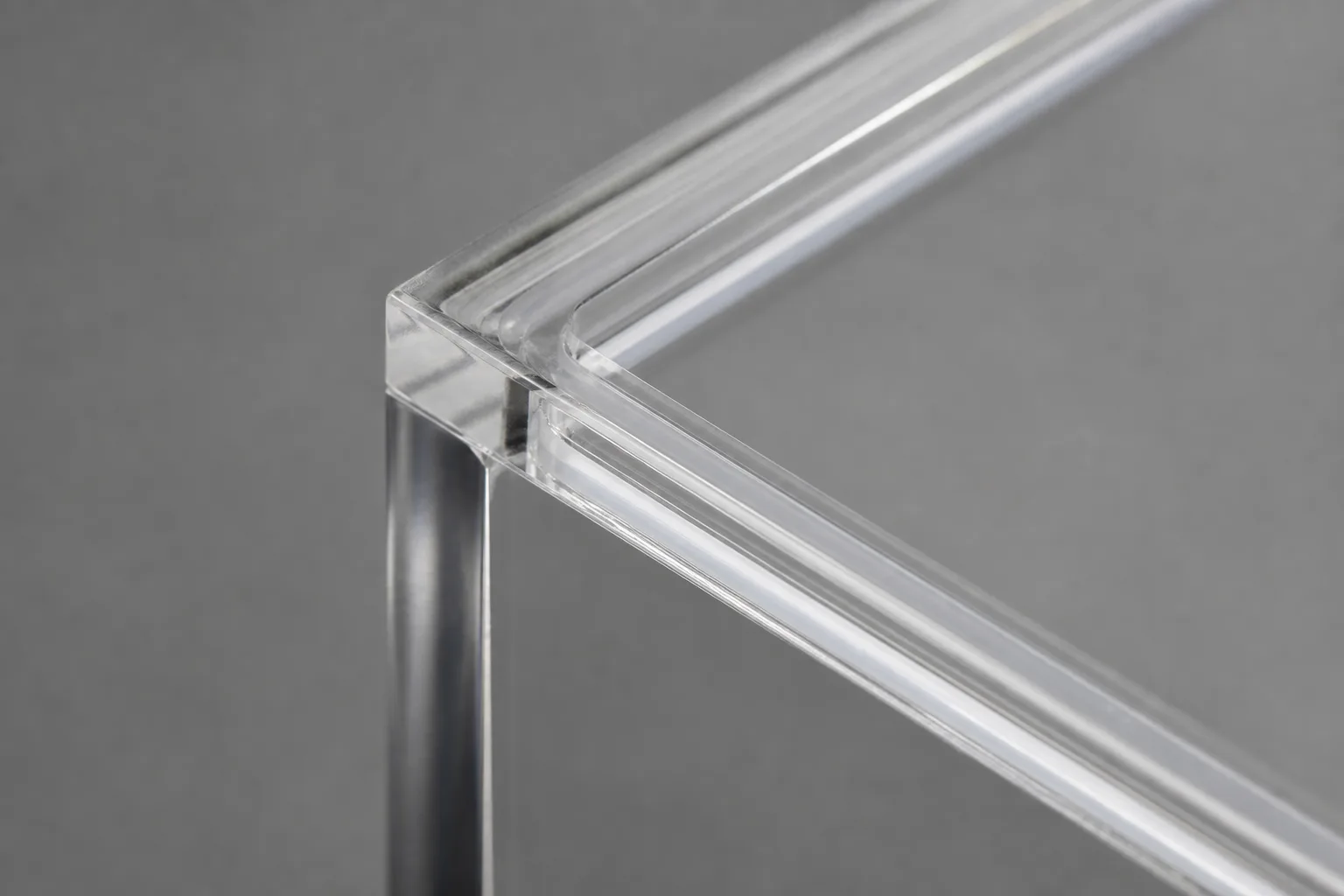
Visual inspection over a light table can reveal bubbles, contamination, or incomplete-looking bond areas, but it does not certify gas-tightness or particle performance. Record the permitted visual conditions separately from any functional ingress test.
Desiccant and humidity: manage RH, don’t chase a hermetic seal
For collectors, humidity is the risk that airtightness claims pretend to answer — and desiccant is what actually answers it. Conservation practice defines damp as sustained relative humidity above 75% RH, the band where mould and corrosion risk climbs steeply.1 Inside any enclosure, a silica gel pouch buffers moisture; the box’s fit then slows how fast the room pulls that buffer back out.
Paper-based collectibles — cards, labels, photographs, and box art — benefit from the cool, controlled storage conditions described by preservation institutions.2 Opening an enclosure exchanges interior and room air, so the project specialist should size and maintain any conditioning material against the actual enclosure and monitoring data. Follow the conditioning-material supplier’s recharge instructions.
This is also where the dust-resistant distinction matters. For humidity-sensitive contents, a conservator or product specialist should define the RH target, conditioning material, monitoring, and maintenance interval. A fitted lid may slow exchange, but it does not replace that brief. Interior gel trays or perforated recesses can be quoted through our custom acrylic boxes build path.
When a conservation specification is required
A conservation-spec microclimate case can require a gasketed enclosure, conditioning chamber, controlled air-exchange target, approved materials, monitoring, and maintenance instructions. The responsible scope must come from the project’s conservator; a retail dust cover is not a substitute.
The decision brief should record the object’s sensitivity and replaceability, display duration, opening frequency, room environment, target RH range, monitoring plan, and responsible conservator or product specialist. Those inputs determine whether a retail dust cover is enough or a conservation specification is required.
If the specification uses words such as airtight, dustproof, splash-resistant, or microclimate, replace each word with a measurable acceptance statement before quoting. Name the assembled configuration, conditioning state, test duration, instrument or challenge material, permitted result, sampling plan, and responsible reviewer. A visual fit check can remain a separate workmanship gate, but it cannot stand in for the functional test.
This page covers lids, clearances, gaskets, and bonded seams; the museum display case specs guide covers archival questions that require project-specific evidence. The coin-shop slab-display project shows how measured contents, drawings, and approved fit samples controlled a different acrylic case program; it is not proof of airtight performance.
Specifying a dust-sealed box from us
Ordering an airtight acrylic box — honestly, a dust-sealed one — comes down to naming four things: interior dimensions, lid or base style, gasket or no gasket, and what the box must keep out. Send those in one message and we quote the build with the clearance spec written down, so “well-fitted” is a number, not a promise.
Here is how the mechanics translate into an order. Give us the object’s dimensions and required working clearance; name the environment, lid or base style, gasket requirement, and acceptance test. The standard published MOQ is 100 pieces per design. Project-specific setup, tooling, gasket, testing, sample, and production timing are named in the quote. A paid sample is quoted separately and never credited to production; approve the lid seating and measured fit before production. Standard payment is 30% deposit with the balance before shipment, FOB Shenzhen.
Browse the base formats on our acrylic boxes hub or start from a clear acrylic box and add the lip, gasket, or gel tray your environment calls for — or send us your dimensions and we will spec the fit for you. We respond within 24 hours.
For a comparable RFQ, also state the opening frequency, cleaning method, monitoring responsibility, and the exact evidence the buyer will use to accept the assembled enclosure.
Footnotes
-
Agent of deterioration: incorrect relative humidity — Canadian Conservation Institute — conservation reference defining damp as sustained RH above 75%, the threshold where mould and corrosion risk climbs, supporting the desiccant-first humidity guidance. ↩
-
The Deterioration and Preservation of Paper — Library of Congress — preservation guidance noting paper stored in cool conditions at 30-40% relative humidity lasts longest, the storage band cited for paper-based collectibles. ↩
Published price point
Quote the enclosure and fit
$3 per unit at 500 pcs, FOB Shenzhen
Published lower-bound point for a 100 × 100 × 100 mm box in 3 mm clear acrylic with a magnetic lid. It is not an airtight or gasketed-box quote.
Paid samples are quoted separately and are never credited to production.
Thank you!
We've received your inquiry. Our team will reply within 24 hours — usually faster.
Frequently Asked Questions
Are acrylic display boxes actually airtight?
Do not treat an opening acrylic box as airtight without a named test standard and a passing result. A fitted lip can reduce settling dust, and a specified gasket can reduce air exchange, but performance depends on the complete enclosure and closure.
What is the difference between dustproof and airtight?
Dust resistance concerns particle ingress; airtightness concerns measured air exchange. A lip lid can slow settling dust, while an airtight claim requires a complete enclosure design, a defined test method, and a passing result.
Do I need a gasket on an acrylic display case?
Only if the case faces liquid splash, heavy airborne dust, or a humidity-managed interior. A silicone gasket in a machined channel adds real sealing but also cost and a visible line. For a shelf display in a home or shop, a recessed lip lid blocks dust without any gasket.
How do I control humidity inside a display box?
With desiccant, not with the box. Conservation guidance flags sustained humidity above 75% RH as the damp threshold where mould and corrosion risk climbs. A silica gel pouch inside the case buffers moisture; recharge or replace it periodically. Chasing a hermetic seal instead of managing RH is fixing the wrong layer.
What is your minimum order for dustproof display cases?
The standard published MOQ is 100 pieces per design; the quote names any project-specific setup, tooling, gasket, and test costs. Approve the lid fit and acceptance method on a paid sample that is quoted separately and never credited to production. If the box is gift packaging rather than a dust enclosure, compare the [acrylic and cardboard gift-box tradeoffs](/guide/acrylic-vs-cardboard-gift-box-buyer-guide/) before approving the rigid format.
Specify the enclosure and seal target
Send the internal dimensions, lid or base style, environment, gasket requirement, quantity, and the test or inspection method the enclosure must pass.