

Non Slip Serving Tray: Grip Options That Last
Four ways to put grip on an acrylic tray — and only two of them still work after a year of commercial washing. Here is the honest ranking.
Need this made?Custom acrylic serving trays →
Key Takeaways
- Grip options ranked by durability: recessed silicone feet and recessed mat inserts outlast textured routing, and all three outlast sprayed anti-slip coatings, which wear visibly under commercial washing.
- Adhesive-backed feet are the weak version of the strongest option — a machined countersink locks the same silicone foot mechanically, so it survives washing that peels a stick-on pad.
- Anti-slip coatings are the only option we quote with a wear warning attached: they scratch, cloud, and thin under repeated cleaning, so they suit short-life promo trays, not hotel programs.
- Grip keeps items on the tray; rim geometry keeps them on it during the carry — a 20-30 mm rim with a machined finger relief does more for a loaded walk than any surface treatment.
- Acrylic trays are hand-wash items: mild soap and warm water preserve every grip option, while alcohol and ammonia cleaners attack the acrylic itself before they attack the grip.
On this page
- What tray briefs ask for, and what they actually need
- The four grip options, ranked by durability
- Silicone feet: recessed beats adhesive, every time
- Recessed cork and rubber mats: grip you can replace
- Routed texture and anti-slip coatings: the honest fine print
- Rim geometry: the grip option nobody lists
- Cleaning chemistry versus each grip option
- Specifying a non-slip tray order
What tray briefs ask for, and what they actually need
The briefs I receive for a non slip serving tray almost always say the same three words — “must not slip” — and almost never say which slip they mean. A tray has two: the tray sliding on the surface under it, and the drinks sliding on the tray during a carry. Different problem, different fix, different line on the quote.
I get this exact gap 2-3 times a month from hotel and bar buyers, so the first email back is always the same question: feet, bed, or both? A non slip serving tray, properly specified, is an acrylic tray with a defined grip treatment on each face — feet or pads on the base for the surface it rests on, and a grip surface in the bed for the glassware it carries. Once the brief names both, the real decision starts: which grip option, because the four common ones age very differently.
That aging is what this guide ranks. Our other tray guides each own a process angle — etched logos, bottom printing, compartment inserts, two-tone laminating, lids, and the melamine and lucite comparisons — while this page owns one thing: grip and carry safety, and how each option survives real food-service cleaning. If you are building a venue-wide program rather than picking a surface treatment, fork to the bar and hospitality tray program guide — it owns quantities, branding tiers, and rollout; this page feeds it the grip spec.
The four grip options, ranked by durability
Ranked by how they hold up in service: recessed silicone feet first, recessed mat inserts second, routed surface texture third, and sprayed anti-slip coatings last. The first two are mechanical and replaceable, texture is permanent but weaker when wet, and coatings wear visibly under commercial washing.
| Grip option | How it attaches | Grip level | Durability under washing | Replaceable? | Relative cost |
|---|---|---|---|---|---|
| Recessed silicone feet | Machined countersink, mechanical lock | High (base) | Excellent — nothing to peel | Yes | Low-mid |
| Adhesive silicone pads | Stick-on | High (base), until adhesive fails | Poor-fair — edges lift in months | Yes, but re-stick | Lowest |
| Recessed cork / rubber mat | Machined pocket, drop-in | High (bed), best when dry | Very good — mat swaps out | Yes | Mid |
| Routed surface texture | Machined into the acrylic | Moderate; drops when wet | Permanent | No | Mid |
| Anti-slip coating | Sprayed film | High when new | Weakest — thins, clouds, scratches | No — re-coat | Low-mid |
Two notes before the option-by-option detail. First, the table ranks durability, not virtue — a coating on a 3-month promotional tray is a rational buy, and I quote them without argument when the buyer names the short life up front. Second, the base and bed columns matter: feet fix the tray-on-table slip, everything else fixes items-on-tray. A full non slip serving tray spec usually pairs one of each — recessed feet under, mat or texture in the bed — and the pairing costs less than buyers expect because both are machining passes on the same CNC program.
Silicone feet: recessed beats adhesive, every time
Silicone feet are the strongest single upgrade on a non-slip tray, and the fixing method decides their lifespan. A foot seated in a machined countersink is locked mechanically — washing, sliding, and years of bar service cannot peel it. The same foot on adhesive backing lifts at the edges within months of wet cleaning.
The failure mode of stick-on pads is not the silicone; it is water creeping under the adhesive every time the tray is washed, then the pad shearing sideways the first time the tray is dragged across a counter with weight on it. A recessed foot has no adhesive edge to attack: we machine a shallow countersink — typically 2-3 mm deep, sized so the foot stands 1-2 mm proud — and the foot’s shoulder seats inside it. The proud height matters: enough silicone contacts the table to grip, but the acrylic base still sits level and does not rock.
Specification is short: four feet for trays up to about 40 cm, six for long banquet formats so the center does not drum; food-contact-grade silicone rather than generic rubber, which can mark light-colored surfaces; and clear or smoke silicone if you want the feet invisible under a transparent tray — a detail hotel buyers consistently care about once they see it on a sample. Silicone’s food-contact use is regulated under FDA 21 CFR 177.2600 for repeated-use rubber articles, and that is the grade we quote for hospitality work.1
Recessed cork and rubber mats: grip you can replace
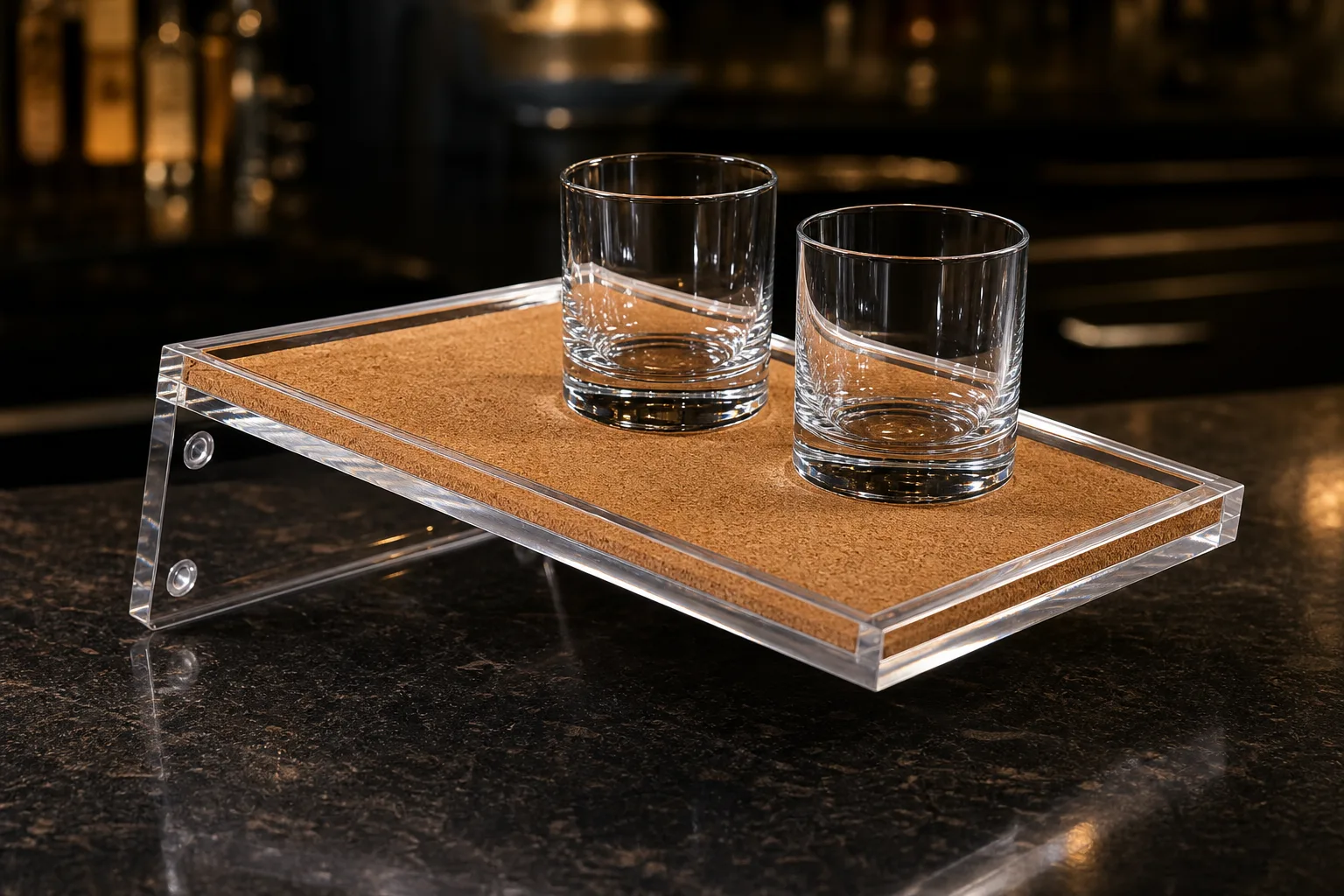
A recessed mat insert turns the tray bed itself into the grip surface: a machined pocket, typically 2-3 mm deep, holds a cut-to-fit cork, rubber, or silicone mat flush with the bed. Glassware rides on the mat, the mat cannot slide because the pocket walls contain it, and when it wears out you replace the mat, not the tray.
This is the option we steer hotel amenity and cocktail programs toward, because it separates the tray’s life from the grip’s life. The acrylic shell survives years; mats are consumables that swap in seconds. Cork reads warm and natural and suits room-service and vanity settings; black rubber or silicone reads professional and grips slightly better when wet, which is why bar programs pick it. Either way the pocket does quiet work: without it, a loose mat creeps toward one rim within a shift, and with it, the mat stays put through the wash cycle too — lift out, rinse, drop back.
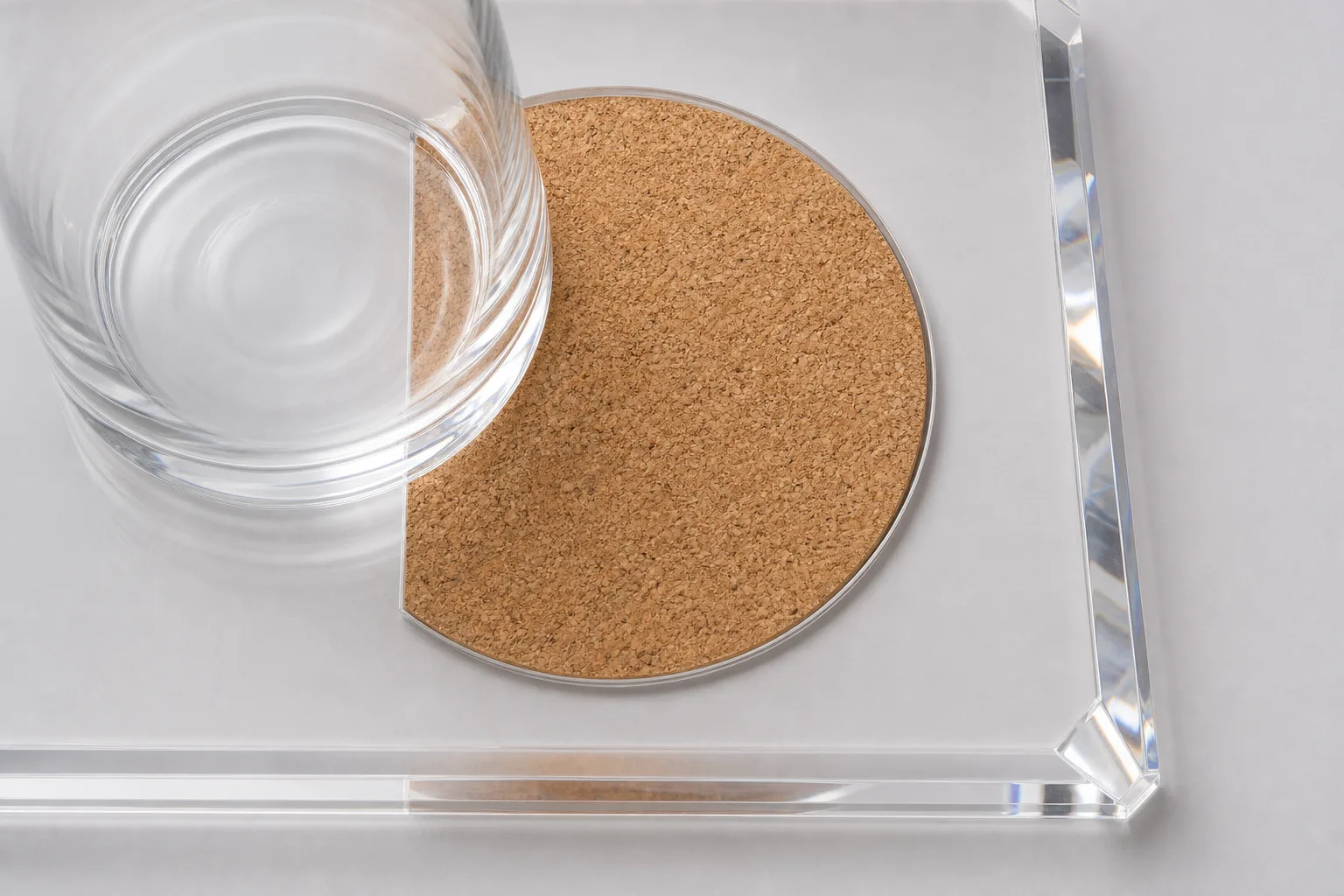
One spec detail worth writing into any order: ask for the mat supplied as a cut set, not glued in. Glued mats trap wash water at the glue line and end up combining the worst of both systems. A snug drop-in fit — we cut mats about 0.5 mm under the pocket size — stays flat, drains, and dries. For the full tray-bed insert conversation beyond grip, sizing and artwork included, our tray logo and insert options guide covers the printed and decorative side of the same pocket.
Routed texture and anti-slip coatings: the honest fine print
Routed texture is permanent but modest; coatings grip hard and die young. A texture pass machines a fine relief — shallow grooves or a stipple pattern, a few tenths of a millimeter deep — into the tray bed, and it can never wear off. A sprayed anti-slip coating starts out grippier and then thins, clouds, and scratches under commercial cleaning.
Texture’s honest limits: on a dry tray it adds real resistance against glass-on-acrylic slide, and because it is cut into the material it survives anything the tray survives. Wet, its advantage shrinks — a film of spilled liquid bridges fine relief, and smooth glass bases plane over it. Friction between plastic surfaces is measured in the lab as a coefficient under standards like ASTM D1894, but no lab number rescues a texture from a wet shift; the practical read is that texture suits amenity and retail-display trays more than a busy cocktail floor.2 It also frosts the surface where it runs — some buyers order it as a deliberate design band for exactly that reason.
Coatings get the plainest language on any quote we send. They work when new, and they are the only grip option that visibly ages: micro-scratches from stacking, clouding from detergents, thinning at the high-touch zones, and no way to refresh short of re-coating. On a promo tray with a one-season life, fine. On a hotel program you expect to look new for years, we decline to quote them as the primary grip and put a recessed mat on the quote instead. An honest wear warning up front costs us some coating orders and saves the reorder relationship — a trade we take.
Rim geometry: the grip option nobody lists
Rim height does more for a loaded carry than any surface treatment. Grip stops items sliding; the rim stops them leaving when a slide happens anyway. A 20-30 mm rim contains a tipped glass’s base, a slight outward flare keeps knuckles clear, and a machined finger relief under the long edges makes the one-hand pickup stable instead of scrabbling.
Think of the physics of a server weaving a floor: every direction change tries to slide the load outward, grip resists the first few degrees of that, and the rim is the backstop for the rest. A flat, rimless presentation tray — beautiful for a vanity — is the wrong platform for transport no matter what its surface does. For carry-heavy programs, spec the rim first and the tray grip surface second: 25 mm rim, radiused inside corners so your wipe-down cloth reaches them, and reliefs positioned for the actual carry (center-balanced for cocktail rounds, end-handled for room service rectangles).
Rim height, depth, thickness, and the load math behind them are dimensioned properly in our custom serving tray spec guide — this page’s point is simpler: a non-slip tray brief that never mentions the rim is half a brief, and a supplier who quotes it without asking is not reading it. For room service, the bed-tray leg, size, and pilot-economics guide adds the folding-leg and guest-room constraints.
Cleaning chemistry versus each grip option
Cleaning kills grip options in a predictable order, and it reaches the acrylic before it reaches most of them. The base rule from our food-safety work applies here unchanged: acrylic trays are hand-wash items — warm water and mild dish soap — because dishwasher heat and detergents craze the surface. The grip options then each add one line of care.
Chemistry first, because buyers ask: acrylic for food contact is covered under FDA 21 CFR 177.1010, and the tray’s clarity is what harsh chemistry attacks — alcohol, ammonia glass cleaners, and solvent wipes craze PMMA into hairline cracks regardless of what grip is fitted.3 So the cleaning spec that protects a non slip serving tray protects its grip almost automatically. Per option: recessed silicone feet are effectively care-free — silicone shrugs off dish soap and sanitizing dilutions. Drop-in mats lift out for separate washing; cork prefers a wipe to a soak, rubber and silicone mats tolerate either. Routed texture needs a soft brush where a cloth skates over the relief — the grooves that grip a glass also grip residue. Coatings are the fragile passenger: abrasive pads and strong degreasers accelerate exactly the wear already described, which is one more reason they rank last for commercial programs.
The full wash-care protocol — water temperature, approved cleaner list, drying — lives in our food-safe acrylic tray guide; hand that one to your operations team and keep this page for your buying decision.
Specifying a non-slip tray order
A complete non slip serving tray spec names five things: tray dimensions and rim height, base treatment (recessed feet, and how many), bed treatment (mat material or texture), the cleaning regime it must survive, and branding. With those five, we quote same-day and the sample that follows is your real test — you load it, you carry it, you wash it.
The commercial terms are the same as every tray program we run: MOQ 100 pieces per design, samples in 3-5 days, production in 15-20 days, FOB Shenzhen, 30% deposit with the balance before shipment, built in our ISO 9001-certified factory we have run since 2008. Because trays are CNC-cut rather than molded, there is usually no tooling fee — countersinks, mat pockets, texture bands, and finger reliefs are programming, not tooling, so a custom size costs quantity price, not mold price. Branding rides the same run: laser-etched logos, UV print, or a printed insert under a clear bed.
For an example of grip-specced tray inputs, see the hotel amenity-tray project, which conditioned material, grip method, cleaning, inspection, and packing on buyer-approved drawings and samples. Browse formats on the acrylic serving trays page or the wider acrylic trays hub — or send us your tray brief with the five points above, and we will return the grip spec and quote within 24 hours.
Footnotes
-
21 CFR 177.2600 — Rubber articles intended for repeated use (eCFR) — the US food-contact regulation covering rubber and silicone articles for repeated use, the grade specified for silicone feet and mat inserts on food-service trays. ↩
-
ASTM D1894 — Standard Test Method for Static and Kinetic Coefficients of Friction of Plastic Film and Sheeting — the standard test protocol for measuring friction coefficients on plastic surfaces, cited as the method behind lab slip measurements on textured sheet. ↩
-
21 CFR 177.1010 — Acrylic and modified acrylic plastics, semirigid and rigid (eCFR) — the US food-contact regulation for acrylic plastics, supporting the claim that acrylic serving trays are permitted for food-contact use. ↩
Frequently Asked Questions
What makes a serving tray non-slip?
Two separate jobs. Feet on the base keep the tray from sliding on a bar top or a lap; a grip surface in the bed — cork mat, silicone mat, or routed texture — keeps glassware from sliding inside the tray. A tray program should specify each side separately, because a grippy bed on slick feet still slides.
Which non-slip option lasts longest on an acrylic tray?
Recessed silicone feet and recessed mat inserts. Both are mechanical — a machined countersink or pocket holds them — so cleaning cannot peel them the way it lifts adhesive pads, and the mats are replaceable. Routed texture never wears off but grips less when wet; sprayed coatings rank last, wearing visibly under commercial washing.
Are silicone feet and mats food-safe?
Yes when specified to the food-contact regulations. Acrylic itself is permitted for food contact under FDA 21 CFR 177.1010, and silicone rubber for repeated food-contact use falls under 21 CFR 177.2600. For hospitality programs we quote food-contact-grade silicone for both feet and mat inserts by default.
Can non-slip serving trays go in the dishwasher?
No — the acrylic disqualifies it before the grip does. Commercial wash cycles pair heat approaching acrylic's roughly 96 °C heat-deflection limit with harsh detergents that craze the surface into hairline cracks. Hand-wash with mild soap keeps both the tray and every grip option intact; a recessed mat lifts out so the bed wipes clean.
What is the minimum order for custom non-slip trays?
100 pieces per design, with samples in 3-5 days and production in 15-20 days. Feet, mat inserts, routed texture, rim height, and branding are all specified per order — trays are CNC-cut, not molded, so there is usually no tooling fee and no penalty for a custom size.
Explore Custom Acrylic Products
Browse product categories to compare formats, materials, and customization options before choosing the closest fit for your project.