Bed Tray Programs for Hotels: A Buyer's Guide
Most people searching for a bed tray want one.
Need this made?Custom acrylic trays →
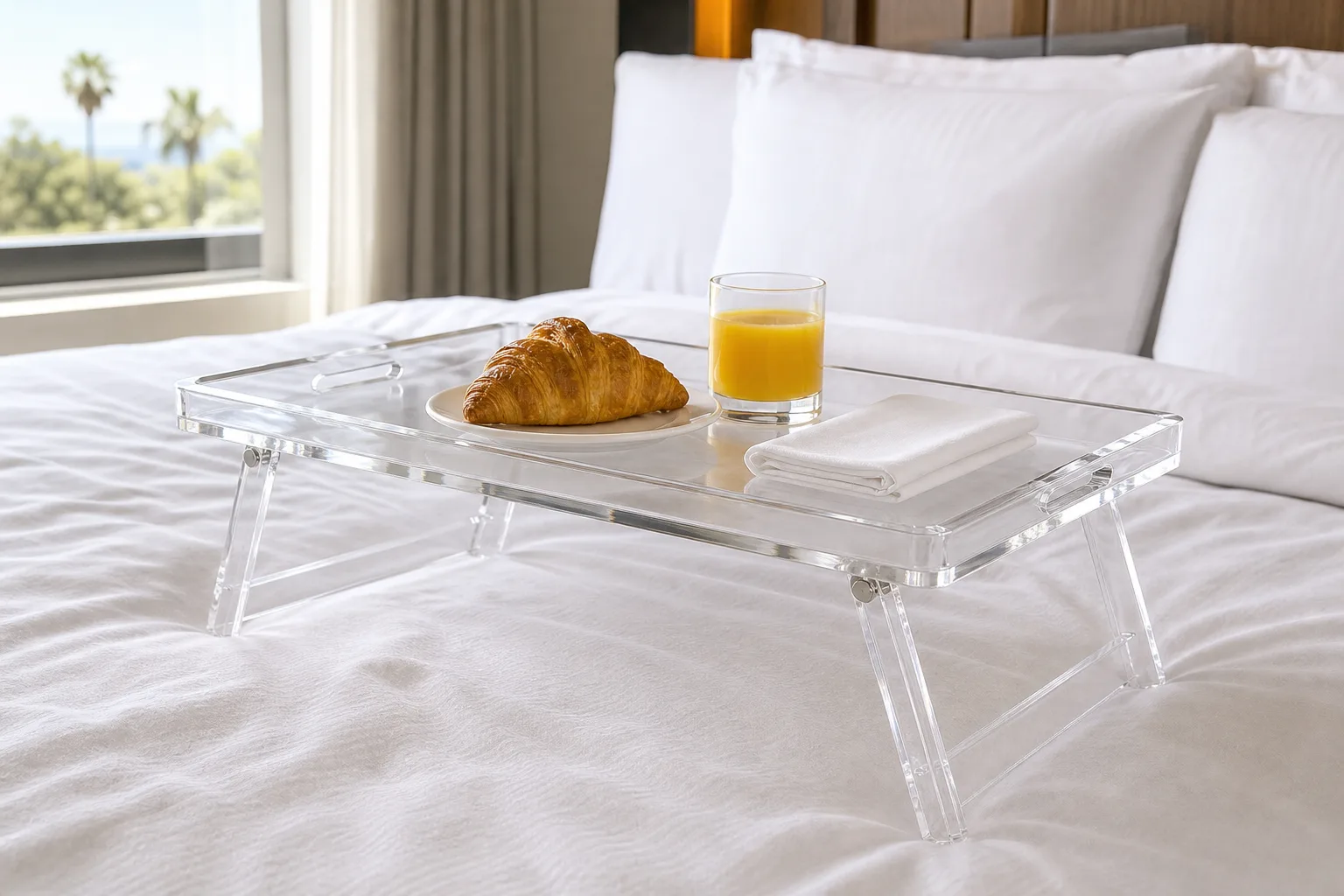
The buyers who email us want two hundred — here's how an in-room dining tray program actually gets specced, priced, and rolled out.
Key Takeaways
- A hotel bed tray program is sized by covers, not rooms: in-room dining volume plus a 25-40% spare float for breakage, staining, and guest walk-offs sets the real order quantity.
- The workhorse room-service size is roughly 500 x 350 mm with a 35-45 mm rim; folding legs add bed clearance but cut stack density in the service station by about two-thirds.
- Acrylic's heat-deflection temperature is about 96 C, so trays survive hot plates and hand-wash cycles but should stay out of high-temperature commercial dishwashers.
- At a 100-piece MOQ with no tooling fee on most designs, a branded pilot on one floor costs a few hundred dollars in samples and lands in roughly 3-4 weeks — samples in 3-5 days, production in 15-20.
On this page
- Who actually orders a bed tray by the hundred
- Bed tray sizes that work for in-room dining
- Legs vs flat: pick by how the tray is delivered
- Why acrylic for a hotel bed tray — and when it isn’t
- Washability, heat, and food contact
- Branding: rim logos, color, and the two-year reorder test
- The 100-piece pilot: program economics
- What to put in your bed tray RFQ
Who actually orders a bed tray by the hundred
A bed tray search usually means one person and one breakfast. But the bed tray orders that cross my desk come from hotels, resorts, and serviced-apartment operators building an in-room dining program — 50 to 500 identical trays, logo on the rim, delivered before a season opens. This guide is written for that second buyer.
The distinction matters because the two buyers need opposite things. A consumer wants one attractive tray at a fair retail price, available tomorrow. A food-and-beverage manager needs a spec that survives hundreds of service cycles, a size that fits the service elevator cart, a wash protocol housekeeping will actually follow, and a reorder path that delivers the same tray in the same color two years from now. Since 2020, I’ve seen more tray programs fail on the boring parts — spares math, wash temperature, stacking height — than on the design.
One honest note before the program talk: if you do want a single bed tray for home use, buy retail. Our factory minimum is 100 pieces per design, and no import math makes one tray from Shenzhen sensible. The rest of this guide assumes you’re outfitting rooms, not a bedroom.
Bed tray sizes that work for in-room dining
The workhorse hotel bed tray measures about 500 x 350 mm (20 x 14 in) with a 35-45 mm rim — room for a covered plate, a cup, cutlery roll, and a folded bill card, while still passing through a doorway carried one-handed. Compact and oversize formats exist for continental breakfast and two-person settings.
Size is a service decision, not an aesthetic one. Every extra 50 mm of tray width is 50 mm less clearance past a door frame and a bigger footprint on the room-service cart. Rim height is the quiet spec: below about 30 mm, a tilted carry sends the coffee sliding; above about 50 mm, the tray starts reading as a storage bin rather than a dining surface. Acrylic at 4-5 mm thickness holds these spans rigid — cast PMMA has an elastic modulus of about 3.2 GPa and a density of 1.2 g/cm³,1 so a 500 x 350 x 5 mm tray comes in around 1 kg before food, light enough for repeated carries without feeling flimsy.
| Format | Typical size | Rim height | Best for | Notes |
|---|---|---|---|---|
| Compact | 450 x 300 mm | 30-35 mm | Continental breakfast, coffee service | Lightest carry, fits narrow carts |
| Standard | 500 x 350 mm | 35-45 mm | Full in-room dining | The default program spec |
| Oversize | 550 x 400 mm | 40-50 mm | Two-person settings, suites | Check door and cart clearance |
| Bed tray with legs | 500 x 350 mm + legs | 35-45 mm | Over-lap dining on the bed | 200-240 mm leg clearance |
Legs vs flat: pick by how the tray is delivered
Choose a bed tray with legs when guests dine over their lap on the bed; choose a flat tray when servers set the meal on a desk, ottoman, or luggage bench. Legs add 200-240 mm of clearance and a premium feel, but a legged tray stacks roughly three times taller in the service station.
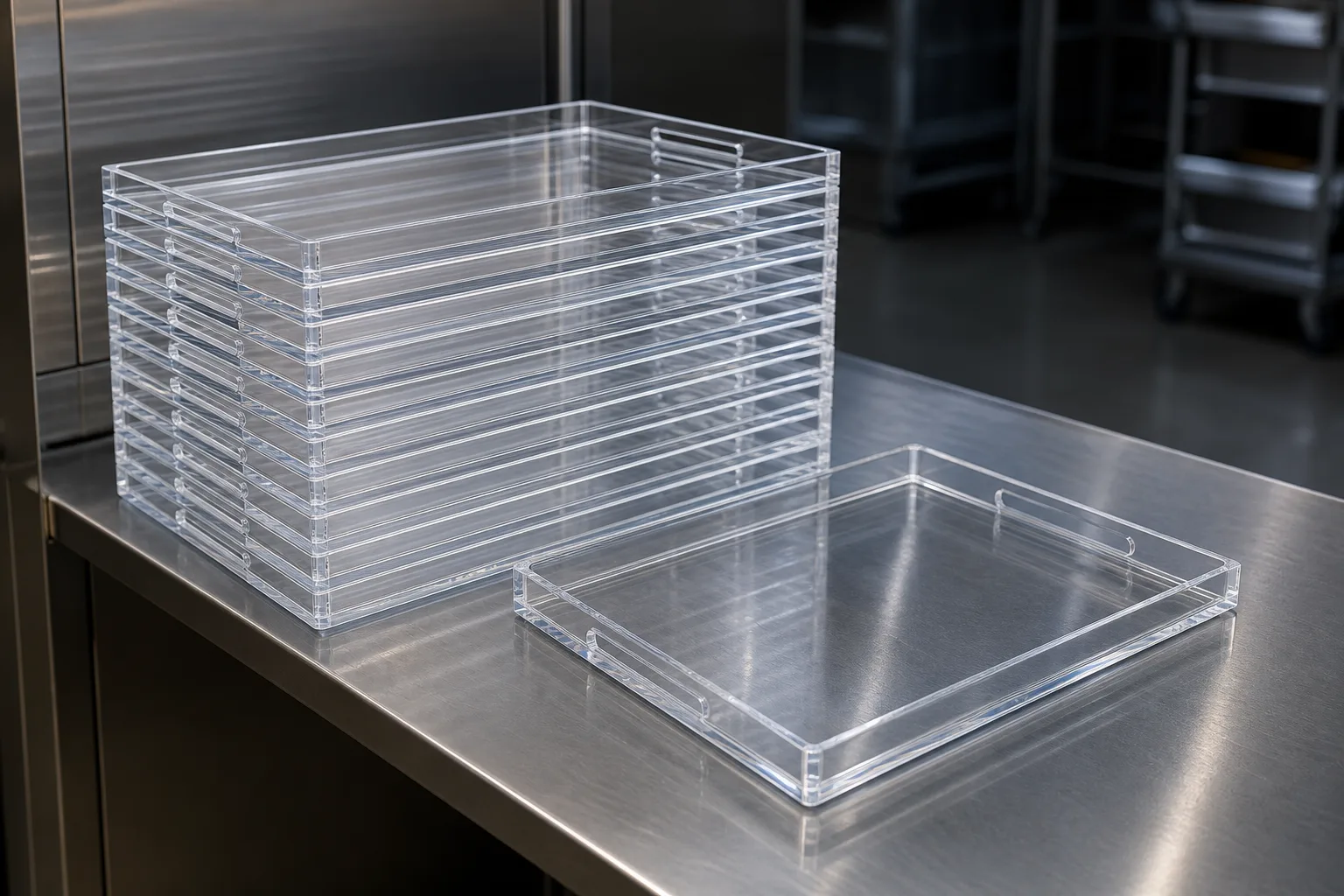
Storage density is the constraint most programs discover too late. Twenty flat trays stack into about 250 mm of shelf; twenty legged trays with folded hardware need most of a shelf bay. That’s why the most common split I set up is 70/30 — flat trays as the default service fleet, legged trays reserved for suites, breakfast-in-bed packages, and marketing photography. Hinged folding legs also add moving parts, and moving parts are what housekeeping breaks first: if you go legged, spec stainless or nylon hinges and order hinge spares with the initial run rather than discovering the gap at reorder time.
If your program leans toward bathroom counters rather than beds — soap, folded towels, amenity bottles — that’s a different spec with different sizes, and our hotel vanity tray program guide owns that territory; this guide covers the in-room dining and bed format.
Why acrylic for a hotel bed tray — and when it isn’t
Acrylic wins the hotel bed tray brief on three counts: it photographs like glass at a fraction of the weight and none of the breakage risk, it takes branding directly on the material, and it shrugs off water that would swell a wood tray’s lacquer within a season. Melamine beats it in only one place — the high-temperature dish machine.
Weight and breakage drive more of this decision than most buyers expect. A glass-look tray that actually was glass would be a liability the first time it slid off a duvet; a 5 mm acrylic tray at around 1 kg takes the same drop and picks up, at worst, a corner chip. Wood and bamboo trays read warm in photography but live badly with room-service reality — standing water rings, sanitizer wipes stripping the finish, and no clean way to carry a printed logo that survives washing. Melamine is the cafeteria answer: nearly indestructible in the dish pit, but it looks like what it is, and premium properties consistently tell us their in-room dining photography is the reason they specced clear or tinted acrylic. Our acrylic vs melamine serving tray comparison runs the full decision if your program leans banquet rather than boutique.
Where acrylic is the wrong call: all-day tray service through a conveyor dish machine, outdoor pool decks in constant direct sun for years without UV-stabilized grade, and any spec where the tray doubles as a cutting surface. We’d rather flag those at quote stage than replace a clouded fleet at month eight.
Washability, heat, and food contact
Acrylic bed trays are hand-wash items. Cast acrylic’s heat-deflection temperature is about 96 C,1 so a hot plate or warm-water wash is no threat, but high-temperature commercial dish machines — sanitizing rinses run hot — plus aggressive alkaline detergents will craze and cloud the surface over repeated cycles.
The wash protocol that works in practice: warm water, mild detergent, soft cloth or non-abrasive pad, air dry. No scouring pads, no glass cleaner with ammonia — ammonia is the classic acrylic-crazing mistake, and it usually arrives via a well-meaning housekeeping cart. We print a one-page care card with every tray program shipment for exactly this reason. For the deeper version of this topic — including which sanitizers are safe — see our guide to food-safe and dishwasher-safe acrylic trays.
On food contact: acrylic (PMMA) is covered by the US FDA’s food-contact regulation for acrylic plastics, 21 CFR 177.1010,2 which defines the conditions under which acrylic articles may contact food. For a tray, contact is incidental — plates and cups sit between food and surface — but hotels with strict procurement checklists can spec food-contact-compliant sheet and we build to it. Ask for the material declaration at quote stage; a supplier who can’t produce one is guessing.
Branding: rim logos, color, and the two-year reorder test
A branded bed tray carries the property’s mark through UV printing or laser etching, and both work at the 100-piece production MOQ because trays are CNC-cut rather than molded — no tooling fee on most designs, no mold amortization forcing thousand-piece minimums.
UV print gives you full color — a crest in gold and navy on a corner, a pattern across the base underside so it shows through the clear surface without touching food. Laser etching gives a frosted, permanent mark that can’t wear off in washing; it reads quietly premium on clear or black trays. Custom body colors beyond our stock range carry a one-time Pantone-matching fee of $200-300 per color, then repeat at no charge on reorders. The comparison of print, etch, and insert branding — durability, cost, and where each fails — lives in our acrylic tray branding methods guide.
The test I push buyers to run at pilot stage: will this exact tray be reproducible in two years? Stock clear always will. A custom Pantone will, because the formula is on file. A dye lot from a trader who won’t name the sheet source will not. Hotels reorder in waves — 60 trays now, 80 next spring — and color drift between waves is the kind of thing a general manager notices at a glance.
The 100-piece pilot: program economics
The lowest-risk way into a bed tray program is a one-floor pilot: 100 trays at the production MOQ, samples in 3-5 days, production in 15-20 days, 30% deposit with the balance before shipment, FOB Shenzhen. You’re testing the spec against real guests and real housekeeping before committing to a property-wide count.
| Stage | Quantity | Timeline | What you learn |
|---|---|---|---|
| Sample | 1-2 trays | 3-5 days + courier | Size, rim feel, logo position, color match |
| Pilot | 100 trays (production MOQ) | 15-20 days production | Wash survival, storage fit, guest response |
| Rollout | 0.5-1 per key + 25-40% spares | 15-20 days per wave | Full-program logistics, reorder cadence |
Quantity math is where I spend the most time with first-time program buyers. Trays attrit — chipped corners from cart collisions, staining from a curry that sat overnight, and the steady leak of walk-offs when a tray is attractive enough. Plan 0.5-1 tray per key for an active in-room dining operation, add 25-40% spares, and schedule the replacement wave before your peak season rather than after the shortage. A 150-room property usually lands between 100 and 200 trays. We hold your artwork and cutting programs on file, so wave two is an email, not a project. The hotel amenity-tray project shows how we controlled designs, color, branding, cleaning, samples, inspection, and property-set packing.
What to put in your bed tray RFQ
A complete bed tray RFQ names seven things: outside dimensions, rim height, thickness, legs or flat, color, logo artwork with placement, and total quantity with the delivery window. Quotes against that spec come back comparable; quotes against “branded breakfast trays, 150 rooms” come back as guesses.
The two lines I most often see left out are tolerance and packaging. Tolerance matters if trays must nest in an existing cart or shelf bay — tell us the slot, and we cut to it; our production runs to a cutting drawing, not to “about 20 inches.” Packaging matters because a tray fleet ships as flat stacks, and how those stacks are separated decides whether tray one scuffs tray two somewhere in an ocean container. We pack with film or foam interleaving on every tray order for exactly this reason, and we say so on the quote — a line worth checking on any supplier’s offer, because scuffed-on-arrival is the most preventable failure in this category.
Artwork deserves one paragraph of its own. Send vector files (AI, PDF, EPS) for logos — a photographed letterhead can’t drive a laser or a UV head. If all that exists is a fuzzy raster mark, have it redrawn as vector on your side before sampling; we produce from your supplied files and do not redraw artwork, and a clean file prevents the pilot from shipping with soft edges on the crest. Color-critical brands should approve a printed sample chip, not a screen preview, before the run. Every one of these gates exists because some past order taught it to us.
Bed trays are one lane of a wider tray family. For the full product range — serving trays, vanity trays, decorative formats — start at our custom acrylic trays hub, and see the acrylic serving trays line for the food-service formats this guide’s specs build on. When you’re ready to spec a pilot, send your room count and logo through our custom acrylic fabrication page and we’ll turn around a drawing and quote.
Footnotes
-
PMMA (acrylic) material properties, MakeItFrom — independent materials database listing cast acrylic’s 1.2 g/cm³ density, 3.2 GPa elastic modulus, and roughly 96 C heat-deflection temperature cited for tray weight, rigidity, and wash-temperature limits. ↩ ↩2
-
FDA 21 CFR 177.1010 — acrylic and modified acrylic plastics — the US federal regulation defining conditions under which acrylic articles may be used in contact with food, referenced for food-contact-compliant tray specifications. ↩
Frequently Asked Questions
What size bed tray works best for hotel room service?
About 500 x 350 mm (roughly 20 x 14 in) with a 35-45 mm rim suits most in-room dining programs — big enough for a plate, cup, and folded card, small enough to carry through a door one-handed. Compact 450 x 300 mm trays fit continental breakfast; oversize 550 x 400 mm suits two-person settings.
Should hotel bed trays have legs or stay flat?
Legs if the tray is meant to sit over a guest's lap on the bed; flat if servers deliver to a desk or luggage bench. Folding legs add about 200-240 mm of clearance but roughly triple the stacked height in a service station, so many properties run 70% flat and 30% legged.
Are acrylic bed trays dishwasher safe?
No — hand-wash and wipe-down only. Acrylic's heat-deflection point is about 96 C, and high-temperature commercial dish machines plus aggressive detergents cause crazing and clouding over repeated cycles. Warm water, mild detergent, and a soft cloth keep a tray presentable for years of service.
Can we get bed trays with our hotel logo at a small quantity?
Yes — our MOQ is 100 pieces per design, with UV-printed or laser-etched logos included and no tooling fee on most designs because trays are CNC-cut, not molded. A custom Pantone color match adds a one-time $200-300 per color. Samples ship in 3-5 days, production runs 15-20 days.
How many trays should a hotel order per room?
Plan on 0.5-1 tray per key for a full in-room dining program, then add 25-40% spares. A 150-room property typically lands between 100 and 200 trays depending on breakfast volume, plus replacements arriving before peak season — attrition from chips, staining, and walk-offs is real.
Explore Custom Acrylic Products
Browse product categories to compare formats, materials, and customization options before choosing the closest fit for your project.