Bar Serving Trays: Grip, Washdown & Branding
A bar tray lives a harder life than almost any other acrylic product.
Need this made?Custom acrylic serving trays →
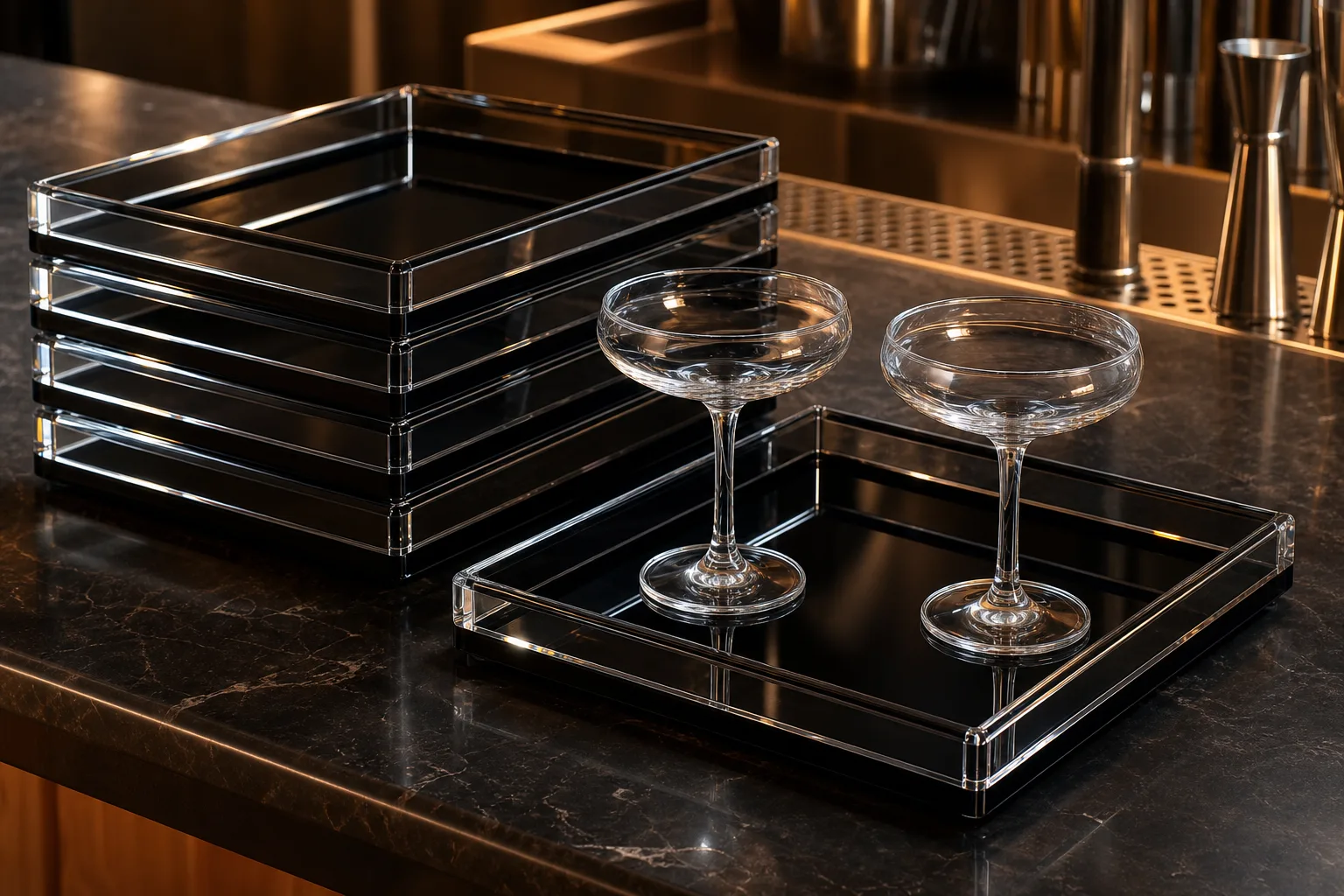
Here is what survives nightly service — grip, washdown, branding — and how to size a fleet across venues.
Key Takeaways
- Bar serving trays fail on grip and washdown before they fail on strength — spec a textured or lined carrying surface, a raised rim of 15-25mm, and a hand-wash care card, and a cast acrylic tray runs for years of nightly service.
- Acrylic trays are not dishwasher-safe: commercial hot-water sanitizing rinses run at 180°F (82°C), only 8°C below cast PMMA's 90°C softening point, and repeated cycles plus alkaline detergents craze the surface.
- Sanitizer wipes are workable with the right chemistry — PMMA is not attacked by alcohol alone, but concentrated solvents and constant high-strength alcohol on glued seams and bent corners invite crazing, so flat one-piece trays outlast bonded ones in bar service.
- Put the logo where service can't wear it: bottom-surface (second-surface) printing seals artwork under the acrylic itself, so glass bases and wipe-downs touch material, not ink.
- A 100-500 piece program prices best as one design in few sizes: MOQ is 100 pieces per design, paid samples take 3-5 days, production 15-20 days, and cutting programs stay on file so replenishment orders match the first run.
On this page
What a Friday night does to a bar tray
Picture the service rail at 11 pm: a loaded tray held one-handed over a shoulder, six glasses sweating condensation onto the surface, a sanitizer wipe-down between rounds, and a drop onto tile at least once a month. Bar serving trays are equipment, not decor — and every spec decision you make should start from that shift, not from the showroom.
A bar serving tray is a rimmed carrying tray — in our shop, cut and formed from cast acrylic sheet — sized for a server to carry drinks one-handed through a crowded room and to survive nightly washdown. That definition carries the whole spec: one-handed carry sets the size and weight ceiling, drinks set the grip requirement, and nightly washdown sets the chemistry and heat limits your material has to meet.
Cast acrylic earns its place on that job description. It weighs roughly half of what glass does at the same size, it takes a fall onto tile without shattering into shards, and it carries branding better than any wood or steel tray. I have built tray programs for hotel bars, cocktail lounges, and restaurant groups, and the ones that come back for reorders instead of complaints all got three things right at the spec stage: the anti-slip build, the washdown protocol, and the logo placement. Those three are the next three sections.
Grip and balance: anti-slip that actually works
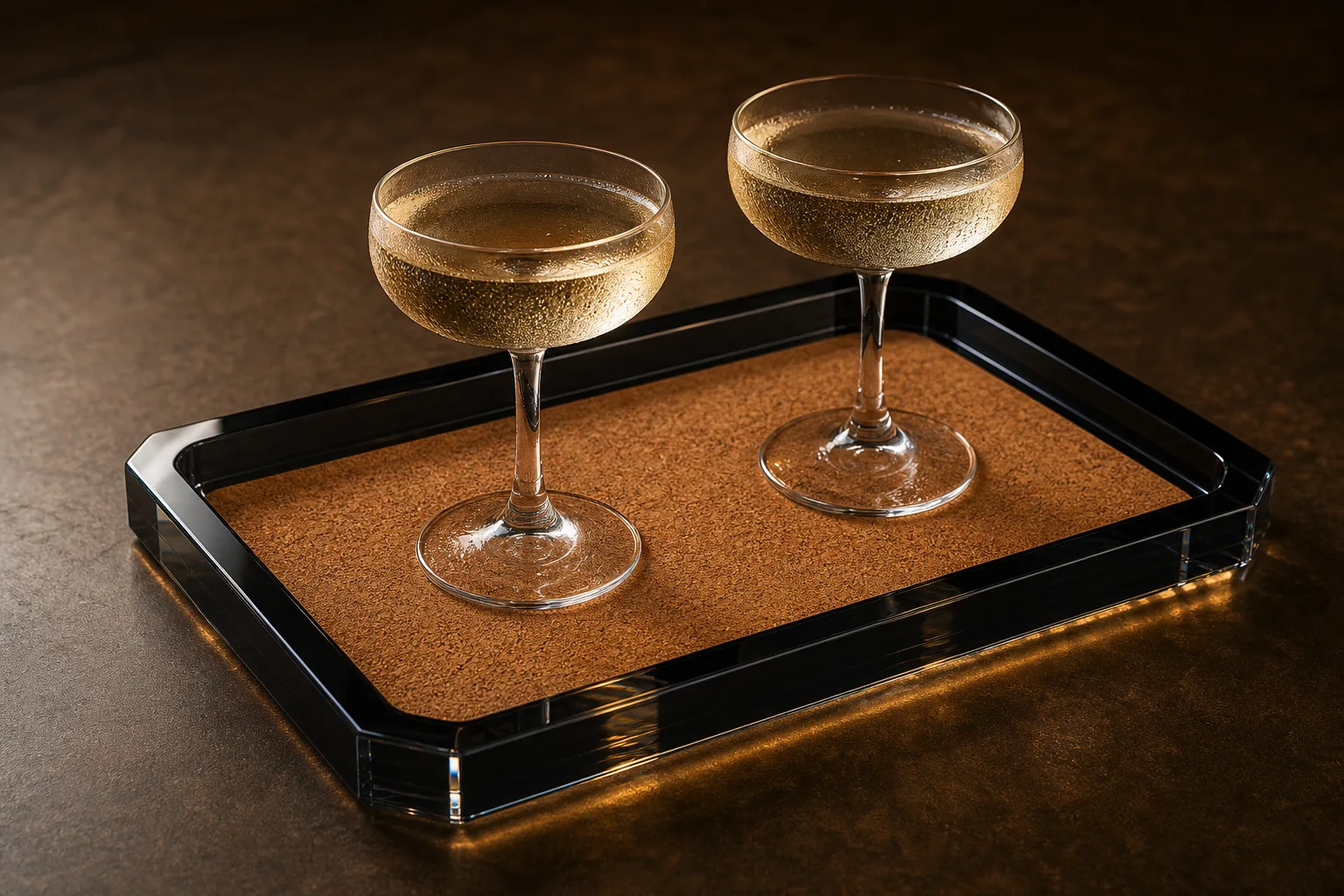
Anti-slip on bar serving trays comes in three builds, in rising order of grip: a frosted or textured carrying surface, a raised gallery rim of 15-25mm, and a replaceable liner — cork, EVA foam, or a silicone mat — recessed into the tray bed. For cocktail service, spec rim plus liner; the liner grips your glassware, the rim catches what the liner misses.
The physics is worth one paragraph because it drives the build choice. A wet glass base on polished acrylic has almost nothing to hold onto — condensation acts as a lubricant film, and a polished tray tilted a few degrees lets glassware skate. Texture breaks that film. A frosted surface helps; a compliant liner (cork or EVA) helps far more because it deforms slightly under the glass base and drains the film into its surface. The recess matters too: we mill the tray bed 1-2mm deep so the liner sits flush and stays put through washdown, instead of being a loose mat that slides along with the glasses it was meant to hold.
The most useful grip test costs nothing and happens before any order: when the sample tray arrives, load it with the venue’s own glassware — wet, straight from the glass washer — and walk it across the room at service pace. A liner that grips a dry rocks glass in a meeting room can still let a sweating highball skate, and that is exactly the gap a 3-5 day sample exists to catch before 300 pieces get cut.
Balance is the quieter half of grip. A tray carried one-handed wants its weight low and centered: we build bar trays with the thick sheet in the base — typically 5mm, stepping to 8mm above 450mm across — and keep rims thin, so the center of gravity stays under the load rather than beside it. Handle cutouts, if the program wants them, get placed on the long sides at the balance line, with fully polished edges; a sharp-edged cutout is the first thing a server will mention. Weight totals stay friendly because of the material — about 1.18 g/cm³, roughly half the density of glass — so even a large 450mm tray comes in light enough for shoulder carries all shift.1
Washdown reality: dishwashers, sanitizer, and alcohol
The washdown rule for acrylic bar trays is simple: hand-wash with warm water and mild detergent, never the commercial dish machine. The FDA Food Code sets hot-water sanitizing final rinses in mechanical warewashing at 180°F (82°C)2 — only about 8°C below cast PMMA’s 90°C Vicat softening point3 — and repeated cycles at that temperature warp trays and craze surfaces.
Heat is half the problem; chemistry is the other half. Machine detergents are strongly alkaline and rinse aids are surfactant-heavy, and both attack acrylic slowly — the damage shows up as crazing, a web of hairline surface cracks that clouds the tray and traps grime. It is cumulative and irreversible, which is why the tray that “survived the dishwasher fine” for two weeks is cloudy by month three. Our own food-safe and dishwasher-safe acrylic tray guide covers the material side in more depth; the bar-service summary is that hand-washing takes seconds per tray and preserves years of service life.
Sanitizer wipes — the between-rounds reality of bar service — are more forgiving than most buyers expect. PMMA is not chemically attacked by alcohol alone1; the risk concentrates where stress lives, at glued seams and bent corners, which is where constant high-strength alcohol exposure can start crazing. That is a build instruction, not just a care note: for bar programs we favor flat one-piece trays with formed or machined rims over bonded four-wall builds, because a tray with no glue lines has nowhere for solvent stress-crazing to start. Food contact, for completeness, is a settled question — acrylic resins are permitted for repeated food-contact use under FDA 21 CFR 177.10104, which covers a tray carrying garnished drinks and bar snacks.
| Washdown practice | Verdict for acrylic bar trays |
|---|---|
| Warm water + mild dish detergent, soft cloth | The standard — spec this on the care card |
| Commercial dish machine (82°C sanitizing rinse) | Never — warping plus detergent crazing |
| Diluted alcohol-based sanitizer wipe on flat faces | Acceptable in service — rinse at close |
| Concentrated solvent cleaners (glass cleaner with ammonia, acetone) | Never — direct route to crazing and clouding |
| Abrasive pads or scouring powder | Never — permanent scratching; use a soft cloth |
The washdown spec only protects a fleet if the staff know it, and bar teams turn over. Two things keep the rule alive after the opening crew moves on: put the care instructions on a laminated card at the wash station, and tell the kitchen-steward team explicitly that the acrylic trays never enter the machine — because to a busy dish pit, everything enters the machine. Venue groups should write the hand-wash rule into the bar operations manual once, so every new site inherits it. We include a care card with program shipments for exactly this reason. When a buyer emails me photos of clouded trays, the story behind them is almost always the same: the care spec lived in someone’s inbox instead of at the wash station.
Logo placement: branding that survives service
The branding rule for bar serving trays: put the logo where service cannot wear it. Bottom-surface printing — artwork UV-printed in reverse on the underside of a clear tray bed and read through the material — is the default we recommend, because glass bases, spills, and nightly wipe-downs touch acrylic, never ink.
Top-surface UV print on the carrying face is the one placement I turn down for bar programs, and I say so on the quote — artwork sitting on a wear surface is where a bar tray’s branding fails first. On a desk organizer it lasts for years; under a thousand glass bases and a nightly wipe cycle, edge-wear starts at the artwork’s high points and the logo goes patchy. If the program wants top-surface branding, laser engraving is the durable route — the mark is cut into the material as a permanent frosted-white graphic, immune to wipes because there is no ink layer to lift. Hot stamping in gold or silver foil suits rim edges and low-touch faces on premium builds.
Color is the other branding lever, and it interacts with print. An opaque black or brand-color tray reads upscale and hides scuffs, but it rules out bottom-surface printing — there is nothing to read the artwork through — so opaque programs get engraving or a printed-and-sealed underside badge instead. A clear or tinted tray keeps the second-surface option open. For programs matching a specific brand color, we source or custom-tint to Pantone with a one-time $200-300 per color charge; stock blacks, whites, and common tints carry no such fee. The full finish and print menu lives on our custom acrylic trays hub if the program brief is still taking shape.
Sizes, rims, and stacking
Bar tray sizing runs smaller than banquet trays because everything is carried one-handed: a cocktail serving tray clusters at 300-400mm diameter in the round, rectangular service trays run around 350-450mm long, and back-of-bar amenity trays sit at 200-300mm. Rim height does real work — 15-25mm contains slides and spills without making glasses hard to lift out.
| Tray format | Typical size | Rim height | Thickness | Where it works |
|---|---|---|---|---|
| Cocktail round | 300 / 350 / 400mm dia. | 15-20mm | 5mm | Floor service, one-handed carries |
| Rectangular service tray | 350 x 250 to 450 x 350mm | 20-25mm | 5-8mm | Table drops, bottle service |
| Bottle-service / VIP tray | 450 x 350mm and up | 25mm | 8mm | Presentation carries, heavier loads |
| Amenity / garnish tray | 200 x 150 to 300 x 200mm | 10-15mm | 3-5mm | Back bar, hotel room bars |
Stacking is a fleet problem, not a tray problem, and it shows up the first time forty trays come back to the wash station at once. Flat one-piece trays with straight rims stack naturally, but polished faces stacked bare will scuff each other — so we design stacking contact onto feet. Four silicone or rubber feet per tray do double duty: they stop the tray sliding on the bar top, and in a stack each tray rests on the feet of neighbors rather than face-on-face. With footed builds, cap your wash-station stacks at roughly 10-12 trays; past that, the bottom tray carries real dead load all night and the stack gets tippy on a wet counter.
Pick sizes from the service style, not the catalog. A floor running cocktail service to standing crowds makes the 350mm round the workhorse, with the 400mm reserved for the strongest servers — a fully loaded 400mm round of stemware is a heavy one-handed carry late in a shift. A venue leaning table service and bottle presentation shifts weight to the rectangular formats, and we put the 25mm rim on anything carrying an ice bucket. In my experience quoting these programs, most single venues land on two sizes; the third size, when it appears, is usually about the back bar, not the floor.
Nesting matters at the ordering stage too. A program’s sizes should share one design language — same rim profile, same corner radius, same liner system — so any tray nests with its size-mates and the venue’s storage plan works with one shelf spec. That is also what keeps unit prices down: one design in three sizes shares programming and jigs in ways three unrelated designs never will. Formats and dimensions for the standard builds are on our acrylic serving trays page.
Planning a 100-500 piece program
A hospitality tray program prices and runs best planned as one design in few sizes, ordered with a replacement pool. The working numbers: MOQ 100 pieces per design, samples in 3-5 days, production in 15-20 days, FOB Shenzhen with CIF and DDP available, and 100% inspection in our ISO 9001-certified factory before anything ships.
Fleet math first. A working bar needs roughly 1.5-2 trays in circulation per server on a peak shift — one in hand, one in the wash cycle — plus house trays for bottle service. A single busy venue lands around 30-60 trays; a boutique hotel group with four bars lands at 150-250; a restaurant group standardizing across a dozen sites is a 400-500 piece program. Order a replacement pool of about 10-15% on top of your working count in the first run, because trays walk, crack in a drop, and get retired for scuffs — a pool on your shelf beats an emergency reorder mid-season.
Reorders start from the approved drawing, material, decoration, and packing record. Changed fields still need review; retained files do not make a new purchase order automatic. The artist tray brand repeat-order record documents another 1,000 4 × 4 inch engraved trays and a request to decrease the engraving size from the previous order. It shows both the value of an order record and the need to approve an intentional revision.
To start a program, send us the venue count, the sizes you think you need, and your logo file — we respond within 24 hours with a spec recommendation and quote. If the brief is still loose, a 3-5 day sample of one size in the proposed build (rim, liner, print method) settles more arguments than a month of renders. We would rather cut one sample tray than have 300 pieces teach the lesson.
Footnotes
-
Polymethylmethacrylate (PMMA, Acrylic) properties and applications — AZoM — material overview documenting that PMMA is not attacked by alcohol alone and listing its density of about 1.18 g/cm³, supporting both the sanitizer-wipe guidance and the half-the-weight-of-glass carrying claim. ↩ ↩2
-
FDA Food Code 2022 — U.S. Food and Drug Administration — FDA Food Code 2022 — hot-water sanitizing requirements for warewashing (the 180°F manifold standard sits in §4-501.112 of the code PDF), the provisions that put commercial dish machines off-limits for acrylic trays. ↩
-
Polymethylmethacrylate (PMMA / Acrylic) material properties — MakeItFrom — property table listing cast PMMA’s Vicat softening temperature of 90°C and heat-deflection temperature of 96°C, the thermal limits behind the hand-wash rule. ↩
-
21 CFR 177.1010 — Acrylic and modified acrylic plastics, semirigid and rigid — eCFR — the FDA regulation permitting acrylic resins in repeated food-contact articles, covering serving trays that carry garnished drinks and bar snacks. ↩
Frequently Asked Questions
Are acrylic trays good for bar service?
Yes, with the right spec. Cast acrylic is light (about half the density of glass), doesn't shatter into shards when dropped, and takes branding well. The two constraints are heat and chemistry: keep trays out of commercial dishwashers, hand-wash with mild detergent, and use a textured or lined surface plus a 15-25mm rim so glassware stays put on a crowded floor.
Can acrylic bar trays go through a commercial dishwasher?
No. Commercial hot-water sanitizing rinses run at 180°F (82°C) under the FDA Food Code, only about 8°C below cast acrylic's 90°C Vicat softening point, and wash chemistry is aggressive — repeated cycles warp trays and craze the surface into hairline cracks. Spec hand-washing with warm water and mild detergent; it takes seconds per tray and the trays stay clear for years.
How do I keep glasses from sliding on an acrylic tray?
Three builds work, in rising order of grip: a frosted or textured tray surface, a raised gallery rim of 15-25mm around the edge, and a replaceable anti-slip liner (cork, EVA, or silicone mat) recessed into the tray bed. For cocktail service we recommend rim plus liner — the liner grips the glass base and the rim catches anything the liner misses.
What's the best way to put a logo on a bar serving tray?
Bottom-surface printing — artwork UV-printed in reverse on the underside of a clear tray bed, read through the acrylic. The material itself seals the ink, so glass bases, spills, and nightly wipe-downs never touch it. Laser engraving is the most durable top-surface option; surface UV print on the carrying face is the one placement we advise against for bar service.
What is the minimum order for custom bar trays?
Our MOQ is 100 pieces per design — one hotel bar or a small venue group can clear it with a single spec. Samples ship in 3-5 days, production runs 15-20 days, and a custom Pantone-matched color adds a one-time $200-300 per color. Programs of 200-500 pieces across multiple venues usually keep one design and vary only size.
Explore Custom Acrylic Products
Browse product categories to compare formats, materials, and customization options before choosing the closest fit for your project.