Museum Display Standards for Acrylic Cases
A case either meets the number or it doesn't — UV in microwatts per lumen, materials that pass a 28-day corrosion test, joints that survive four venues. Here is the spec system behind the label.
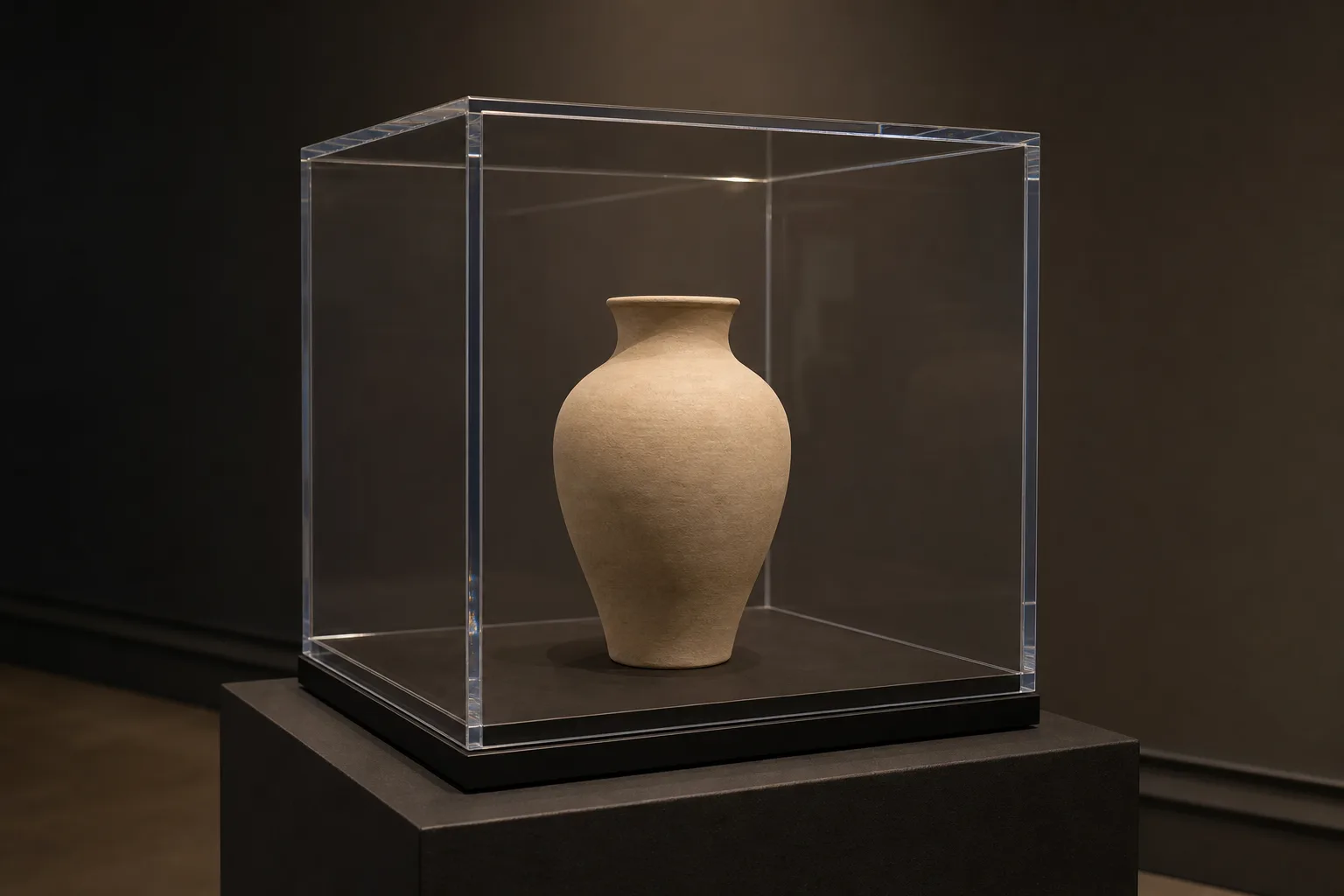
Key Takeaways
- Museum display standards are checkable numbers, not a label: UV at the object below 75 microwatts per lumen, light levels near 50 lux for sensitive material, and case components that pass a 28-day Oddy test.
- Standard clear acrylic transmits roughly 55% of incoming UV; UV-filtering grade blocks about 90-98% — the single spec line that separates a display box from a conservation-grade case.
- Acrylic itself is a conservation-accepted glazing, but adhesives, gaskets, felts, and paints inside the case are where off-gassing failures start — specify Oddy-tested components, not just the sheet.
- Most 'sealed' cases are dust seals, not microclimates. A true microclimate case needs a gasketed enclosure plus a conditioning chamber for silica gel — spec which one you mean, because the price is very different.
- Traveling-exhibit cases add a fifth standard: keyed, tool-friendly joints that reassemble identically at every venue, with fasteners that never touch the object side.
On this page
- What “museum-grade” means when it means anything
- Light: the UV numbers behind the label
- Material inertness: the Oddy test decides what shares the air
- Sealing: dust cover, gasketed case, or true microclimate
- Support and mounts: the object never takes a point load
- Traveling exhibits: the standard is repeatability
- Writing the spec and placing the order
What “museum-grade” means when it means anything
Search “museum-grade acrylic” and the phrase turns up on everything from picture frames to card holders — usually attached to no spec at all: no UV transmission figure, no materials test, no sealing spec. Museum display standards, by contrast, are checkable: conservation specifications for light control, material inertness, enclosure sealing, and support design that a case either meets or does not.
That distinction is the whole subject of this guide. Ten years of quality audits in, I treat the word museum-grade itself as a red flag and ask for the numbers behind it — because when a real museum, a conservator, or an exhibit designer specs a display case, the word never stands alone.
What stands instead is a short list of standards, and they are refreshingly concrete. How much ultraviolet reaches the object, measured in microwatts per lumen. Whether every material inside the enclosure passes an accelerated corrosion test. Whether the case is a dust cover or a controlled microclimate. Whether the object’s weight spreads across a designed support or grinds on a point. And for traveling shows, whether the case reassembles identically at venue four. This guide walks through each standard, what to write on the spec sheet, and where a custom acrylic display case build meets or misses it; the museum display application page covers the corresponding buyer brief.
| Spec area | What you actually specify | The benchmark |
|---|---|---|
| Light / UV | UV-filtering cast acrylic glazing | UV at object below 75 µW/lm; UV grade blocks ~90-98% |
| Materials | Oddy-tested components throughout | 28-day test, silver/copper/lead coupons unchanged |
| Sealing | Dust seal or gasketed microclimate | Stated air-exchange intent + conditioning chamber if microclimate |
| Support | Distributed mounts, no point loads | Thickness stepped to span; padded, inert contact surfaces |
| Travel | Dismountable, keyed joinery | Identical assembly at every venue, no fabricator present |
Light: the UV numbers behind the label
The light standard has two halves: how bright, and how much ultraviolet. Conservation guidance benchmarks display lighting for sensitive material around 50 lux, and holds ultraviolet at the object below 75 microwatts per lumen — the traditional museum ceiling.1 Lighting design owns the lux number; the case glazing owns the UV number.
That division matters when you spec a case, because a fabricator cannot fix bright lighting — but glazing choice decides how much UV passes. Unfiltered daylight carries roughly 600-1000 microwatts of UV per lumen, and even daylight through ordinary window glass still runs around 400-500 — five times the museum ceiling. Standard clear acrylic helps only modestly: it transmits roughly 55% of incoming UV. UV-filtering cast acrylic changes the math, blocking about 90-98% of UV while keeping the same optical clarity, which is what brings a daylit gallery or a storefront-adjacent lobby case under the 75 µW/lm line.
Sensitivity drives how strict to be. Dyed textiles, works on paper, watercolors, and feathers sit at the fragile end — these are the 50-lux objects where UV-filtering glazing is non-negotiable. Oil paintings and finished wood tolerate more. Metal, stone, ceramic, and glass have no meaningful light sensitivity at all; a bronze can live behind standard clear sheet forever. The practical rule on any exhibit-case order: if fading the object would be a loss, the glazing line on the spec must name the UV grade, not just say “acrylic.” Our museum display case UV spec guide goes deeper on transmission curves and anti-reflective coatings.
The honest corollary is that UV grade is not always worth paying for. It typically adds 15-25% to material cost, and on a case built for stone tools, coins, or glassware it buys nothing the object can use. A mixed collection is where the spec earns its keep: write UV-filtering glazing for the paper and textile cases, standard cast sheet for the mineral hall, and you fund the protection where light actually does damage. When your exhibit designer sends one blanket glazing line for forty cases, that is usually budget leaking, not caution.
Material inertness: the Oddy test decides what shares the air
The inertness standard says nothing inside the enclosure may emit vapors that attack the object. The museum world’s screening tool is the Oddy test: seal a sample of the candidate material for 28 days at 60 degrees Celsius and high humidity with silver, copper, and lead coupons, then read the coupons for corrosion.2 Corroded coupons mean the material off-gasses; it stays out of the case.
Acrylic sheet itself is the easy part. Cast PMMA is chemically stable at room conditions and is a widely accepted glazing choice in conservation practice — this is why acrylic, at less than half the weight of glass and far more shatter-resistant, became the default for exhibit cases in the first place. The failures I see in quality review almost never come from the sheet. They come from everything attached to it: solvent cements not fully cured before the case was closed, rubber gaskets that sulfur-corrode silver, wool felts, off-the-shelf paints on a case deck, MDF plinths hiding under a laminate.
So the standard, written properly, covers components: adhesives fully cured and aired before enclosure, gasket materials selected from conservation-accepted polymers, liners and deck fabrics from tested stock, and no composite wood inside the sealed volume. When a museum client sends us an approved-materials list, my inspection team checks the physical build against it line by line — that document, not the word museum-grade, is what artifact display requirements actually look like in practice. If your institution runs its own Oddy program, ship us the pass list; if not, ask us to build only from materials with published conservation acceptance.
Cure time deserves its own line on the schedule. Solvent-bonded joints release vapor for days after assembly, so a conservation build cannot go from bonding bench to sealed crate in one shift. We stage museum cases so bonded assemblies air out in open racking before gaskets close the volume, and we say so on the production plan — which is one reason a conservation-grade case takes the full 15-20 day production window even when the geometry looks simple. A supplier promising a gasketed case in a week is either skipping the cure or not gasketing much.
Sealing: dust cover, gasketed case, or true microclimate
Museum display standards treat sealing as a spectrum with three honest stops: a fitted dust cover, a gasketed low-exchange enclosure, and a conditioned microclimate. Most cases sold as “sealed” are the first. The three builds differ in air-exchange rate, in cost, and in what the museum must do after delivery — so the spec has to name which one it means.
A dust cover — a five-sided acrylic hood over a base — protects from handling, dust, and pests, and that is genuinely enough for stable objects like ceramic, stone, and most metal. A gasketed enclosure adds compressed gasket lines at every joint and a sealed cable path, cutting air exchange low enough that interior conditions drift slowly. A microclimate case goes further: the gasketed volume plus a concealed conditioning chamber, sized and vented so silica gel or equivalent media can hold relative humidity around a setpoint for months between servicing.
Be honest about the boundary of fabrication. A case maker delivers the envelope — the gasket engineering, the media chamber, the access panel that opens without lifting the hood off the object. The conservation team owns the climate itself: choosing the RH setpoint, conditioning the media, monitoring. When I inspect a microclimate build before shipment, what I verify is mechanical: gasket compression continuous along every edge, chamber accessible, no light leaks at the seams. For the cleanliness and RH side of that build sheet, see the museum display case UV spec guide.
Support and mounts: the object never takes a point load
The support standard is simple to state: the object’s weight spreads across a designed contact area, on an inert padded surface, with no point loads and no unplanned contact with the glazing. Collection-care references like the NPS Museum Handbook treat support and handling as a core exhibit-planning discipline, not an afterthought.3 Everything else — deck thickness, mount geometry, vibration behavior — is engineering in service of that sentence.
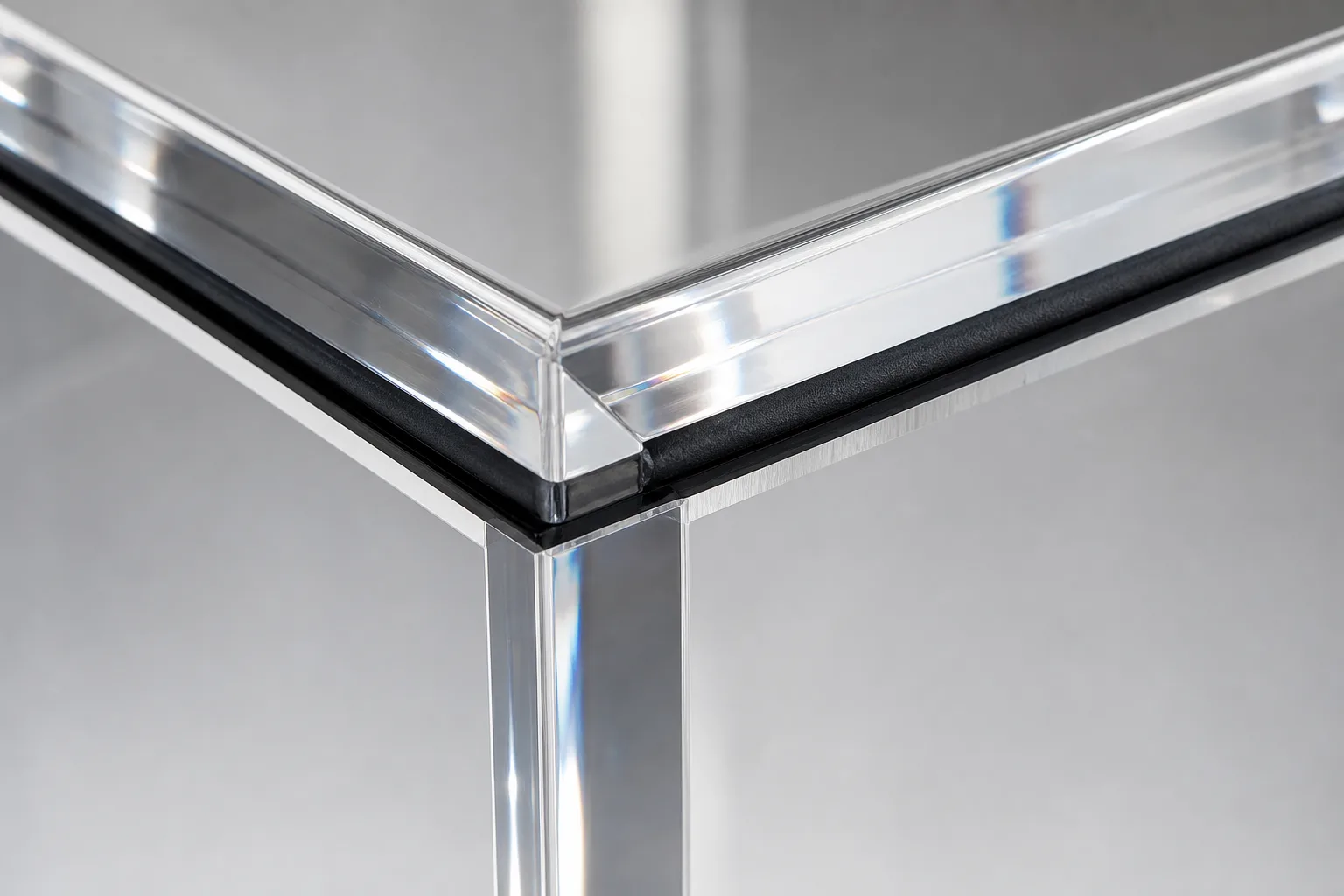
In acrylic terms, that means the deck and any internal shelving are stepped to span. A 3mm shelf that is fine at 200mm will visibly deflect at 600mm; museum builds step to 8-10mm or add a concealed rib long before sag appears, because a sagging deck tilts the object toward the glazing. Cradles, ring mounts, and slanted supports are CNC-cut to the object’s measured profile — this is where a fabricator working to ±0.2 mm on machined profiles earns the spec — then faced with conservation-accepted padding so the contact surface passes the same inertness standard as the rest of the case.
Vibration is the quiet requirement. Cases near foot traffic, loading docks, or on upper floors transmit low-level vibration into the object continuously, and hard acrylic-on-hard-object contact concentrates it. The standard response is padded, form-fitted contact plus enough case mass and base stiffness that the enclosure doesn’t ring. For fragile assemblies, the mount holds the object so it cannot walk: a shallow profiled recess beats a flat deck every time. I flag any drawing where a top-heavy object stands free on a smooth deck — it passes every photo review and fails the first school group that stomps past.
Traveling exhibits: the standard is repeatability
A traveling exhibit adds a fifth standard on top of the four above: the case must dismantle, pack, ship, and reassemble identically at every venue, put together by a different crew each time with no fabricator in the room. The design target is not strength in one assembly — it is sameness across many.
That changes the joinery. Permanent solvent bonds give way to keyed, mechanically fastened joints that only fit one way, so a crew cannot assemble the case wrong even working fast. Fasteners are captive or bagged and labeled per panel; every gasket surface is designed to compress and release repeatedly without taking a set; panel edges get protection for the crate, because a chipped edge at venue two is a failed case for the rest of the tour. Assembly documentation ships in the crate — numbered panels, one-page sequence, torque-light fastening so nobody cracks a panel driving a screw home.
The buyer or appointed conservator defines the material evidence, enclosure performance, handling sequence, inspection method, and venue approvals for a traveling program. Our regional museum traveling exhibit case Manufacturing Case shows how those decisions can be recorded in a non-electrical planning model. It does not claim a delivered tour, archival-grade status, a fixed case quantity, or validated conservation performance. Assembly, disassembly, gasket, and packing checks belong in the approved drawing and paid-sample release when the buyer requires them.
Writing the spec and placing the order
Specifying to museum display standards comes down to five lines a fabricator can quote against: UV grade of the glazing, an approved or conservation-accepted materials list for every component, the sealing level (dust cover, gasketed, or microclimate-ready), mount design with distributed inert contact, and — for touring work — dismountable keyed construction with repeat-assembly verification.
Put numbers on each line and the vague word disappears from the conversation. “UV-filtering cast acrylic, ~90-98% UV block” instead of museum-grade. “All interior components Oddy-pass or conservation-accepted; solvent joints cured and aired before enclosure” instead of archival. “Gasketed enclosure with conditioning chamber for institution-managed silica gel” instead of sealed. A supplier who can’t quote against those lines has answered your qualification question early.
Two practical notes for procurement. First, museum display standards apply per case, not per order — a mixed program can hold paper behind UV grade and stone behind standard clear, and the quote should show the split rather than average it. Second, ask for the verification step in writing: what gets measured or exercised before crating. On our builds that means gasket-line inspection, materials checked against the approved list, and — for touring cases — a full assemble-and-strike cycle on the factory floor. You are buying the checking as much as the acrylic.
On our side: we fabricate large display cases and full exhibit-case programs from UV-filtering and standard cast acrylic in our ISO 9001-certified Shenzhen facility, with samples in 3-5 days and production in 15-20 days. Send the object dimensions, the sensitivity class, the sealing level, and the tour schedule if there is one — send us your spec and we respond within 24 hours with a build proposal against each standard above, stated in numbers you can check.
Footnotes
-
Agent of Deterioration: Light, Ultraviolet and Infrared — Canadian Conservation Institute — CCI’s guidance documents the 50-lux visibility benchmark, the traditional museum rule keeping UV below 75 µW/lm, and typical UV loads of daylight (~600-1000 µW/lm) and daylight through window glass (~400-500 µW/lm). ↩
-
Oddy Test — AIC Conservation Wiki — describes the museum materials-screening protocol: a sample sealed with silver, copper, and lead coupons at 60 °C and high humidity for 28 days, with coupon corrosion indicating the material is unsafe near collection objects. ↩
-
Museum Handbook — National Park Service — the NPS Museum Handbook is the reference for collection-care practice behind exhibit-case requirements, including agents of deterioration, object handling, and exhibit conservation planning. ↩
Frequently Asked Questions
What does museum-grade acrylic actually mean?
On a real spec sheet it means UV-filtering cast acrylic — blocking about 90-98% of ultraviolet versus the roughly 55% that standard clear sheet transmits — fabricated with components inert enough to share air with a collection object. If a supplier can't state the UV grade and what the adhesives and liners are, the word museum-grade is decoration.
How much UV protection does a museum display case need?
Conservation guidance keeps UV at the object below 75 microwatts per lumen — the traditional museum ceiling. Unfiltered daylight runs around 600-1000 microwatts per lumen, so glazing has to do real work. UV-filtering cast acrylic blocks about 90-98% of incoming UV, which brings typical gallery and window lighting under the line.
What is the Oddy test and does acrylic pass it?
The Oddy test is the museum world's accelerated corrosion screen: a material sample sealed for 28 days at 60 degrees Celsius with silver, copper, and lead coupons. If the coupons corrode, the material off-gasses and stays out of the case. Cast acrylic sheet is widely accepted for display glazing; the components to interrogate are adhesives, gaskets, paints, and fabric liners.
Can an acrylic display case control humidity?
Not by itself — a case is a barrier, not a machine. What a fabricated case can provide is a gasketed, low-exchange enclosure with a concealed chamber sized for silica gel or other conditioning media, which the museum's conservation team then maintains. Specify microclimate-ready construction if you need it; a plain dust seal is a different, simpler and lower-cost build.
What should a traveling exhibit case specification include?
Dismountable construction with keyed joints that only assemble one way, captive or bagged hardware, gasket surfaces that survive repeated assembly, edge protection for transit, and labeled packing. The test is repeatability: venue four should get the same case as venue one, assembled by a different crew without a fabricator on site.
Explore Custom Acrylic Products
Browse product categories to compare formats, materials, and customization options before choosing the closest fit for your project.