
End Cap Displays: What Acrylic Does Best
The store owns the end cap fixture. What your brand sends is the set of parts that sits on it, and acrylic is the material for the parts that have to last more than one promotion.
Need this made?POS display manufacturer →

This guide covers end cap parts, fixture fit, graphic changes and store rollouts. Choosing between acrylic and cardboard for a whole POP program has its own guide.
Key Takeaways
- An end cap display is the shelving unit at the end of an aisle, facing the main walkway; the store owns the fixture and the brand supplies the parts on it.
- Acrylic suits the end cap parts that are handled and reused: headers with changeable graphics, shelf dividers and fences, shelf-edge sign holders, risers and product trays.
- Measure the retailer's actual fixture first: section width, shelf depth, shelf-edge profile and how parts may attach without drilling the store's shelves.
- Plan the acrylic to outlast the promotion and change only the printed graphics, which keeps later campaigns to a print order.
- Published references: a two-tier countertop stand is $28 each at 100 pieces and $16 at 500; a 300 × 150 mm shelf is $8 at 100; an A5 slant-back sign holder is $6.80 at 100, FOB Shenzhen.
On this page
What an end cap display is
An end cap display is the shelving unit at the end of a store aisle, facing the main walkway where most shoppers pass. Stores give end caps to promotions, seasonal lines and featured brands for a set period. The fixture itself, usually a metal gondola section, belongs to the store; the brand supplies what goes on it.
That split decides the brief. You are rarely designing a free-standing unit. You are designing a kit of parts that fits a fixture you do not control: a header on top, product on the shelves, price and promotion signs on the shelf edges, and sometimes a stand or tray on the base deck.
Most end caps are 3 or 4 feet wide, the width of the gondola run they finish, with three to five shelves. Treat those figures as a starting point only. The fixture at your retailer is the one that counts.
Which end cap parts acrylic does best
Acrylic is the right material for end cap parts that are handled every day, cleaned often and expected to survive more than one promotion. Clear acrylic sheet transmits up to 92 percent of visible light,1 so a divider or fence does not hide the product, and the same sheet takes printing, engraving and color. The store’s metal frame and shelves stay as they are, and very short promotions can still use cardboard.
| End cap part | Why acrylic | Usual alternative |
|---|---|---|
| Header or topper panel | Takes UV print or a slide-in graphic; reads from down the aisle | Printed card on the fixture’s header frame |
| Shelf dividers and front fences | Keeps rows upright and faced without hiding the product | Wire dividers |
| Shelf-edge sign holders and price strips | Protects price and promotion cards; cleaned in place | Paper strips in the store’s own channel |
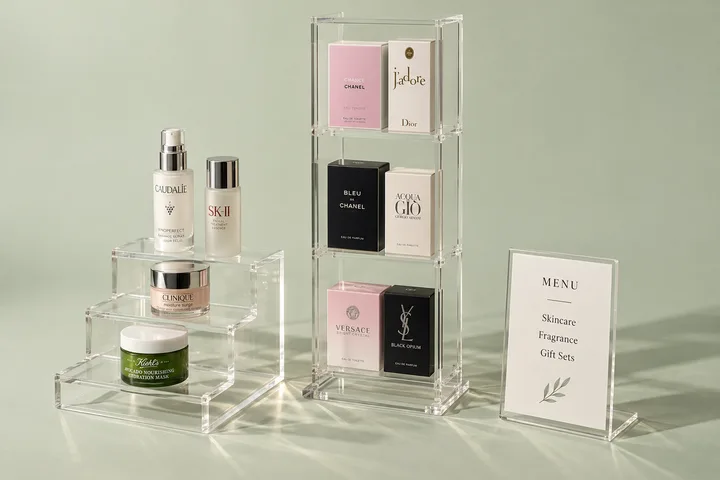
| Risers and stepped stands | Lifts hero products at the top of the end cap | Cardboard risers |
| Trays and bins on the base deck | Holds loose or small items in a neat block | Corrugated trays |
| Tester or sample holders | Survives handling and daily wiping | Not usually replaced by card |
For a 4–6 week promotion with a fixed date at both ends, cardboard is often the better choice. When the same end cap layout returns every season, or the brand holds the space for months, acrylic parts pay back because they stay in the store. Our acrylic vs cardboard POP guide compares cost per week of display life.
Fit the parts to the store’s fixture
End cap parts are drawn from the retailer’s actual fixture, not a catalog size. Before a drawing starts, get the section width, the shelf depth and thickness, the shelf-edge profile, the header frame size and the rules on attaching anything. Many retailers do not allow drilling into their shelves, which changes how dividers and sign holders are fixed.
What to measure or ask the retailer’s store-planning team for:
- Section width and the number and spacing of shelves.
- Shelf depth, and the profile of the front edge or price channel.
- Header frame or topper size, if the fixture has one.
- Base deck size and the weight it will carry.
- Attachment rules: clip-on, adhesive, magnetic or free-standing only.
Most acrylic end cap parts sit on the shelf, clip over its front edge or use an adhesive matched to the shelf surface, with the contact area sized to the load. The paid sample is where that fixing gets tested on a real shelf section, together with the product fit and the graphics.
Shelf load matters if acrylic shelves or trays carry product. As a published reference, an 8 mm acrylic shelf on a 300 mm span holds about 5 kg, and a 500 mm span at the same thickness about 3 kg before visible deflection; heavier loads move to 10 or 12 mm. Our acrylic shelves page lists spans, thicknesses and mounting options.
Change the graphics, keep the acrylic
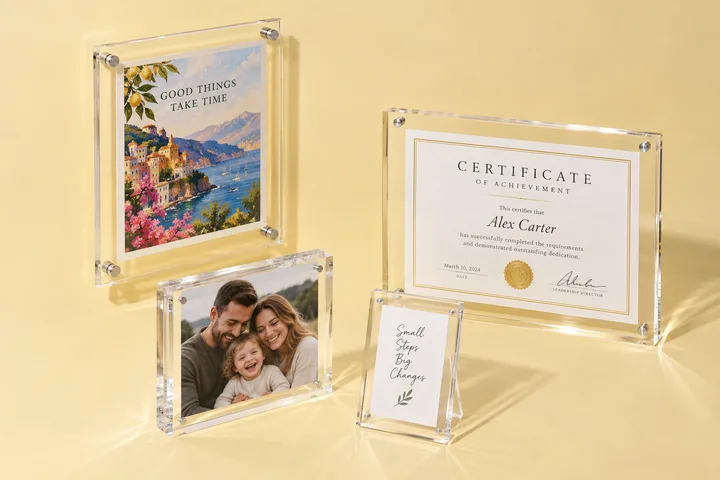
The most useful end cap decision is to plan the acrylic to stay and the graphics to change. A header panel with a slide-in channel, or sign holders with a pocket, take a new printed insert for each promotion. The next campaign then needs a print order and a store visit, not a new fabrication run.
Three choices make graphics changes easy for store staff:
- Top-loading or side-loading channels, so an insert slides in without tools or removing the part from the fixture.
- One insert size across all stores in the program, so a print run serves every end cap.
- Inserts printed on paper, card or thin PET, so staff can handle them; UV print directly on the acrylic only for the elements that never change, such as the brand mark.
Store staff clean end cap parts with whatever is on the cart. The ACRYLITE sheet manufacturer lists window cleaning sprays, scouring compounds and solvents including alcohol among the products not to use on acrylic sheet;2 add mild soap and water to the store’s setup card. Our interchangeable graphics guide compares the four ways a display takes a new graphic, and for shelf-edge parts our custom acrylic sign holders page shows pocket and channel formats.
Roll out to stores in one program
Production starts at 100 pieces per design, so most end cap programs are ordered for a group of stores at once. Approve one physical sample on a real fixture section first, then run every part for the program and pack it per store, with the fixing hardware and a planogram card in each store’s carton.
On a delivered rollout, 5,400 acrylic display units across 12 SKUs reached all 50 stores of a US retail chain in 7 weeks from brief to first delivery, packed per store with the hardware and planogram card. That is the pattern to copy: one approval, one run, and cartons a store team can open and install without calling the brand.
Count parts per end cap before asking for prices. A kit with two stands and four sign holders across 100 stores is 200 stands and 400 sign holders, and those totals set the price tier for each part. The 50-store rollout case shows how a multi-part program was split into shipment waves.
What end cap parts cost
Our published FOB Shenzhen references cover the common end cap parts. A 250 × 180 × 220 mm two-tier countertop stand in 5 mm clear acrylic with one-color UV branding is $28 each at 100 pieces, $16 at 500 and $12 at 1,000. A 300 × 150 mm shelf in 5 mm clear is $8 at 100, and an A5 slant-back sign holder is $6.80 at 100.
| Reference part (FOB Shenzhen) | 100 pcs | 500 pcs | 1,000 pcs |
|---|---|---|---|
| Two-tier countertop stand, 250 × 180 × 220 mm, 5 mm clear, one-color UV | $28 | $16 | $12 |
| Shelf, 300 × 150 mm, 5 mm clear, two brackets | $8 | $4.80 | $3.80 |
| A5 slant-back sign holder | $6.80 |
Priced with the 100-piece references, two stands and four sign holders come to $83.20 per end cap before packing and freight. At 500 stands, the stand price falls to $16 each. Headers, dividers, fences and anything cut to a specific fixture are quoted from your drawing. Our custom POP display cost guide explains how materials, graphics and quantity move POP prices.
Send an end cap RFQ
A complete end cap brief gets a quote within 24 hours. Send the retailer’s fixture details and the list of parts per end cap, so the quote shows each part as its own line with the quantity across all stores.
Include these items:
- Photos and measurements of the fixture, including the shelf-edge profile.
- The parts per end cap and the products each one holds.
- Store count, and how many end caps per store.
- Graphics plan: what is printed on the acrylic and what changes by promotion.
- Logo files as production-ready vector artwork.
- Packing per store, destination and the in-store date.
We build from your drawing or marked photos and do not design displays or artwork. As a POS display manufacturer for brands and retail programs, we sample in 3–5 days, produce in 15–20 days after approval and inspect every piece against the approved sample. For the wider range of stands, see our custom acrylic display stands.
Footnotes
-
PLEXIGLAS: Light transmission — the sheet manufacturer states that clear-transparent PLEXIGLAS shows transmittance of up to 92 percent in the visible range, the loss coming from about 4 percent surface reflection at each face. ↩
-
ACRYLITE: Clean, disinfect and maintain ACRYLITE acrylic sheet — the sheet manufacturer’s care manual lists window cleaning sprays, scouring compounds and solvents including alcohol as cleaners not to use on acrylic. ↩
Frequently Asked Questions
What is an end cap display?
An end cap display is the shelving unit at the end of a store aisle that faces the main walkway, where shoppers pass most. Stores use end caps for promotions and featured products; the brand supplies the merchandising parts that sit on the store's fixture.
Which end cap parts should be acrylic?
Parts that are handled, cleaned and reused across promotions: header panels with slide-in graphics, shelf dividers and fences, shelf-edge sign holders, risers and product trays. The store's metal gondola stays as it is, and short promotions may still use cardboard.
How do acrylic parts attach to a store end cap?
Most sit on or clip to the store's existing shelves, or use an adhesive matched to the shelf surface, because many retailers do not allow drilling. Send a photo of the fixture and its shelf-edge profile, and the fixing method is confirmed on the paid sample.
What is the minimum order for end cap displays?
Production starts at 100 pieces per design. A paid sample costs USD 200–500 depending on complexity, takes 3–5 days, is paid separately and is never credited to production. Production takes 15–20 days after approval.
Can we change the end cap graphics without new acrylic?
Yes, if the parts are designed for it. Header panels and sign holders with a pocket or slide-in channel take a new printed insert for each promotion, so the acrylic stays in the store and only the print is reordered.
Send Your End Cap Plan for a Parts Quote
Attach a photo and measurements of the retailer's fixture, the parts you want, quantity per design, store count, graphics plan and destination. We reply within 24 hours.