



Dispensary Locking Display Case Buying Guide
The buyer and local authority define access and regulatory requirements; the acrylic supplier turns approved inputs into a mechanical enclosure.
Need this made?Dispensary display cases →
Key Takeaways
- Treat laws, access rules, labeling, placement, and anchoring as buyer and local-authority inputs, not supplier assumptions.
- Specify the mechanical lock, key control, opening path, service access, and staff workflow as one system.
- The local installer must approve substrate, fasteners, loads, clearances, and site conditions.
- Visibility depends on product layout, sight lines, reflections, labels, shelves, and buyer-approved lighting.
- Approve the enclosure with a paid sample or production-representative section before a multi-location release.
On this page
- Put local requirements before the enclosure
- Define products and planogram
- Specify the mechanical lock system
- Design staff access and replenishment
- Assign anchoring to the local installer
- Control visibility and lighting
- Review material and cleaning documents
- Approve a production-representative sample
- Build the store rollout matrix
- Send a review-ready RFQ
- Plan keys, spares, and service records
Put local requirements before the enclosure
A dispensary locking display case begins with buyer-approved legal, licensing, security, accessibility, labeling, and store-operating requirements. Those inputs vary by jurisdiction and business model. The acrylic supplier should fabricate to the approved brief, not market a generic enclosure as universally compliant.
Ask the buyer to name the reviewing authority or qualified adviser, the applicable store location, product category, permitted customer access, staff workflow, required labels, and installation responsibility. Keep that record with the drawing.
The cannabis display compliance guide provides a question set for state-specific review. It does not replace legal advice or approval from the buyer’s local authority.
I separate fabrication questions from regulatory decisions in the first call. That lets the buyer own the rule interpretation while Wetop owns material, geometry, workmanship, sample, inspection, and packing within the approved scope.
The lockable acrylic display case page provides the nearest product route. The multistate dispensary locking-case project shows how buyer and local-review inputs were separated from fabrication promises.
Define products and planogram
Send actual package sizes or controlled models, quantity per facing, labels, shelf positions, visibility priorities, and replenishment method. The case must fit the finished packages, not a nominal product category.
Define minimum and maximum package envelopes when suppliers or labels vary. Include caps, hang tabs, security devices, sleeves, and price labels. A planogram image should connect to a dimensioned layout.
Separate display capacity from storage. A countertop case designed for daily presentation may not be the right stock-holding cabinet. State whether staff load through a rear door, lift-off lid, sliding panel, drawer, or removable tray.
Keep required warnings, license information, prices, and product labels visible according to buyer instructions. The supplier can provide graphic zones and holders but should not author regulated copy.
Specify the mechanical lock system
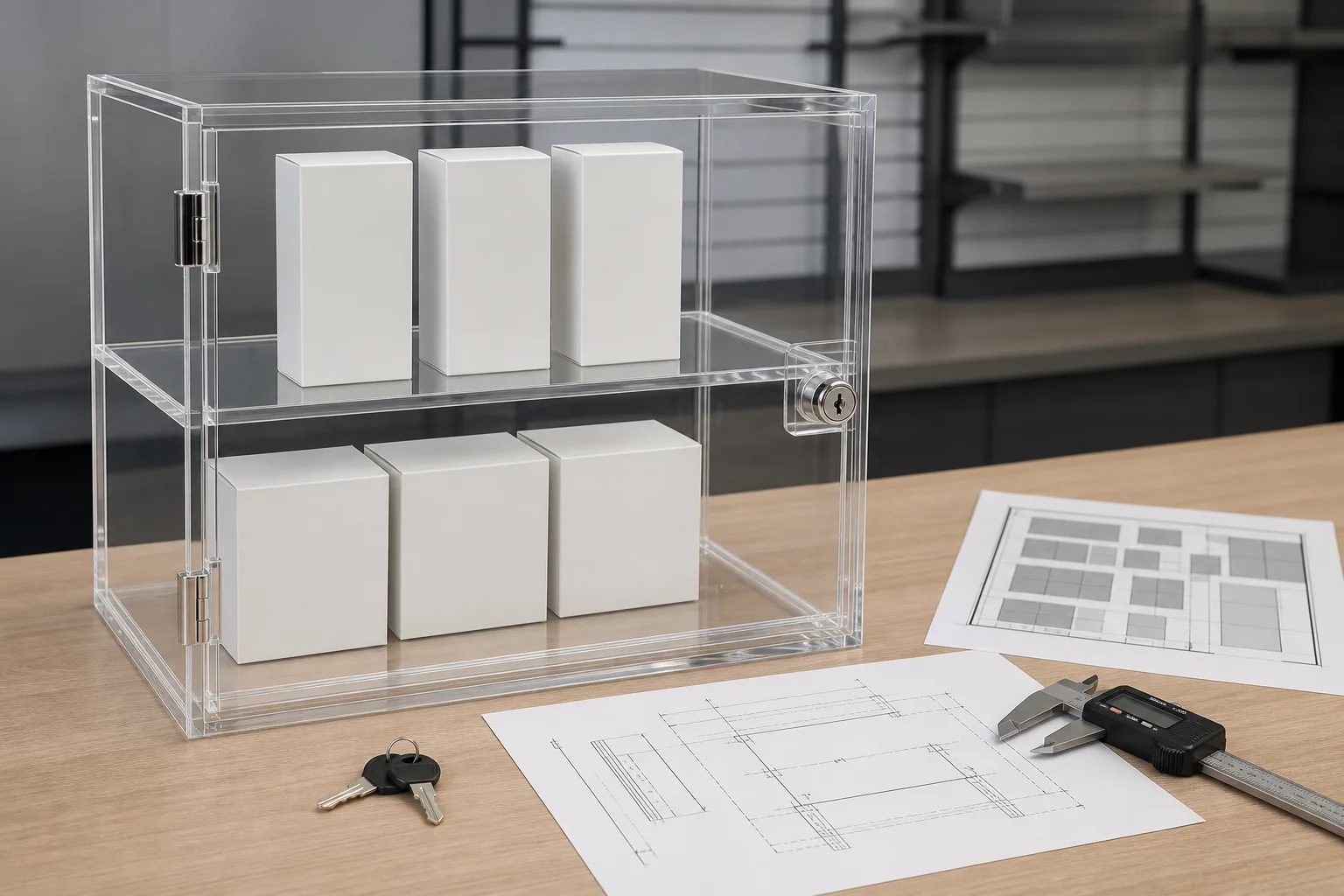
Select the lock from door or lid geometry, opening frequency, staff access, key control, service plan, and buyer security review. Cam locks, keyed-alike groups, keyed-different groups, hasps, and buyer-nominated hardware create different interfaces.
Name lock manufacturer or performance requirements when procurement standards demand it. The quote should identify included lock, keys per unit, key coding, spare policy, replacement route, and any buyer-supplied hardware.
Approve operation on the assembled sample. Check opening sequence, door alignment, latch engagement, clearance, key removal position, staff hand access, and the behavior of shelves or products when the case opens.
Do not claim a generic case is burglar-proof, child-resistant, tamper-proof, odor-proof, or certified. Those outcomes require defined standards, test methods, and appropriate evidence beyond a mechanical lock.
Design staff access and replenishment
Security and daily use must share one workflow. Define who opens the case, where the key is controlled, how products are replenished, whether the customer can touch anything, and how the case is cleaned without removing it from service.
Choose hinge, sliding, lift-off, or removable-panel access from aisle clearance, counter depth, shelf position, and staff reach. Show the full opening envelope on the drawing. A door that clears in CAD can collide with a wall, neighboring fixture, label rail, or product.
Include finger access, handles, stops, stays, bumpers, and removable shelves where needed. Keep hands away from sharp corners and pinch points through buyer-approved geometry and hardware.
If several stores use different counters, create a site matrix rather than forcing one unverified mounting arrangement. The case body may remain common while the installer interface changes by approved site type.
Assign anchoring to the local installer
The local qualified installer should approve substrate, fasteners, edge distances, loads, clearances, access, and site conditions. Wetop can fabricate drawing-defined holes, plates, brackets, or interfaces but should not certify an unknown counter, wall, or floor.
Provide counter material, thickness, underside access, existing services, prohibited drilling zones, and load assumptions. Mark buyer-supplied and supplier-supplied hardware separately.
Do not treat adhesive tape as a universal security anchor. Surface preparation, coating, temperature, load direction, dwell, aging, and removal requirements vary. Use a named system with its current producer instructions when adhesive is approved.
For multi-location programs, the installation pack should include the approved case drawing, site interface, hardware list, instructions, responsibility split, inspection points, and escalation contact.
Control visibility and lighting
Visibility depends on acrylic clarity, sheet finish, reflections, panel count, joints, shelf edges, labels, product density, viewing angle, store light, and background. Approve the complete case in the intended viewing condition.
If the case needs built-in lighting, we build the LED version to your drawing and lighting spec: light source, driver position, wiring route, heat, service access, and the certification marks your market requires. Store lighting and on-site installation stay with your installer.
General workplace and retail-safety resources can support the buyer’s site review, while they do not certify a specific case or installation.1 Local building and fire requirements may adopt and amend model codes, so the buyer and installer should confirm the rules at the actual address.2
Use clear sight lines for primary packages and place labels where they do not cover regulated or brand information. Frosted or colored elements can define structure but may reduce visibility behind them.
The paid sample should be loaded with representative products and labels. Review front, side, staff, and customer views under buyer-selected light and background conditions.
Review material and cleaning documents
Specify the acrylic producer, grade, thickness, finish, and required supplier documents when those facts matter. Avoid unsupported “medical,” “food-safe,” or “compliance-grade” labels. The buyer decides which documents its jurisdiction and operating procedures require.
Provide the store cleaning agents, frequency, tools, and contact time to the material and hardware suppliers for review. Wetop’s general acrylic care guidance uses mild detergent and a soft cloth and avoids alcohol on acrylic unless a named material supplier approves otherwise for the specific sheet.
Cleaning should not compromise labels, lock lubrication, adhesive, printed graphics, or product packages. Define removable shelves and access where staff need to reach interior surfaces.
Record approved products and instructions in the store handoff. A material datasheet supports review, while it does not approve a complete enclosure for every chemical or procedure.
Approve a production-representative sample
The sample should include the approved case geometry, acrylic, shelves, lock, keys, access hardware, labels or holders, product fit, anchoring interface, protective film, and packout. Use buyer-approved products or models.
Wetop paid samples take 3–5 days, are paid separately, and are never credited to production. Production MOQ is 100 pieces per design. Standard production takes 15–20 days after drawing, sample, artwork, and commercial approvals.
Record fit, opening, lock operation, key plan, sight lines, shelf loading, product removal, cleaning access, artwork, cosmetic boundary, and carton assumptions. Any local compliance review remains the buyer’s responsibility.
If the sample changes, issue a new drawing and approval. Do not release multiple stores from a mix of marked-up screenshots and an obsolete physical sample.
Build the store rollout matrix
Create one row per store or site type with quantity, counter or wall interface, product planogram, lock group, key count, labels, carton mark, delivery destination, installation owner, and required date. Group only sites that truly share the same approved physical design.
For keyed-alike programs, document the buyer’s security acceptance and key distribution. For keyed-different programs, control unit-to-store allocation and replacement identification without exposing unnecessary key information on public labels.
Ask for store-ready and central-warehouse packout alternatives. Store-ready cartons can reduce downstream sorting but require stricter labeling and allocation control.
Preserve drawing, sample, lock schedule, site matrix, packing, and approval records for repeat or replacement units. A replacement must match the correct physical and key revision.
Send a review-ready RFQ
Send jurisdiction and buyer requirements, product samples or models, planogram, case dimensions, access workflow, lock and key brief, site drawings, anchor responsibility, artwork, quantity by store, packing, destination, and dates.
Ask the supplier to return material, construction, included hardware, lock schedule assumptions, access, site interface, sample, unit price, packing, carton data, Incoterm, production time, freight, and exclusions.
Use the locking case quote form to upload the brief. We reply to complete files within 24 hours and identify which inputs remain buyer or local-authority decisions.
The final release should distinguish fabrication approval, store approval, installation approval, and regulatory review. A clear responsibility split is more useful than a supplier compliance slogan.
Plan keys, spares, and service records
Locking cases remain useful only when the buyer can control keys and service parts. Create a confidential key schedule with lock group, key count, authorized holders, spare location, replacement route, and store allocation. Keep public carton marks separate from sensitive key information.
Define which components are replaceable: lock, key, hinge, shelf, bumper, panel, handle, or complete door. Give each serviceable item a part number and revision. The supplier should identify buyer-nominated hardware and any component whose future availability is not guaranteed.
For replacement orders, send the original case revision, store, lock group, photos, failure description, and required part. Do not match a replacement from appearance alone when several key or hardware revisions exist.
Record installation date, approved site interface, key handoff, maintenance instructions, and service events. This record supports the buyer’s operating procedures and helps prevent a local repair from silently changing the approved access geometry.
Service planning does not create a security or compliance guarantee. It gives the buyer a controlled way to maintain the mechanical enclosure it has approved.
Compare the brief with the lockable acrylic case product page and broader custom acrylic cases. The dispensary display manufacturing route keeps local legal review, access policy, installation, and enclosure approval with the buyer.
Footnotes
-
OSHA retail safety resources — OSHA provides general workplace safety resources; buyers and installers remain responsible for site-specific requirements. ↩
-
International Code Council — The ICC publishes model building codes adopted and amended by local jurisdictions. ↩
Frequently Asked Questions
Are acrylic display cases compliant for dispensaries?
Compliance depends on jurisdiction, store license, product, access, labeling, placement, anchoring, and operating procedures. The buyer and local authority must approve requirements; the supplier should not give a blanket compliance guarantee.
What lock should a dispensary display case use?
Choose from the required access workflow, user group, opening frequency, door geometry, key control, service plan, and buyer security review. Approve the complete mechanical assembly, not a lock name alone.
Can a locking case be anchored to the counter?
Yes, when the buyer's local installer approves the counter substrate, fasteners, edge distances, loads, access, and site conditions. Show the buyer-defined interface on the drawing.
Does a lockable acrylic case control odor or child access?
Do not assume it does. Odor containment, child resistance, tamper resistance, or other regulated performance requires a defined test method, acceptance criteria, and appropriate product certification outside a generic case claim.
What should a multi-store RFQ include?
Send jurisdiction and store requirements, product sizes, planograms, access workflow, lock and key plan, counter drawings, anchoring responsibility, quantities by site, labels, packing, and installation handoff.
Turn Store Requirements into a Locking-Case Drawing
Send the product, layout, access workflow, lock brief, site interface, quantity by store, and destination. We will identify missing fabrication inputs within 24 hours.