Delivered Project · Cannabis Dispensaries · United States
Cannabis Dispensary Locking Case Program
A U.S. cannabis dispensary buyer needed locking acrylic cases that fit its staff-access workflow and store layout.
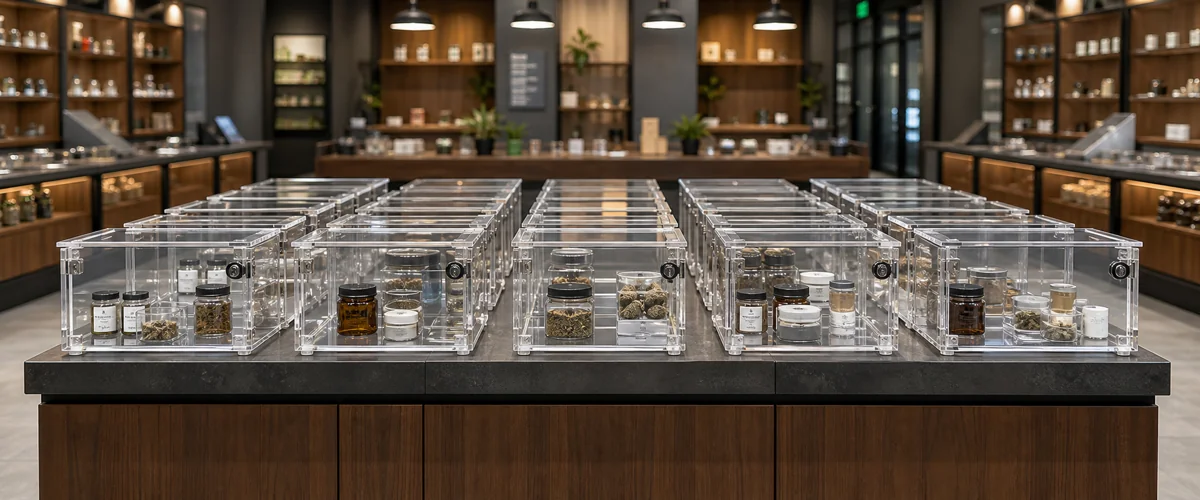
Its compliance team set the local rules; we drew, sampled, built and inspected the cases to that approved specification.
Ordering a similar project
The minimum order is 100 pieces per design. Paid samples normally take 3–5 days; sample fees are paid separately and never credited. Standard production takes 15–20 days after the drawing, hardware, sample, inspection plan, labels, and packing are approved. Wetop responds to a complete brief within 24 hours.
Closest published price: this order was quoted line by line from the approved drawing and hardware. The nearest public reference on the acrylic cases hub is a 600 × 400 × 1000 mm, 8 mm clear, lockable floor-standing case at 100 pieces, from $60–120 per unit FOB Shenzhen. Access hardware, shelves, mounting, labels, packing, quantity and destination set the final figure.
Key Takeaways
- A U.S. cannabis dispensary buyer came to us for custom locking acrylic cases; its compliance team and local counsel set the access, lock, labeling and inspection rules before we drew the case.
- We built one approved drawing per hardware and access specification, with a removable lock plate and a gasket made to the buyer's test method.
- The paid sample took 3–5 days and proved door travel, lock fit, key control, shelf load, finish, cleaning access and packing before production.
- Manufacturing records and the accepted hardware part number shipped with the cases, and keys were handled under the buyer's written handover instructions.
The Brief
The buyer ran cannabis dispensaries in the United States and needed locking acrylic cases for product on display. The brief started with the product, the staff-access workflow, the store layout, the cleaning method, the destination and the local requirements.
The RFQ named the authority having jurisdiction and carried the buyer's approved rules for locks, key control, labeling, access, anchoring, product separation and inspection. The buyer's compliance team and local counsel settled the regulatory questions before we drew anything. Our part was to build and inspect the case they approved; we did not choose the legal requirements or certify the fixture for a state or city.
Our Approach
We made one approved case drawing for each distinct hardware and access specification. We did not assume one lock, hinge, gasket or label would work across jurisdictions.
Set acrylic thickness from the approved geometry
Panel span, door size, shelf load, hinge layout, mounting and handling set the material and thickness. We recorded the approved grade and thickness on the drawing after sample review.
Made lock hardware replaceable because the brief required it
We mounted the lock on a removable plate so the buyer could service or change hardware later. The buyer approved the plate, fasteners, access clearances and tamper controls, and the signed drawing recorded the construction.
Treated a gasket as a product requirement, not a legal claim
The brief named the gasket's purpose, material restrictions, compression, cleaning method and test. We quoted and ran the buyer's test method and made no promise of odor containment or regulatory acceptance.
Sample and Specification
The paid sample review covered door operation, lock fit, key control, shelf load, mounting, edge finish, cleaning access, labels and packing. Each check used a written method and acceptance threshold the buyer supplied or approved. The buyer confirmed that the sample matched its checklist before we released production.
Door and gasket construction
The diagram shows how the door, gasket and case-body landing met on this order.
Access hardware
The buyer specified the lock and the access sequence. We checked fit and operation on the paid sample and recorded the accepted hardware part number in the order file.
Mounting and load
The buyer sent the intended contents, load, installation surface, anchoring method and site restrictions. We returned a drawing, and the buyer and its installer approved it.
Production
Production ran 15–20 days after the drawing, hardware, sample, inspection plan, labels and packing were approved. Each hardware variant ran as a separate design code with its own 100-piece MOQ.
The production file recorded material, cutting files, hardware, assembly sequence, inspection points and packing. We packed each case with the hardware kept off the acrylic faces, and keys were handled under the buyer's written handover instructions. Carton marks showed the design code and destination.
Install and Local Review
The manufacturing records traveled with the shipment. The buyer's installer and the authority having jurisdiction reviewed the installed cases. Site anchoring, staff procedures, product handling, local labels and inspections stayed with the buyer, as agreed before quotation.
If You're Planning Something Similar
Write down the access workflow before you pick hardware: who opens the case, where keys are kept, how often staff need access, and what happens at stocking and closing. If stores follow different rules, treat each as its own design. Put any test in the RFQ with a named method, cycle count and pass threshold, and list the documents your review needs. Our factory inspection covers the drawing, hardware, appearance, operation and packing; site acceptance stays with you and your local reviewers.
Send the case dimensions, contents, load, access workflow, lock specification, mounting surface, cleaning method, labels, quantity, destination and local requirements, and we return questions, a DFM review and a written quote. See custom acrylic display cases and the dispensary display compliance guide.
Sourcing cannabis display cases for a multi-state rollout?
Send the case dimensions, contents, load, lock specification, mounting, cleaning method, quantity, destination, and buyer-approved local requirements. We will return a DFM review and written quotation.
Sample fees are paid separately and never credited.