





Dispensary Display Compliance: Fixture Spec Guide
A cannabis display isn't just a merchandising choice — it's a compliance decision.
Need this made?Dispensary display cases →
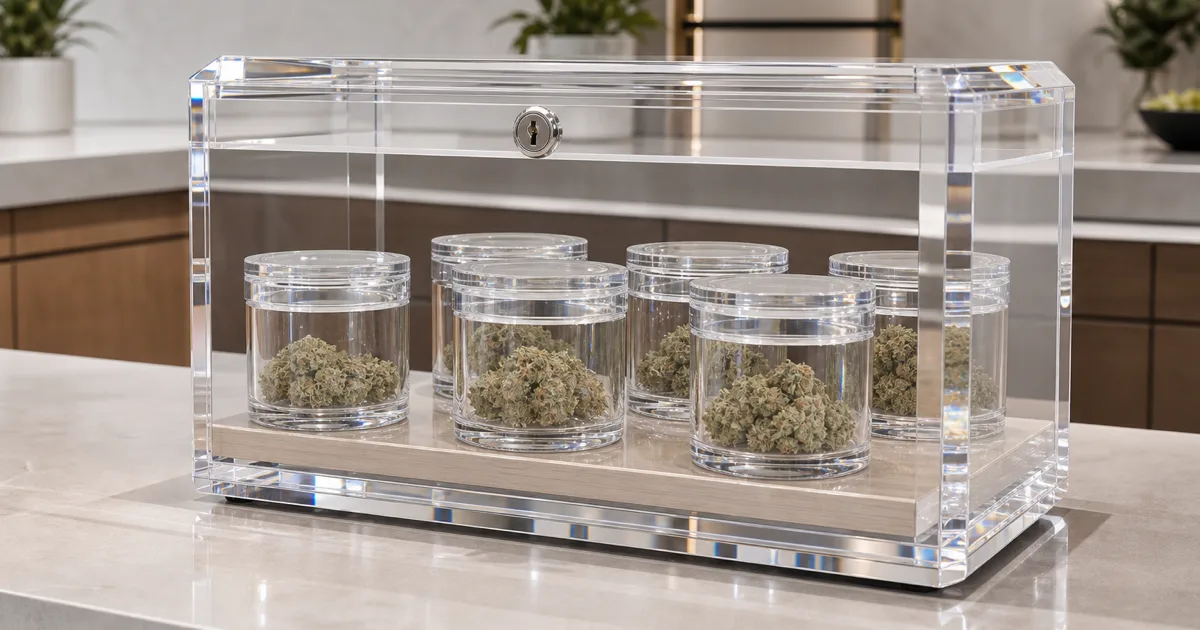
The fixture you pick has to match how your state lets customers see, reach, and buy the product.
Key Takeaways
- A cannabis dispensary display is a compliance fixture first and a merchandising fixture second — many states restrict self-service access to cannabis goods, so the fixture has to keep product staff-controlled or locked, not open on a shelf.
- Rules vary by state and locality — California's DCC, New York's OCM, and every other state cannabis agency write their own retail regulations, so a fixture that's fine in one market may fail inspection in another; always verify against your own state's regulations.
- Lockable cases and staff-side counter risers are the workhorse fixtures because they let a customer see the product clearly through optical-grade acrylic while a budtender controls physical access — the exact see-but-don't-touch model most retail cannabis rules require.
- Child-resistant requirements under the federal Poison Prevention Packaging Act apply to the product packaging leaving the store, not the display fixture — but the fixture still matters, because locked and staff-controlled displays keep un-child-resistant open stock away from public reach on the floor.
- Cast acrylic (PMMA) is the practical display material over glass for cannabis retail: optically clear, lighter and safer to handle behind a busy counter, and easy to wipe down and sanitize between customers, which matters in a high-touch, high-turnover retail setting.
On this page
- The short answer — a dispensary display is a compliance decision
- Why cannabis retail needs specific fixtures
- The fixture types — matched to the compliance need
- Lockable display cases — the workhorse fixture
- Staff-side counter risers and product jars — see-but-don’t-touch
- Material — why cast acrylic over glass for cannabis retail
- The child-resistant question — packaging vs. fixture
- State-by-state — why “rules vary” is the whole point
- How to spec a compliant fixture — a working sequence
- What we inspect before a dispensary fixture ships
- How we sourced the compliance facts in this guide
The short answer — a dispensary display is a compliance decision
A cannabis dispensary display is a compliance fixture before it’s a merchandising fixture. Most states restrict self-service of cannabis goods, so the display has to keep product staff-controlled or locked while still letting the customer see it clearly. Pick the fixture to your state’s access rule first; the look and the price follow from there.
In ten-plus years of inspecting custom fixtures before they ship, I’ve watched the cannabis category turn an ordinary retail question — how do I show product to a customer — into a regulated one. A cosmetics brand can put a tester on an open shelf. A dispensary usually can’t put flower within a customer’s free reach, because the rules in most legal markets treat cannabis goods as controlled retail: viewable, but not self-service. That single constraint is what separates a dispensary display from any other retail fixture, and it’s why “what does a cannabis display look like” is the wrong first question. The right first question is: how does my state let a customer see, reach, and buy the product? Answer that, and the fixture almost picks itself. This guide walks the fixture types, the material choice, and the compliance framing the way I’d walk a dispensary buyer through a spec before we quote it.
A required disclaimer, up front and repeated: cannabis retail rules vary by state and locality, they change, and we do not certify any fixture as legally compliant. Everything below is a fixture-spec framework, not legal advice. Verify every requirement against your own state’s cannabis regulations — we build to your compliance spec, we don’t define it for you.
Why cannabis retail needs specific fixtures
Cannabis retail needs purpose-built fixtures because the product is legal to sell but tightly regulated at the point of sale — most state rules limit who can physically reach the goods, so the fixture has to enforce staff-controlled or locked access, not open self-service. That’s a structural difference from ordinary retail merchandising.
The pattern repeats across legal markets even though the exact wording differs. State cannabis agencies write their own retail regulations covering the licensed premises, limited-access areas, storage, and security — California’s Department of Cannabis Control, for instance, sets these out in Title 4 of the California Code of Regulations, sections 15000 through 17905.1 New York’s Office of Cannabis Management runs an entirely separate rulebook, including a dedicated retail-dispensary regulation (Part 116) under its own state process.2 Two legal markets, two different regulators, two different rule sets — which is exactly why a fixture that passes in one state can’t be assumed compliant in another. The common thread that survives across almost all of them is the access model: the customer sees the product, a licensed employee controls the product. Your fixtures exist to make that model physical. A locking case, a staff-side counter riser, a sealed sample jar — each one is a way of saying “look, but a budtender hands it to you,” which is what the regulations, in most markets, require.
The fixture types — matched to the compliance need
Cannabis dispensary fixtures fall into a small, repeatable set, and each one exists to solve a specific access or presentation requirement. The matrix below maps the common fixtures to the compliance need they serve, so you can start from the requirement and work back to the fixture instead of the other way around.
| Fixture | What it’s for | The compliance need it serves | Access model |
|---|---|---|---|
| Lockable display case | Flower jars, edibles, cartridges, high-value SKUs | Keep product out of free customer reach; theft and diversion control | Locked — staff key/latch only |
| Staff-side counter riser / tiered stand | Presenting product from behind the counter | Budtender controls handling; customer views, doesn’t touch | Staff-controlled |
| Sealed product display jar | A viewing sample of flower the customer inspects | Show the product without dispensing open stock to the floor | Sample only — never handled by customer |
| Pre-roll tray / organizer | Merchandising and organizing pre-rolls behind glass or on the staff side | Orderly staff-side presentation, fast retrieval | Staff-controlled |
| Menu / sign / price holder | Pricing, potency, and required compliance notices | Display mandated consumer information clearly | Open (information, not product) |
The logic to read here: every fixture that touches actual cannabis goods lands on “locked” or “staff-controlled,” never “open customer self-service.” The only open-access fixtures are the ones that show information — menus, price cards, compliance signage — not product. That’s the see-but-don’t-touch model made physical, and it’s the through-line of nearly every retail cannabis rule set. When a buyer sends me a fixture list, the first thing my team checks is whether anything on it would put open product within a customer’s unassisted reach — because that’s the spec error most likely to fail a state inspection.
Lockable display cases — the workhorse fixture
A lockable display case is the core cannabis retail fixture because it does the two things the rules and the business both demand: it shows the product clearly through optical-grade acrylic, and it keeps that product behind a lock only staff can open. For flower jars, edibles, cartridges, and any high-value SKU, this is usually the default fixture, not the exception.
The lock is doing regulatory and commercial work at once. On the compliance side, applicable access rules vary by jurisdiction and store format, so the buyer and its local advisers must define the requirement. On the business side, a lock can control access to a high-value, easily pocketed product. The fixture spec that matters here is the locking mechanism (a keyed cam lock or a hasp-and-padlock, seated in a precise cutout so the panel does not crack or the lock wobble) and the clarity of the viewing panels. We build these as lockable acrylic display cases and function-check the buyer-approved hardware before shipment. The dispensary locking-case project shows how we recorded access, local review, hardware, sampling, inspection, and packing; it is not a compliance approval.
Staff-side counter risers and product jars — see-but-don’t-touch
Counter risers, tiered stands, and sealed product display jars are the fixtures that make the see-but-don’t-touch model work at the point of sale, letting a budtender present product from the staff side while the customer views it clearly and never handles the goods. They’re the everyday complement to the locked case.
A staff-side riser or tiered stand sits behind the counter and lifts product to eye level so a customer can inspect it while it stays firmly on the employee’s side of the transaction — the same acrylic riser shapes used across retail, spec’d here for staff-controlled access rather than open shelving. A sealed product display jar is the neat solution to a specific problem: customers often want to see and (in some setups) smell the flower, but you can’t hand open stock around the floor. A sealed sample jar — one dedicated viewing unit the customer inspects but never opens — shows the product without dispensing un-packaged goods, keeping the actual inventory staff-controlled and the sample consistent. The material choice matters more than it looks: these are high-touch fixtures a budtender picks up and sets down all day, so light weight, shatter resistance, and a wipe-clean surface aren’t luxuries — they’re what keeps the fixture usable and sanitary at retail volume. That’s the case for acrylic over glass, which the next section takes head-on.
Material — why cast acrylic over glass for cannabis retail
Cast acrylic (PMMA) is the practical display material for cannabis retail over glass: it’s optically clear, far lighter, shatter-resistant, and easy to wipe down and sanitize between customers — all of which matter in a high-touch, high-turnover counter environment. Glass reads premium but is heavy, breakable, and slower to handle at volume.
The tradeoff is concrete once you picture the workflow. A budtender opens a locked case, lifts a jar off a riser, and sets it back down dozens of times an hour, at a counter, in front of customers. In that setting, glass’s weight and fragility are real operational risks — a dropped glass jar behind the counter is a safety and downtime problem, not a minor one — while cast acrylic gives you the same clarity with a fraction of the weight and no shatter hazard.3 Sanitation is the other quiet advantage: cannabis retail is high-touch, and a cast acrylic surface wipes clean quickly between customers without the chip-and-shard risk of glass. Where I hold the line on my inspection bench is optical quality and edge finish — a cannabis display’s whole job is showing the product, so cloudy panels or rough edges fail the fixture regardless of how the lock works. We build most dispensary fixtures in cast acrylic and inspect the clarity, edge polish, and lock function on every piece before it ships. For the deeper material comparison behind this recommendation, our acrylic vs. glass displays guide covers the clarity, weight, and durability numbers in full.
The child-resistant question — packaging vs. fixture
Child-resistant requirements apply to the product packaging that leaves the store, not to the display fixture itself — so a display case or riser is not, and doesn’t need to be, a child-resistant container. But the fixture still supports child safety indirectly, by keeping open and un-packaged stock off the public floor.
The federal baseline is the Poison Prevention Packaging Act, whose testing standard (16 CFR 1700.20) requires special packaging to be significantly difficult for children under five to open while remaining usable by normal adults — tested against panels of children aged roughly 42 to 51 months and separate adult groups.4 That standard governs the exit packaging: the bag, tin, or container the customer walks out with. It does not govern your display case, and no display fixture is expected to meet a child-resistant packaging test. Where the fixture earns its keep on child safety is access: a locked case and staff-controlled risers keep open sample stock and un-packaged product out of a child’s unassisted reach while it’s on the floor. Many states layer their own, sometimes stricter, packaging and display rules on top of the federal baseline, so this is exactly the kind of requirement to confirm against your own state’s regulations rather than assume the federal floor is the whole picture. The fixture-spec takeaway is clean: spec your display for controlled access, spec your packaging supplier for child-resistant compliance — two different requirements, two different products, don’t conflate them.
State-by-state — why “rules vary” is the whole point
There is no single national standard for cannabis retail displays, so “rules vary by state and locality” isn’t a hedge — it’s the central planning fact. A fixture spec that satisfies one state’s regulator can fail another’s, because each legal market writes and enforces its own retail rules through its own agency.
The contrast between two mature markets makes the point. California regulates cannabis retail through the Department of Cannabis Control under Title 4 of the California Code of Regulations, with its own definitions of the licensed premises, limited-access areas, and security requirements.1 New York regulates through the Office of Cannabis Management under the Marihuana Regulation and Taxation Act, with a separate body of rules including a dedicated retail-dispensary part.2 These are independent frameworks — different agencies, different rulebooks, different update cycles — and neither one binds the other. Add local city and county ordinances on top, and a multi-store operator can face genuinely different fixture constraints across its own footprint. That’s why my strongest advice to any dispensary buyer is procedural, not prescriptive: pull your own state’s (and locality’s) current cannabis regulations, identify the access and storage requirements that apply to your license type, then spec the fixture to those. We don’t tell you what your state requires — we can’t, and it would be reckless to. We build the fixture to the requirement you verify. If you’re spec’ing for more than one state, treat each market’s rules as its own checklist, and send us the spec per market so we build to the right constraint each time. Start the conversation at our cannabis dispensary displays application page, which frames the fixture range for this vertical.
How to spec a compliant fixture — a working sequence
Spec’ing a compliant dispensary fixture comes down to a short, ordered sequence: confirm the rule, choose the access model, pick the fixture, then set the material and finish. Run it in that order and the fixture matches the requirement instead of the requirement getting bent to fit a fixture you already liked.
- Confirm the rule. Pull your state’s and locality’s current cannabis retail regulations. Identify how customers are allowed to view, reach, and be handed product for your license type. This step is non-negotiable and it’s yours (or your compliance counsel’s), not ours.
- Choose the access model. From the rule, decide per SKU group: locked, staff-controlled, or open-information-only. Anything that’s actual product lands on locked or staff-controlled.
- Pick the fixture. Map each access model to a fixture — lockable case for locked product, counter riser or sealed jar for staff-controlled, menu/sign holder for open information. Use the matrix above.
- Set material and finish. Default to cast acrylic for weight, safety, and sanitation; specify the locking mechanism, panel clarity, and any branding or compliance-signage integration.
- Send the spec, not the guess. Give your fabricator the verified requirement — “locking cam-lock case, staff-side, this footprint” — so the fixture is built to the rule, not to an assumption.
When the answers point one way, that’s your fixture. When a single SKU group triggers competing needs — say a high-value edible you also want visually front-and-center — the compliance requirement wins over the merchandising wish every time: it goes in the locked case, and you solve visibility with lighting and clear panels, not by loosening access. That ordering discipline is what keeps a display from becoming a compliance liability.
What we inspect before a dispensary fixture ships
Before any cannabis display leaves our floor, we inspect the three things that decide whether the fixture does its compliance job: lock function, panel clarity, and edge finish. A dispensary fixture that arrives with a sticky lock or a cloudy panel isn’t a cosmetic defect — it’s a fixture that can’t perform the controlled-access, show-the-product role it was spec’d for.
In my decade running our 4-stage inspection, I’ve learned that cannabis fixtures fail differently from ordinary retail displays. On a plain merchandising riser, a slightly stiff joint is a nuisance. On a locking cannabis case, a lock that binds means a budtender fights it in front of a customer, dozens of times a day, and a fixture that’s hard to operate is one staff will prop open — quietly defeating the exact access control the fixture exists to provide. So we open and close every lock on every unit, not a sample of the batch. We check panel clarity against the light because the whole point of the fixture is that a customer can read a label and inspect product through it without touching it; a hazy panel undermines the see-but-don’t-touch model as surely as an open shelf would. And we check edge polish and cutout tolerance around the lock seat, because a rough or oversized cutout is where an acrylic panel cracks under repeated use. We build to your verified spec, and we inspect to make sure the fixture that arrives actually holds that spec — because in this vertical, a fixture that underperforms isn’t just a quality miss, it’s a compliance gap on your sales floor.
How we sourced the compliance facts in this guide
The regulatory facts here come from primary government sources, and they are framed deliberately as “rules vary, verify locally” because that is the honest state of cannabis retail regulation. The California retail-regulation framing comes from the Department of Cannabis Control’s published regulations under Title 4 of the California Code of Regulations;1 the New York framing from the Office of Cannabis Management’s regulations page, including its dedicated retail-dispensary part;2 and the child-resistant packaging standard from the federal testing regulation at 16 CFR 1700.20 under the Poison Prevention Packaging Act.4 The material comparison between cast acrylic and glass for retail fixtures reflects published material-property differences in clarity, weight, and impact resistance, not internal Wetop testing.3
What we bring is fabrication, not legal certification. We do not, and cannot, certify any display as legally compliant — cannabis retail rules vary by state and locality, they change, and only your regulator or compliance counsel can confirm a fixture meets them. What we do is build to your verified compliance spec: you confirm the access, storage, and security requirement; we fabricate and inspect the fixture to it. We manufacture custom acrylic dispensary fixtures — part of our wider custom acrylic display stands line — under our ISO 9001 system with a 100-piece MOQ, samples in 3–5 days, and production in 15–20 days, and I inspect every piece — lock function, panel clarity, edge finish — before it ships. To spec a fixture against a requirement you’ve verified, send us your compliance spec and we’ll build to it. We review this guide against its cited sources periodically and update it when a referenced regulation changes — but a periodic update is not a substitute for checking your own current state rules.
Footnotes
-
California Department of Cannabis Control — Regulations — the official California DCC regulations page, confirming that cannabis retail rules are set in Title 4 of the California Code of Regulations (sections 15000–17905), cited for the point that state agencies define retail premises, limited-access, and security requirements. ↩ ↩2 ↩3
-
New York Office of Cannabis Management — Regulations — the official NY OCM regulations page listing adult-use rules including Part 116 for retail dispensaries, cited to show that each legal market runs its own distinct regulatory framework, so rules vary by state. ↩ ↩2 ↩3
-
Acrylic (PMMA) material properties — AZoM — materials reference for cast acrylic’s optical clarity, low weight, and impact resistance relative to glass, cited for the material recommendation of cast acrylic over glass for high-touch cannabis retail fixtures. ↩ ↩2
-
16 CFR 1700.20 — Testing procedure for special packaging (Poison Prevention Packaging Act) — the federal child-resistant packaging testing standard, cited for the point that child-resistant requirements apply to product packaging (significantly difficult for children under five to open), not to display fixtures. ↩ ↩2
Frequently Asked Questions
Do cannabis dispensaries have to keep product in locked or staff-controlled displays?
In most states, yes — retail cannabis regulations commonly restrict customer self-service and require that cannabis goods stay in areas or fixtures customers can't freely reach. California's DCC, for example, regulates retail premises and limited-access areas under Title 4 of the California Code of Regulations. The practical result is see-but-don't-touch: customers view product through a clear display while a budtender controls physical access. The exact rule — locked case, behind-counter, or limited-access room — varies by state and locality, so verify against your own regulations before you spec the fixture.
Which acrylic display fixtures do dispensaries actually use?
The common set is lockable display cases (for flower jars, edibles, and high-value SKUs), staff-side counter risers and tiered stands (so a budtender can present product from behind the counter), sealed product display jars (a viewing sample the customer never handles), pre-roll trays, and menu or sign holders for pricing and compliance notices. Each maps to a compliance need: the lockable case and the staff-side riser exist specifically to keep product out of open customer reach, which is what most retail cannabis rules require.
Are cannabis displays required to be child-resistant?
The child-resistant requirement under the federal Poison Prevention Packaging Act (16 CFR 1700.20) applies to the packaging a product leaves the store in — it must be significantly difficult for children under five to open — not to the display fixture itself. A display case or riser isn't a child-resistant container. But the fixture still supports child safety indirectly: a locked or staff-controlled display keeps open, un-packaged, or sample stock off the public floor where a child could reach it. Always confirm your state's specific packaging and display rules, which can be stricter than the federal baseline.
Is acrylic or glass better for a dispensary display?
For most cannabis retail, cast acrylic (PMMA) is the more practical choice. It's optically clear like glass but far lighter and shatter-resistant, which is safer for staff repeatedly opening a locked case behind a busy counter, and it's easy to wipe down and sanitize between customers in a high-touch environment. Glass looks premium but is heavy, breakable, and slower to handle at volume. We build most dispensary fixtures in cast acrylic for exactly these reasons, and inspect the clarity and edge finish on every piece before it ships.
Can Wetop guarantee a display is legally compliant for my dispensary?
No — we do not certify any display as legally compliant, because cannabis retail rules vary by state and locality and only your regulator (or your compliance counsel) can confirm a fixture meets them. What we do is build to your compliance spec: you tell us the requirement — locking mechanism, staff-side access, sealed sample jar, limited-access room fitment — and we fabricate and inspect the fixture to that spec. Verify the requirement against your state's cannabis regulations first, then send us the spec and we'll build to it.
Explore Custom Acrylic Products
Browse product categories to compare formats, materials, and customization options before choosing the closest fit for your project.