





Chinese New Year Factory Shutdown: 2027 Calendar
Every acrylic ordering deadline between October 2026 and March 2027 works backward from one date. Here is the calendar to pin up before the rush starts.
Need this made?Custom acrylic fabrication services →
Key Takeaways
- Chinese New Year 2027 falls on Saturday, February 6 — our factory pauses for about two weeks around that date, and the wider supply chain runs below capacity for several weeks on either side.
- For a pre-CNY sea shipment, a new custom acrylic order needs its sample approved with deposit paid by about November 30, 2026; a repeat order needs confirmation by roughly December 15.
- Sea freight from China to the US runs 30-40 days door to door versus 8-10 days by standard air — air is the January rescue lane, at several times the cost.
- Reorders confirmed with a deposit in January run first when lines restart in late February; a restock ordered in March realistically lands in April.
- Freight rates typically climb 20-30% around the holiday and carriers cut sailings afterward, so booking windows matter as much as production dates.
On this page
- February 6, 2027: the date that moves every deadline
- What actually stops, and for how long
- The work-back math from February 6
- Sea or air around the holiday
- The crunch weeks: before and after the gate falls
- Month by month: October 2026 to March 2027
- Reorder timing for a post-CNY restock
- Booking a pre-CNY production slot
February 6, 2027: the date that moves every deadline
Chinese New Year 2027 falls on Saturday, February 6.1 Every acrylic ordering deadline this winter counts backward from that square on the calendar: the Chinese New Year factory shutdown pauses our production for about two weeks, so new custom orders need their sample loop closed by the end of November 2026, repeat orders need confirmation by mid-December, and the last comfortable sea sailings leave in mid-January.
I have watched eighteen of these cycles come and go since founding Wetop in 2008, and the pattern never changes — the buyers who plan in October ship on schedule, and the buyers who first ask about the holiday in January end up choosing between air freight and an April delivery. The holiday itself moves each year because it follows the lunar calendar, which is why a generic “order early” note is useless. What you need are dates.
This guide is the dated version: the work-back math from February 6, the sea-versus-air cutoffs, the crunch weeks on both sides of the pause, and a month-by-month table from October 2026 through March 2027. Our standard numbers apply throughout — 100-piece MOQ, samples in 3-5 days, production in 15-20 days — and if you want the phase-by-phase breakdown of where those days go, our acrylic production lead-times guide covers that; this page owns the seasonal calendar.
What actually stops, and for how long
The official public holiday is about a week; the real interruption is longer. Our factory pauses for roughly two weeks around the date. Upstream of us, sheet suppliers, packaging printers, and trucking firms each stop on their own schedules — and the overlap of all those windows, not any single closure, is the gap a buyer actually feels.
China’s State Council publishes the official 2027 holiday schedule late in 2026, and on paper it will read like a one-week break. In practice, most factory workers travel long distances home for the most important family holiday of the year, so lines wind down before the official start and restart gradually after it. In eighteen holiday cycles I have never seen the printed schedule match what the loading docks actually do, which is why we plan around a two-week pause rather than the printed dates.
The other half of the story is the restart. SEKO Logistics’ Lunar New Year planning guide puts numbers on a pattern I watch repeat across our own street of suppliers every February: up to a quarter of factory workers industry-wide do not return to their previous employer after the holiday, and the supply chain takes roughly four to six weeks from the start of the holiday to climb back to full output.2 We hold our crew better than that average because most of our 65+ people have been with us for years — but our suppliers, our packaging printer, and the trucking company that runs our containers to the port all reload at their own pace. Until every link is back, nobody ships at normal speed.
So when you plan against the Chinese New Year factory shutdown, plan against three windows, not one: the slowdown in the two or three weeks before February 6, the pause itself, and a ramp through late February into March.
The work-back math from February 6
Working backward from the holiday: cargo that must beat the shutdown should be on a vessel by the week of January 18, which means production complete and at the port by mid-January, which means a repeat order confirmed by about December 15 — and a new custom order sampled, approved, and deposit-paid by about November 30.
Here is the arithmetic behind those dates, using our standard numbers. Production runs 15-20 days, then QC and export packing take a few more, then the container needs trucking and a port cut-off several days before sailing. Counting back from a January 18 sailing, production has to start by roughly the second week of December. A repeat order can start that fast because the files, jigs, and packing specs are already on record. A new order cannot: it needs a quote, a 3-5 day sample, a courier leg, and sign-off before the deposit — a loop that comfortably takes three to four weeks of calendar time. Start it in October and it is relaxed; start it in December and it is arithmetic against a closed gate. Every December I have the same conversation with a buyer who wants to start a new order for a pre-CNY sea shipment, and every December the calendar gives the same answer.
Two clarifications on those cutoffs. First, they are planning recommendations, not cliff edges — a repeat order confirmed December 20 can still make it if the freight booking cooperates, but every day past mid-December spends buffer you will want in January. Second, the dates assume sea freight to the US; air freight moves the whole calendar about a month later, which is the subject of the next section.
Sea or air around the holiday
The mode decision is an arrival-date decision. Sea freight from China to the US runs around 30-40 days door to door, while standard air freight runs around 8-10 days.3 Goods you need in hand during February must sail by mid-January — or fly as late as the end of January at several times the freight cost.
The cost side has a seasonal twist that catches first-time importers: this is the ocean market’s winter peak. Shippers across every industry push cargo out ahead of the same holiday, so vessels fill, and freight costs around the period typically run 20-30% higher, with carriers adding peak-season surcharges on top.2 Booking matters as much as production — ocean space should be reserved three to four weeks before the planned sailing, which is why the December conversations I have with buyers are as much about freight bookings as about production slots. After the holiday, carriers cancel sailings outright while volume recovers, so the thin schedule cuts both ways.
Air freight is the honest rescue lane, not a failure. Every January we ship a handful of orders by air for buyers whose retail dates cannot move — the math that decides it is landed cost against the cost of an empty shelf, and for high-margin display programs air often wins. The mistake I see most often is choosing by habit rather than arithmetic. Run the numbers per shipment, and if you are still choosing between incoterms as well as modes, our FOB vs DDP guide walks the ownership and cost split properly.
For destinations outside the US the same logic holds with different transit numbers — send us your destination port or door and the date you need goods in hand, and we will run the work-back math for your lane.
The crunch weeks: before and after the gate falls
The tightest production weeks of the year are the last three before the pause; the slowest are the first two or three after it. December and January quotes take longer because engineering hours are scarce, and rushed January jobs are where quality risk concentrates — which is why we schedule honestly instead of overbooking the line.
I will tell you what a January production floor looks like, because it explains why we say no to some orders. Every machine is running full shifts against confirmed deposits. A new order that wants to jump the queue can only do it by squeezing someone else’s slot or by compressing steps — and the steps that get compressed at a rushed factory are exactly the ones you cannot see from overseas: cure time before packing, edge inspection, carton drop protection. We do not compress our 100% pre-shipment inspection for a deadline; the ISO 9001 paperwork on our wall means the inspection happens whether the calendar is friendly or not. When a January request cannot fit honestly, we quote the post-holiday schedule instead of promising a date the floor cannot keep. Some buyers walk; the ones who have shipped with us through a few of these winters know that a promise made in January is only worth the capacity behind it.
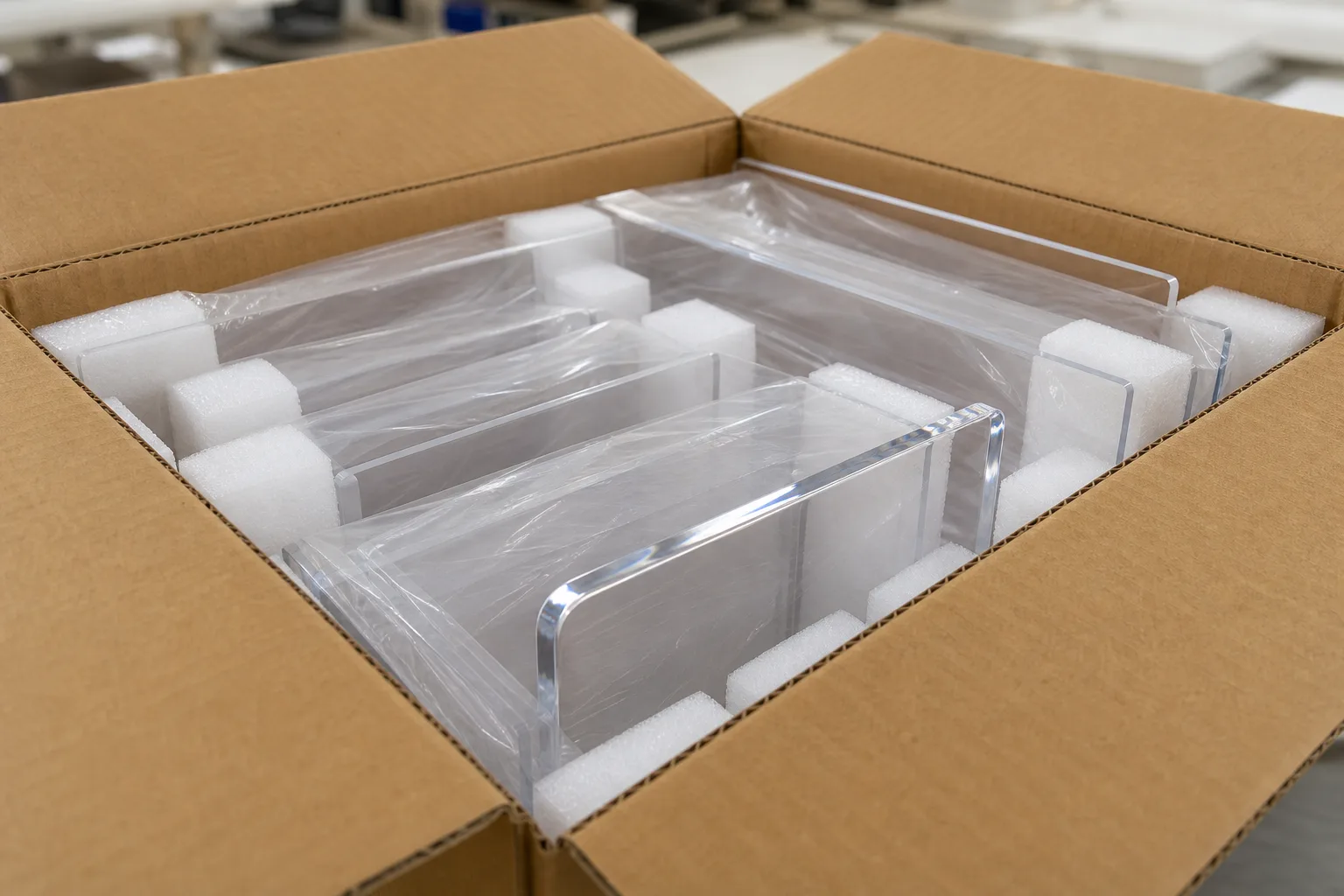
The after-side crunch is quieter but just as real. Lines restart in mid-February, but the first weeks run below speed — some hands are new, suppliers are reloading their own queues, and the trucking market is catching up. That recovery arc across the industry is the four-to-six-week figure from the logistics data above, and it is why the delivery dates we quote for late-February restarts carry more buffer than our normal 15-20 days. The queue order is simple: deposits paid before the holiday run first.
Month by month: October 2026 to March 2027
Here is the whole season in one table. Find the row that matches the order on the desk — new custom, repeat, or freight booking — and act in the month it lands on.
| Month | New custom orders | Repeat orders | Freight |
|---|---|---|---|
| Oct 2026 | Send your RFQ, lock specs, request samples — the relaxed month | Audit stock and forecast what Q1-Q2 will sell through | Nothing urgent; rates near normal |
| Nov 2026 | Close the sample loop; approve and pay deposit by Nov 30 for a pre-CNY sea slot | Place large-volume reorders now if Q1 stock matters | Reserve December sailings 3-4 weeks ahead |
| Dec 2026 | Last realistic new-order starts (early Dec, air-freight plans only) | Dec 15: last confirmation for a pre-CNY sea shipment | Book January sailings by mid-month; rates climbing |
| Jan 2027 | Too late for pre-CNY sea; small orders can still finish and fly by month-end | Confirm your post-CNY restock now — a January deposit runs first when lines restart | Final pre-CNY sailings the week of Jan 18; peak surcharges; air space tightens |
| Feb 2027 | Inquiries still answered within 24 hours through the holiday; production resumes mid-month | Post-CNY queue starts moving in late February, in deposit order | Carriers cancel sailings while volume recovers; schedules thin for 2-3 weeks |
| Mar 2027 | Quoting and sampling back to normal rhythm; new orders land in April | Pre-holiday reorders arriving; place the next one on normal cadence | Schedules and rates normalize through the month |
January in the repeat-order column is the row I point buyers to first. Most buyers treat January as dead time because pre-CNY shipping is closed to them — but it is the single best month to confirm the order you want in March, for reasons the next section unpacks.
Reorder timing for a post-CNY restock
Reorder before the holiday, not after it. Production queues restart in late February in deposit order, so a repeat order confirmed in January ships in early March, while the same order placed in March joins the catch-up queue and lands in April — usually right when the stock it was meant to replace has already run out.
Repeat orders are the fastest thing we build, because the sample loop disappears: the artwork, cutting files, jigs, and packing specs from the last run are already in our repeat-order tooling library, so confirmation goes straight to a production slot. That speed is exactly what makes the January window work. We have run this pattern for years with program buyers — the PS5 display case repeat program in France is a typical rhythm, where each reorder rides the tooling from the last one and the calendar, not the engineering, decides the ship date.
Two wrinkles worth planning for. First, adding a new SKU to a repeat order — the question I get most often in these threads — splits the timeline: the repeat SKUs keep their fast path, but the new SKU needs its own sample loop, so either start it early enough to close before the holiday or let it trail the restock by a few weeks rather than holding the whole shipment. Second, mode choice applies to reorders too: a January-confirmed restock shipping in early March by sea reaches a US warehouse in April, so if your February sell-through is strong, air freight on part of the quantity is a reasonable hedge — we can split a shipment across both modes and quote each leg.
And if your winter looks busy in both directions — pre-CNY stock plus a spring restock — the cleanest pattern I know is one conversation covering both: confirm the pre-CNY order in November and the post-CNY reorder in January, and the second one is first in line when the display production floor comes back to life.
Booking a pre-CNY production slot
To hold a slot, we need four things: what you are ordering (specs and artwork, or just your previous order number for a repeat), quantity per SKU at our 100-piece MOQ, the destination port or door, and the date you need goods in hand. We reply within 24 hours and tell you plainly which side of the calendar your order lands on.
From October through December we quote against the work-back dates in this guide, and we will tell you honestly when a request has slipped past the sea cutoff rather than let freight reality deliver the news in February. Request a quote with the four items above — or with a reference photo, if the design is still forming and needs a 3-5 day sample first — and you get slotted into the calendar the same week. February 6 is not going to move. With the dates on this page, nothing about it needs to surprise you either.
Footnotes
-
China Highlights — When Is Chinese New Year? — lunar calendar date table showing Chinese New Year 2027 on Saturday, February 6 (Year of the Goat), with public holiday February 5-11. ↩
-
SEKO Logistics — Lunar New Year: Complete Supply Chain Planning Guide for Asia Sourcing — logistics-provider planning data for the holiday cycle: freight costs 20-30% higher around the period with peak-season surcharges, up to 25% of factory workers not returning to their previous employer, and a 4-6 week recovery to full output. ↩ ↩2
-
Freightos — Shipping From China to US — freight-marketplace transit data showing sea freight at around 30-40 days door to door and standard air freight at around 8-10 days between China and the US. ↩
Frequently Asked Questions
Can you ship a repeat acrylic reorder before Chinese New Year?
Yes, if you confirm it by roughly December 15, 2026. A repeat order with unchanged artwork and specs skips the sample loop, so 15-20 days of production plus QC, packing, and port transfer still fits ahead of the final pre-CNY sailings in mid-January. Confirm later than that and the practical path is air freight, which stays workable for orders completed by late January.
How early should I place a new acrylic order before Chinese New Year 2027?
Start the conversation in October 2026. A new custom order needs a quote, a 3-5 day sample, courier time, your approval, and then 15-20 days of production — so the sample loop should close, with deposit paid, by about November 30 to hold a production slot that finishes ahead of the mid-January shipping cutoff.
How long do Chinese factories actually close for Chinese New Year?
The official public holiday runs about a week, but the practical pause is longer. Our factory stops for about two weeks around the date, and logistics providers report the wider industry takes four to six weeks from the start of the holiday to return to full output, since suppliers, packaging plants, trucking, and ports all restart on their own schedules.
Should I ship by sea or air before the CNY cutoff?
Decide by arrival date, not preference. Sea freight from China to the US runs about 30-40 days door to door, so goods you need in February must sail by mid-January. Standard air freight runs about 8-10 days, which keeps orders finishing as late as the end of January viable — at a much higher rate, and rates around the holiday typically climb 20-30%.
When should I place a post-CNY restock order?
Before the holiday, not after it. Production queues restart in late February in deposit order, so a reorder confirmed in January is among the first to run and can ship in early March. A restock ordered in March joins the catch-up queue and realistically arrives in April — often exactly when spring inventory is running thin.
Need goods in hand before the holiday?
Send four things — specs or a previous order number, quantity per SKU, destination, and the date goods must arrive. We reply within 24 hours and tell you plainly which side of the February 6 calendar the order lands on.