


Display Case Dimensions: How to Size Any Case
There is no standard display case size — there is a method. Measure the object, apply the clearance rules, and the case dimensions write themselves.
Need this made?Custom acrylic display cases →
Key Takeaways
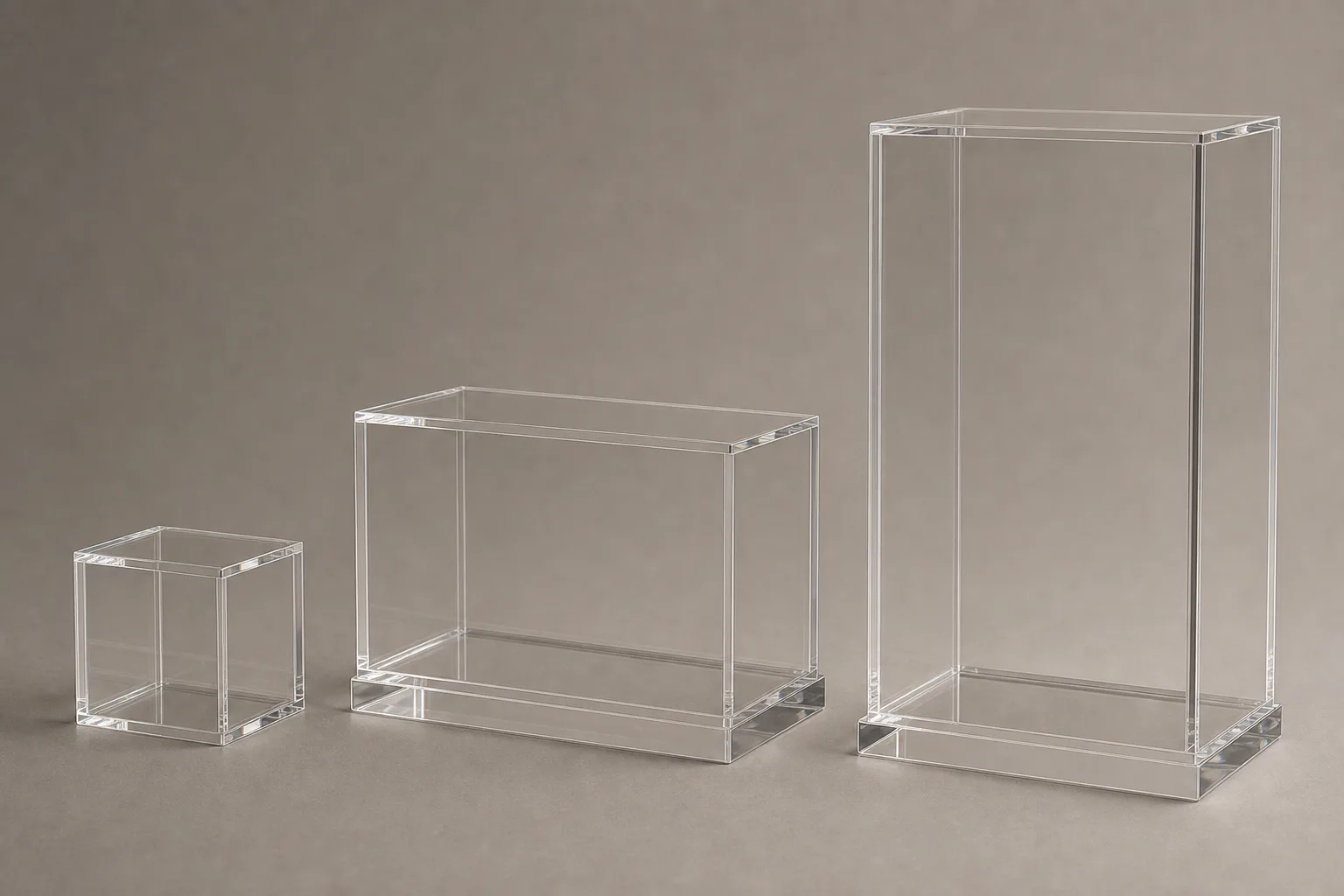
- There are no true standard display case sizes — cases are cut from flat sheet, so every dimension is a choice. Size from the object outward: object dimensions plus clearance per side, top, and base.
- Clearance starts from the measured object and intended access. Published bands are planning references; the drawing and production-representative sample approve the final fit.
- Wall thickness depends on panel span, support, access, load, sheet grade, joint geometry, packing, and the approved sample rather than one universal size table.
- Large spans, tall bases, shelves, wall mounting, and oversize freight need project-specific structural and logistics review.
On this page
How Do I Choose the Right Size Display Case?
Choose display case dimensions from the object, not from a list. Measure its width, depth and height at the widest points, add 10–15 mm per side (20–40 mm if hands reach in) and at least 20 mm above, then add the wall thickness on each side and the base. The result is the outer case size.
That method works for anything from a figurine to a full-size helmet, and it is how we size every custom acrylic display case we build. Because acrylic cases are cut from flat sheet, there is no catalog size to fit into; every dimension is a choice. It is still worth knowing what goes inside, how it goes in and out, and how it will be viewed before the drawing is fixed, because those answers change the clearance.
The clearance rules, per zone
| Zone | Planning clearance | Why |
|---|---|---|
| Sides (fixed collector piece) | 10-15mm per side | Reads intentional, not shrink-wrapped |
| Sides (retail, staff reach in) | 20-40mm per side | Fingers and product both need room |
| Above the object | 20mm or 15% of object height, whichever is larger | The piece shouldn’t appear to touch the lid |
| Above products that get lifted out | ~70mm (a hand’s width) | Lift-and-tilt removal without scraping |
| Base recess (if the object seats in one) | +0.5-1mm around the object footprint | Locates the piece without gripping it |
A recess only works if the fabricator can hold it: our standard working tolerance is ±0.2 mm, set out in our tolerance standard.
Two of these rules do most of the work. The top clearance rule stops the most common visual failure — an object grazing the lid reads as a packing error, not a display. And the reach clearance rule stops the most common operational failure: a retail case sized for the product but not for the hand that restocks it.
Typical acrylic display case sizes by object family
Acrylic display case sizes cluster into families because objects do: figurines, sneakers, balls, helmets, jerseys, and countertop assortments have recognizable envelopes. The table is a planning reference for a first brief, not an industry standard or production release; for framed shirts, see shadow box sizes for jerseys.
| Object family | Typical outer dimensions (W x D x H) | Typical wall |
|---|---|---|
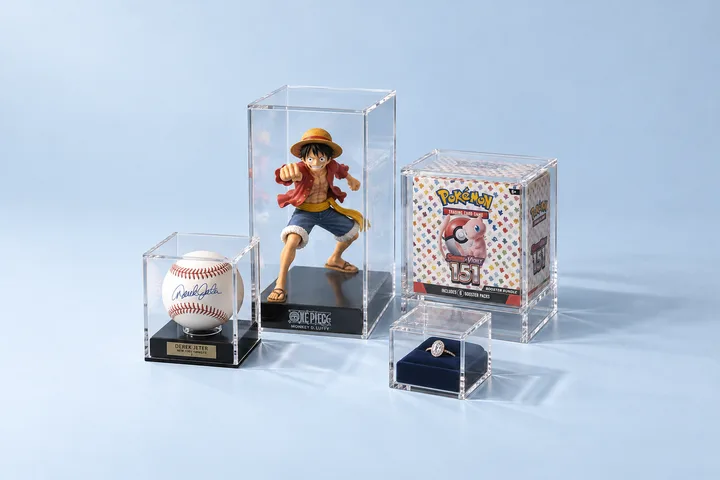
| Figurine / vinyl collectible | 150 x 150 x 200mm | 3mm |
| Graded card slab (single, angled) | 100 x 80 x 150mm | 3mm |
| Sneaker (single, size US 10-12) | 360 x 260 x 230mm | 4-5mm |
| Basketball / soccer ball | 320 x 320 x 320mm | 5mm |
| Full-size helmet | 350 x 350 x 350mm | 5mm |
| Framed jersey (wall case) | 900 x 70 x 750mm | 6-8mm |
| Countertop retail tower | 300 x 300 x 450mm | 5mm |
| Pedestal vitrine (museum style) | 400 x 400 x 400mm on a 900-1,000mm pedestal | 6-8mm |
Use the table as a sanity check, not a specification. A high-top and a runner can need different top clearance even when both are sold as sneaker cases, so size a multi-SKU program from the actual assortment rather than the category name. For graded cards, our PSA slab dimensions guide lists the slab sizes; for building sets, the LEGO acrylic display case page covers set-sized cases; for animal habitats, sizing also has to carry the ventilation and heat-source plan in the reptile enclosure ventilation guide.
One family deliberately missing from the table: anything above 1.5m on the long edge. Those builds change at the sheet-sourcing level, and they get their own section below.
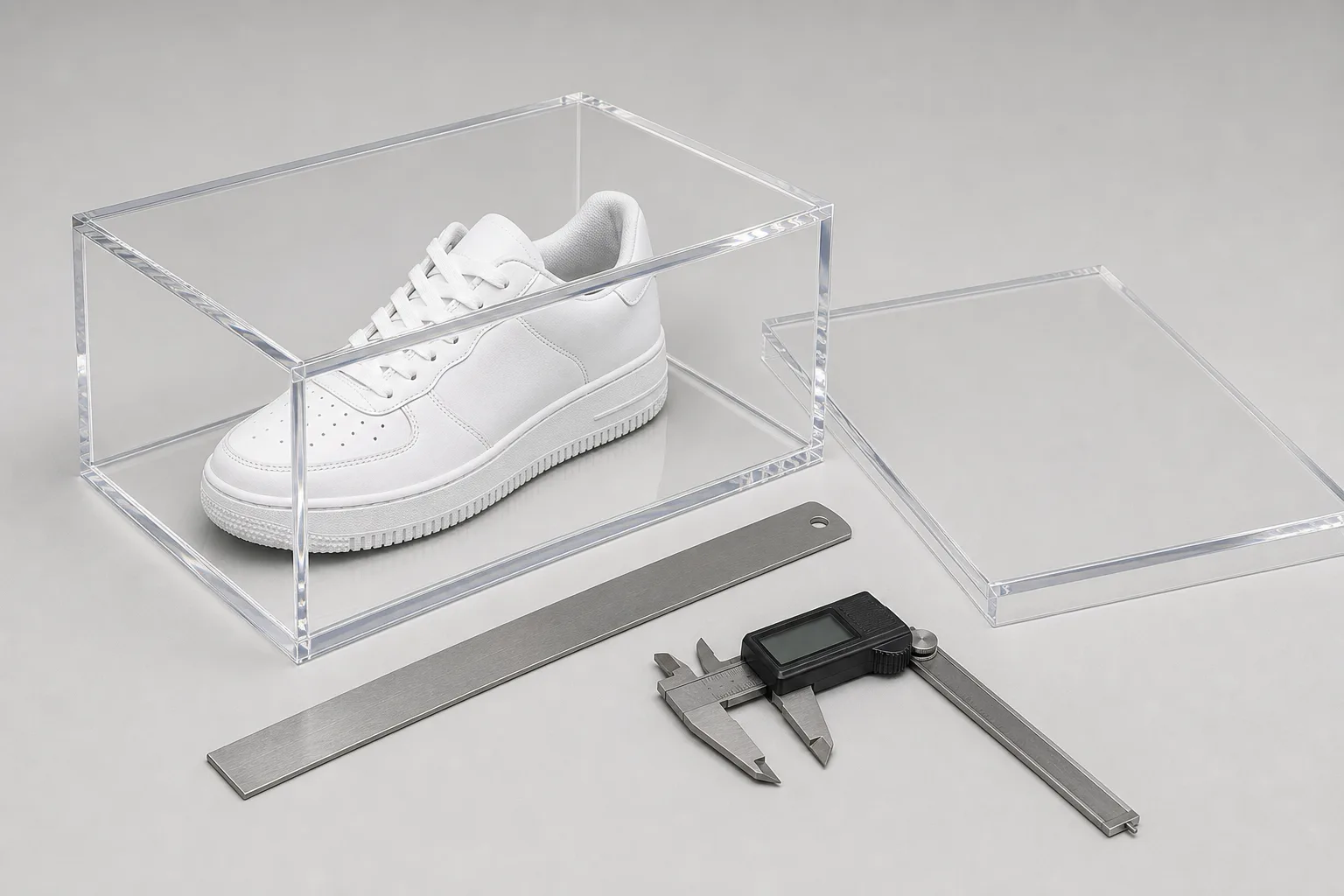
Wall thickness follows case size, not object weight
The longest unsupported panel edge is one thickness input, but not the only one. Material grade, support, access, shelf or base load, joint geometry, packing, and acceptable deflection also matter. Use the table as a quote-planning band and verify the final selection on the drawing and sample.
| Longest panel edge | Wall thickness | What it feels like |
|---|---|---|
| Under 200mm | 3mm | Light, crisp, cost-efficient at volume |
| 200-400mm | 4-5mm | The default for countertop cases |
| 400-800mm | 6-8mm | Rigid faces, solid edge presence |
| 800mm-1.5m | 10-12mm | Furniture-grade weight, premium edge glow |
| Over 1.5m | 12mm+ and an engineering review | A different build — see the oversize section |
The physics is unglamorous but useful to know: acrylic’s flexural modulus is about 2.9 GPa,1 roughly 1/25th of glass, so acrylic compensates with thickness what it lacks in stiffness per millimeter. Stiffness rises with the cube of thickness — stepping from 3mm to 6mm makes a panel roughly eight times harder to bow, which is why one thickness step solves most flex complaints and two steps is almost never needed.
What thicker walls don’t cost you is clarity. General-purpose cast acrylic sheet is rated at about 92% total light transmission per ASTM D1003 on producer datasheets,2 and that figure holds across the thickness range used in display work — an 8mm wall reads as clear as a 3mm wall, just with a deeper, brighter polished edge. So when my operators flag a case design where the panel span outruns the wall spec, the fix is a thickness step the buyer will feel in rigidity and see only in the edge.
Weight enters the calculation in exactly two places: shelves and bases. A shelf’s span-to-thickness math is stricter than a wall’s because it carries load flat — our acrylic thickness guide covers those span tables in detail. And a base carrying a heavy object (stone, bronze, dense resin) should step up one thickness regardless of the wall spec.
Base and riser height: the vertical half of sizing
Case height is only half the vertical decision — the other half is what lifts the case and the object. A base plinth of 20-60mm raises the piece off the counter surface, hides magnets and fixings, and gives the composition footing. Risers inside a case tier multiple objects toward the sight line.
The plinth range splits by job. At 20-30mm, a base reads as a frame — enough shadow line to separate the object from the counter without announcing itself. At 40-60mm, the base becomes part of the presentation: room for a felt-lined recess, an engraved title plate, embedded magnets for a lift-off cover, or a weighted bottom that stops a top-heavy case tipping. Below 20mm a base is structural but invisible; above 60mm it starts competing with the object, which is a choice you make deliberately for trophy-style presentation or not at all.
Inside multi-object cases, riser steps of 40-60mm per tier keep every row visible from a standing viewer’s angle. The arithmetic that matters is eye level: retail sight lines land around 1,400-1,600mm from the floor, so a countertop case on a 900mm counter puts its middle shelf right in the zone, while a floor-standing vitrine wants its display volume centered near 1,500mm — which is how a 400mm museum-style case ends up on a 900-1,000mm pedestal. When a program brief skips the pedestal height, I ask for a photo of the install space before we cut anything; the case dimensions are only correct relative to where the case stands. Our acrylic riser size guide covers the tiering math for open displays.
When oversize forces design changes
As spans grow, sheet availability, seams, support, access, deflection, packing, freight, and installation become project-specific engineering inputs. A 1.5m long edge is a routing prompt for deeper review in this guide, not a published capacity limit or automatic thickness rule.
Below that threshold, everything in this guide is a straightforward cut-bond-polish job on standard sheet. Above it, three things change at once. Sheet sourcing: standard cast stock tops out around common mill sizes, so an oversize face means either a custom mill batch or a multi-panel bond with a visible joint line to plan around. Structure: panel weight grows with area while bond seams grow linearly, so corner joints need deeper kerfs and longer cures. Logistics: a case that can’t lie flat in a standard crate changes freight class, and sometimes the honest answer is flat-pack panels bonded on site.
Our large acrylic display case page covers sheet-size limits, freight, and on-site assembly for large builds. Use it whenever the standard planning bands no longer describe the actual span or handling route.
Size also quietly changes lid selection before it changes structure. A lift-off cover is comfortable to about 600mm on the long edge; beyond that it’s a two-person lift, and hinged or sliding access starts winning. That’s a dimensions-driven design change buyers rarely see coming, and it costs far less to decide at the drawing stage than after the first sample ships.
Dimensions are one of three decisions
A correctly sized case can still be the wrong case. Dimensions, material format, and sourcing route are three separate decisions, and this guide owns only the first. The other two have their own guides, and the ordering path from a measured object to a produced case is shorter than most buyers expect.
On material and format: if you’re weighing an all-acrylic case against a glass cabinet or a wood-framed hybrid for a collectibles program, that three-way decision — weight, UV behavior, security, cost per unit — is the job of our glass vs acrylic display case guide; this guide assumes acrylic and tells you what size to cut it. And if what you’re really asking is what “custom made” means when a factory says it — who owns the drawing, what a design-not-included workflow looks like, what the buyer must supply — our custom acrylic display cases page covers the buying route itself.
Send the object’s measured dimensions or a physical reference, the clearance and access you want, where the case stands, base, lid, quantity and destination. Samples take 3–5 days, production takes 15–20 days after approval, and MOQ is 100 pieces per design. Our 2,620-case retail diorama program shows one case program moving from approved geometry to packed production. Send the specification and check the finished fit with the real object on the approved sample before bulk.
Footnotes
-
Polymethyl Methacrylate (PMMA, Acrylic) properties — AZoM — materials database entry listing PMMA’s flexural modulus at 2.9 GPa, the stiffness figure behind the wall-thickness-by-panel-span table. ↩
-
Plaskolite OPTIX general-purpose acrylic sheet datasheet (PDF) — manufacturer datasheet rating general-purpose cast acrylic at 92% total light transmission per ASTM D1003, the basis for the claim that thicker display case walls do not visibly reduce clarity. ↩
Published price point
Send the object dimensions and get a case quote
From $6 per unit at 500 pcs, FOB Shenzhen
Published low-end reference for a 150 × 100 × 100 mm case in 3 mm clear acrylic with a magnetic lid. Larger spans, thicker walls, access hardware, bases, printing, and packing move the final quote.
Paid samples are quoted separately and are never credited to production.
Thank you!
We've received your inquiry. Our team will reply within 24 hours — usually faster.
Frequently Asked Questions
How do I choose the right size display case?
Measure the object's width, depth and height at its widest points. Add 10–15 mm per side for a fixed collectible (20–40 mm if staff reach in), add at least 20 mm or 15% of the object height above it, then add the wall thickness on each side and the base height. That gives the outer case size.
What are standard display case sizes?
There is no industry-standard case size, because acrylic cases are cut from flat sheet. Typical outer sizes cluster by object: about 150 × 150 × 200 mm for a figurine, 360 × 260 × 230 mm for a single sneaker, and 350 × 350 × 350 mm for a full-size helmet. Use them to sanity-check a drawing, not as a specification.
How much clearance should a display case leave around the object?
About 10–15 mm per side for a fixed collectible, 20–40 mm per side where staff reach in, at least 20 mm (or 15% of object height) above the object, and around 70 mm above products that are lifted out. Confirm the final fit with the real object on the sample.
What acrylic thickness does a display case need?
Size the wall from the longest unsupported panel edge: about 3 mm under 200 mm, 4–5 mm for 200–400 mm, 6–8 mm for 400–800 mm and 10–12 mm for 800 mm–1.5 m. Heavy bases, shelves and wall mounting need their own check.
How tall should the base of a display case be?
A plinth of 20–30 mm reads as a frame; 40–60 mm leaves room for a recess, title plate, magnets or weight. Above about 60 mm the base starts competing with the object. Set the final height from where the case stands and the viewer's eye level.
Can I order custom display case dimensions at low volume?
Production starts at 100 pieces per design. Paid samples take 3–5 days, cost USD 200–500 depending on complexity, and are never credited to production; production takes 15–20 days after sample approval. Our published low-end reference is a 150 × 100 × 100 mm case in 3 mm clear acrylic with a magnetic lid from $6 per unit at 500 pieces, FOB Shenzhen.
Turn the measured object into a production case
Send the object dimensions, clearance, access, base, quantity, and destination. Paid samples are quoted separately and never credited to production.