Keychain Packaging: Bags, Backing Cards, Barcodes
The keychain sells the design; the packaging decides where it can be sold. Pick the format for your sales channel before the artwork is final.
Need this made?Custom acrylic keychains →
This guide covers retail packaging that ships with the keychains. Export cartons and transit protection are covered in our packing guide.
Key Takeaways
- Three keychain packaging formats cover most programs: a plain OPP bag, a bag with a printed backing card, and custom retail packaging such as a box.
- Choose by sales channel: OPP bags for online orders and bulk restock, backing cards with a hang hole for peg hooks and booths, boxes for gifts.
- Size the backing card to the largest keychain in the range so one card, one bag and one hang hole work for every design.
- GS1 US guidance keeps a barcode at least 8 mm and no more than 102 mm from any package edge, on the flattest area and away from perforations.
- Ordering the packaging with the keychains means one shipment, packed and sorted at the factory; custom retail packaging may add 2–3 days.
On this page
Three keychain packaging formats
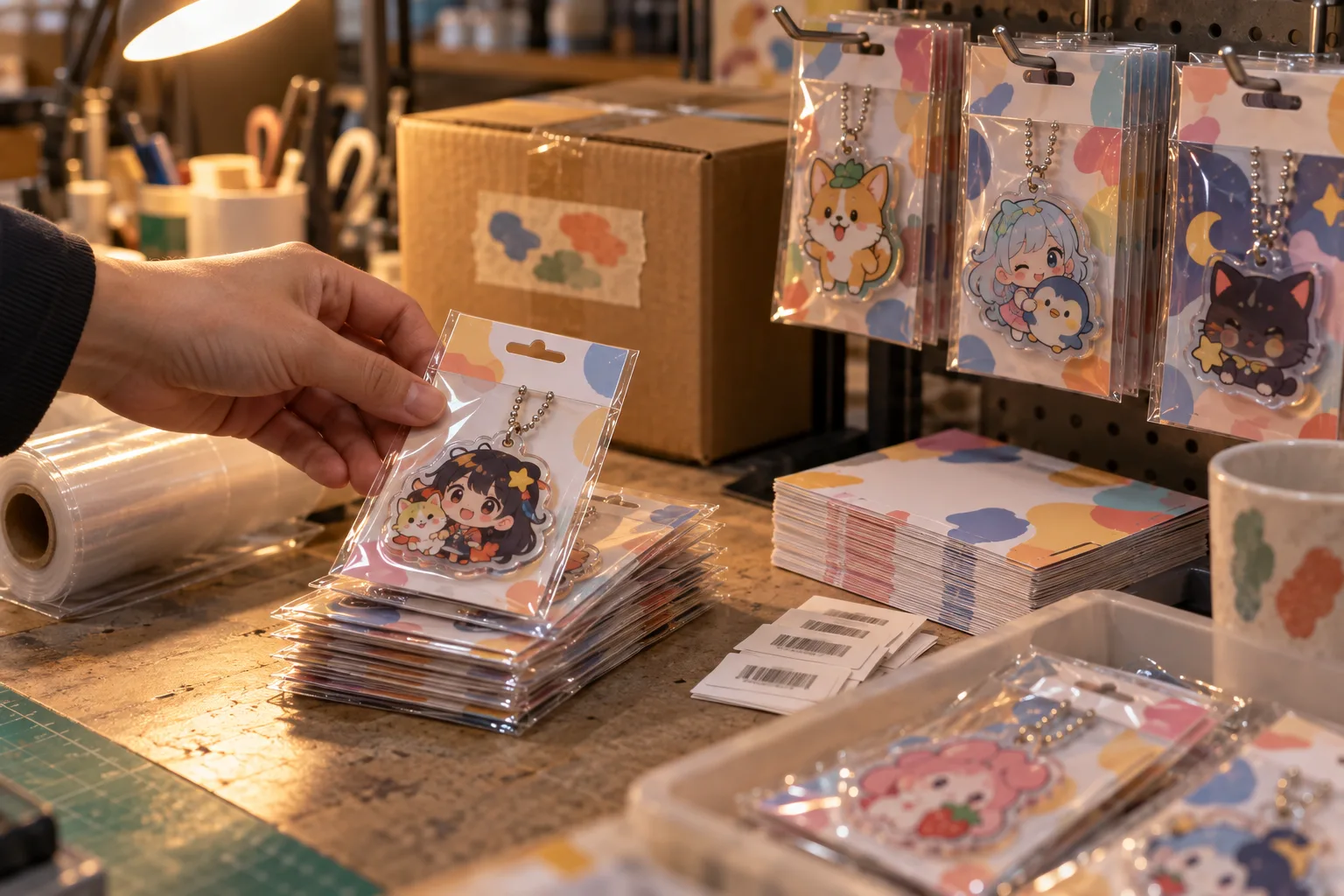
Keychain packaging for custom acrylic keychains comes in three common formats: a clear OPP bag on its own, an OPP bag with a printed backing card, and custom retail packaging such as a printed box. The right format depends on where the keychain is sold, because a peg hook, a convention table and an online order each need something different from the package.
| Format | What it is | Best sales channel | What it adds |
|---|---|---|---|
| OPP bag | Clear self-seal or heat-sealed bag per keychain | Online orders, bulk restock, giveaways | Scratch protection and a clean count |
| Bag with backing card | Keychain on a printed card, inside a clear bag, often with a hang hole | Retail peg hooks, booths, conventions | Brand, product info, barcode, a way to hang it |
| Custom retail packaging | Printed box or window box | Gifts, premium collector items | Shelf presence and gift value |
Our custom acrylic keychains ship OPP bagged, card-backed or in custom retail packaging. A delivered example on our ornaments page: 25,000 double-sided UV-printed keychains in 3 mm glitter acrylic with ball chains, card-backed, for a Korean entertainment agency, delivered in 22 days.
Match the format to the sales channel
Pick the packaging by the place the keychain is sold, not by how it looks in a mockup. A keychain that ships to customers one at a time needs protection and a count. A keychain on a peg hook needs a hang hole and a barcode. A keychain sold as a gift needs a box.
- Online store or print-on-demand fulfilment: an OPP bag is enough. The shipping envelope does the rest, and a backing card adds cost the customer throws away.
- Convention booth or pop-up: a backing card in a bag gives the keychain a price tag area and lets it hang on a grid wall.
- Retail store: a backing card with a hang hole and a barcode is usually required by the store. Ask the buyer for their packaging guide before the card artwork is drawn.
- Gift or premium line: a printed box or window box. Expect a longer packaging setup than a bag or card.
If one design sells in several channels, keep one card format and bag the online stock the same way. One format is simpler to count, pack and reorder.
Size the backing card and the hang hole
Size the backing card to the largest keychain in the range, then use the same card for every design. The card needs a clear margin around the keychain, space above it for the hang hole and space below or on the back for the barcode and product text. A single card size keeps bags, cartons and peg spacing identical across designs.
Decisions to fix in the card artwork before the sample:
- Card size and orientation, set by the largest keychain plus the chain or clasp.
- Hang hole type: a round hole or a euro slot, placed so the hanging card does not tilt.
- How the keychain is held: through a slit or tied with the chain, so it does not slide around in the bag.
- Back-of-card content: brand, product name, material, age or safety marks your market needs, and the barcode area.
Card artwork, like keychain artwork, comes from you as print-ready files. We produce from the files and do not redraw artwork. The keychain’s own size and coating are covered on the keychains page; the protective film guide explains how film protects printed acrylic faces in transit.
Barcodes on bags and cards
A retail barcode identifies your product, so it has to be registered to your brand. In the US, GS1 US issues the company prefixes and GTINs behind UPC barcodes, and its barcodes identify the company as the brand owner.1 A UPC-A barcode carries 12 digits, one of which is a check digit.2
Where the barcode sits matters as much as the number. GS1 US placement guidelines set an edge rule: the barcode must be no closer than 8 mm and no farther than 102 mm from any package edge, because cashiers hold bags and cards by the edge.3 The same guidelines tell you to place bag barcodes on the area most likely to stay flat, and to keep carded-item barcodes clear of the product and of perforations or holes.
For a keychain card, that means the back of the card, below the keychain, away from the hang hole and the card edge. Print the barcode into the card artwork when one card serves one design. If one card is shared across designs, a barcode sticker per design is the alternative; whether we apply stickers on your order is confirmed on the quote.
Mixed designs and carton sorting
Mixed keychain orders are packed design by design. Each design is bagged, counted and kept separate, then packed into cartons in the order you specify: one design per carton, a set per store, or a mixed assortment per carton. Tell us the sorting at the RFQ, because it changes the packing labor and the carton count.
Production starts at 100 pieces per design. A range of eight designs is eight designs at 100 pieces or more each, and each design gets its own count on the packing list. If the designs share one card, the card artwork carries a design name or number area so stores can tell them apart.
Order the packaging with the keychains or separately
Order the packaging with the keychains when the format and artwork are settled. The keychains then leave the factory bagged, carded and counted in one shipment, and the packaging is checked against the approved sample with the keychains. Orders with custom retail packaging or epoxy dome coating may add 2–3 days to the 15–20 day production time.
Ordering packaging separately makes sense when cards are printed near your warehouse, or when the packaging is shared with products from other suppliers. In that case the keychains ship in OPP bags and you card them on arrival.
The cost drivers are the packaging format, card size and print, whether each keychain is bagged by hand, any barcode stickers, and the carton sorting. A plain OPP bag adds the least; a printed box adds the most. Keychain price itself follows size, outline, side count, coating, hardware and quantity, and is quoted from your artwork.
What to send for a quote
A complete brief gets a quote within 24 hours with keychains and packaging as separate lines:
- Keychain artwork with the cut outline, size, sides and hardware.
- Quantity per design and the number of designs.
- Packaging format: OPP bag, backing card, or box.
- Card or box artwork, including the barcode if it is printed in.
- Carton sorting: by design, by store or mixed.
- Destination and target date.
The paid sample costs USD 200–500 depending on complexity, takes 3–5 days, is paid separately and is never credited to production. For export cartons, foam and carton labels, see how acrylic orders are packed.
Footnotes
-
How to get a UPC barcode — GS1 US — GS1 US explains its company prefix and single GTIN options and states that GS1 barcodes identify the company as the brand owner of the product. ↩
-
Universal Product Code — Wikipedia — reference article stating that a UPC-A barcode consists of 12 digits, the last being a check digit, with numbers assigned through GS1. ↩
-
Guidelines for Bar Code Symbol Placement — GS1 US — GS1 US placement guideline with the 8 mm to 102 mm edge rule and specific rules for bags (place on the flattest area) and carded items (keep clear of the product and perforations). ↩
Frequently Asked Questions
What packaging can custom acrylic keychains ship in?
Our keychains ship in an OPP bag, card-backed, or in custom retail packaging. Card artwork and box artwork come from you as print-ready files. Header cards, barcode stickers and other specific formats are confirmed on your quote.
What size should a keychain backing card be?
Size it to the largest keychain in the range plus a clear margin on every side, with space above for the hang hole and below for a barcode. One card size for all designs keeps the bags, cartons and peg spacing the same.
Where should the barcode go on a keychain card?
On the back of the card, on a flat area, at least 8 mm and no more than 102 mm from any edge, and not over the hang hole or the keychain itself. GS1 US placement guidelines give these rules for bags and carded items.
Does custom retail packaging change the lead time?
It can. Orders with custom retail packaging or epoxy dome coating may add 2–3 days to the 15–20 day production time. Samples still take 3–5 days, and packaging artwork should be final before the sample is approved.
How are mixed keychain designs packed in one order?
Each design is packed and counted separately, and you tell us how cartons should be sorted: by design, by store or as mixed assortments. Production starts at 100 pieces per design.
Send Your Keychain and Packaging Brief
Attach the keychain artwork, size, quantity per design, the packaging format and the card or box artwork. We reply within 24 hours with keychains and packaging as separate lines.