

Cosmetic Tester Display Stands: Slots and Cost
A tester stand gets handled, smudged and wiped all day. Spec it for that wear, not just for how it looks on launch day.
Need this made?Custom countertop display stands →
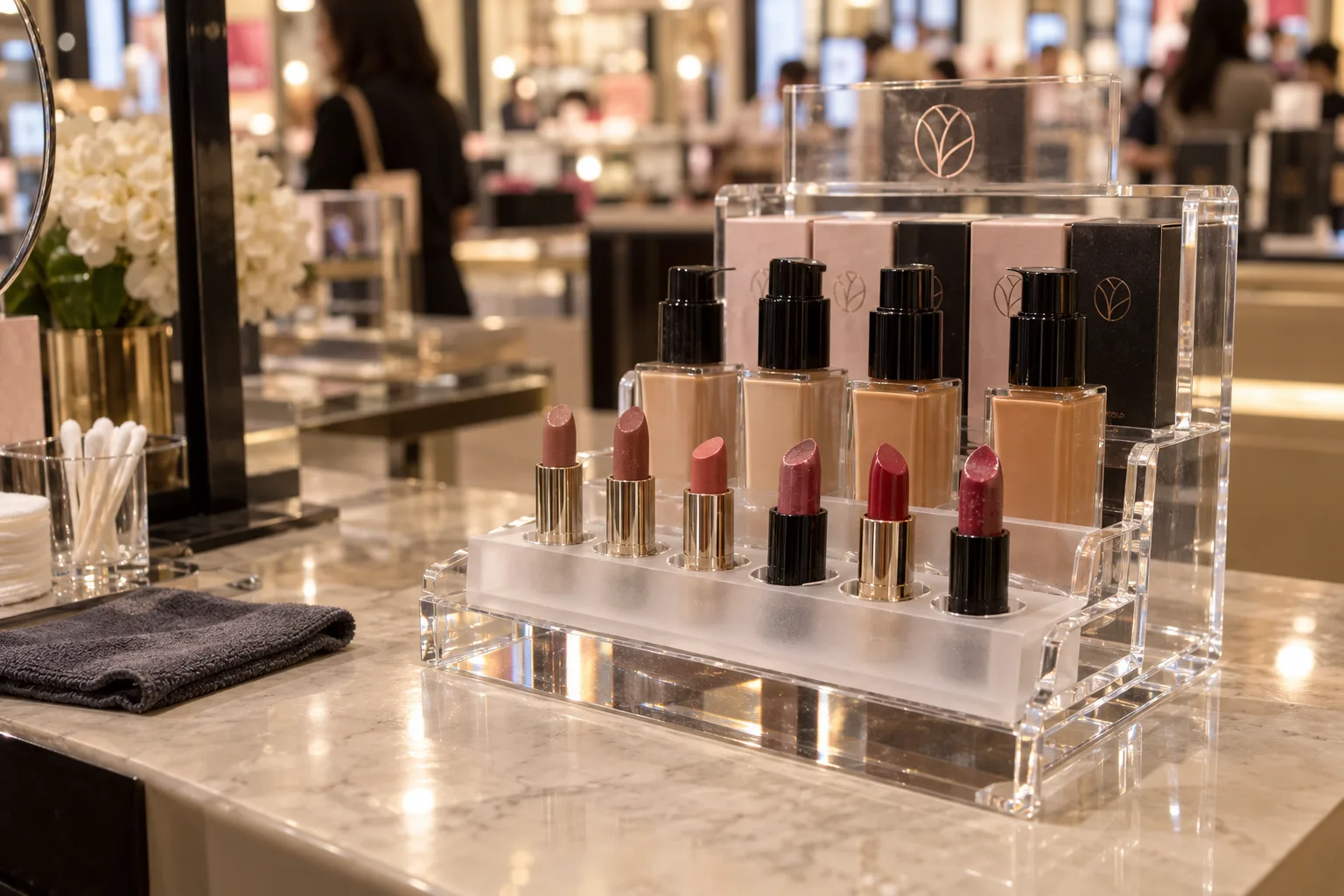
This guide covers the decisions that only tester units have: slot fit, cleaning, theft and refills. Branding and general cost have their own guides.
Key Takeaways
- A cosmetic tester display is handled, smudged and cleaned every day, so the spec starts with slot fit, cleaning and theft, not with the shape.
- Cut each tester slot from the measured product, not the product name; testers often differ from retail units in cap and height.
- A lift-out tester tray can be washed at the sink or replaced, while the branded body stays on the counter for the whole program.
- Acrylic should be cleaned with mild soap and water; alcohol and ammonia cleaners can craze it, which matters on a counter that is disinfected often.
- Published reference: a 250 × 180 × 220 mm two-tier countertop stand in 5 mm clear acrylic with one-color UV branding is $28 at 100 pieces, $16 at 500 and $12 at 1,000, FOB Shenzhen.
On this page
- What a tester stand has to survive
- Cut tester slots from the measured product
- Tester row and stock row: one stand or two parts
- Plan the cleaning before the first store opens
- Theft, refills and shade changes
- What tester stands cost at 100, 500 and 1,000 pieces
- What we have built for tester programs
- Send a tester display RFQ
What a tester stand has to survive
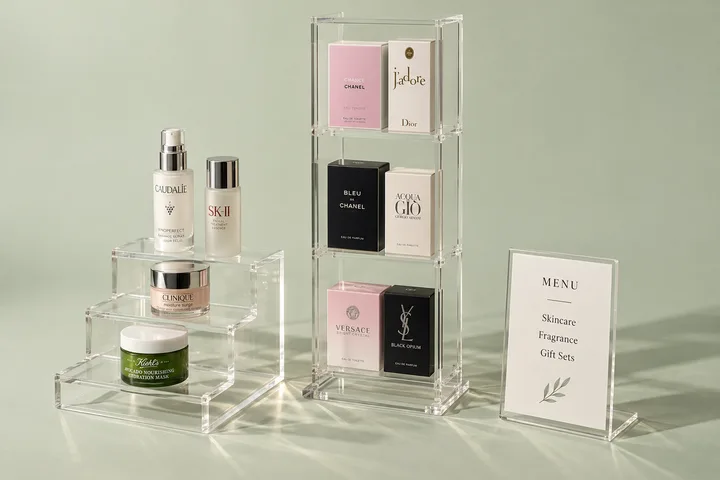
A cosmetic tester display is a counter stand that holds open products for shoppers to try. Unlike a stock display, it is handled all day, smudged with product, wiped by staff, and occasionally robbed. Those four kinds of wear decide the slot design, the material finish and how the stand comes apart, so they belong in the brief before any shape does.
The four wear points, and what each one asks of the stand:
| Wear | What happens on the counter | What the spec needs |
|---|---|---|
| Handling | Testers are lifted and put back all day | Slots that hold each tester upright without rattling or jamming |
| Product residue | Lipstick, foundation and powder land on the stand | Surfaces and corners a cloth can reach, and a part that can go to the sink |
| Cleaning | Staff wipe and disinfect the counter | A finish and cleaning routine that do not craze the acrylic |
| Theft and refills | Testers walk off or run out | A way to secure testers and a simple swap when shades change |
The U.S. Food and Drug Administration notes that the risk of contamination may be greater with testers at retail stores, where many people use the same sample, and advises single-use applicators such as clean cotton swabs.1 A good tester stand makes room for that: a well for swabs or applicators next to the testers, so staff are not improvising with a cup.
Cut tester slots from the measured product
Tester slots are cut to the product, not to the product name. Measure the tester itself, because a tester lipstick, foundation or serum can differ from the retail unit in cap, pump and height. Each slot is the measured outline plus a small clearance per side, and the clearance is approved on the paid sample with real testers.
Common tester formats and what to measure:
| Tester | Measure | Slot type |
|---|---|---|
| Lipstick | Case diameter with and without cap | Round cut well or bored hole, cap stored separately or removed |
| Foundation or serum with pump | Bottle base, height to top of pump | Shaped well or locator plate, tier height above the pump |
| Eyeshadow palette or compact | Open footprint and closed thickness | Angled ledge with a front lip |
| Skincare jar | Diameter and height with lid | Shallow well, lid parked beside or behind |
A clearance of about 1.5 mm per side is a starting point for a bottle that drops into a well. Tight slots make testers hard to return, so they end up lying on the counter. Loose slots let testers tip into each other. The bottle and product-fit guide explains well depth, clearance and when a soft insert works better than an acrylic pocket.
Tester row and stock row: one stand or two parts
Most tester stands carry two jobs: the open testers in front and boxed stock or retail units behind. They can be one bonded body or a body with a separate tester tray. A separate tray costs one more part, but it lets the tester row be washed, replaced or re-cut for new shades without touching the branded stand.
Choose a single bonded body when the shade lineup is fixed for the life of the program and the stand is small enough to wipe in place. Choose a body plus a lift-out tray when shades change by season, when testers are messy (foundation, lip gloss, loose powder), or when stores are told to disinfect testers often.
A frosted tray hides light scratches and residue better than clear. A clear body keeps the stock and the brand mark readable. That pairing is common on beauty counters. Our multi-SKU beauty counter display program used it across three SKUs and 120 doors: shade refreshes shipped as frosted insert trays instead of new stands.
Plan the cleaning before the first store opens
Acrylic is cleaned with a soft cloth, mild detergent and water, then dried. Alcohol-based, ammonia and abrasive cleaners can craze the surface into fine cracks over repeated use. On a tester counter that staff disinfect several times a day, that is a real risk, so the cleaning routine belongs in the store instructions and in the stand design.
The ACRYLITE sheet manufacturer lists window cleaning sprays, scouring compounds and solvents including alcohol among the products not to use on acrylic sheet.2 Three design choices make the right routine easier for store staff:
- A lift-out tray that goes to the sink with dish soap, so wipes never touch the branded body.
- Open corners and smooth edges on the tester row, so residue does not collect where a cloth cannot reach.
- A spare tray per store, so one tray is in use while the other is washed.
Put the cleaning method on the store’s setup card. The acrylic cleaning guide lists safe and unsafe cleaners in more detail.
Theft, refills and shade changes
Testers disappear and run out. A tester stand should make both problems cheap to fix. Bonded tester wells, drilled holes for security tethers and a lift-out tray that a store can swap in seconds are all standard fabrication steps, and each is far cheaper to plan into the first drawing than to retrofit across a hundred stores.
Plan the refill path with the brand team before the drawing is frozen:
- Shade changes. If the lineup changes each season, the tray is the part that changes. Keep the slot pattern on file and reorder trays against the approved drawing.
- Security. For higher-value testers, add tether holes or a locked stock section behind the tester row. The cosmetics display decision guide covers lockup options for prestige items.
- Header and back panel. Put the brand mark on a separate header card if campaigns change. The display branding methods guide compares UV printing, screen printing and engraving for panels that are touched every day.
What tester stands cost at 100, 500 and 1,000 pieces
Our published reference for a counter stand is a 250 × 180 × 220 mm two-tier countertop stand in 5 mm clear acrylic with one-color UV branding and bulk packing: $28 each at 100 pieces, $16 at 500 and $12 at 1,000, FOB Shenzhen. A tester stand of similar size starts from that ladder, then adds lines for its tester-specific parts.
| Quantity | Published reference price (FOB Shenzhen) | What changes on a tester stand |
|---|---|---|
| 100 pieces | $28 each | Slots, tray and header quoted from your drawing |
| 500 pieces | $16 each | Same parts; setup spread across more units |
| 1,000 pieces | $12 each | Material, polishing and packing dominate |
What moves a tester stand away from the reference: the number of cut slots and wells, a separate lift-out tray, a frosted or colored tray, a header card, tether holes, extra branding colors and store-ready packing. The display stand cost guide breaks those drivers down line by line.
Production starts at 100 pieces per design. A paid sample costs USD 200–500 depending on complexity, takes 3–5 days, is paid separately and is never credited to production. Production takes 15–20 days after approval.
What we have built for tester programs
Tester stands are often ordered as part of a brand’s counter kit. Recent work includes a 550-piece tester holder order confirmed in July 2026 as part of a brand point-of-sale kit, and a 350-set skincare device counter stand whose pre-production sample is being revised before production.
Both followed the same order of decisions: measured products first, then the tray and body split, then branding, then the packed kit. The sample is where the slot clearance, the tray fit and the logo get approved together. For the vertical fixtures and trays that pair with tester stands, see our custom cosmetic display stands page.
Send a tester display RFQ
A complete tester display brief gets a full quote within 24 hours. Send measured testers, not product names, and say which parts change by season. That lets us quote the stand body, the tester tray, the sample and the packing as separate lines, so you can see which part moves the price.
Include these items:
- Each tester’s measured dimensions, plus the stock items that sit behind it.
- The counter footprint and the store count.
- Quantity per design, and how many spare trays per store.
- Finish for the body and the tray, and the logo files with placement.
- Cleaning routine the stores will follow.
- Packing route, destination and target date.
If you are comparing suppliers, ask each one for the same named specification and quantity. As an acrylic display stand manufacturer, we quote from your drawing or a marked photo, sample in 3–5 days and inspect every piece against the approved sample before shipment.
Footnotes
-
U.S. FDA: Eye Cosmetic Safety — FDA states that the risk of contamination may be greater with testers at retail stores used by many people, and recommends single-use applicators such as clean cotton swabs. ↩
-
ACRYLITE: Clean, disinfect and maintain ACRYLITE acrylic sheet — the sheet manufacturer’s care manual lists window cleaning sprays, scouring compounds and solvents including alcohol as cleaners not to use on acrylic. ↩
Frequently Asked Questions
How much does a custom cosmetic tester display stand cost?
Our published reference is a 250 × 180 × 220 mm two-tier countertop stand in 5 mm clear acrylic with one-color UV branding and bulk packing: $28 each at 100 pieces, $16 at 500 and $12 at 1,000, FOB Shenzhen. Tester slots, a lift-out tray, a header card and extra branding are quoted from your drawing.
What is the minimum order for a tester display?
Production starts at 100 pieces per design. A paid pre-production sample costs USD 200–500 depending on complexity, takes 3–5 days, is paid separately and is never credited to production. Production then takes 15–20 days after approval.
How should store staff clean an acrylic tester stand?
Wipe with a soft cloth, mild detergent and water, then dry. Avoid alcohol-based, ammonia and abrasive cleaners, which can craze acrylic. If your stores disinfect testers often, put the testers in a lift-out tray that can be washed at the sink or replaced.
Can tester trays be replaced without replacing the whole stand?
Yes, if the tray is designed as a separate part from the start. The branded body stays on the counter and only the tray changes when shades change or the tray wears. Reorder the trays against the same approved drawing.
What should I send to quote a tester display?
Send each tester's measured dimensions, the stock items that sit behind it, the counter footprint, quantity per design, store count, finish, logo files, packing route, destination and target date. A photo with the critical dimensions marked is enough to start.
Send Your Tester Line, Get a Stand Quote
Attach the measured testers, counter footprint, quantity per design, logo files and destination. We reply within 24 hours with the stand, tray, sample and packing as separate lines.