


MDF vs Acrylic Retail Risers: Cost and Lifespan
The unit price says MDF. The second year on the counter usually says acrylic.
Need this made?Custom acrylic risers →

Here is how to price the riser over its service life instead of its invoice.
Key Takeaways
- Transparency is the working difference: a clear acrylic riser lets the shelf read as product, while an MDF plinth adds a visual block — an asset for color-blocked plinths, a cost on crowded counters.
- Moisture decides many verticals — MDF swells and its edges blow out when water gets past the paint or laminate, while acrylic shrugs off daily wet-wiping at cosmetics, food, and beverage counters.
- MDF's surface is its weak point in service: chipped corners, worn laminate, and flaking paint are why counter-top MDF risers commonly get replaced every reset, while polished acrylic keeps its finish for years.
- MDF keeps two honest wins — large painted plinths at low material cost, and heavy floor-load pedestals where solid thick sections are economical.
- Priced per year of counter service rather than per invoice, a 3-5mm acrylic riser that survives multiple resets routinely beats an MDF unit that ships heavier and retires sooner.
On this page
- MDF vs Acrylic Retail Risers: What Does the Brief Need?
- Sightlines: what the shopper sees
- Moisture and daily cleaning
- Surface wear: paint and veneer versus polished sheet
- Load and structure
- Cost per year, not cost per unit
- Decision rules
- Speccing the acrylic riser once it wins
- Ordering acrylic risers from Wetop
MDF vs Acrylic Retail Risers: What Does the Brief Need?
100 pieces per design, a paid sample in 3-5 days, 15-20 production days, a 3-5 mm starting thickness, and a ±0.2 mm standard working tolerance frame the MDF vs acrylic comparison; final thickness and critical tolerances follow the approved span, load and geometry.
| Published price reference | Scope | Price basis |
|---|---|---|
| 250 × 200 × 300 mm three-tier display | 4 mm slot-tab construction, one-color print, 500 pieces | About $7.40 each FOB Shenzhen; illustrative acrylic display comparator, not a riser quote |
MDF earns its keep on large opaque plinths and heavy pedestals; clear acrylic earns consideration on counter risers that need sightlines and wet wiping. The approved drawing, finish, packing and service conditions decide the actual cost comparison.
The material line on an incoming riser RFQ reveals whether the material was chosen or inherited. Briefs that name MDF almost never argue for MDF — the line usually reads “MDF or similar, painted white,” which tells me the buyer priced last year’s fixture and copied it forward. That is not a material decision; it is a default. When I ask what happened to last year’s units, the answer is usually some version of “they looked tired, we replaced them at the reset” — which means the true spec question is not what does a riser cost but what does a year of acceptable-looking riser cost.
That is the comparison this guide runs. Not acrylic cheerleading — MDF holds two genuine wins, spelled out below — but a production-floor look at how each material behaves on a counter: what shoppers see through it, what water does to it, how the surface wears, what it carries, and what it costs annualized over its real service life.
Sightlines: what the shopper sees
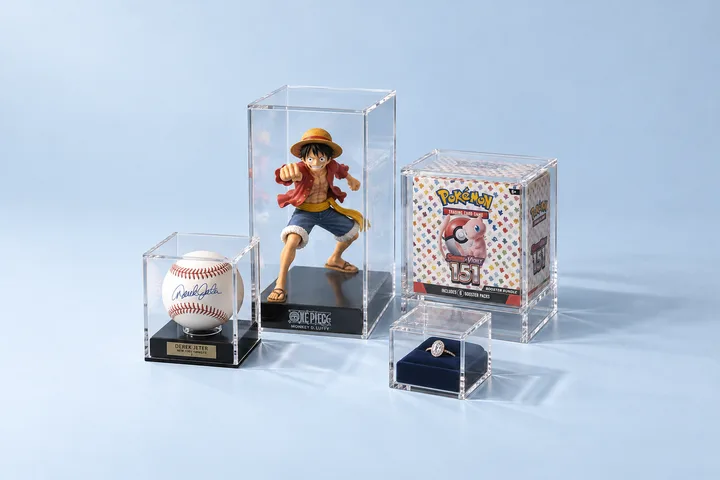
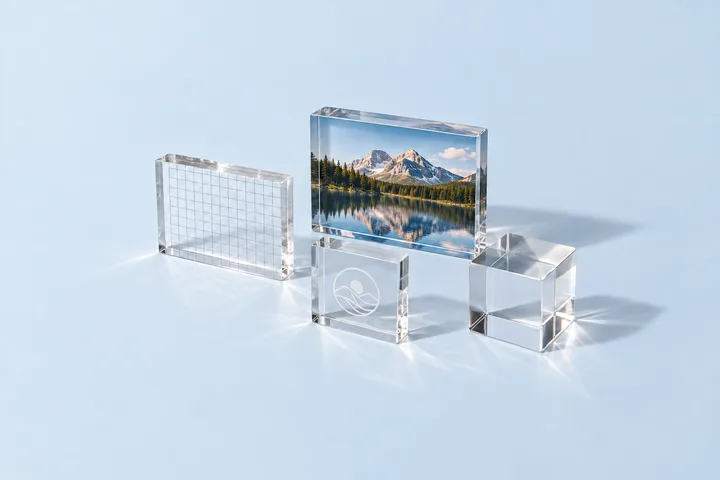
A clear acrylic riser is visually silent — cast acrylic transmits about 92% of visible light, so the shopper reads product, not fixture.1 An MDF riser is a painted or laminated block that occupies the same visual space as the merchandise. Which behavior you want depends on whether the fixture should disappear or make a statement.
On a crowded counter, disappearance is usually the point. A riser exists to lift the back row into the sightline — and a clear step does that without adding visual mass, without shadowing the products in front of it, and without fighting the packaging for attention. This is why cosmetics counters, eyewear walls, and electronics tables default to clear acrylic: the fixture budget buys elevation for the product, not presence for the fixture. Our acrylic risers page shows the standard bent and five-sided forms this logic produces.
The honest counterpoint: sometimes you want the block. A monolithic color-matched plinth under a hero product is a legitimate design move — a matte-black cube under a handbag, a brand-red pedestal in a window. MDF takes paint beautifully and delivers that look at low material cost in large sizes. Acrylic can play the same game with colored or frosted sheet, and adds finishes MDF cannot fake, but for a big opaque painted box, MDF is the economical material for the job. The sightline question, answered honestly, sorts a lot of riser briefs in one pass: should the shopper see this fixture or see through it?
Moisture and daily cleaning
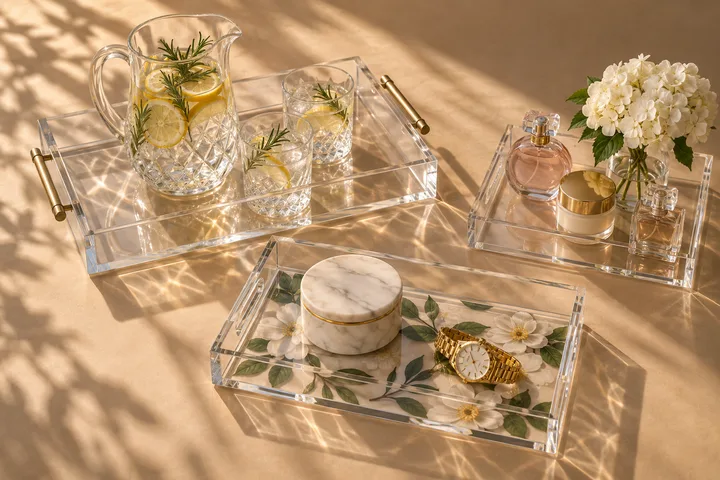
Retail counters get wet-wiped daily, and this is the sharpest durability split. MDF is a wood-fiber panel: when moisture gets past the paint or laminate — at a chipped corner, a screw hole, an unsealed bottom edge — the fiber swells and the surface telegraphs it permanently.2 Acrylic is a moisture-indifferent thermoplastic that takes daily damp cloths without any change.
The failure mode on retired MDF fixtures is nearly always the same sequence: an edge chip or a worn spot opens the seal, cleaning water finds it, the board swells locally, and the paint or veneer around the swell lifts. Once that starts, no touch-up recovers the surface — the riser looks water-damaged because it is. Bathrooms of the retail world — beauty counters with product spills, food and beverage displays, anywhere near a mister or a cleaning cart — retire painted MDF fixtures fast.
There is also a compliance line item buyers importing MDF fixtures inherit: composite wood products sold into the US fall under EPA formaldehyde emission standards (TSCA Title VI), which means compliant panels and documentation on the import paperwork.3 It is manageable — the furniture industry does it every day — but it is one more spec line an acrylic riser simply does not have. Acrylic’s own care rule is short: soft cloth, mild soap, no ammonia or alcohol-based cleaners, and the surface stays presentable for years.
Surface wear: paint and veneer versus polished sheet
An MDF riser’s finish is a coating; an acrylic riser’s finish is the material. Paint chips, laminate edges peel, and vinyl wrap wears at exactly the corners shoppers and stock hands touch — while a polished acrylic surface is the same substance all the way through, with edges diamond- or flame-polished rather than banded.
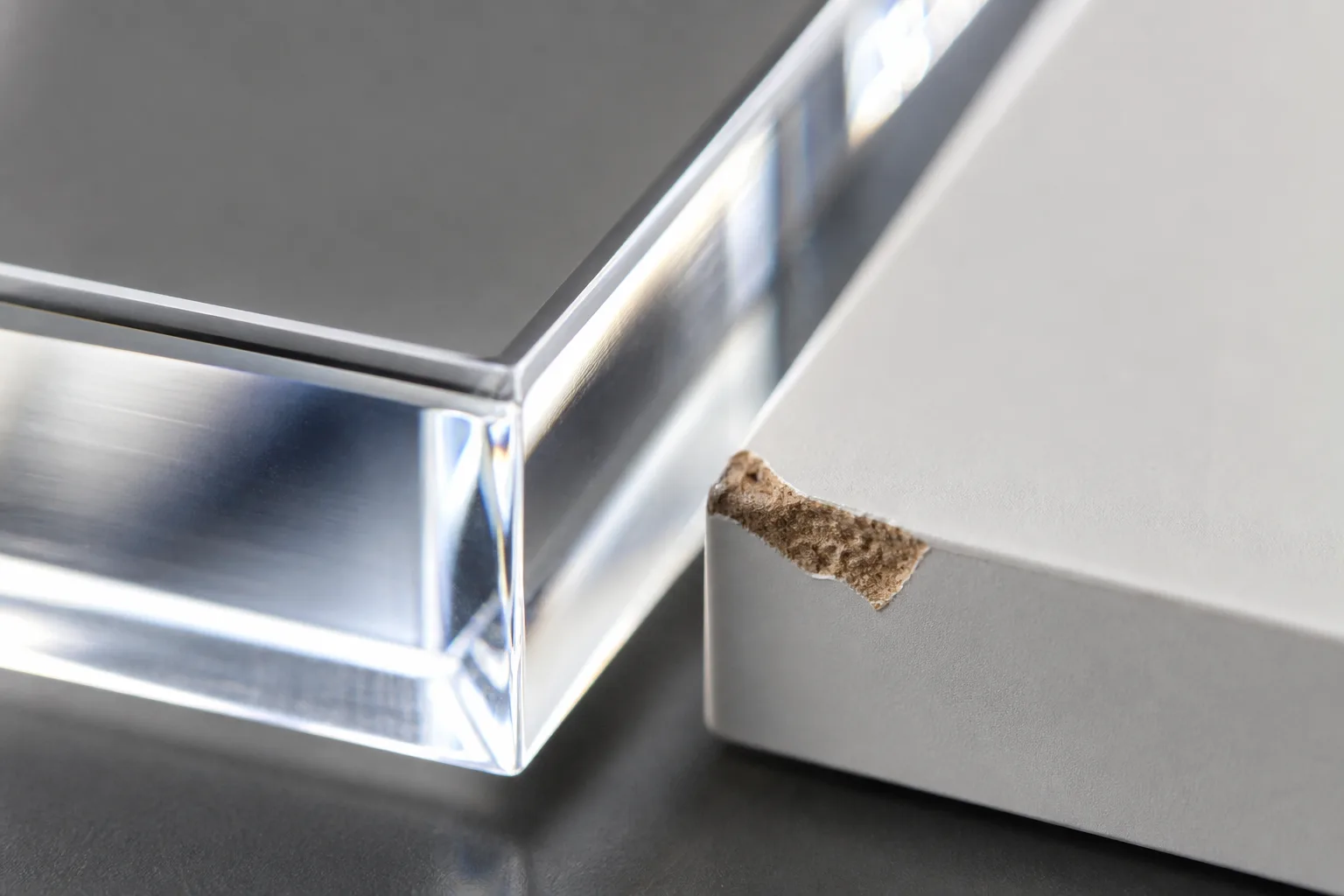
This is why the two materials age so differently in the same store. Every touch point on an MDF riser — the corner a stock hand grabs at reset, the edge a tester bottle scrapes — abrades a coating a few tenths of a millimeter thick. Once through it, the brown fiber core shows and the unit reads as worn no matter how good the rest looks. Acrylic scratches too; it is a softer surface than glass and abrasive cloths will haze it over time. The difference is what a scratch means: on acrylic it is a mark in the finish that fine polishing can reduce, not a breach through the finish exposing a different material underneath.
On my lines the practical consequence shows up as reorder patterns. MDF-based programs reorder replacements; acrylic riser programs reorder expansions — the original fifty units are still on counters when the next fifty ship for new doors. I have watched that pattern hold across cosmetics, eyewear, and electronics programs — 12+ years of production without a counterexample — and it is the single best real-world summary of the surface-wear argument.
Load and structure
For counter merchandise, bent 4-5mm acrylic carries everything a riser realistically holds — cosmetics, phones, shoes, glassware — and 6-10mm handles wider spans and heavier single pieces. MDF’s structural win arrives at floor scale: thick solid sections make heavy-load pedestals and big plinths economically that would take expensive thick acrylic to match.
The engineering behaviors differ in kind, not just degree. An acrylic riser is usually a thin-wall form — a bent U or a five-sided box — so its capacity is a stiffness problem: span, thickness, and how much the top may deflect before it looks wrong. The working rules are simple (thickness steps up with span; a mid-span support doubles a long shelf’s confidence), and we run the numbers on any spec where the load is unusual. A solid MDF cube, by contrast, is effectively a block — crush strength is never the issue, and for a 100kg floor pedestal a boxed MDF core is often the sensible economy, sometimes skinned in acrylic for the finish. For genuinely heavy retail loads, our acrylic display pedestals page shows how far engineered acrylic goes and where hybrid construction takes over.
Weight cuts the other way at counter scale. Because the acrylic riser is hollow and thin-walled, it ships lighter than a solid or boxed MDF unit of the same footprint — MDF board runs around 0.7-0.8 g/cm³ but there is simply much more of it in a solid form than in three bent faces of 4mm sheet.4 Across a 50-store rollout, carton weight is a freight line worth checking before assuming board is the budget choice.
Cost per year, not cost per unit
Annualize the fixture and the acrylic vs MDF retail riser math usually flips at the second reset. An MDF riser that ships at a lower invoice price but retires at the first or second reset costs more per year of counter service than an acrylic riser that stays presentable through several resets — before counting freight weight and mid-season replacements.
| Factor | Clear acrylic riser (3-5mm) | Painted / laminated MDF riser |
|---|---|---|
| Invoice price | Higher per unit at small sizes | Lower per unit, best at large sizes |
| Typical service life | Multiple resets; years of surface life | Often retired at first or second reset |
| Wet-wipe cleaning | Unaffected | Swells at any breach in the coating |
| Surface after 12 months | Polished, may show fine hairlines | Chips and worn corners expose fiber core |
| Shipped weight (counter sizes) | Lighter — thin-wall hollow forms | Heavier — solid or boxed board |
| Compliance paperwork | None specific | EPA TSCA Title VI formaldehyde documentation |
| Custom tooling | Zero — CNC-cut from sheet | Low — board is also cut, jigs vary |
Two fair caveats keep this honest. First, at large plinth sizes MDF’s material economy is real: a 600mm painted cube in MDF costs meaningfully less than the same cube in thick acrylic, and if the design calls for an opaque monolith, that gap does not close. Second, service life depends on position — a riser inside a glass showcase, untouched and dry, will let even MDF live for years; the comparison above describes open counters with daily cleaning and regular resets, which is where most riser programs actually live.
For the sizing side of the spec — footprints, lift heights, and step spacing for tiered sets — our acrylic riser size guide covers the three numbers that matter. And for what a multi-fixture acrylic program looks like at chain scale, see the 50-store retail display rollout case study.
Decision rules
Spec acrylic when the riser sits on an open counter, holds product that must stay the hero, gets wet-wiped, or needs to survive more than one reset. Spec MDF when the design wants a large opaque painted plinth, the load is floor-scale heavy, or the fixture is a one-campaign build in a dry, low-touch position.
The five-question acrylic vs MDF retail riser checklist I give buyers who send me “MDF or similar”:
- Will the shopper look through it or at it? Through → acrylic. At (color-blocked plinth) → MDF or colored acrylic.
- Does it get cleaned with a wet cloth? Daily wiping → acrylic, no debate.
- How many resets must it survive? One season → either. Two or more → acrylic’s surface life pays for itself.
- How heavy is the load? Counter merchandise → acrylic at 4-10mm. Floor-scale weight → MDF core or hybrid build.
- What does freight cost across the rollout? Weigh a sample carton of each before assuming board is the economy.
Hybrids deserve a mention because they solve briefs that neither material wins alone: an MDF or plywood core skinned in colored acrylic gets the monolith look with a surface that wipes clean; a clear acrylic riser set on a painted plinth gives the window both a statement base and invisible elevation. We build the acrylic side of those programs daily and engineer the joinery to the core material you specify.
Speccing the acrylic riser once it wins
If the service-life math lands on acrylic, the spec needs four decisions: footprint, lift height, thickness, and finish. Start from the product, not from a catalog size — the riser exists to put your merchandise at the shopper’s eye line, so its dimensions are derived numbers, not picked ones.
Work through them in order:
- Footprint. Measure the product’s base and add 10-25mm of margin per side. Tighter margins look intentional and save counter space; looser margins let staff restage quickly. If several SKUs rotate across the same riser, size to the largest and note it in the RFQ.
- Lift height. Decide what the back row must clear — typically the height of whatever stands in front of it. Counter risers do most of their work between 50mm and 250mm of lift; if you find yourself speccing more, consider whether the position wants a pedestal instead.
- Step spacing. For tiered sets, keep 50-100mm of height difference between tiers so each row reads over the one in front without turning the set into a staircase. Three tiers cover most counter programs.
- Thickness. Let span and load drive it: 3mm suits small single-product lifts, 4-5mm is the workhorse for standard counter risers, and 6-10mm covers wide tops, heavy single pieces, or anything a shopper might lean on. When in doubt, state the product weight in the RFQ and let us run the numbers.
- Finish. Clear is the default for the sightline reasons above; frosted softens glare under strong spotlights; colored or printed sheet puts brand identity into the fixture. Logo marking — laser engraving or UV print — adds no meaningful lead time on our lines.
Send those five decisions and your quantities, and the quote comes back without a clarification round. If you only have the product and a photo of the counter, send that instead — deriving the spec from the merchandise is a normal first step on riser programs, and the sample stage confirms the answer before production commits to it.
Ordering acrylic risers from Wetop
To quote a riser program we need the product going on top (dimensions and weight), the counter position, the number of tiers or sizes, and quantities per size. Send those through our contact form and we respond within 24 hours with pricing, thickness recommendations, and a production plan.
From approval the path is standard: a sample in 3-5 days, then 15-20 day production at a 100-piece MOQ, 100% inspection in our ISO 9001-certified factory, and a 30% deposit with the balance before shipment. Custom sizes, step sets, frosted or colored sheet, and logo printing all run on the same CNC and laser lines — usually no tooling fee at any shape. If the brief still says “MDF or similar,” send it anyway: pricing both paths against the same service-life math is exactly the comparison worth seeing on paper. Start at the custom acrylic display stands hub for the full fixture range.
Footnotes
-
OPTIX acrylic sheet datasheet — Plaskolite — manufacturer datasheet listing acrylic total light transmission at 92% per ASTM D1003, the optical-clarity figure behind the see-through sightline claim. ↩
-
Wood Handbook, Chapter 11: Wood-Based Composite Materials — USDA Forest Products Laboratory — the US federal wood-science reference covering fiberboard panels, including the moisture sensitivity and thickness-swell behavior of wood-fiber composites like MDF. ↩
-
Formaldehyde emission standards for composite wood products (TSCA Title VI) — US EPA — the US regulation requiring MDF and other composite wood panels sold or imported into the US to meet formaldehyde emission limits with compliance documentation. ↩
-
Medium-density fiberboard (MDF) material properties — MakeItFrom — independent material database listing MDF density around 0.7-0.8 g/cm³, the board-weight figure used in the shipped-weight comparison. ↩
Frequently Asked Questions
MDF vs acrylic: which is better for retail risers?
2 use cases split the decision: acrylic suits counter risers that need clear sightlines and wet wiping, while MDF can suit large opaque plinths and heavy floor pedestals. Price the approved geometry and expected service conditions rather than selecting from the material name alone.
How long do MDF risers last in a store compared with acrylic?
3 conditions drive service life: edge impacts, moisture reaching the MDF core, and the cleaning method used on the acrylic. Treat any lifespan estimate as project-specific and approve the finish and care method on a physical sample.
Does MDF cost less than acrylic for retail displays?
1 quote should separate material, fabrication, finish, packing and freight before the two builds are compared. MDF board may cost less for a large opaque plinth, while a hollow acrylic riser can reduce visual mass and shipping weight; the drawing decides which comparison is valid.
Do acrylic risers hold enough weight for retail products?
4 inputs are needed before a load claim: product weight, clear span, support geometry and material thickness. A paid sample or load test should validate the approved build; heavy floor pedestals remain a separate engineering case from counter risers.
What is the MOQ and lead time for custom acrylic risers?
100 pieces per design is the production MOQ, with paid samples in 3-5 days and production in 15-20 days after approval. Sample fees are paid separately and are not credited to production; final timing also depends on artwork, packing and freight.
Compare an MDF brief with an acrylic production build
Send the riser footprint, lift height, load, material or finish intent, quantity and destination. We will return a line-item quote and a paid-sample plan; sample fees are paid separately and are not credited to production.