
Acrylic Cut to Size: When Factory Parts Beat DIY
Buying sheet and cutting it yourself is often the right answer — until quantity, tolerance or the color list crosses a line you can locate in numbers.
Need this made?CNC acrylic machining →
Key Takeaways
- Small factory-cut acrylic parts at 1,000+ pieces typically land between $0.50 and $2.00 each FOB depending on size, thickness, and cut complexity — the number the DIY spreadsheet has to beat after sheet cost, shop time, scrap, and edge finishing.
- The phrase names two different purchases: local same-day sheet cutting priced per sheet, and a factory parts program priced per part with a quoted tolerance, a named edge finish, and a 100-piece minimum per design.
- A factory cut-parts program carries a quoted tolerance — ±0.2 mm standard working tolerance unless the approved drawing states otherwise — with a chosen edge state — saw-cut, laser, flame-polished, or diamond-polished — as a separate line item.
- Color range follows the sheet market, not local stock: clear, colored, frosted, opal, and mirrored grades are all orderable, but special colors can carry sheet-purchase minimums, so MOQ can vary by color.
- The lead-time tradeoff is real and worth stating plainly: samples in 3-5 days plus 15-20 days production plus freight will never compete with a local shop's same-day cut — the program buys repeat-run consistency, not speed.
On this page
- The per-part math at 1,000 pieces
- Two products share the name “acrylic cut to size”
- Tolerance and edges: what the per-part price includes
- Color availability follows the material, not the catalog
- What a cut-to-size quote needs from you
- Per-part cost at 500-5,000 pieces
- The honest lead-time answer
- When you should keep cutting it yourself
The per-part math at 1,000 pieces
At 1,000 pieces, small factory-cut acrylic parts land between $0.50 and $2.00 each FOB, depending on footprint, thickness, and cut complexity. That range — not the sheet price — is the number the make-or-buy math on acrylic cut to size has to beat, because the DIY side of the ledger is never just material.
Price the self-cut side honestly and it has four lines: the sheet, the machine time, the scrap, and the edges. A 1,220 × 2,440 mm sheet cut into 100 × 100 mm squares yields 288 blanks on paper; a real nest lands lower once kerf, clamping margins, and the strip sacrificed to dial in the saw come out. Every re-cut eats a blank. Every part that chips on the exit side of a cut eats another. And if the parts need polished edges, finishing time routinely exceeds cutting time — flame and diamond polishing are separate operations with their own equipment and their own learning curve.
I price both sides of this ledger a few times a month, because buyers tell me — often in the same email — that they are choosing between ordering finished parts and buying stock to cut themselves. My answer depends entirely on quantity and finish. At ten pieces, cutting your own sheet wins almost every time. At 1,000 pieces with polished edges in two colors, the arithmetic flips hard. The factory-side numbers in this guide are our own quoted values, not industry averages.
Let me be plain about who this guide serves. We don’t trim single sheets: our production runs start at 100 pieces per design, and a paid sample (USD 200–500, never credited) is how you test a part before the run. This guide is for the buyer hiding inside the same search who is specifying hundreds to thousands of identical parts.
Two products share the name “acrylic cut to size”
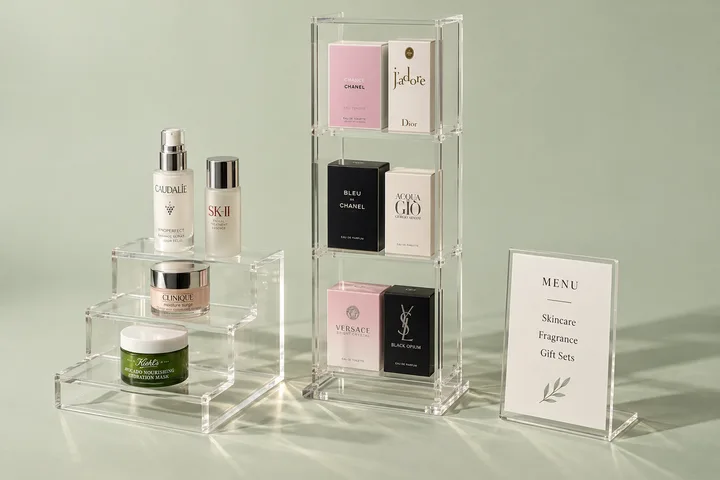
“Acrylic cut to size” names two different purchases. The first is retail sheet cutting: a local shop trims stock sheet to your dimensions, same or next day, priced per sheet plus a cutting fee. The second is a factory parts program: identical finished parts priced per piece, with a defined tolerance band, a named edge finish, and a packing spec that survives export freight. Shelves cut to one size are a typical example; our acrylic shelves page covers them as finished parts.
The fork rule is short. A sheet or two needed this week with a saw edge is a counter purchase, not a production program. Run a parts program when the same part repeats — 500 to 5,000 pieces per run is where most of our cut-parts orders concentrate — and when the spec includes things a sheet counter does not quote: a tolerance band, a named edge finish, color matching across reorders, or packing built for a container crossing. Our production runs start at 100 pieces per design; to test a part before committing, order a paid pre-production sample (USD 200–500 depending on complexity, never credited to the order). I read the quantity line first on every incoming cut list, because it tells me which column the buyer is actually in.
Every entry in the factory column is a line item you can interrogate. The next four sections take them in order: what the tolerance and edge actually promise, why color behaves differently at a factory, what a quote needs, and what moves the per-part number at volume.
Tolerance and edges: what the per-part price includes
A factory-cut part carries a quoted tolerance: ±0.2 mm is our standard working tolerance unless the approved drawing states otherwise, and fit-critical 2D features can be held to ±0.1 mm after drawing review. That is the number we cut and inspect against. A sheet counter’s trim saw makes no such promise, and an in-house shop’s tolerance is whatever its equipment and jigs happen to repeat. That difference — a number we sign, hold, and inspect — is a large part of what the per-part price buys.
The cut method sets the floor for those bands. A laser vaporizes a kerf of roughly 0.18 mm in thin sheet, widening to about 0.32 mm at 20 mm thickness1, and good CAM compensates for it so the finished edge lands on the drawing line. Whether a part should route through the laser or the CNC is its own decision — our CNC vs laser cutting comparison owns that choice, and what a CO₂ beam does to the cut face is covered in the laser edge-quality guide. For a cut-to-size buyer the outcome is what matters: the quoted tolerance holds whichever machine the part routes through.
When a drawing arrives without tolerances, the shared vocabulary is ISO 2768: its medium class allows ±0.2 mm on 6-30 mm features, ±0.3 mm on 30-120 mm, and ±0.5 mm on 120-400 mm2 — a useful reference when a drawing arrives without tolerances, while our own acceptance limit stays the drawing-controlled ±0.2 mm standard, so the inspection sheet and the quote sheet agree. When a program genuinely needs tighter, that is priced work, not a favor: the precision component project shows the drawing, datum, measurement, first-article, and approval inputs needed before a tighter band can be quoted. The full breakdown of what each band costs lives in our acrylic tolerance guide.
One tolerance no cutter can fix is thickness, because thickness follows the sheet: under the cast-sheet standard, a nominal 3 mm sheet may legally arrive anywhere from 2.3 to 3.7 mm3. If a dimension in your assembly depends on thickness, flag it on the RFQ so the material choice — cast versus tighter-gauge extruded — is made deliberately.
Edges are the other half of the line item. A cut-to-size order specifies one of four edge states: saw-cut (clean but matte), laser-sealed (a slight sheen straight off the machine), flame-polished (glossy, efficient on straight runs), or diamond-polished (optically flat, the display-grade finish). The first thing I ask when a cut list arrives without an edge spec is where the edge ends up — buried in a frame channel or visible on a shelf. Our default is to quote raw and polished as separate line items, so you can see the cost of polish before committing to it.
Color availability follows the material, not the catalog
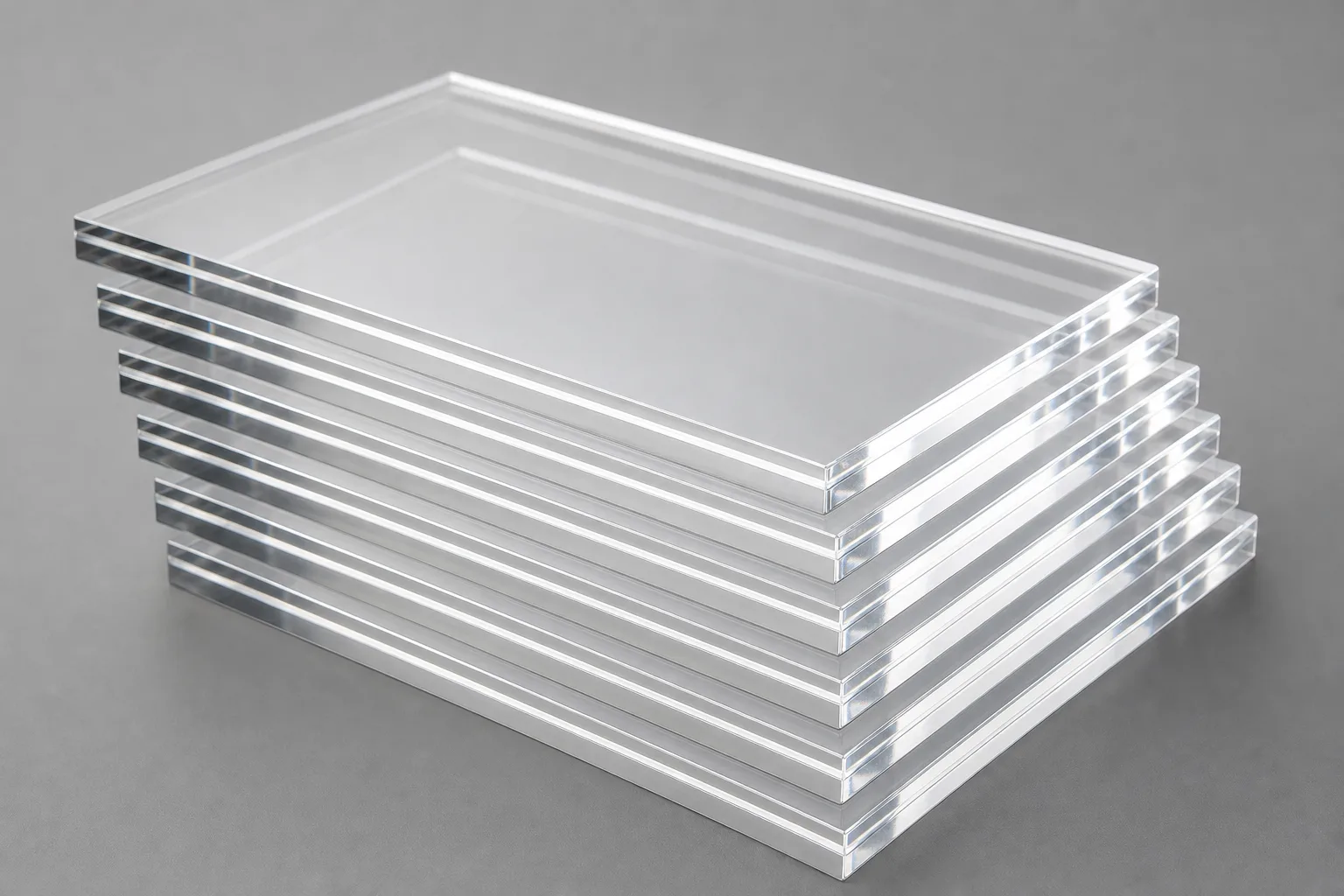
Cut in-house and the color range is whatever the local supplier stocks — usually clear plus a short list of common tints. Order a factory parts program and the range becomes the sheet market itself: clear, colored, frosted, opal, and mirrored grades are all orderable, because we purchase sheet per program rather than selling off a rack.
That width comes with an honest constraint. Standard clear is always on hand, but a special color — a brand-matched tint, an opal diffuser grade, a mirror — is bought as whole sheets for the program. A color that has to be purchased specially can carry a higher effective minimum before the order makes sense, which is why MOQ on cut parts can vary by color even when the geometry is identical. That sheet purchase is priced into the program openly, not hidden in the per-part number. When a buyer asks me whether a special color is worth it, I ask about the reorder plan first — a one-off run rarely justifies a special sheet purchase; a standing program usually does.
Nesting interacts with color too. Parts in one color share sheets and share yield; split the same quantity across four colors and each color nests on its own material, each with its own offcut. On multi-color orders each variant needs to clear a workable minimum on its own, and consolidating to two or three core colors is usually the cheapest change a buyer can make to a quote. When a color truly matters — a brand tint on a retail counter — we cut a sample from the actual sheet before the run, so the approval happens on real material rather than a screen swatch.
What a cut-to-size quote needs from you
A cut-parts RFQ reaches us in one of two formats. The first is a vector file — EPS, AI, or DXF — with the shapes at true scale. The second is simpler than most buyers expect: a dimensioned table listing each size, quantity per size, thickness, material or color, and the edge finish. We reply to either within 24 hours.
A clean vector file lets us take dimensions directly from the geometry, though we confirm the critical ones with you before cutting rather than silently trusting file scale — a rescaled export is one of the quietest ways a cut run goes wrong. No CAD software in-house is no barrier: a clear sketch with dimensions plus a quantity table prices exactly as fast, and we convert it into cutting files as part of the quote. If the parts are heading somewhere deeper than flat cutting — pockets, bends, assemblies — the CAD file preparation guide covers what production-grade files need.
What actually delays quotes is rarely the file. It is the missing line: no thickness, no edge spec, or one quantity for a list of twelve sizes. Since 2014, I have learned to send back a three-question email the same day — thickness, edge, quantity per size — because a quote built on assumptions becomes a dispute at inspection. Send those three answers with the file and the quote comes back complete the first time.
Per-part cost at 500-5,000 pieces
Four things move the per-part number at program volume: nesting yield, cut-path time, edge finishing, and packing. Yield is the biggest lever — a shape that tiles cleanly across a sheet costs meaningfully less than one that strands material between parts, which is why we sometimes suggest a 2 mm dimension change that drops the price more than any negotiation could. I walk the nesting layout on screen before we quote any shaped part, because yield decides the price more than bargaining ever does.
Cut-path time scales with perimeter and thickness, not footprint alone: a lace-edged decorative part can cost more to cut than a plain rectangle twice its area. Edge finishing is pure labor and scales with the number of edges you want polished — which is why the edge spec is a line item, not a rounding error. Packing matters more than buyers expect, because a cut part that arrives chipped was never cheap: interleaving, edge protection, and carton build are a spec of their own.
The same volume curve shows up on almost every program we run: per-part cost falls steeply from 100 to about 1,000 pieces as file preparation, nesting programming, and first-article inspection spread across more parts, then flattens — past a few thousand pieces the price is mostly material and machine minutes, which do not amortize. That is why our indicative $0.50-2.00 range is anchored at the 1,000-piece mark, and why doubling from 2,500 to 5,000 pieces rarely halves anything.
Proof that the model survives contact with freight: a US property developer ordered 400 cut-to-size opal cast sheets in 4 sizes, cut to ±1 mm against their existing frame channels, and logged zero cracked panels after the ocean crossing. The same cut-parts capability feeds our finished acrylic display work — many programs start as flat cut parts and grow into assembled fixtures on a later order. For European buyers we also quote DDP on request, so the comparison against local cutting is one landed number instead of a freight guess.
The honest lead-time answer
A factory parts program will never beat a local shop on speed, and you should distrust any overseas supplier who implies otherwise. Our clock runs: samples in 3-5 days, production in 15-20 days, then freight — days by air, weeks by ocean. A local cut-to-size counter hands over trimmed sheet the same afternoon. A factory program is for parts that repeat, not for a one-off this week.
What the longer clock buys is everything speed cannot: every piece cut from the same files on the same machines, 100% inspection before packing, edges finished to the spec you chose, and cartons built for the crossing. On a repeat program the second order is where this compounds — we keep your cutting files, nesting programs, and packing spec on record, so a reorder six months later matches the first run without re-engineering. A same-day saw cut is a different product; it solves a different problem.
The planning rule I give buyers is simple: count backward from the day parts must be in hand, subtract freight, subtract 15-20 days of production, and what remains is your decision window. Programs that fail on lead time almost always failed at the calendar, not at the factory — the RFQ went out three weeks before a fixed installation date that needed ten. If the install date is genuinely fixed, tell us on the first email; we would rather decline a program than miss an install.
When you should keep cutting it yourself
Keep your saw for prototypes, one-offs, same-week repairs, and anything under 100 pieces. That is not modesty — it is the same arithmetic from the top of this guide pointed the other way. At prototype quantities, in-house shop time is cheaper than any freight line, iteration speed matters more than tolerance, and a factory minimum helps nobody. Plenty of our best programs started with a buyer cutting their own first ten pieces on a table saw.
The handoff point arrives when the design stops changing and the quantity starts climbing. When that happens, send us what the prototype taught you: the drawing you actually built, the dimensions you measured rather than the ones you intended, where the edges show, and what broke. A prototype-to-bulk transition carries real information a fresh RFQ never has — and it is the single most common way I see a self-cutting buyer become a program buyer.
So price the factory column against your own spreadsheet at the quantity actually written on your cut list. A vector file works; so does a plain size-and-quantity table — either one gets a quote back within 24 hours, numbers laid out so the comparison is yours to make. Runs start at 100 pieces per design, and a paid sample lets you check the first part before you commit.
Footnotes
-
CutLaserCut — understanding laser kerf when cutting — published kerf measurements for acrylic by thickness (0.18 mm at 1-3 mm, 0.21 mm at 5-8 mm, 0.30 mm at 10-15 mm, 0.32 mm at 20 mm), supporting the kerf figures behind the tolerance-band discussion. ↩
-
ZEISS Quality Forum — ISO 2768-1 and ISO 2768-2 tolerance tables (PDF) — the general-tolerance table showing medium-class bands of ±0.2 mm (6-30 mm), ±0.3 mm (30-120 mm), and ±0.5 mm (120-400 mm), the shared drawing vocabulary referenced when a cut list arrives without tolerances. ↩
-
ACRYLITE knowledge base — thickness tolerance of ACRYLITE cast GP acrylic sheet — manufacturer tolerance table showing a 3.0 mm nominal cast sheet allowed at 2.3-3.7 mm under ISO 7823-1, supporting the thickness-follows-the-sheet caveat. ↩
Frequently Asked Questions
Should I buy acrylic sheet or bar stock and cut it myself, or order cut-to-size parts?
Run it on quantity and finish. For prototypes, one-offs, and anything under our 100-piece minimum, buy stock and cut it yourself — it is faster and cheaper. At hundreds to thousands of identical parts, factory cutting usually wins: the per-part price includes the quoted ±0.2 mm standard working tolerance, the edge finish you specify, color matching across reorders, and 100% inspection — all things that show up as labor, scrap, and rework on the DIY side of the spreadsheet.
What does an order of 1,000 custom-cut acrylic pieces cost?
Small precision-cut acrylic parts at 1,000+ quantities typically land between $0.50 and $2.00 per piece FOB, depending on part size, sheet thickness, cut complexity, and edge finish. Nesting yield is the biggest lever — a shape that tiles efficiently across the sheet costs less than one that strands material. Send a vector file or a dimensioned size list and we quote within 24 hours; for European buyers we can also quote DDP so the landed cost is one number.
What files do you need to quote acrylic cut to size?
Either a vector file — EPS, AI, or DXF — or a simple dimensioned table listing each size, the quantity per size, the thickness, the material or color, and the edge finish. We can take exact dimensions from a clean vector file, but we confirm critical dimensions with you before cutting rather than silently trusting the file scale. No CAD software on your side is fine: a clear sketch with dimensions plus a quantity table quotes just as fast.
What edge finishes are available on cut-to-size acrylic parts?
Four states, priced separately: saw-cut (clean but matte, fine for hidden edges), laser-cut (sealed with a slight sheen straight off the machine), flame-polished (glossy, fast, suited to straight edges), and diamond-polished (the optically flat premium finish for visible display edges). If your cut list does not specify an edge, we quote raw and polished as separate line items and ask where the edge ends up — buried in a frame channel or visible on a shelf.
Does the MOQ for cut acrylic parts change by color?
The base minimum is 100 pieces per design. Standard clear sheet is always stocked, so small runs are easy. Special colors — a specific tint, opal grade, or mirror — are bought as whole sheets per program, so a color we have to purchase specially can carry a higher effective minimum for the order to make sense. On multi-color orders, each color variant needs to clear a workable minimum on its own; consolidating to two or three core colors is often the cheapest fix.
Have a cut list ready to price?
Send a vector file or a simple size-and-quantity table — with thickness, color, and where the edges end up. We quote within 24 hours, samples ship in 3-5 days, and production runs 15-20 days.