



Case Study · Property Development · United States
400 Cut-to-Size Opal Acrylic Sheets — Flat, In Tolerance, and Nothing Cracked After the Crossing
A US property developer needed 400 opal cast acrylic panels in 4 sizes for LED-backlit signage and light diffusers across a multi-building residential development.
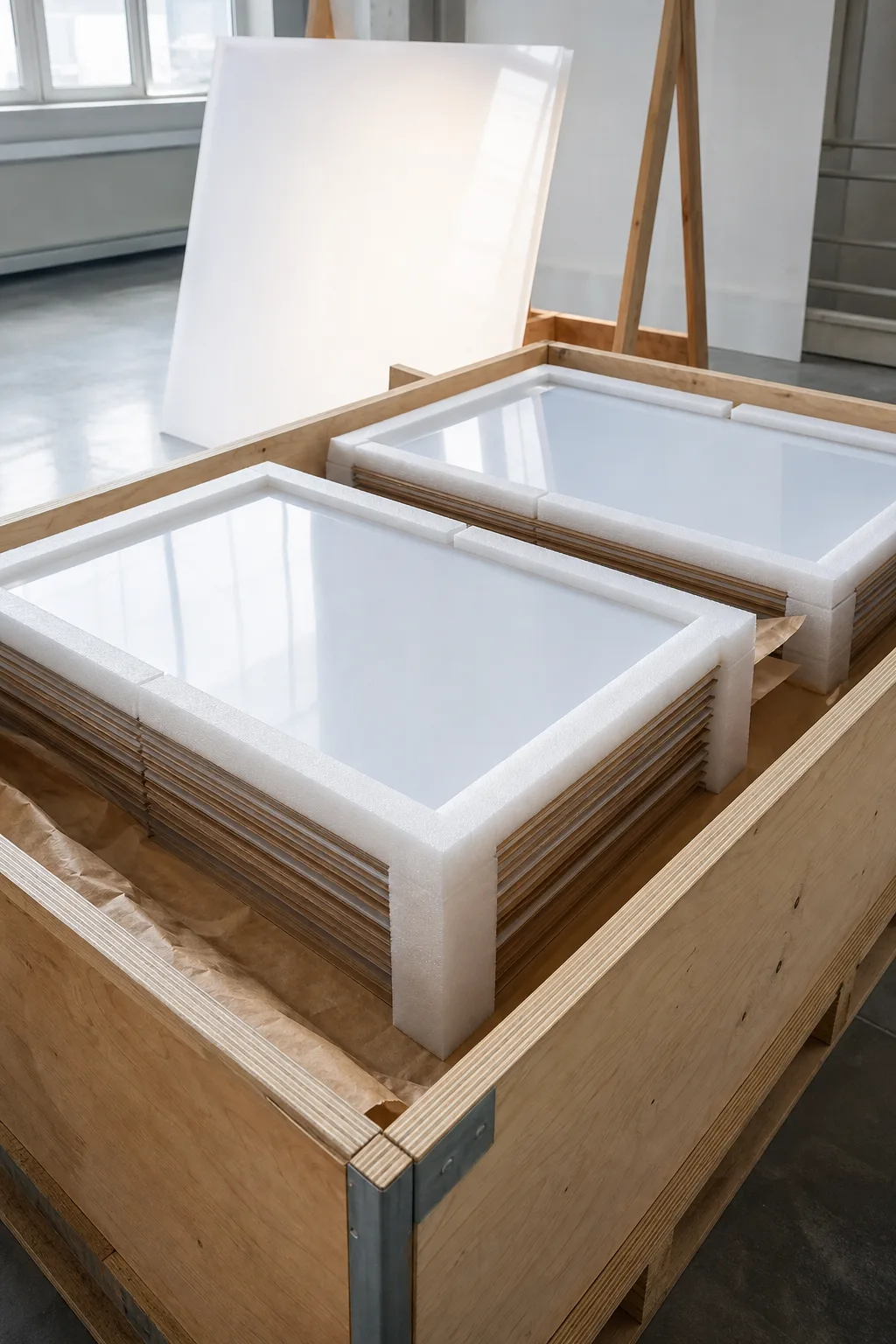
The order was supply-only, cut to fit aluminum frames that already existed. We held ±1 mm on every panel, verified the fit in a frame cutoff the client mailed us, and packed the sheets so an ocean crossing couldn't crack them. The order cut in 15 production days, arrived with zero damaged panels, and a 200-sheet batch for the next building followed on the same cut list. It was also our first sheet-only project at this scale.
- sheets cut
- 400
- panel sizes
- 4
- cut tolerance
- ±1 mm
- cracked in transit
- 0
Key Takeaways
- All four edges of a framed panel are invisible — specifying saw-cut edges instead of polished ones cut real cost from 400 panels with zero visible difference once installed.
- The frames existed before the panels did, so ±1 mm was the spec that mattered: the client mailed a 300 mm cutoff of their aluminum frame extrusion and we test-fitted sample panels in the actual channel before releasing the cut run.
- Cast sheet gauge varies more between batches than extruded, so actual thickness was measured per batch against the channel depth — the nominal “3 mm” on a label is not a fit guarantee.
- Packing carried the risk: interleaving paper on every sheet, foam edge protectors on every stack, size-matched plywood crates, and an A-frame rack for the largest panels — zero cracked after the ocean crossing.
- 400 sheets across 4 sizes cut in 15 production days; a 200-sheet phase-2 batch followed on the same cut list.
The Challenge
A backlit sign panel that arrives 2 mm oversize does not go into its frame. One that arrives 2 mm undersize goes in, rattles, and leaks a bright line of raw LED light along the channel edge. Either way, the panel is scrap — and on this project, scrap meant a re-cut in Shenzhen, a re-ship across the Pacific, and an installation crew standing down at a building that was otherwise finished.
The developer was standardizing wayfinding, amenity signage, and ceiling light diffusers across a multi-building residential development. Their sign contractor had already fabricated the aluminum frames to fixed opening dimensions; what remained was the acrylic itself — 400 opal panels in 4 sizes, supply-only, no further fabrication. Local cut-to-size pricing at that volume was the reason they looked overseas. The distance was the reason they hesitated: sheet acrylic has a reputation for arriving from sea freight with chipped corners and cracked faces, and a single damaged stack would have erased the price advantage in one blow. The order stood on two questions — would every panel fit a frame that already existed, and would every panel survive the crossing?
Our Approach
Most of our work ships as finished products — displays, cases, trays. A sheet-only order moves the entire risk into two unglamorous places: the saw and the crate. So that is where the project's attention went.
Four sizes, one cut list — and edges nobody will ever see
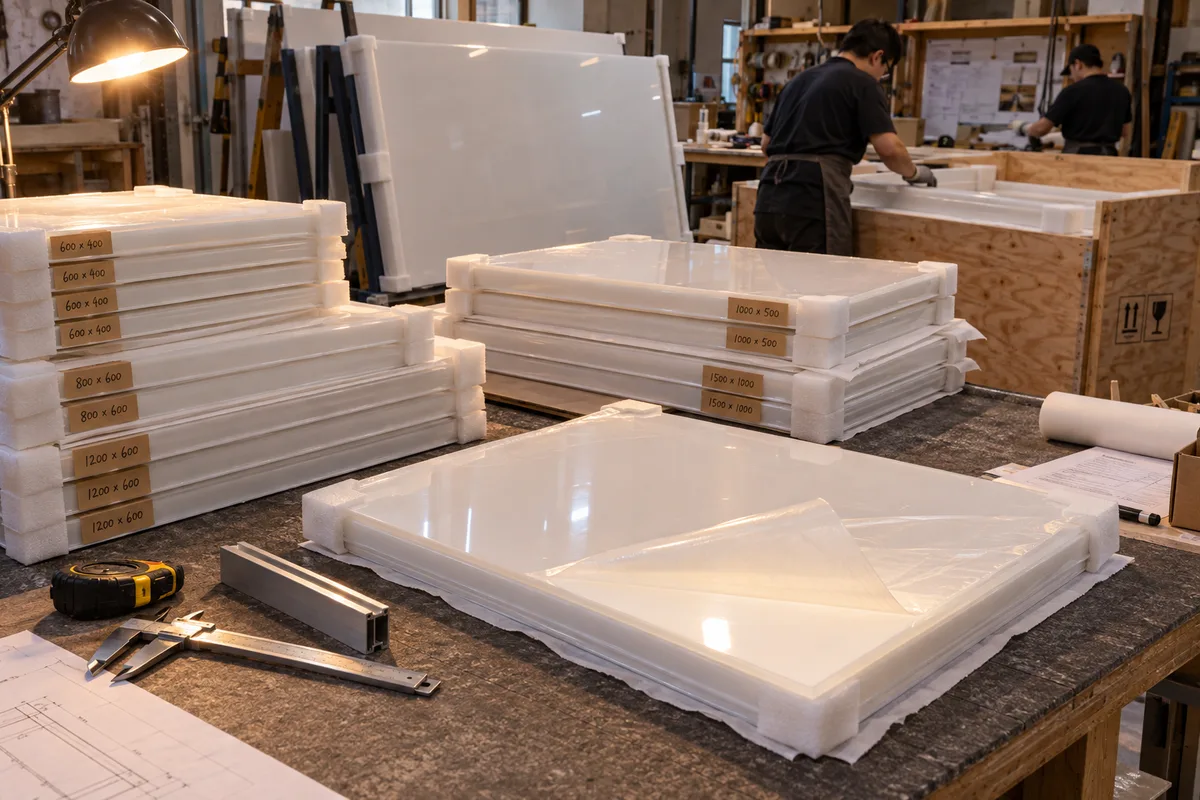
We consolidated the developer's per-building specifications into a single cut list: 4 panel sizes at 100 sheets each, 3 mm sheet for the standard diffuser faces and 5 mm for the largest panels, which span wide frames and would sag at the thinner gauge. The first cost decision came from a question we asked rather than one they did: every edge of every panel would sit hidden inside a frame channel, so we quoted saw-cut edges with no polishing. Flame- or diamond-polished edges are the right call when an edge is visible; on 400 framed panels they are money spent on surfaces nobody will ever see. The masking film stayed on both faces of every sheet through cutting, packing, and transit, and each panel was labeled by size code so the site crew could pull the right crate at the right building. The full scope of what we cut, drill, and finish beyond sheet work is on ourcustom fabrication and cut-to-size services page.
Holding ±1 mm against frames we had never seen
Cut tolerance was the real specification on this order, because the frames were built first. We asked the client to mail us a 300 mm cutoff of their aluminum frame extrusion. Before the cut run released, we cut sample panels of the two largest sizes and test-fitted them in that actual channel — insertion, seating depth, edge clearance — rather than trusting two sets of drawings to agree.
Thickness got the same treatment. Cast acrylic diffuses light more evenly than extruded across a large opal face, and it machines more cleanly at the saw — but its gauge varies more from batch to batch, which matters when a panel has to seat in a channel of fixed depth. So we measured actual sheet thickness on each incoming batch against the channel dimension instead of reading the nominal number off the label. Sheets were stored flat, and cut panels went straight into flat, size-matched stacks so nothing had the chance to take on a bow between the saw and the crate.
Packing for the crossing
What cracks sheet acrylic in transit is rarely a single drop — it is point loads and pallet flex working on unprotected edges for five weeks. The packing plan removed both, tiered by panel size:
| Panel group | Thickness | Pack method |
|---|---|---|
| Small formats (under ~600 mm) | 3 mm | Flat stacks, same size only, paper interleaved, foam edge protectors, plywood crate |
| Mid formats (~600–1,200 mm) | 3 mm + 5 mm | Shallower flat stacks to cap stack weight, corner blocks added, plywood crate |
| Largest panels (~1,850 × 950 mm) | 5 mm | Vertical on an A-frame rack — shock loads pass into the rack, not the panel corners |
Every sheet carried interleaving paper on top of its masking film, every stack wore foam edge protection on all four edges, and every crate was labeled by building and size code. The A-frame decision for the oversize panels is the one that looks like overkill until you watch a forklift set a pallet down hard: a flat stack takes that shock across its faces and corners; a racked panel standing on edge barely registers it.
The Results
All 400 panels cut in 15 production days, every one within ±1 mm of the cut list, and the site crew's crate-by-crate check on arrival logged zero cracked or chipped panels.
The number that carried the project was the ±1 mm — not because the tolerance is exotic, but because of what it was measured against. A cut list checked against its own drawing proves consistency; a sample panel seated in the client's actual frame channel proves fit. That one mailed extrusion cutoff converted the order's biggest unknown into a checked box before the saw ran at volume.
The reorder is the quieter proof. When the next building phase reached the signage stage, the developer sent a purchase order against the same cut list — 200 sheets, no new drawings, no new questions. Supply-only sheet work does not usually build relationships; a fit that held across 400 panels and an ocean apparently does.
"Every panel we've installed so far has gone into its frame on the first try — no re-cuts, no light leaking at the edges. We opened every crate the week they landed and found nothing cracked. The 200 sheets for the next building are on the same cut list."
What This Means for Your Project
If you are sourcing cut-to-size acrylic sheet against frames or fixtures that already exist, the two questions that decide the outcome are what is the cut verified against andhow is it packed. Mail your supplier a frame cutoff, a channel section, anything physical — a sample panel seated in real hardware beats two drawings agreeing with each other. And ask specifically how sheets over a meter travel: if the answer does not distinguish flat-stack from racked, the packing plan has not met a forklift yet. And when an install date is tighter than an ocean crossing, an air-first split shipmentcan put the first building's panels on site while the balance sails.
Sheet supply also does not have to stay sheet supply. The same opal, clear, colored, and mirror stock we cut panels from feeds every category of custom acrylic productswe fabricate — so a program that starts as diffuser panels can add matchingwall-mounted acrylic sign holders or lobby display pieces from the same material batch, in the same shipment.
Common Questions
Can you cut acrylic sheets to my exact sizes and ship them overseas?
Yes — supply-only, cut-to-size sheet orders are a standard job for us, with or without any further fabrication. Send a cut list (sizes, thicknesses, quantities, opal or clear or colored grade) and we cut to ±1 mm, leave the protective masking on both faces, label every panel by size code, and pack for the ocean crossing. Our MOQ is 100 pieces per design. If your panels drop into existing frames, mail us a short cutoff of the frame extrusion — we test-fit sample panels in the actual channel before releasing the full cut run.
Why use cast acrylic instead of extruded for backlit panels?
Cast acrylic diffuses light more evenly across a large opal face and machines more cleanly at the saw — extruded sheet is softer, chips more readily on the cut edge, and is more prone to stress marks around machining. The trade-off is thickness: cast sheet gauge varies more from batch to batch than extruded, so on a job where panels seat in fixed channels we measure actual sheet thickness per batch before cutting rather than trusting the nominal number.
How do you keep acrylic sheets from cracking during sea freight?
Point loads and pallet flex are what crack sheet acrylic in transit, so the packing removes both. Every sheet is interleaved with paper on top of its masking, stacked flat with panels of the same size only, and the stack gets foam edge protectors on all four edges before being banded into a plywood crate. Oversize panels ship vertically on an A-frame rack so road and sea shock loads pass into the rack instead of the panel corners. On this 400-sheet order, the site crew logged zero cracked or chipped panels across every crate.
Sourcing cut-to-size acrylic sheet for a property or signage program?
Send your cut list — sizes, thicknesses, grade, quantities — and a frame or channel detail if your hardware already exists. We'll come back with a fit-verification plan, a packing spec, and a quote.
Samples in 3–5 days · Production 15–20 days · 30% deposit, balance before shipment