Delivered Project · Video Game Collectibles · Australia
Four Sizes, One Line, Launched at the Floor
This retro video game case line launch put four acrylic display case models on sale for an Australian collectibles brand at exactly 100 pieces each: one for a standard jewel case, one for a thick jewel case, one for a fat-box PC case, one for a DVD keep case. Each is 5 mm UV-filtering acrylic on an 8 mm clear base, diamond-polished with mitred corners, closed by a magnetic top lid, marked with an engraved logo, and shipped in a white inner box. The brand went from a paid sample round to a production order in about five weeks.
- models × pieces
- 4 × 100
- UV-filtering walls, clear base
- 5 + 8 mm
- samples to production order
- ~5 weeks
- inspected before boxing
- 100%
Ordering a similar project
MOQ is 100 pieces per design. Paid samples normally take 3–5 days; sample fees are paid separately and never credited. Standard production takes 15–20 days after drawing, material, lid, engraving, packing, and sample approval. Wetop responds to a complete brief within 24 hours.
Named price reference: the video game display cases page lists FOB ranges for comparable acrylic cases from about $4–8 per unit for a simple 3 mm case up to $15–30 for a 5 mm UV-filtering case with 45° mitred joints, quantity dependent. The USD 5–7 band on this page is this project's product price by model at 100 pieces each and is not a quote for yours.
Key Takeaways
- An Australian retro video-game collectibles brand launched a four-model acrylic display case line, sized for a standard jewel case, a thick jewel case, a fat-box PC case, and a DVD keep case, ordering exactly 100 pieces of each model.
- Each case uses 5 mm UV-filtering acrylic walls on an 8 mm clear base, diamond-polished edges with mitred corners, a magnetic lift-off top lid, and the brand's mark laser-engraved at one corner, all frozen on the approved samples.
- A paid sample round in July covered the candidate formats; the brand chose the four, settled the lid and engraving position, and placed the production order in August, about five weeks after the samples shipped.
- Every case ships in a plain white inner box so the brand can reship to a customer without repacking, and the inner box was part of the approved specification rather than an afterthought at dispatch.
- Current ordering for a display case line still starts at 100 pieces per design with a 3–5-day paid sample, a fee that is paid separately and never credited, and 15–20-day standard production after approvals.
The Challenge
Retro games are sold twice. Once as the game, and again, years later, as the object: the box, the manual, the disc or cartridge that a collector wants to keep in the condition it was found in and put somewhere visible. The brand behind this project sells to those collectors in Australia, and it wanted to add a display case line to the games it already sold. Not a case. A line, because retro game packaging is not one size, and a case that fits a jewel case is useless for a DVD keep case.
The founder had four formats in mind: the standard jewel case that most 1990s console and PC discs shipped in, the thick double jewel case for multi-disc releases, the fat-box PC case, and the DVD keep case that later consoles used. Each needs its own footprint and depth. Each needs to be clear enough to show the box art and protective enough to stop that art fading. Each needs a lid a collector can open and close without a tool, and a mark that says who made the case without covering what is inside.
The commercial problem was the one every small brand has at launch: how many of each? The brand did not know which formats its customers would buy first. Ordering 400 of one model and finding out it was the wrong one would be expensive; ordering 20 of each was below any sensible production floor and would have priced each case out of the market. The question underneath the brief was how to launch a complete line at the smallest quantity that still made production sense.
There was a technical question under the commercial one. UV-filtering acrylic costs more than standard clear, and the founder wanted to know whether the line needed it at all, and if so, where. A blanket answer of "use UV grade everywhere" would have added cost to the base, which never faces the light. A blanket answer of "standard clear is fine" would have put 30-year-old printed cardboard behind a window that filters nothing. Our guide on UV-filtering acrylic for collectibles covers the material question in general; this project needed the specific answer for a display case with a base.
Our Approach
We answered the commercial question with the MOQ and the technical question with the sample round, and we let the second inform the first. Four models at 100 pieces each is the smallest order that puts a complete line on sale, and a paid sample round is the cheapest way to make the decisions that turn four ideas into four drawings.
A paid sample round that bought decisions
The founder sent the game packaging dimensions for each format and a description of what the case had to do. We built a paid sample round in July that covered the candidate formats, and we built them to be compared, not admired: the same wall thickness, the same base, the same lid action, the same corner joint, so that the only thing changing between samples was the size and the fit. The samples went to Australia, and the founder did what a sample round is for. Each candidate was tried with the real games, the lid was opened and closed by people who would open and close it, and the engraving position was looked at on a shelf rather than on a screen.
What came back was a set of decisions rather than a set of comments: these four formats, this lid, the mark here, and a white inner box so a case can be reshipped to a customer without repacking. That is a line specification. The sample fee for the round was paid separately and is never credited to production, and I make that point on every launch because the fee buys exactly what this brand got out of it: the decisions that a production order can be written from.
UV-filtering where it counts
The material answer that came out of the sample round is the one we recommend for most game and collectible cases with a base. The walls and lid, the parts that face a window or a shop light, are 5 mm UV-filtering grade. The base, which sits under the game and sees nothing, is 8 mm standard clear: thicker for stiffness and a solid feel in the hand, but not UV grade, because there is no light path through it to the box art. The saving is real and the protection is where it needs to be. We confirmed the wall grade on the approved samples and held the same sheet for production. A datasheet describes a grade; the sample is what the buyer actually approved.
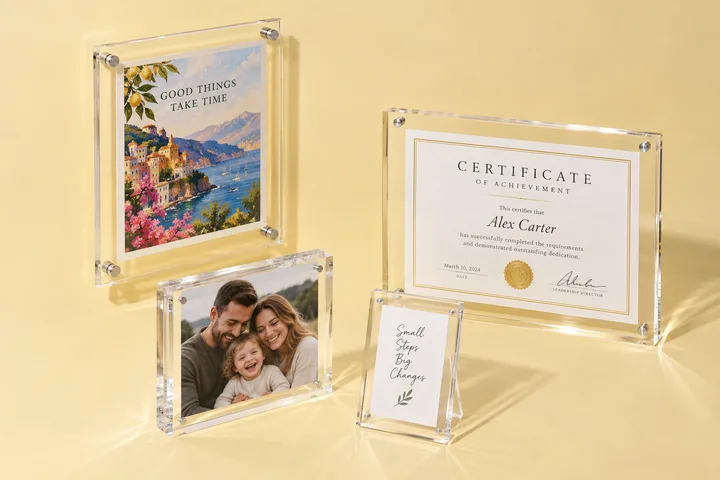
The 8 mm base also does something for the joint. A 5 mm wall bonded onto an 8 mm base gives the corner a wider land to bond to, and with the corners mitred at 45 degrees and diamond-polished, the case reads as a single clear form rather than a box of panels. It is the construction our video game display case page describes for the higher end of its range, and it is why the cases in the hero photo have edges that carry light.
Four footprints, one clearance rule
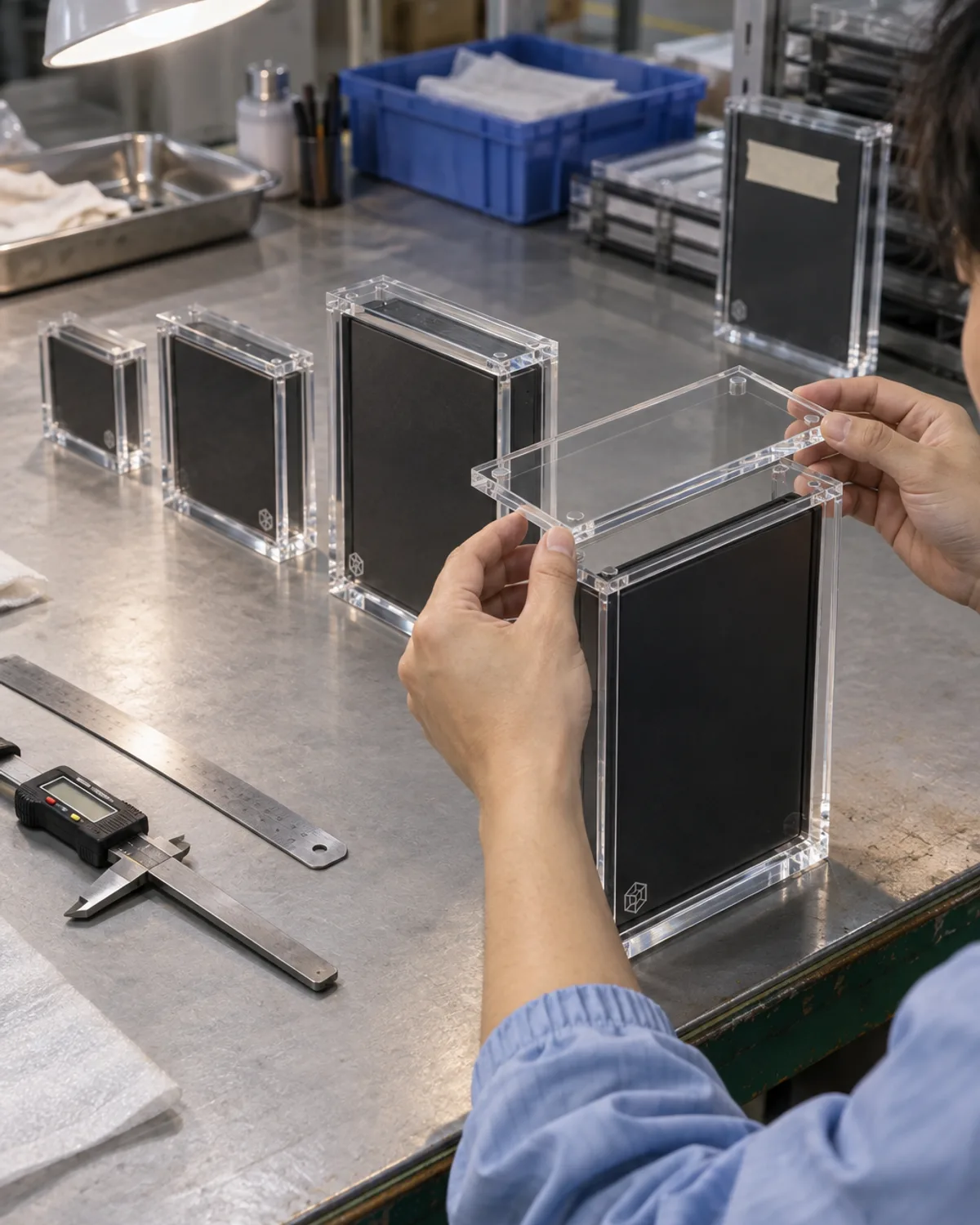
Each model was sized from its reference game case plus about 1 mm of clearance on each side: enough that the game slides in and out without force, not so much that it rattles or sits crooked. Four models means four drawings, four jigs, four first-off checks, and four tagged samples-of-record, and we treated them as four products that happen to share a construction. The first-off of each model was checked against its reference game case for lid seating and side clearance before that model's run was released, and every piece was checked the same way before boxing.
The mark, the lid, and the box
The brand's mark is laser-engraved at the lower front corner of each case. That position was one of the sample-round decisions: low enough not to sit over the box art, on the front so it reads on a shelf, and small enough that the case is about the game rather than the case maker. Engraving rather than printing means the mark cannot wear off and needs no ink match; our guide on engraving versus UV printing covers the trade-off for logo blocks, and the same logic applies to a case corner.
The lid is a lift-off top held by small magnets set into the wall tops and the lid. It is the simplest closure a collector can use, there is nothing to hinge or slide, and it lets the case be opened from above on a shelf with other cases either side. Our card-shop display case procurement guide covers the closure options for a retail shelf; on a shelf product, top-lift wins more often than not.
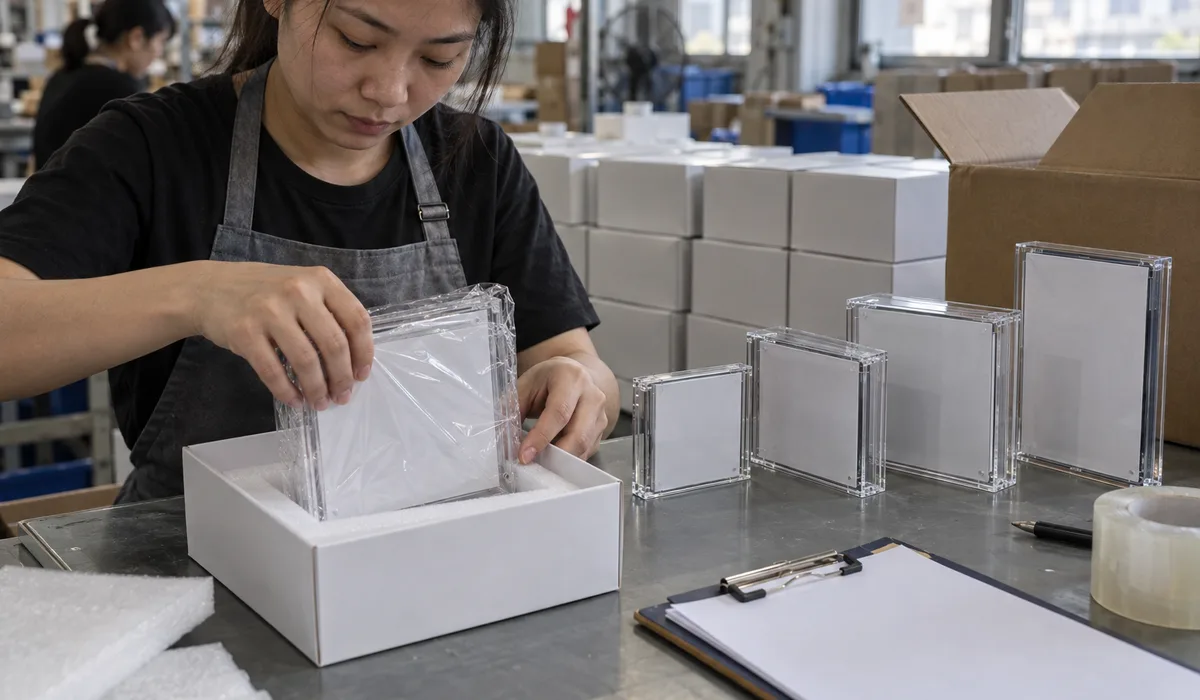
The white inner box is the decision most buyers leave until dispatch, and this brand made it during sampling. A plain white box with a foam insert means a case can go from the brand's stock shelf into a customer parcel without being repacked, and it means the case arrives at the brand in the same protection it will leave in. It was written into the specification with the material and the lid, not added at the packing bench.
Spec at a glance
Prices and some dimensions on this page are shown as bands or rounded to protect the buyer's commercial detail. The underlying order is documented in our records.
The Results
Four hundred cases across four models were produced from the approved samples, checked model by model against their reference game cases, inspected one by one for polish, joints, lid action, engraving, and scratches, boxed in white inner boxes, and shipped to Australia. The invoice was paid in full. The brand had a complete display case line on sale from a single production order at the smallest quantity that made production sense.
Two points in that table deserve a careful reading. "About five weeks" is the record from the sample round shipping in July to the production order in August; it is the brand's decision time plus our sample lead time, not a production promise, and standard production ran after that on the usual 15–20-day baseline once the four drawings were approved. And "400 cases" is four separate runs of 100 that happened to be ordered together. Each model has its own tagged sample-of-record, which means the brand can reorder the model that sold fastest on its own at 100 pieces without touching the other three.
What the brand got was a line, not a case, at a quantity it could afford to be wrong about. What it also got is a record: four samples, four drawings, one engraving file, and a packing specification, so the next order for any of the four is a purchase order and not a project.
Project note: A line launch is four products that share a construction. Sample them together so the decisions are made once, then order each at the floor so the market, not the forecast, decides which one gets reordered.
What This Means for Your Project
If you sell collectibles, retro games, graded cards, or sealed media and you are adding display cases to your range, the shape of this project is the shape of most line launches: several sizes, one construction, a material question about UV, and not enough sales data to know which size to bet on. Our guide on launching a collectible product line covers the planning; this project shows what it looks like on the bench.
Three practical points follow, and I give them to every brand launching a case line.
Sample the line, not the case. Ask for the candidate formats in one paid round built to the same construction, so the only variable between samples is fit. Try them with the real products. The round will give you the lid, the mark position, the box, and the formats in one pass, and its fee is paid separately, never credited, because what it buys is the specification.
Put UV grade where the light goes. Walls and lid protect the box art; the base does not. Specify UV-filtering for the parts that face the light and standard clear where nothing shines through, and confirm the grade on the sample rather than on a datasheet. Our collectible display cases page covers the same logic across other object types.
Launch every model at the floor. 100 pieces per design is the smallest run that prices sensibly, and four models at 100 each is a complete line at the lowest risk. Keep a tagged sample per model so any one of them can be reordered alone. The PS5 console display case repeat order shows what that reorder looks like a year later.
We build custom collectible display cases and video game display cases for collectibles brands, card shops, and e-commerce sellers from 100 pieces per design, with a paid pre-production sample before the first run and a sample-of-record per model on every run after it. The trading card and collectibles display page covers the neighbouring formats.
Common Questions
Three questions we answer most often when a brand asks for a display case line rather than a single case.
Why launch four retro game case models at 100 pieces each instead of 400 of one?
Because retro game packaging is not one size. A standard jewel case, a thick double jewel case, a fat-box PC-style case, and a DVD keep case have different footprints and depths, and a collector buying a case wants it to fit the game it holds. Our MOQ is 100 pieces per design, so four models at 100 each is the smallest order that puts a complete line on sale. The brand launched all four at that floor, learned which sold, and can reorder the winners without re-sampling.
Does a video game display case need UV-filtering acrylic?
If the box art is the thing being protected, yes. Printed cardboard and paper inserts from the 1990s fade under daylight and shop lighting, and a clear case that lets UV through is a clear case that lets the fading through. On this line the 5 mm walls are UV-filtering grade and the 8 mm base is standard clear, because the base sits under the game and does not face the light. Material grade is confirmed on the paid sample, not on a datasheet.
How long does it take to go from samples to a production order on a new display case line?
On this project about five weeks: a paid sample round covering the candidate formats in July, the brand's evaluation and lid and engraving decisions, then a production order for four models at 100 each in August. Standard production then runs 15–20 days after approval. A sample round is paid separately and is never credited to production; it buys the decisions, which is what a line launch actually needs.
Launching a display case line for games or collectibles?
Send the packaging dimensions for each format, the material and lid preference, the mark you want engraved, and the quantity per model. We will return a sample-round plan covering the candidate formats, a paid sample quote, and a written production quote per model.
Paid samples in 3–5 days · Fees paid separately and never credited · Production in 15–20 days after approval · MOQ 100 pieces per design · Response within 24 hours