
Bulk Graded Card Display Cases Guide
Card-shop cases fail at the interface between the slab, stand, access, shelf, and carton; one measured sample closes those gaps before the PO.
Need this made?Graded card display cases →
Key Takeaways
- Measure each slab format in hand; grading-company names do not replace finished length, width, thickness, label, and corner measurements.
- Separate single-slab, multi-slab, countertop, wall, and lockable designs into their own drawing and MOQ lines.
- Choose access from staff workflow: lift-off, hinged, magnetic, sliding, or lockable mechanisms create different clearances and inspection points.
- Approve the actual slab, stand angle, access motion, artwork, and carton in a paid sample before production.
- Wetop's production MOQ is 100 pieces per design; samples take 3–5 days and production takes 15–20 days after approval.
On this page
Measure the slab before drawing the case
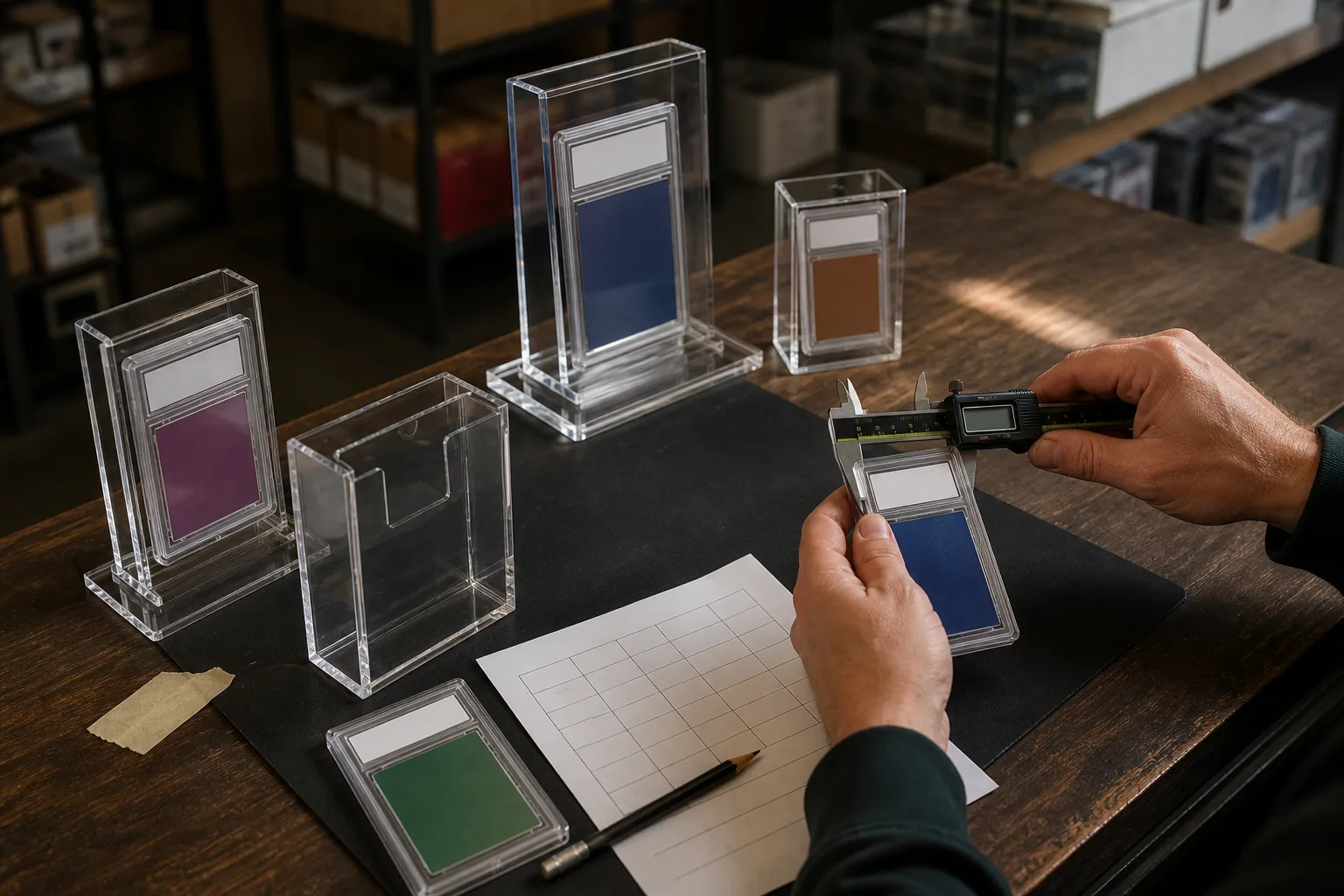
Buyers searching for wholesale graded card display cases usually need a made-to-order production program, not stocked wholesale inventory. Size the cases from actual slabs, not grading-company names. Measure finished width, length, thickness, corner shape, label area, edge steps, and any sleeve or bag that remains on the slab. Add the removal path and stand angle before setting the internal envelope.
I ask card buyers for one physical slab from each intended format when the program serves several grading companies. A nominal size from a listing may omit a raised label, tapered edge, or corner condition that affects fit. The sample answers those details faster than an email chain.
Build a format matrix. Give each slab a buyer code, measured dimensions, quantity forecast, display orientation, and case SKU. Mark whether the slab should sit free, locate in a recess, rest on an easel, or slide into a channel. The case drawing should name the actual approved slab formats.
PSA publishes submission requirements and identifies the card holder used for submissions, but the finished encapsulated slab remains the object your display must fit.1 Measure the finished item in hand. The same rule applies to other grading services.
Separate the physical case formats
A card shop may need single-slab countertop stands, multi-slab trays, lockable counter cases, wall frames, or larger assortment cabinets. Those formats solve different jobs. Put each on its own drawing and quantity line.
Single-slab stands optimize label visibility and a compact footprint. Multi-slab layouts need spacing, consistent angle, and a loading sequence. Lockable cases add access hardware and anchoring. Wall units add mounting points, installation responsibility, and service access.
The graded-card display cases page shows these product paths. Use the page to select the physical form. This guide covers the card-shop procurement program around it.
Production MOQ is 100 pieces per design. A new slab count, footprint, case size, closure, artwork, or mounting arrangement can create a separate design because setup and inspection change. Ask the quote to show quantity and setup by SKU.
Choose access from staff workflow
Access should match who opens the case, how often, and where the case sits. A lift-off cover gives simple full access but needs clear space above. A hinge keeps the cover attached but requires swing clearance and hardware checks. Magnets support quick opening yet need an approved force and alignment. Sliding access needs a clean travel path. Locks add key control and installation questions.
Map one restocking cycle. Place the case on a counter or shelf at the intended height. Have staff remove and replace the slab while keeping nearby products in place. Record the hand path, clearance, and any surface that touches the slab.
Do not call a mechanism secure without a buyer-defined threat and installation plan. A keyed door can control casual access, while the entire case may still need anchoring. The buyer or local installer approves fixture attachment, key management, and store procedure.
Our box lid and closure guide compares common access mechanisms. Use it to shortlist options, then approve the chosen hardware and motion on the paid sample.
Control visibility without promising preservation
Clear acrylic supports full label and card visibility, but the buyer should specify the sheet grade, finish, viewing distance, lighting, and acceptable reflections. Tinted, frosted, or mirrored accents can frame the card while reducing some sight lines. Sample the finished combination.
UV-related claims require a named material and current supplier datasheet. General-purpose clear acrylic and specialty UV-filtering grades do not share one transmission curve. Light exposure, duration, distance, temperature, and the card’s own materials also affect preservation decisions.
The Library of Congress recommends limiting light exposure for paper collections because light damage accumulates.2 A display case can form one part of the buyer’s plan, but it does not replace collection-care decisions. Ask the buyer or conservator to set material, light, and monitoring requirements.
State this boundary on the RFQ: factory supplies the named acrylic case to the approved drawing; buyer approves preservation requirements. That sentence prevents a vague “museum grade” request from becoming an unsupported guarantee.
Build the SKU and reorder file
Card shops often expand one product family across slab formats, colors, or store locations. Use a SKU matrix with the case code, slab format, drawing revision, artwork revision, quantity, carton mark, destination, and approval status. Keep retired versions visible so a repeat PO cannot revive an old file by mistake.
Artwork may include the shop logo, category, set name, price area, QR code, or a replaceable insert. State whether graphics are permanent or replaceable. Assign each version a production file and proof.
A repeat order should cite the prior drawing and approved sample, then list every change. Do not write “same as last order except logo” without a revision package. The logo change can affect print method, setup, inspection, labels, and carton allocation.
Use a change log with four columns: old revision, new revision, requested change, and approval. Ask the supplier to confirm whether material, hardware, process, or packing has changed since the last release.
Approve the sample with actual cards
The paid sample should carry the actual smallest and largest intended slabs. Check fit, movement, label visibility, stand angle, access, closure, stability, edges, joints, artwork, protective film, and carton protection. Record the approved drawing and artwork revision on the sample report.
Wetop samples take 3–5 days, are paid separately, and are never credited to production. The sample buys one-off setup and evidence before the 100+ piece release. If a second design or artwork version changes the acceptance questions, quote it as a separate sample line.
Photograph the sample in the intended viewing position. A stand that looks balanced on a workbench can sit too low on a retail shelf. A label can disappear behind a front lip at customer eye level. Use the shop environment to approve the final angle and visible area.
Our triple PSA display case provides a related manufacturing example. Apply its fit-and-approval logic to your slab matrix rather than copying the program dimensions.
The magnetic slab-case sample-to-bulk project follows a single-slab route built around the buyer-supplied graded-card holder, polarity review, opening feel, first-off inspection, and protective packout.
Define inspection and packout
Critical checks usually include internal fit, stand angle, closure, hardware alignment, base stability, artwork, visible finish, protective film, and carton contents. Name the tool or sample used for each check. Link the report to the drawing revision and SKU.
Multi-slab cases need a position map. The inspector should know which slot or support corresponds to each slab format. A photo can show the loaded arrangement, but the report should still identify the measured dimensions and result.
Packing must prevent polished acrylic and printed faces from rubbing. Specify bags or interleaves, corner protection, inner cartons, master cartons, and labels. If the shop needs store-ready kits, give the factory a location allocation sheet and require a packout check.
Ask for carton dimensions, units per carton, gross weight, and pallet plan before approving freight. Case dimensions and non-nesting construction can make carton volume a larger cost driver than product weight.
Compare the landed program
Require line items for case fabrication, hardware, artwork, sample, packing, and freight. State the Incoterm and named place. Use the same destination and service condition across bidders.
Price each design at the forecast quantity and at the 100-piece floor. A high-volume hero SKU may carry a lower unit cost while a secondary slab format stays at MOQ. That visibility helps the buyer decide whether to launch every format at once.
Keep warehouse and obsolescence costs in the decision. A larger release can lower unit price while tying cash to a format that may change. Card programs with frequent label or slab changes benefit from controlled releases and a clean reorder file.
Ask each supplier to quote one agreed reference design before comparing alternates. The reference should name the slab, finished outside size, material and thickness, access mechanism, stand or recess, artwork, packing, quantity, Incoterm, and destination. A bidder may then price a lock, wall mount, second artwork, or store-ready kit as a separate option.
Use a comparison sheet with columns for included scope, excluded scope, sample fee, production unit price, carton data, freight, payment trigger, and production start gate. Record the quote validity date. Freight and material offers may carry different validity periods, so keep them separate.
Review the supplier’s open questions. A factory that asks about slab measurements, access, shelf height, artwork version, and carton allocation is defining the product. A quote that closes without those inputs probably contains silent assumptions. Require those assumptions in writing before the purchasing team selects a bidder.
For a first release, budget the paid sample and one controlled revision. The sample may confirm the drawing at once, but procurement should not rely on that outcome. A defined revision path is cheaper than rushing an unapproved case into production.
Wetop production takes 15–20 days after drawing, artwork, sample, and payment approval. Freight sits outside that clock. We reply to complete briefs within 24 hours.
Send the card-shop RFQ
Send actual slab measurements or samples, the case format, layout, access method, shelf or wall location, material requirement, artwork, quantity per design, packing, destination, and target date. Identify any buyer-side preservation, lock, or installation approval.
Use the graded-card case quote form to upload the matrix and files. We will return the drawing assumptions, sample scope, production lines, packout, and open questions.
Compare the matrix with the graded-card case product page and card display-case family. The trading-card display program covers shop-counter, wall, and multi-SKU buying contexts.
Footnotes
-
PSA card submission guidelines — PSA’s official guidance identifies handling and holder requirements for submitted cards; display procurement still starts from the finished slab measurement. ↩
-
Library of Congress care of paper collections — the Library of Congress explains that light exposure contributes to paper deterioration and should be controlled as part of collection care. ↩
Frequently Asked Questions
Can one acrylic case fit PSA, CGC, and Beckett graded cards?
Do not assume a universal fit. Measure the actual slab formats and approve the largest and smallest intended units in the sample. Label the drawing with the approved formats and clearance method.
What MOQ applies to a card-shop display case program?
Wetop's production MOQ is 100 pieces per design. A different size, slab layout, artwork, closure, or wall-mount arrangement can create a separate design quantity.
Should a graded-card case be lockable?
Use a lock when the shop's risk review and staff workflow require controlled access. The buyer should approve the lock, key control, anchoring, access clearance, and local installation plan.
Do acrylic cases block UV?
Select a named sheet grade and review its current supplier datasheet. Do not treat clear acrylic, a marketing label, or one percentage as a universal preservation guarantee.
How do I approve a card display case sample?
Check the actual slabs, stand angle, label visibility, access, closure, stability, finish, artwork, protective film, and carton. Paid samples take 3–5 days and are never credited to production.
Build a Card-Shop Case Program from Your Slabs
Send slab measurements, layout, access method, shelf or wall location, quantity per design, artwork, packout, and destination. We reply within 24 hours.