
Delivered Project · Home Organization · Australia–New Zealand
A Meter-Wide Acrylic Yearly Wall Planner with Standoffs, Built as a 200-Set Retail Program
A direct-to-consumer planner brand in the Australia–New Zealand region moved its hero product, an acrylic yearly wall planner with standoffs, to Wetop for its next 200-set run.
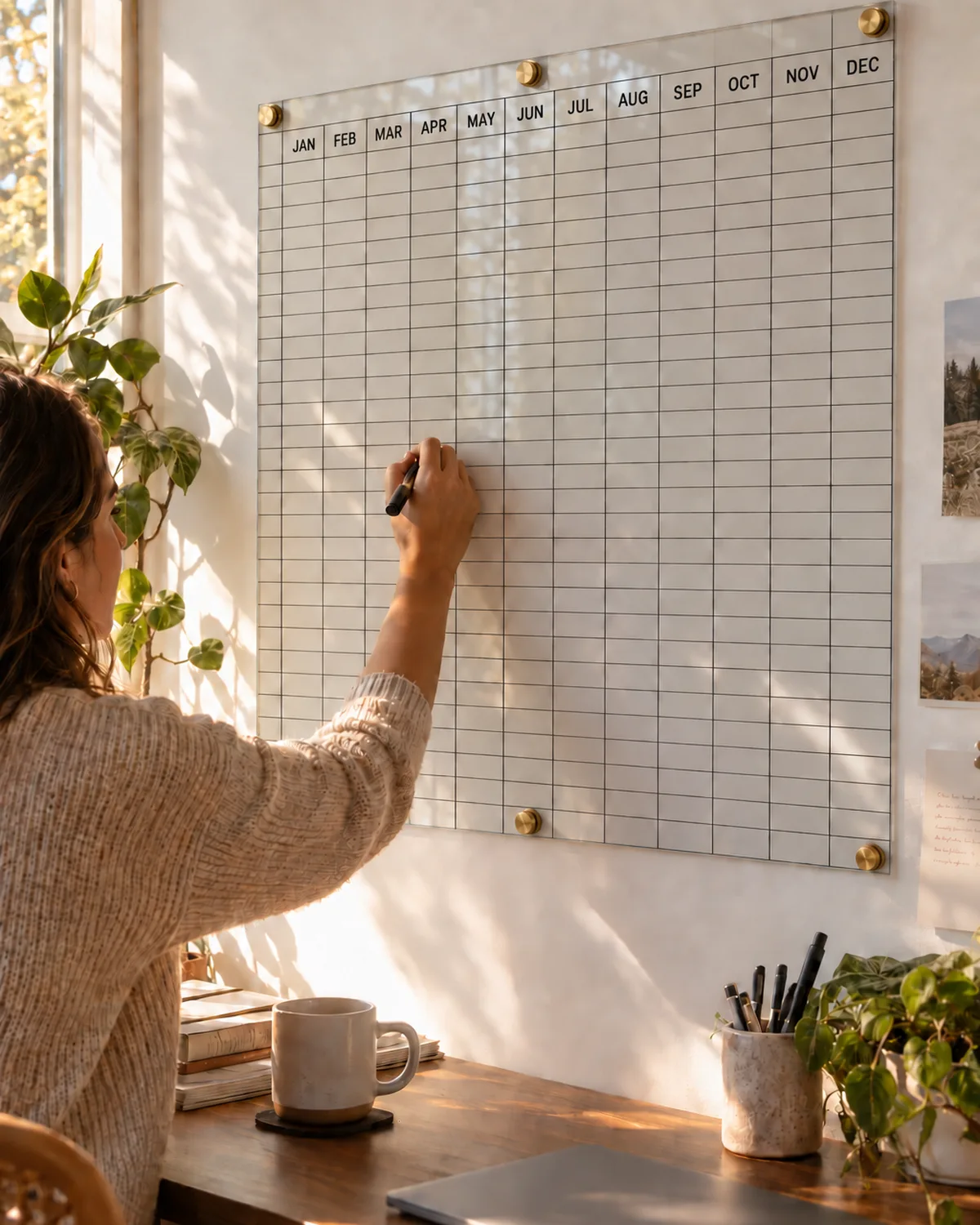
The panel is 5 mm clear cast acrylic about a meter wide, back-printed in one color, and ships in a printed rigid box with a six-standoff mounting kit. Before release we changed the print method, printed the grid to the edge, corrected the screw heads and wall anchors, and declined a magnetic no-drill variant. The order was released to production in early August on a 30% deposit and the balance was settled in early September. Project profile: 200 sets · 5 mm back-printed panel · six-standoff kit · printed rigid box · DDP sea to the ANZ region.
- Project record · sets in the production order
- 200
- Project record · standoffs per set
- 6
- Project record · per set, product only
- USD 25–30
- Project record · DDP sea freight vs goods
- ~25%
Ordering a similar project
MOQ is 100 pieces per design. Paid samples normally take 3–5 days; sample fees are paid separately and never credited. Standard production takes 15–20 days after drawing, material, artwork, hardware, packing, and sample approval. Wetop responds to a complete brief within 24 hours.
Price context: the USD 25–30 per set band above is this project's product price at 200 sets, with freight as a separate DDP line. A different panel size, thickness, print, hardware finish, box, or quantity changes the number; a written quote follows the approved drawing.
Key Takeaways
- A 200-set acrylic yearly wall planner with standoffs was released to production in early August after a full pre-production sample set, panel plus hardware plus retail box, was approved; the balance was settled in early September.
- One-color artwork on a panel about a meter wide moved from silkscreen to UV digital back printing, and the grid was printed to the cut edge to remove the 5 mm halo the earlier batch had carried.
- Two hardware corrections were made before release: screw heads went from 7 mm to 6 mm so they sit inside the standoff cap, and green masonry anchors were replaced with white plasterboard anchors.
- Each set ships in a printed rigid box with EVA corners, tissue, and an A5 instruction card; three retail boxes go in one outer carton of about 15 kg, and shipping labels never touch the retail box.
- A no-drill magnetic version for renters was requested and declined: a roughly 3.5 kg sheet on adhesive-backed magnets has no positive lock, and downsizing the panel does not change that.
The Challenge
The founder of a direct-to-consumer planner brand in the Australia–New Zealand region sells one hero product: an acrylic yearly wall planner with standoffs. It is a clear 5 mm sheet about a meter wide and a little over half a meter tall, printed on the back with a year-at-a-glance grid so the artwork sits behind a glossy face that can be written on with a marker and wiped clean. The product was already selling and was already on its second production round with another factory. The brand was not looking for a new product. It was looking for a manufacturer that answered the same day, could reorder the same specification without re-explaining it, and would still be there for the third and fourth runs.
That sounds like a simple hand-over. It was not, for three reasons. First, the brand did not have a factory-ready drawing; it had a physical planner and its retail box from the earlier batch, plus the print files. Second, the earlier batch carried a defect the brand had learned to live with: the printed grid stopped about 5 mm short of every edge, leaving a clear halo between the artwork and the polished edge. On a screen mock-up that gap is invisible. On a wall, lit from a window, it is the first thing you see. Third, the mounting kit had been assembled from whatever the earlier factory had on the shelf, and it included green masonry anchors for a product that is almost always screwed into plasterboard.
On top of that, the brand wanted a retail-ready pack rather than a bubble-wrapped sheet in a carton. Each planner ships one at a time to a consumer after it lands, so the box the buyer opens is part of the product: a printed rigid box, foam corners, tissue, and an instruction card. And the founder wanted a landed price to an Australian address by sea with duties handled, a DDP quote, so the unit economics could be compared without building a freight spreadsheet.
The scope settled at 200 sets for this run, with 100-set pricing prepared alongside it so the brand could see the volume difference. A companion marker rail, a 3 mm hot-bent U-profile about a meter long, was costed with the planner but left out of this run. That is the shape of the brief: one SKU, a custom acrylic yearly planner in production quantity, with the print, hardware, and packaging each needing a decision before release.
Our Approach
We started from the physical sample, not from the files. The brand's own planner and its box arrived at our factory in late June. We measured the panel, the hole positions, the standoff barrels, the box, and the packed weight, which came to about 4 kg per boxed planner. Then we costed the set, and instead of quoting from a drawing alone we built a full pre-production sample set: the back-printed panel, the six-standoff hardware kit, the printed rigid box, the tissue, and the A5 instruction card. Everything below happened between that sample and the production release in early August.
Silkscreen to UV digital, and printing to the edge
The artwork is one color, which on a small panel would be a silkscreen job. On a panel about a meter wide the screen printer declined the work: the screen size and the registration risk across the full sheet were more than the shop would take on for a one-color run. We moved the print to UV digital on the back face of the 5 mm sheet. That raised the per-panel print cost, so we isolated the change as its own line and asked the buyer to approve it before the sample was built, rather than folding it into the set price and explaining it later.
Back printing, sometimes called second-surface printing, puts the ink on the rear face and lets the buyer look at the grid through 5 mm of clear acrylic. The ink is protected from the marker and from the cleaning cloth, the face stays glossy, and the artwork reads with a slight depth that a front print never has. The trade is that the artwork has to be mirrored and built with bleed to the cut line. This is where the earlier batch had gone wrong. Its files had been shrunk about 5 mm per side, presumably to avoid ink at the edge, and that shrink is exactly the halo the brand had been living with. Our instruction to the print line was the opposite: print to the cut edge, no per-side shrink, and check the corners on the sample against the radiused corner of the panel. Our UV printing on acrylic guide covers the file preparation in more detail.
A six-standoff kit built for plasterboard, not masonry
Each set carries six metal standoffs, brushed gold on this run, six screws, six wall anchors, and the spacer gaskets that sit between the barrel and the panel. Two corrections came out of the hardware check, and both were small enough to miss on a spreadsheet.
The first was the screw head. The earlier kit used a screw with a 7 mm head. The standoff cap on this kit closes over the screw, and a 7 mm head sat proud, so the cap did not seat flush and the joint looked unfinished from the side. We changed to a 6 mm head, which sits fully inside the cap and matches the hardware we stock. The second was the anchor. Green masonry plugs are for brick and concrete. This product is sold to households and mounts on plasterboard in almost every case, and a masonry plug in plasterboard spins and pulls out. We replaced them with white plasterboard expanding anchors. The center spacer was already right and stayed as it was.
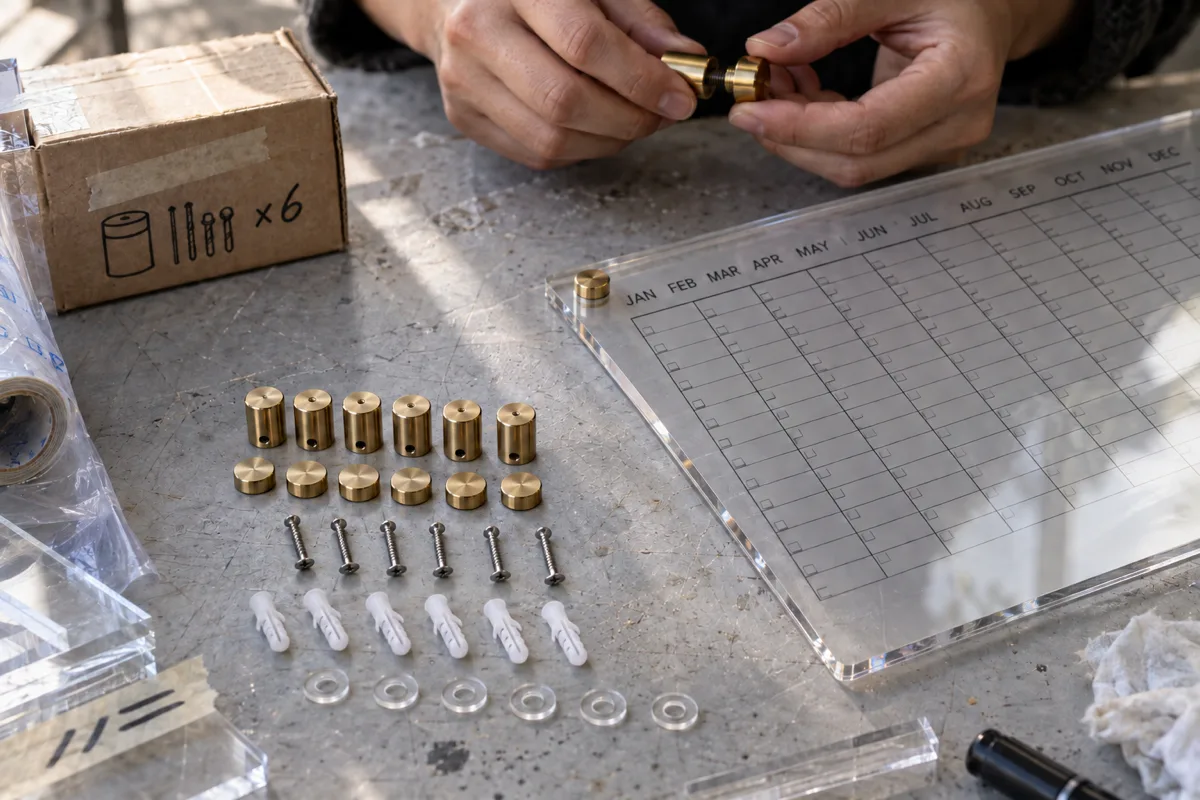
Buyers often ask us for standoff hardware by finish and diameter and stop there. The two questions that decide whether the kit works are quieter: does the screw head disappear inside the cap, and is the anchor made for the wall your customer actually has? If a product is sold across markets where masonry is common, the honest answer is to ship the plasterboard anchor in the box and note in the instruction card that masonry walls need a different plug. Our standoff poster frame page describes the same barrel-and-cap system on frames.
Retail box, outer carton, and where the label goes
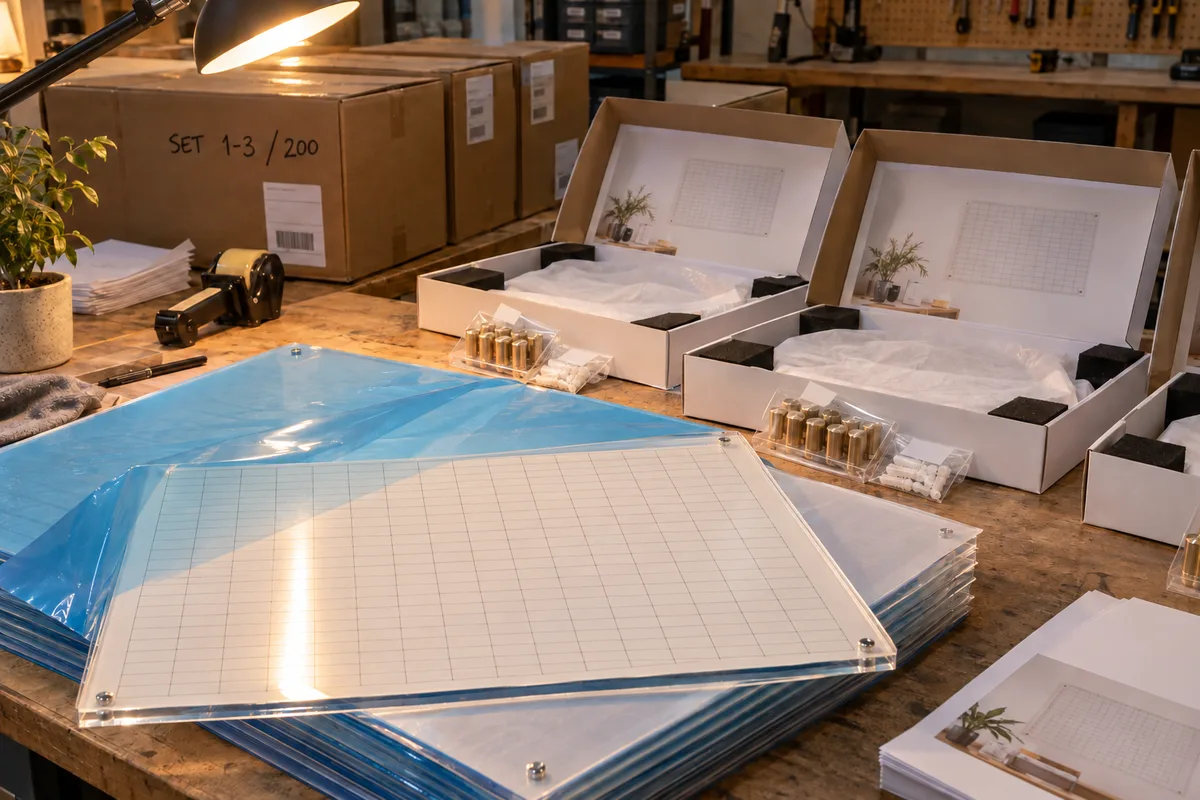
The retail pack was specified from the brand's own sample: a printed rigid box about 3.5 cm deep with a one-color logo, black EVA foam corner protectors, printed tissue, and an A5 instruction card on 300 gsm stock, double-sided and matte laminated. One detail did not survive contact with the packaging supplier. The brand's tissue was a single large sheet, and a custom-printed sheet at that size could not be made in one piece at this quantity, so we matched the sample's look with the closest available format and showed it on the pre-production set. Custom-logo bubble bags were also considered and ruled out; their minimum run is in the thousands of pieces, which makes no sense at 100 to 200 sets.
For freight we added an outer carton the brand had not needed before: three retail boxes per carton, about 15 kg each, with shipping marks for item, quantity, weight, and country of origin. The rule we wrote into the packing specification is simple and worth copying: shipping labels go on the outer carton and never touch the retail box. The retail box is the thing the end customer opens, and a courier label or a customs sticker on it turns a premium unboxing into a returned item. Our guide on how acrylic orders are packed explains the general carton logic.
The no-drill request we turned down
In mid-August, with the run already released, the founder asked a good question. Renters do not want to drill six holes. Could the next version mount with magnets and adhesive wall pads, the way our magnetic frames close, and would a smaller panel make that safer? We had the same conversation internally and the answer was no on both counts.
A 5 mm clear sheet at this size weighs roughly 3.5 kg by material density calculation. Magnets on adhesive pads carry that weight in shear, through the adhesive bond to the paint, with no positive lock; if the pad lets go, a 3 kg sheet is on the floor. Standoffs are the most secure option for a panel this size and they do the least wall damage: six small holes, filled in minutes when the tenant moves out. The only genuine no-drill route is direct adhesive strips on a smooth painted wall, and only within the strip maker's published rating for the finished weight. A smaller panel reduces the weight but does not remove the shear-and-no-lock problem, so we did not recommend a downsized magnetic variant either. Our magnetic acrylic frames hold a print between two panels; they are not a way to hang a meter-wide sheet. The acrylic frame mounting methods guide lays out standoffs, magnets, easels, and cleats side by side. The brand kept standoffs and the SKU count stayed at one, which is the cheaper outcome for a 200-set run.
The Results
The order was invoiced in early August for 200 sets, released to production on the 30% deposit, and the 70% balance was settled in full in early September. The 200 sets were then shipped and received by the buyer.
Spec at a glance
| Item | Specification on this run |
|---|---|
| Panel | 5 mm clear cast acrylic, about a meter wide, radiused corners, six through-holes |
| One-color UV digital print on the back face, artwork to the cut edge, no per-side shrink | |
| Hardware per set | 6 metal standoffs (brushed gold), 6 screws with 6 mm heads, 6 white plasterboard anchors, spacer gaskets |
| Retail pack | Printed rigid box about 3.5 cm deep, black EVA corner protectors, printed tissue, A5 instruction card (300 gsm, matte laminated) |
| Outer carton | 3 retail boxes per carton, about 15 kg; shipping marks on the carton only |
| Quantity | 200 sets; 100-set pricing prepared for comparison; companion marker rail costed but excluded |
| Price band | USD 25–30 per set, product only; DDP sea freight as a separate line at roughly 25% of goods value |
| Terms | 30% deposit before production, 70% balance before shipment |
| Sample | Full pre-production set approved before release (panel, hardware, box, tissue, card) |
The numbers above are bands and rounded figures from the project record; the panel dimensions are described rather than listed so the brand's product stays its own. What the record shows is a manufacturer working as an acrylic wall planner manufacturer rather than a sheet cutter: the print method, the hardware, the packaging, and the freight term were each decided and approved before the run, and each of those decisions is now on file for the next reorder.
The timeline is worth reading honestly. From the brand's physical sample arriving at the factory in late June to the production release in early August was about six weeks, most of it spent on the pre-production sample set and the hardware and packaging corrections. That is slower than a cut-and-ship order and faster than the alternative, which is finding the halo, the proud screw heads, and the wrong anchors after 200 boxed planners have crossed the ocean.
Buyer decision point: approve the print method change, the print-to-edge artwork, the 6 mm screw heads, the plasterboard anchors, and the retail box on one physical pre-production set before releasing 200 sets to production.
What This Means for Your Project
If you sell a printed acrylic planner, calendar board, or any back-printed wall panel and you are moving production or starting one, the useful lesson is that the panel is the easy part. Send us the panel size, thickness, and corner radius; the print files with bleed and the color; the standoff finish and count; the wall type your customers have; the retail pack you want them to open; and the destination and freight term. A physical sample of your current product is worth more than any of those files, because it lets us measure what you are actually selling.
Expect the same decision points this brand went through. A one-color print on a panel wider than about 60 cm will usually be UV digital rather than silkscreen, and the cost difference should be shown to you as its own line. The hardware kit should be specified down to the screw head diameter and the anchor type, and the anchor should match the wall. The retail box and the outer carton are two different objects with two different jobs, and the courier label belongs on only one of them. Ask for a full pre-production set, not just a panel, before you release the run.
On cost, the 100-set versus 200-set comparison matters more than the headline unit price. Sea freight to the ANZ region is a lump sum that barely moves between 100 and 200 boxed planners, so the landed cost per set falls faster than the product price does. Compare quotes on the same basis: product price and DDP freight as separate lines, with the same box, the same hardware, and the same Incoterm. A lower unit number against a bubble-wrapped sheet and a masonry plug is not the same product. Our FOB versus DDP guide explains what the freight line includes.
Wetop builds custom acrylic organizers and wall-mounted formats, with UV back printing and hardware kitting handled in-house through our custom acrylic fabrication process. A comparable standoff project in a different category is our colored acrylic floating frames for art galleries case.
Common Questions
The three questions below are the ones this project record answers directly.
Why did the print move from silkscreen to UV digital on this planner?
The screen printer would not take a one-color job on a panel about a meter wide, so the artwork moved to UV digital printing on the back face of the 5 mm sheet. The change raised the per-panel print cost, so we isolated it as its own line and asked the buyer to approve it before the pre-production sample was built.
Can a meter-wide acrylic wall planner be mounted without drilling?
Not with magnets. A 5 mm clear sheet at this size weighs roughly 3.5 kg by material density, and magnets on adhesive pads carry that load in shear with no positive lock. Standoffs remain the most secure option with the least wall damage. The only no-drill route is direct adhesive strips on a smooth painted wall within the strip maker rating, and a smaller panel does not remove that limit.
What does a set include, and what does it cost?
Each set is one back-printed 5 mm panel, six metal standoffs, six screws with 6 mm heads, six plasterboard anchors, spacer gaskets, an A5 instruction card, and a printed rigid box with foam corners and tissue. On this run the product price fell in the USD 25 to 30 per set band at 200 sets, with DDP sea freight to the ANZ region quoted as a separate line at roughly a quarter of the goods value.
Planning a printed acrylic wall planner run?
Send the panel size, print files, standoff finish, wall type, retail box requirement, quantity, and destination. We will return the open questions, a pre-production sample quote, and a written production quote with freight as its own line.
Paid sample in 3–5 days · Sample fees paid separately and never credited · Production in 15–20 days after approval · MOQ 100 pieces per design · Response within 24 hours