
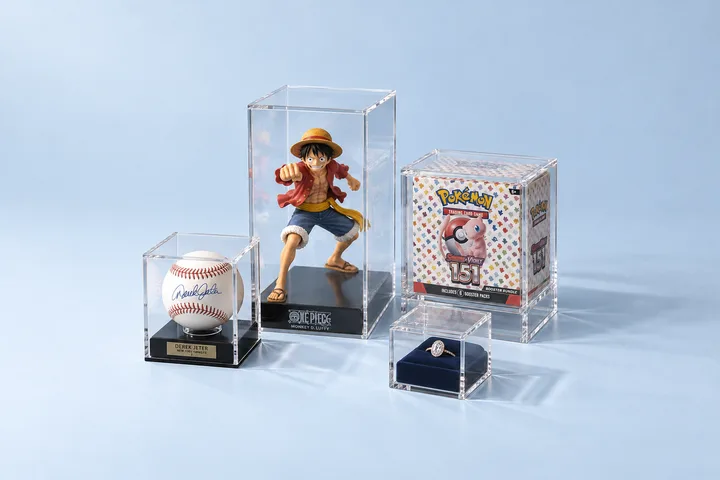




How to Compare Custom Acrylic Display Quotes
Two quotes for the same display can differ by half and both be honest. Put them on the same drawing, quantity, packing and trade term before you compare the totals.
Need this made?Acrylic display manufacturer →
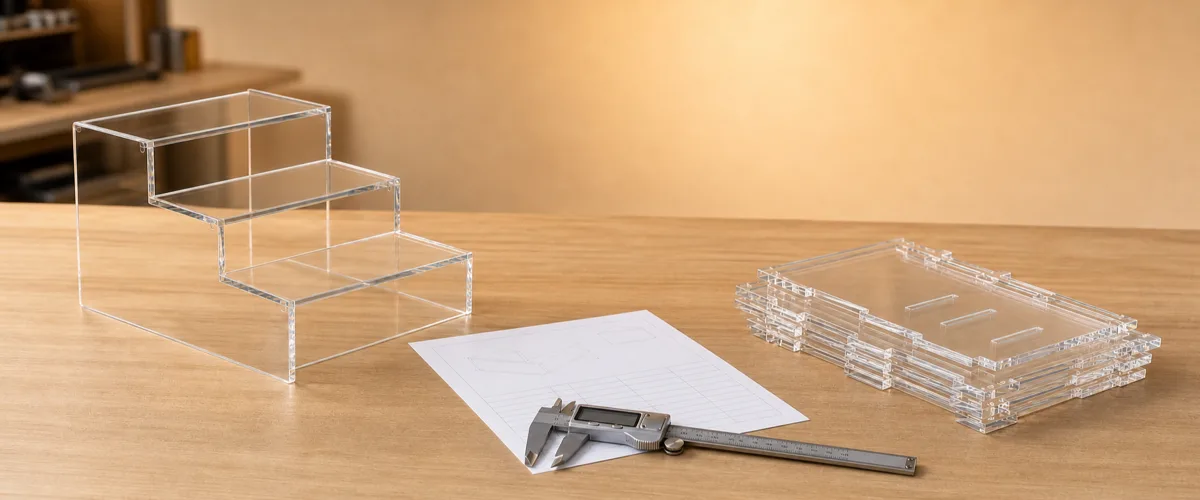
This guide is for buyers holding two or more quotes for a custom acrylic display, stand or case and trying to work out which one is actually cheaper.
Key Takeaways
- A like-for-like comparison starts from one drawing revision, one quantity per design, one packing spec and one trade term with a named place. Change any of them and the totals stop being comparable.
- Ask every supplier to split the quote into four parts: production, one-time charges (setup and sample), packout and freight. A single all-in number hides where the price difference comes from.
- Most custom acrylic displays carry no tooling fee; when one applies, it should be its own line, along with whether it repeats on a reorder.
- Packing changes freight: an assembled stand ships far more air than a flat-packed one, so the carton count, carton size and gross weight belong on the quote.
- An FOB Shenzhen price and a DDP price measure different journeys. Compare FOB to FOB or delivered to delivered, at the same destination.
On this page
- How to compare custom acrylic display quotes like for like
- Can the quote separate the unit price from freight and packaging?
- Production: what the unit price has to state
- One-time charges: setup, tooling and the sample
- Packout: why the same stand ships in different volumes
- Freight and terms: compare on the same Incoterm and destination
- What if one quote is far below the others?
- A comparison sheet you can copy
How to compare custom acrylic display quotes like for like
To compare custom acrylic display quotes fairly, give every supplier the same drawing revision, quantity per design, packing spec and trade term with a named place, then ask each to return four separate parts: production, one-time charges, packout and freight. Compare part by part, not total against total. A cheaper total that drops a line is not cheaper.
Buyers who reach this point usually ask some version of the same three questions: does this quote separate the unit price from freight and packaging, why is one quote so far below the others, and what does a quote need to include before I can trust it. The sections below answer them in the order the money moves: the product, the one-time charges, the cartons and the journey.
Before comparing anything, check that every quote names the same inputs. If one supplier quoted from your drawing and another from a reference photo, or one priced 300 pieces and another 500, fix that first. Our RFQ template lists the nine fields that make a brief quotable in the same way by every supplier.
Can the quote separate the unit price from freight and packaging?
Yes, and it should. A like-for-like quote shows production, one-time charges, packing and freight as separate lines, each with the assumptions behind it. When a supplier sends one all-in figure, ask for the split; without it you cannot tell whether a lower price comes from the product, the cartons or the freight.
| Quote part | What the line must state | Why it matters when comparing |
|---|---|---|
| Production | Unit price, quantity per design, drawing revision, material and thickness, edge finish, print method and colors, assembly | This is where specs quietly differ |
| One-time charges | Paid sample and its courier cost; any setup or tooling charge, and whether it repeats on a reorder | One-off costs distort the unit price at small quantities |
| Packout | Packing method per unit, pieces per carton, carton dimensions, gross weight, any packing charge | Packing sets the freight volume and the damage risk |
| Freight and terms | Trade term with named place, transport mode, destination, what is included and excluded, quote validity | FOB and DDP prices cover different parts of the journey |
At Wetop every quote itemizes product, branding and freight as separate lines, and on request we add carton count, per-carton dimensions and gross weight, the three numbers a forwarder needs to price the lane. Ask every supplier for the same.
Production: what the unit price has to state
The production line is where two quotes for “the same display” most often differ, because each supplier fills unstated specs with its own default. Check five things on every quote: sheet type and thickness, edge finish, print method and color count, assembly method, and the quantity tier the unit price applies to.
Sheet first. Cast and extruded acrylic look alike in a photo but differ in cost and in how they machine and polish; the cast vs extruded guide explains the trade. A quote that says “acrylic, 5 mm” without the sheet type has left the door open. Then the edges: polished edges take an extra process step that saw-cut or raw-cut edges skip. Printing: a one-color logo and a full-color UV print are different costs, and so are one face and two. Assembly: a bonded, assembled stand costs more labor than flat-pack parts the buyer assembles.
Ask for the same specification at three or four quantities. Unit price falls as quantity rises, because sample, setup and handling work spread across more pieces. One published reference from our acrylic display stands page: a 250 × 180 × 220 mm two-tier countertop stand in 5 mm clear acrylic is $28 each at 100 pieces, $16 at 500 and $12 at 1,000, FOB Shenzhen. A tiered quote lets you see whether a lower unit price elsewhere is a better price or just a larger assumed quantity. Our production minimum is 100 pieces per design.
One-time charges: setup, tooling and the sample
One-time charges should sit on their own lines, because they behave differently from the unit price: they are paid once, and at 100 pieces they can move the effective unit cost more than the unit price itself. Look for the paid sample, any setup or tooling charge, and whether either repeats on a reorder.
Most custom acrylic products carry no tooling or setup fee, because the parts are cut by laser or CNC from your drawing rather than molded; the tooling cost guide explains why. Some complex custom parts do carry one, and when they do it belongs in the written quote. A quote that is silent on setup is not the same as a quote that states none.
The sample is a separate cost. A Wetop sample normally costs USD 200–500 depending on complexity, takes 3–5 days to make, is paid separately and is never credited to the production order. When comparing, check whether each supplier’s sample price includes the courier and whether the sample is built from production material on production equipment, because a sample that is not representative proves little about the bulk order.
Packout: why the same stand ships in different volumes
Packout is the packing specification: how each piece is protected, how many go in a carton and how big that carton is. It changes the freight bill because freight is charged on volume as well as weight, so two quotes with the same unit price can land at different costs if one assumes assembled stands in individual boxes and the other flat-packed parts in bulk cartons.
For air and courier shipments the carrier charges the greater of the actual weight and the dimensional weight calculated from the carton size;1 for sea freight in a shared container, the volume in cubic meters is what is billed. Acrylic displays are often light for their size, so an assembled stand can cost more to ship than its weight suggests. Our packing guide works through the carton arithmetic and the four packing tiers, from an OPP bag per unit to fulfilment-ready packs.
To compare packout across quotes, ask each supplier for the packing method per unit, pieces per carton, carton dimensions and gross weight. If one quote is for individually boxed stands and another for bulk-packed ones, ask the cheaper supplier to price the same packing before deciding.
Freight and terms: compare on the same Incoterm and destination
Compare freight only when both quotes use the same trade term, the same named place and the same transport mode. Under FOB Shenzhen the price stops when the goods are loaded at the port of Shenzhen; under DDP it includes delivery to your named address with duty paid. A FOB price will always look lower than a DDP price because it covers less of the journey.
Incoterms rules set out where delivery happens and how costs and risks are split between seller and buyer, but they do not make two quotes comparable on their own.2 Also note that FOB is a sea term, so an air option should be quoted as a delivered or carrier term. Our default term is FOB Shenzhen, with Ex-Works, CIF and DDP available. The FOB vs DDP guide compares the two leg by leg and covers when air beats sea on small orders.
Check validity too. Product prices and freight rates often carry different validity windows, and freight is commonly re-quoted near booking. Record both dates so a delayed approval does not leave you comparing a current quote with an expired one.
What if one quote is far below the others?
A quote far below the others usually differs in specification, not in efficiency. Before accepting it, check the four parts above line by line; the gap is most often in sheet type or thickness, edge finish, print colors, packing or the trade term. If the specs truly match, ask for a sample built to the drawing before you commit.
If your own target budget sits below every quote, say so and ask for priced options instead of a discount on the same spec. Realistic options include a thinner sheet where the load allows, fewer print colors, flat-pack instead of assembled, bulk packing instead of individual boxes, or a larger quantity tier. Each should come back as its own line. The value-engineering guide covers seven of these levers and what each one changes on the finished display.
A comparison sheet you can copy
Put every quote into one sheet with the same rows, and mark any line a supplier did not price as “not quoted” rather than zero. A blank is a question to send back, not a saving.
| Row | Supplier A | Supplier B | Supplier C |
|---|---|---|---|
| Drawing revision quoted | |||
| Quantity per design | |||
| Sheet type, thickness, edge finish | |||
| Print method and colors | |||
| Unit price × quantity | |||
| Sample price incl. courier | |||
| Setup or tooling, repeats on reorder? | |||
| Packing per unit, pieces per carton | |||
| Carton size and gross weight | |||
| Trade term and named place | |||
| Freight, mode and destination | |||
| Product price and freight validity | |||
| Payment terms | |||
| Total to the same named place |
For reference, our standard payment terms are a 30% deposit before production and the 70% balance before shipment. For a multi-SKU rollout, the display case procurement checklist adds the sample gate and inspection plan to the same comparison.
Footnotes
-
Dimensional weight — Wikipedia — defines dimensional (volumetric) weight as an estimated weight calculated from a package’s length, width and height, and states that the shipping fee is based on the dimensional or actual weight, whichever is greater. ↩
-
Incoterms 2020 — International Chamber of Commerce — the ICC’s official rules defining the trade terms, including where delivery happens and how costs and risks transfer between seller and buyer under FOB and DDP. ↩
Frequently Asked Questions
Should a supplier separate the unit price from freight and packaging?
Yes. Ask for production, one-time charges, packing and freight as separate lines. Wetop itemizes product, branding and freight as separate lines and, on request, adds carton count, carton dimensions and gross weight so you or your forwarder can check the freight.
Why is one acrylic display quote much cheaper than another?
Usually because the two quotes are not for the same thing: thinner or extruded sheet instead of cast, saw-cut edges instead of polished, fewer print colors, bulk packing instead of individual boxes, or an FOB price set against a delivered one. Line the specs up before comparing totals.
Can you quote several quantity tiers, like 100, 500 and 1,000?
Yes. Ask for the same specification at three or four quantities. As one published reference, a 250 × 180 × 220 mm two-tier countertop stand in 5 mm clear acrylic is $28 each at 100 pieces, $16 at 500 and $12 at 1,000, FOB Shenzhen.
Is there a setup fee for a custom acrylic display?
Most products carry no tooling or setup fee. Some complex custom parts do; when one applies it is stated in the written quote. The paid sample, USD 200–500 depending on complexity, is separate and never credited to production.
What if my target budget is lower than the quotation?
Tell the supplier the target and ask for priced options rather than a lower number on the same spec: a thinner sheet where load allows, fewer print colors, flat-pack instead of assembled, bulk packing, or a larger quantity tier. Each option should come back as its own line so you can see what it changes.
Send Your Display Drawing for a Line-Item Quote
Attach the drawing or marked photo, quantity per design, packing requirement and destination. We reply within 24 hours with production, one-time charges, packing and freight on separate lines.