


FBA Ready Acrylic Products: Packaging and Prep
Amazon stopped prepping and labeling FBA units in the US on January 1, 2026. Your custom acrylic now has to leave the supply chain ready to sell.
Need this made?Custom acrylic boxes →
This guide covers what an acrylic item needs before it reaches a fulfillment center, which steps belong in the factory order and which stay with you.
Key Takeaways
- Since January 1, 2026, Amazon no longer preps or labels FBA units in the US store. Units must arrive bagged, protected and barcoded.
- Common prep rules for an acrylic item: transparent poly bags at least 1.5 mil thick with a suffocation warning, bubble wrap or a box that survives a 3-foot drop, and shipping cartons no larger than 25 inches per side or 50 lb.
- Packed dimensions and weight set the FBA fee tier. Decide the unit box size on the paid sample, before production, and check it in your own Seller Central account.
- We can apply your FNSKU label files at an approved position and scan them in inspection. Carton labels, delivery address and the shipping term are confirmed on the quote.
- Custom acrylic is made to order from 100 pieces per design. A 100 mm clear box with a magnetic lid is a published USD 6–12 at 100 pieces and USD 3–6 at 500, FOB Shenzhen.
On this page
What FBA ready means for an acrylic product
FBA ready acrylic products arrive at an Amazon fulfillment center already bagged or boxed, protected and labeled, so they can ship to a customer with no extra work. Since January 1, 2026, Amazon no longer offers prep and item labeling for FBA shipments in the US store.1 That work now has to happen before the inventory arrives.
The prep can sit in three places: the factory, a third-party prep center, or your own team. Each step done at the factory saves one handling, but only if the specification is fixed before production. A unit box designed after the parts are cut usually means repacking.
General FBA guides skip what acrylic adds. Its surface scratches if it travels unprotected, thin parts and sharp corners can crack in a parcel network, and its weight climbs quickly with thickness. Each one shows up in the prep specification.
Amazon’s prep rules that touch acrylic
Four prep rules matter most for custom acrylic: poly bag specifications, protection for breakable items, product barcodes and carton limits. Amazon updates these rules, so check the current packaging and prep requirements in Seller Central before you approve a sample. The values below are the commonly published ones.2
| Rule | Common requirement | What it means for acrylic |
|---|---|---|
| Poly bags | Transparent, at least 1.5 mil thick, sealed, with a suffocation warning | Acrylic with protective film usually goes in a bag even inside a box |
| Fragile items | Fully wrapped in bubble wrap or boxed, able to pass a 3-foot drop test on a hard surface | Thin panels, sharp corners and assembled boxes need corner protection |
| Barcodes | Each unit carries a scannable barcode, such as an FNSKU, on the outside | The label needs a flat, reachable surface on the bag or box |
| Shipping cartons | No more than 25 inches on any side and 50 lb, unless one item is oversize | Dense acrylic fills a carton by weight before volume |
The drop test is the rule that most often changes an acrylic design. A clear box or stand that arrives cracked at a corner fails it, whatever the product looks like on the listing. Corner geometry, edge finish and protective packing are fixed on the drawing and checked on the paid sample.
Packed size and weight set the fee
FBA fees follow the packed dimensions and weight of each unit, so the unit box affects cost as well as protection. Decide it on the paid sample, then check the packed sample against the current size tiers and fees in your own Seller Central account before you approve production.
Acrylic thickness drives weight. Cast acrylic weighs about 1.18 g/cm³, so a 100 mm cube box with a lid, six 3 mm panels, carries about 210 g of acrylic before packaging. The same box in 5 mm acrylic carries about 350 g. Two options change the packed size without changing the product:
- Flat-pack or assembled: flat-packed parts save space but add an assembly step for your customer and can expose surfaces in transit.
- A snug unit box: a box cut to the protected product, not a stock carton size, keeps the packed dimensions down.
One FBA seller we worked with compared flat-pack and assembled packouts on the paid sample, checked both against current size tiers and fees in its own account, then approved one. The FBA sign holder case study shows the release checklist used.
Which packing tier to order
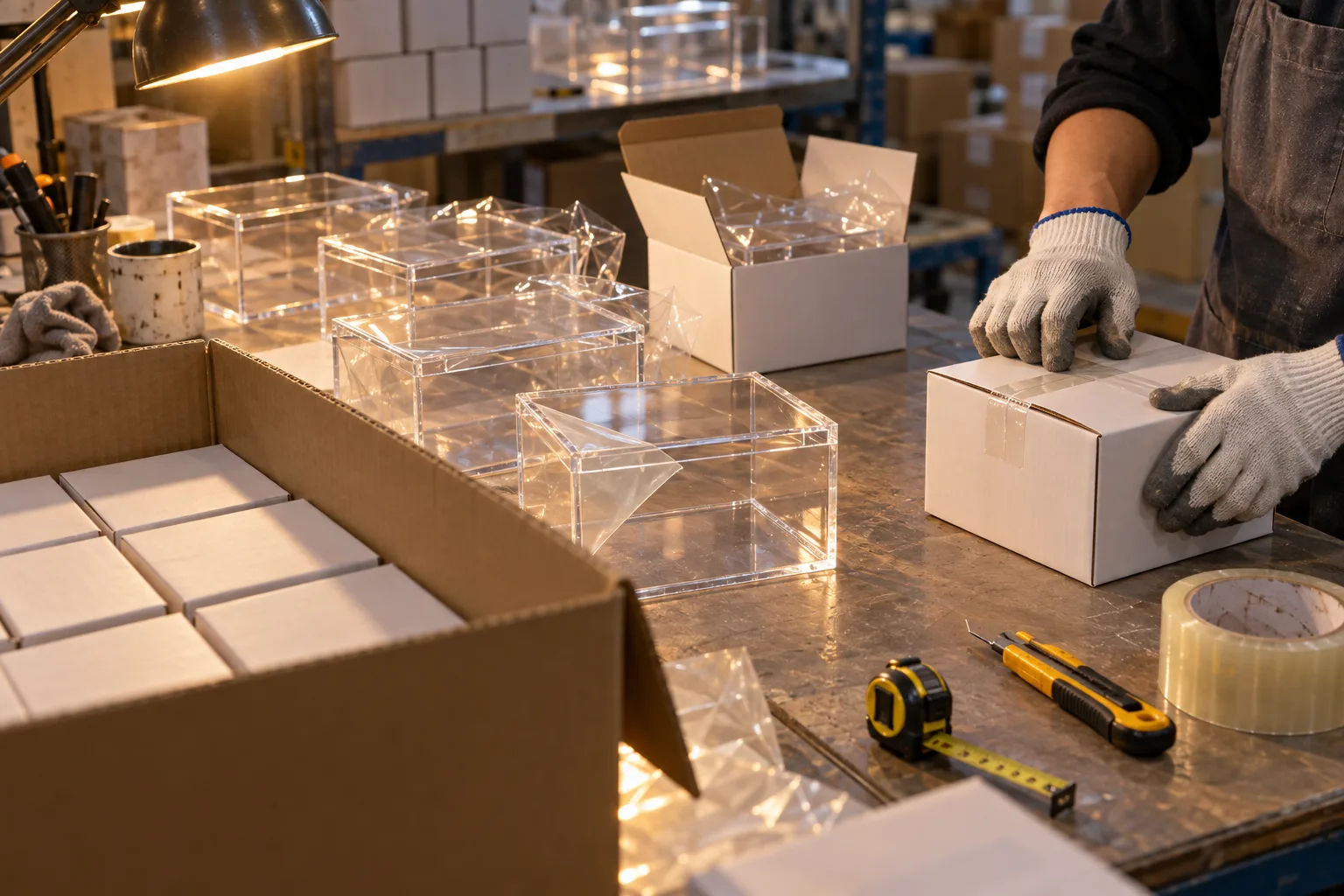
For FBA, choose between a poly bag with corner protection and an individual box. A bag is lighter and smaller, and suits solid or rounded parts. An individual box protects corners and gives the label a flat face, and suits thin panels, lidded boxes and display cases.
Our packing guide covers four tiers, from a bulk OPP bag to a fulfillment-ready pack, with carton math for each. For FBA units, the fulfillment-ready tier is the usual starting point, because each unit leaves the master carton ready to ship to a customer. Bundled items that must stay together are bagged or boxed as one unit and marked as a set.
Protective film is a separate choice from the packing tier. Film left on a clear acrylic box keeps it scratch-free in transit but adds a step for your customer. Decide whether the film stays on, comes off before bagging, or stays on one face only, and record it on the drawing.
Labels: what the factory can apply
We can apply your FNSKU label files to each unit at an approved position and scan them during inspection. We did this on a delivered order for an FBA seller: the seller supplied current barcode artwork and placement, we printed, applied and scanned the labels, and marketplace acceptance stayed with the seller.
Settle the labels on the quote:
- Unit labels. Send current FNSKU files for every variant and the position on the bag or box. One wrong file across a color variant means relabeling the whole lot.
- Carton labels. Box ID labels come from your shipment in Seller Central. Confirm on the quote whether you send them for us to apply or your prep center adds them.
- Warnings and marks. Suffocation warnings on bags and any set or fragile marks are agreed on the drawing.
Where the order ships
Delivery follows the shipping term and address on the quote. FOB Shenzhen is our default; DDP, EXW and CIF are available. Name the destination, whether an Amazon fulfillment center, a prep center or your forwarder, and we confirm the route and term before you order.
Many sellers ship to a prep center or their own warehouse first and send inventory into FBA in smaller lots. That route also lets a third party inspect and relabel if a listing changes. The FOB vs DDP guide explains who carries the freight risk under each term.
Cost and ordering
FBA-ready custom acrylic is made to order from 100 pieces per design. We do not hold stock. The published reference for a custom acrylic boxes program is a 100 mm cube in 3 mm clear acrylic with a magnetic lid: USD 6–12 at 100 pieces, USD 3–6 at 500 and USD 2–4 at 5,000, FOB Shenzhen. Unit boxes, bags, label application and corner protection are quoted as separate lines.
The ordering steps:
- Send the product drawing or reference, quantity per design, unit packaging, label files and destination.
- Approve the drawing and pay for the sample: USD 200–500 depending on complexity, 3–5 days, paid separately and never credited to production.
- Check fit, finish, packed dimensions, label scan and the drop test on the packed sample.
- Production takes 15–20 days after approval, with 100% inspection against the approved sample.
For display cases rather than boxes, see our custom acrylic display cases, which use the same steps.
Footnotes
-
Packaging Insights: Amazon ends US prep and labeling services in 2026 — reports Amazon’s notice that from January 1, 2026 it no longer offers prep and item labeling for FBA shipments in the US store. ↩
-
Jungle Scout: Amazon packaging requirements for FBA — summarizes the 1.5 mil poly bag rule, the 3-foot drop test for fragile items and the 25-inch, 50 lb carton limit. ↩
Frequently Asked Questions
Does Amazon still prep and label FBA inventory?
Not in the US store. Starting January 1, 2026, Amazon stopped offering prep and item labeling services for US FBA shipments. Units must arrive bagged, protected and labeled, by the seller, the factory or a prep center.
Is acrylic treated as a fragile item for FBA?
Check the current rule for your product category in Seller Central. In practice, thin or sharp-cornered acrylic can crack in a parcel network, so most sellers protect it like a fragile item: bubble wrap or its own box, able to pass a 3-foot drop test without breaking.
Can the factory put FNSKU labels on each unit?
Yes, from your files. We have applied a seller's FNSKU barcode files at an approved position and scanned every variant during inspection. You supply current label files and placement; marketplace acceptance stays with you. Confirm label scope on the quote.
Can you ship straight to an Amazon fulfillment center?
Delivery follows the shipping term and address on the quote. FOB Shenzhen is our default and DDP, EXW and CIF are available. Name the destination, whether a fulfillment center, a prep center or your forwarder, and we confirm the route and term before you order.
What is the minimum order for FBA-ready acrylic?
Production starts at 100 pieces per design. A paid sample costs USD 200–500, takes 3–5 days, is paid separately and is never credited to production. Production takes 15–20 days after the sample is approved.
Send Your Listing Specs, Get an FBA-Ready Quote
Attach the product drawing, the unit packaging you want, label files, quantity per design and destination. We reply within 24 hours with the product, packing and label lines priced separately.