





Shipment Arrived Damaged From Supplier: Playbook
The claim is won or lost in the first two days, and the deciding moves should be agreed before you wire a deposit, not over a broken carton.
Need this made?Custom acrylic fabrication services →
Key Takeaways
- A damage claim is decided in the first 48 hours: photograph the carton before you unpack it, keep every carton until the claim closes, and send the four-shot evidence package the same day.
- A reasonable claims window is about 14 calendar days from the carrier's delivery scan — the same day count the Montreal Convention sets for international air cargo damage complaints.
- Your claim is with the factory first, whatever broke the piece; the separate carrier claim is filed by whoever booked the freight — the buyer's forwarder under FOB, the supplier under CIF or DDP.
- A remake should cover the affected quantity only — ours runs 7 working days on stock material, with launch-critical units flown at our cost while the balance travels by sea.
- Missing hardware or accessories doesn't need a full claim: confirmed by count and photo, replacement parts either courier alone or ride the next shipment free.
On this page
- The claims timeline: day 0 to day 14
- Day 0: photograph before you unpack
- Carrier fault or factory fault — and who files what
- Remakes: full re-run vs partial air replacement
- Replacement parts can ride the next shipment
- What a reasonable claims window looks like
- Five questions to ask before wiring a deposit
The claims timeline: day 0 to day 14
Buyers typing “shipment arrived damaged from supplier” into a search bar are usually standing at day 0: the carrier’s scanner has just logged the delivery, someone on the receiving dock has opened a carton, and something inside is cracked. Here is the fastest version of the playbook: photograph before you unpack, send the evidence the same day, expect a written pathway decision within 48 hours, and know that a reasonable claims window runs about 14 calendar days from that delivery scan.
The rest of this guide walks that clock day by day, because a claim is a timeline, not an argument. On our own orders it runs like this. Day 0: the delivery scan starts the window; your team photographs cartons before unpacking and counts pieces against the packing list. Day 0 to 1: the evidence package reaches us. Within 48 hours of complete evidence: we confirm the pathway in writing — remake, refund, or parts-only — with quantities and ship dates. Day 2 to 9: the remake runs, 7 working days on stock material. Day 9 to 12: launch-critical units fly; the balance follows by sea. Day 14: the claims window closes, and anything reported after it moves from policy to goodwill.
Two things about that ladder are worth saying up front. First, almost all of the buyer’s work sits in the first two days — after the evidence lands, the clock runs on the supplier’s side. Second, every number on it is knowable before the order is placed. In 6+ years coordinating claims from the supplier’s side of the table, the difference I see between a two-week recovery and a two-month dispute is rarely the damage itself. It is whether the buyer had these terms in writing before the deposit, and whether the first hour at the dock was spent photographing or unpacking.
Day 0: photograph before you unpack
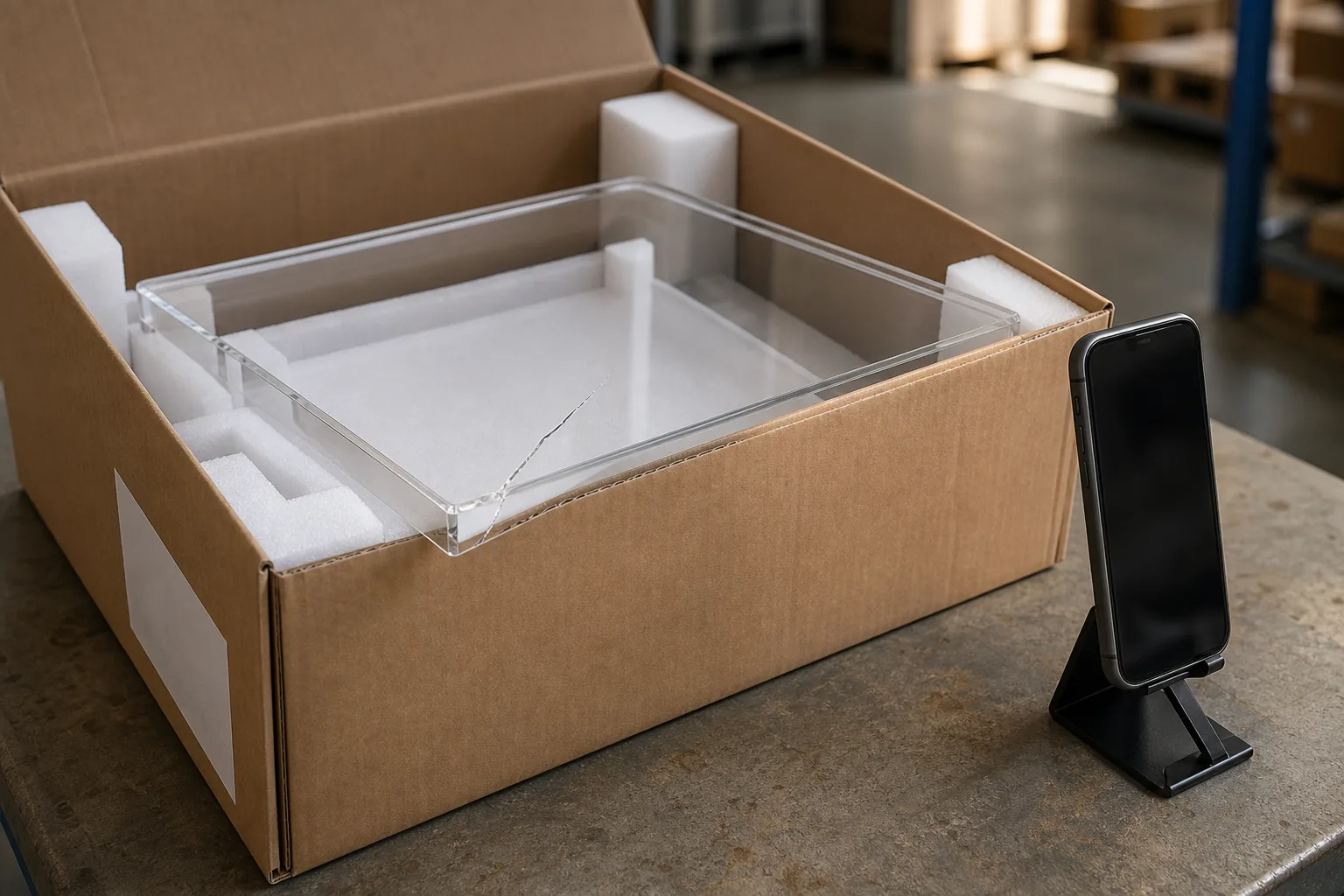
The single most valuable habit at the receiving dock costs ten minutes: photograph the shipment in the state it arrived, before anyone unpacks it. Once cartons are flattened and pieces are on shelves, nobody — not you, not the factory, not the carrier — can reconstruct where the damage happened, and an ambiguous claim is a slow claim.
The evidence package we ask for is four shots, and it is worth adopting whatever the supplier on the other end. One: the carton exterior, two angles, showing any crush, puncture, tape resealing, or tilted-load marks along with the shipping label. Two: the packing layer as you open it — foam corners, dividers, and wrapping still in position around the contents. Three: each damaged piece against a ruler or tape measure, so a 3 mm chip and a 30 mm fracture read differently on the other side of the world. Four: a wide shot of the affected units together, establishing how many pieces the claim covers.
Two additions turn a good report into a complete one. Keep every carton — including the intact ones — until the claim closes, because a carrier inspection can ask to see the packaging weeks later, and discarding it is the most common way buyers weaken their own claim.1 And count received units against the packing list by SKU in the same pass: a crushed carton and a wrong or missing item are usually discovered together, and reporting shortages, mis-picks, and damage in one message resolves them in one channel instead of three email threads.
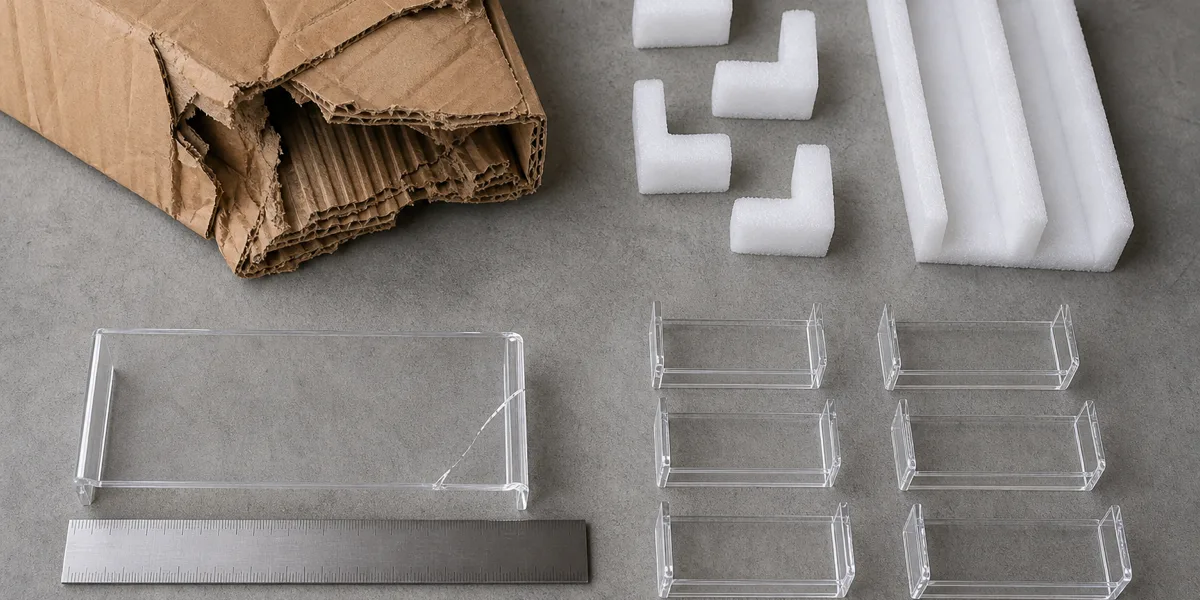
On our side, complete evidence is what starts the 48-hour decision clock. The claims I close fastest all arrive the same way — one email, four photos, a count — and on those I can usually confirm the pathway without a single follow-up question. We do not ask buyers to ship broken pieces back before acting — for most acrylic under a few hundred dollars of unit value, return freight costs more than the goods, so photos decide and the damaged pieces are disposed of locally unless we ask you to hold one for a carrier inspector.
Carrier fault or factory fault — and who files what
The fault question has a short answer: your claim is with the factory first, whichever party broke the piece. A crushed carton points to the transit leg; a clean carton with a cracked piece inside points to packing or production. But that distinction decides who ultimately absorbs the cost — it should never decide whether you get replacement pieces. A supplier who answers damage photos with “take it up with the carrier” is converting their packing responsibility into your logistics project.
Reading the carton is still worth doing, because it sets the paper trail. When I open a claims email, the first photo I look at is the carton, not the piece — the carton decides where our paper trail starts. Visible external impact — crush, forklift puncture, corner collapse — supports a carrier claim, and the photographs from day 0 are exactly the evidence a carrier’s claims desk will request. A clean carton around broken acrylic means the packing spec failed, and the factory should be studying its own foam allowance rather than drafting a carrier letter. Our packing standard — individually wrapped pieces, foam dividers, double-wall export cartons — exists precisely so that transit damage shows on the outside; the acrylic display stands we ship leave the line photographed inside their cartons for this reason.
Who files against the carrier follows who booked the freight, which is set by the shipping term. Under FOB — our default — your forwarder books the ocean or air leg, so the carrier contract is yours and the formal claim runs through your forwarder, with our packing photos and load documentation attached. Under CIF or DDP, we book the freight, so we file, and your only job is the evidence package. The cost side of that choice belongs to its own guide — see FOB vs DDP for acrylic orders — but the claims side is one sentence: whoever holds the carrier contract chases the carrier.
The deadlines on that carrier leg are statutory, and they are tighter than most buyers expect. International air cargo runs under the Montreal Convention: damage complaints must be in writing within 14 days of receipt.2 US domestic motor freight runs under the Carmack Amendment, where carriers may not set a claim-filing window shorter than nine months3 — and their claims desks must acknowledge a filed claim within 30 days and pay, decline, or make a settlement offer within 120 days.1 None of those clocks pause while an email thread debates fault, which is another reason the photographs come first.
Remakes: full re-run vs partial air replacement
A remake should cover the affected quantity, not the order. If 60 pieces out of 500 arrived cracked, the remake is 60 pieces on the same tooling and files already approved — nobody should be asked to fund or wait for a full re-run. On stock material ours takes 7 working days; custom colors or thicker cast run 10 to 14.
The interesting decision is not the remake itself but how it travels, because sea freight timing is usually why the damage hurts. The pattern we run on launch-critical claims: split the remake, fly the units your install date depends on at our cost, and let the balance ride the next sea shipment. In the launch claims I have coordinated, a buyer staging a retail rollout rarely needs all 60 replacement pieces by the install date — they need the 20 that fill the gap on opening day. Air freight on 20 pieces is a real cost, but it is a fraction of air freight on 500, which is why we can absorb it and why a full-order air replacement is almost never the right ask. The same split-shipment logic applies to a trade-show deadline: identify the minimum booth stock, validate customs time with the forwarder, and leave contingency between arrival and setup. The trigger differs; the logistics decision does not.
Wrong-item and missing-item reports resolve in the same channel. A mis-picked SKU or a short carton discovered during the day-0 count follows the identical path: evidence, 48-hour decision, replacement units on the fastest leg that matters. What changes is only the production step — a mis-pick needs no remake at all, so the timeline compresses to the freight.
One more thing belongs in writing before any remake starts: what happens to the damaged pieces. The usual answer is local disposal after photos, occasionally a hold for carrier inspection. It matters because the deposit-and-balance payment structure — ours is 30% down, 70% before shipment — means a claim lands after the buyer has paid in full, and a supplier’s willingness to remake without demanding return freight or a fresh payment is the single clearest signal of how they treat the relationship.
Replacement parts can ride the next shipment
Not every claim involves broken acrylic. A tray order arrives and one carton of handles is missing; a display’s mounting screws are absent; a back panel was drilled without its mounting holes. Hardware and accessory shortages are the most common post-delivery report I handle after transit damage — and they need a lighter path than a full claim, not a heavier one.
The verification step is count and photo, nothing more. The buyer tells us which accessory and how many, with one photograph of what did arrive; we check it against the packing record for that order. Accessory packs are bagged and counted at packing on our line — hardware is one of the items our 100% pre-ship inspection covers piece-by-piece — so a genuine shortage traces to a specific packing miss and gets logged against the packing checklist, which is how the same miss stops recurring on your reorders.
Then the parts travel one of two ways, and the choice is genuinely yours. Install-blocking parts — a missing bolt pattern that stops a wall install, screws without which a launch display cannot stand — go by courier alone, typically a few hundred grams in an envelope moving on a days-not-weeks clock. Everything else can ride your next shipment at zero freight cost: we add the replacement pack to the next order’s master carton, flagged on the packing list so the receiving team knows to pull it. Repeat buyers tend to use the next-shipment route for anything that is not install-blocking — and on a program with regular reorders, it is worth asking for a standing spare-parts line: a small percentage of extra hardware added to each shipment, so minor shortages and site losses never need a claim at all.
A drilling error sits between parts and remake: mis-drilled or missing mounting holes on the acrylic itself cannot be couriered around, so the affected pieces re-run like any remake. But the report path is identical — the count-and-photo message that flags missing screws is the same one that flags a missing bolt pattern, and both get the 48-hour written answer.
What a reasonable claims window looks like
A reasonable claims window for a custom acrylic order is about 14 calendar days from the carrier’s delivery scan, in writing, with a defined evidence list and a committed response time. Shorter than a week squeezes real-world receiving — freight deliveries sit unopened over weekends, and warehouse QC often runs on a weekly cycle. Much longer than a month and the evidence stops meaning anything, because after weeks on a buyer’s floor nobody can honestly separate transit damage from a forklift clip.
Fourteen days is also not an arbitrary supplier invention — it is the day count the Montreal Convention sets for damage complaints on international air cargo,2 which makes it a defensible benchmark for the supplier leg too. Our own published policy uses exactly that window, paired with a 48-hour pathway decision for repeat buyers and 72 hours on a first order; the full mechanics — the defect taxonomy on the production side, the evidence rules, the replacement-versus-refund logic — live in our acrylic block RMA policy, and the numbers in this playbook are the same numbers in that one. One extension is worth negotiating where it fits: if incoming inspection on your side runs monthly, ask for a 30-day window in writing on the order — we grant it, and any supplier confident in their packing can.
The red flags are easy to list because they cluster. A 48-hour-only claims window is engineered to expire before a pallet is unwrapped. “Damage must be noted on the delivery receipt or no claim” imports a carrier-side technicality into the supplier relationship — noting visible damage on the POD is genuinely good practice at the dock, but concealed damage inside an intact-looking carton is discovered at unpacking, and a policy that voids it is a policy designed to void. And a supplier with no written window at all has not decided to be generous; they have decided to decide later, after the balance payment has cleared. I have read supplier terms with all three. Against the statutory floors — 14 days on air cargo, a nine-month minimum on US motor-freight claims3 — a supplier window measured in hours tells you exactly how the relationship will run when something breaks.
Five questions to ask before wiring a deposit
Every number in this playbook was knowable before the order went to production — which means the real playbook is the one you run at quote stage. Buyers ask me about damage handling before ordering more often than any other risk topic, and the ones I remember as easy claims almost all asked the same five questions at quote stage — and got a materially different experience when a carton did arrive crushed.
First: what is the claims window, in writing, and when does it start? The right answer is a day count anchored to the delivery scan, not “prompt notification.” Second: what exactly counts as evidence? A supplier with a defined list — ours is the four-shot package plus SKU counts — has processed claims before; a supplier who will “review what you send” has not. Third: what is the remake lead time, and who pays the freight on it? The answer worth hearing pairs a working-day number with freight at the supplier’s cost, and offers the air-sea split for launch-critical quantities. Fourth: is there a parts-only path, or does a missing bag of screws require a formal claim? Fifth: who files the carrier claim under the shipping term we are using — and does my replacement wait for that claim to pay out? The only acceptable answer to the second half is no.
Ask them of us too — that is not a rhetorical flourish. Send your project through our inquiry form and ask for the claims terms alongside the quote, or start with a paid sample and test the whole loop, packing quality included, before moving to the 100-piece production run. A supplier’s answer to “what happens when it arrives broken?” before any money moves is the cheapest due diligence available on how they will behave after it does.
For an example of packing a mechanically complex acrylic assembly, see the wearable catering-tray case study.
Footnotes
-
49 CFR Part 370 — Principles and Practices for the Investigation and Voluntary Disposition of Loss and Damage Claims. eCFR. https://www.ecfr.gov/current/title-49/subtitle-B/chapter-III/subchapter-B/part-370 — requires carriers to acknowledge a filed claim in writing within 30 days and to pay, decline, or offer settlement within 120 days; carrier inspection rights are why claimants should retain damaged shipping containers. ↩ ↩2
-
Convention for the Unification of Certain Rules for International Carriage by Air (Montreal, 1999), Article 31. https://www.mcgill.ca/iasl/files/iasl/montreal1999.pdf — requires written complaint to the carrier within 14 days of receipt for damaged cargo, and within 21 days for delay. ↩ ↩2
-
49 U.S.C. §14706(e) — Liability of carriers under receipts and bills of lading (Carmack Amendment). Cornell Law School, Legal Information Institute. https://www.law.cornell.edu/uscode/text/49/14706 — a US motor carrier may not set a period of less than 9 months for filing a cargo claim, nor less than 2 years for bringing a civil action. ↩ ↩2
Frequently Asked Questions
What should I do first when an acrylic shipment arrives damaged?
Photograph before you unpack: the carton exterior from two angles, the packing layer as you open it, each damaged piece against a ruler, and a wide shot showing how many pieces are affected. Keep every carton — including intact ones — until the claim closes, and count received units against the packing list by SKU in the same pass. Send that package to the supplier the same day; our pathway decision comes back within 48 hours of complete evidence.
Who pays when a shipment arrives damaged — the factory or the carrier?
Your claim is with the factory first, either way. If packing was inadequate, the cost is the factory's; if the carton shows transit impact, the factory pursues the carrier — but that recovery is the supplier's or forwarder's problem, not a condition of your replacement. Who files against the carrier follows who booked the freight: under FOB your forwarder books and files, under CIF or DDP the supplier does.
Can part of a remake ship by air while the rest goes by sea?
Yes — that split is standard practice on launch-critical orders. We remake the affected quantity only, typically 7 working days on stock material, then fly the units your install or launch date depends on at our cost while the balance travels by sea. On a claim with clean photo evidence, the pathway and both ship dates are confirmed in writing within 48 hours.
Can replacement parts ship with my next order instead of separately?
Yes. For missing or damaged hardware — handles, screws, brackets, back panels, accessory packs — we confirm the affected count by photo, then either courier the parts alone or add them to your next shipment at no freight cost. Repeat buyers often choose the next-shipment route for anything that isn't install-blocking; a standing spare-parts line on regular orders absorbs small shortages entirely.
What is a reasonable claims window for a custom acrylic order?
About 14 calendar days from the carrier's delivery scan, extendable in writing to 30 days if your incoming QC runs on a monthly cycle. That matches the Montreal Convention's 14-day complaint period for damaged international air cargo. Treat a 48-hour-only window, a policy that voids claims unless damage was noted on the delivery receipt, or no written window at all as red flags worth raising before you pay a deposit.
Want the claims terms in writing before you order?
Send us your project and ask for the damage-claims terms with the quote — the 14-day window, the four-shot evidence list, the 48-hour decision commitment, and the remake lead time. Knowing the recovery path before you wire a deposit is exactly the point of this playbook.