




Is Acrylic Recyclable? An Honest Buyer's Answer
The recycling triangle on acrylic is technically true and practically misleading.
Need this made?Custom acrylic fabrication services →
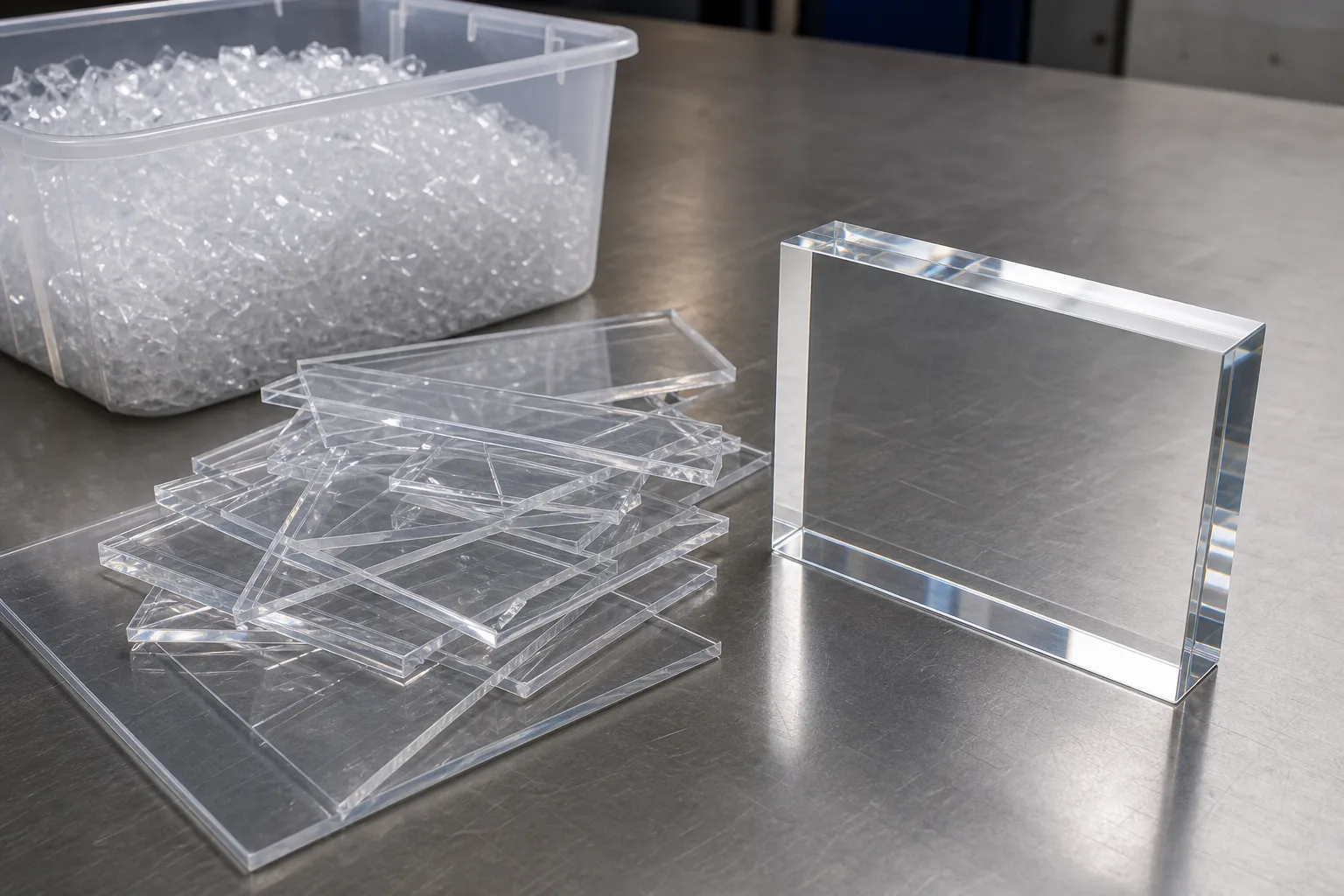
Here's what actually happens to PMMA — in the bin, at the factory, and in the chemical plants rebuilding it into new monomer.
Key Takeaways
- Acrylic (PMMA) is a thermoplastic and technically recyclable — it can be remelted or chemically broken back down — but it falls under resin code 7 'Other,' which most curbside programs do not accept.
- Only 8.7% of all plastics in US municipal waste were recycled in 2018 per EPA data, and PMMA is a low-volume stream within that — recovery runs through industrial channels, not household bins.
- PMMA's chemistry gives it a real advantage: it depolymerizes back to MMA monomer, and an EU consortium (MMAtwo) has run regenerated-monomer production at pilot-industrial scale.
- Factory offcuts are the stream that actually gets recycled today — clean, sorted, single-polymer scrap sold to reclaimers is standard industry practice, unlike mixed post-consumer waste.
- For a display or fixture buyer, service life beats recyclability as the footprint lever: a fixture that lasts 5+ years replaces several disposable alternatives regardless of end-of-life route.
On this page
Is Acrylic Recyclable at Home and at Industrial Scale?
Yes, acrylic is recyclable, but not through a household bin. Acrylic (PMMA) is a thermoplastic that can be reground into new sheet or chemically broken back into its monomer. Most curbside programs still reject it because it falls under resin code 7, “Other,” and no municipal stream collects it. Clean, sorted industrial scrap is what actually gets recycled.
The confusion online comes from two questions sharing one sentence. The chemistry question has a good answer: PMMA is one of the few commodity plastics that can be depolymerized back to reusable monomer at high yield. The logistics question has a poor one: the collection route that would get a used acrylic item to a processor barely exists. If you are specifying acrylic for a program rather than disposing of one item, the useful levers are factory scrap, supplier questions and service life, and our custom acrylic fabrication work is planned around the last of those.
Why your curbside program rejects acrylic
Curbside recycling sorts for volume. Materials recovery facilities are tuned for high-volume household streams such as PET bottles, HDPE jugs, cardboard and aluminum, and acrylic is none of them. Under the resin identification code system standardized as ASTM D7611, PMMA falls into code 7, “Other,” the catch-all category most municipal programs exclude.1
Per US EPA data, 35.7 million tons of plastics entered municipal solid waste in 2018 and 8.7% was recycled, concentrated in PET and HDPE containers that have established buyers for sorted bales.2 Post-consumer acrylic arrives as an occasional picture frame or broken organizer in a small code-7 trickle, with no bale category and no buyer. A binned acrylic item usually rides the line to the reject stream and lands in landfill, and it can contaminate a PET bale on the way. So the household answer to “can you recycle acrylic” is: not through the bin.
Mechanical vs chemical recycling of PMMA
Two real recycling routes exist for acrylic. Mechanical recycling grinds sorted PMMA into flake and remelts it into lower-spec product: established and low-cost, but downgrading. Chemical recycling uses heat to depolymerize PMMA back into its monomer, MMA, which can be purified and re-polymerized into material equivalent to virgin sheet.
| Route | Input needed | Output | Quality | Status |
|---|---|---|---|---|
| Mechanical (regrind) | Clean, sorted, single-color PMMA | Flake for lower-spec sheet, profiles, filler | Degrades each cycle | Established industry practice |
| Chemical (depolymerization) | Sorted PMMA scrap, tolerates more variety | Regenerated MMA monomer | Virgin-equivalent after purification | Pilot-industrial scale, expanding |
| Curbside / municipal | Post-consumer mixed waste | Mostly landfill or energy recovery | — | Effectively unavailable for PMMA |
Acrylic is on this table because it is a thermoplastic: it softens and re-flows every time it is heated, unlike a thermoset, which cures once into a cross-linked network. The same property that lets a fabricator heat-bend a flat sheet into a tray rim lets a reclaimer remelt the offcut from that sheet.
Mechanical recycling is limited by purity and heat history. Regrind flake carries every contaminant, color and heat cycle it has seen, so each pass produces a duller, weaker material: fine for a garden edging profile, not for an optically clear display face. One painted or glued piece degrades the batch, which is why regrind streams demand clean, sorted input.
Chemical recycling is where PMMA’s chemistry pays off. Heated under the right conditions, PMMA “unzips” back to MMA monomer at high yield. The EU’s MMAtwo consortium spent four years and six trial campaigns building this value chain, processing several grades of PMMA waste, including hard-to-recycle streams, into high-quality regenerated monomer and reaching Technology Readiness Level 7, meaning demonstrated at pilot-industrial scale.3 Regenerated MMA re-polymerizes into material that performs like virgin, which closes the loop in a way regrind cannot. Capacity is still being built.
What happens to acrylic offcuts at a factory
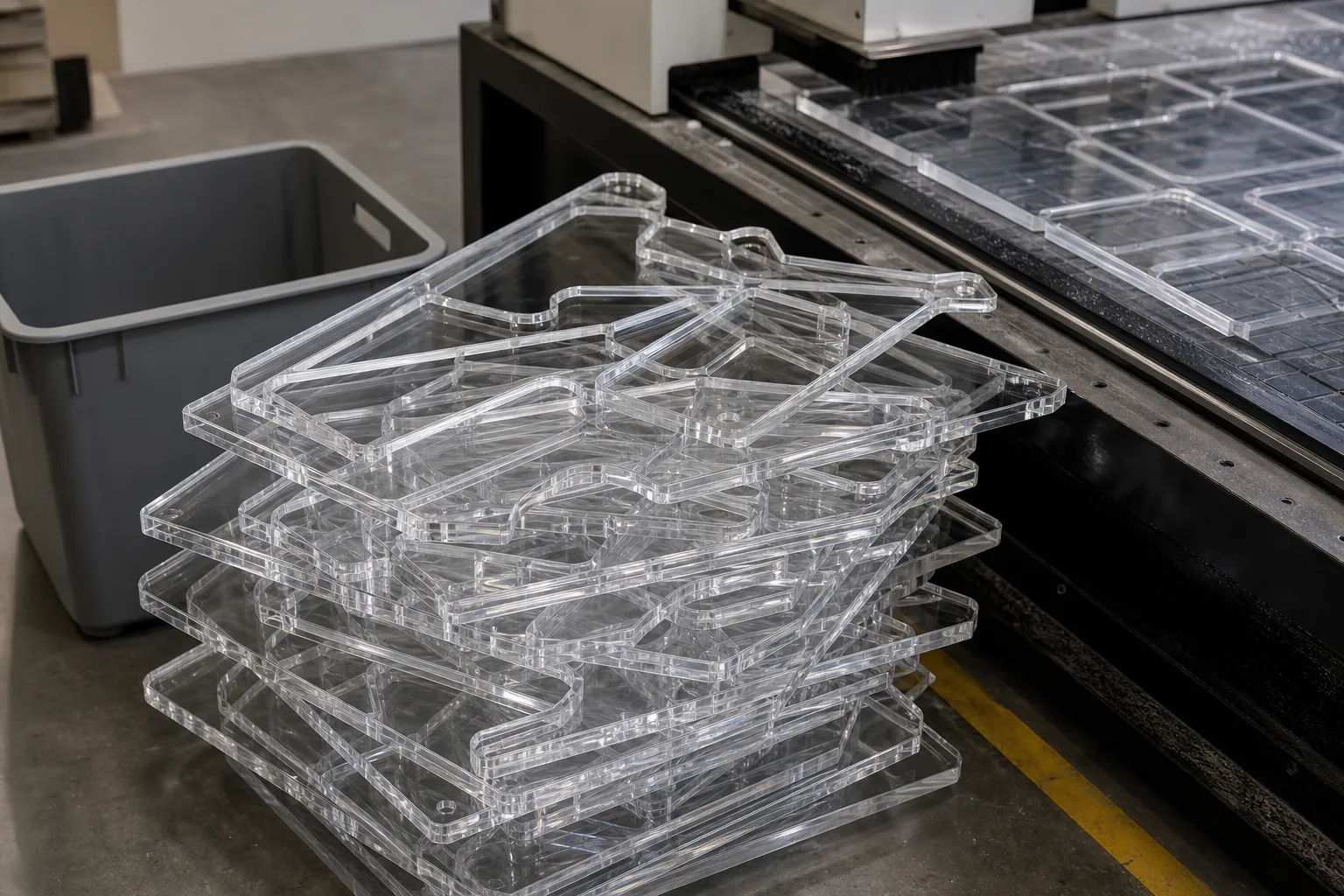
Factory offcuts, not household bins, are where acrylic recycling works today. Cutting sheet into parts leaves skeleton scrap that is single-polymer, known-grade, unglued and unpainted: the clean input mechanical and chemical processors want. Selling sorted offcuts to material reclaimers is standard practice across the fabrication industry.
Like most CNC-cutting operations, we sort our clear and colored offcuts separately and sell them to reclaimers rather than sending them to landfill; clean cast-acrylic scrap has resale value precisely because processors compete for good input. I won’t dress that up as a branded sustainability program — it’s ordinary, economically rational industry practice — but it does mean the “waste” a buyer imagines piling up behind a fabrication shop is mostly a traded commodity on its way to a regrind line or a depolymerization plant.
The quieter lever is not creating the scrap. Nesting software packs part outlines onto the sheet before cutting, and a tight layout saves material on every order. It is one reason CNC and laser fabrication suit custom runs without a mold, as the zero tooling fees guide explains from the cost side.
Sustainability questions worth asking an acrylic supplier
Ask about streams, not slogans. Since 2016, I’ve watched sustainability move from the last page of the checklist to the first call, and the useful questions are the ones a supplier can only answer with specifics about their own floor.
Four earn their place on an RFQ. First: where do production offcuts go (reclaimer, in-house regrind, or landfill)? A real operation knows, because scrap is either revenue or a disposal cost. Second: do you nest parts to cut scrap? Third: can you run recycled-content or reclaimed sheet if the program allows it? Recycled-content acrylic trades some optical quality for footprint, a fine trade for opaque or painted parts and a poor one for a clear display face; the cast vs extruded acrylic guide covers the virgin grades it would replace. Fourth: can you document material grade and origin? Traceable sheet is the foundation under every other claim.
What you should not expect: a small fabricator with an in-house monomer loop (that is a chemical plant, not a workshop), or precise recycled-percentage claims without documents behind them. When I review a sustainability claim, a vague percentage worries me more than a plain statement such as “our offcuts go to a named reclaimer.”
Recyclability vs durability: the real footprint lever
For a buyer of displays, fixtures or trays, end-of-life is the wrong end of the sustainability question. The dominant footprint lever is service life: a fixture that stays on the floor for five years replaces several rounds of disposable alternatives — whatever those alternatives’ recycling story claims.
We see this play out in our own order history. The programs that come back to us for reorders after three, four, five years aren’t replacing worn-out fixtures — they’re expanding, opening stores, or refreshing a logo on the same tray and case designs we hold on file. Meanwhile the disposable formats those fixtures replaced would have been remade and rebinned several times over. No end-of-life route, however good, competes with not manufacturing the replacements in the first place.
A corrugated or thermoformed display that lives one season gets manufactured, shipped, and disposed of four or five times while one acrylic fixture just keeps working. Acrylic’s durability makes that hold: it does not yellow under interior lighting the way polycarbonate does, it does not shatter in handling the way glass does, and light scratches polish out instead of retiring the unit. Routine care is simple, as the guide to cleaning acrylic displays shows. Multi-store programs like our 50-store retail display rollout are built on that premise, with fixtures from the custom acrylic display range specified once and kept in service.
Footnotes
-
ASTM D7611 — Standard Practice for Coding Plastic Manufactured Articles for Resin Identification — the standard behind the resin identification codes; acrylic/PMMA falls under code 7 “Other,” the category most curbside programs exclude. ↩
-
US EPA — Plastics: Material-Specific Data — EPA figures showing 35.7 million tons of plastics generated in US municipal solid waste in 2018 with an 8.7% recycling rate, cited for the scale of the curbside-infrastructure gap. ↩
-
MMAtwo — EU Horizon 2020 PMMA chemical recycling project — consortium that developed a value chain and technology for processing PMMA waste into high-quality regenerated MMA monomer over four years and six trial campaigns, reaching Technology Readiness Level 7. ↩
Frequently Asked Questions
Can acrylic be recycled at home in a curbside bin?
Almost never. Acrylic carries resin identification code 7 ('Other'), and municipal recycling programs sort for high-volume streams like PET (#1) and HDPE (#2). Putting acrylic in a curbside bin usually sends it to landfill anyway — and can contaminate the sorted stream. Check your local program, but expect the answer to be no.
What is the difference between mechanical and chemical recycling of PMMA?
Mechanical recycling grinds sorted acrylic into flake that is remelted into lower-spec sheet or profiles — low-cost, established, but quality degrades with each cycle. Chemical recycling depolymerizes PMMA back into MMA monomer that can be re-polymerized into virgin-equivalent material; the EU MMAtwo consortium ran this at pilot-industrial scale with regenerated monomer as the output.
What happens to acrylic offcuts at a fabrication factory?
Clean production offcuts are the most recyclable acrylic that exists — single polymer, known grade, unglued and unpainted. Standard industry practice, ours included, is to sort offcuts by type and color and sell them to material reclaimers, who regrind them for lower-spec sheet or feed them to depolymerization processors. Nesting software also shrinks the offcut volume before it is ever created.
Is acrylic more sustainable than glass or polycarbonate for displays?
It depends on the lever you measure. Acrylic ships lighter than glass (roughly half the density), survives handling that shatters glass, and outlasts polycarbonate optically because it doesn't yellow the way PC does under UV. For a fixture, the biggest footprint variable is usually service life: a display that stays in use 5+ years beats any single-use alternative on any material.
What sustainability questions should I ask an acrylic supplier?
Four practical ones: Where do your production offcuts go — reclaimer, regrind, or landfill? Do you use nesting software to cut scrap rates? Can you run recycled-content or reclaimed sheet if my program allows it? And can you document material grade and origin? A supplier who answers all four specifically is running a real process, not a marketing page.
How can an acrylic product be designed for easier recycling?
Use one identified PMMA grade where possible, make hardware and inserts removable, avoid unnecessary mixed-plastic laminates, and document the material on the drawing and packing record. Design for disassembly does not create a local recycling route, but it gives a commercial reclaimer a cleaner, identifiable stream.
What recycling number is acrylic plastic?
Acrylic or PMMA falls under resin identification code 7, Other. That code groups several low-volume plastics together, which is why it identifies the material but does not mean a curbside program has a buyer or processing route for it.
Can recycled acrylic stay optically clear?
Chemically recycled PMMA can return to virgin-equivalent monomer after purification. Mechanically recycled flake normally moves into lower-spec sheet, profiles, or filler because color, contamination, and repeated heat history reduce optical quality.
Can printed or glued acrylic be recycled?
Sometimes, but it is harder than clean sheet scrap. Ink, adhesive, hardware, and mixed inserts must be separated or accepted by a processor whose feedstock specification allows them; ask the reclaimer before treating an assembled display as recyclable.
How should a business collect acrylic for recycling?
Separate PMMA by clear versus colored grade, keep it free of other plastics and hardware, and confirm the reclaimer's minimum volume and contamination limits before collection. Commercial recovery works as a defined material stream, not as a mixed office recycling bin.
Is recycled-content acrylic right for a clear retail display?
It depends on the required clarity and documentation. Recycled-content sheet can suit opaque, printed, or non-optical parts; a premium clear face may still need virgin cast PMMA unless the supplier can document an optical-grade recycled sheet and approve it in a sample.
Comparing materials for a production program?
Send the product, service-life target, quantity, and finish. We'll explain where virgin, recycled-content, or reclaimable PMMA fits before quoting; physical samples are paid separately and never credited.