
Delivered Project · Educational Media · Germany and the US
One Run, Three Colors, Two Continents
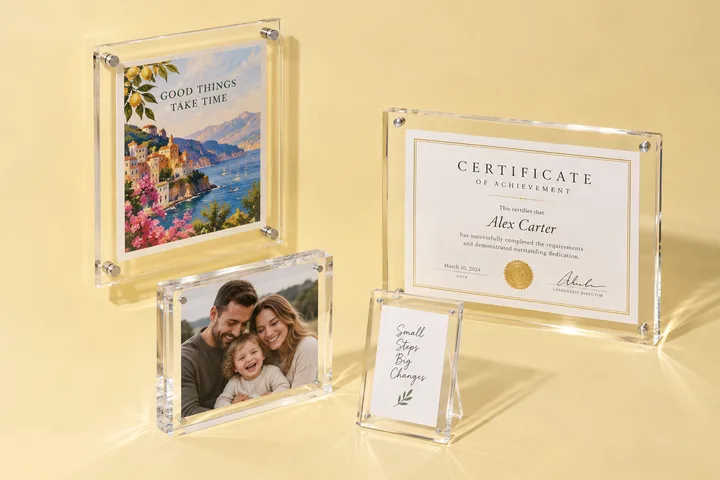
This dual continent acrylic floating frame reorder came from a German educational media studio that sells a merchandise line alongside its programmes. It needed about 3,000 more of the A5-format floating frame we had built for it before, in the same three sheet colors, with half going to a US warehouse and half to Germany. We produced the run from the retained tooling and color samples, boxed every frame in a labelled inner box, and released two DDP sea consignments with their own quotes, packing lists, and transit times.
- frames, one design
- ~3,000
- sheet colors
- 3
- DDP sea lanes
- 2
- new samples needed
- 0
Ordering a similar project
MOQ is 100 pieces per design. Paid samples normally take 3–5 days; sample fees are paid separately and never credited. Standard production takes 15–20 days after drawing, sheet color, construction, packing, and sample approval. Wetop responds to a complete brief within 24 hours.
Price context: the USD 4–5 band on this page is this project's product price at about 3,000 frames in a labelled inner box. A different size, depth, sheet color, box, or quantity changes the number; the floating frames page describes the constructions and a written quote follows the approved drawing.
Key Takeaways
- A German educational media studio reordered about 3,000 A5-format acrylic floating frames, roughly 230 × 300 mm and 40 mm deep, in three sheet colors from the previous run, for the merchandise line it sells alongside its programmes.
- The frame holds the print between a clear front and a colored back with no magnets, so there is nothing to lose and nothing to misalign; the construction was frozen on the first run and reused from the tooling library.
- One production run was split at the packing bench into two consignments of about 1,500, each with its own DDP sea quote, packing list, and commercial invoice: about 30–35 days to a US warehouse and 50–60 days to Germany.
- Each frame ships in a labelled inner box so the studio's two fulfilment teams can pick by color without opening anything; the label layout came from the previous run's packing record.
- Current ordering for a new frame design still starts at 100 pieces per design with a 3–5-day paid sample, a fee that is paid separately and never credited, and 15–20-day standard production after approvals.
The Challenge
The studio makes educational programmes and sells a small merchandise line to the people who watch them. One of those items is a print in an acrylic floating frame: an A5-format illustration held between a clear front and a colored back, in one of three colors, sold from two places at once. Its German fulfilment serves Europe. Its US partner serves North America. The frame is the same object on both sides of the Atlantic, and the customer who buys it in one place expects it to look exactly like the one a friend bought in the other.
We had built the first run for this studio, so the reorder arrived the way good reorders do: a reference to the previous order, three color quantities, two delivery addresses, and a request for DDP so that each fulfilment team would receive goods with duty already paid and nothing to clear. The difficulty was not in the frame. It was in producing one design in three colors as a single run and then splitting it cleanly into two consignments with different transit times, different customs regimes, and different receiving teams, without either half drifting from the other or from the run before.
Color is where a reorder like this usually goes wrong. Three colored sheets, a reorder months after the first run, and a factory that picks the "same" color from a swatch rather than from the retained sample will deliver three colors that are each slightly different from last time. On a merchandise line that is not a defect anyone measures. It is a customer photo on a forum next to an older frame, and it is the kind of thing a studio that lives on its audience's trust notices immediately.
The second difficulty was the split itself. Two continents means two sea lanes with very different durations, two packing lists, two commercial invoices, two duty calculations, and two receiving teams who had never spoken to each other. If the two halves were treated as one shipment that happened to fork at the port, something would be wrong at one end or the other. I have seen a "single order, two destinations" job arrive with the US carton count on the German paperwork, and the studio would have discovered it at customs.
Our Approach
We treated this as one production job and two logistics jobs, and we drew the line between them at the packing bench. Everything upstream of the bench, cutting, bonding, color, inspection, was one run against one set of references. Everything downstream, boxing, cartons, labels, paperwork, freight, was done twice, separately, with the other consignment's documents kept out of the way.
Reorder from the tooling library
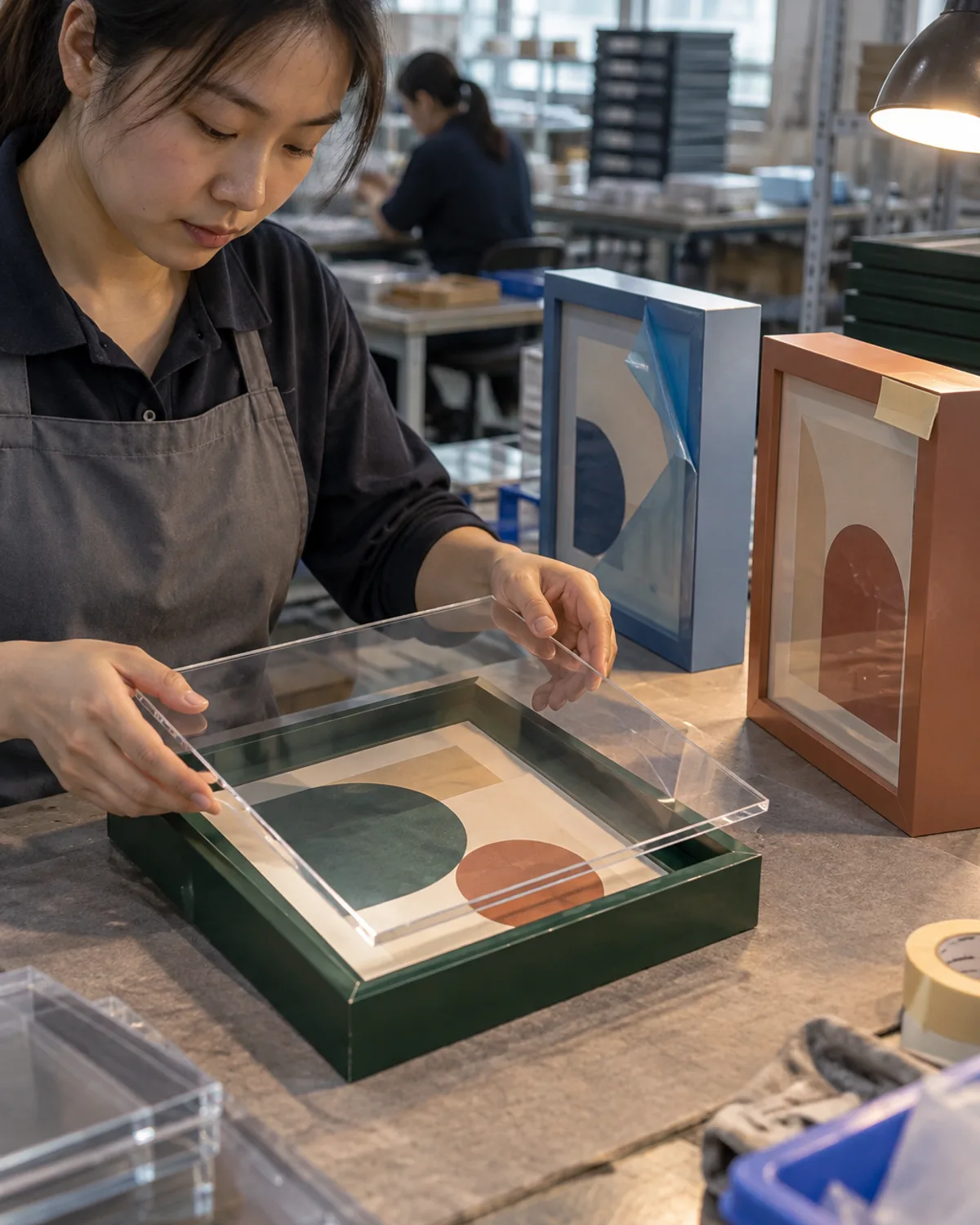
Every design we have run keeps its tooling: the cutting files, the bonding jig that sets the side walls square to the back panel, the packing record, the label layout, and a tagged approved sample for each color. For this frame the library held all of that from the first run. Production pulled the jig and files without redrawing anything, and the three color samples went to the bench before a single sheet was cut. The purchase order referenced the previous run, so the order file pointed at the same objects the studio had approved. Our guide on the acrylic repeat-order tooling library describes what we keep and why a reorder that starts from it needs no new paid sample.
That is the reason this order needed zero new samples. Nothing in the size, construction, or colors had changed, and the studio's sign-off from the first run still described the object we were about to build. Had the studio asked for a fourth color or a different depth, that change would have reopened sampling for that variant, with the sample fee paid separately and never credited to production. It did not, and the run went straight to first-off.
Three colors, three references, one light
Sheet color on a colored acrylic frame comes from in-stock cast acrylic. We do not mix color; we match the buyer's target to a stocked sheet on the first run and the buyer approves that sheet on the physical sample. On a reorder the question is only whether the sheet we are about to cut matches the sheet we cut before, and the answer comes from putting the first-off frame of each color beside its tagged sample under the same light. Not beside a photo, not beside the swatch book, beside the object. All three matched, and the run was released color by color.
We also keep the sheet reference for each color in the order file, so if a stocked sheet were ever discontinued we would know before cutting and would go back to the studio with a proposed replacement rather than substituting quietly. Our guide on Pantone color matching for acrylic OEM orders lays out that protocol; the short version is that color on a reorder is a comparison, never a description.
A frame with nothing to lose
The construction matters here because it is what makes the frame safe to ship twice and sell from two warehouses without instructions. The print sits between the clear front panel and the colored back panel, captured by the geometry of the bonded side walls. There are no magnets, so there is nothing to fall off in transit, nothing to misalign when a customer changes the print, and no hardware to reconcile across two fulfilment teams. The floating frames page describes the magnetic and non-magnetic constructions; this studio chose the simpler one on the first run and had no reason to revisit it. The floating frame guide explains what each construction is for.
The split at the packing bench
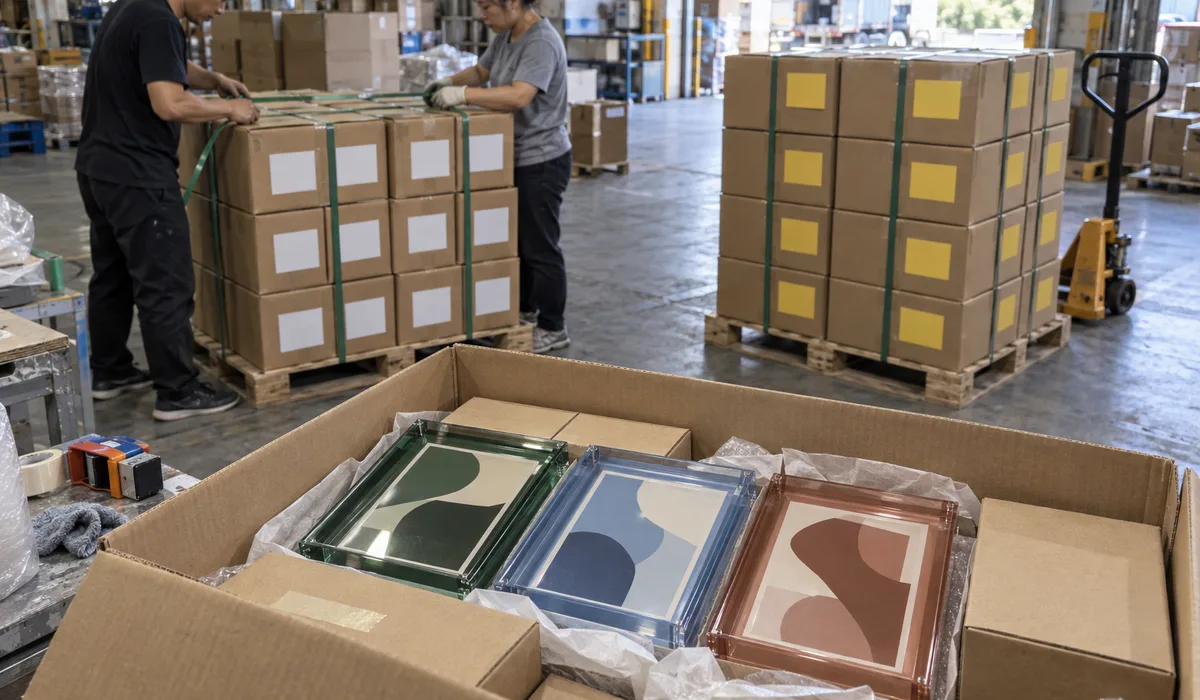
Every frame went into a labelled inner box, the label carrying the item reference and the color so that either fulfilment team can pick by reading the box. Inner boxes went into cartons sorted by color, and only then did the run become two orders. We built the two consignments as two separate packing lists with their own carton numbering, and each carton carried a label color that matched its destination's paperwork so a packer could not put a German carton on the US stack by mistake. The two commercial invoices described only their own goods. The two DDP quotes named their own delivery addresses, and the studio's two receiving teams each got the documents for their own consignment and nothing else.
The transit times were never going to match, and we did not pretend they would. The US lane was quoted at about 30–35 days to the door and the German lane at 50–60. Both left from the same inspection. Both had duty included at destination. The studio planned its two launches on the two dates rather than on one, which is the correct way to read a dual-continent quote. Our FOB versus DDP guide explains what a delivered quote has to state for each named place, and why two destinations are two quotes.
Spec at a glance
Quantities, prices, and dimensions on this page are shown as bands or rounded to protect the buyer's commercial detail. The underlying orders are documented in our records.
The Results
About 3,000 floating frames in three colors were produced as one run from the retained tooling, inspected against the three tagged samples from the first run, boxed individually, and released as two DDP sea consignments of roughly 1,500 each, one to a US warehouse and one to Germany. Both invoices were paid in full. No color was re-picked, no sample was reopened, and each receiving team got paperwork that described only what it received.
The transit numbers in that table are the two lanes' quoted windows, not a promise that every future sailing will match them. Sea schedules move, and a DDP quote is re-confirmed near booking. What did not move was the point at which our part of the job ended: both consignments passed the same inspection, both were photographed before release, and both carried the documents their own destination needed. From the packing bench onward the two halves lived separate lives, and that separation is the result.
What the studio got was the frame it had already approved, on two continents, with nothing to re-decide. What it also has now is a tooling library entry with two packing records in it, one per destination, so the next reorder can name the same two addresses and go straight to production again.
Project note: A dual-continent order is one production job and two logistics jobs. Draw the line at the packing bench: inspect once against the retained samples, then build every document twice and keep the two sets apart.
What This Means for Your Project
If you sell a merchandise line from more than one fulfilment point, whether you are a studio, a publisher, a museum shop, or a brand with a European and a North American warehouse, the useful lesson is not about frames. It is that a supplier should be able to run one design once and deliver it to two places without either place getting the other's paperwork. That takes a retained sample per color, a tooling library, and a packing bench that knows where the split happens.
Three practical points follow, and I give them to every buyer who asks for one order to two countries.
Ask for two quotes, not one blended number. Two destinations are two DDP quotes with two named addresses, two transit windows, and two duty calculations. A blended freight line hides which lane is expensive and leaves one receiving team surprised. Plan the two launches on the two dates.
Freeze color on a sample, then reorder against it. A colored acrylic frame is matched to an in-stock sheet on the first run and approved on a physical sample. Ask your manufacturer to tag that sample per color and to compare the first-off of every reorder with it. If the answer is "we use the same color code", that is a description, not a comparison. Our guide on repeat-order change control lists the fields that drift on a reorder and the approval each one reopens.
Put the fulfilment information on the inner box. A labelled inner box with the item reference and color lets a picker on either continent work without opening anything or reading a spreadsheet. It costs little at the factory and saves a great deal at two warehouses that have never met.
We build custom acrylic frames for studios, publishers, galleries, and brands from 100 pieces per design, with a paid pre-production sample before the first run and the tooling-library process described here on every run after it. The colored floating frames for an art gallery network case shows the same color discipline on a first run rather than a reorder, and the frame manufacturing program page lists the inputs we ask for on a first order.
Common Questions
Three questions we answer most often when a buyer wants one frame order delivered to two countries.
Can one acrylic frame order be shipped to two countries under DDP?
Yes, as two shipments with two quotes. On this reorder about 3,000 frames were produced as one run and split at the packing bench into two consignments of roughly 1,500, one to a US warehouse and one to Germany, each with its own DDP sea quote, packing list, commercial invoice, and named delivery address. The US lane ran about 30–35 days and the German lane about 50–60 days. What cannot be split is the quality reference: both halves were inspected against the same approved sample before either left the factory.
How do you keep three colors consistent on a floating frame reorder?
By reordering from a record rather than a description. Each of the three colors has a sheet reference and a tagged approved sample from the previous run in the tooling library, and the first-off frame of each color is compared with its sample under the same light before the run is released. Sheet color comes from in-stock cast acrylic, so a reorder is matched to the retained sample and the named sheet, never re-picked from a swatch. The buyer signs off any change; none was requested here.
What is in a floating frame tooling library and why does it matter for reorders?
The cutting files, the bonding jig for the side walls, the packing record, the label layout, and the tagged approved sample for each color. Keeping them means a repeat purchase order can reference the previous run and go straight to production without re-sampling, which is why this reorder needed no new paid sample. Any change in size, sheet, or construction reopens sampling; the sample fee is paid separately and is never credited to production.
Reordering a frame for more than one warehouse?
Send the previous order reference or the frame size and depth, the colors and quantity per color, and the delivery addresses. We will confirm the tooling and samples on file, the inner-box label, and a written quote with DDP freight per destination as its own line.
Paid samples in 3–5 days · Fees paid separately and never credited · Production in 15–20 days after approval · MOQ 100 pieces per design · Response within 24 hours