Delivered Project · Professional Haircare · Scandinavia to the US
The Color Lives on the Back of the Block
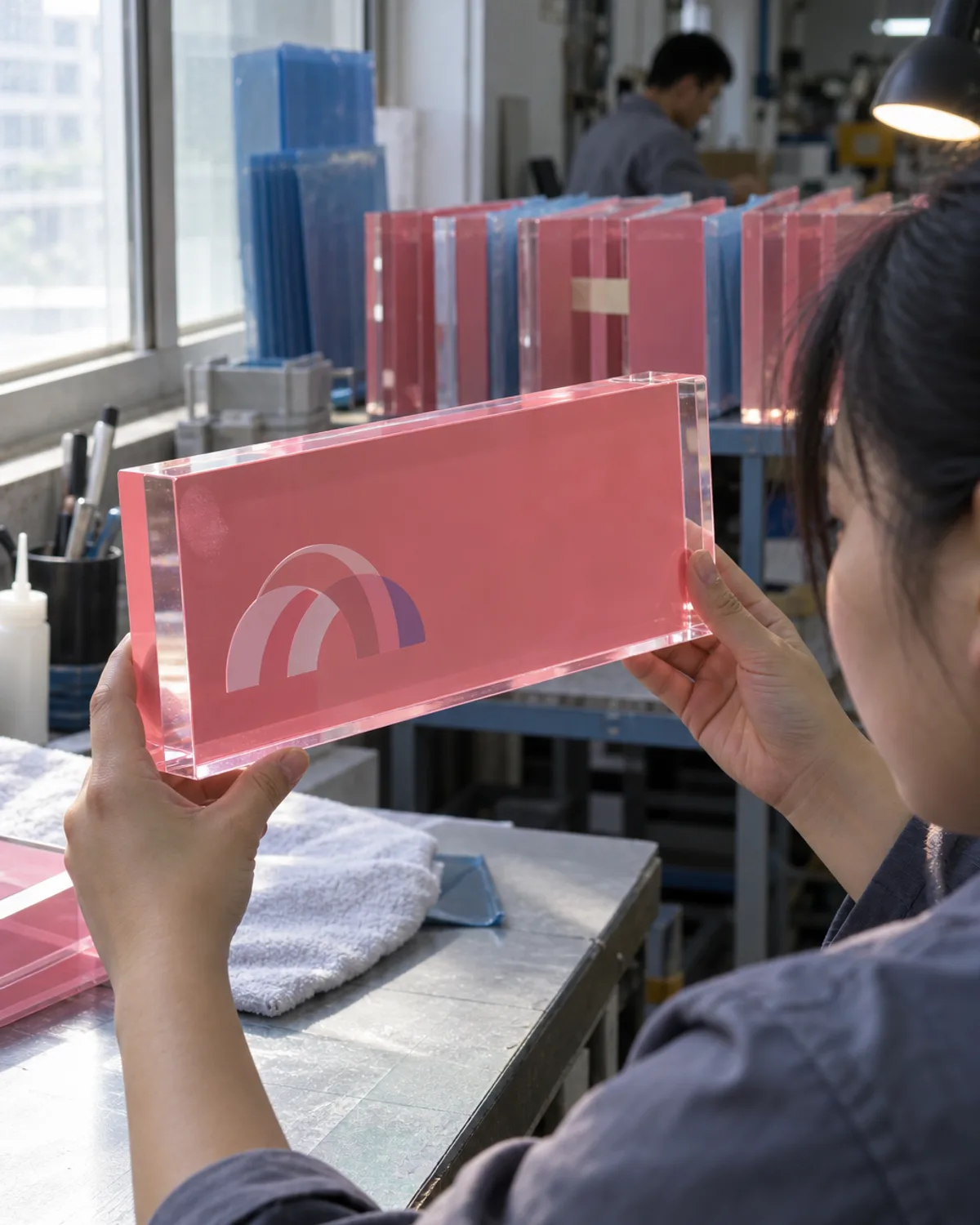
A Scandinavian professional haircare brand reordered about 1,500 brand color back printed logo blocks for its salon counters in the United States: solid clear cast acrylic, roughly 300 × 140 × 30 mm, the brand's color printed as an opaque layer across the whole back face and its mark on the front. We produced the run from the retained proof and sample, packed it in about 150 non-palletized cartons the way a third-party logistics warehouse receives inventory, and delivered it DDP by sea to the brand's US 3PL with duty paid.
- logo blocks, one design
- 1,400–1,600
- clear cast acrylic
- 30 mm
- cartons, non-palletized
- ~150
- sea to a US 3PL
- DDP
Ordering a similar project
MOQ is 100 pieces per design. Paid samples normally take 3–5 days; sample fees are paid separately and never credited. Standard production takes 15–20 days after drawing, artwork, color proof, packing, and sample approval. Wetop responds to a complete brief within 24 hours.
Named price reference: the logo blocks page lists a 100 × 60 × 20 mm clear UV-printed desk block at $12 each at 100 pieces, $9 at 250, and $7 at 500, FOB Shenzhen. The block on this page is far larger, printed on two faces, and delivered DDP; its USD 7–8 band is this project's product price at about 1,500 pieces and is not a quote for yours.
Key Takeaways
- About 1,500 clear cast acrylic logo blocks, roughly 300 × 140 × 30 mm, were printed with a solid brand-color layer across the full back face and the brand mark on the front, so the block glows the brand color through the clear body and along every polished edge.
- The reorder ran from the retained proof and approved sample of the previous run, with the color reference, print files, and packing record pulled from the order file rather than rebuilt from scratch.
- The buyer is a Scandinavian professional haircare brand whose US operation receives inventory through a third-party logistics warehouse, so the packing was designed for 3PL receiving: 10 blocks per carton, about 150 cartons, one reference on every label, no pallet.
- Freight was quoted DDP by sea to the 3PL door with duty included; on a heavy solid-acrylic product the freight line came to roughly half the goods value, which is why we price freight on packed weight at the same time as the product.
- Current ordering for a logo block still starts at 100 pieces per design with a 3–5-day paid sample, a fee that is paid separately and never credited, and 15–20-day standard production after approvals.
The Challenge
A professional haircare brand does not sell in a shop of its own. It sells through salons, and a salon counter is a crowded place: retail bottles, a card reader, somebody's coffee, a tablet. The brand's presence on that counter has to survive without a salesperson standing next to it. For this brand, based in Scandinavia and selling across the United States through its own US operation, that presence is a solid acrylic block with the logo on the front and the brand color behind it. The block sits beside the products and says, quietly, who made them.
The brand had ordered these blocks from us before. The reorder was for about 1,500 more of the same design, for the same US market, with one operational difference that changed the whole back half of the job. The brand's US operation now receives inventory through a third-party logistics warehouse rather than its own office. A 3PL does not unpack a shipment and admire it. It scans a label, counts cartons against a packing list, and puts the goods away. If a carton count is wrong, or a label carries a different reference from the one in the warehouse system, the receipt is held and someone in another time zone gets an email.
So the brief had two halves that pulled in different directions. The block itself had to be indistinguishable from the previous run: same color on the back, same mark on the front, same polish, same weight in the hand. The delivery had to be reinvented around a warehouse the brand did not run, with the brand paying one delivered price and never touching the cartons in between.
There was a third pressure under both of those, and I want to name it because it decides more logo block orders than buyers realise: the block is heavy. Solid cast acrylic at 30 mm thick weighs well over a kilogram in this size. Fifteen hundred of them, with sleeves, dividers, and cartons, pack out close to two tonnes. That weight sets the freight line, it sets how many blocks can go in a carton before a warehouse worker refuses to lift it, and it sets how the cartons have to be built so that polished edges arrive without chips. A brand-color logo block is a printing job on the front and a freight job on the back, and the freight job is the one that goes wrong.
Our Approach
We split the order the way the brief split itself: reproduce the block from the record, and design the delivery around the 3PL. The first half is discipline. The second half is a packing specification and a freight quote that agree with each other. Both start with the same question, which is what the previous run actually was.
Reorder from the record, not from memory
Every approved sample at Wetop is tagged and kept for as long as the account is active, and the proof that produced it stays in the order file next to the color reference the brand supplied. For this block the record held three things: the brand's color target for the back face, the approved printed proof that matched it, and the sample the brand signed off before the previous run. Production pulled all three before touching a sheet. The first-off block was printed, cured, and put on the bench beside the retained sample under the same light, and only when the two matched did the print line release.
That comparison matters more on a color-backed block than on a clear one. The back face is a single opaque field of color, and any drift between batches shows as two slightly different pinks on the same salon counter. We hold it by keeping one ink batch for the run, keeping the print master from the proof, and comparing the first block of every shift with the retained sample rather than with the previous shift's output. Comparing with the previous shift is how a color walks; each step looks fine and the end of the run does not match the start.
Why the color is printed on the back
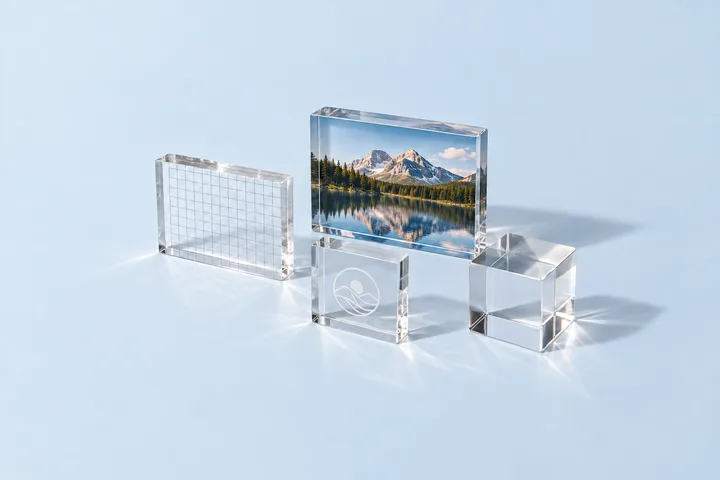
Buyers sometimes ask why we print the brand color rather than cut the block from colored sheet. The answer is in the hero photo. Light enters the block through the polished edges and the clear front, crosses 30 mm of clear cast acrylic, hits the opaque color layer on the back, and comes back out. The block reads as the brand color with depth, and every polished edge carries a line of that color. Colored sheet is flat by comparison, and it limits the brand to whatever color is in stock. A printed back is proofed against the brand's own color reference and approved on the physical sample, which is the standard our logo block page describes for any printed decoration.
The front carries the brand mark, printed so it sits crisp on the clear face with the color field glowing behind it. Two printed faces on one solid block means two registration checks, and the mark on the front is what a customer's eye lands on, so that is the one we measure. Our guide on engraving versus UV printing on logo blocks covers when a printed mark is the right call and when an engraved one is.
Packing for a warehouse that only counts
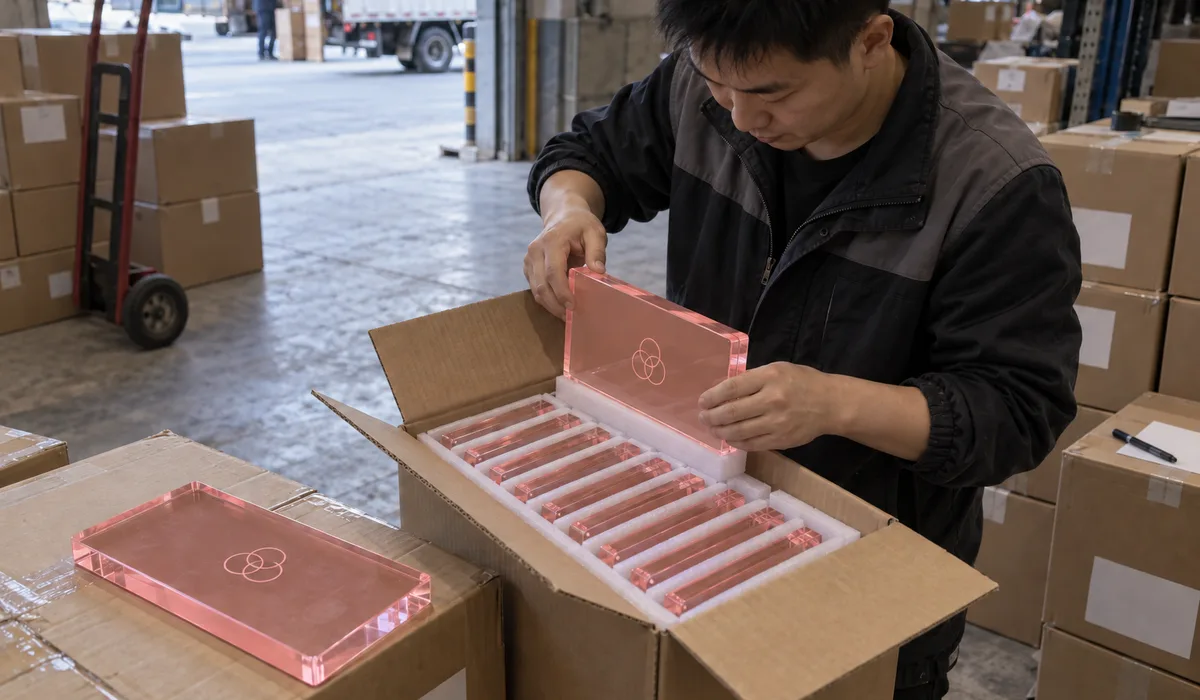
A 3PL receives on three things: the carton count, the label, and the packing list. We built the packing specification backward from that. Ten blocks per carton, each block in its own sleeve with a corrugated divider between neighbours so polished edges never touch, and a carton weight a single worker can lift without a second thought. That gave about 150 cartons for the order. Each carton label carried the brand's item reference, the count, the carton number out of the total, and the gross weight; nothing else, because a label that says more than the warehouse system expects is a label that gets questioned.
The brand asked for the cartons to ship without pallets. Its 3PL floor-loads small consignments and charges to break down and dispose of pallets it did not ask for, so on this shipment a pallet would have been a cost with no benefit. Non-palletized cartons of heavy acrylic need more from the carton itself, so these were double-wall with the sleeves and dividers doing the work a pallet would otherwise have done. The packing list was written carton by carton, so a receiving clerk could tick each one off against its label, and it was sent ahead of the goods rather than with them. Our guide on how acrylic orders are packed explains the general carton logic; the 3PL version is the same logic with the warehouse's receiving rules written on top.
One delivered price to the 3PL door
The brand wanted one number that ended at the warehouse door with duty paid, so the shipment went DDP by sea. On a product this heavy the freight line is not a rounding error: the DDP sea quote came to roughly half the value of the goods. I would rather a buyer see that number next to the product price at quote time than discover it after the deposit, so on logo blocks we price freight on packed weight and carton count at the same time as the product, and the two quotes travel together. A block that costs USD 7–8 to make and weighs over a kilogram will always carry a large freight share by sea; by air it would have been a multiple of the goods, which is why nobody proposed air. Our FOB versus DDP guide walks through what a delivered price includes and why the comparison has to be landed cost to landed cost.
Spec at a glance
Quantities, prices, and dimensions on this page are shown as bands or rounded to protect the buyer's commercial detail. The underlying order is documented in our records.
The Results
About 1,500 brand-color logo blocks were printed from the retained proof, inspected one by one, sleeved and packed ten to a carton in about 150 non-palletized cartons, and delivered DDP by sea to the brand's US third-party logistics warehouse with duty paid. The invoice was paid in full. The 3PL received on the carton-by-carton packing list, and no receiving query came back to the brand or to us.
Two things in that table deserve a careful reading. The color result is not "matched Pantone"; it is "held to the retained proof and compared with the approved sample". A printed color on acrylic is approved on a physical object under a known light, and a reorder is judged against that object, not against a swatch on a screen. The freight result is a ratio, not a promise: roughly half of goods value on a shipment close to two tonnes going DDP by sea to one US warehouse. A different block size, a different route, or a different month changes it, which is why we quote it fresh on packed weight every time rather than carrying a percentage forward.
What the brand got was the thing it asked for: the same block on more salon counters, delivered to a warehouse it does not run, at one price that ended at the door. What it also got is an order file that now records the ink batch, the first-off comparison, the carton specification, and the 3PL labelling rules, so the next purchase order can be one line long and the next receipt can be silent too.
Project note: A brand-color logo block is two jobs. The print job is judged against a retained proof and a tagged sample. The freight job is judged by whether a warehouse that has never heard of the brand can receive 150 heavy cartons without sending an email.
What This Means for Your Project
If you run a beauty, haircare, or personal-care brand that sells through other people's counters, a logo block is one of the few pieces of brand presence you fully control. It does not need power, it does not need a fixture, and it does not get thrown away when the promotion ends. The decisions that make it work are the ones this project shows: put the color where the light will find it, reorder from a record rather than a memory, and pack for the warehouse you actually ship to.
Three practical points follow from this order, and I give them to every brand that asks for a color-backed block.
Send your color reference, then approve on the sample, not the screen. A printed back is matched to your reference on a proof and confirmed on a physical block under a consistent light. That block becomes the sample-of-record, and every reorder is compared with it. If your current supplier cannot show you where your approved block lives, that tells you how the next reorder will go. Our guide on Pantone color matching for acrylic OEM orders explains what a color reference can and cannot promise.
Tell us how the warehouse receives before we quote the packing. Count per carton, label content, pallet or no pallet, and whether the packing list should arrive ahead of the goods are 3PL rules, not factory preferences. Written into the packing specification before production, they cost nothing. Discovered at the receiving dock, they cost a held receipt and a week of emails. The logo block manufacturing program page lists the packing and labelling inputs we ask for on a first order.
Get the freight quote on the same packed weight as the product quote. Solid acrylic is heavy, and a 30 mm logo block carries a large freight share by sea no matter who makes it. That is not a reason to make the block thinner; it is a reason to see the two numbers side by side before the deposit, so the landed cost is one decision. A thinner or smaller block changes the ratio, and our logo block price guide shows how size and quantity move the product side of that number.
We build custom acrylic blocks for beauty, haircare, and corporate brands from 100 pieces per design, with a paid pre-production sample before the first run and the retained-record process described here on every run after it. The corporate logo block vendor program case shows the same discipline across seven artworks and two order years.
Common Questions
Three questions we answer most often when a brand asks for a color-backed logo block delivered to a warehouse it does not run.
Why print the brand color on the back of a clear acrylic logo block instead of using colored sheet?
Because a printed back on clear cast acrylic gives the color depth and an edge glow that a solid colored sheet cannot. Light enters the polished edges and the clear front, hits the opaque color layer on the back, and returns through 30 mm of clear material, so the block reads as the brand color from every angle while the logo on the front stays crisp. A colored sheet would be flat, and a Pantone-matched sheet color is limited to what is in stock; a printed back is proofed against the brand's own color reference and approved on the physical sample.
What does "3PL-ready" mean for acrylic logo block packing?
It means the cartons arrive the way a third-party logistics warehouse receives inventory: a fixed count per carton, one item reference on every label, a packing list that lists carton by carton, and no pallet if the warehouse floor-loads small consignments. On this order that was 10 blocks per carton in individual sleeves with dividers, about 150 cartons, and a DDP quote that ended at the 3PL door with duty included. The brand's own team never touched the shipment.
How much does freight add on a heavy logo block order shipped DDP by sea?
More than buyers expect, because solid 30 mm acrylic is heavy for its price. Each block on this order weighed well over a kilogram, so about 1,500 pieces packed out close to two tonnes, and the DDP sea line came to roughly half the value of the goods. That ratio is specific to this product and route; a thinner or smaller block changes it. Ask for the freight quote on the same packed weight and carton count as the product quote so the landed cost is one number.
Planning a color-backed logo block for salon or retail counters?
Send the block size, your color reference, the mark for the front face, the quantity, and how your warehouse receives. We will return a color proof plan, a paid sample quote, and a written production quote with freight on the packed weight as its own line.
Paid samples in 3–5 days · Fees paid separately and never credited · Production in 15–20 days after approval · MOQ 100 pieces per design · Response within 24 hours