Case Study · Brand Marketing · United States
Seven Co-Brand Artworks, One Color Standard, One Vendor
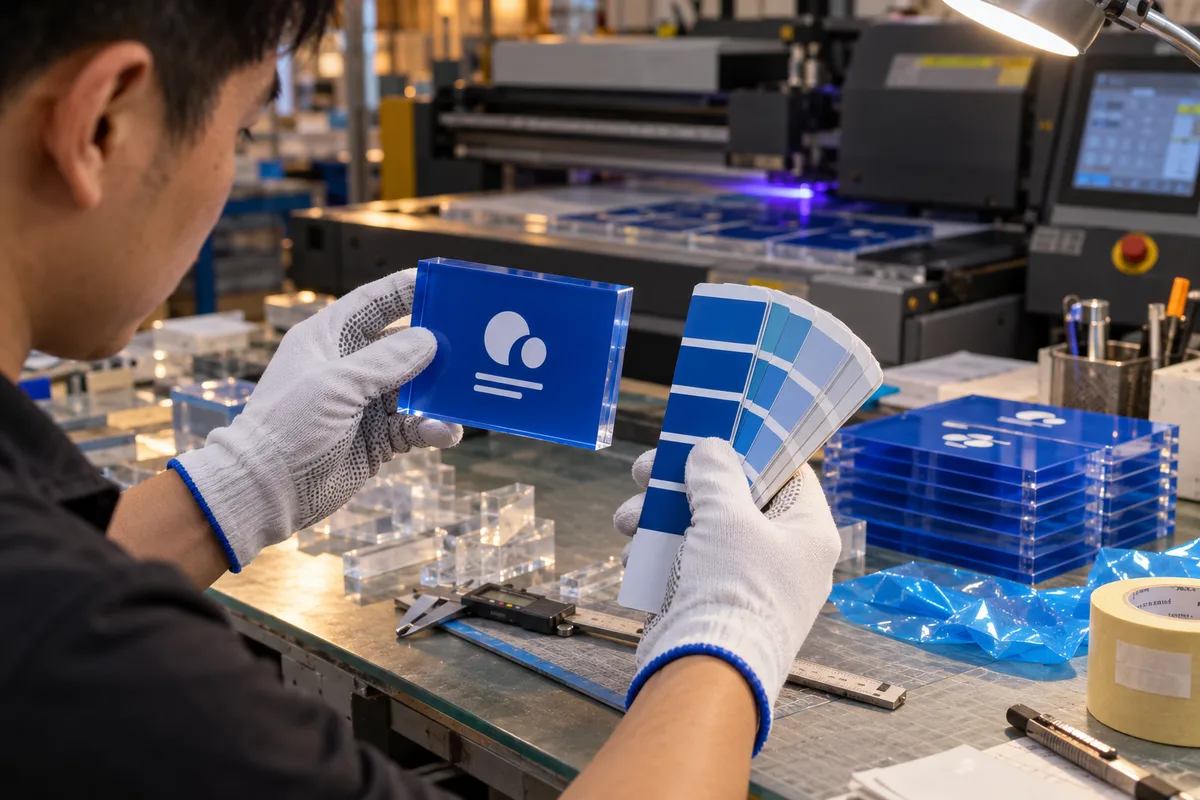
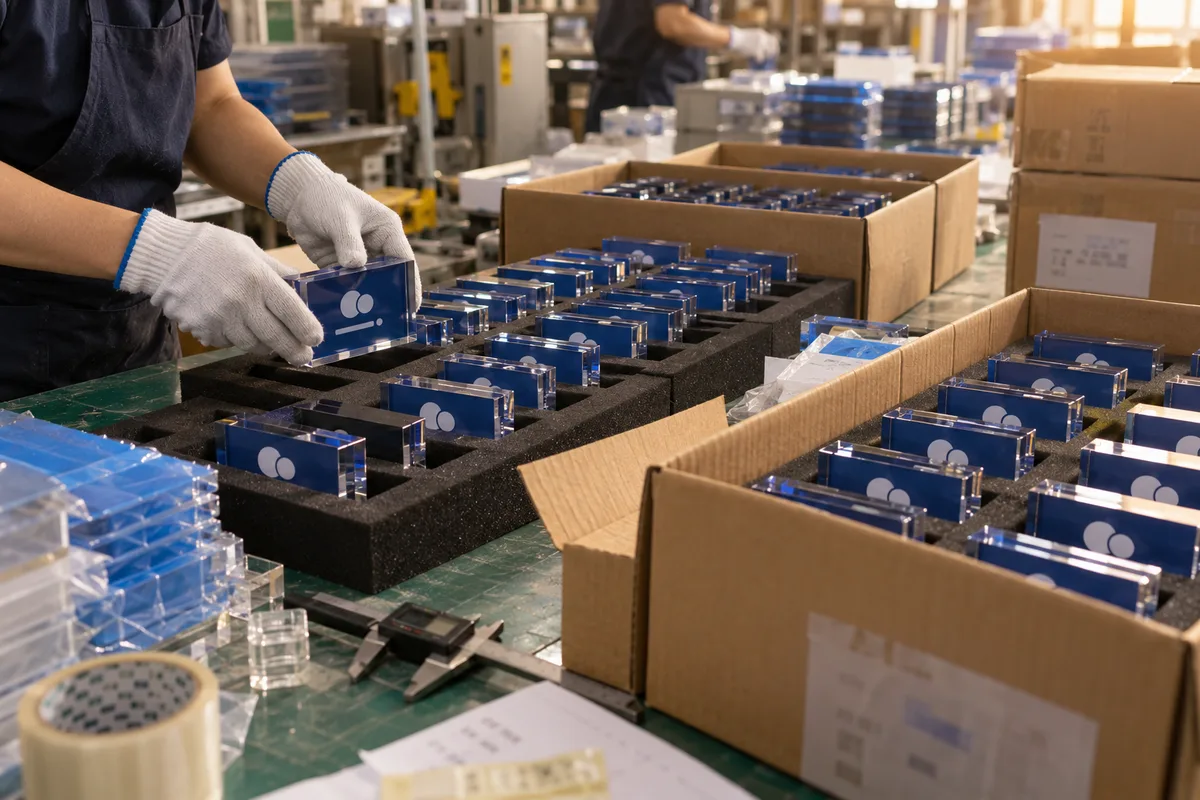
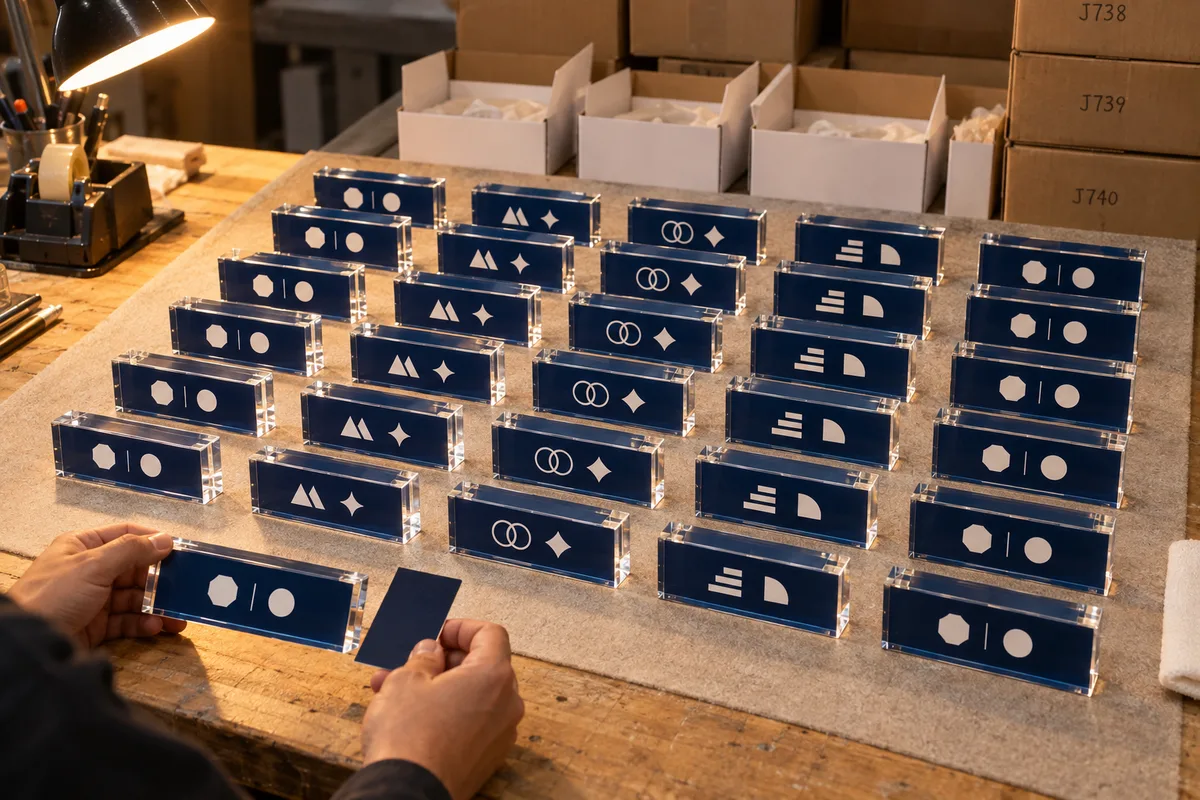
The marketing group of a US performance-fabric manufacturer runs every co-branded acrylic block job through our floor: 2,600+ corporate logo blocks across seven artworks in two fiscal years.
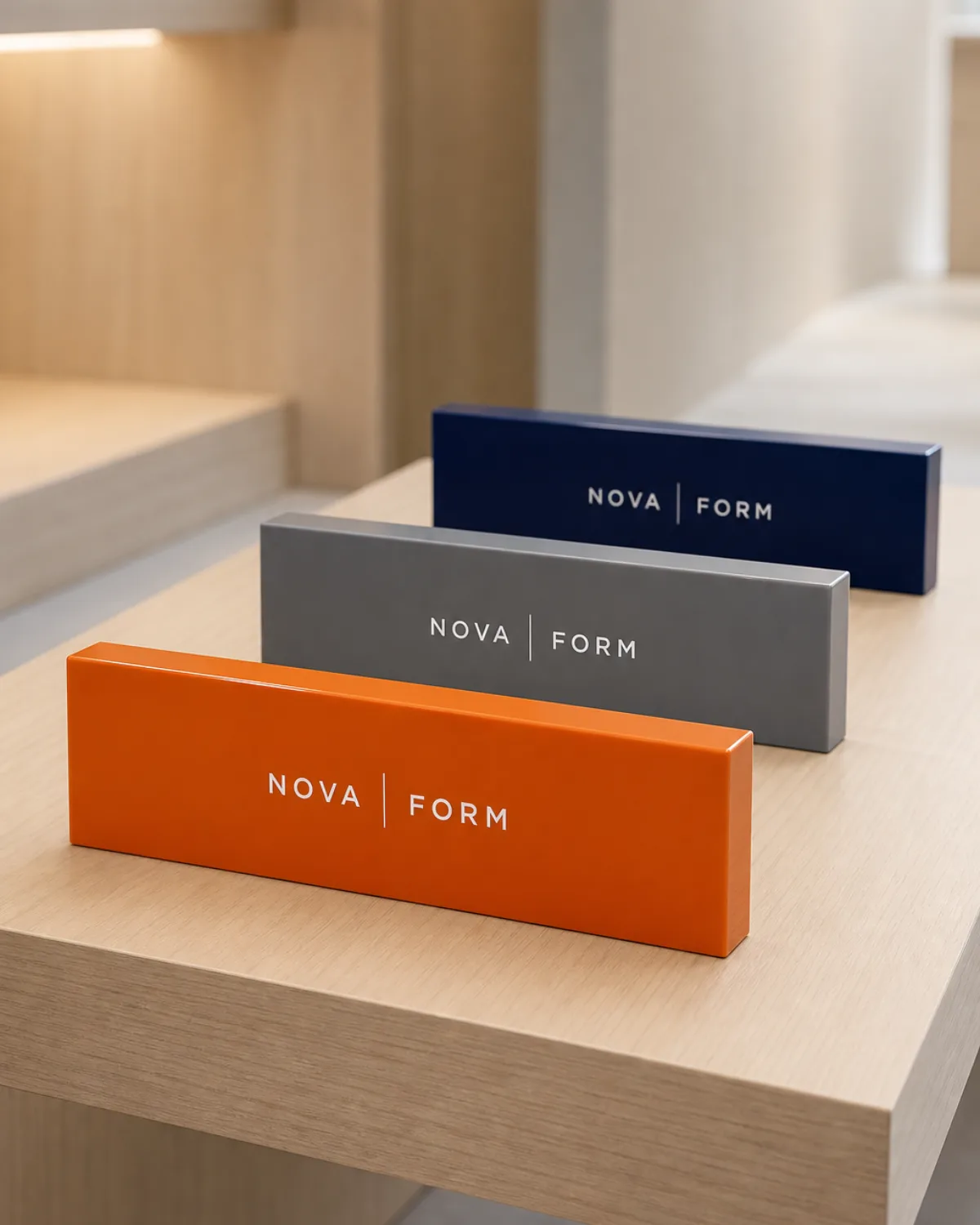
The program runs from per-design brand runs to a 1,500-piece rollout. Reorders are quoted the same day, produced in 10–12 days, and approved by photo proof against samples we retain from every run, and the account has moved from deposit terms to pay-after-ship.
- blocks across the program
- 2,600+
- co-brand artworks
- 7
- reorder quote turnaround
- Same day
- production per run
- 10–12 days
Ordering a similar project
Current standalone production starts at 100 pieces per design. Paid pre-production samples take 3–5 days; sample fees are paid separately and never credited. Standard production takes 15–20 days after artwork and sample approval.
Traceable price references: this delivered program recorded a historical $6.50-to-about-$4.20 unit ladder as pooled run size increased. For a current named comparator, our acrylic logo block prices list a 100 × 60 × 20 mm clear block with full-color UV print at $12 each for 100 pieces, $9 at 250 and $7 at 500, FOB Shenzhen. Neither figure replaces a quote for a new size, artwork, color, edge, packing, or freight plan.
Key Takeaways
- One standing vendor program has moved 2,600+ corporate logo blocks across seven co-brand artworks in two fiscal years, every run held to the same brand PMS standard.
- Combined cutting put each co-brand artwork on the same cutting program as the 1,000-piece rollouts, holding a flat $6 unit price.
- Retained approved samples turn reorders into photo-proof approvals: the latest 1,000-block reorder was quoted the same morning it arrived and needed no physical sample at all.
- Print-side artwork review caught a stretched logo, a file that was not built at 1:1 scale, and a wrong-color artwork before a single block was printed.
- Trust compounds into terms: over the life of the program the account moved from deposits to pay-after-ship, and from physical samples to photo proofs.
The Challenge
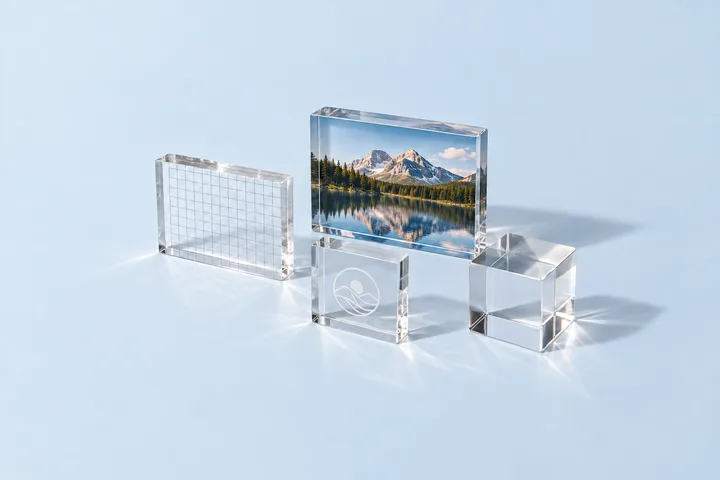
When a fabric brand licenses its material to furniture makers, hospitality lines, and retail programs, every one of those partnerships eventually needs a physical marker: a co-branded block that sits on a dealer counter, a showroom shelf, or a trade-show table and says these two brands stand together. For the marketing and sourcing group behind this program, that marker is a printed acrylic block — the brand's logo locked up with an end customer's logo, in the brand's exact color, on a block sized to its point-of-purchase system.
The demand pattern is what makes corporate logo blocks a hard sourcing problem. It is not one big order. It is a stream of 100-to-150-piece, deadline-locked jobs that all have to look identical: 100 blocks for one furniture retailer's showrooms, 150 for a coastal-lifestyle launch heading to a fall market, 120 for a casegoods brand ahead of a spring furniture market, 100 each for two partner brands at a summer casual-furnishings show — and then, once or twice a year, a 1,000-to-1,500-piece masterbrand rollout that restocks the whole program.
Three requirements sat under every one of those jobs.
First, the color. The brand's identity lives on a published PMS standard, and the logo block is often the most color-critical object in the room, because it sits next to the branded fabric it is supposed to match. A block that drifts warm or reads muddy is not a QC footnote; it is the brand being wrong in front of the very partner the block was made to honor. Every artwork — theirs and each end customer's — had to hit its number, run after run, year after year.
Second, the economics of partner runs. A 100-piece run for a single partner brand priced as a standalone production job carries its own material cutting, machine setup, and freight overhead. Most suppliers answer with a higher minimum or a small-run surcharge. The buyer needed a vendor that could make 100-piece co-brand runs behave, economically, like part of something bigger.
Third, the paperwork had to match how a corporation actually buys. Each job carries its own internal job number, its own PO, and often its own end customer paying the bill — so each job needed its own quote and its own invoice, referencing that number. Ship-to addresses ranged from the buyer's own headquarters to a logistics hub to the end customer's dock in another state, sometimes changing mid-order.
None of these requirements is exotic. Together, held to hard trade-show dates and repeated across seven artworks, they filter out most factories. This case is about what the arrangement that survives looks like — a standing vendor program rather than a series of one-off orders.
Our Approach
Three practices carry this program: holding every artwork to the brand's PMS standard, pooling small co-brand runs onto shared cutting programs, and running the invoicing and logistics the way the client's own purchasing system expects.
Color held to the brand standard — and artwork checked before print
Every artwork in this program prints against the client's PMS number, and we keep an approved sample from each production run in our sample library. That retained sample is the reference every later run is checked against, which is the same discipline we describe in our Pantone color matching guide: the standard is a physical object plus a recorded print recipe, not a memory of what the last batch looked like.
The less obvious half of color discipline happens before anything prints. Files arrive from more than one design team — the client's own designers plus each end customer's — and our print department checks every file before it goes near a machine. Across this program that pre-flight has caught a file that was not built at 1:1 scale with fonts left unconverted, a logo that had been stretched horizontally away from its drawn proportions, and, on one pair of same-size blocks headed to the same show, an artwork whose color did not match its sister file. We put the two mockups side by side, the client's team saw the discrepancy immediately, confirmed both should carry the same PMS number, and re-issued the file. The wrong color never touched a block.
The same review settled a production-geometry question early in the program. The artwork specified a 0.063-inch (1.6 mm) print offset from the block edge; in mass production that tight an offset amplifies every fraction of cutting and registration variance. We proposed 2.5 mm (about 0.098 inch), showed the comparison, and got written approval — and because the change is documented, every later run has used the same offset instead of quietly re-deciding it.
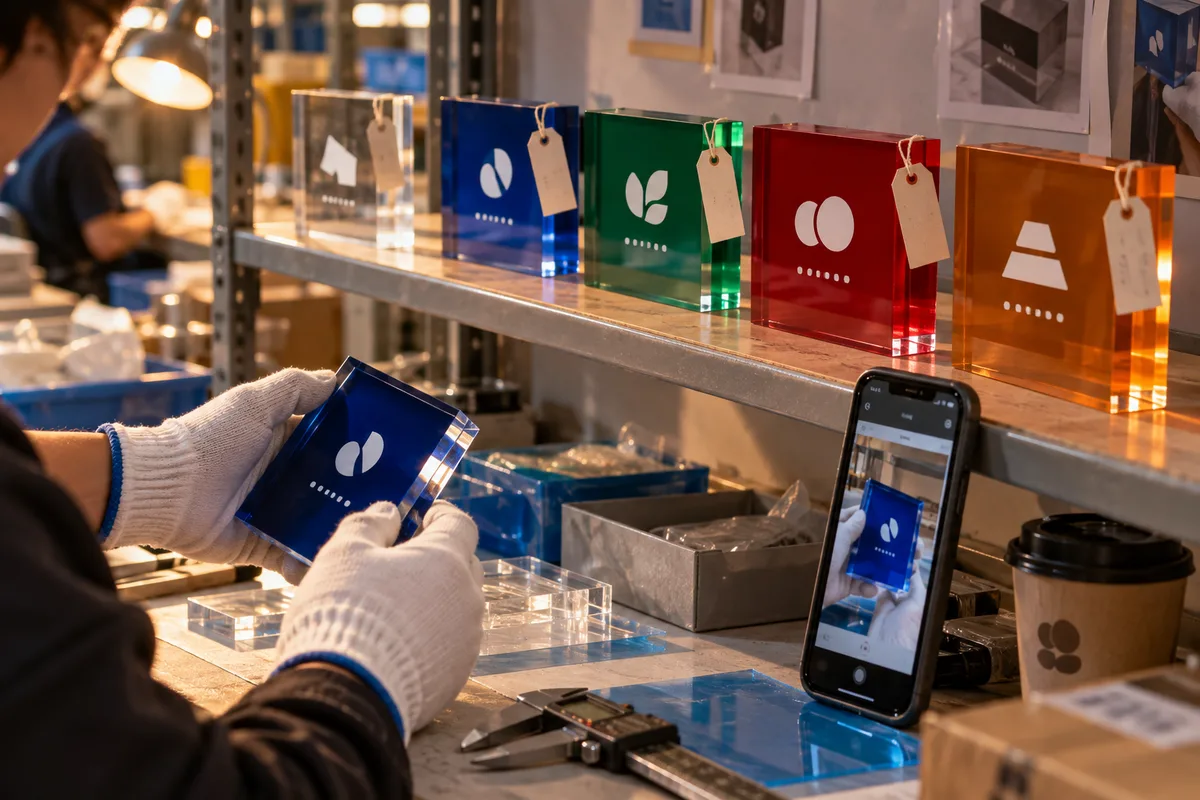
Sampling itself has evolved with trust. Early jobs got physical pre-production samples couriered across the Pacific, adding roughly two weeks per cycle. Once several artworks had approved runs behind them, the client proposed the obvious upgrade: we photograph the new pre-production block next to the retained approved sample, they confirm the match to their brand guidelines, and production proceeds. New artworks and new colors still get a physical sample — a recent new-color launch had its sample cut, printed, and on an express flight the day after the request — but reprints of proven artwork are approved from photos in a day or two.
Pooling co-brand runs onto 1,000-piece cutting programs
The economics answer is combined cutting. Almost every artwork in this program lives on the same few block geometries — 8-, 10-, and 11.875-inch lengths, 3 inches high, 1 inch thick — so when a small co-brand run lands while a larger run is on the schedule, we cut them from the same material program and the setup cost spreads across all of it. Orders placed together can even ship weeks apart without repricing, because the cutting, not the shipping, is where the sharing happens.
That is what lets a launch run carry a flat $6.00 unit price — the same number a mid-size run pays — instead of a small-batch surcharge: each co-brand artwork rides the shared cutting program, and the annual rollouts balance the ledger. On the volume end the same logic compounds, with the program's price falling to roughly $4.20 above 1,000 pieces.
One note for readers mapping this onto their own project: our production minimum is 100 pieces per design, and every partner run in this program was released at 100 pieces or more per artwork. New programs use paid samples for validation before moving to full production.
Approval hardware is part of the record too. When the client wanted to test a new triangular block format with its partners, four evaluation pieces were produced under the historical program and the geometry was revised. The team asked whether the face could come down from 2.5 inches to 2 with the logo held centered, and the next sample answered the question before the related purchase order.
Invoicing, packaging, and freight that fit a corporate buyer
Every job in this program is quoted and invoiced separately against the client's internal job number, because two blocks for two end customers are two budgets on their side even when we cut them from one sheet. When one shipment carried two jobs and our packing team discovered one carton had both models boxed together, we flagged it to the client before the cartons landed so their team could separate them on arrival — a small mistake, and exactly the kind a vendor should report before the customer finds it.
Packaging itself was an early fix. After the first co-brand delivery, the end customer asked how the blocks would be protected in transit; we moved the program to an individual white inner box per block, which ended the scratch question and became the packaging standard for every run since — pre-ordered ahead of final quantities when a deadline is tight, so box lead time never gates production.
Freight gets engineered per deadline instead of quoted one way. The program's big rollout needed part of the quantity early and the rest on budget, so we split it: 200 blocks flew to arrive ahead of an early-fall deadline while 1,300 followed by sea express at well under half the air cost, both legs delivered duty-paid so the client's team never touches customs paperwork. When customs tightened inspection on logo-bearing goods mid-program, we flagged the new brand-authorization requirement to the client, supplied a template letter for their legal team, and routed the signed authorization to the broker — the shipment cleared without the client's schedule ever feeling it. Hard dates hold: a co-brand run committed to a late-summer delivery arrived on the committed date, and a spring-market job went from artwork to delivered blocks inside five weeks, photo-approved without a physical sample.
The Results
Two fiscal years in: 2,600+ blocks across seven co-brand artworks, every run matched to the brand standard, and a reorder cycle that keeps getting shorter.
The most recent reorder shows the program at speed. The request for 1,000 masterbrand blocks arrived with size, color, and destination; the full quote — unit price, air and sea options, duty-paid totals, production timeline — went back the same morning, under an hour later. PO, invoice, photo proof against the retained sample, approval, production. No physical sample crossed the ocean, no spec was re-litigated, and the whole exchange fit inside a working week.
FY26 reorder, July 2026: the client's purchasing team placed the 1,000-block masterbrand reorder — PMS-matched to the retained standard — and approved the proof by email, with production released on that emailed approval and no physical sample round. The handoff follows the versioned-proof discipline in our proof approval and version-control guide.
The terms tell the trust story more plainly than any testimonial. The program began on standard deposit terms. As runs accumulated, we moved the account to pay-after-ship — the goods leave our dock before any money moves — because a partner who has paid every invoice across two fiscal years has earned the simpler process. The client's sourcing engineer called it what it is: a good partnership, running on accumulated proof rather than fresh negotiation.
The program is also growing along the client's own map. After the masterbrand blocks proved themselves in US showrooms, the client introduced its Asia marketing team to explore the same blocks for its China-side customers; samples were on an express courier within days, with a tiered quote from 25 to 2,000 pieces on the table the next morning. A vendor program that started as one region's point-of-purchase fix is becoming the brand's default answer wherever a partnership needs a physical marker.
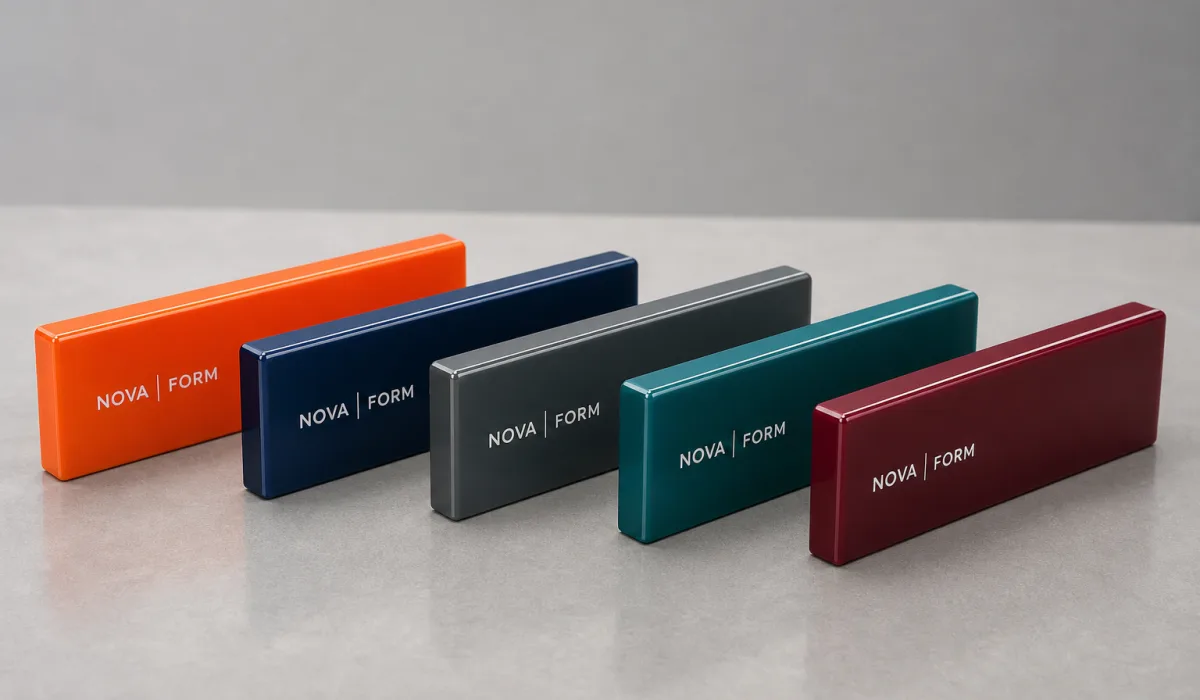
"Wetop quoted our 1,000-block reorder the same morning and the photo proof matched our color standard, so nothing physical had to cross the ocean. Seven of our customer brands are on these blocks now, and every run has matched the one before it."
What This Means for Your Project
If your marketing team buys co-branded corporate logo blocks — or award blocks, dealer plaques, any printed acrylic that carries your identity next to a partner's — this program is a template for what to ask a vendor before the first PO.
Ask how color survives a reorder. The workable answer involves a retained physical sample and a recorded print recipe tied to your PMS standard, so that run five is checked against run one rather than against someone's memory. Ask what the artwork pre-flight actually checks: scale, outlined fonts, offsets, and color callouts against your own guidelines, because the file errors a print department catches cost nothing and the ones it misses cost a run. Our acrylic logo blocks page covers the print methods and color options this program draws on.
Ask how partner runs are priced. If every partner run is quoted as an island, you will pay setup costs seven times for seven artworks. A vendor holding your geometry and recipes on file can pool your 100-piece runs onto shared cutting programs — the difference between a co-brand program that scales with your partnerships and one your budget quietly kills. The full range of formats is on our acrylic logo blocks page.
And ask what gets easier over time. In a healthy vendor program, each cycle should shed a step: physical samples become photo proofs, deposits become pay-after-ship, quotes come back in hours because nothing needs re-engineering. If every order with your current supplier feels like the first one, that is the signal to change something.
Running a co-brand program that needs one color standard?
Send us your artwork and block size — we'll come back with a per-job quote, a pooling plan for your smaller partner runs, and a proofing workflow that gets faster every cycle.
Paid sample in 3–5 days · Sample fees paid separately and never credited · We reply within 24 hours