

Magnetic Acrylic Frame Cost at 100, 500 and 1,000
The panel pair and magnet count set the base price; setup, insert printing and packaging are the lines that move when the quantity does.
Need this made?Acrylic magnetic photo frames →

Key Takeaways
- A magnetic acrylic frame quote has four lines: the base frame (panel pair, magnet count, polish), setup, printed inserts, and packaging. Freight sits on a fifth.
- The base frame is set by the panel thickness pair (8+8 mm to 15+15 mm) and the magnet count (4 corner magnets up to 8×10 in, 6–8 for A4 and larger).
- Setup has no separate line on our quotes; it is built into the unit price, which is why the unit rate falls with quantity. Our published 4 × 6 in reference is $8.16 each at 100 pieces, $4.44 at 500, and $3.48 at 1,000, FOB Shenzhen.
- Printed inserts and gift boxes are quoted as their own lines, and both need a physical approval before the bulk run.
- Every frame is made to order: paid sample in 3–5 days, production in 15–20 days, then transit. Put the in-hand date in the first message.
On this page
- The brief says a quantity; the quote needs four lines
- Base cost: the panel pair and the magnet count
- Setup: no separate line, so quantity is what shrinks it
- Insert printing: a per-sheet line with an approval gate
- Gift packaging: three retail-ready tiers
- What moves at 100, 500 and 1,000 pieces
- Made to order: the calendar behind the price
- Send a four-line magnetic frame RFQ
The brief says a quantity; the quote needs four lines
Most magnetic frame briefs that reach my inbox say something like “price for 500 magnetic photo frames, 5×7, with our logo.” That sentence answers one of the four questions a magnetic acrylic frame cost depends on. The quote we send back has four lines: the base frame, setup, printed inserts, and packaging, with freight as a fifth line that depends on your destination. Magnetic acrylic frame cost only becomes comparable between suppliers, and between 100, 500, and 1,000 pieces, when all four lines sit on the same specification.
Use one reference spec from the start. Ours is the named reference published on the acrylic magnetic frames page: a 4 × 6 in acrylic magnetic frame, 8 + 8 mm clear panels, 4 corner magnets, polished edges, bulk packed, no printing, at $8.16 each at 100 pieces, $4.44 at 500, and $3.48 at 1,000, FOB Shenzhen. Production MOQ is 100 pieces per design, the paid sample takes 3–5 days, and production takes 15–20 days after sample approval.
That reference is a planning anchor, not a price list. A larger insert, thicker panels, more magnets, a logo, printed inserts, or a gift box each move the number up from there; the number for a program depends on which of the four lines you switch on and how many pieces carry each one.
Base cost: the panel pair and the magnet count
The base frame is two acrylic panels, the magnets that clamp them, and the edge finish. Panel thickness is quoted as a pair: 8+8 mm for compact tabletop frames, 10+10 mm for 5×7 and 6×8 builds, 12+12 mm for 8×10 and A4, and 15+15 mm for large or premium double-sided and wall-mounted frames. A 15+15 mm frame uses close to twice the acrylic of an 8+8 mm frame of the same outline, and thicker panels need deeper magnet pockets, so the pair is the first thing I read on your brief.
The magnet count follows the span. Frames up to 8×10 in take four corner magnets; we fit six to eight on A4, 11×14, and larger so the panels stay flat across the middle of the insert. Each magnet is a purchased part plus a drilled pocket plus a bonding step, so six magnets cost more than four in both material and labor. Neodymium grade matters less than count: a higher N grade is a stronger magnet at the same size,1 and 6 mm N52 discs are our standard because they hold a 10+10 mm frame upright without making the panels hard to peel apart.
Edge finish is the last base variable. We diamond-polish larger tabletop builds because buyers pick a frame up and turn it in the hand; flame polishing costs less and suits compact 4×6 frames. Recessed magnets need precision-drilled pockets; visible corner magnets skip the pocket and read as a design feature. Our photo-booth magnetic frame project is the proof that the construction also scales down: a 2+2 mm sandwich with six flush magnet pairs is a different base cost from the 8+8 mm published reference, and it is quoted as its own spec.
Setup: no separate line, so quantity is what shrinks it
Buyers who ask “what is the setup fee for the logo?” are often surprised by our answer. There is no separate tooling or setup fee line on our quotes; engraving and UV print setup is built into the unit price. Drawing review, the digital proof, fixture preparation, first-off inspection, and carton development all happen once per design and are spread across the pieces in the order.
That is the mechanism behind the tier ladder. At 100 pieces, each frame carries one hundredth of that work; at 500, one five-hundredth; at 1,000, one thousandth. The published 4 × 6 in reference on the magnetic frames page shows the effect: $8.16 each at 100 pieces, $4.44 at 500, and $3.48 at 1,000, FOB Shenzhen. Nothing about the frame changed between those tiers; the share of once-per-design work did.
Below 100 pieces, the path is a paid sample or pre-production trial of 1–5 pieces. It validates the design and logo placement, and we charge the sample fee separately; it is never credited to a production order. It does not lower the production MOQ of 100 pieces per design.
Artwork preparation is where a “setup” cost can quietly reappear as rework, so I ask you for one specific file structure. Send a layered AI or PDF with three separate layers: the print artwork, any metallic or special-ink areas, and the cut line. Name which face of which panel receives your print, because a logo on the inside face of the front panel reads through 10 mm of acrylic differently from a logo on the outside face. An outline that only marks where the acrylic is cut must never sit on the print layer; I have seen it printed as a thin border around a whole run because the file did not separate it. Vector files (AI, EPS, PDF, or SVG) for logos, and we confirm placement on a proof before production.
Insert printing: a per-sheet line with an approval gate
A printed insert is the part of a magnetic frame program that most often has a marketing deadline attached, and we quote it as its own line. We print inserts in-house when buyers want frames and inserts to arrive as one finished kit. The insert line moves with paper or card stock, single or duplex printing, the number of artwork versions, and the sheet count, so ten retailer versions at 100 each cost more to print than one artwork at 1,000 even though the frame quantity is the same.
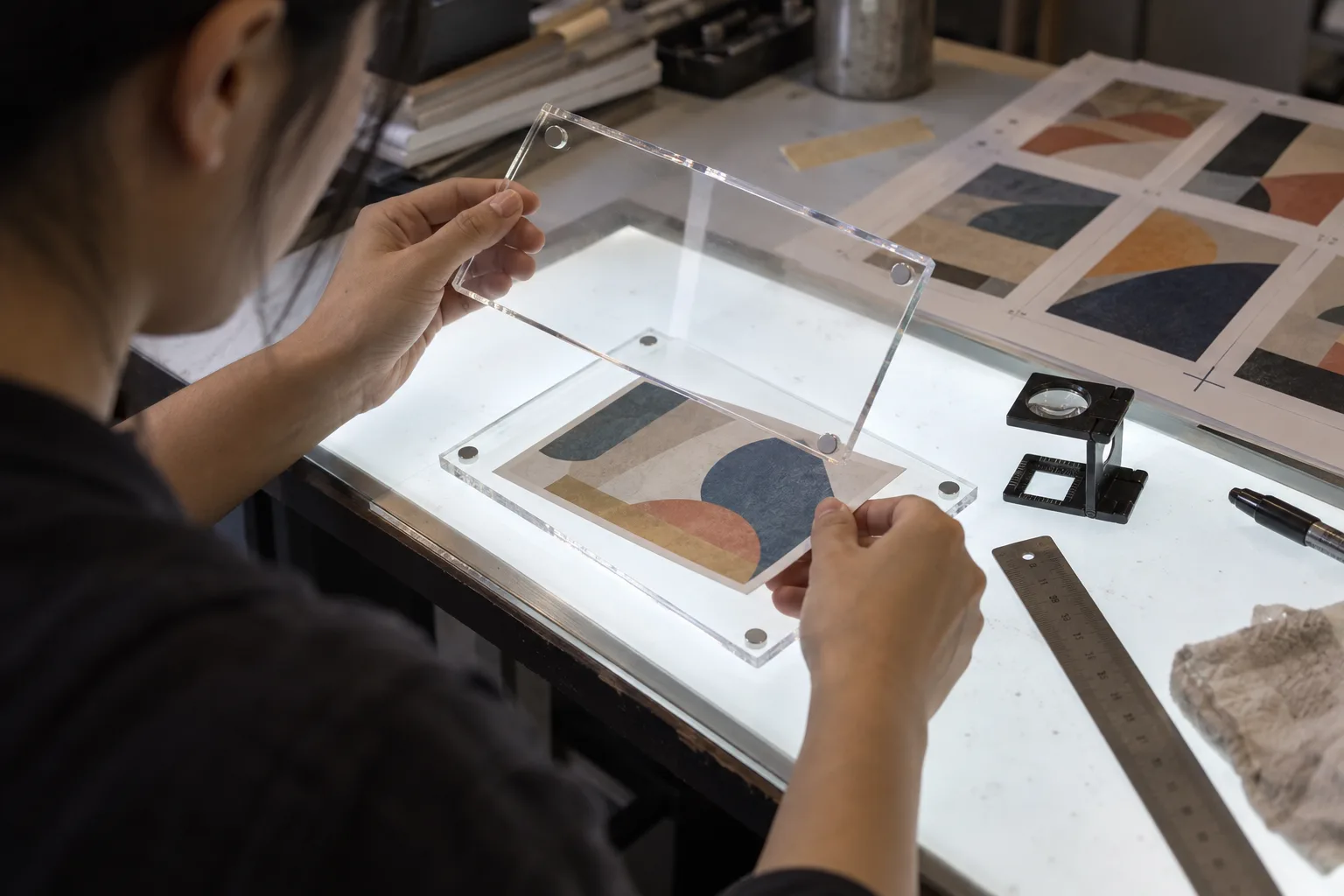
The approval gate is the part of this line I insist on. On screen, duplex artwork looks fine. In the frame, registration drifts a millimeter, or the color runs darker behind 10 mm of acrylic than the brand team expected, or the trim clips a headline. So a physical proof of the printed insert goes to your approvers before a single bulk sheet runs. Bulk frame production can start on schedule; bulk insert printing waits for that sign-off. It costs a few days once, and it removes the one scenario that reprints an entire insert run.
If you print inserts locally, tell us the insert size and stock at quote time anyway. We cut the frame about 5 mm larger than the insert on every side, so an insert that arrives 2 mm oversize after a local trim will not sit flat, and that shows on the first frame a customer opens.
Gift packaging: three retail-ready tiers
Standard bulk packaging is included in the base frame price. Retail-ready packaging is a separate line because the materials, the packing labor, and the carton volume all change. We quote three levels, and we can mix them across one order when part of the run ships onward one piece at a time.
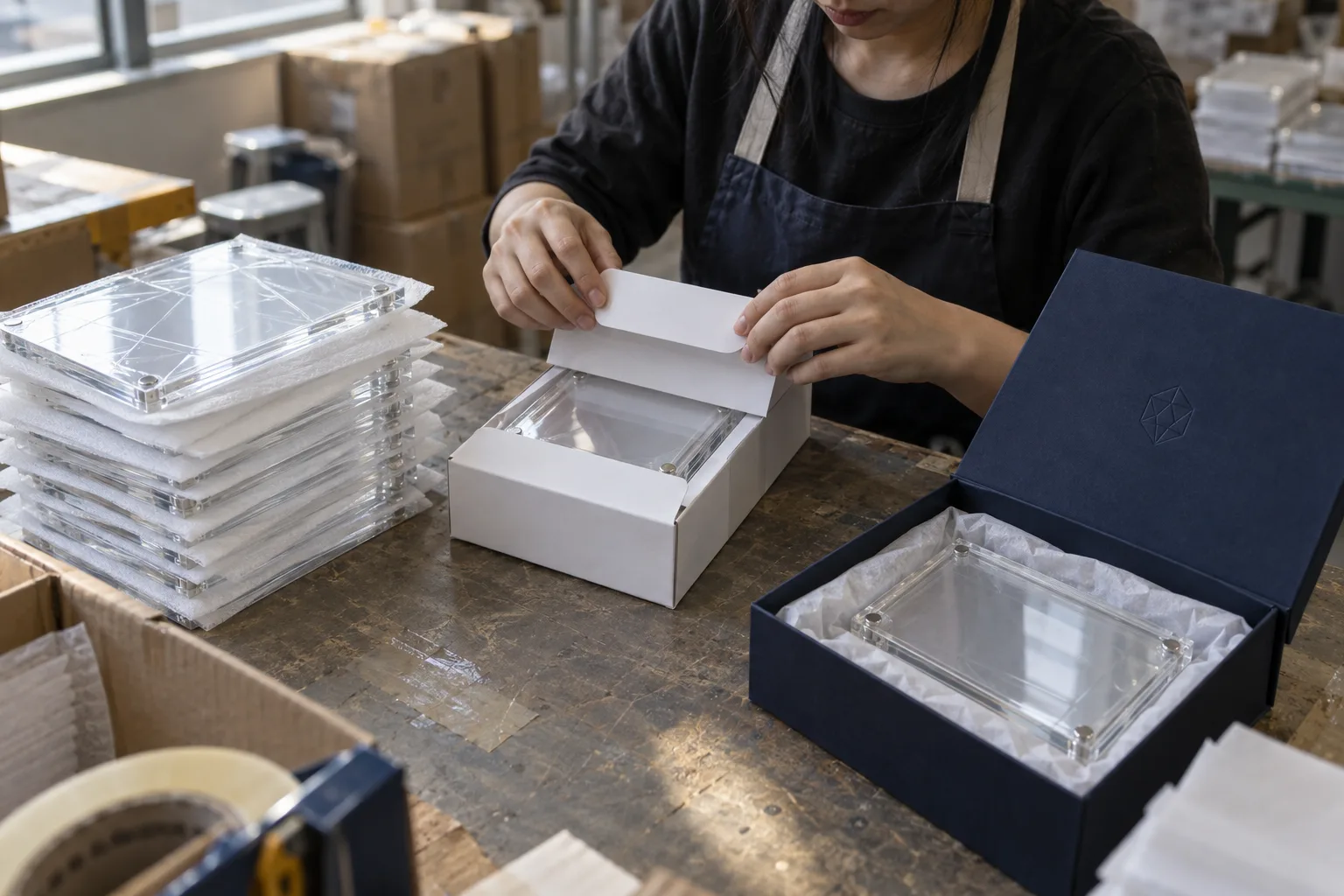
| Packaging level | What it includes | What it adds to the quote |
|---|---|---|
| Bulk-packed (included) | Protective film on both faces, foam interleaving, frames stacked in export cartons | Nothing beyond the base line; lowest carton volume per frame |
| Individual white box | One plain folding box per frame, sized to the panel pair, inside the export carton | Box material, one packing touch per frame, more carton volume |
| Branded gift box | Rigid or printed box with your artwork, tissue or foam insert, optional care card | Box tooling and print, insert, a physical box approval, the most carton volume |
The protective film stays on every panel until the end user peels it; that is standard on our line at all three levels. The gift box needs its own physical approval, the same way the printed insert does, because box artwork and a tissue insert are approved by hand, not on a PDF.
Carton volume is the hidden cost inside this line. A 10+10 mm frame bulk-packed is dense; the same frame in a gift box can take two to three times the carton space. Carriers bill on the greater of actual and dimensional weight, so the packaging tier changes the freight line as well as the packing line. Packed-carton dimensions and gross weights come with our quote so the forwarder can price both. If frames ship onward as single parcels, the ISTA test procedures describe the transit simulations a shipper box can be checked against,2 and we can pack the sample in its production packaging so you approve the unboxing, not only the frame.
What moves at 100, 500 and 1,000 pieces
The four lines do not move together. The base frame row uses the published 4 × 6 in reference from the magnetic frames page; every other line is quoted on your own specification.
| Quote line | 100 pieces | 500 pieces | 1,000 pieces |
|---|---|---|---|
| Base frame (published 4 × 6 in reference, FOB Shenzhen) | $8.16 each; each frame carries the largest share of once-per-design work | $4.44 each | $3.48 each; sheet nesting and steady repetition add to the gain |
| Setup (built into unit price) | Largest share per frame | Spread across five times the pieces | Spread across ten times the pieces |
| Printed inserts | Per-sheet cost with few sheets; versions dominate | Sheet count grows; one artwork prints efficiently | Same; multiple versions still print as separate runs |
| Packaging | Per-frame material is flat; carton development is once per design | Per-frame material flat; carton plan settles | Per-frame material flat; pallet and container fit start to matter |
| Freight (ratio to product) | Highest ratio; small shipment, courier or air | Ratio falls as cartons consolidate | Lowest ratio by sea; air remains an option for a split shipment |
Two patterns follow from that table. First, the base and setup lines fall with quantity; the insert and packaging lines mostly do not, because their material is per frame. A buyer who moves from 100 to 500 pieces and adds a gift box at the same time can see a unit price that barely moves, and the reason is the packaging tier, not the frame. Second, quantity is counted per design. Five artwork versions at 100 each are five releases, five proofs, and five insert runs; the frames may pool for the volume tier, and the inserts do not.
The way I read a target price is to switch the lines on one at a time. If your number is tight, the questions are whether 8+8 mm holds the size, whether four magnets carry the span, whether the insert prints single-sided, and whether the white box does the job of the gift box for the channel. Those four questions are the whole negotiation; the acrylic price per kilogram is not.
Made to order: the calendar behind the price
Every magnetic frame is made to order, so there is no shelf stock to pull from for an urgent order. That is the trade-off that gets you your exact insert size, panel pair, and branding instead of catalog dimensions. The calendar is the paid sample in 3–5 days, your approval, 15–20 days of production, and transit. Sea freight runs roughly 4–6 weeks door-to-door; air closes the shipping leg to days at a real premium. A deadline order needs about 25 days from first message to in-hand when everything approves in one round; the day-by-day math for 10, 15, and 25-day windows is in our magnetic picture frames buyer’s guide.
For an event date, put the in-hand date, the delivery address, the quantity, and the proof deadline in the first message. We tell you plainly whether the date is achievable before you commit. When it is not, the honest plan is a proper branded order for the next event rather than a compressed run that skips the sample gate. Repeat orders reuse the approved sample and spec, so the second event mainly carries production time.
The Incoterm changes what “delivered by the date” includes. ICC Incoterms allocate the delivery tasks, costs, and risk between seller and buyer under each named term,3 so an FOB Shenzhen quote and a DDP quote for the same cartons are different scopes, not different prices for the same thing. Our FOB vs DDP guide covers who books each leg, and I point every first-time importer to it before we quote DDP; for a printed-block program with the same packaging questions, the acrylic block frame photo printing guide shows the retail-ready configurations we build for print labs.
Send a four-line magnetic frame RFQ
Send the insert size, frame format, panel thickness pair, magnet count or the span you need held flat, edge finish, artwork with layers separated, quantity per design, insert printing needs, packaging level, destination, and target date. Ask us for 100, 500, and 1,000 pieces on the same specification, and ask for the base frame, insert, and packaging lines separately so the comparison shows which one moves.
Wetop’s production MOQ is 100 pieces per design. Paid samples take 3–5 days, are paid separately, and are never credited to production. Production takes 15–20 days after approval, every frame passes our 100% inspection for panel clarity, magnet alignment and hold, edge finish, and closure function, and we reply to a complete brief within 24 hours.
Upload the files through the magnetic frame quote form; I read every brief that comes through it, and the custom acrylic fabrication page is the place to start if your frame is a new format. The formats, sizes, and thickness pairs live on the acrylic magnetic frames page, and the wider frame family, including floating and certificate frames, is on the acrylic frames hub.
Footnotes
-
K&J Magnetics neodymium magnet information — explains neodymium grades and states that, as a general rule, a higher N grade is a stronger magnet at the same size. ↩
-
ISTA test procedures — the International Safe Transit Association’s packaged-product test series simulate the motions, forces, and conditions of transport environments. ↩
-
ICC Incoterms rules — the International Chamber of Commerce defines delivery obligations, cost allocation, and risk transfer for each named trade term. ↩
Frequently Asked Questions
Is there a setup fee for a logo on a magnetic acrylic frame?
No. There is no separate tooling or setup fee line on our quotes; engraving and UV print setup is built into the unit price. Send the logo as a vector file (AI, EPS, PDF, or SVG) and we confirm placement on a proof before production. Production MOQ is 100 pieces per design; below that, the path is a paid sample of 1–5 pieces, which validates the design but does not lower the MOQ.
How should metallic ink and cut lines be shown in acrylic frame artwork?
Send a layered AI or PDF with three separate layers: the print artwork, the metallic or special-ink areas, and the cut line. Name which face of which panel receives print. An outline that only marks where the acrylic is cut must not sit on the print layer, or it will be printed as a border.
Can I approve one printed insert before the bulk insert run?
Yes, and we recommend it on every printed-insert order. A physical proof of the insert goes to your approvers first; bulk frame production can start on schedule while bulk insert printing waits for that sign-off. It costs a few days once and avoids reprinting the whole insert run.
Do you keep magnetic acrylic frames in stock for urgent orders?
No. Every magnetic frame is made to order, so there is no shelf stock. The timeline is a paid sample in 3–5 days, production in 15–20 days after approval, then transit. Air freight cuts the shipping leg to days. Send the in-hand date with the first message and we tell you whether it is achievable before you commit.
Can custom magnetic acrylic frames be delivered by a fixed event date?
Often, when the event is about 25 days out or more: sample, one approval round, 15–20 day production, and air freight. Inside that window, a first-time spec runs on digital proofs and carries more risk. If the date cannot be met, we say so and plan the branded order for the next event instead.
Price the Same Magnetic Frame at Three Quantities
Send the insert size, panel thickness, magnet count, artwork, quantity per design, packaging level, and destination. We return the base frame, insert, and packaging lines for 100, 500, and 1,000 pieces within 24 hours.