



Case Study · Photo Booths · United States
2,000 Magnetic Photo Frames for a Photo-Booth Events Company
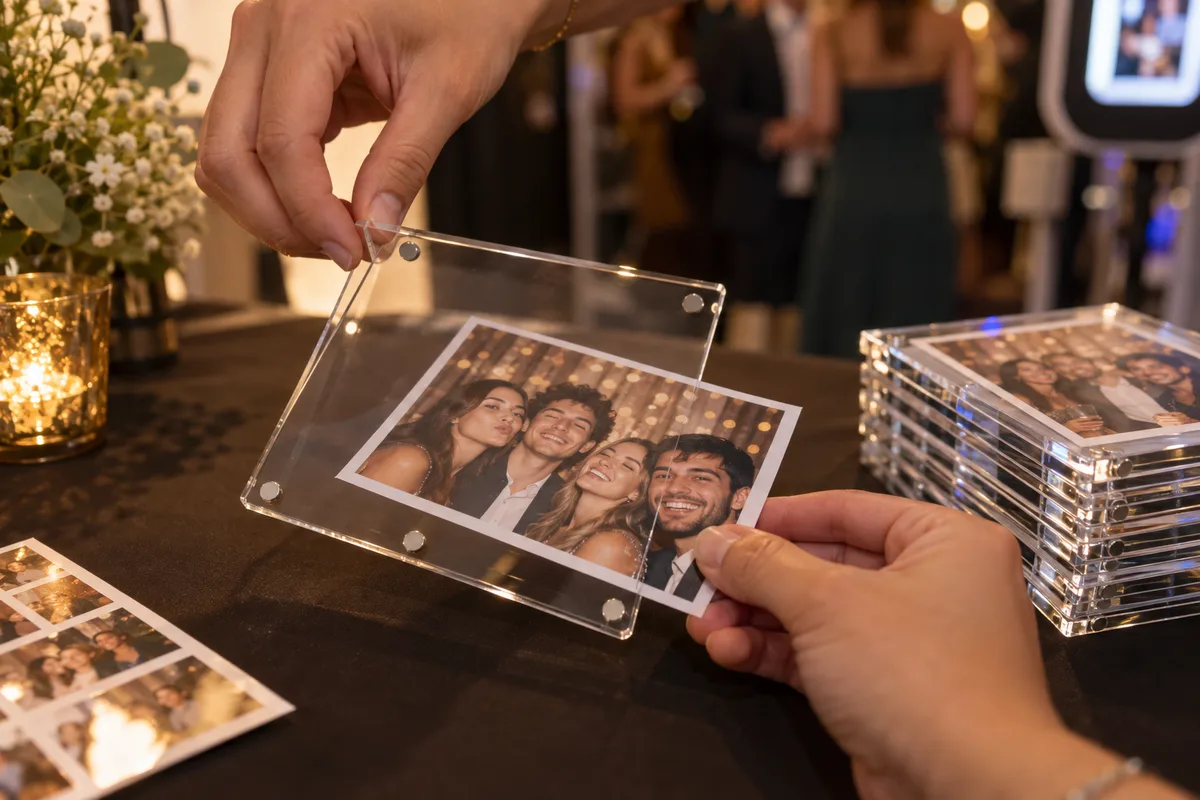
A US events company hands every photo-booth guest their print in an acrylic magnetic frame that the client's crews swap in about two seconds at event pace.
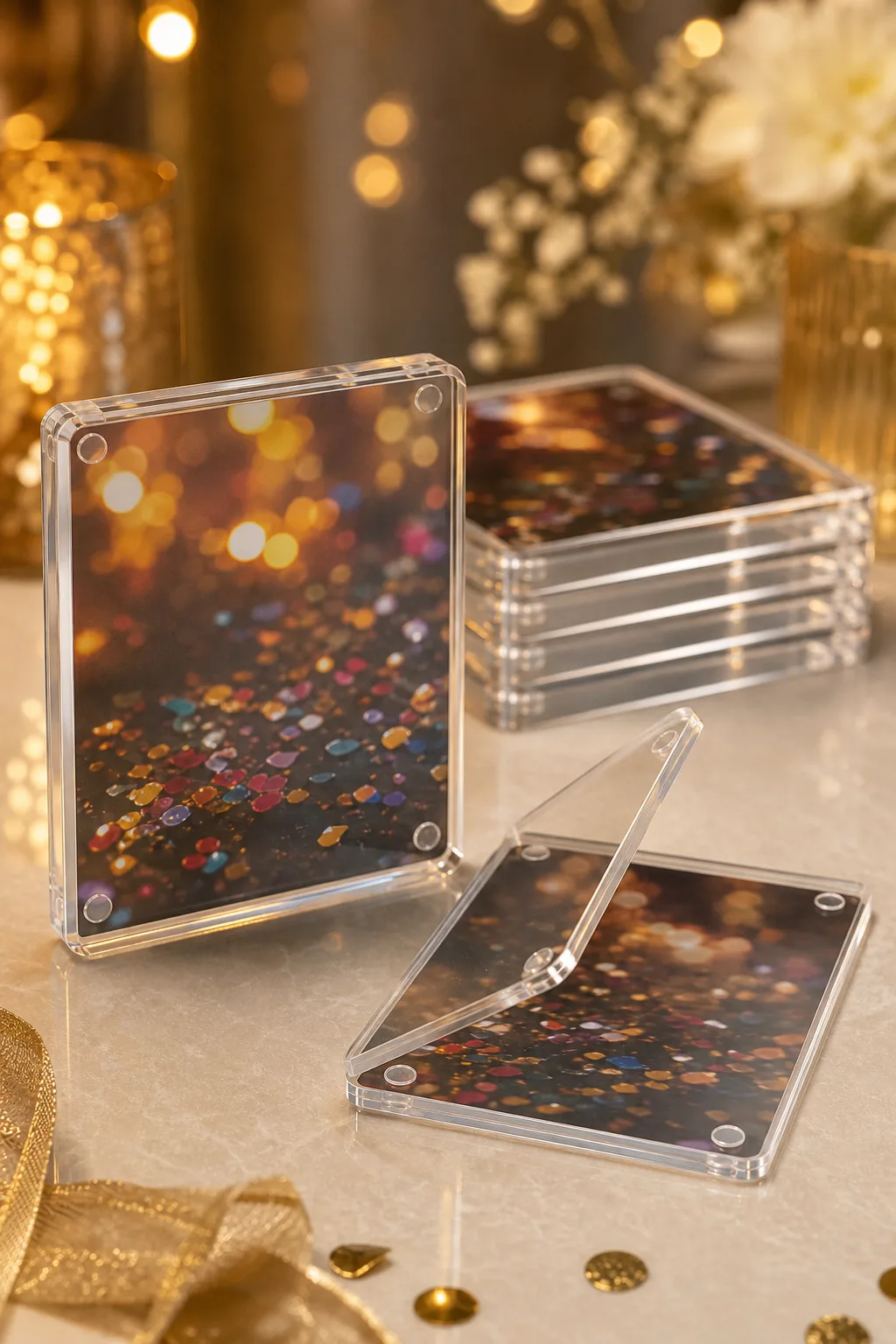
The frame is a 2+2 mm sandwich with six flush-embedded magnet pairs that snaps closed square. We shipped 2,000 frames in 16 production days as four 500-unit event kits, and a 3,000-unit wedding-season reorder followed at month 3.
- frames shipped
- 2,000
- production time
- 16 days
- magnet pairs / frame
- 6
- month-3 reorder
- +3,000
Key Takeaways
- Magnet sizing for a photo frame is a two-force problem: pairs must resist shear (the print sliding) while staying easy to peel open from a corner — six Ø5 × 1.5 mm N42 pairs hit that balance on a 2+2 mm sandwich.
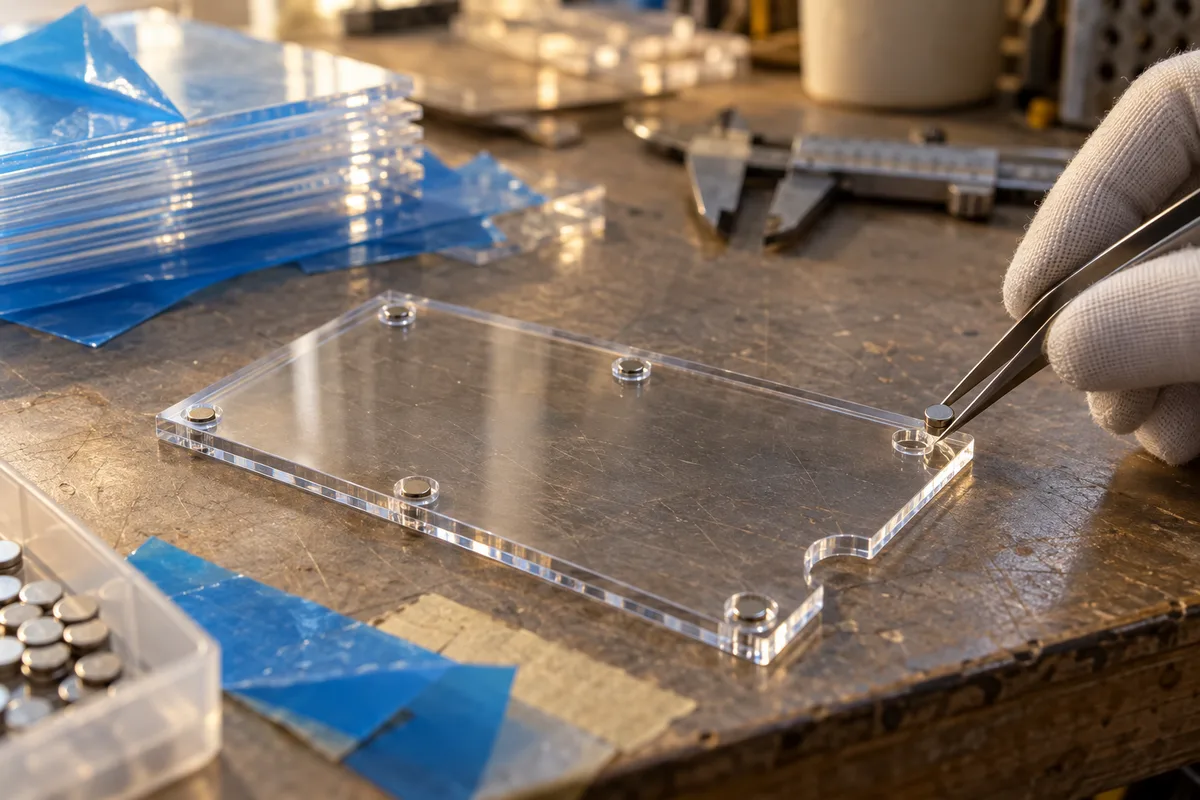
- Magnets sit in 1.6 mm CNC pockets machined into the mating faces, bonded flush under a 0.4 mm acrylic skin — no surface bumps to snag prints, and a consistent clamp gap on every frame.
- Opposing-polarity pairs make the layers self-align as they close, which is what lets a booth attendant swap a print in about two seconds during a live event.
- The first sample used four corner pairs; a live-event trial by the client’s crew showed 4×6 prints curling along the long edge, so two mid-edge pairs were added before production.
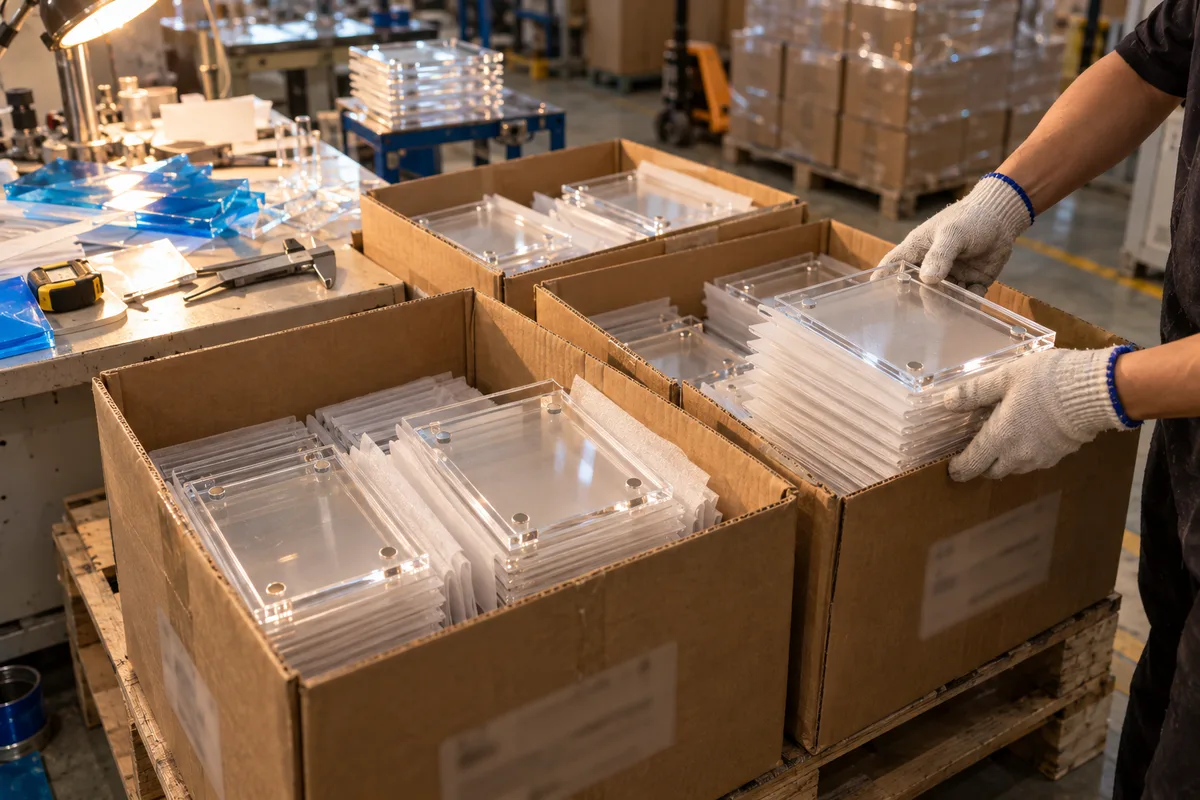
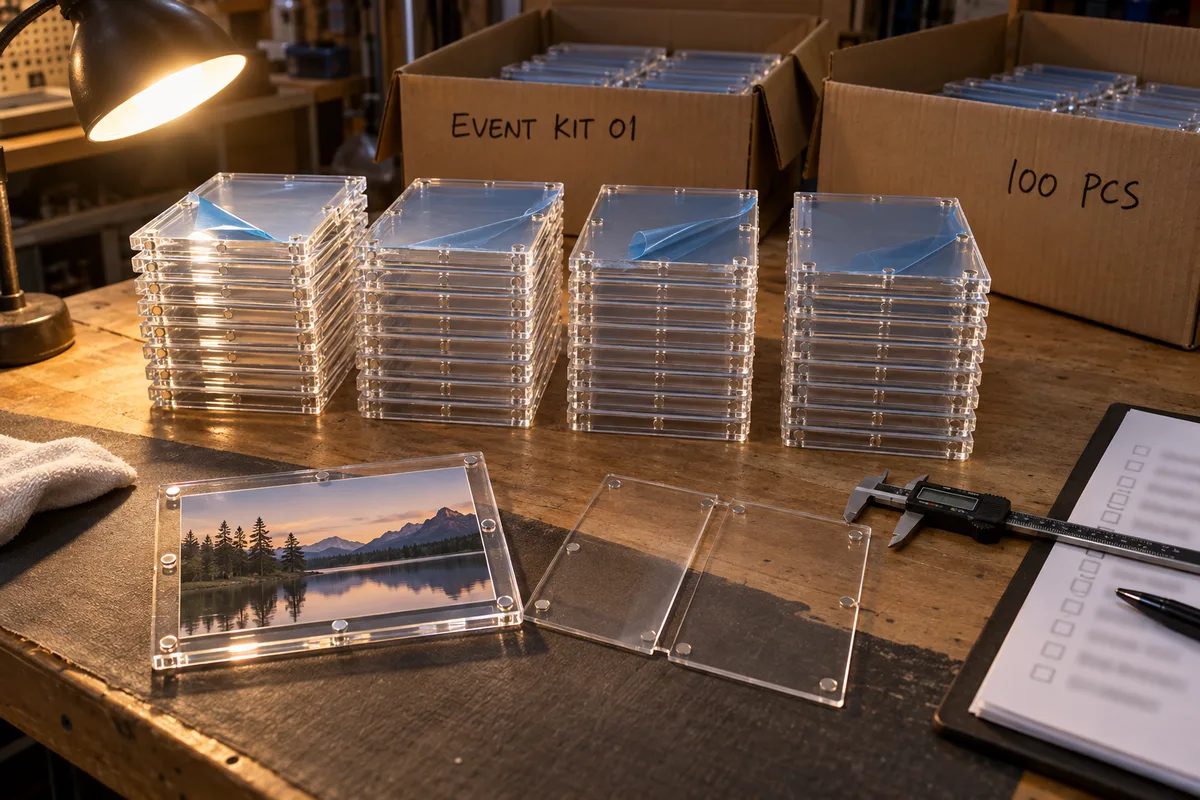
- 2,000 frames shipped in 16 production days, every frame inspected, packed 100 per carton as four 500-unit event kits; a 3,000-unit reorder followed at month 3 for wedding season.
The Challenge
A busy photo-booth line moves on roughly a ninety-second beat: pose, print, hand over, next group. The client — a US events company running booths at weddings, galas, and brand activations — wanted to upgrade the hand-over moment from a bare 4×6 print to a framed keepsake the guest carries out. The frame had to survive a handbag, look like a gift rather than a promo item, and above all not slow the line down.
That last constraint is where their first attempt failed. The off-the-shelf magnetic frames they trialed came in two flavors of wrong. The weak ones let the two layers shear sideways in a bag, so guests got home to a print that had slid half out of register. The strong ones needed two hands and a fingernail fight to open — attendants fumbled them under time pressure, and a few guests creased their prints prying the layers apart.
The brief we received was refreshingly concrete: a frame an attendant can load in a couple of seconds, a guest can open one-handed, and a bag ride cannot misalign. Quantity 2,000, delivered before their four headline summer events.
Our Approach
We built the frame as a 2+2 mm sandwich: two CNC-cut clear acrylic layers, 130 × 180 mm, holding a standard 4×6 print between them. Everything that matters lives in the magnet system — how strong, how many, and how they sit in material this thin.
Magnet strength is a two-force problem
Magnets resist a straight pull far better than a peel, and the frame design leans on that asymmetry. Against shear — the layers sliding across each other, which is how a print goes crooked in a handbag — the six pairs act together and hold firm. Against a peel started at one corner, only the nearest pair resists at first, so the frame opens with one thumb. We cut a 12 mm chamfered notch into one corner of the front layer to give that thumb an obvious place to start.
| Magnet option | Behavior in a 2+2 mm frame | Verdict |
|---|---|---|
| Ø5 × 1 mm N35, 4 pairs | Layers shear in a bag; print slides out of register | Too weak |
| Ø5 × 1.5 mm N42, 6 pairs | Holds shear; peels open one-handed from the corner notch | Chosen |
| Ø8 × 3 mm N52, 4 pairs | Needs two hands to open; too thick to pocket flush in a 2 mm layer | Too strong |
The chosen pair is deliberately smaller than our house default: the standard corner spec on our magnetic-frame product line is typically a 6 mm N52 disc, sized for thicker layers, and this 2+2 mm build downsized to Ø5 × 1.5 mm N42 pairs so the pocket could stay inside a 2 mm skin.
Flush pockets, not surface-glued discs
In a sandwich this thin there is nowhere to hide a magnet, so each 2 mm layer gets a 1.6 mm-deep pocket machined into its mating face, and the disc is bonded flush inside it — a 0.4 mm acrylic skin covers the magnet, and nothing stands proud of the surface. Surface-glued discs, the shortcut on cheaper frames, snag the print on the way in, hold the layers apart by their own thickness, and shear off eventually. Pocketed discs also fix the clamp gap by geometry, so all 2,000 frames close with the same force.
The pairs are set in opposing polarity, which gives the frame its best trick: as the layers come within a few millimeters, they pull themselves into register. An attendant does not align the frame — the frame aligns itself. That self-seating action is what makes a two-second photo swap realistic at event pace, and it is a property worth asking any supplier to demonstrate on a sample before committing to magnetic photo frames at volume. Our magnetic picture frame buyer's guide walks through the same checks in supplier-agnostic terms.
The sample round changed the count. Our first sample carried four corner pairs — the standard layout. The client's crew took it to a live event weekend and came back with one observation: 4×6 prints curled along the unsupported long edge, lifting the front layer just enough to notice. We added two mid-edge pairs, re-sampled in three days, and the curl was gone. Six pairs per frame, 24,000 pocketed magnets across the order.
The Results
All 2,000 frames cleared pre-shipment inspection and shipped in 16 production days as four 500-frame event kits, packed 100 per carton so a single crew member can load a venue drop without equipment.
The reorder is the verdict that counts. After the four summer events, the client booked the frame into their wedding-season packages and placed a 3,000-unit reorder at month 3. Because the cutting files and pocket program were already on file — and CNC-cut acrylic carries zero tooling fees — the reorder skipped sampling and priced the same as the first run. For an events business, a giveaway that guests photograph on their own fridges afterward is marketing that outlives the event; the frame just has to not fumble on the night.
"At three hundred guests a night, a frame that needs two hands is a queue. These pull themselves square when the layers get close, so our attendants stopped fiddling entirely. And the corner notch means nobody creases a print getting it open — that was our real fear with magnets this firm."
What This Means for Your Project
If your product includes embedded magnets — frames, closures, mounting systems — the questions that separate a working part from a returned one are all mechanical: how deep can the pocket go in your wall thickness, does anything stand proud of a mating surface, and is the magnet sized for the force direction that actually occurs in use rather than the biggest number on a datasheet? Those answers come out of a sample in the field, which is why the live-event trial in this project was worth more than any spec sheet revision.
The event-kit structure travels well beyond photo booths: conference organizers, wedding planners, and brand-activation agencies all consume framed keepsakes in batches of 500+ per date, and a frame this thin packs 100 to a carton without protective casework. Send us your print size and your event calendar through our custom acrylic fabrication process, and the magnet layout, notch position, and kit packing come back as a sample you can put in an attendant's hands.
Common Questions
How strong should the magnets in an acrylic photo frame be?
Strong enough that the two layers cannot shear sideways and let the print slide, weak enough that one hand can peel the frame open from a corner without creasing the photo. Those are two different forces — magnets resist a straight pull far better than a peel — which is what makes the balance findable. On this frame, six Ø5 × 1.5 mm N42 disc pairs hold a 4×6 print flat and immobile, yet the frame opens one-handed from a 12 mm chamfered thumb notch.
How are magnets embedded in a thin acrylic sandwich frame?
Each 2 mm layer gets a 1.6 mm-deep pocket CNC-machined into its mating face, and the disc magnet is bonded flush inside it, leaving a 0.4 mm acrylic skin over the magnet. Nothing sits proud of the surface, so prints slide in without snagging and the clamp gap stays identical on every frame. The pairs are set in opposing polarity, which makes the two layers self-align as they close — the property that turns a photo swap into a two-second action instead of a fiddle.
What lead time should an events company plan for a 2,000-frame order?
This order ran as a 4-day first sample, a 3-day revision sample after the client's crew trialed it at a live event, and a 16-day production run — inside the standard 15–20 day window — on 30% deposit with the balance paid before shipment. Because the cutting files and pocket program stay on file and CNC work carries zero tooling fees, the month-3 reorder of 3,000 units skipped sampling entirely and went straight to production.
Planning event keepsakes at batch volume?
Send us your print size, your per-event quantities, and a reference photo — we'll come back with a magnet layout, a sample plan, and a quote.
Sample in 3–5 days · Production in 15–20 days · MOQ 100 pieces per design · Zero tooling fees