Acrylic Coffee Table Hospitality Spec — A Designer's Guide
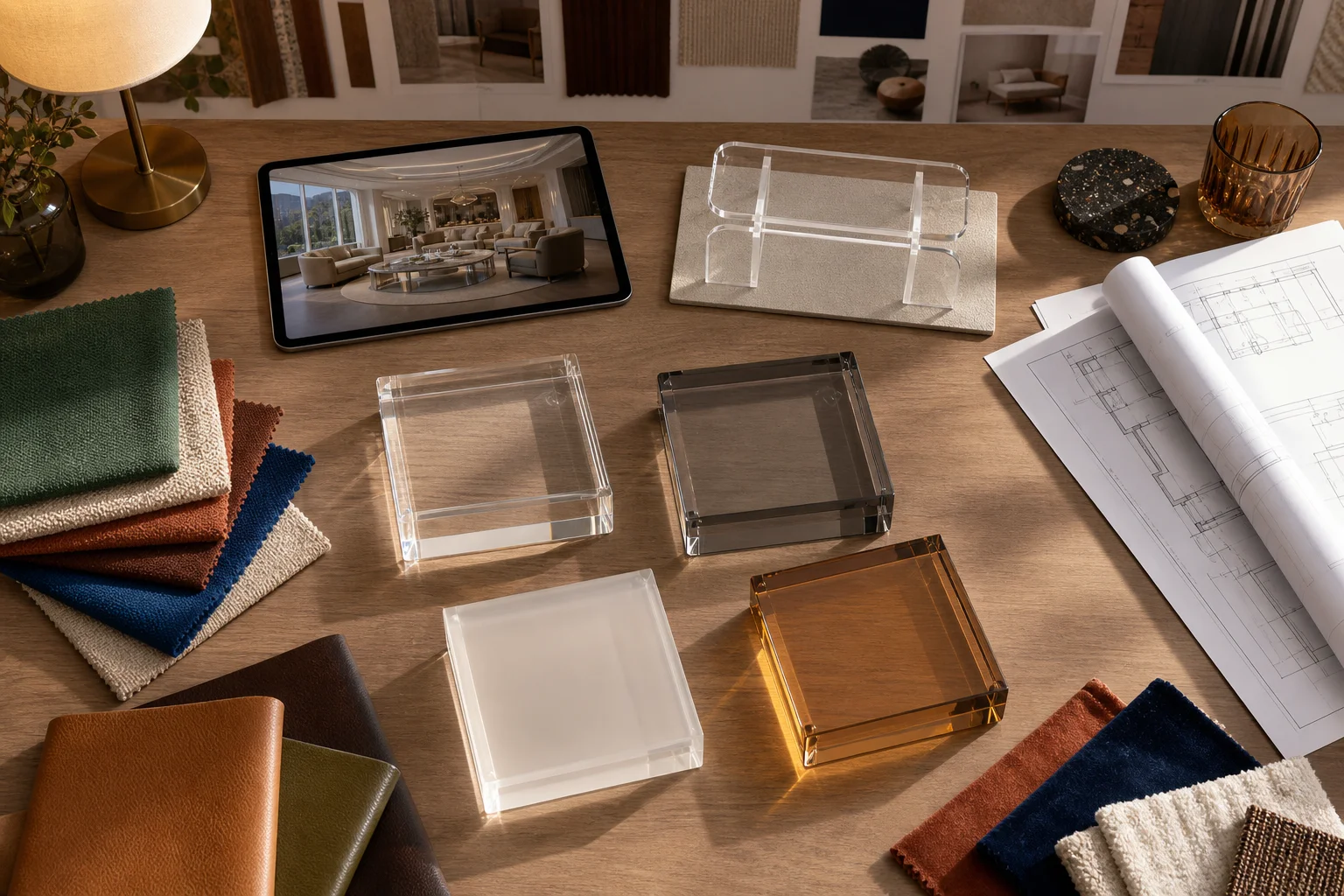
When a designer walks into our inquiry process, they usually have a mood board and a deadline. What they rarely have is a material spec.
Need this made?Custom acrylic furniture →
This guide bridges that gap.
Key Takeaways
- Every acrylic coffee table spec resolves to 5 decisions: shape (rectangular/round/freeform), top thickness (12-25 mm), edge profile (flame/diamond/beveled), base type (waterfall/pedestal/legs), and tint (clear/smoke/bronze/custom).
- Span-and-load math: a 1,200 mm clear-span acrylic top needs 15 mm minimum thickness at 50 kg center load with a 2x safety factor — designers who skip this step get deflection complaints after install.
- Custom acrylic furniture ships in 15-20 days from approved brief to crated delivery — vs 6-10 weeks for custom wood or glass, giving designers a deadline advantage on tight hospitality schedules.
- Against tempered glass, acrylic weighs half as much (about 13 kg vs 28 kg for a 1,200 x 600 x 15 mm top) and scratches more easily, but polishes back; on a 100-table order over three years, acrylic costs about 11-18% more than glass in total.
On this page
- The 5 spec decisions every designer needs to lock
- Span-and-load math designers should not skip
- Acrylic vs glass, solid surface, and wood: the material comparison
- Sofa-to-table pairing: clearance, proportion, and visual weight
- From mood board to production brief: the spec handoff
- Lead time advantage: 15-20 days custom vs 6-10 weeks
- 3 designer collaboration stories
- Putting the spec together: a reference checklist
The 5 spec decisions every designer needs to lock
Every acrylic coffee table hospitality brief resolves to five decisions: shape, top thickness, edge profile, base type, and tint. Lock all five before requesting a sample, and the production brief writes itself. Leave any one open, and the sample cycle doubles.
I walk designers through this sequence on almost every hospitality project that lands in my inbox. The order matters because each decision constrains the next. Shape determines maximum span. Span drives minimum thickness. Thickness limits which edge profiles are feasible. Base type defines structural load paths. Tint is last because it has the fewest technical constraints and the most emotional weight in the mood board conversation.
Shape: rectangular, round, or freeform
Rectangular tops (typically 1,200 x 600 mm or 1,400 x 700 mm for lobby settings) are the most common because they pair predictably with sofas and section seating. Round tops (900-1,100 mm diameter) suit clustered lounge arrangements. Freeform or organic shapes require a full-scale template or CAD file — we CNC-cut from the designer’s DXF, so the profile tolerance stays within 0.3 mm regardless of complexity.
Thickness: 12-25 mm depending on span and base
For a 4-leg base with supports near the corners, 12 mm cast acrylic handles a standard 1,200 mm top at normal hospitality loads (magazines, tablets, coffee service). For a waterfall design where the acrylic bends from top to floor with no separate base, 15-20 mm is the working range. If the base uses acrylic legs, the acrylic furniture leg load guide sets leg section by load. Unsupported clear spans above 900 mm should start at 15 mm minimum — the deflection math in the next section explains why.
Edge profile: flame, diamond, or beveled
Flame-polished edges give a soft, slightly rounded finish that reads as minimal — the default for most hospitality pieces. Diamond-polished edges produce a flat, optically clear face that catches light in a way designers often describe as “jewelry-like.” Beveled edges (typically 3-5 mm at 45 degrees) add visual depth and a deliberate design line. We can combine profiles on the same piece — beveled top edges with flame-polished bottom edges is a common spec for waterfall tables.
Base type: waterfall, pedestal, or legs
Waterfall bases are a single sheet of acrylic bent from the top surface down to the floor, creating a continuous visual line. We thermoform the bend at a controlled radius (typically 15-25 mm inside radius depending on thickness) to avoid stress whitening at the fold. Pedestal bases use a separate acrylic column or cross, solvent-bonded to the underside. Metal legs (brushed stainless, matte black powder-coated) are specified when the designer wants the top to “float” — we drill precision mounting holes at CNC tolerance and supply the hardware.
Tint: clear, smoke, bronze, or custom Pantone
Standard furniture tints follow the 100-piece furniture MOQ. Clear is the default for hospitality because it preserves visual openness in compact lobby layouts; smoke and bronze add warmth without blocking sightlines. A fully custom Pantone-matched cast color requires a dedicated mill batch. We send physical chips first so the designer can compare a standard tint with the custom-color route before sampling.
Span-and-load math designers should not skip
An acrylic coffee table top deflects under load in proportion to the cube of its unsupported span. A 1,200 mm clear-span top at 12 mm thickness will show visible flex under a 50 kg center load — enough to make a guest’s coffee cup wobble. Moving to 15 mm thickness at the same span cuts deflection by roughly half and satisfies a 2x safety factor against the BIFMA X5.5 stability standard for occasional tables.1
We use a simplified beam-deflection formula adapted for cast PMMA’s flexural modulus of approximately 3,100 MPa.2 The results for common acrylic coffee table hospitality spans:
- 1,200 mm span, 15 mm thickness, 50 kg center load: deflection stays under 2 mm — imperceptible in use.
- 1,200 mm span, 12 mm thickness, same load: deflection approaches 4-5 mm — visible and felt.
- 900 mm span, 12 mm thickness, same load: deflection under 1.5 mm — safe for most applications.
The practical rule: if the unsupported span exceeds 900 mm, start at 15 mm. If it exceeds 1,400 mm (conference-style tables), start at 20 mm and consider a center support or pedestal.
I have had designers push back on thickness because thicker acrylic looks heavier in renders. The counter-argument is simple: a coffee table that flexes under a stack of design books erodes the premium perception the designer worked to create. We always recommend running the numbers before locking thickness, and we include deflection estimates in every production brief.
Acrylic vs glass, solid surface, and wood: the material comparison
Most hotel FF&E briefs compare acrylic against tempered glass first, but the real shortlist has four materials: cast acrylic (PMMA), tempered glass, solid surface such as Corian, and hardwood such as walnut. Acrylic wins on clarity, weight, custom shapes, and lead time. It loses on scratch resistance and heat tolerance, and designers should plan for both.
| Property | Cast acrylic (PMMA) | Tempered glass | Solid surface | Hardwood (walnut) |
|---|---|---|---|---|
| Surface hardness | Rockwell M 95 | Mohs 5.5 | Barcol 60-65 | 1,010 Janka |
| Density | 1.19 g/cm3 | 2.5 g/cm3 | 1.7 g/cm3 | 0.55 g/cm3 |
| Weight, 1,200 x 600 x 15 mm top | ~13 kg | ~28 kg | ~18 kg | ~6 kg |
| Light transmission | 92% | ~90% | 0% | 0% |
| Scratch resistance | Low: micro-scratches in 6-12 months of daily use | High | Medium | Medium: dents rather than scratches |
| Repair | Polish out with micro-mesh and plastic polish | Chips and cracks are permanent | Sand and buff | Sand and refinish |
| Heat tolerance | HDT 80-100°C: coffee cup safe, hot pan not | 250°C+ | HDT 120-150°C with a trivet | Lacquer marks above about 70°C |
| Breakage | About 17x the impact resistance of glass; breaks into large dull pieces | Breaks into small granules | Cracks, does not shatter | Splits along the grain |
| Unit cost reference (FOB) | $180-280 | $150-220 | $300-450 | $350-600 |
| Custom lead time | 15-20 days | 20-30 days | 30-45 days | 6-8 weeks |
The scratch objection is valid: in a lobby where staff slide metal trays and use commercial spray twice a day, acrylic shows wear within months. In guest lounges with microfiber cleaning, a 15-minute polish per table on a regular schedule keeps it clear; our acrylic furniture cleaning guide covers the housekeeping routine. PMMA hardness data puts acrylic well below glass on the scale.3 Heat is the other limit: acrylic suits lounge coffee service, not surfaces where servers set down hot plates or cookware.
Three-year cost of ownership for a 100-table order
Unit price is where procurement teams look first, but tables replaced on three-to-five-year cycles cost more than their purchase price. This model prices one design at 100 tables, since our furniture production runs from 100 pieces per design. Each table is 1,200 x 600 x 400 mm, priced FOB Shenzhen for acrylic, glass, and solid surface, and at domestic US workshop pricing for wood. Freight, maintenance, and replacement are scaled per table from an LCL ocean estimate to a US West Coast port; a 100-table shipment may move by full container, which usually lowers the per-table freight.
| Cost component (100 tables) | Acrylic | Tempered glass | Solid surface | Hardwood (walnut) |
|---|---|---|---|---|
| Unit cost x 100 | $18,000-28,000 | $15,000-22,000 | $30,000-45,000 | $35,000-60,000 |
| Crating + shipping | $3,330-5,000 | $5,830-8,330 | $4,580-6,670 | $2,500-4,170 (domestic) |
| Maintenance, 3 years | $1,500-3,000 (quarterly polish) | $0-500 (cleaning only) | $1,000-2,000 (annual sand and buff) | $3,000-5,000 (annual refinish) |
| Replacement (est. 1 in 6 tables in 3 years) | $3,000-4,670 | $2,500-3,670 | $5,000-7,500 | $5,830-10,000 |
| 3-year total, 100 tables | $25,830-40,670 | $23,330-34,500 | $40,580-61,170 | $46,330-79,170 |
Acrylic lands about 11-18% above glass over three years. Acrylic’s higher unit price is partly offset by half the shipping weight (about 1,400 kg vs 2,800 kg for 100 tables) and by polishing out surface damage instead of replacing the table. Solid surface runs about 50-57% above acrylic, and custom wood about 1.8-1.9x.
Sofa-to-table pairing: clearance, proportion, and visual weight
The height and proportion relationship between a sofa and an acrylic coffee table determines whether the table looks intentional or afterthought. Three dimensions matter: table height relative to sofa seat, gap between table edge and sofa front, and the visual weight ratio between the two pieces.
Height: 380-420 mm, always below the sofa seat
Standard hospitality sofa seat height runs around 430 mm. The acrylic coffee table should sit 10-50 mm below that line — high enough for comfortable reach, low enough that the table does not visually compete with the seating. A 400 mm table height is the most common spec we produce for hotel lobbies and lounge areas. Going below 380 mm starts to feel like a side table; above 420 mm and guests feel they are eating at a dining surface.
Horizontal clearance: 450-600 mm
The gap between the front edge of the sofa and the nearest edge of the coffee table needs to be 450-600 mm for comfortable seated access without forcing guests to lean forward. Below 450 mm, guests feel crowded. Above 600 mm, the table is too far to reach from a natural seated position. We confirm this dimension on every hospitality layout by asking designers to mark the sofa footprint and table footprint on their floor plan.
Visual weight: acrylic’s advantage
Clear acrylic reads as “lighter” than wood, stone, or metal at the same dimensions. A 1,200 x 600 mm clear acrylic coffee table occupies the same physical footprint as its wood equivalent but contributes roughly a third of the visual weight. This lets designers use a proportionally larger table in compact hospitality spaces — lobbies, executive lounges, boutique hotel living rooms — without the room feeling crowded. Smoke or bronze tints add some visual mass back, which is useful when the surrounding furniture is light-colored and the table needs anchoring presence.
From mood board to production brief: the spec handoff
The gap between a designer’s mood board and a manufacturer’s production brief is where most acrylic coffee table projects stall. A mood board communicates intent — material feel, color palette, spatial mood. A production brief communicates specifications — exact dimensions, thickness, edge profile, tint code, base construction, hardware, finish, quantity, and delivery date.
We bridge that gap in a structured intake sequence that takes 2-3 email exchanges over 3-5 days:
- Designer sends mood board + floor plan + rough dimensions. We review and ask clarifying questions about load expectations, seating layout, and any brand-color requirements.
- We return a spec recommendation covering all five decisions (shape, thickness, edge, base, tint) with specific values, a deflection estimate for the proposed span, and a unit price range at the target quantity.
- Designer confirms or revises. Once locked, we produce a physical sample in 3-5 days. The sample goes to the designer for material feel, edge quality, and tint approval.
- Sample approved, production begins. 15-20 days to crated delivery, FOB Shenzhen. We send progress photos at the polishing and assembly stages.
I coordinate this process for every custom furniture project that comes through our team. Maybe 50 projects across six-plus years of handling these have arrived with a first brief that was production-ready without a single clarifying question. The other 450+ needed at least one round of “what thickness do you actually need for this span?” or “your tint reference is a paint swatch — here is the closest acrylic match.”
The most common bottleneck is edge profile indecision. Designers often want to see flame vs diamond vs beveled on the same sample. We offer a tri-profile sample strip — a single 300 mm piece with all three edge finishes — so the designer can compare side by side without ordering three separate samples.
Lead time advantage: 15-20 days custom vs 6-10 weeks
Custom acrylic coffee tables ship in 15-20 days from approved production brief to crated delivery at our 5,000 m2 facility in Shenzhen. Sample pieces ship in 3-5 days. This compares to 6-10 weeks for custom wood furniture (kiln-drying, joinery, finishing) and 4-6 weeks for custom tempered glass (tempering queue, edge processing, crating).
For hospitality projects with fixed opening dates, the difference between 15 days and 6 weeks is often the difference between meeting the FF&E install window and missing it. I have worked on multiple hotel lobby projects where the designer switched from a wood coffee table spec to acrylic specifically because the wood supplier could not deliver before the soft-opening date.
Our production timeline breaks down as follows:
- Days 1-2: Material sourcing and sheet cutting (CNC or laser, depending on shape complexity).
- Days 3-7: Thermoforming (waterfall bases), bonding (pedestal and leg assemblies), drilling (mounting hardware).
- Days 8-12: Edge polishing — diamond polishing for optical clarity runs 3-4 days; flame polishing completes in 1-2 days.
- Days 13-15: Assembly, 100% inspection, custom crating for freight.
- Days 16-20: Buffer for any revision or rework. Most orders ship by day 17.
For rush projects, we can compress the timeline to 10-12 days at standard pricing — no rush surcharge — if the production line has capacity. We communicate real-time slot availability at the quote stage so designers know exactly where they stand.
3 designer collaboration stories
These are past projects, told with the quantities they ran at. Today, custom acrylic furniture production runs from 100 pieces per design.
Story 1: Boutique hotel lobby in the American Southeast
A hospitality design firm in Atlanta needed 12 clear acrylic waterfall coffee tables for a boutique hotel lobby renovation. The designer sent a mood board referencing mid-century modern transparencies and a floor plan showing clustered seating with 500 mm sofa-to-table clearance. The challenge was that the original spec called for 12 mm thickness on a 1,400 mm span — our deflection estimate showed 6+ mm flex under a 50 kg load. We recommended 20 mm thickness and adjusted the thermoform bend radius to 20 mm to maintain the visual lightness the designer wanted. Sample approved in one round. All 12 tables delivered in 18 days, installed the week before the hotel’s soft opening.
Story 2: Co-working lounge in Western Europe
An interior architecture studio in the Netherlands specified 8 smoke-tinted acrylic coffee tables with metal legs for a co-working space lounge. The brief arrived with Pantone 7540 C as the tint reference — a warm medium gray. The challenge: Pantone references are paint-system colors, and the closest cast acrylic smoke tint skews cooler than 7540 C under fluorescent lighting. We sent three tint samples under both warm (3000K) and cool (5000K) lighting. The designer selected a custom tint between our standard smoke and bronze that read correctly under the co-working space’s 4000K overhead fixtures. Custom tint added 5 working days to the timeline. Total delivery: 22 days.
Story 3: Resort restaurant in Southeast Asia
A design consultancy in Singapore specified 20 bronze-tinted acrylic pedestal coffee tables for a beachfront resort restaurant lounge. The brief was clean — dimensions, tint, and base type were all locked. The challenge appeared during sample review: the solvent bond between the pedestal and the top showed a visible joint line that the designer considered unacceptable for a luxury setting. We switched from standard solvent bonding to a UV-cure optical adhesive that produces a near-invisible joint at PMMA-to-PMMA interfaces. The revised sample passed. All 20 tables delivered in 19 days, each individually crated with corner foam for international air freight to the resort site.
Putting the spec together: a reference checklist
Before you send a production brief for an acrylic coffee table hospitality project, confirm these items are locked:
| Spec item | What to provide | Common range |
|---|---|---|
| Shape | DXF/CAD file or dimensioned sketch | Rectangular 1,200 x 600 mm / Round 900-1,100 mm dia |
| Top thickness | Confirmed after span-and-load review | 12-25 mm cast PMMA |
| Edge profile | Flame / diamond / beveled / combination | Diamond most common for hospitality |
| Base type | Waterfall / pedestal / metal legs | Specify bend radius or leg material |
| Tint | Clear / smoke / bronze / custom Pantone | Custom color needs a dedicated mill batch |
| Quantity | Per table design, with tier pricing | MOQ 100 pieces per design |
| Delivery date | Hard deadline or flexible window | 15-20 days standard production |
| Crating spec | Standard or custom for air freight | Air freight requires corner foam + double-wall |
For your next hospitality acrylic furniture project, send your mood board, floor plan, and this checklist to our team. We respond within 24 hours with a spec recommendation and unit pricing.
If you are still comparing materials, the four-material comparison above covers hardness, weight, heat, and three-year cost. For tables, consoles, and other pieces we build, browse our custom acrylic furniture range. And for a real-world example of a multi-piece hospitality rollout, read our boutique hotel lobby case study.
Explore our custom acrylic furniture line for coffee-table sizes and customization options.
Footnotes
-
BIFMA X5.5 — Desk/Table Products Test Standard — defines stability and structural requirements for occasional tables, including center-load and edge-load test protocols. ↩
-
Cast PMMA flexural modulus (ASTM D638 / D790) — AZoM PMMA cast-sheet data — materials reference listing cast PMMA flexural modulus at 3.1 GPa (≈3,100 MPa) and tensile strength at 72 MPa, the property data used to calculate acrylic deflection under load. ↩
-
Acrylic Rockwell hardness M80–M100 (Rockwell M scale), measured per ASTM D785 — acrylic-PMMA property datasheet showing the Rockwell M-scale hardness range that brackets the M 95 rating used in the material comparison. ↩
Frequently Asked Questions
How do interior designers specify custom acrylic coffee tables?
A complete spec includes five decisions: shape (rectangular, round, or freeform), top thickness (12-25 mm depending on span), edge profile (flame-polished for minimal look, diamond-polished for optical clarity, beveled for visual depth), base type (waterfall, pedestal, or legs), and tint (clear, smoke, bronze, or custom Pantone match). We walk designers through each decision during the inquiry process.
How thick should an acrylic coffee table top be?
For a standard 1,200 x 600 mm coffee table with 4-leg support, 12 mm is the minimum. For a waterfall design with no separate base, 15-20 mm is typical. Unsupported spans over 900 mm need 15 mm minimum at 50 kg center load. We calculate specific thickness recommendations based on the designer's dimensions and expected load.
How long does it take to make a custom acrylic coffee table?
15-20 days from approved production brief to crated delivery at our Shenzhen facility. Sample pieces ship in 3-5 days. This compares to 6-10 weeks for custom wood furniture and 4-6 weeks for tempered glass — a significant advantage when designers are working to a hotel opening deadline.
Can acrylic coffee tables be color-matched to a brand palette?
Yes. The furniture MOQ is 100 pieces per SKU for standard tints such as clear, smoke, bronze, and opal white. A fully custom Pantone-matched cast color requires a dedicated mill batch and adds material cost and lead time. We send physical color chips before production so the designer can compare a standard tint with the custom-color route.
Have specs in hand? Get a quote for your specific project.
Send us your drawings, reference photos, or a description of what you're making. We reply within 24 hours with a material recommendation, thickness, fabrication method, and a per-unit quote.