Acrylic vs Glass Coffee Table for Hotels — 4 Materials
A hotel purchasing director told us: 'I love the look of acrylic, but my GM is worried about scratches. Convince me.' Here is the honest answer.
Key Takeaways
- Acrylic weighs 50% less than glass at the same dimensions — a 1,200×600mm acrylic coffee table weighs ~14 kg vs ~28 kg in tempered glass, making multi-property rollouts cheaper to ship.
- Acrylic loses on scratch resistance: Rockwell M 95 vs tempered glass Mohs 5.5. For high-traffic hotel lobbies with daily housekeeping, this is the most common objection — and it's valid.
- Total cost of ownership at 12 pieces over 3 years (purchase + shipping + maintenance): acrylic and glass are within 8% of each other. Solid surface costs 40-60% more. Custom wood costs 2× but carries perceived luxury value.
On this page
- The 4 materials hospitality buyers actually choose between
- Property comparison — hardness, weight, repairability, UV, cost
- When acrylic wins — visual lightness, customization speed, branding integration
- When acrylic loses — scratch resistance, perceived luxury, heat tolerance
- 3 hospitality scenarios — which material fits each
- Total cost of ownership at 12-piece rollout
- How to decide — matching material to your project brief
The 4 materials hospitality buyers actually choose between
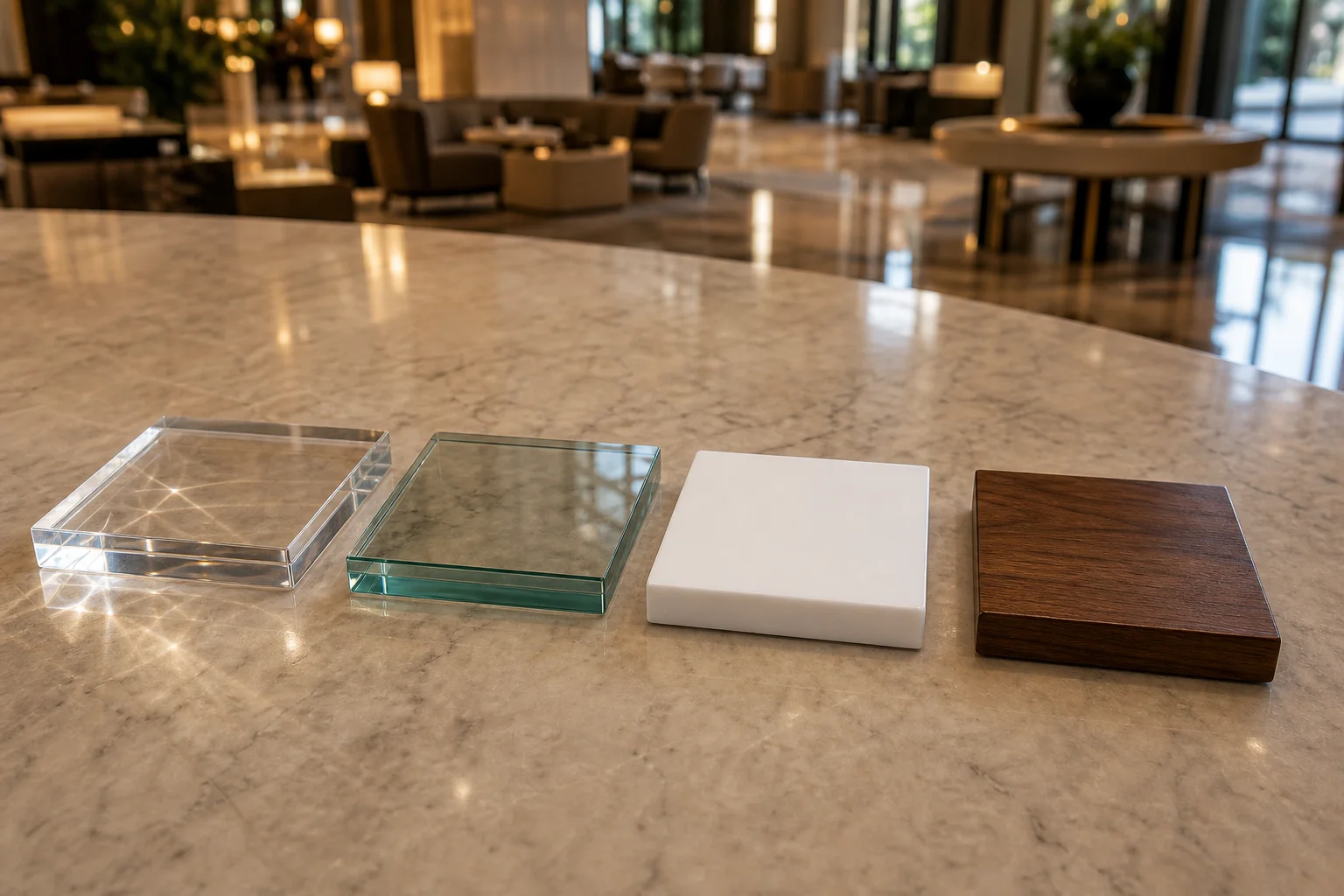
The acrylic vs glass coffee table debate is the starting point for most hotel FF&E buyers — but the real decision involves four materials, not two. Cast acrylic (PMMA), tempered glass, solid surface (Corian or equivalent), and hardwood (typically walnut or oak) each win in different scenarios. The honest comparison starts with understanding what each material actually is — and what it is not.
A hotel purchasing director in Dallas sat across from me at NeoCon last year and said exactly what the subhead quotes. His GM had seen micro-scratches on an acrylic console after 8 months and vetoed acrylic for the lobby refresh. I did not try to convince him acrylic was scratch-proof — because it is not. Instead, I walked through the full 4-material picture. By the end, he specified acrylic for the guest lounge and glass for the lobby. That is the outcome a fair comparison should produce: each material in the space where it performs best.
Cast acrylic is a thermoplastic (polymethyl methacrylate, PMMA) with 92% light transmission, a density of 1.19 g/cm3, and a Rockwell hardness of M 95.1 Tempered glass is a heat-treated soda-lime silicate with Mohs hardness around 5.5 and density of 2.5 g/cm3. Solid surface is a filled acrylic or polyester composite — Corian’s Barcol hardness is 60-65, density around 1.7 g/cm3. Hardwood varies by species, but walnut runs about 1,010 Janka and 0.55 g/cm3.
Your procurement team likely has opinions about all four. The job of this guide is to give you the data to back those opinions up — or to change them.
Property comparison — hardness, weight, repairability, UV, cost
The most useful comparison for a hospitality buyer is a head-to-head property table covering the six dimensions that actually drive a purchasing decision: surface hardness, weight per unit, repairability in the field, UV stability, unit cost at hospitality volume, and production lead time.
| Property | Cast Acrylic (PMMA) | Tempered Glass | Solid Surface (Corian) | Hardwood (Walnut) |
|---|---|---|---|---|
| Surface hardness | Rockwell M 95 | Mohs 5.5 (~Rockwell M 400+) | Barcol 60-65 | 1,010 Janka |
| Density | 1.19 g/cm3 | 2.5 g/cm3 | 1.7 g/cm3 | 0.55 g/cm3 |
| Weight (1,200x600x15mm top) | ~14 kg | ~28 kg | ~18 kg | ~6 kg |
| Scratch resistance | Low — daily use creates micro-scratches | High — resists most abrasion | Medium — resists light abrasion | Medium — dents, does not scratch clean |
| Repairability | Polishable — micro-mesh + plastic polish restores clarity | Not repairable — chips and cracks are permanent | Sandable — 400-grit + buff restores surface | Refinishable — sand + re-oil or re-lacquer |
| UV stability | Excellent — UV-stabilized cast PMMA resists yellowing 10+ years | Excellent — glass does not yellow | Good — some formulations yellow after 5-7 years outdoors | Poor — direct sun bleaches and cracks finish |
| Shatter behavior | Shatters into large dull pieces (17x impact resistance of glass) | Shatters into small granules (safety glass) | Does not shatter — cracks propagate slowly | Does not shatter — splits along grain |
| Heat tolerance | HDT 80-100°C — coffee cup safe, hot pan risky | 250°C+ — effectively heat-proof for hospitality | HDT 120-150°C — hot pot safe with trivet | Depends on finish — lacquer marks above 70°C |
| Unit cost (FOB, 12 pcs) | $180-280 | $150-220 | $300-450 | $350-600 |
| Lead time (custom, 12 pcs) | 15-20 days | 20-30 days | 30-45 days | 6-8 weeks |
The weight difference is the single largest logistical variable. At 12 pieces, acrylic ships at roughly 168 kg total vs 336 kg for glass — that is a meaningful freight cost difference on air or LCL ocean. For multi-property rollouts across 3-5 locations, the shipping delta alone can offset the per-unit acrylic premium. That is how the 54-piece boutique hotel furniture program penciled out across its lobby, poolside, and guest-room phases.
When acrylic wins — visual lightness, customization speed, branding integration
Acrylic is the strongest choice when the design brief prioritizes visual lightness, fast turnaround, or brand-integrated custom shapes. In hotel and restaurant projects where the furniture must feel invisible — letting the architecture or decor carry the room — acrylic coffee tables create that effect in a way no other material can match.
The optical clarity advantage is not marginal. Cast PMMA transmits 92% of visible light, compared to roughly 90% for standard tempered glass and 0% for solid surface or wood. In a lobby with a statement rug or terrazzo floor, an acrylic coffee table lets the floor design read through the table surface. I have had interior designers tell me the acrylic table “disappeared” in the room — and that was exactly what they wanted.
Customization speed is where acrylic pulls ahead for hospitality rollouts on a deadline. We produce custom acrylic coffee tables in 15-20 days from approved drawings. Tempered glass with custom shapes, rounded corners, or edge polishing takes 20-30 days. Solid surface runs 30-45 days. Custom wood furniture from a reputable shop takes 6-8 weeks minimum. When an FF&E buyer needs 12 coffee tables for a soft opening in 5 weeks, acrylic is often the only material that fits the calendar.
Branding integration is the third advantage. Acrylic accepts UV printing, silk-screen printing, laser engraving, and embedded elements (LED strips, colored interlayers, metallic films). We have built coffee tables with a hotel’s logo subtly embedded in the table surface — visible at certain angles, invisible at others. You cannot do that with glass or wood without adding a secondary material.
When acrylic loses — scratch resistance, perceived luxury, heat tolerance
Acrylic loses on three properties that matter in specific hospitality contexts: surface scratch resistance, perceived material luxury, and heat tolerance. If your project hits any of these three scenarios hard, acrylic is the wrong choice — and we will tell you that directly.
Scratch resistance is the most common and most valid objection. Cast acrylic’s Rockwell M 95 hardness means it is significantly softer than tempered glass (Mohs 5.5, roughly equivalent to Rockwell M 400+). In a hotel lobby where housekeeping drags a metal tray across the table surface daily, acrylic will develop visible micro-scratches within 6-12 months. Glass in the same environment stays pristine for years. The trade-off: acrylic scratches can be polished out with 1500-grit micro-mesh and a plastic polish compound — a 15-minute maintenance task per table. Glass scratches are rare, but glass chips and cracks are permanent and unrepairable. You cannot polish a chip out of tempered glass.
Perceived luxury is subjective but commercially real. In a 5-star hotel lobby where guests expect weighty, substantial furnishings, a 14 kg acrylic table can feel insubstantial compared to a 28 kg glass table or a 6 kg but visually warm walnut table. The lightness that makes acrylic ideal for modern design-forward spaces works against it in traditionally luxurious settings. I have learned not to fight this perception — if the brand identity is classic luxury, recommend wood or glass and save acrylic for the spaces where its visual lightness is an asset, not a liability.
Heat tolerance is a real constraint for restaurant use. PMMA has a heat deflection temperature (HDT) of 80-100°C. A standard coffee cup at 60-70°C is safe. A hot cast-iron skillet or a teapot fresh from boiling will leave a mark. For hotel coffee tables in a lobby lounge, this is rarely an issue — guests use cups, not cookware. For restaurant dining tables where servers place hot plates directly, acrylic is not the right material. Solid surface (HDT 120-150°C with a trivet) or glass (250°C+ tolerance) handles restaurant heat loads without risk.
3 hospitality scenarios — which material fits each
The right material depends on the space, the traffic pattern, and the brand positioning. Three real scenarios from projects we have worked on illustrate how the decision plays out.
Scenario 1: Boutique hotel guest lounge — acrylic wins
A 45-room boutique hotel in the American Southwest needed 8 coffee tables for a guest lounge with polished concrete floors and desert-palette soft furnishings. The designer wanted the tables to vanish visually. Traffic was moderate — guests, not staff, used the space. Housekeeping touched the tables once daily with a microfiber cloth.
We specified 15mm cast acrylic, diamond-polished all edges, 1,200x600x400mm waterfall design. The tables arrived in 18 days. Total project cost for 8 tables including shipping: under $2,800. The designer later told us the acrylic tables were the single most-complimented element in the lounge — guests kept asking if the tables were “actually there.”
Scenario 2: Full-service hotel lobby — glass wins
A 200-room business hotel in a major metro area was replacing 12 lobby coffee tables. The lobby saw 400+ daily foot-traffic passes. Bell staff regularly placed metal luggage carts near the furniture. Housekeeping used commercial cleaning spray and paper towels twice daily.
In this environment, we recommended tempered glass over acrylic. The daily abrasion from commercial cleaning and incidental contact with metal objects would have degraded acrylic surfaces within months. Glass at $150-220 per unit was also 15-30% less expensive at the piece level. The hotel went with 12mm tempered glass on brushed steel frames.
Scenario 3: Resort restaurant — solid surface wins
A beachfront resort needed 6 coffee-height tables for an outdoor restaurant terrace. The tables would face direct sun for 4-6 hours daily, salt air, and hot plate service. Guests set down hot coffee pots and occasionally rested wet towels on the surface.
Neither acrylic nor glass was the right call. Acrylic’s HDT of 80-100°C made hot plate service risky. Glass would need heavy frames to resist wind gusts on an open terrace. We recommended solid surface (Corian or equivalent) — higher cost at $300-450 per unit, but the combination of heat tolerance, UV resistance, salt-air durability, and on-site repairability made it the practical choice for this specific environment.2
Total cost of ownership at 12-piece rollout
When procurement teams compare an acrylic vs glass coffee table, unit price is the number they fixate on. But for hospitality furniture replaced on 3-5 year cycles, the total cost of ownership — purchase, shipping, installation, maintenance, and end-of-life — tells a different story.
We modeled a 12-piece coffee table rollout (1,200x600x400mm, custom to spec) across all four materials. The numbers below assume FOB Shenzhen pricing for acrylic, glass, and solid surface, and domestic US workshop pricing for custom wood. Shipping is estimated at LCL ocean to a US West Coast port.
| Cost component | Acrylic | Tempered Glass | Solid Surface | Hardwood (Walnut) |
|---|---|---|---|---|
| Unit cost x 12 | $2,160-3,360 | $1,800-2,640 | $3,600-5,400 | $4,200-7,200 |
| Crating + shipping (LCL) | $400-600 | $700-1,000 | $550-800 | $300-500 (domestic) |
| Annual maintenance x 3 years | $180-360 (quarterly polish) | $0-60 (cleaning only) | $120-240 (annual sand+buff) | $360-600 (annual refinish) |
| Replacement (est. 2 units / 3 yr) | $360-560 | $300-440 | $600-900 | $700-1,200 |
| 3-year TCO (12 units) | $3,100-4,880 | $2,800-4,140 | $4,870-7,340 | $5,560-9,500 |
Acrylic and glass land within 8-15% of each other on total cost of ownership. The acrylic premium on unit price is offset by lower shipping weight (168 kg vs 336 kg for 12 units) and the ability to polish out surface damage rather than replacing units. Solid surface costs 40-60% more than acrylic, driven by higher unit cost and longer lead times. Custom wood costs roughly 2x acrylic — justified when the project demands the warmth and perceived luxury that only real wood delivers.
Lead time comparison
For multi-property rollouts where the same table design ships to 3-5 locations, lead time compounds. A 6-8 week wood lead time means the last property might not receive tables until 10-12 weeks after the order. Acrylic’s 15-20 day production window, even with staggered shipping, delivers all locations within 4-5 weeks.
| Material | Production | Crating | Transit (ocean to US West Coast) | Total to first delivery |
|---|---|---|---|---|
| Acrylic | 15-20 days | 2-3 days | 18-22 days | 35-45 days |
| Tempered glass | 20-30 days | 3-5 days | 18-22 days | 41-57 days |
| Solid surface | 30-45 days | 3-5 days | 18-22 days | 51-72 days |
| Hardwood | 6-8 weeks | included | domestic 5-10 days | 47-66 days |
How to decide — matching material to your project brief
The decision framework is simpler than the data above suggests. Answer three questions about your project, and the material choice narrows to one or two options.
Question 1: Is visual transparency or lightness a design requirement? If yes, your choices are acrylic or glass. Solid surface and wood are opaque. If the design requires the table to “disappear,” acrylic is the only option — glass still has visible green-tinted edges on thick panels.
Question 2: Will the surface face daily abrasion from metal objects, commercial cleaning chemicals, or high-frequency staff contact? If yes, glass outperforms acrylic on surface durability. If the environment is guest-only with microfiber cleaning, acrylic’s scratch risk is manageable with monthly polishing.
Question 3: Does the space require heat tolerance above 80°C or outdoor UV/salt exposure? If yes, solid surface or glass. Acrylic and lacquered wood both have HDT limitations in direct-heat or harsh-weather environments.
If you have walked through these three questions and still cannot decide, send us your project brief. We will tell you which material we recommend — even when the answer is not acrylic. We have specified glass, solid surface, and wood for hotel clients when those materials fit the brief better. The goal is a table that performs for 3+ years in your specific environment, not a material sale.
For more on custom acrylic furniture specifications, see our design principles guide. If you are specifically evaluating acrylic for display applications rather than furniture, our acrylic vs glass displays comparison covers the display-specific trade-offs. And for projects where acrylic coffee tables are the right fit, our acrylic coffee tables product page has spec sheets and gallery images from completed hospitality projects.
For hospitality projects that extend from furniture into room identification or corridor directories, treat signage as a separate engineering package. Our wall-mounted sign holder page covers mounting substrates, insert formats, and artwork-change requirements.
Footnotes
-
Acrylic Rockwell hardness M80–M100 (Rockwell M scale), measured per ASTM D785 — acrylic-PMMA property datasheet showing the Rockwell M-scale hardness range that brackets the M 95 rating used throughout this comparison. ↩
-
BIFMA X5.5 — Desk/Table Products Tests — the stability, structural integrity, and durability standard for commercial furniture including hospitality coffee tables. ↩
Frequently Asked Questions
Is acrylic or glass better for hotel coffee tables?
It depends on the priority. Acrylic wins on weight (50% lighter), customization speed (15-20 days vs 6-8 weeks), and shatter safety. Glass wins on scratch resistance and perceived luxury. For high-traffic lobbies with daily cleaning, glass or solid surface may be more practical. For design-forward spaces where visual lightness matters, acrylic is the better choice.
Do acrylic coffee tables scratch easily in hotels?
Yes — acrylic is softer than glass (Rockwell M 95 vs Mohs 5.5). Daily use with coasters, trays, and cleaning creates micro-scratches over 6-12 months. The trade-off: acrylic scratches can be polished out with micro-mesh and plastic polish, while glass chips and cracks are permanent. Hotels that maintain acrylic furniture on a monthly polishing schedule report 3+ year lifespans.
How much does a custom acrylic coffee table cost vs glass?
At a 12-piece hospitality rollout, custom acrylic coffee tables (1,200×600×400mm, 15mm cast, diamond-polished) run $180-280 per unit FOB. Tempered glass of equivalent dimensions runs $150-220 per unit. The acrylic premium is 15-30%, offset by lower shipping cost (lighter) and faster lead time.
Can acrylic furniture handle hot beverages?
PMMA softens at 80-100°C. A coffee cup at 60-70°C will not damage acrylic. However, placing a hot pot or pan directly on acrylic will leave a mark. For restaurant applications, we recommend coasters or trivets as standard table accessories — the same as with solid surface or lacquered wood.
Have specs in hand? Get a quote for your specific project.
Send us your drawings, reference photos, or a description of what you're making. We reply within 24 hours with a material recommendation, thickness, fabrication method, and a per-unit quote.