Cast Acrylic vs Extruded Acrylic for Display Cases
'Cast' and 'extruded' sound like minor manufacturing details. For display cases, it's the difference between museum clarity and department-store fog.
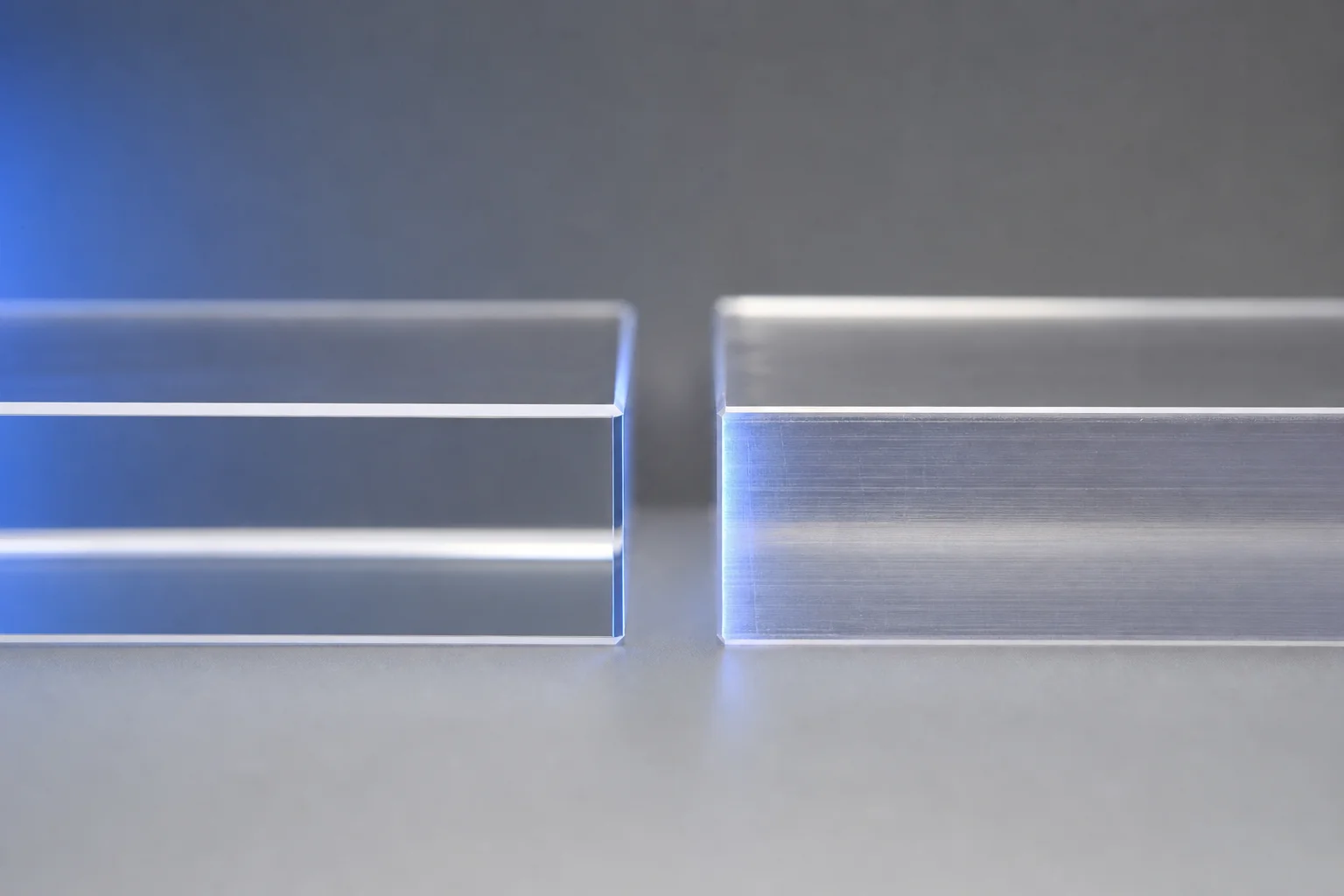
Key Takeaways
- Cast is the looser sheet on thickness, not the tighter one — a 3.0mm nominal cast sheet may legally arrive 2.3-3.7mm while extruded holds roughly ±5% above 3mm, so buy cast for edge clarity and bond strength and cut mating panels to the measured lot.
- Solvent-welded cast-to-cast joints achieve 85-90% of parent material tensile strength vs 60-70% for extruded-to-extruded — the difference between a case that survives shipping and one that cracks.
- Extruded wins on cost (30-40% less per m²) and availability — use it for internal structures, bases, and cases where edges are hidden or capped.
On this page
- How Cell-Cast Acrylic Is Made — and Why It Costs 30-40% More
- How Extruded Acrylic Is Made — and Where Cost Savings Come From
- The 4 Spec Differences That Matter for Display Cases
- Edge Quality — Why Cast Wins for Visible-Edge Cases
- Bond Strength — Solvent-Welded Joint Data for Each Grade
- Cast or Extruded — A Decision Matrix by Display Case Type
- How Wetop Selects Sheet Grade for Your Project
How Cell-Cast Acrylic Is Made — and Why It Costs 30-40% More
The debate around cast acrylic vs extruded acrylic matters more for display cases than for any other PMMA application. Cell-cast acrylic starts as liquid MMA monomer poured between two polished glass plates, then polymerized over 10-14 hours in a controlled water bath. The slow cure produces long polymer chains with molecular weight above 1,000,000 g/mol, which is the root cause of every property advantage cast holds over extruded sheet in display case fabrication.
“Cast” and “extruded” — buyers treat these as interchangeable labels on a quote sheet, the way you might gloss over “304 vs 316” on a steel spec. For display cases, the distinction runs deeper. I have rejected incoming sheet shipments on my production floor because the supplier swapped extruded for cast without disclosure, and every downstream operation — cutting, polishing, bonding — performed measurably worse. The process difference is not academic. It determines whether your finished case looks like museum glass or clouded plastic.
The glass-plate method gives cell-cast PMMA two properties that matter for display cases specifically, and neither of them is dimensional. First, optical: both faces cure against polished glass, and the high-molecular-weight sheet cuts to a clear, flame-polishable edge — the property that separates a display-grade cast sheet from a general-purpose extruded one in the ASTM D4802 classification we buy against1. Second, structural: the slow polymerization leaves minimal residual stress in the sheet, which means solvent-welded joints achieve higher bond strength because the solvent can properly craze the surface without fighting internal tension — and the same low stress is why cast shrugs off the retail cleaners and solvents that craze a stressed extruded panel in service.
What cast does not buy you is a tighter sheet. Liquid monomer shrinks unevenly as it polymerizes between the plates, so cast thickness is the looser of the two by a wide margin: manufacturer tolerance tables built on ISO 7823-1 allow a 3.0mm nominal cast sheet anywhere from 2.3 to 3.7mm, and a 12.0mm sheet from 10.4 to 13.6mm2. That is the standard working as written, not a bad lot — it just means panel thickness is something you measure on the incoming pallet rather than read off the drawing, which is where the spec section below picks the story up.
Cast sheet costs 30-40% more per square meter than extruded at equivalent thickness. For a 5-panel display case using 5mm sheet at 400mm x 300mm per panel, the raw material cost difference is roughly $8-15 per case depending on supplier. On a 500-piece production run, that adds $4,000-7,500 to material cost alone. Whether that premium is justified depends entirely on whether your application demands the tolerance, edge clarity, and bond strength that cast delivers.
How Extruded Acrylic Is Made — and Where Cost Savings Come From
Extruded acrylic is made by melting PMMA pellets at 230-260°C and forcing the molten polymer through a flat die into continuous sheet. The process runs at 1-3 meters per minute, producing far more sheet per hour than cell-casting — and that throughput advantage is where the 30-40% cost reduction comes from.
The extrusion process introduces two characteristics that affect display case performance. First, the heat-and-shear cycle degrades polymer chains, dropping molecular weight to 100,000-300,000 g/mol — roughly one-third to one-tenth of cast’s molecular weight. Lower molecular weight means the sheet is softer, scratches more easily, and produces a frosted rather than flame-polished edge under laser cutting. Second, the directional extrusion introduces residual stress aligned with the sheet direction. When you solvent-weld extruded panels, that stress interferes with joint formation and reduces bond strength.
Extrusion also wins one measurable property outright, and it is the one buyers most often hand to cast by mistake: thickness consistency. Pushing melt through a fixed die gap under continuous gauge control holds roughly ±5% above 3mm nominal — published sheet-maker tables put a 6.0mm extruded sheet at 5.69-6.30mm and a 3.0mm sheet at about ±0.3mm3 — against a cast band more than twice as wide at the same nominal. That still matters at a bonded joint, whichever grade you buy: two panels drawn from opposite ends of a wide thickness band meet at a bonded edge as a visible step where the design called for flush faces, and no polishing operation corrects a thickness mismatch after bonding. The fix is not a grade choice, it is a fabrication habit — caliper the incoming lot and cut mating panels to the measured thickness rather than to the number on the drawing.
Where extruded sheet earns its place in display case work: internal shelves, rear panels that sit against a wall, base plates hidden by product, and structural dividers that carry load but are never seen edge-on. We use extruded for these components routinely — it saves material cost without any quality penalty in the finished product, because the cost-driving properties (edge clarity, thickness tolerance, bond strength) only matter on visible surfaces.
The 4 Spec Differences That Matter for Display Cases
Four measurable properties separate cast from extruded acrylic in display case applications: thickness tolerance, edge clarity after laser cutting, tensile strength, and solvent-weld bond strength. They do not all point the same way — cast takes three of them, extruded takes thickness. Light transmission and density are nearly identical between the two grades and do not drive the material decision for cases.
| Property | Cast Acrylic | Extruded Acrylic | Why It Matters for Cases |
|---|---|---|---|
| Thickness tolerance | ±10% (3.0mm sheet: 2.3-3.7mm) | ≈±5% above 3mm (6.0mm sheet: 5.69-6.30mm) | Extruded is the tighter sheet — cut mating panels to the measured lot, not the nominal |
| Tensile strength | ~72 MPa | ~60 MPa | Structural integrity under load and shipping stress |
| Laser-cut edge haze | <1% (flame-polished) | 8-15% (frosted) | Visual quality of exposed edges |
| Solvent-weld bond | 85-90% of parent strength | 60-70% of parent strength | Joint survival during shipping and handling |
| Light transmission | ~92% | ~92% | No meaningful difference |
| Density | 1.19 g/cm3 | 1.18 g/cm3 | No meaningful difference |
The tolerance gap matters most in multi-panel assemblies, and it runs against the advice buyers usually arrive with. A five-sided display case has eight bonded edges. Two cast panels drawn from opposite ends of a 2.3-3.7mm band differ by more than a millimetre, and at a bonded joint that reads as a step or lip that catches light and collects dust; the same case built from extruded sheet starts from a narrower band. You cannot sand or polish a thickness mismatch out of a bonded joint without thinning the panel. So specifying cast for a visible-edge case buys the edge and the bond — it does not buy dimensional consistency, and the panels still have to be cut against a measured lot.
The tensile strength gap — 72 MPa cast vs 60 MPa extruded — matters less for static displays and more for cases that ship assembled. A case that ships flat-packed and gets assembled on-site puts no stress on the material itself. A case that ships fully bonded absorbs shock loads through its panels and joints during transit. The 17% tensile advantage of cast acrylic provides measurable margin against shipping damage.
Edge Quality — Why Cast Wins for Visible-Edge Cases
Cast acrylic produces a flame-polished, optically clear edge directly from the CO2 laser cutter, with measured haze below 1%. Extruded acrylic produces a frosted, milky edge under the same laser parameters, with haze measured at 8-15% depending on sheet thickness and brand.
The mechanism behind this difference is molecular weight. Cast acrylic’s long polymer chains (molecular weight above 1,000,000 g/mol) vaporize cleanly under laser energy — the material transitions directly from solid to gas, leaving a smooth, glass-like surface. Extruded acrylic’s shorter chains (100,000-300,000 g/mol) partially melt rather than vaporize cleanly, leaving a rough, frosted surface that scatters light.
For display cases, edge quality is a material selection gate, not a finishing preference. A museum-grade case — the type used for collectibles, graded trading cards, jewelry, or cosmetics — exposes all four vertical edges of every panel to the viewer. Those edges become visual features of the product. In our production experience, this is exactly where an undisclosed extruded substitution shows up first: a test cut on a corner offcut tells you within seconds whether a sheet will flame-polish clean or frost. When a buyer’s spec calls for visible edges, that corner check is our gate — a frosted offcut means the sheet is extruded, and it does not go into a visible-edge case.
You can flame-polish or diamond-polish extruded edges to reduce haze, but the result never matches a cast laser-cut edge. Flame polishing extruded acrylic introduces micro-crazing from the residual stress in the sheet, visible as faint hairline patterns under angled light. Diamond polishing achieves a smooth surface but cannot match the optical clarity of a cast flame-polished edge because the underlying material has lower refractive uniformity. For acrylic display cases where edge appearance drives perceived quality, cast is the correct spec.
Bond Strength — Solvent-Welded Joint Data for Each Grade
Solvent-welded cast-to-cast joints achieve 85-90% of parent material tensile strength. Solvent-welded extruded-to-extruded joints achieve 60-70%. This difference is the single most important structural consideration when choosing acrylic grade for bonded display cases.
Solvent welding works by temporarily dissolving the acrylic surface with a solvent (typically methylene chloride or a methylene chloride / acrylic cement blend), allowing the polymer chains on each face to intermingle, then evaporating the solvent to form a fused bond4. The bond strength depends directly on how well the polymer chains intermingle — and that depends on molecular weight, residual stress, and surface condition.
Cast acrylic’s high molecular weight and low residual stress allow deep, uniform solvent penetration. The long polymer chains entangle thoroughly across the joint interface, producing bonds that approach the strength of the parent sheet. Extruded acrylic’s shorter chains and directional stress limit solvent penetration depth and chain entanglement. The result: joints that are structurally adequate for static display but measurably weaker under dynamic loads — the kind of loads that occur during shipping, handling, and retail restocking.
| Joint Type | Bond Strength (% of parent tensile) | Typical Application |
|---|---|---|
| Cast-to-cast | 85-90% | Visible panel joints, structural bonds, shipping-assembled cases |
| Extruded-to-extruded | 60-70% | Internal dividers, hidden shelf joints, non-structural bonds |
| Cast-to-extruded | 70-80% | Mixed assemblies where cast faces bond to extruded bases |
For display cases that ship fully assembled — which is most of what we build at Wetop — cast-to-cast bonding on all structural joints is the default recommendation. We reserve cast-to-extruded bonds for non-structural interfaces like shelf-to-back-panel joints where the bond carries minimal load. If your project is a flat-pack case assembled by the end user, extruded-to-extruded bonding may be acceptable because the joints experience zero shipping stress before assembly.
Cast or Extruded — A Decision Matrix by Display Case Type
The cast acrylic vs extruded acrylic decision comes down to three variables: whether edges are visible, whether the case ships assembled, and budget tolerance. This matrix maps common display case types to the recommended grade based on how those variables combine.
| Display Case Type | Visible Edges? | Ships Assembled? | Recommended Grade | Reason |
|---|---|---|---|---|
| Museum / collectible case | Yes — all 4 vertical edges | Usually yes | Cast | Edge clarity + bond strength for shipping |
| Graded card / PSA slab case | Yes — all edges | Yes | Cast | Edge clarity on every visible face; slab pocket cut to the measured lot |
| Retail countertop case | Yes — front + sides | Yes | Cast faces, extruded base | Visible faces need clarity; base is hidden |
| Wall-mounted shadow box | Yes — front edge | Yes | Cast front, extruded sides/back | Only front edge is buyer-facing |
| Bulk promotional bin | No — edges capped | Flat-pack | Extruded | Edges hidden by aluminum channel or cap |
| Internal shelf/divider | No | N/A | Extruded | No visible edges, no shipping stress on joints |
| Bakery / food service case | Partially | Yes | Cast front panel | Front optical clarity matters; sides less critical |
For projects where the budget is the primary constraint and you are willing to accept flame-polished extruded edges (which look acceptable at arm’s length but not under close inspection), extruded can work for the full case. Communicate this tradeoff to your end client — a buyer who sees a cast acrylic display sample and receives extruded production units will notice the difference.
How Wetop Selects Sheet Grade for Your Project
We default to cell-cast acrylic for any display case project where edges are visible and the case ships assembled. This is not an upsell — it follows directly from the material science: extruded’s lower molecular weight and directional residual stress produce weaker solvent-weld joints (60-70% of parent strength vs 85-90% for cast) and a frosted cut edge, which is why extruded visible-edge cases are the ones most exposed to bonding and transit failures.
When a new project RFQ arrives, I evaluate the material decision against three criteria. First, edge exposure: if any panel edge faces the buyer, that panel is cast. Second, assembly method: if panels are solvent-welded and the case ships assembled, structural joints use cast-to-cast bonding. Third, cost threshold: if the buyer’s target price requires material savings, we move hidden components (bases, backs, internal shelves) to extruded while keeping visible panels in cast.
We source our cast sheet from established manufacturers whose product meets ASTM D4802 Grade UVF (UV-filtered) or Grade UVT (UV-transmitting) depending on the application. Every incoming shipment gets thickness verification — we measure at five points per sheet with digital calipers and record the lot value, then cut mating panels against that measurement instead of the nominal, because the cast band is wide enough that the number on the drawing is a name rather than a measurement. For custom display case projects, this incoming QC is the first gate that protects downstream bonding quality.
The cost difference between an all-cast case and a mixed cast/extruded case is typically 15-25% of raw material cost — less than the 30-40% sheet price gap suggests, because fabrication labor (cutting, polishing, bonding, QC) is the same regardless of grade. On a 300-piece order of five-sided countertop cases in 5mm sheet, the material savings from using extruded on the base panel alone saves $3-5 per case while maintaining cast quality on every visible surface.
If you are unsure which grade your project requires, send us your design or a rough sketch with the intended use case. We will recommend the grade breakdown by panel — not by project — so you get cast where it matters and extruded where it saves money without compromising the finished product. We also maintain a broader guide on cast vs extruded acrylic that covers the material science in general terms, and a comparison of acrylic against PETG and polycarbonate for buyers evaluating material families rather than grades within PMMA.
For retail display case projects that require custom shelf-edge integration, our supermarket shelf-edge sign holder case study shows the cost and timeline for a 400-store rollout using mixed cast/extruded construction.
Footnotes
-
ASTM D4802 — Classification of Poly(Methyl Methacrylate) Sheet — defines cast and extruded PMMA grades by optical, mechanical, and dimensional properties used for incoming sheet QC. ↩
-
ACRYLITE knowledge base — thickness tolerance of ACRYLITE cast GP acrylic sheet — sheet-maker tolerance table, manufactured to ISO 7823-1, showing a 3.0 mm nominal cast sheet allowed at 2.3–3.7 mm and a 12.0 mm sheet at 10.4–13.6 mm; the source for every cast thickness band in this guide. ↩
-
Extruded acrylic sheet thickness tolerance table (ACRYLITE / Röhm) — sheet-maker tolerance table for extruded sheet, showing roughly ±5% above 3 mm nominal (6.0 mm published at 5.69–6.30 mm) and 3.0 mm nominal published as 0.106–0.130”, ≈ ±0.3 mm. ↩
-
Cast PMMA acrylic tensile strength ~72 MPa, per ASTM D638 (AZoM material data) — materials-science reference displaying the cast-PMMA tensile-strength value (72 MPa) underlying the parent-material and solvent-weld bond-strength figures in the comparison table. ↩
Frequently Asked Questions
Is cast or extruded acrylic better for display cases?
Cast acrylic is better for display cases where edges are visible, optical clarity matters, and joints need maximum strength. Extruded is acceptable for internal structures, hidden bases, and budget-driven projects where edge quality is less critical. Most museum and retail display cases use cast exclusively.
Why is cast acrylic more expensive than extruded?
Cell-cast acrylic is poured between glass plates and polymerized slowly over hours — this process produces superior optical clarity, better machinability, and higher resistance to solvent crazing, but it's labor-intensive and slow. Extrusion pushes molten acrylic through a die continuously, producing sheet faster and cheaper but with more internal stress and a frosted cut edge. Thickness is the one property that runs the other way: continuous gauge control holds extruded thickness closer to nominal than batch casting does.
Can you mix cast and extruded acrylic in one display case?
Yes — and we often do. A common approach is cast panels for visible faces and extruded for hidden bases or internal dividers. The key constraint is solvent welding: cast-to-extruded joints are weaker than cast-to-cast, so structural bonds should be cast-to-cast wherever possible.
How do I tell cast from extruded acrylic?
Check the edge after laser cutting: cast acrylic produces a clear, flame-polishable edge with minimal frosting. Extruded acrylic often shows a milky or slightly opaque edge that requires more polishing work. Thickness is a tell too, but in the opposite direction from what most buyers expect — put calipers on both and the cast sheet is usually the one further from its nominal, because a 3.0mm cast sheet may legally run 2.3-3.7mm while extruded holds roughly ±5% above 3mm.
Have specs in hand? Get a quote for your specific project.
Send us your drawings, reference photos, or a description of what you're making. We reply within 24 hours with a material recommendation, thickness, fabrication method, and a per-unit quote.